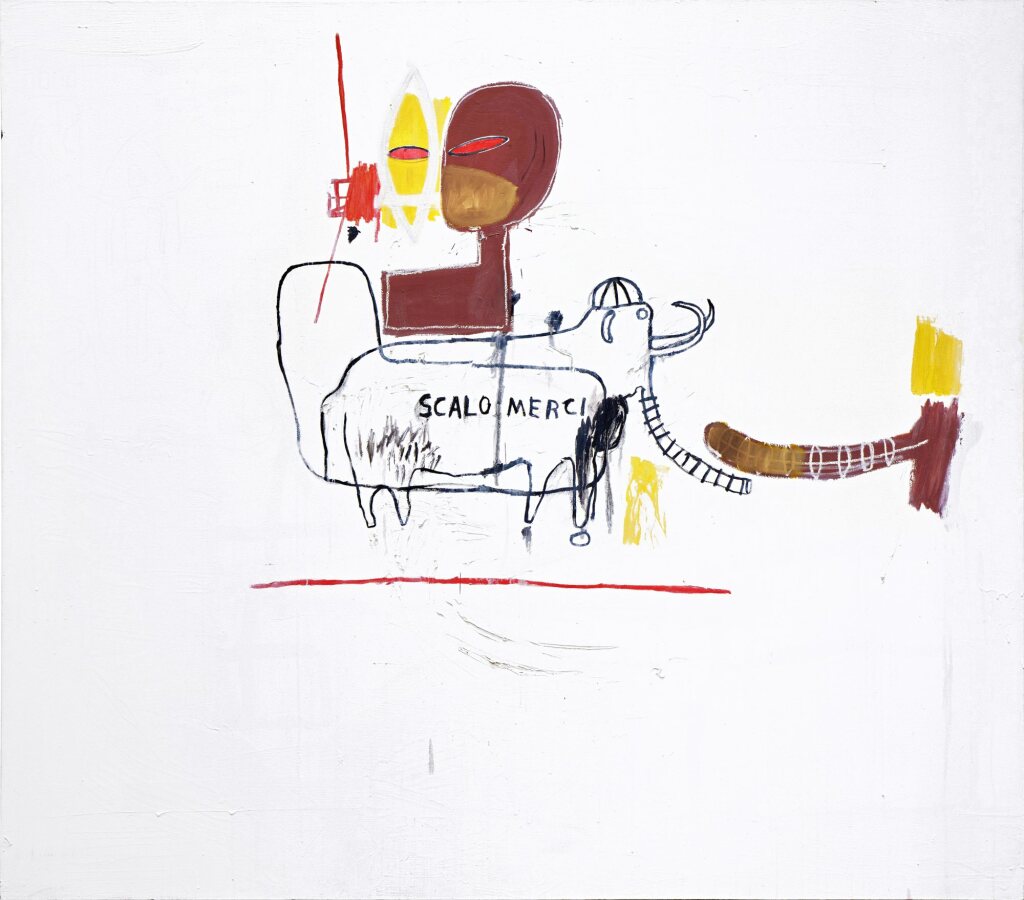
JEAN-MICHEL BASQUIAT
Emblem, 1984
Acrylic and oilstick on canvas
86×98 inches (218.4 x 248.9 cm)
Signed twice, titled and dated 1984 twice on the reverse
Provenance
Mary Boone Gallery, New York|
Private Collection
Sotheby’s, London, 15 October 2015, Lot 30
Private Collection, New York
Acquired from the above by the present owner
Auction History
Sotheby’s Hong-Kong: 7 October 2022
Estimated: HKD 28,000,000 – 35,000,000
HKD 28,205,000 / USD 3,592,764
REPEAT SALE
Sotheby’s London: 15 October 2015
Estimated; GBP 650,000 – 850,000
GBP 665,000 / USD 1,028,910
Alive with color, gesture and texture against a stark matte-white background, Emblem is a testament to the work of Jean-Michel Basquiat at its most commanding, and most subversive. Rich with implications whilst eluding specific meaning, the work brings together many of the key themes of Basquiat’s oeuvre: the signature human head and powerful use of words which hark back to Basquiat’s years as “street poet” in late 1970s New York. It is through the evocation of sparing and speculative motifs that Basquiat confronts themes both European and African, making reference not only to his multi-cultural identity as an artist of Haitian and Puerto Rican descent, but also to the canon of Western art. Confident and mature after a highly successful year, the present work was created at the zenith of his career, having cemented his place as an acknowledged artistic prodigy. Further, a striking, rare aspect of this painting is the presence of Basquiat’s signature scrawled skull which reveals itself only under Ultraviolet light, on top of which the artist has painted the present imagery. Dominating this hidden image, the bulbous form of a skull that fluoresces under Ultraviolet light recalls works such as the artist’s monumental UNTITLED work from 1982, the auction record for Basquiat set by Sotheby’s New York in 2017.
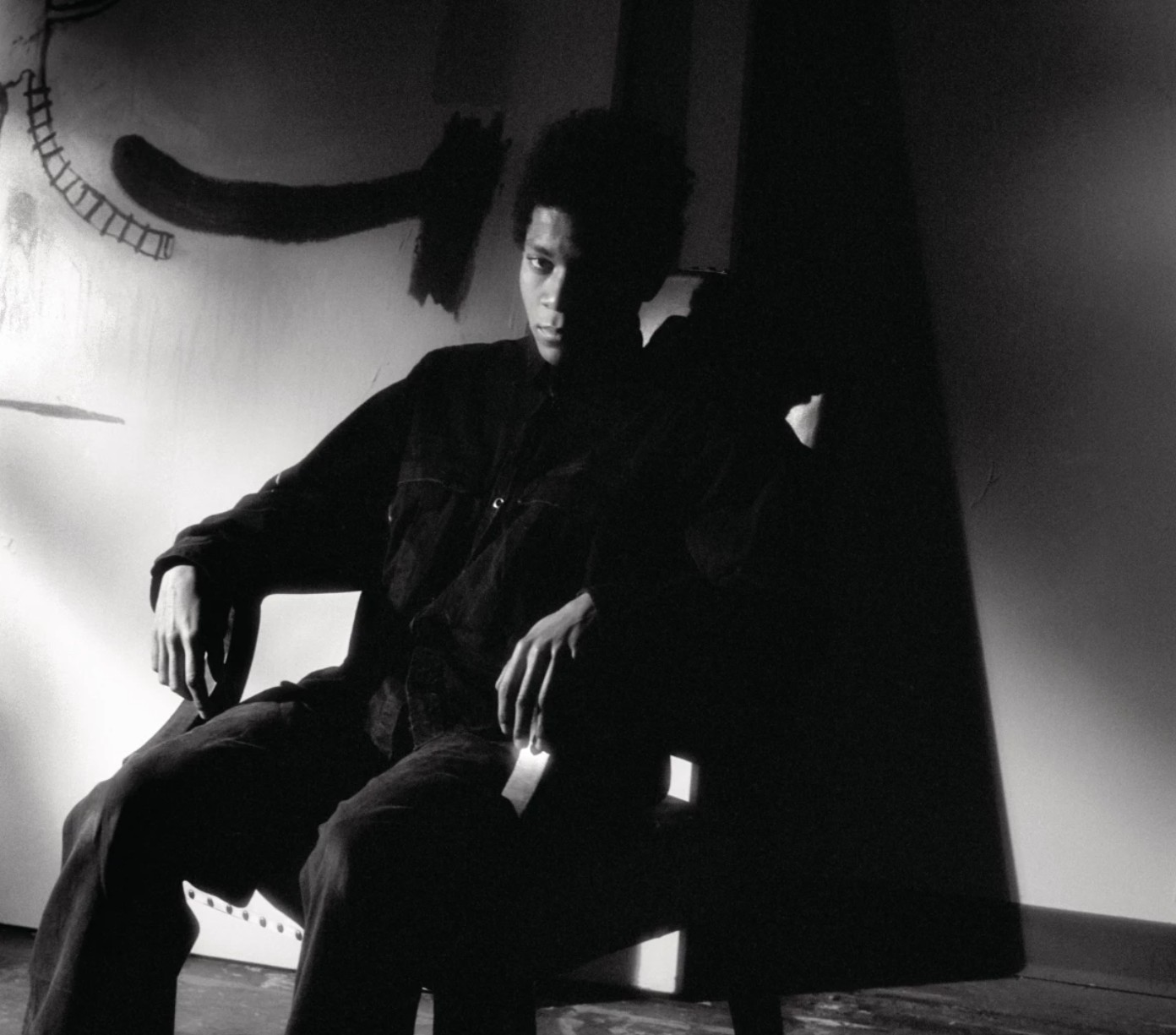
Jean-Michel Basquiat in the studio in front of the present work, 1985. Photograph by Jeannette Montgomery Barron
Executed in 1984, the present work was created after a run of exciting successes for Basquiat. Following his rapid rise to fame during the early part of the decade, the artist began to consolidate his success with the support of industry powerhouses such as Mary Boone and Andy Warhol, who would go on to become his friend and collaborator, providing inspiration and influence that united two figureheads of American art. In the year running up to the creation of the present work, Basquiat had exhibited in seventeen group shows, and four major solo shows across America, Europe, and Japan, as well as becoming the youngest artist ever to be included in the Whitney Biennial at only 22 years old. The creative confidence that this success instilled can be seen in the highly assured utilization of paint and minimal yet striking artist language employed within Emblem. Basquiat’s newfound clarity of purpose and execution employed here materializes from the same vigor and immediacy emblematic of Basquiat’s emergence as street artist in the late 1970s in a new manifestation of style.
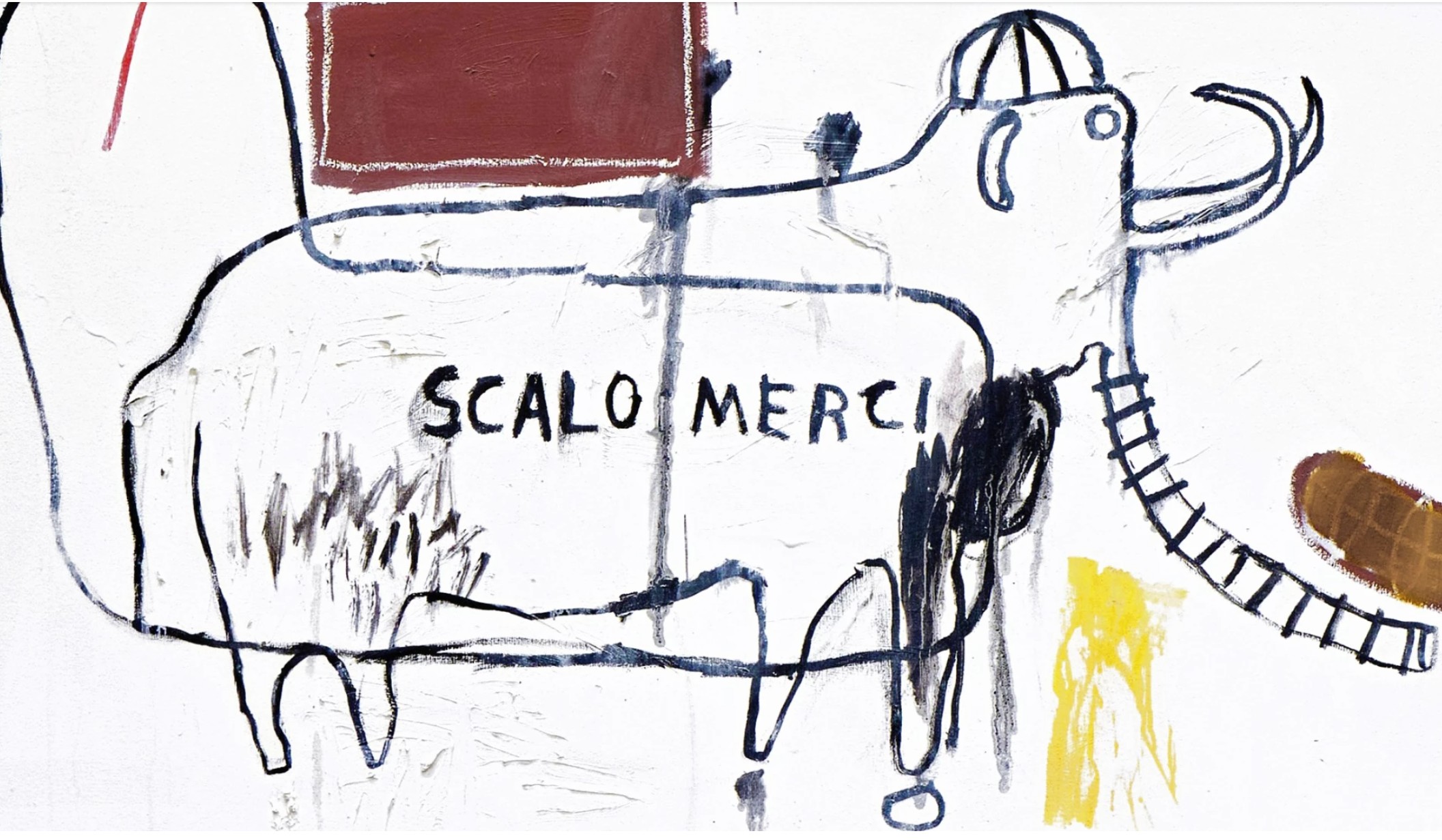
The composition of this work is centered upon two words written in Basquiat’s idiosyncratic capitalized oil stick scrawl: SCALO MERCI. Despite the artist being fluent in Spanish and English from the age of 11 – owing to his Haitian father, Puerto Rican mother, and New York upbringing – this textual reference translates as ‘Freight Yard’ from Italian. A reverberation of Basquiat’s pithy slogan SAMO written on the sides of New York subway trains, this phrase also hints at Basquiat’s time spent in Italy, where he had exhibited in Modena, at the Galleria d’Arte Emilio Mazzoli in 1981, and at the Galleria Civica del Commune in 1982. However, the inclusion of this phrase should not be taken as a specific or coherent token of a particular reference, nor as a symbol of particular meaning. Basquiat’s use of ephemeral phraseology is profoundly evocative of his encyclopedic relationship to his own artistic and spatial context, drawing upon various visual and historical stimuli. As prominent dealer and curator Jeffrey Deitch has described it: “Basquiat’s canvases are aesthetic dropcloths that catch the leaks from a whirring mind. He vacuums up cultural fall-out and spits it out on the stretched canvas, disturbingly transformed” (Jeffrey Deitch quoted in: Larry Warsh, Ed., Jean-Michel Basquiat: The Notebooks, New York 1993, p. 13).
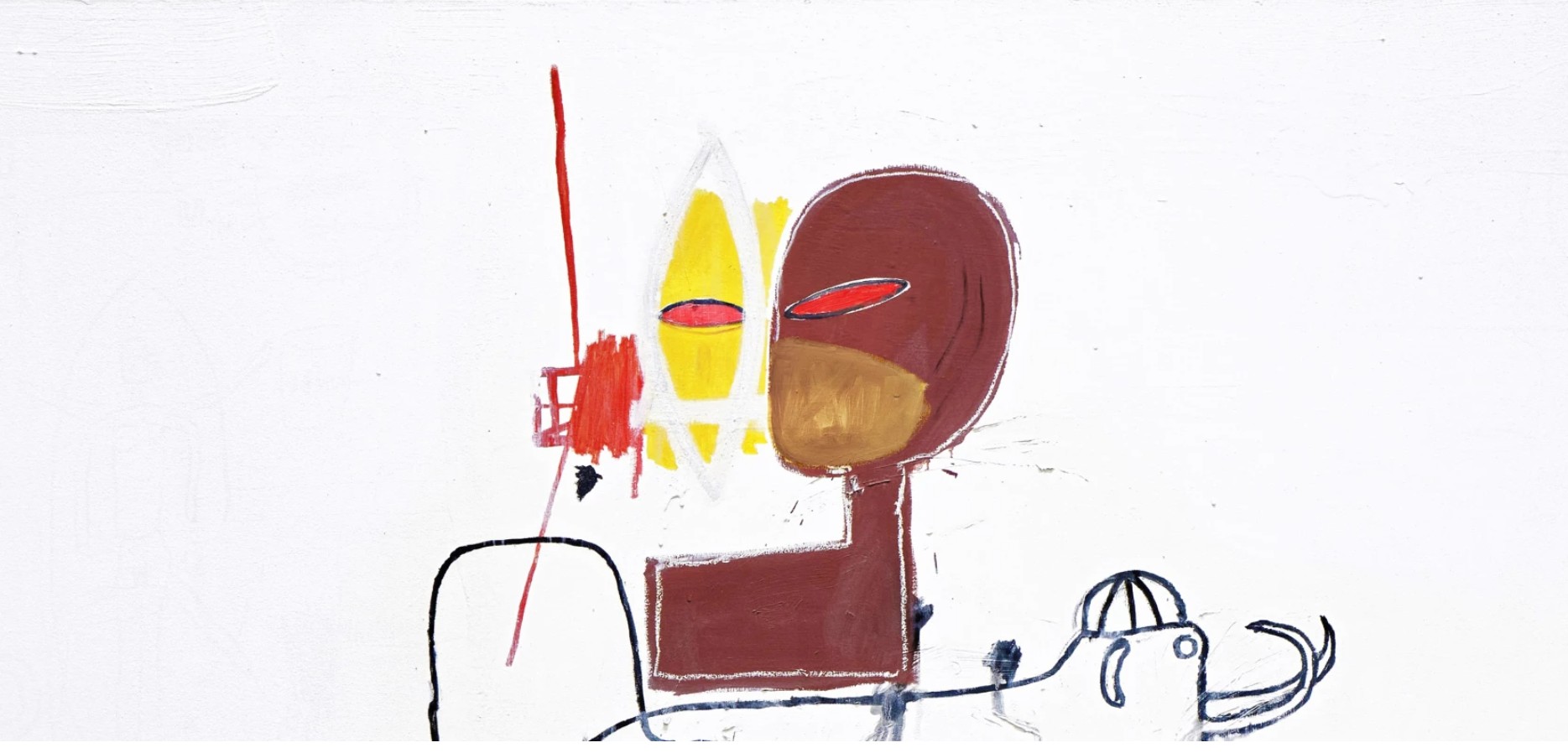
However, if European influence can be inferred from the textual elements of this work, then the more graphic forms surely recall the strains of Haitian mythology, and his own Haitian and Puerto Rican heritage that were already central tenets of Basquiat’s oeuvre. Here, yellow, brilliant red and brown sharply contrast against the whiteness of the surrounding canvas. The central figure appears to be an elephant or a mammoth, cartoonishly executed with curly trunks and a little hat. Rooted in the artist’s childhood ambition to be a cartoon artist, Basquiat’s canvas is a world of playful slap-stick and phycological drama. Above it, two visage-like forms are delineated, one in yellow and one in a deep muddy brown. This head, with bared teeth and a flickering red eye, is fractured in the manner of a Picasso portrait. A recurring motif, heads seem to be influenced by such modernists’ taste for primitivism and the prevalence of TV and comics in 1970s/1980s America. These faces, with their eyes reduced to red pointed slits surrounded by a thin outline of white on their boarders, clearly imitate the tribal masks characteristic of Basquiat’s matrix of motifs and that frequently people so many of his most famous works.
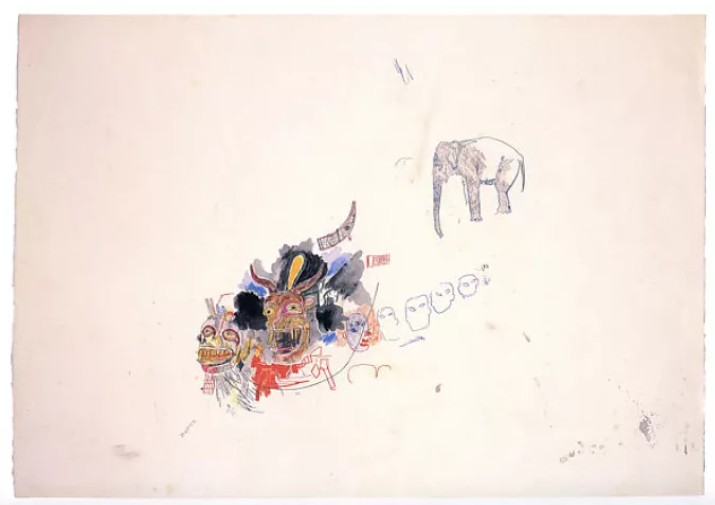
Jean-Michel Basquiat, Untitled, 1986 / Collection of the Met Museum, New York
Gift of the Estate of the artist, 1992 © Estate of Jean-Michel Basquiat. Licensed by Artestar, New York.
To view this work, however, as a straightforward homage to traditional African visual culture would do a disservice to Basquiat’s constant repartee with the western artist cannon. The influence of Picasso, who Basquiat greatly admired and continually referenced in his own work, cannot be understated. In Emblem, the artist reappropriates and recontextualizes the Western modernist obsession with traditional African objects and sculpture, using Picasso, who famously incorporated African mask imagery in such seminal works as Les Demoiselles d’Avignon from 1907, as a cross-temporal, cross-textual sounding board. In leaving vast swathes of the canvas blank, and the overt utilization of phallic shapes and the use of text in an abstract manner, the present work is in dynamic dialogue with the artist tradition that Basquiat had resoundingly established himself a part of. Emblem typifies the artistic confidence that Jean-Michel Basquiat attained as his career progressed. In this work, the frenetic, chaotic energy associated with his earlier work is boldly deployed in a more painterly rarefied manner, with Basquiat seemingly relishing in the opportunity to encounter the titans of twentieth-century art history on his own bombastic terms.