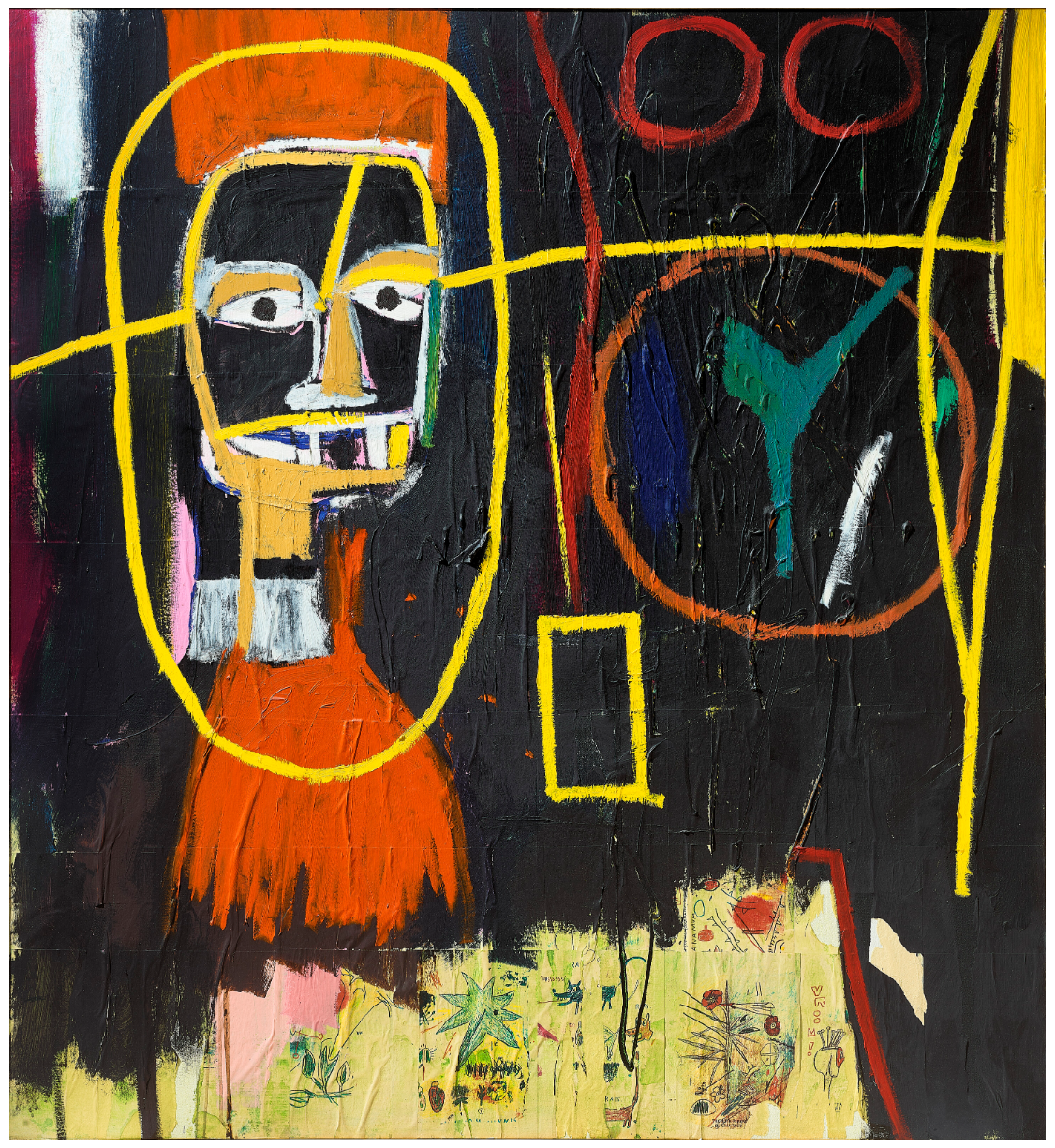
JEAN-MICHEL BASQUIAT
Ancient Scientist, 1984
Acrylic, oilstick, Xerox and paper collage on canvas
66×61 inches (167.7 x 154 cm)
Signed with the artist’s initials, titled and dated ‘JMB “ANCIENT SCIENTIST” 1984’
(on the reverse)
Provenance
Larry Gagosian Gallery, Los Angeles
Private collection, Chicago (acquired from the above in 1984)
Marianne Boesky Gallery, New York
Private collection, Arizona
Sotheby’s New York, 11 May 2005, lot 348
Galerie Jan Krugier, Ditesheim & Cie, Geneva (acquired by 2005)
Private collection, Europe (acquired from the above)
Phillips in Association with Poly Auction Hong Kong, 3 December 2020, lot 7
Acquired at the above sale by the present owner
Auction History
PROPERTY FROM AN IMPORTANT FAMILY COLLECTION
Christie’s Hong-Kong: 29 September 2026
Estimated: HKD 56,000,000 – 76,000,000
HKD 76,975,000 / USD 9,811,980
JEAN-MICHEL BASQUIAT (1960-1988), Ancient Scientist | Christie’s
REPEAT SALE
Phillips Hong-Kong: 3 December 2020
Estimated: HKD 50,000,000 – 70,000,000
HKD 58,330,000 / USD 7,525,230
Jean-Michel Basquiat – 20th Century … Lot 7 December 2020 | Phillips
Jean-Michel Basquiat possessed one of the most extraordinarily capricious minds of any artist of his generation. Shaped by the cultural scene of downtown New York in the 1970s and 1980s (including jazz, early punk, street art, performance, and slam poetry), he nonetheless cast his net further afield in search of subjects and ideas for his paintings. These other interests included anatomy, astronomy, botany, history, exploration, colonialism, literature, music, poetry, art, and sport. Much like his hero Leonardo da Vinci, Basquiat used his canvases and drawings as a way of challenging and refining his ideas, and to determine his place as a Black man in a predominantly white world. These ideas play out in real time on the surface of his art; Ancient Scientist is one such painting.

This richly layered painting reveals itself slowly, as a considered examination of Basquiat’s various symbols, themes, motifs, and graphic devices begins to tell the story of a voracious, yet complex, artist. Like the archeological digs that fascinated him as a child, the layers of Basquiat’s painting can be ‘excavated’ to reveal many of the sources and subjects that influenced his short but prolific career. Oblique references to botany, travel, exploration, Basquiat’s own African heritage, art history, ancient ethnography, and contemporary culture can viewed through a highly sophisticated visual vocabulary and an extraordinary range of mark-making techniques.
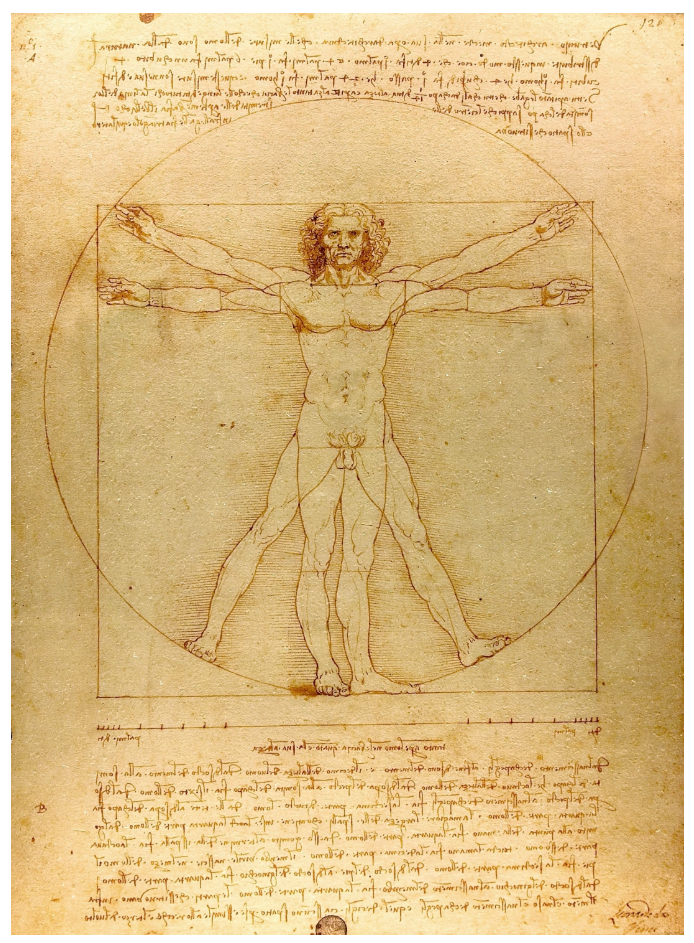
Leonardo da Vinci, Vitruvian Man, c. 1490, Gallerie dell’Accademia, Venice.
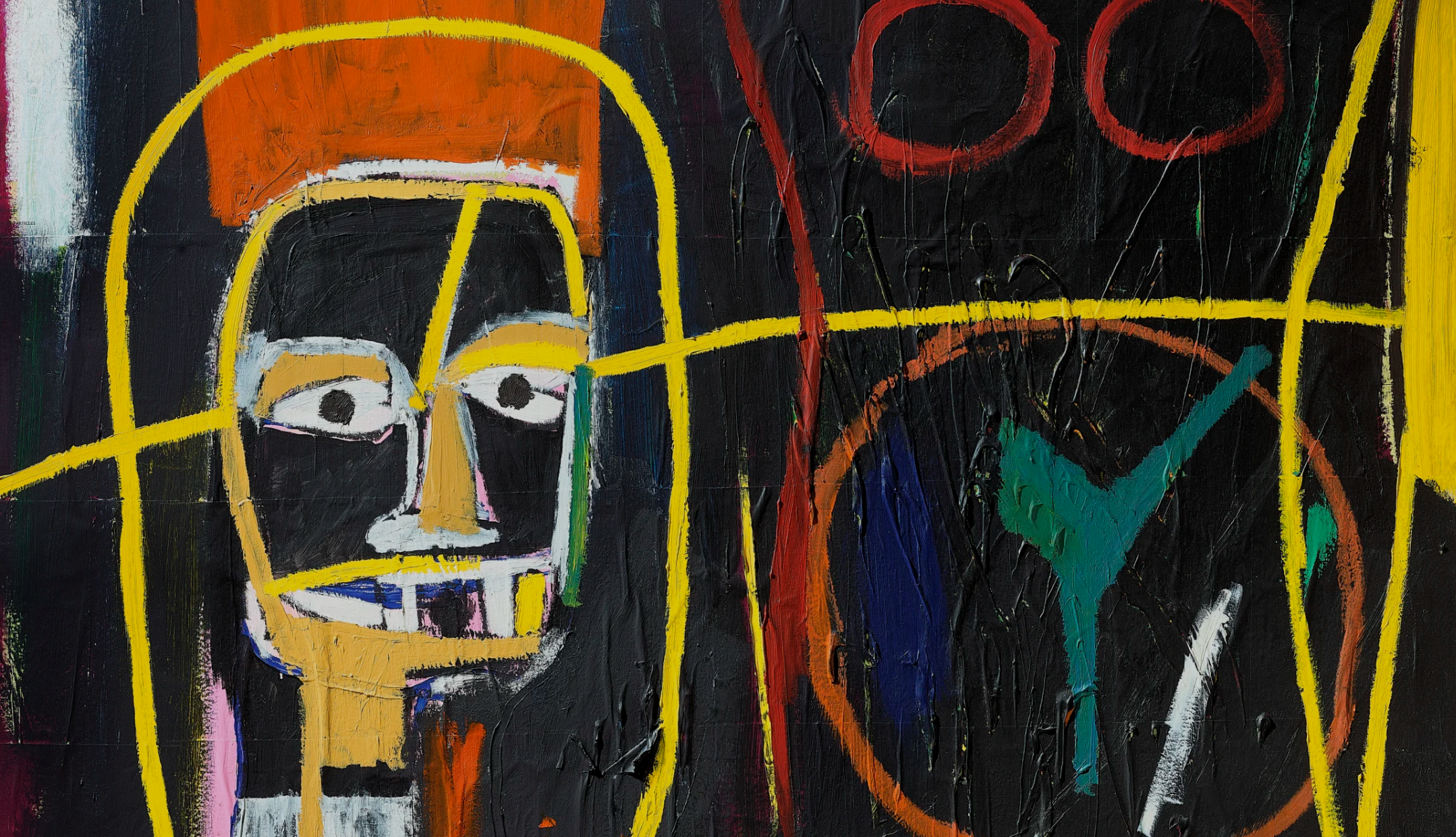
Ancient Scientist is dominated by a large field of dark black paint. On it Basquiat lays out a complex array of signs, symbols, and one of his iconic ‘heads’ in a cryptic network of cyphers. Commanding the composition, an impressive and imposing head gazes out of the picture plane. Constructed in Basquiat’s trademark style, the artist eschews traditional academic techniques in favor of raw and elemental applications of pigment and oilstick. Penetrating eyes are framed by prominent eyebrows, a broad nose is ‘carved’ out of yellow, white, and pink pigment, and a wide grin is constructed out of a progression of large teeth. The figure is further adorned by some dominant red headwear and a matching red tunic. This could be an art historical reference to Piero della Francesca’s famous fifteenth century portrait of the Duke of Urbino, a painting which the artist may have seen during his visits to Italy in the early 1980s. Depicting a black face in the manner of such an iconic Renaissance portrait may have been Basquiat’s way of inserting himself into an art historical narrative from which he otherwise felt excluded.

Left: Present lot illustrated (detail)
Right: Piero della Francesca, Diptych of Federico da Montefeltro and Battista Sforza (Left Panel), circa 1473-1475. Uffizi Gallery, Florence.
To the right of the head is another figure which suggests art historical references. Three circles are enclosed within the curved silhouette of a female body, a subject that has served as a central motif in art since the earliest civilizations. From the prehistoric Venus of Willendorf (circa 30,000 BCE, Naturhistorisches Museum, Vienna) to Botticelli’s The Birth of Venus (circa 1484-1486, Galleria degli Uffizi, Florence), the fecund female figure has been staple of art history.
The nature of the black surface suggests that underneath lies collaged layers of paper applied directly to the surface of the canvas. This is borne out by the emergence along the lower edge of the painting of a series of collaged xeroxed drawings by the artist. This established technique can be found in many of the artist’s most celebrated paintings from this period including Glenn (1985) and Pink Devil (1984, The Broad, Los Angeles). The xeroxed sheets feature a series of botanical drawings, some depicting flowers and plants native to Hawaii and others indigenous to the regions of eastern and southern Africa. The ‘spikey’ plant with the red flower that occurs on the right of the drawings has been identified as red oleander (Nerium oleander), a plant which although beautiful is poisonous to both people and animals. Likewise on the opposite side of this passage of drawings, and partly obscured by pink paint, is a rendering of Solanum Sodomeum, the Devil’s Apple, a poisonous plant from the Nightshade family. Basquiat’s interest in the flora of Hawaii might have been sparked by a trip he made there in February 1984.
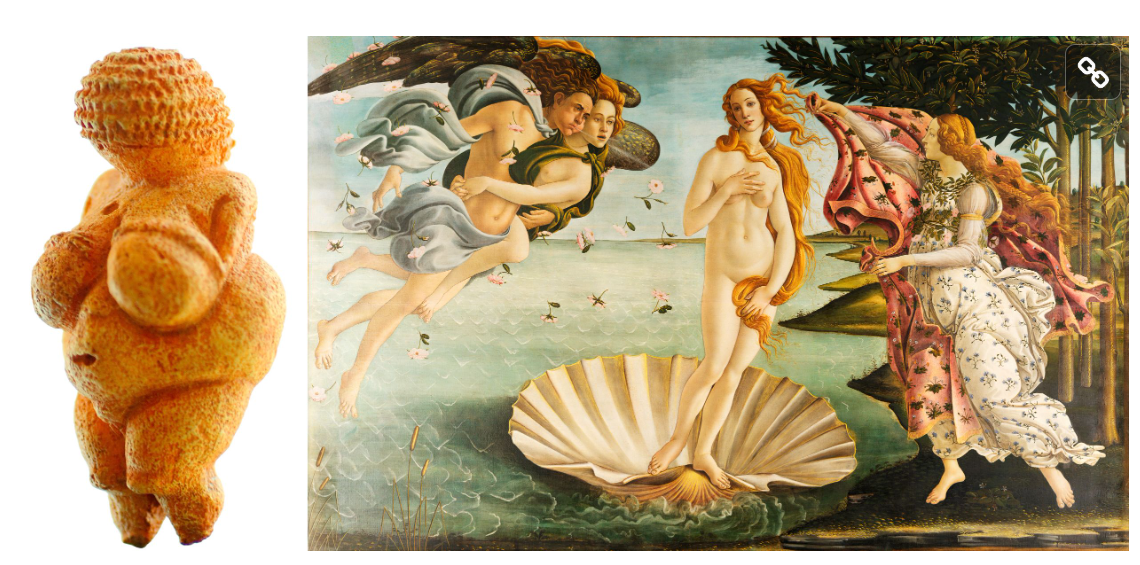
Left: Venus of Willendorf, c. 30,000 BCE, Naturhistorisches Museum, Vienna. Photo by Matthias Kabel under CC BY-SA 3.0
Right: Sandro Botticelli, The Birth of Venus, c. 1484-1486, Uffizi Gallery, Florence.
1984, the year Ancient Scientist was painted, was a year which saw Basquiat traverse the globe to escape what had become a high-pressure environment in New York; having become one of the most in-demand artist in the city, the attention often overwhelmed him. First in Los Angeles, and later in Hawaii, Basquiat would secrete himself away from the pressure of dealers, critics, patrons, and the assorted ‘hangers-on’ that wanted to be in circle. His girlfriend at the time, Paige Powell, remembered that Hawaii became a particularly special place for the artist, seduced by the colors, the fragrant air, and the fresh fruit—all depicted in the drawings of the present work.
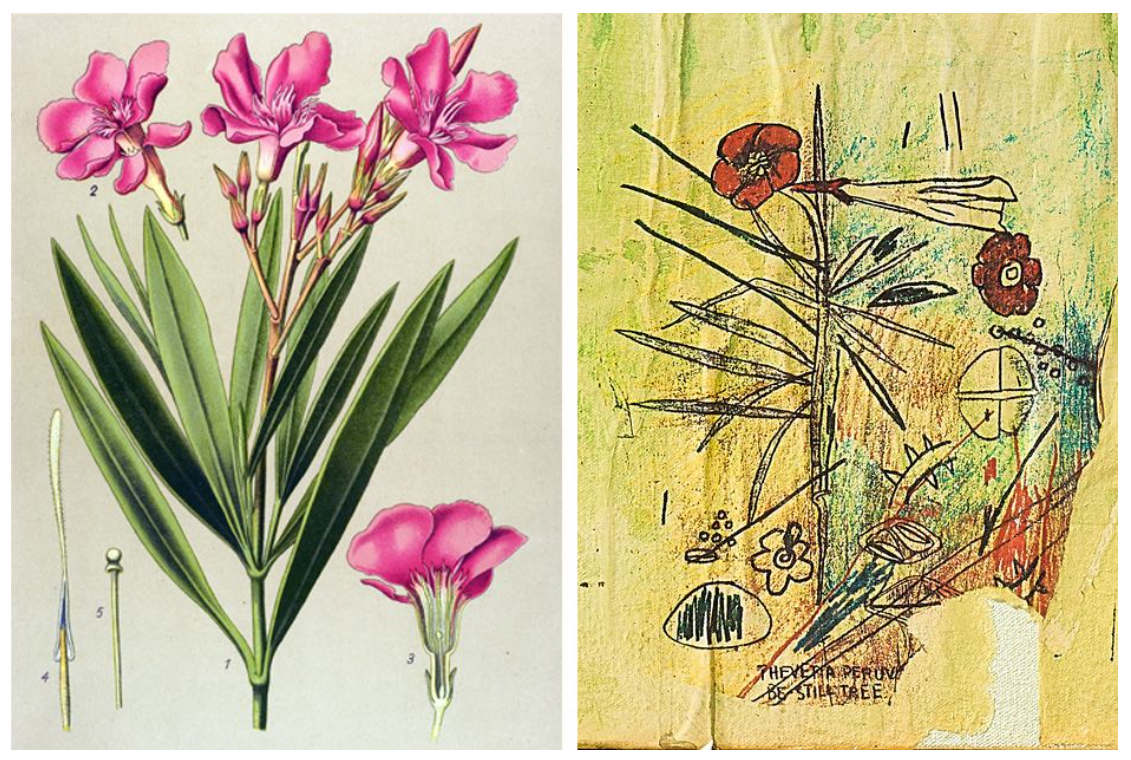
Left: Illustration of Red Nerium Oleander © Imagebroker / Bridgeman Images
Right: Present lot illustrated (detail)
Basquiat’s lifelong interest in science began at an early age. In September 1968, at the age of eight, the artist was hit by a car while playing in the street in Brooklyn and spent a prolonged period in hospital being treated for a broken arm and series of internal injuries. During his month-long stay, his mother gave him a copy of Gray’s Anatomy which he studied avidly. The artist’s subsequent fragmented and diagrammatic representations of the human body clearly have their roots in this influential medical text and demonstrate his ability to transform personal experiences into enduring artistic inspiration.
During the course of his career, Basquiat produced a number of paintings that directly referenced this interest in science and the wider world around him. In addition to the present work, he painted Future Sciences Versus the Man (1982), with its references to ancient Egypt, the chemical element radium, and aeronautics, as well as Leonardo da Vinci’s Greatest Hits, and its direct references to anatomy. In 1983 he painted what is probably his most searing commentary in the political nature of science and progress. In Untitled (Charles Darwin), Basquiat juxtaposes the legacy of evolutionary science with broader themes of marginality, connecting the work of Darwin with that of Thomas Huxley (an English biologist and leading advocate of Darwin’s theory of evolution), and Gregor Mendel (the founder of the modern science of genetics) to the subsequent commodification of Blackness and the manipulation of scientific discourse for socio-political ends. This interplay between science and art highlights how Basquiat critiques both racial and intellectual histories, revealing their entanglement in narratives of oppression and commodification.
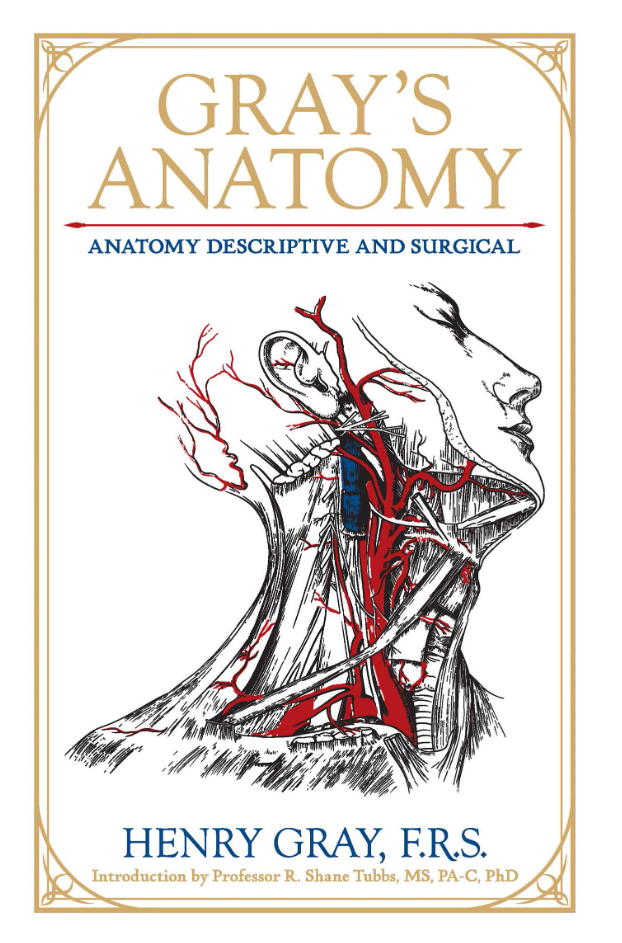
Gray’s Anatomy book cover
Ancient Scientist stands as a compelling testament to Basquiat’s remarkable ability to collapse disparate histories, cultures, and systems of knowledge into a single pictorial field. Here, science, botany, ethnography, art history, and personal identity converge in a work that reveals the extraordinary breadth of the artist’s intellectual curiosity and the sophistication of his visual language. Rather than presenting knowledge as fixed or authoritative, Basquiat transforms it into a dynamic process of inquiry, layering imagery and meaning in ways that invite continual discovery. The painting’s commanding central figure, enigmatic symbols, and evocative references to the natural and scientific worlds exemplify the artist’s lifelong project of reclaiming, revising, and expanding historical narratives from which Black voices had too often been excluded. Ancient Scientist encapsulates the restless brilliance, cultural awareness, and profound originality that secured Basquiat’s place among the most important artists of the twentieth century.
Jean-Michel Basquiat, dubbed “the radiant child” by the American art critic Rene Ricard, was an extraordinarily gifted neo-expressionist painter with an ability to shock, inspire and get under the skin of his viewers past and present i. Self-taught, with a restless and prolific mind, he developed a unique visual vocabulary drawn from his Haitian and Puerto Rican heritage, pop culture, art history, poetry and his enduring fascination for Abstract Expressionist art. Starting out as a graffiti renegade under the pseudonym SAMO with fellow artist Al Diaz in the late 1970s, Basquiat eventually entered the world of contemporary art, and his works caught the attention of gallerists and dealers such as Annina Nosei and Bruno Bischofberger. The artist swiftly rose to fame with the support of industry powerhouses such as Andy Warhol, Larry Gagosian and Mary Boone, and in 1983 Basquiat was included in the Whitney Museum of American Art, New York (Whitney Biennial) to become the youngest artist to have represented America in a major international exhibition of contemporary art. Basquiat was also the youngest artist ever to be included in Documenta in Kassel, two years before the present work’s inception, in 1982. Executed in 1984, Ancient Scientist was created at the pinnacle of the artist’s career.
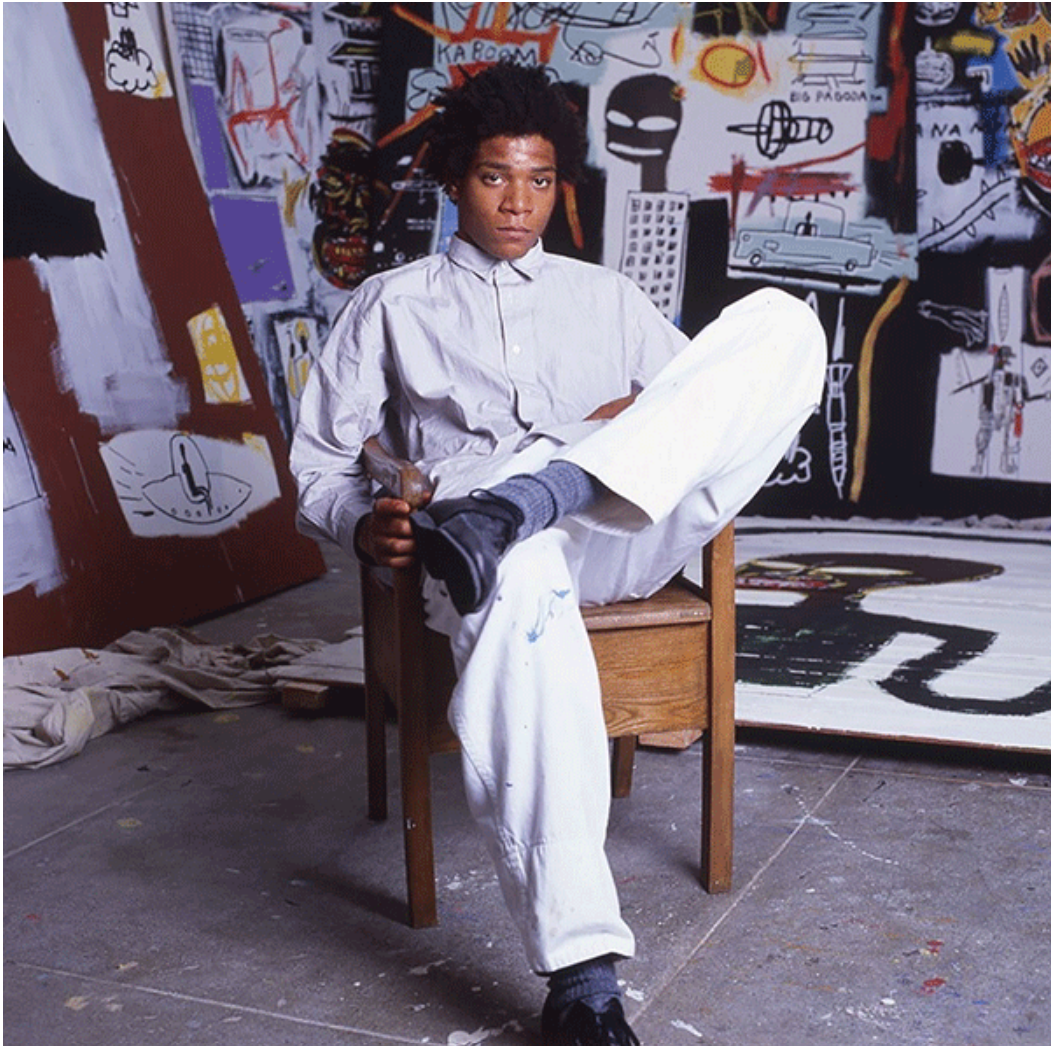
Jean-Michel Basquiat in his studio, 1980s
Basquiat’s insatiable hunger for information allowed him to draw inspiration everywhere, appropriating references from music, poetry, history, politics and popular culture in the development of his own personal iconography. In an interview showcasing a collection of drawings by Basquiat, collector and scientist Herbert Schorr elucidated on the workings of his close friend’s mind: ‘he didn’t have formal lessons, but he went to museums. He understood what he was seeing. I was told he went to some dealer’s library and scoured through the books…Basquiat was just like that—visually he could see it and absorb it instantly. He was extremely smart’. Living downtown in his Manhattan studio was highly significant to Basquiat’s development as an artist. Interviewed for an exhibition at the Fun Gallery in 1982, the artist noted that he took various academic references from trips to the Metropolitan Museum, or history and anatomy books, using them as source material and incorporating various sketches of artifacts to juxtapose them with ‘what he normally does’. With an endless expanse of information at his fingertips, Basquiat studied the world widely, condensing his knowledge onto the canvas.
“When I’m working, I hear them you know, and I just throw them down.”
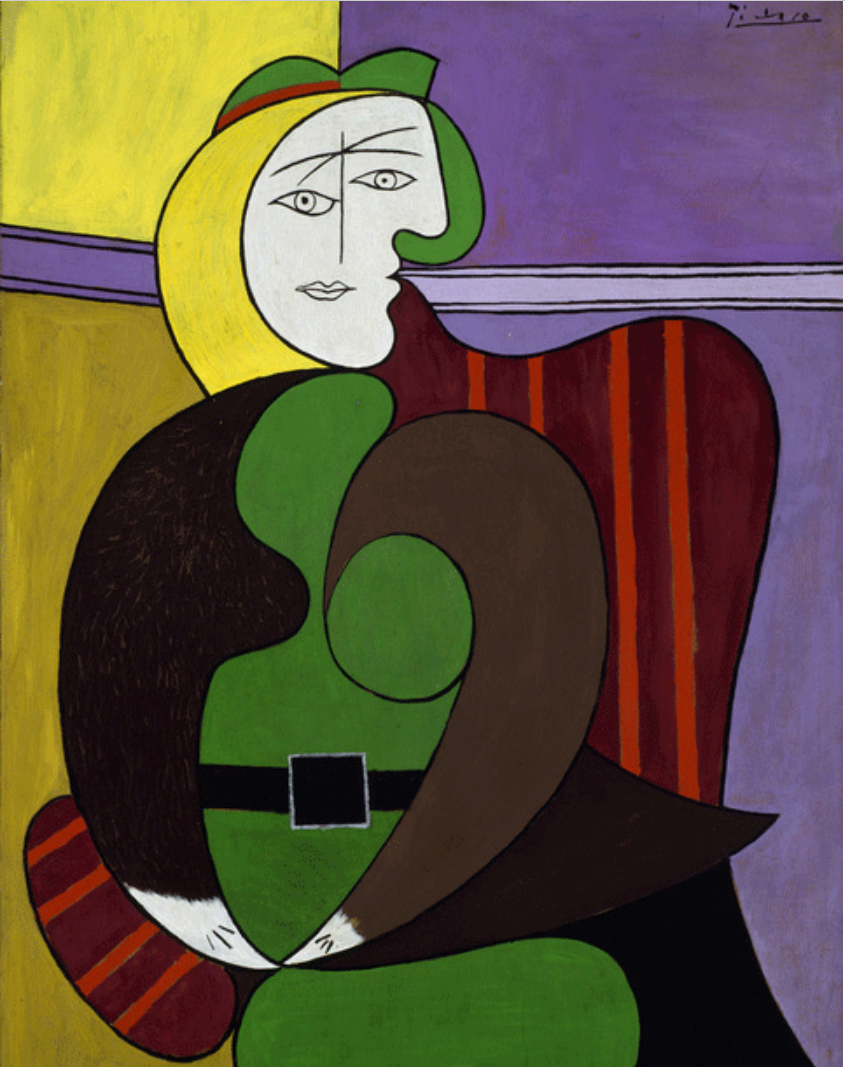
Pablo Picasso, The Red Armchair, 1931. Collection of the Art Institute of Chicago. © 2018 Estate of Pablo Picasso / Artists Rights Society (ARS), New York
A nod to Pablo Picasso’s Cubist aesthetic derived from ancient masks and sculptures (see for example Pablo Picasso, The Red Armchair, 1931), bold lines form the outline of a mask-like head and body on a heavily blacked out canvas. The angular formation of the face with a distinct triangular nose that runs up the figure’s forehead draws another comparison to African Banda masks of the late 19th and early 20th century, including the mask held in the collection of the Brooklyn Museum, which Basquiat was known to have frequented.
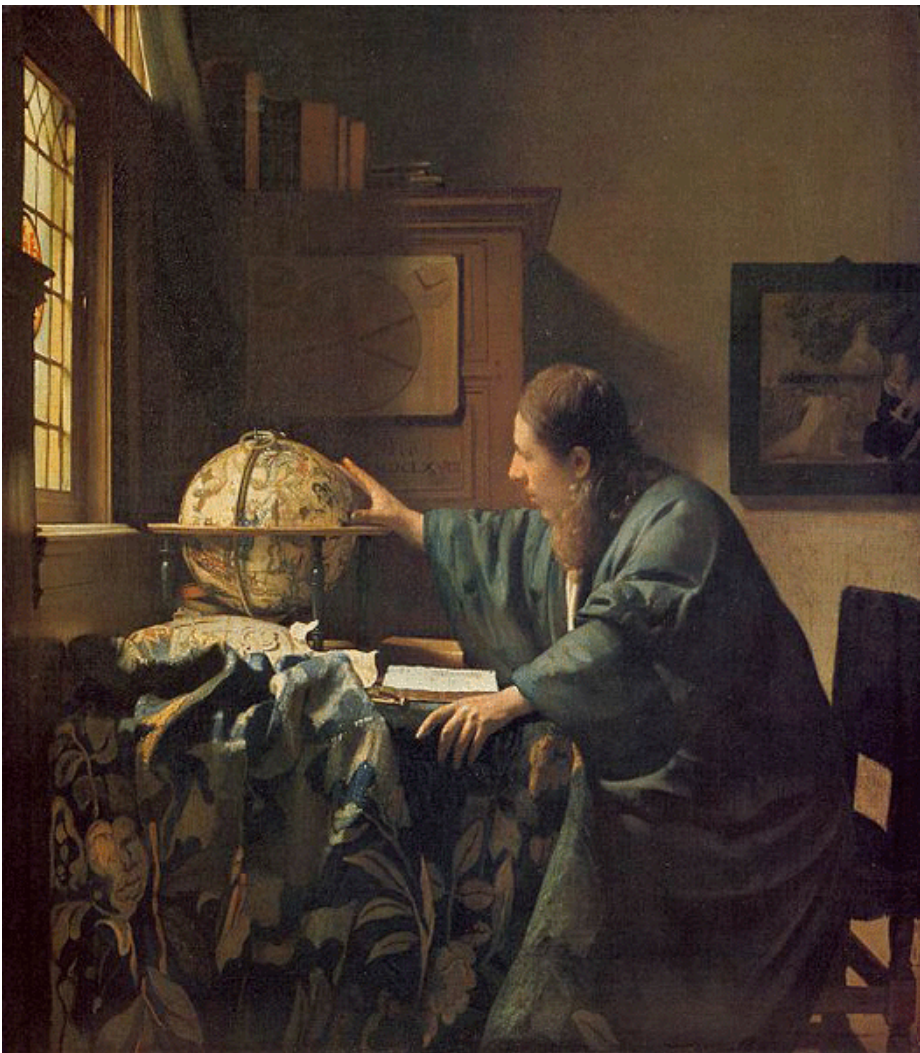
Johannes Vermeer, The Astronomer, c. 1668. Collection of the Museé du Louvre, Paris
With stark white eyes that directly confront the viewer, the profile of the figure in the present work further calls to mind classical half-length portrait paintings of characteristic three-quarter turned faces. The subject of Ancient Scientist could perhaps be an influential scientific figure such as Sir Isaac Newton (see for example Sir Godfrey Kneller, Sir Isaac Newton, 1702), whose mask like- wig and white collared attire bear an uncanny likeness to that of the figure. Following the line of sight with another streak slashed across the picture plane are a cluster of red circles. Possibly alluding to the shape of a scientist’s globe (See for example Johannes Vermeer, The Astronomer, c. 1668), an image of a female torso comes into view when paired with two smaller circles above. Showcasing his deep dive into the world of Classical and Contemporary art, Basquiat distills the female figure into the essential features associated with sexual reproduction and fertility, stripping down figure to its simplest forms.

Basquiat’s inherent interest in science and anatomy stems from his childhood; Having been incolved in a car accident at 6 years old, the artist’s mother gifted him a copy of Gray’s Anatomy by Henry Gray, an influential work on the subject of human anatomy for medical knowledge. The workings of the human body would continue to fascinate him, taking the anatomical drawings from books and the art of Renaissance artists such as Leonardo Da Vinci and translating them onto his canvases.
A genius of his time, Basquiat experimented with new artistic techniques and mixed different methods of expression, capturing the mix of high and popular culture with an acute sensibility characterised by unconventional spontaneity. The present work was also exhibited in Musée Maillol, gracing the cover of its flyers alongside works by Pablo Picasso, placing him in the same league as the masters that he had looked up to.