JEAN-MICHEL BASQUIAT (1960 – 1988)
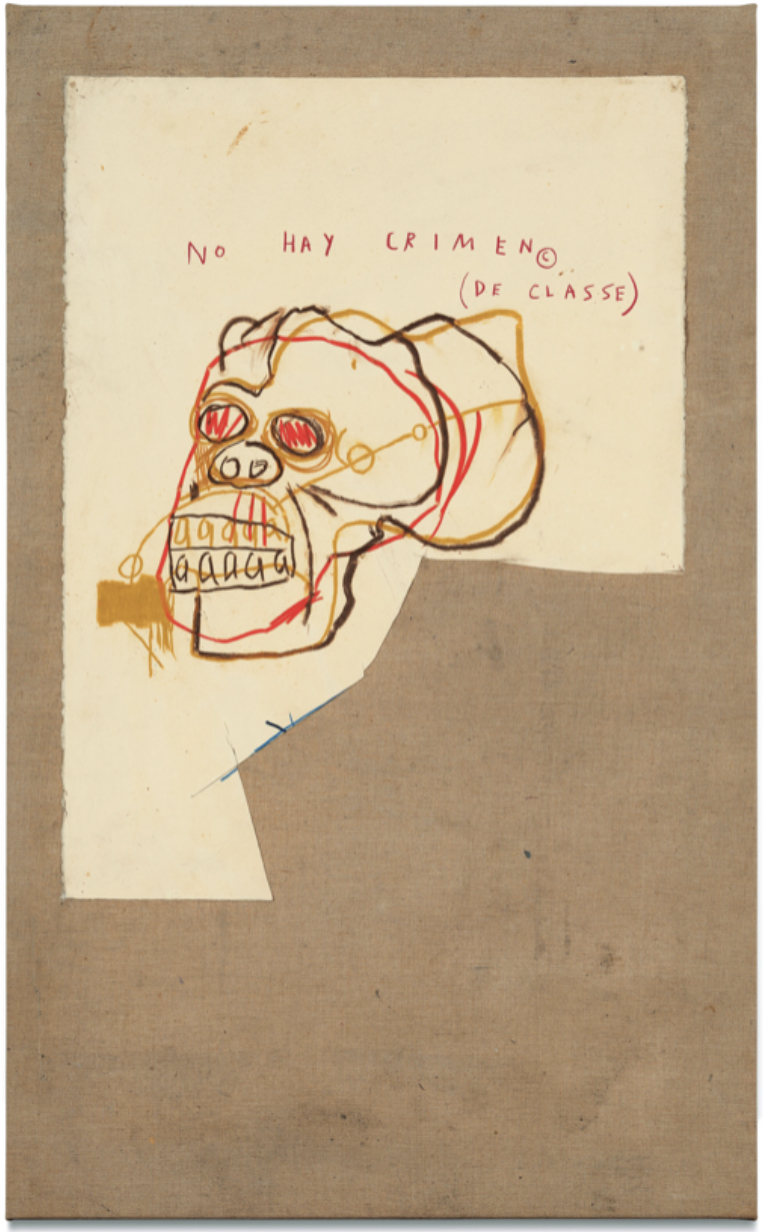
No Hay Crimen ©, 1983
Oilstick, colored pencil and paper collage on canvas
44 1/2 x 27 1/4 inches (113 x 69.2 cm)
Provenance
Richard Hambleton, New York (acquired directly from the artist)
Robert Miller Gallery, New York
Acquired from the above in May 1992 by the present owner
Auction History
Sotheby’s New-York: 15 November 2023
Estimated: USD 1,200,000 – 1,800,000
USD 1,996,000
No Hay Crimen © | Contemporary Evening Auction | 2023 | Sotheby’s (sothebys.com)
Charged with electric verve, Jean-Michel Basquiat’s silhouette of the skull fixes the viewer with its ruby gaze in No Hay Crimen © from 1983, epitomizing the vigorous drawing practice at the core of the legendary artist’s oeuvre. Atop his talismanic symbol, Basquiat scribbles in capital letters, “NO HAY CRIMEN © (DE CLASSE),” or “There is no crime (of class),” maintaining the enigmatic yet biting sociopolitical critique and the shorthand copyright symbol from his foundational street art origins. Furthermore, the skull-like visage in the present work is paradigmatic of Basquiat’s most iconic and timeless motif: utterly mesmerizing in its passionate intensity, the inner soul of the man appears to burst forth from his portrait in undulating red and yellow striations. Enduring as both idiosyncratic self-portraits and symbolic icons, the singular figure revealed in works such as No Hay Crimen © prevails as a key conceptual anchor for Basquiat throughout his career, appearing in and dominating the majority of his best-known masterworks. No Hay Crimen © bears an exceptional provenance that attests to Jean-Michel Basquiat’s expansive legacy on art history: first acquired by artist Richard Hambleton, Basquiat’s contemporary in the vanguard of the 1980s New York City art scene who is today recognized as the “Godfather of Street Art,” the present work has since belonged to esteemed gallerist John Cheim, who designed and edited Basquiat: Drawings, the first published book of Basquiat’s drawings coinciding with an acclaimed exhibition he curated at Robert Miller Gallery in November 1990.
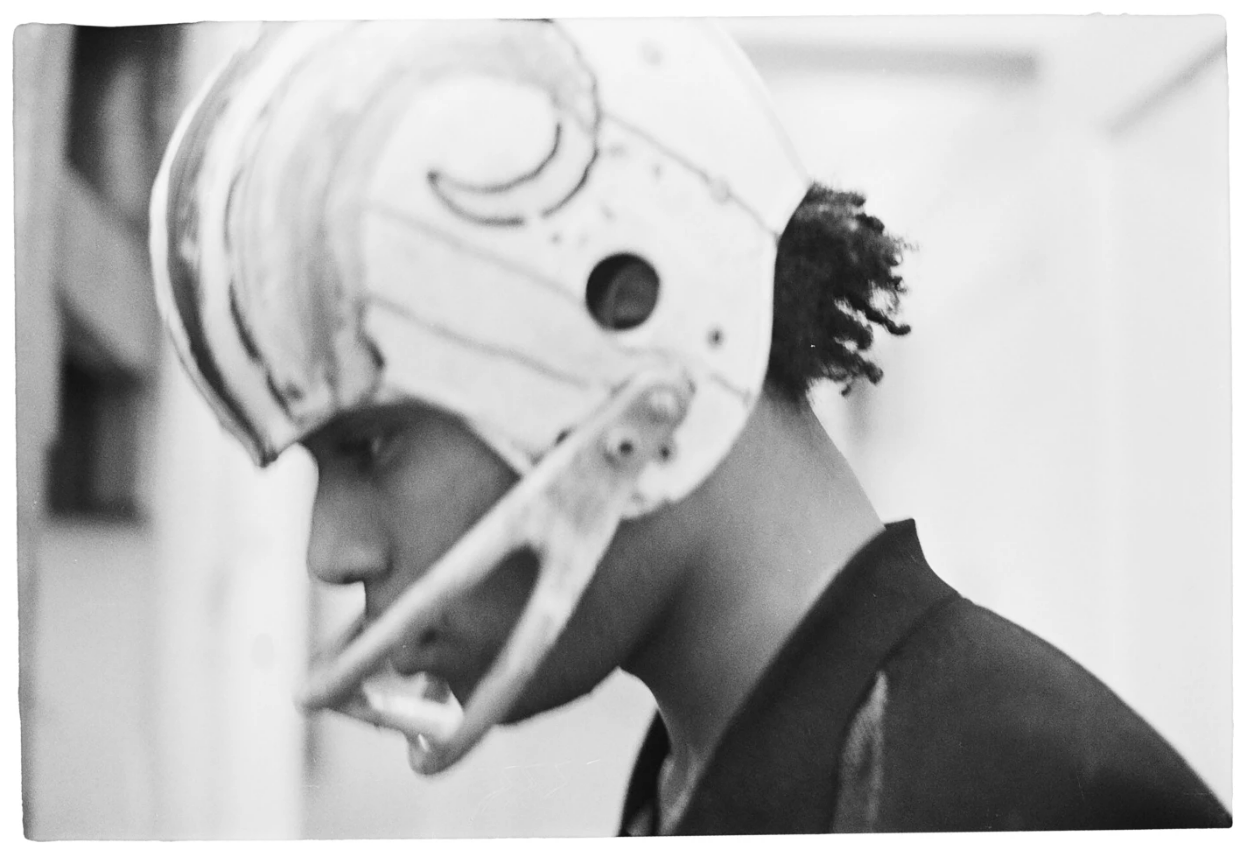
JEAN-MICHEL BASQUIAT, FILM STILL FROM BOOM FOR REAL: THE LATE TEENAGE YEARS OF JEAN-MICHEL BASQUIAT, MAGNOLIA PICTURES, 2017. IMAGE © ALEXIS ADLER. PHOTO COURTESY OF MAGNOLIA PICTURES. ART © ESTATE OF JEAN-MICHEL BASQUIAT. LICENSED BY ARTESTAR, NEW YORK.
In No Hay Crimen ©, furious strokes of umber, ochre and cadmium red oil stick congregate against an off-white background to form a disembodied human head. The scorching gaze, bared teeth and fiercely delineated head seen in the present work express a degree of emotional intensity that evidences Basquiat’s astute observations in the psycho-spiritual states of being, an association further heightened by his tactile, stunningly immediate handling of oil stick. “What drew Basquiat almost obsessively to the depiction of the human head was his fascination with the face as a passageway from exterior physical presence into the hidden realities of man’s psychological and mental realms,” writes Fred Hoffmann. “They not only peer out as if seeing, but also invite the viewer to penetrate within.” (Exh. Cat., New York, Acquavella Galleries, Jean-Michel Basquiat Drawing: Works from the Schorr Family Collection, 2014, p. 74).
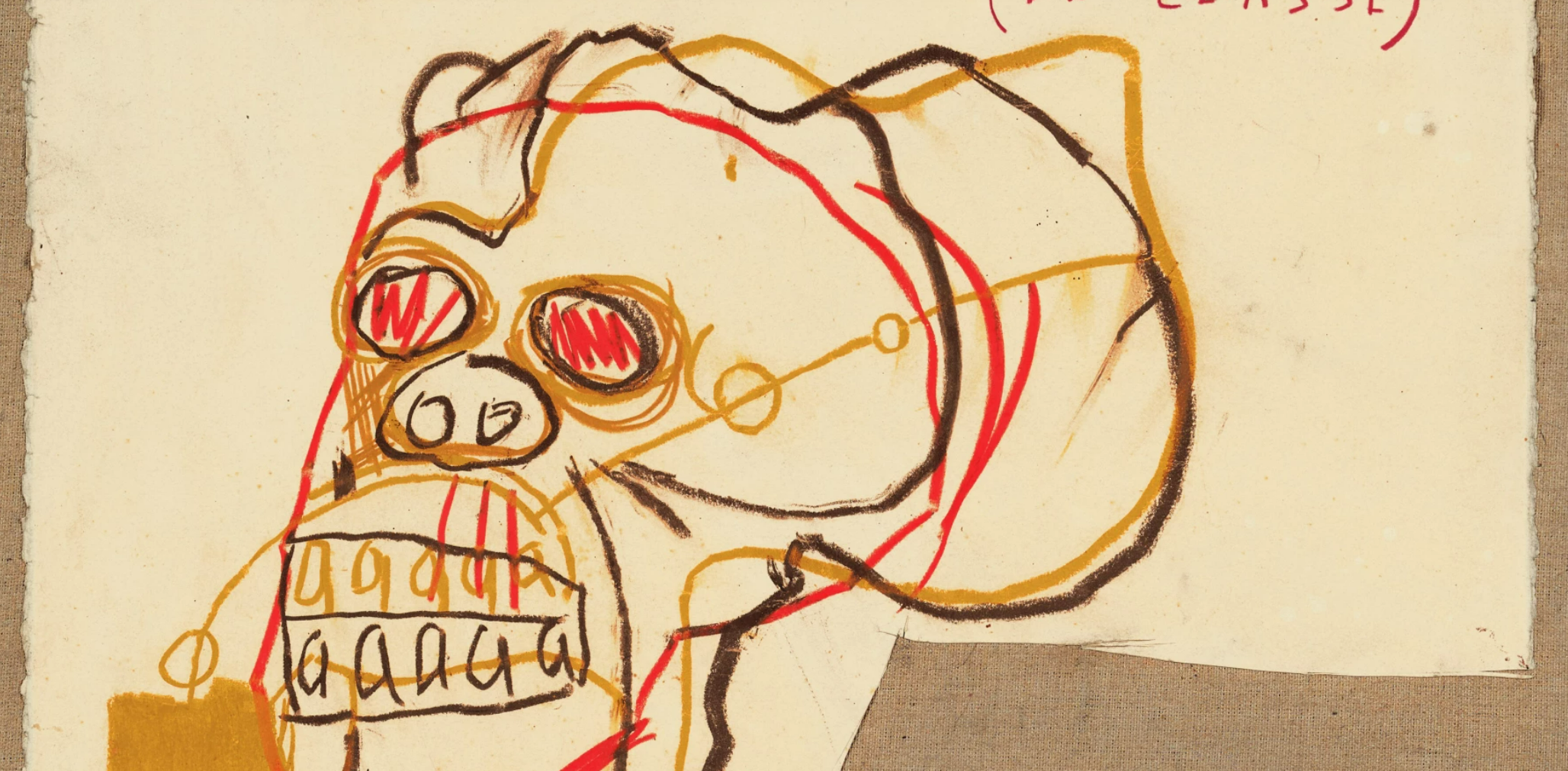
Glaring outwards with the skull’s bloodshot eyes, No Hay Crimen © breaks down the dichotomy between the external and internal, revealing the cacophonous innermost aspects of psychic life with intense dynamism. As Basquiat transitioned from street to studio, the skull served as one of his most resilient pictorial throughlines. In its unfiltered grit and guttural symbolism, the skull captured the vibrance of urban life with thrilling authenticity, simultaneously memorializing his past as a celebrated member of Manhattan’s street art vanguard and his remarkable future as contemporary art’s dazzling prodigy. Absorbing, warping and reshaping the myriad dissonant influences of the Downtown New York, Basquiat forged an extraordinarily lucid and intelligent pictorial vernacular that, while entirely his own, typified the language of the sidewalks and walls of the city with searing candor.
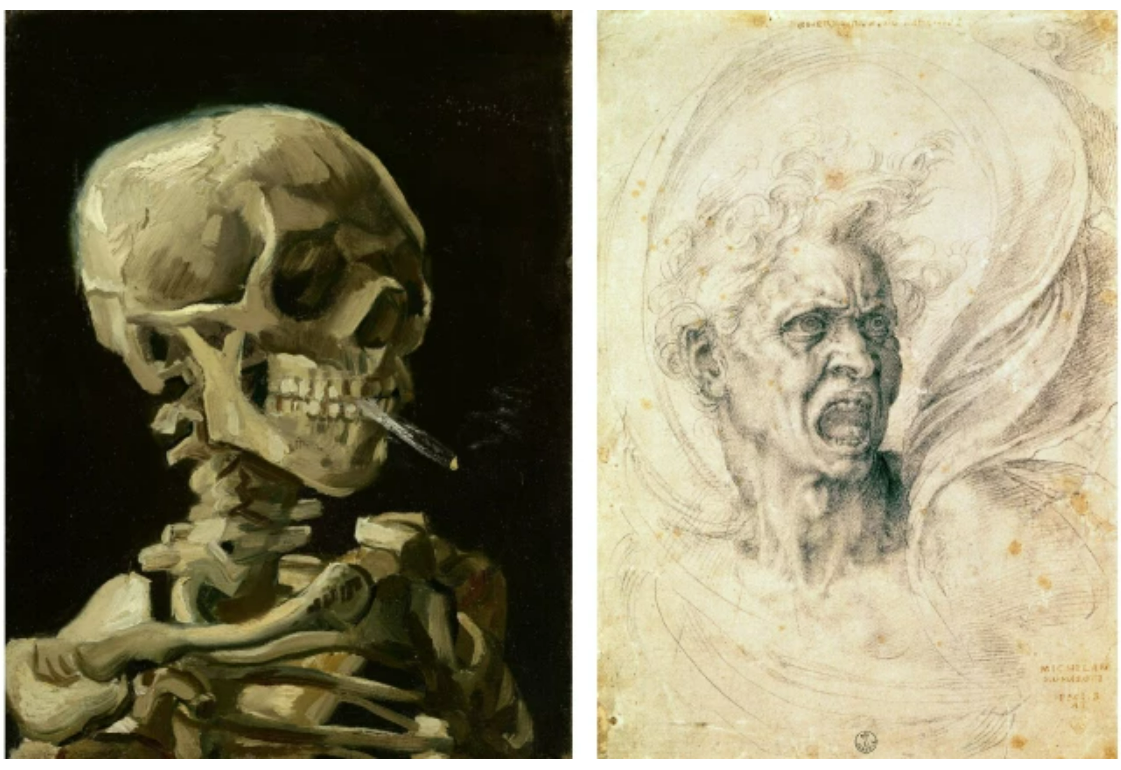
LEFT: VINCENT VAN GOGH, HEAD OF A SKELETON WITH A BURNING CIGARETTE, 1886. VAN GOGH MUSEUM, AMSTERDAM. IMAGE © BRIDGEMAN IMAGES. RIGHT: MICHELANGELO BUONARROTI, THE DAMNED SOUL, C. 1525. GALLERIA DEGLI UFFIZI, FLORENCE. IMAGE © BRIDGEMAN IMAGES
Above the cranial visage, Basquiat abandons none of the vehemence behind his marks as he scrawls the Spanish title of the present work in his own unmistakable handwriting: NO HAY CRIMEN [DE CLASSE]. Translating to “There is No Crime [Of Class],” this ambiguous inscription recalls Basquiat’s renegade sociopolitical musings as SAMO, his street art alter-ego of the late 1970s under which he roamed the streets of New York and emblazoned his moniker upon the abandoned walls of the city. Like personal hieroglyphs, the text reveals Basquiat’s complex worldview that encompasses the hard-hitting social concerns of class struggle and racial discrimination; not least within art itself.