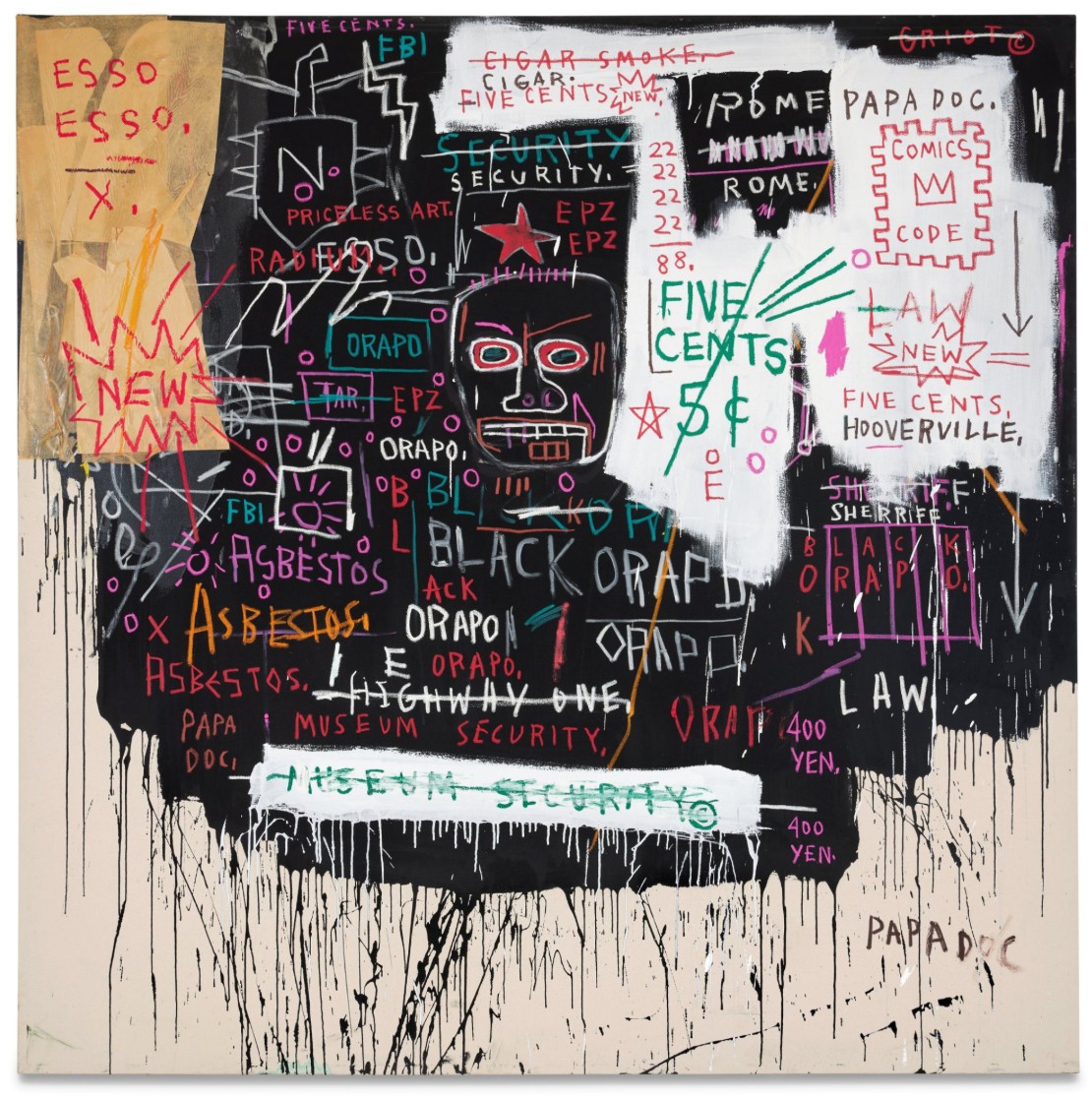
JEAN-MICHEL BASQUIAT
Museum Security (Broadway Meltdown), 1983
Acrylic, oilstick and paper collage on canvas
84×84 inches (213.4 x 213.4 cm)
Provenance
Larry Gagosian Gallery, Los Angeles
Kamran Diba, Paris (acquired from the above in 1983)
Faggionato Fine Arts, London
Lord Edward Spencer-Churchill, London
Christie’s London, 13 February 2013, lot 30 (consigned by the above)
Acquired at the above sale by the present owner
Auction History
Property from a Distinguished Collection
Sotheby’s New-York: 14 May 2026
Estimate upon Request
USD 52,717,500
Jean-Michel Basquiat | Museum Security (Broadway Meltdown) | The Now
REPEAT SALE
Christie’s London: 12 February 2013
Estimated: GBP 7,000,000 – 9,000,000
GBP 9,337,250 / USD 14,509,650
Jean-Michel Basquiat (1960-1988) (christies.com)
Few masterworks so powerfully capture the extraordinary iconographical infrastructure that anchored the themes, concerns and personal history of Jean-Michel Basquiat’s oeuvre as Museum Security (Broadway Meltdown). The work unfolds as an incendiary index of the irrepressible young mind who painted it: here, success and exploitation, fame and abjection, value and merit, race, class, and colonialism collide in a gestural maelstrom, materializing through the staggeringly lucid vernacular for which Basquiat is best known.
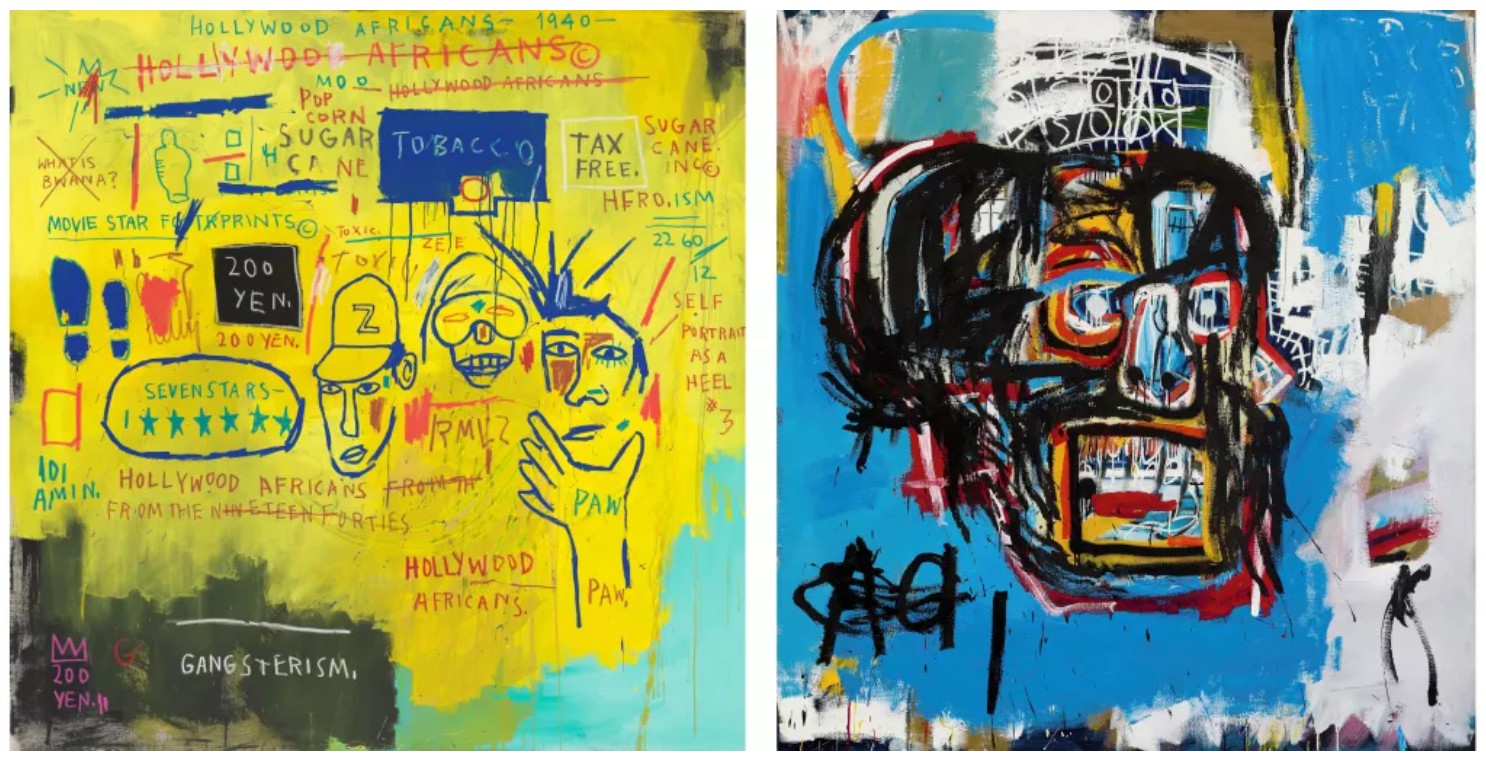
Left: Jean-Michel Basquiat, Hollywood Africans, 1983. Whitney Museum of American Art, New York. Image © Whitney Museum of American Art / Licensed by Scala / Art Resource, NY. Art © 2026 Estate of Jean-Michel Basquiat. Licensed by Artestar, New York. Right: Jean-Michel Basquiat, Untitled, 1982. Private Collection. Sold at Sotheby’s New York in May 2017 for $110.5 million. Art © 2026 Estate of Jean-Michel Basquiat. Licensed by Artestar, New York
Closely related to his triumphant Hollywood Africans, also executed in 1983 and now in the collection of the Whitney Museum of American Art, New York, Museum Security (Broadway Meltdown) ranks among the most significant works ever created by the artist.
Museum Security (Broadway Meltdown) made its debut at the artist’s historic solo exhibition at Larry Gagosian Gallery, Los Angeles in 1983, one in a suite of 12 monumental canvases all created that year. One of the most complex in this seminal group, the work has since graced some of the most distinguished institutions and famous exhibitions around the world, from the seminal 2010-11 retrospective at the Fondation Beyeler in Riehen and Musée d’Art Moderne de Paris, a five year long-term loan to the Fondation Beyeler from 2014-18, an exhibition at the Salon d’Honneur in Basel, the monumental survey exhibition at the Fondation Louis Vuitton in Paris in 2019, the Basquiat presentation at the Brant Foundation, New York in 2019, the acclaimed Jean-Michel Basquiat: Made on Market Street show at Gagosian Los Angeles in 2024, to the recent exhibition at the Zaha Hadid-designed Dongdaemun Design Plaza Museum in Seoul in 2025-26, where this work was reproduced on the front cover of the exhibition catalogue.
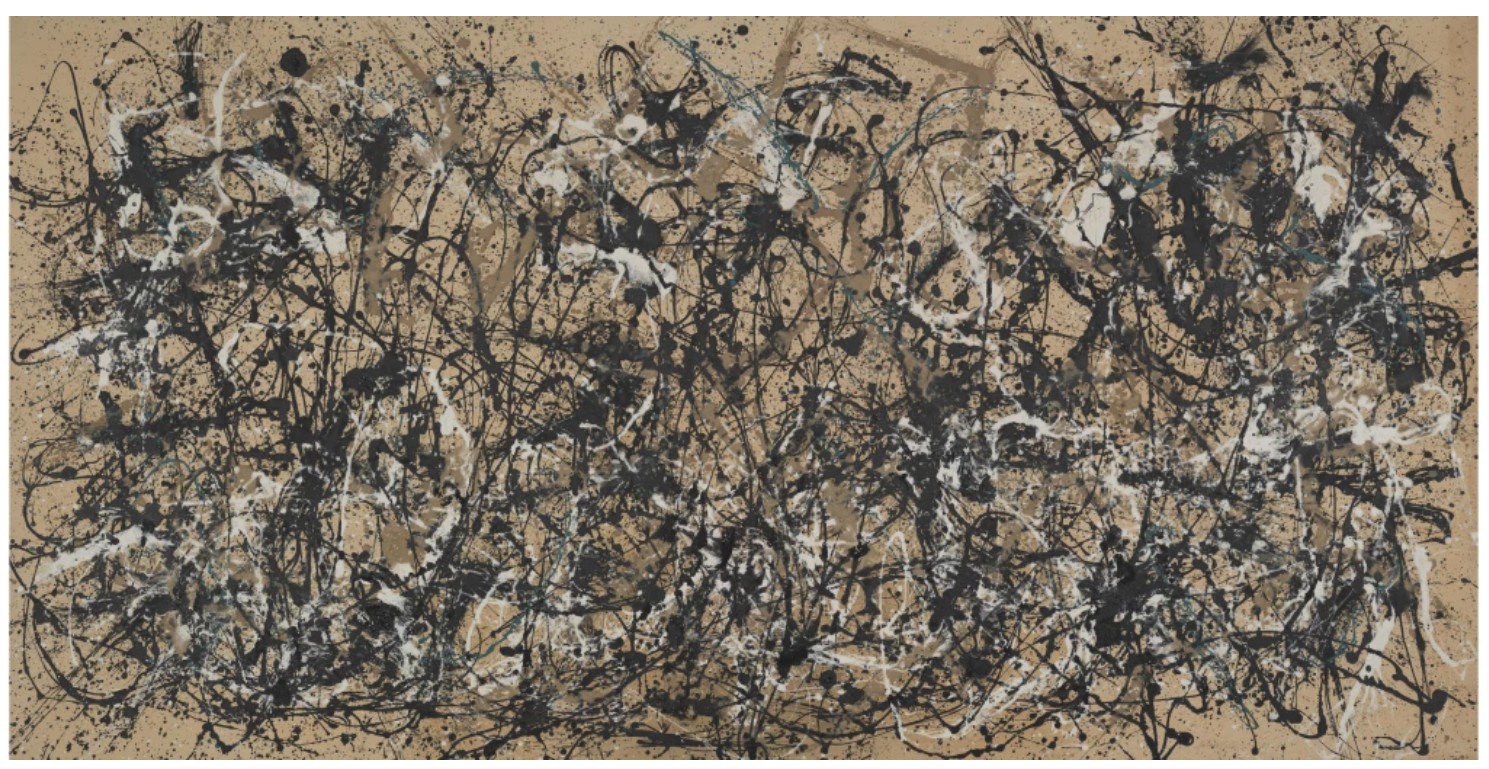
Jackson Pollock, Autumn Rhythm (Number 30), 1950. The Metropolitan Museum of Art, New York. Image © The Metropolitan Museum of Art. Image source: Art Resource, NY. Art © 2026 Pollock-Krasner Foundation / Artists Rights Society (ARS), New York
To only further testify to its institutional caliber, the present work was previously owned by architect Kamran Diba, who designed the Tehran Museum of Contemporary Art in Iran, as well as Lord Edward Spencer-Churchill, and was almost acquired three decades ago by The Museum of Modern Art in New York at the encouragement of legendary curator Kynaston McShine. In addition to Museum Security (Broadway Meltdown)’s decorated exhibition history and illustrious provenance, the present work has been requested for inclusion in the forthcoming exhibition Jean-Michel Basquiat: An Italian Renaissance at the Palazzo Strossi in Milan, to be curated by Dieter Buchhart and Anna Karina Hofbauer and opening in January 2027. Rattling with the graphic power of Basquiat’s legendary dictionary of deeply personal and historically resonant symbols and syntax, the present work unites the imagery that defined not only an artist but an era. The eponymous tagline “Museum Security” thunders across the composition.
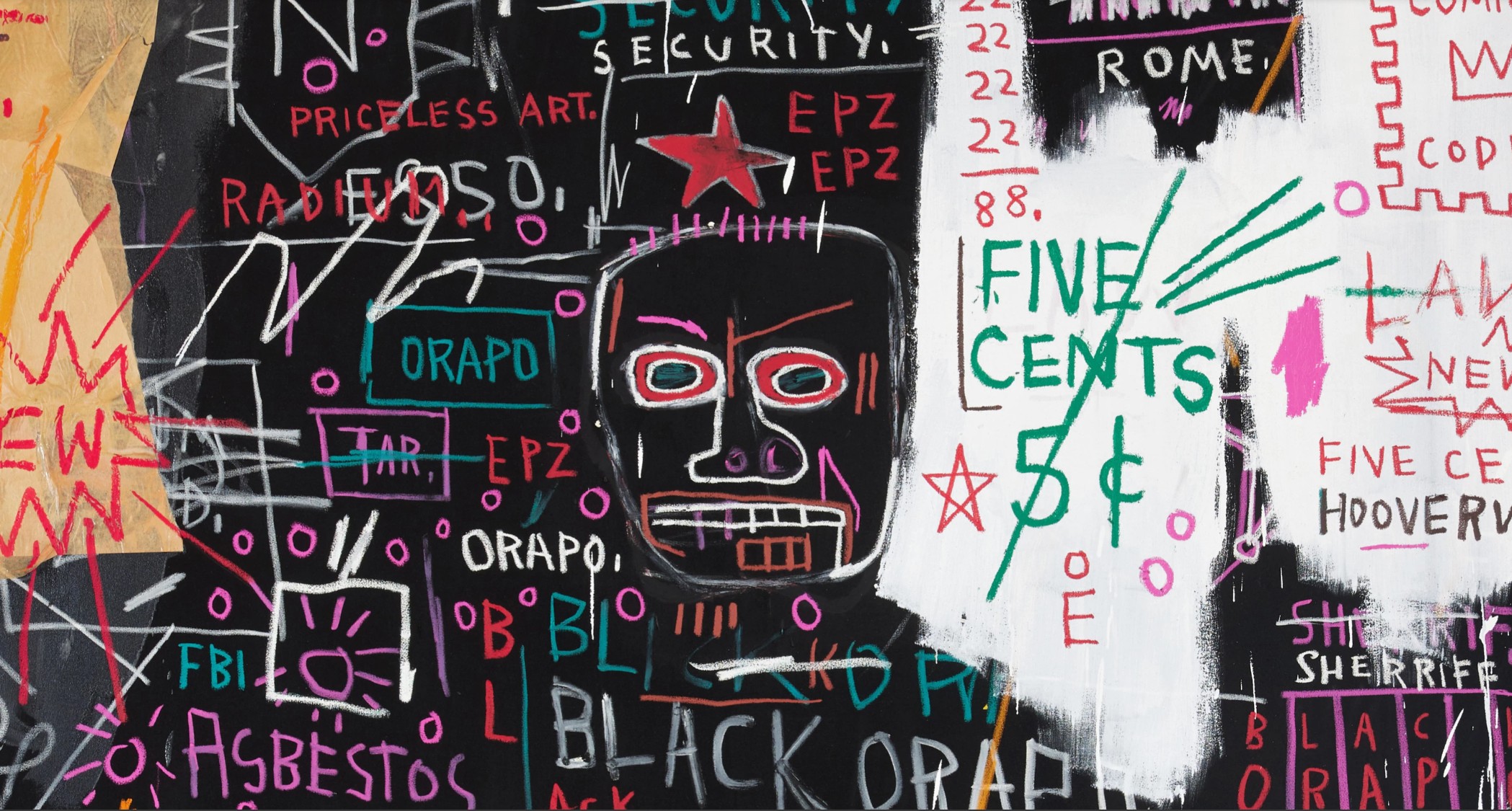
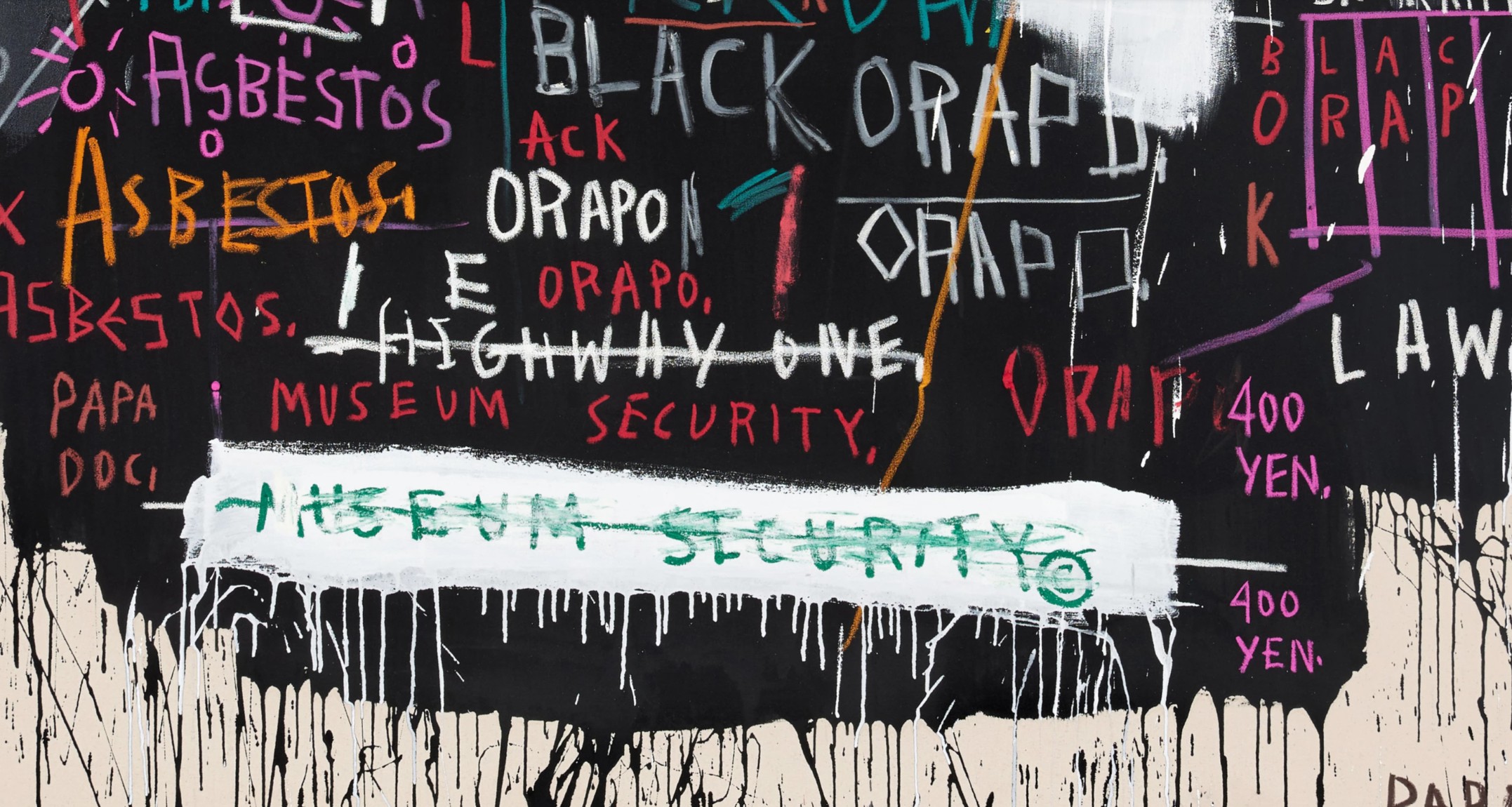
At center reigns an imposing, piercing skull-like head; surrounding it are the three-point crown—a pictograph coined during the earliest stages of Basquiat’s career working behind the pseudonym SAMO ©—and language which confronts notions of commerce, value, and trade such as “Priceless Art,” “New,” “Yen,” and “Five Cents.” Phrases which connote a highly attuned sensitivity to power, law, sovereignty, and governance, among them “FBI” and “Sherriff,” collide with the twice-inscribed “Rome,” the capital of classical antiquity and the veritable birthplace of the Western art historical canon. Looming large in the upper right of the present work is the Comics Code Authority postage stamp, the seal of self-regulation found on comic books, as well as a prominent “5 ¢” inscription that may refer to the United States nickel, which features President Thomas Jefferson and his Virginia plantation, Monticello. “Hooverville” calls out the makeshift homeless settlements built during the Great Depression, juxtaposed against “Papa Doc,” the moniker for Haitian dictator François Duvalier.
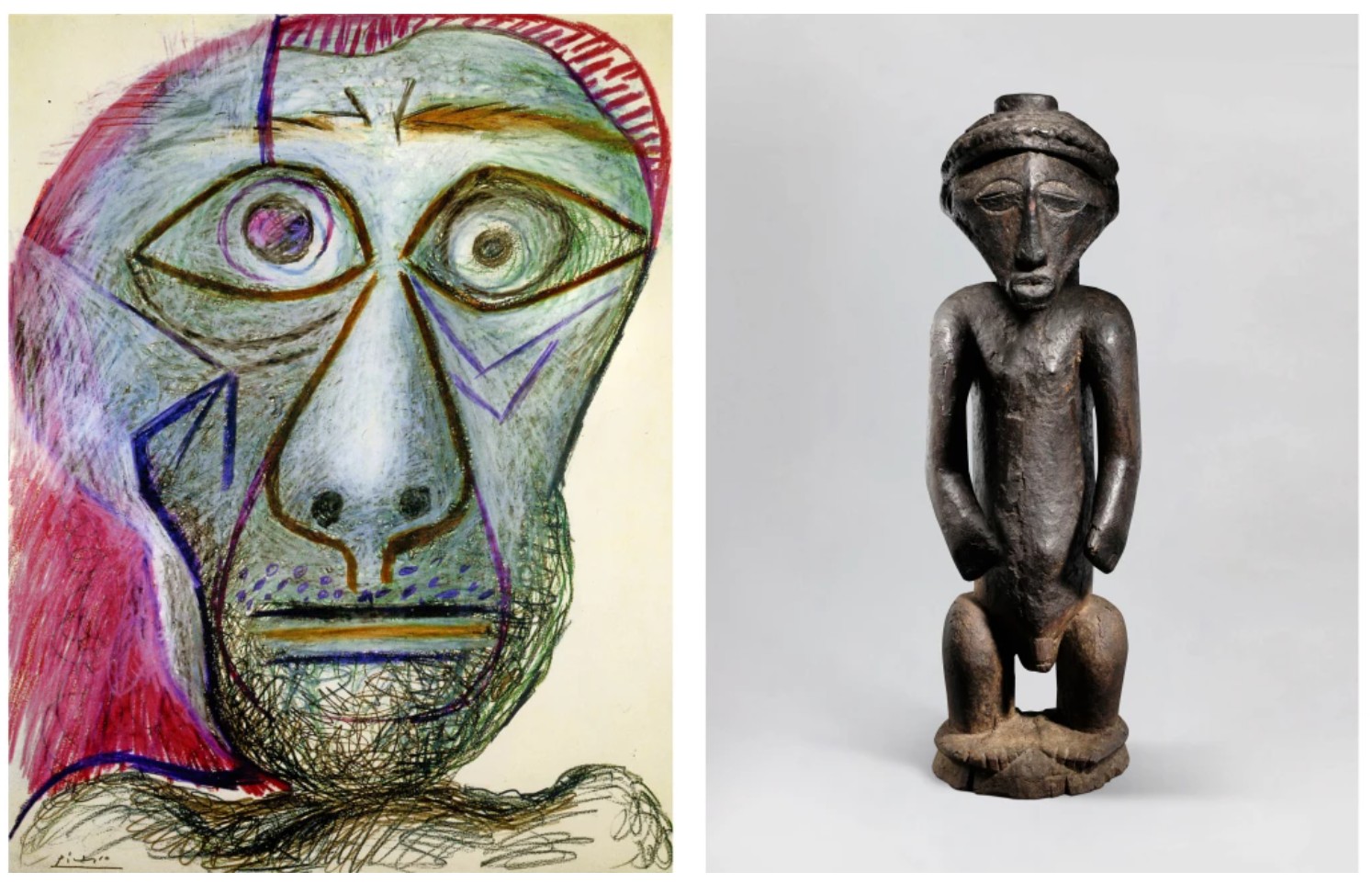
Left: Pablo Picasso, Self Portrait Facing Death, 1972. Fuji Television Gallery, Tokyo. Image © Fine Art Images / Bridgeman Images. Art © 2026 Estate of Pablo Picasso / Artists Rights Society (ARS), New York. Right: Pre-Bembe or Buyu Artist, Figure of an Ancestor. Private Collection
In this cyclone of text, image, and exuberant abstract gesture, Museum Security (Broadway Meltdown) presents the artist’s oblique yet charged indictment of his place in the art world and the broader, far deeper role that history and social politics have imposed. At the very core of Basquiat’s electric yet calamitously brief career was a spectacularly individuated lexicon, one anchored by the visuals and verbiage through which Basquiat communicated his worldview. In this way, Museum Security (Broadway Meltdown) suggests the artist himself suspended in a cacophony of conflicting interests: the disjunction between fame, iconization, celebrity, and wealth, and the limited and unsettlingly surveilled access of Black art, artists, and culture in the very commercial and institutional spaces into which Basquiat was suddenly thrust. Layer upon frenzied layer of emerald, vermilion, fuchsia, and orange oilstick expose where cultural authority abrades personal and political autonomy, uniquely proffering Basquiat’s tormented evaluation of his imposed status as the meteoric darling of an overwhelmingly white, commercially-driven art world.
Here, the surface stamped with words challenging the correlation between price and value, art becomes product, painting becomes commerce. Now in the throes of stardom, Basquiat, for whom creativity activity began not as career nor commodity but rather an inquietable, unstoppable instinct, his self-expression had become an asset, one bound by the mechanisms of the market and subject to the opinions of its stakeholders. (Andrea Frohne, “Representing Jean-Michel Basquiat,” in: Isidore Okpewho, Carole Boyce Davies, and Ali A. Mazrui, eds., The African Diaspora: African Origins and New World Identities, 1999, p. 442) In Museum Security (Broadway Meltdown) Basquiat reflects on himself not merely as a rising star, but as a martyr of modernity and the polemics that plague it, from race and class, equity and exploitation, to access and acceptance.
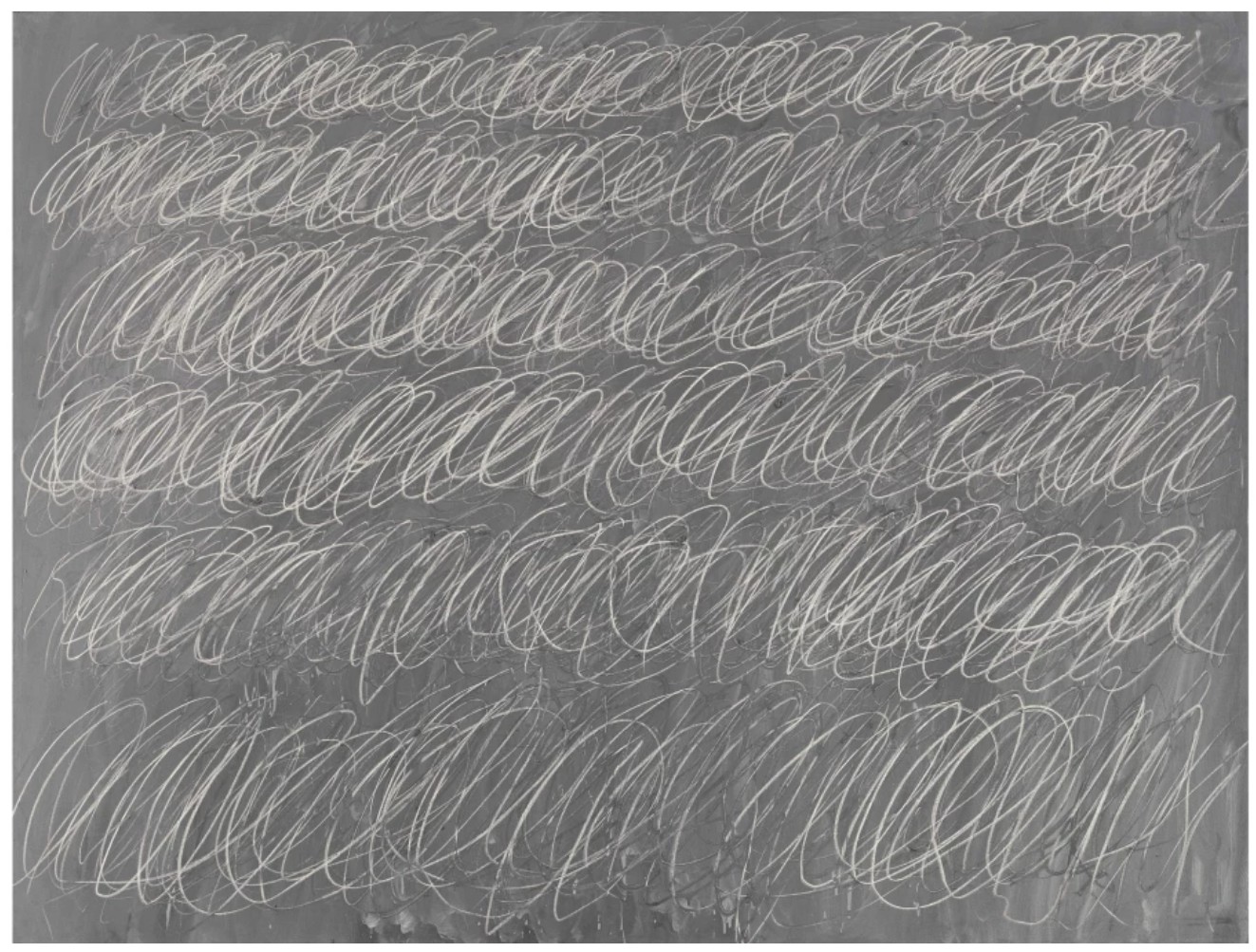
Cy Twombly, Untitled (New York City), 1968. Private Collection. Sold at Sotheby’s New York in November 2015 for $70.5 million. Art © 2026 Cy Twombly Foundation
Palimpsests of comparable art historical masterworks emerge in the present work, from the symbology that aligns it to humanity’s earliest creative expressions—the cave drawings at Lascaux—the skeletal, self-conscious treatment of the head seen in Picasso’s haunting final self-portraits, and, perhaps most prominently, the outcry of immediate gesture in Basquiat’s application of pure black pigment. The sheer activity aligns it with the frenetic, ferocious all-over Drip paintings by Jackson Pollock and the explosive ciphers of Cy Twombly’s masterwork Leda and the Swan, which similarly engages with Italian mythology. The weight of art history evinces itself, too, beyond the formal qualities of Museum Security (Broadway Meltdown)—the canvas itself bears sheets of collaged paper that harkens back to Basquiat’s origins as a graffiti artist, transforming it into a palimpsest of the New York street. (Eric Fretz, Jean-Michel Basquiat: A Biography, Greenwood, 2010, p. 89)
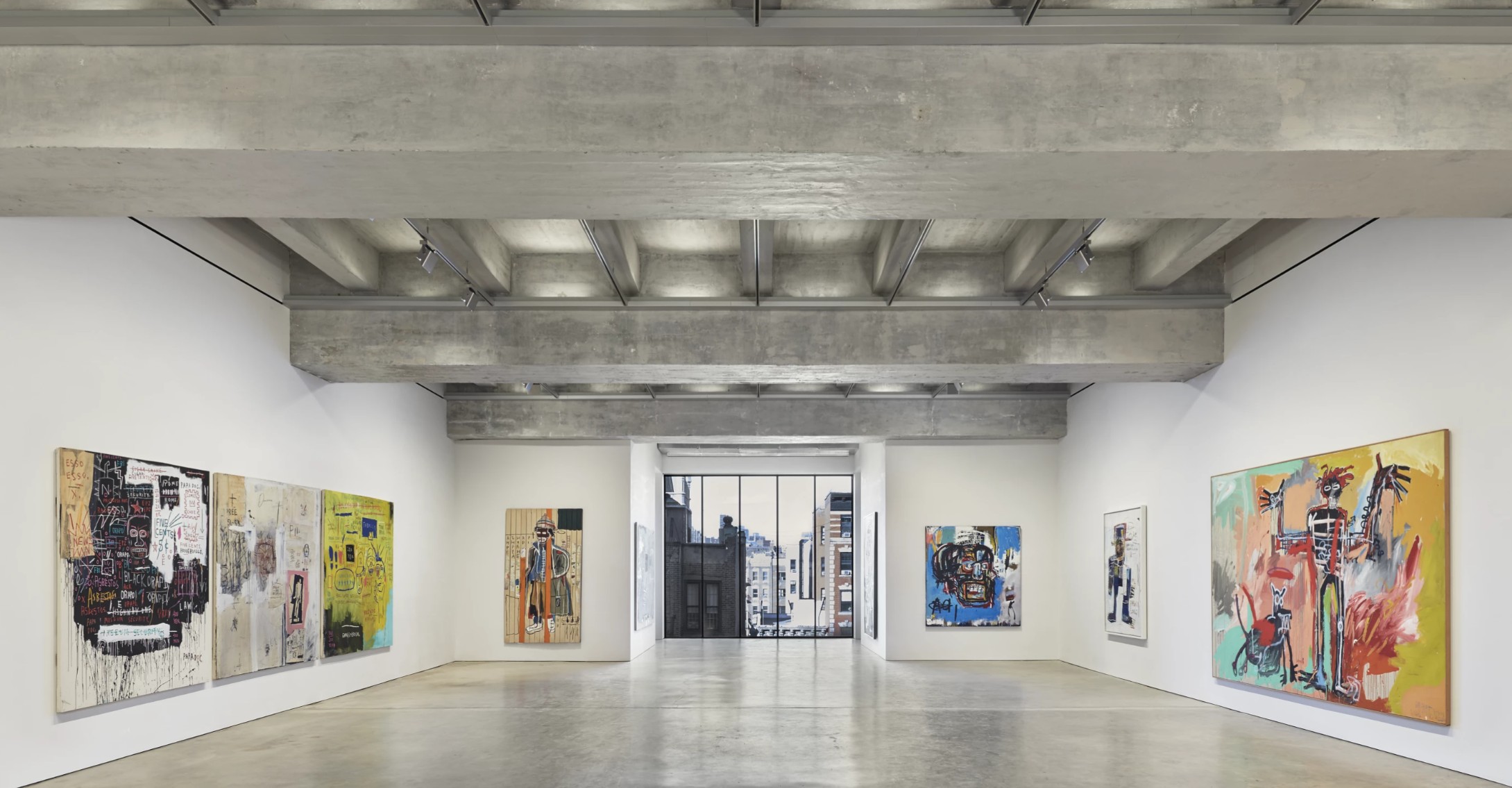
The present work installed in Jean-Michel Basquiat at The Brant Foundation Art Study Center, New York, March 2019 – May 2019. Photo © Tom Powel Imaging. Art © 2026 Estate of Jean-Michel Basquiat. Licensed by Artestar, New York
Indeed, so critical was the present work in crystallizing Basquiat’s most important themes that it graced the Fondation Beyeler in Riehen for half a decade on long-term loan. The Director of the Foundation, Sam Keller, describes the present work:“The Fondation Beyeler had the honour of holding the first major retrospective in Europe of Jean-Michel Basquiat’s work on the anniversary of his 50th birthday in 2010. The exhibition traced the development of this extraordinary, ground-breaking artist in over 150 paintings, drawings and objets d’art. One of the most important paintings was Museum Security (Broadway Meltdown) (1983), which took a prominent place in the comprehensive retrospective. I was able to study the painting on an almost daily basis for the three-month duration of the exhibition and it came to be one of my personal favourites. It is a key work in Jean-Michel Basquiat’s oeuvre, a modern-day ‘writing on the wall’ in the metaphorical and literal sense, and one of the great masterpieces of contemporary art.” (Sam Keller, Director of Fondation Beyeler quoted in: Dieter Buchhart and Anna Karina Hofbauer, eds., Jean-Michel Basquiat, ‘Museum Security – Broadway Meltdown’ 1983 monograph, Munich 2015, p. 10)
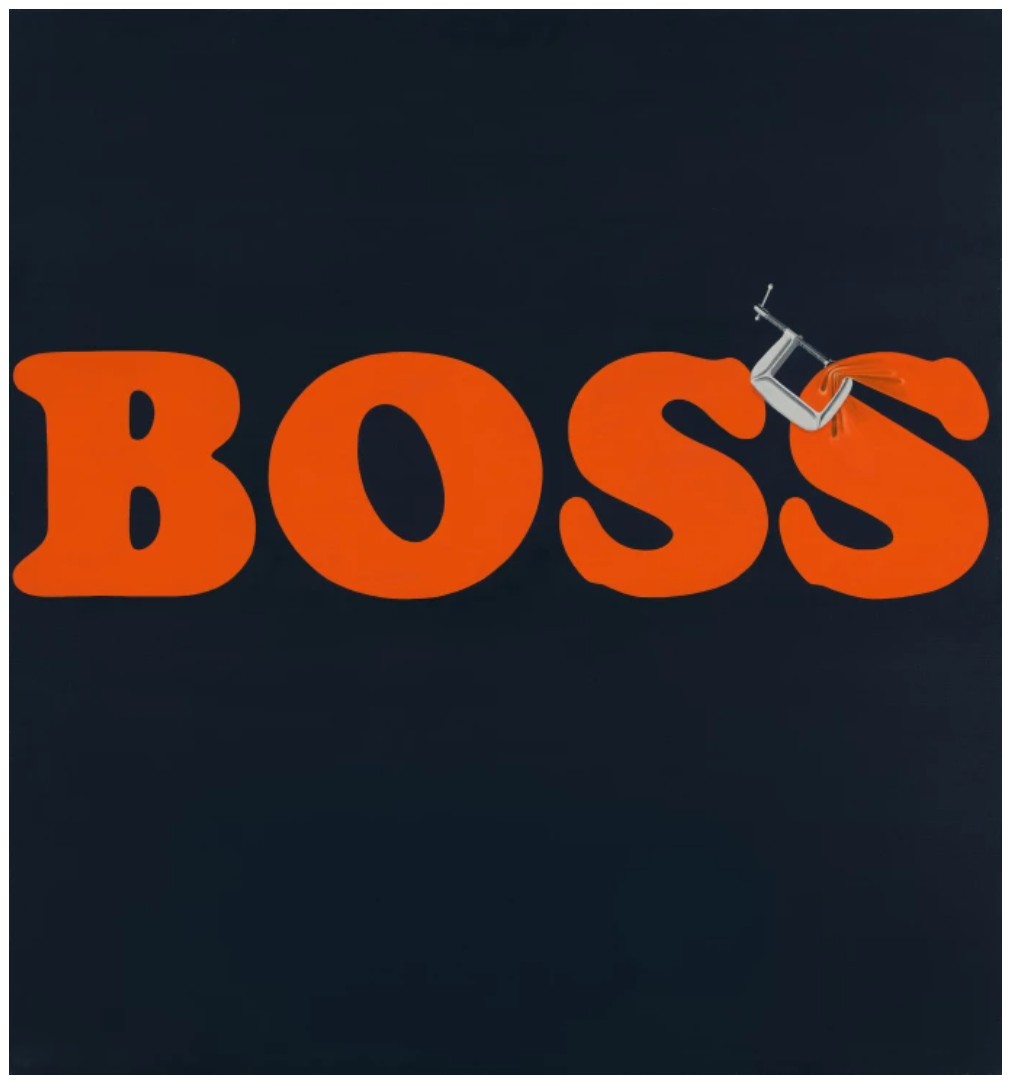
Ed Ruscha, Securing the Last Letter (Boss), 1964. Private Collection. Art © 2026 Ed Ruscha
In Museum Security (Broadway Meltdown), ego, id, and superego subsequently collapse into a raw painterly manifesto of the self and state of the art world, testifying to the transcendental breakthrough that constitutes the artist’s indelible legacy. “I knew he was great—he was electric,” recalls Glenn O’Brienn about the late artist. “A tesla coil with dreadlocks—cool fire emanating wherever he went. Magic.” (Glenn O’Brien, “Basquiat: The Show Must Go On,” 17 September 2013 (online)) Nowhere is this visceral sense of magic best exerted than in Museum Security (Broadway Meltdown), whose seismic interrogation of the Western artistic continuum lays bear the socio-political dynamics of its present moment. In this painterly battleground, Basquiat poignantly reflects upon the precarity of own success, identity, past, and future, thus reifying and manifesting his triumphal self-assessment: “I’m not a real person. I’m a legend” (the artist quoted in Anthony Haden-Guest, “Burning Out”, Vanity Fair, November 1988, p. 197 (online)).
Bursting with a litany of words, symbols and signifiers in a cacophony of rainbow colours, Jean-Michel Basquiat’s Museum Security (Broadway Meltdown) is a masterpiece by the artist. Both painting and urban poem, it was undertaken at the very height of Basquiat’s practice, marrying the energy of his haiku street graffiti, Cy Twombly’s stream of consciousness applied to the written and painted word with the expressive gestures of the American Abstract Expressionist generation. Exhibited in the artist’s second solo show at the Gagosian Gallery in Los Angeles in 1983 alongside Hollywood Africans (1983), now held in the Whitney Museum of Modern Art, New York, the present work can be considered as a direct pendant to this important painting. Included in the artist’s major retrospective exhibitions at the Fondation Beyeler in Basel and the Musée de la Ville de Paris Museum Security (Broadway Meltdown), was originally owned by Kamran Diba, the architect of the renowned Tehran Museum of Contemporary Art considered to be one of the greatest museum collections of contemporary art in the world. Museum Security (Broadway Meltdown) was undertaken at the very height of Basquiat’s artistic prowess. In 1982, Basquiat had exhibited at Documenta VII in Kassel, and in 1983 he was included in the Whitney Biennial, becoming the youngest artist to have represented America in a major international exhibition of contemporary art at the tender age of 22. Despite his youth and the originality of his art, critics unanimously recognized the maturity and talent demonstrated in his work. Basquiat said about this period, ‘I had some money. I made the best paintings ever. I was completely reclusive, worked a lot, took a lot of drugs’ (J.M. Basquiat, quoted in C. McGuigan, ‘New Money: The Marketing of an American Artist’, in The New York Times Magazine, 10 February 1985, p. 29).
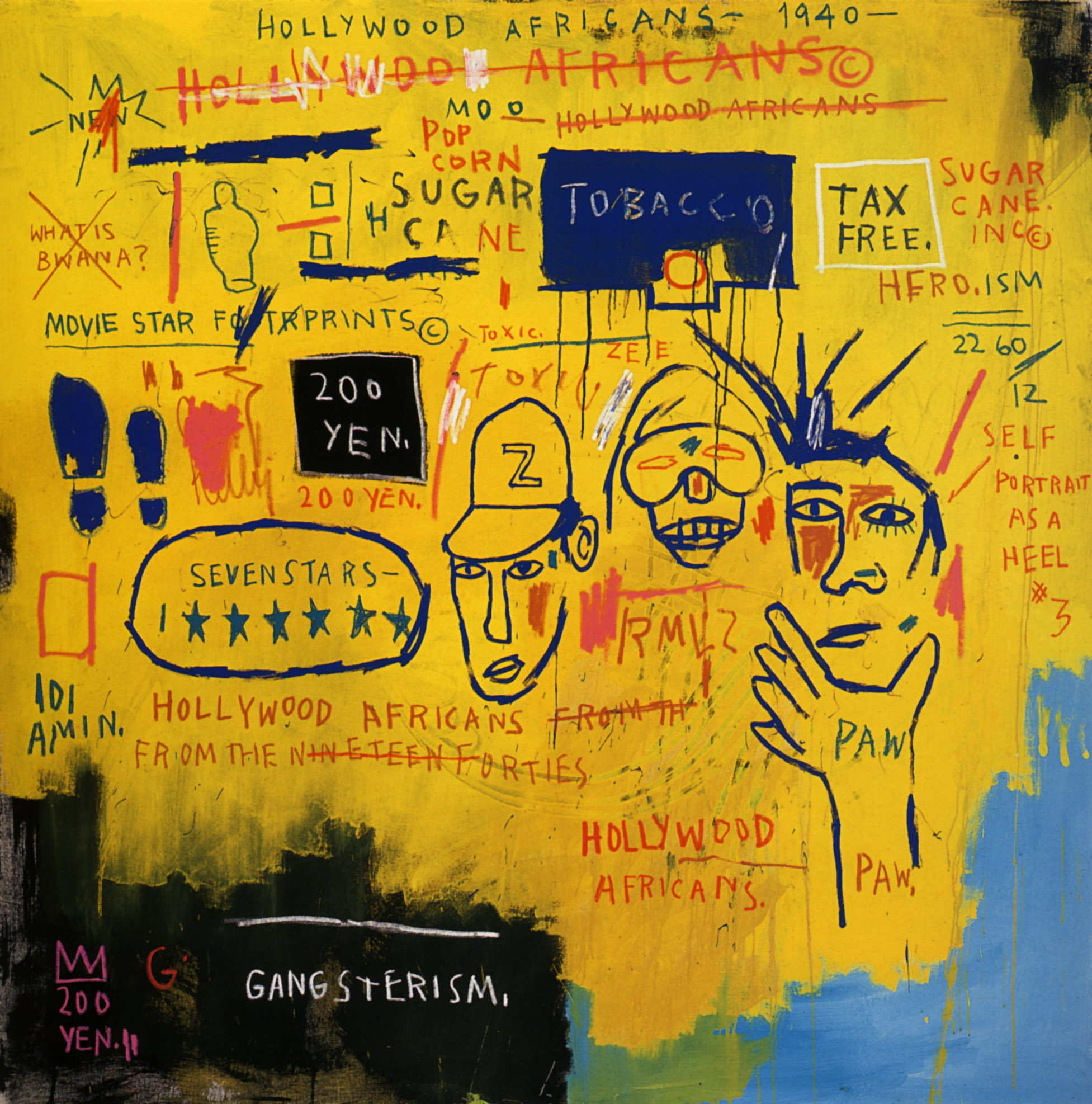
Hollywood Africans, 1983, The Whitney Museum of American Art, New-York
In Museum Security (Broadway Meltdown) as in Hollywood Africans, we see Basquiat return to the same potent compositional frame. Executed on the same scale the two counterparts share an expressive application of paint, Hollywood Africans drenched in black like the tarmac of New York City, overlayed with intense cadmium yellow, Museum Security (Broadway Meltdown) in black on white with brilliant color, like the bright lights on Broadway or the strobe illuminations of the downtown New Wave scene. Both share Basquiat’s explosive display of enigmatic symbols and verbal erasure. Rendered in pyrotechnics of color: shrieking violet, emerald green, fire engine red, orange and white, Museum Security (Broadway Meltdown) captures the frenetic pace of the artist’s peripatetic existence. Across the surface of the canvas, Basquiat has spelt out words including Esso, Asbestos, Rome, 400 Yen and Priceless Art; the artist joking with characteristic mock irony about the value of his painted composition given the burgeoning demand for his work, his new found fame and fortune. As the title suggests, this work becomes a physical manifestation of Basquiat’s thought process, committing images and ideas to canvas with a sense of urgency and immediacy. Simple phrases are interspersed with complex motifs taken from the artist’s daily life. Dominating the top right portion of the canvas is Basquiat’s riff on the ubiquitous Comic Code stamp, a self-regulatory seal of approval used to denote moral upstanding that appeared on all comic books from the 1950s until its use fell into decline in the mid-1980s. In Basquiat’s version the Comics Magazine Association of America logo is replaced with his own monogram, his signature crown, an attempt perhaps both to mock the older convention and to assert his own status by placing his self-endorsed, seal of approval on this particular work. Other more enigmatic symbols include a hand with an outstretched index finger, his interpretation of an African mask that dominates the center of the composition, and the mysterious shield-like emblem that appears in the top left-hand corner.
Basquiat’s breathless vocabulary is ushered onto the canvas with a force that combines both urgency and political perceptiveness. Ranging from historically dubious figures such as Papa Doc, the 1960s Haitian despot, to Hooverville; the name for shanty-towns built by the homeless people during the Great Depression, Basquiat’s choice of words show an empathy with the social underclass as they struggle to make their voices heard in society as a whole. In many ways Museum Security (Broadway Meltdown) can be seen as a work that documents Basquiat’s meteoric arrival on the art scene. As one of the few African Americans in a predominantly white art-world (the only other black faces he might have seen in the art world would have been the museum security guards of the work’s title), he may have found it difficult to adjust to his rising fame. In Hollywood Africans (1983), we see Basquiat engaging a similar theme, playfully adding himself to a coterie of African-American Hollywood stars and reflecting upon his new-found stardom. It was during this important period that Basquiat begun to gain a reputation as one of the most exciting and innovative artists in New York, having been propelled from a street artist to artistic wunderkind in less than two years. The sense of speed and intensity of this ascension is deftly contained within the composition of Museum Security (Broadway Meltdown) and the boldly hieroglyphic features, enigmatically rendered vocabulary, and painterly drips could be seen, in part, as an expression of the artist’s stream of consciousness as well as a metaphor for his sudden rise to fame.
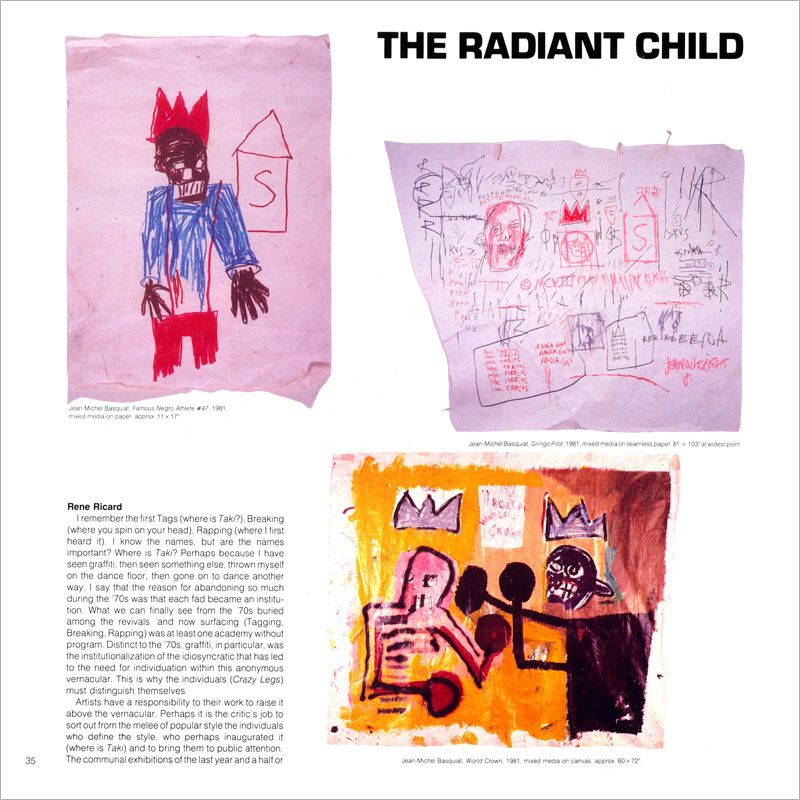
With its wild agglomeration of elements and artfully combined color palette, Museum Security (Broadway Meltdown) eschews the icy serial production of Pop art in favour of a new type of Expressionism, evoking the intuitive scrawls of Cy Twombly and the raw energy of Dubuffet’s Art Brut. As Rene Ricard once famously asserted, ‘if Cy Twombly and Jean Dubuffet had a baby and gave it up for adoption, it would be Jean- Michel’ (R. Ricard, quoted in ‘Radiant Child’ Artforum, December 1981, p. 43). In Museum Security (Broadway Meltdown) we see sentences simultaneously drawn, scored through, obscured and rewritten. Cy Twombly was clearly an influence in this respect. A close reading of Twombly’s 1970 Untitled (Study for Treatise on the Veil) or The Italians (1961), would have perhaps provided Basquiat with a precedent for such verbal erasure. The difference however, is that whilst Twombly cancels to cancel, Basquiat cancels to reveal. As the artist himself explained, ‘I cross out words so you will see them more; the fact that they are obscured makes you want to read them’ (J.M. Basquiat, interview with R. Farris Thompson, quoted in ‘Royalty, Heroism and the Streets: The Art of Jean-Michel Basquiat’, R. Marshall (ed.), Jean-Michel Basquiat, New York 1992, pp. 28-43).