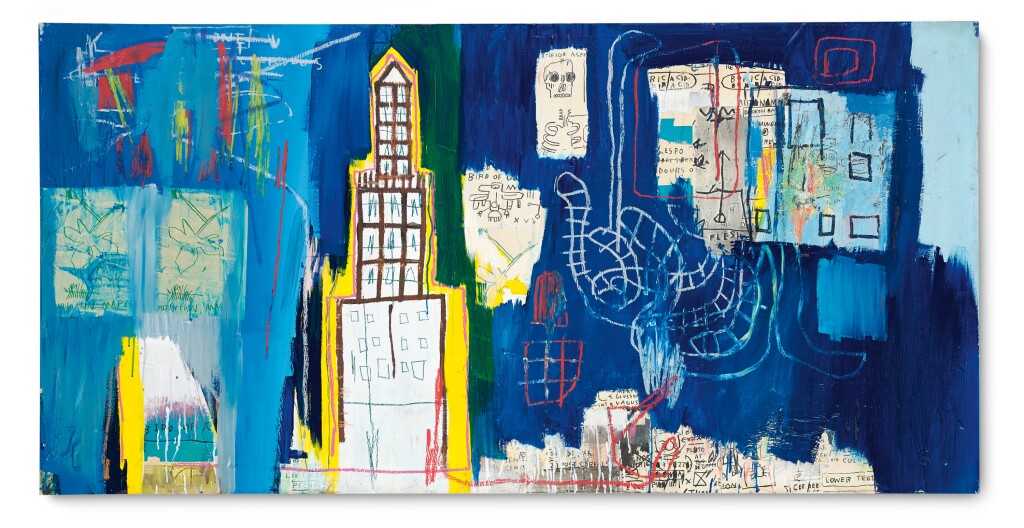
JEAN-MICHEL BASQUIAT
Just Come Suit, 1983
Acrylic, oilstick and coloured Xerox collage on canvas
40.5 x 79.1 inches (103×201 cm)
Signed, titled and dated 1983 on the reverse
Provenance
Mary Boone Gallery, New York
Galerie Bruno Bischofberger, Zurich
Private Collection
Christie’s, London, 22 April 1998, Lot 13
Private Collection, France
Acquired from the above by the present owner circa 1999
Sotheby’s London: 21 October 2020
GPB 5,081,250
Source: Sotheby’s
JEAN-MICHEL BASQUIAT | JUSTCOME SUIT | Contemporary Art Evening Auction | | Sotheby’s (sothebys.com)
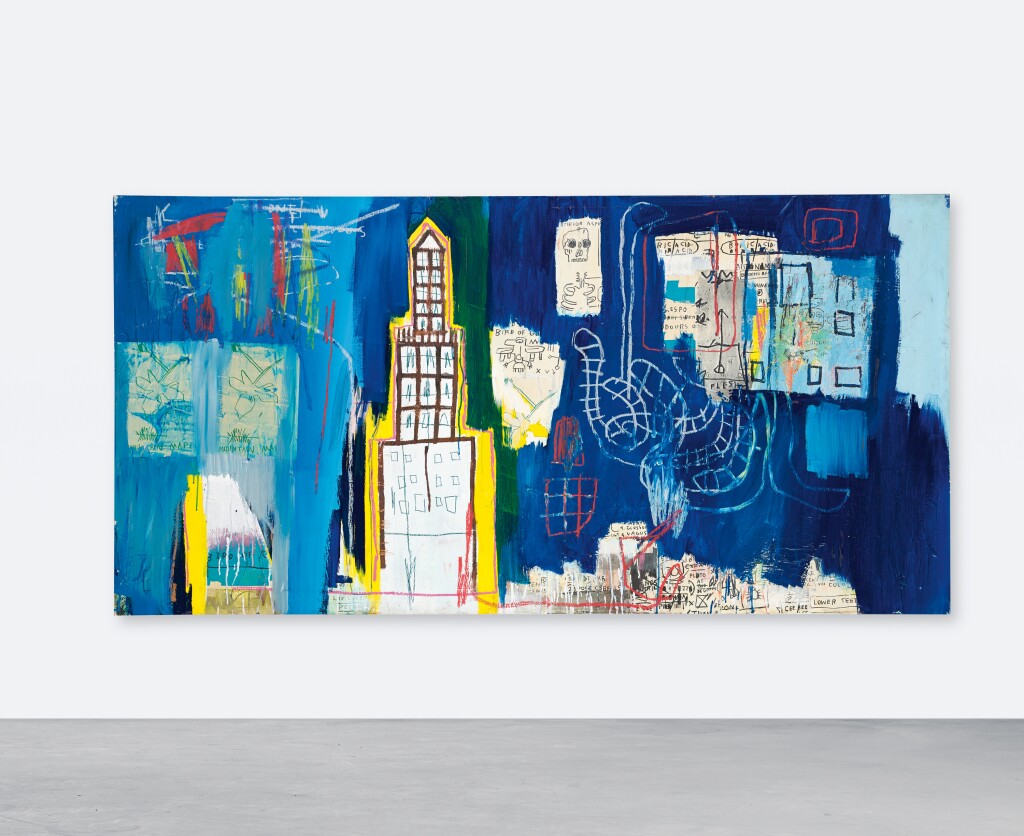
Epitomizing Jean-Michel Basquiat’s reverence for the energy and dynamism of New York City, Just Come Suit narrates the artist’s seismic transition from the streets of Manhattan to the realm of fine art. In a combative amalgamation of gestural abstraction and bold figuration, Basquiat’s canvas pulsates with urban rhythm. The frenetic composition, swathed with expressive image-making, harnesses a myriad of references that strongly evoke the language of a city in glorious disarray. As Glenn O’Brien wrote of New York during the late 1970s and early ‘80s: “New York was cheap, poor, run-down and dangerous. In its own fabulous way of course” (Glenn O’Brien, ‘SAMO©’s New York’, in: Exh. Cat., London, Basquiat: Boom for Real, Barbican Centre, 2017, p. 101).
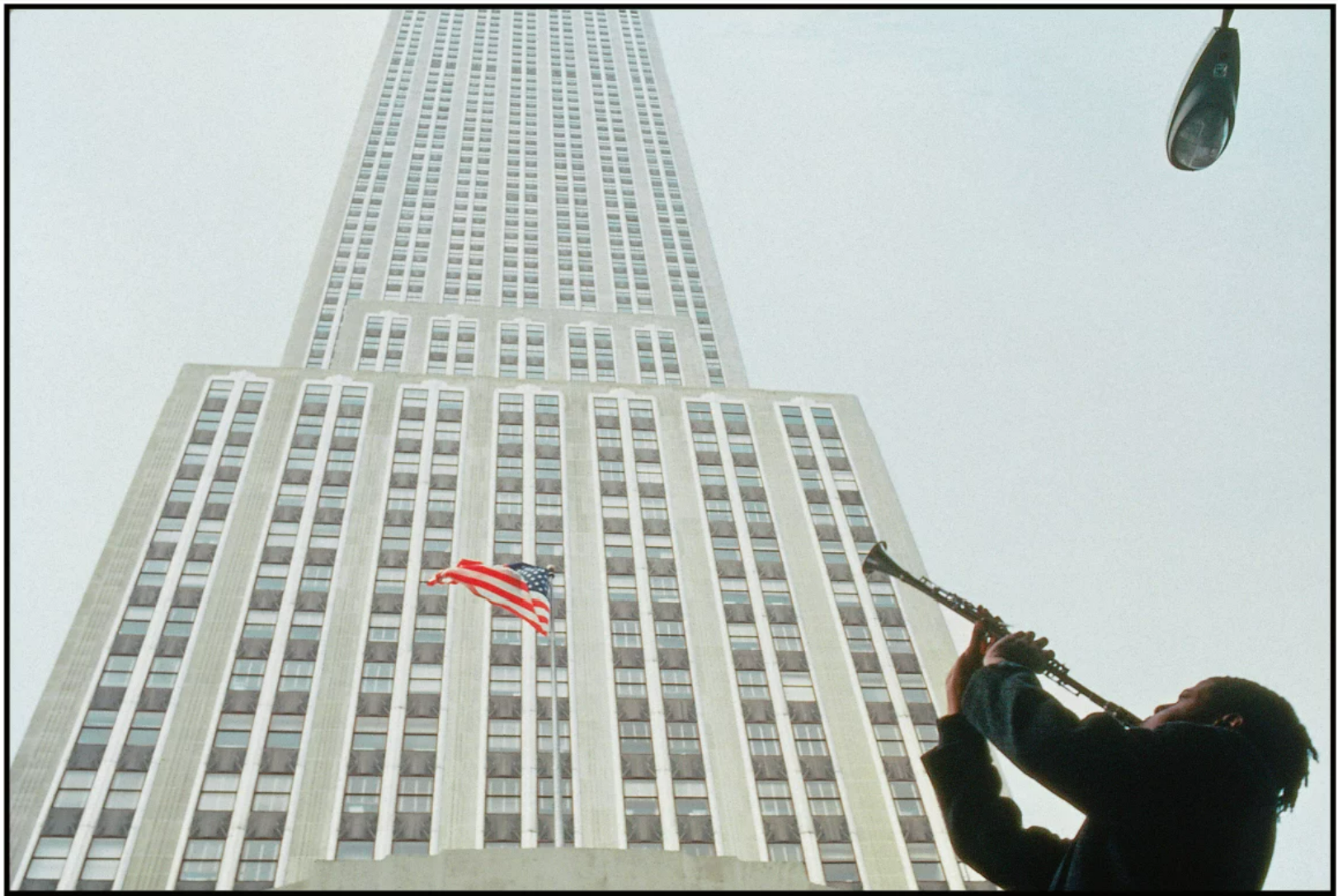
A striking image of the Empire State Building pierces the abstract ground of Just Come Suit, its outline illuminated in vibrant yellow as if glowing against a night sky. The haphazardly pasted and over-painted sheets of intricate Xerox drawings on the surface of the present work further recall the myriad billboards and construction site walls that were victim to bootleg advertisements and graffiti across Manhattan in the 1970s and ‘80s. With its striking syntax and bold imagery, Just Come Suit powerfully encapsulates a metropolis at the centre of an explosively creative cultural scene. Unconstrained by convention, this painting embodies the genius of an enormously talented young spirit.
Immediate and consuming, Just Come Suit is a testament to the unprecedented intensity which emerged in Basquiat’s paintings of the early 1980s. With virtuosic dexterity, he channeled the explosive charge of his earlier street art into the first, strikingly intense canvases of his mature career. Basquiat made waves on the burgeoning downtown art scene as early as 1978, when he teamed up with his classmate Al Diaz to paint enigmatic slogans across the walls of corporate or public buildings in highly visible spaces all over the city. More than just a graffiti tag however, these slogans – executed under the aegis of SAMO, a euphemism for ‘Same Old Shit’– were poetic, syncopated literary maxims aimed at critiquing both the art-world and American culture at large. As SAMO, Basquiat roamed the streets of New York, emblazoning his moniker and chosen icons – the three-pointed crown and acquisitive © – upon the abandoned walls of the city. SAMO thus became known for his unique blend of the conceptual and the visual, merging a diverse linguistic arsenal of words with enigmatic symbols and icons that, while inscrutable, were likewise unforgettable. Reflecting upon the unique, painterly spirit of Basquiat’s cryptic tags, scholar Marc Mayer notes: “Deliberate and practiced, far more slick than raw, the tags also had a cheerful spontaneity in their favor that felt related, somehow, to a primordial decorative impulse. It was the city, more than any other source, which provided fodder for Basquiat’s art brut sensibility” (Marc Mayer, ‘Basquiat in History’ in: Exh. Cat., New York, Brooklyn Museum, Basquiat, 2005, p. 46).
In Just Come Suit, Basquiat sacrifices none of the immediacy and directness of SAMO, but rather, channels his riotous army of painted marks into a formal order. Describing this shift, critic Achille Bonito Oliva reflects: “Now, he brought to his canvases the abstract-figurative intensity of this experience, its declarative and narrative nature, explicit and didactic vigor, and its confused and spontaneous accumulation of visual elements” (Achille Bonita Oliva, ‘The Perennial Shadow of Art in Basquiat’s Brief Life’ in: Exh. Cat., Lugano, Museo d’Arte Moderna, Jean-Michel Basquiat, 2005, p. 40). Conjuring the specter of SAMO, notorious vandal/hero of the New York City streets, Just come Suit achieves a potent fusion of viscerally charged iconography and an unbridled painterly assault, in a composition unified by the unwavering confidence of Basquiat’s line.
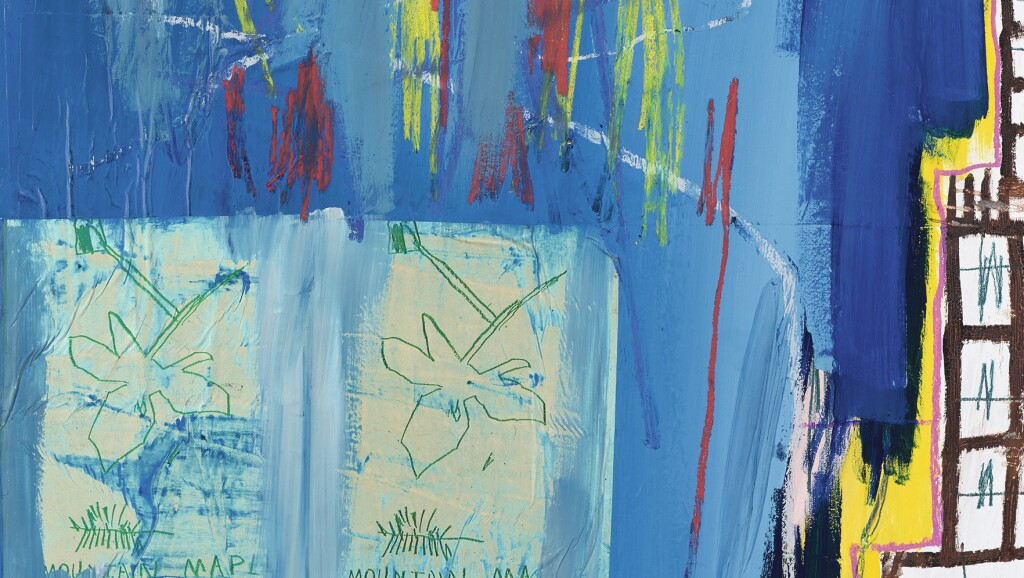
Drawing upon his experience on the streets of Manhattan, the series of ‘cityscapes’ to which the present work belongs were among Basquiat’s first large-scale paintings. Together they form an in-depth investigation into the urban environment in which he lived. Graffiti encompassed a whole range of associations and meanings for Basquiat, from an urban vehicle for free speech to a synthesis of cultural art forms, or an investigation into the historical language of symbolism. He was intrigued by early modes of human expression and communication, and often incorporated into his compositions codes found in Henry Dreyfuss’ Symbol Sourcebook. Many of these symbols, carried throughout his practice, are repeated like incantations in his drawings and paintings.
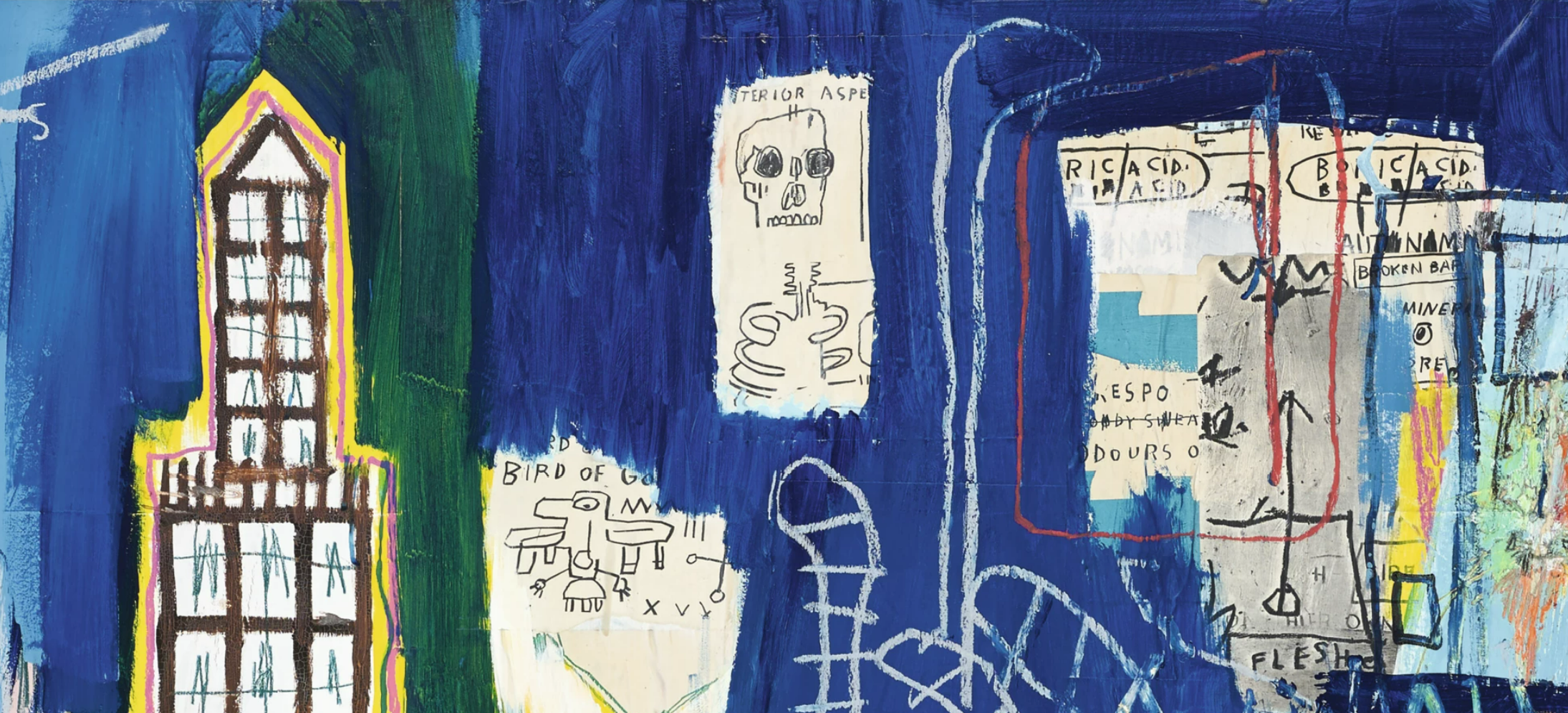
While the illuminated, architectural image of the Empire State Building on the surface of Just Come Suit evokes the vertiginous skyscrapers of New York’s famous skyline, so too do the roughly rendered boxes to the right of the composition, stacked and suggestive of the windows of the city’s infinite high-rise towers which endlessly punctuate the Manhattan skyline. Even the title of the present work – Just Come Suit – embodies the chaos of the city’s business districts: Wall Street, and the ever-bustling Midtown, the latter of which is home to some of the city’s most famous and spectacular buildings, among them the Empire State Building, the Chrysler Building, Grand Central Terminal and Rockefeller Center.
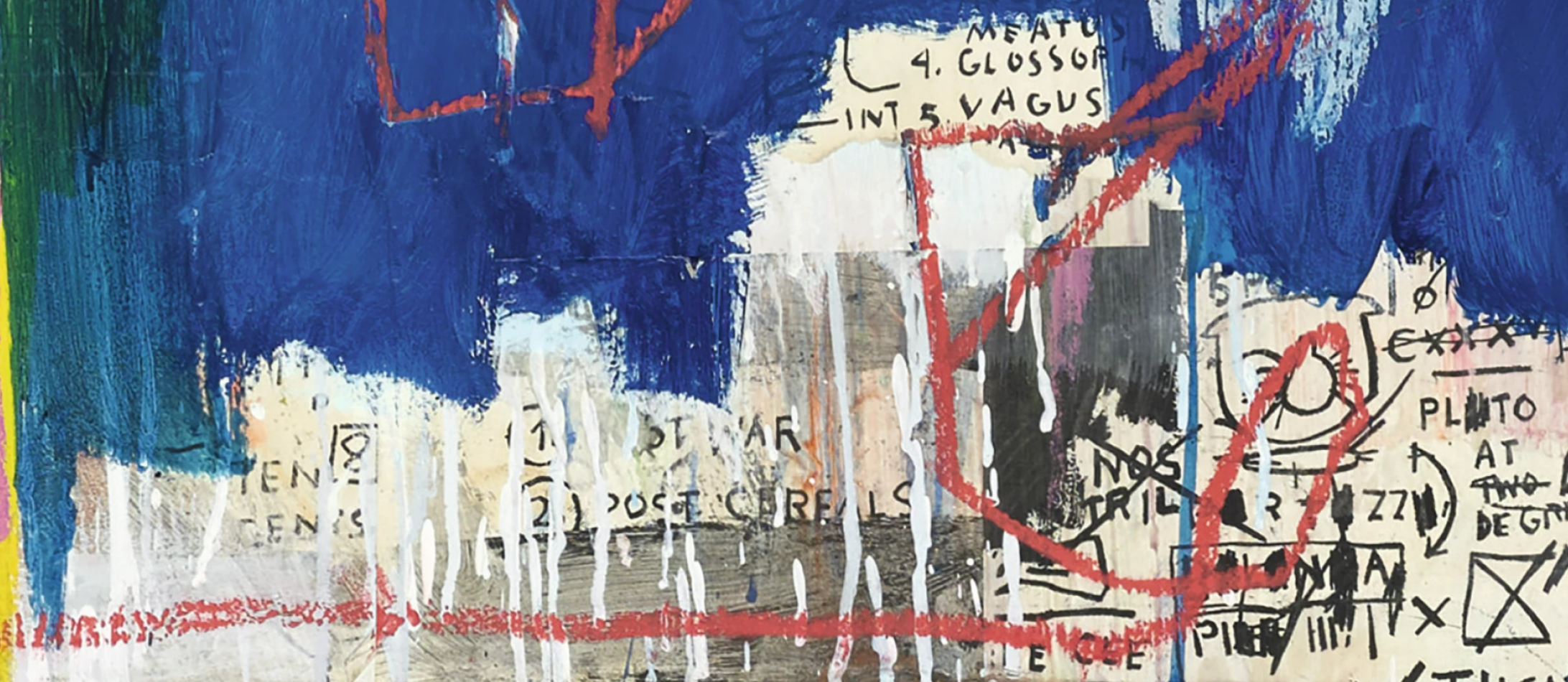
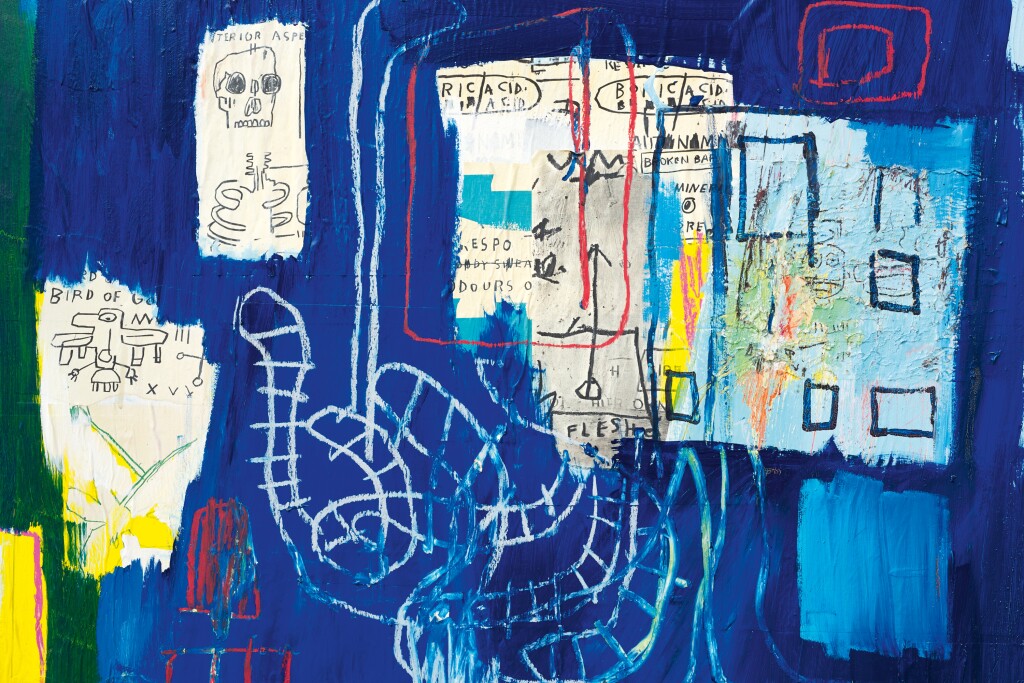
The urban iconography of New York that permeates the surface of the present work is complimented by a plethora of diagrams and slogans relating to the realms of medicine and science. The artist had an erudite knowledge of the human form, and he explored its structure of bones and body parts almost incessantly throughout his painterly practice. This fascination with anatomy dates back to his childhood when, after being hit by a car at the age of seven, Basquiat underwent a splenectomy. During his convalescence, his mother gave him a copy of Gray’s Anatomy, and its impact on Basquiat’s future artistic practice was nothing short of profound. Indeed, the loose brushstrokes of indigo at the centre of the composition part to reveal a Xerox sheet emblazoned with a skeleton, the skull of which has been severed from the neck and ribs, its eye sockets hollow and vacant. A similarly ominous drawing is evident on the surface of the Xerox sheets to the right of the composition, where medical diagrams are interrupted by Basquiat’s roughly written inscriptions such as FLESH, BORIC ACID, BROKEN, MINERAL, ODOURS, and the half-obliterated letters forming the word AUTONOMOUS. Intermingling rigid oil-stick with loose smears of oil paint, intricate sheets of Xerox drawings and loosely scrawled phrases, Basquiat seals and intensifies the immediacy of his forms.