JEAN MICHEL BASQUIAT
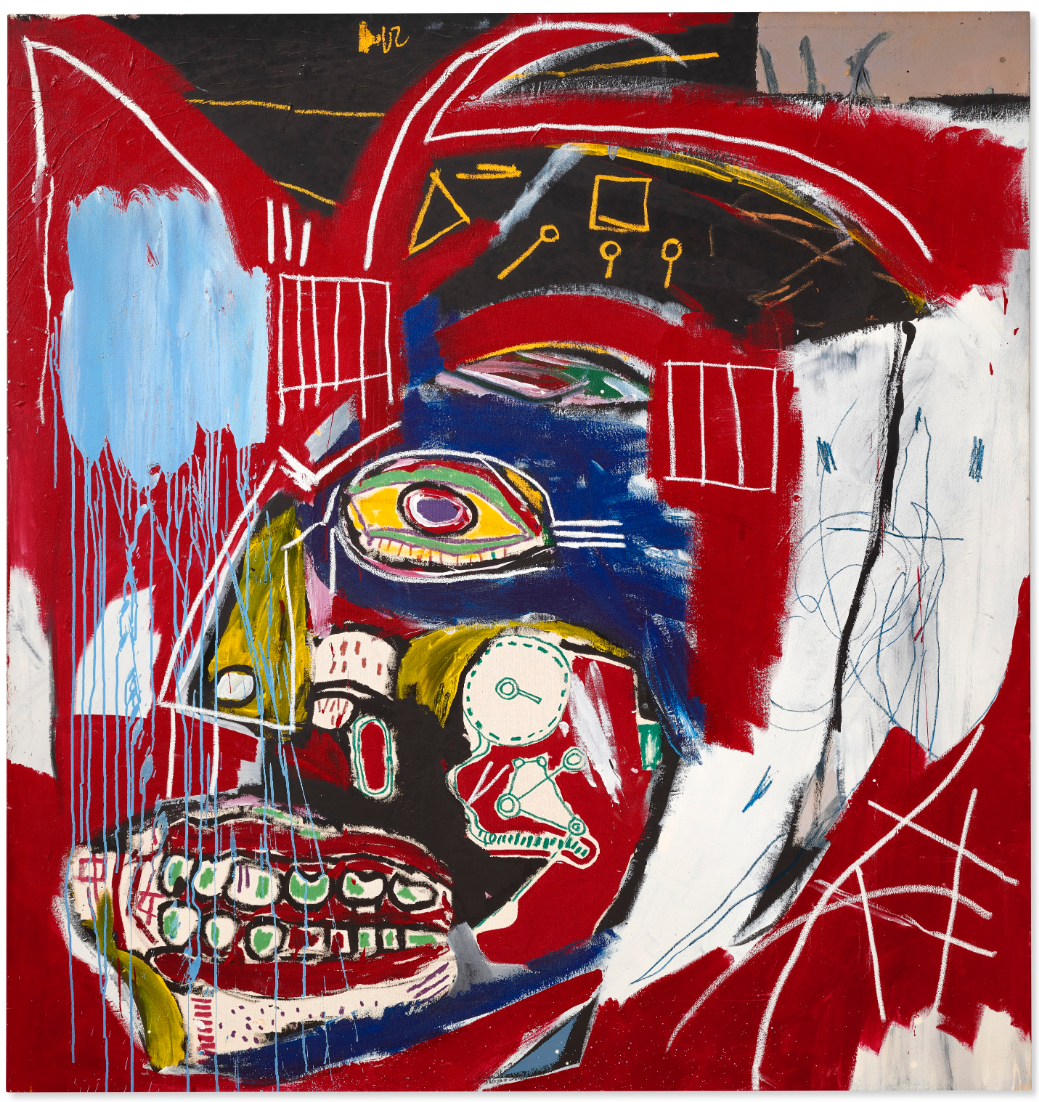
In This Case, 1983
Acrylic and oilstick on canvas
77 7/8 x 73 3/4 inches (197.8 x 187.3 cm)
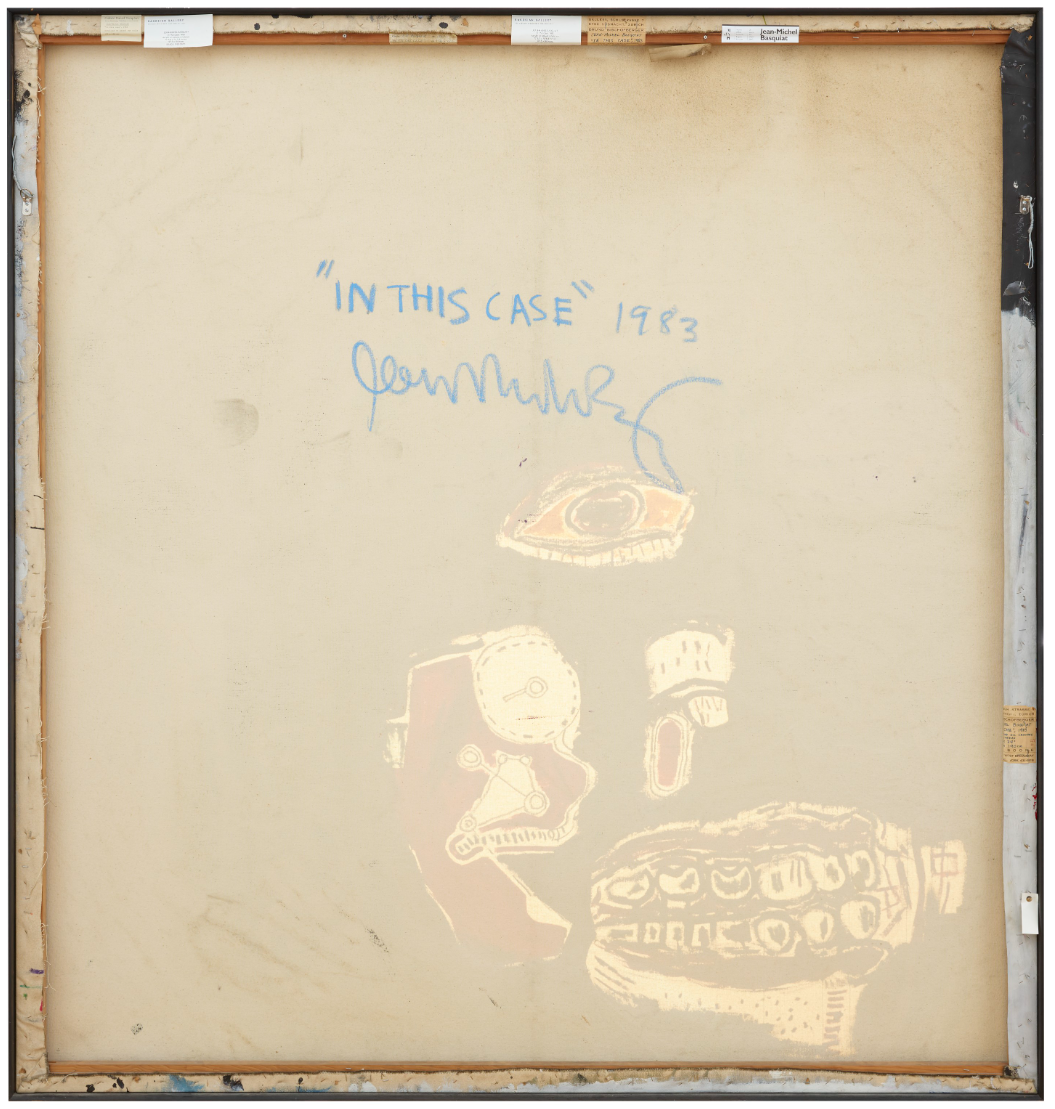
Signed, titled and dated ‘”IN THIS CASE” 1983 Jean Michel Basquiat’ (on the reverse)
Provenance
Galerie Bruno Bischofberger, Zürich
Galerie Daniel Templon, Paris
Private collection, Europe
Anon. sale; Sotheby’s, New York, 12 November 2002, lot 26
Gagosian Gallery, New York
Acquired from the above by the present owner, 2007
Auction History
Christie’s New-York, 11 May 2021
Estimate Upon Request
USD 93,105,000
Jean-Michel Basquiat (1960-1988) (christies.com)
No subject is more powerful or more sought after in Jean-Michel Basquiat’s oeuvre than the singular skull. For the enigmatic artist, the human head was more than an obsession. As the punning title of In This Case implies, the head is a case or a cage for a cog-like machine teeming with impulses and ideas. Perhaps one of Basquiat’s greatest achievements: a cranial chasm into which the artist has poured the contents of his visual imagination, melting together centuries of stylistic influence.
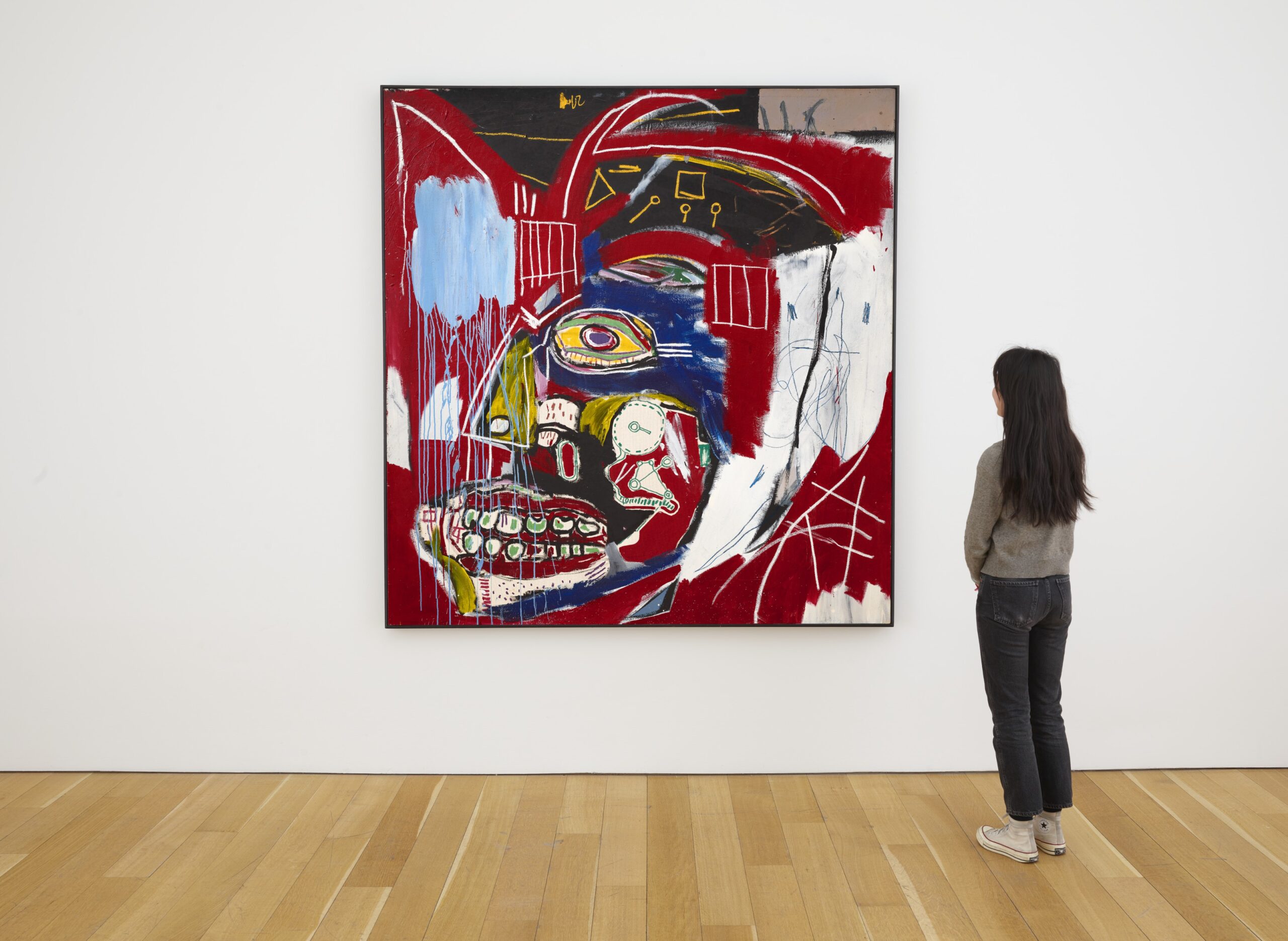
In 2018, a ground breaking Basquiat retrospective opened at the Fondation Louis Vuitton in Paris featuring a trinity of the artist’s skull paintings — together for the first time — in a small, chapel-like room. ‘Three Heads dating from 1981, 1982, and 1983 open the exhibition,’ explained Co-Curator, Olivier Michelon. ‘What situates these canvases among his most arresting is the violence they bring to their upending of the vanitas. Listed Untitled, the first two are sometimes dubbed Skull, while the third is titled In This Case; these cranial anatomies are not memento mori, but amplified memories played very, very loud. So loud that their presence is indisputable.’
At the time of the 2018 retrospective, both Untitled paintings had already achieved international recognition. Untitled (1981) was acquired by Eli and Edythe Broad the year after it was painted — and is now housed at The Broad in Los Angeles. Meanwhile, Untitled (1982) had recently realized the highest price achieved for an American artist at auction when it sold for over $110 million in 2017.
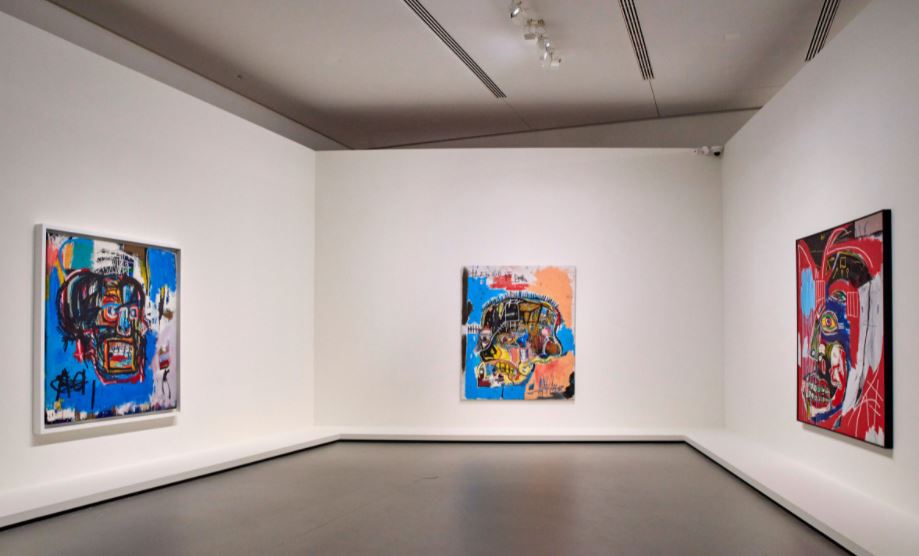
Photo : Manuel lagos Cid/Paris Match via Getty Images.
In This Case, the last of the series, had also previously been the highlight of a major Basquiat survey at Gagosian Gallery New York, in 2013. Robert Farris Thompson described the work at the time as ‘one of Basquiat’s strongest…a climactic portrait of the black face that haunts painting after painting. Every creative touch — the green teeth, the yellow eye, the navy-blue skin — is exactly right.’
Basquiat’s proclivity for the human form is rooted in his childhood. After a car accident left the then-seven-year-old artist with a broken arm and several internal injuries, his mother gave him a copy of Gray’s Anatomy while he recuperated in the hospital. Already an adept draughtsman, the young Basquiat absorbed every detail of the human form depicted in the book’s diagrams — from its skeletal architecture to its musculature and cardiovascular network — leading to a lifelong preoccupation with the physical body. He would come to find his most poignant expression in the form of the skull, returning to the iconic motif over and over again.
‘What drew Basquiat almost obsessively to the depiction of the human head,’ wrote curator and publisher Fred Hoffman, ‘was his fascination with the face as a passageway from exterior physical presence into the hidden realities of man’s psychological and mental realms.’
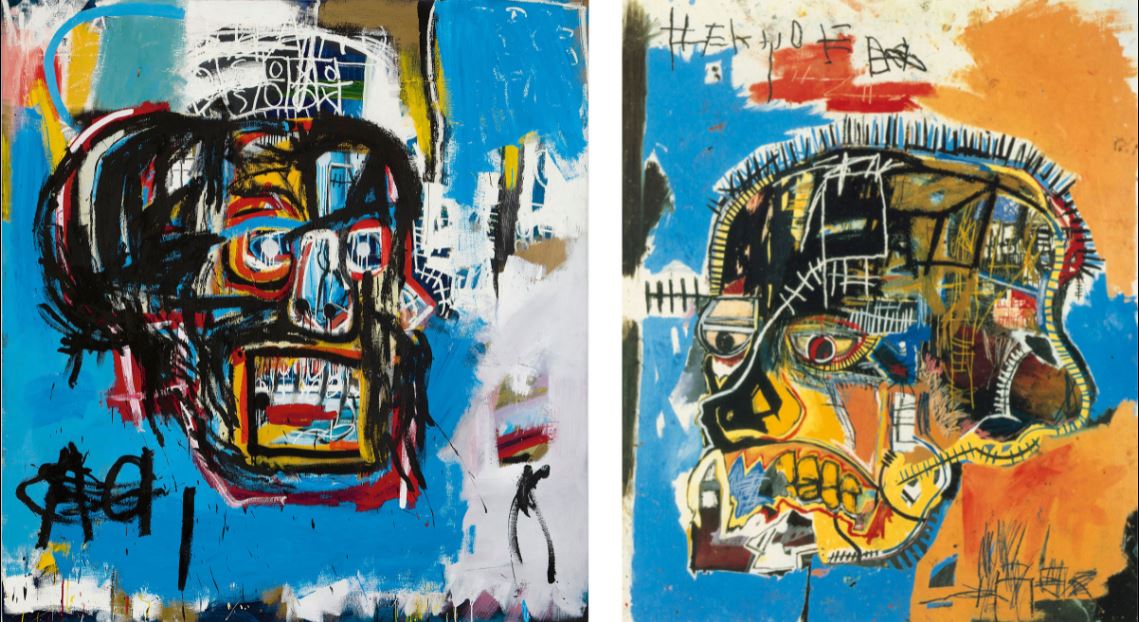
Right: Jean-Michel Basquiat, Untitled, 1981. The Broad, Los Angeles. © Estate of Jean-Michel Basquiat. Licensed by Artestar, New York
Constantly seeking reinvigorated modes of inspiration, new sources eventually came to inform his anatomical figures, among them: Paul Richer’s Artistic Anatomy, Burchard Brentjes’ African Rock Art, and a 1966 volume on Leonardo da Vinci. Combining the precision of Renaissance drawing with the primordial gestures of cave painting and the analytical distortions of Pablo Picasso’s Cubist heads, In This Case is powerful fusion of Basquiat’s chief influences charged with the frenetic energy of the street art from which his practice stemmed.
By the time In This Case was painted, Basquiat was already an international star. At only 22 years of age, he was one of just a few African American artists working in the art world. Keenly aware of the pressures of his situation, Basquiat’s work not only celebrated the famed Black sports stars and musicians to whom he felt akin, but also exposed the racial injustice and violence that continue to haunt American society today.
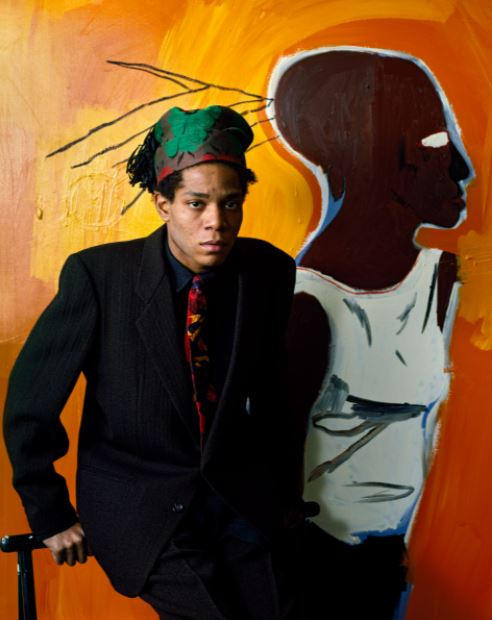
Photo: Evelyn Hofer/Getty Images. Artwork: © Estate of Jean-Michel Basquiat.
Licensed by Artestar, New York
Curator Dieter Buchhart has suggested that In This Case was created as a tribute to the young Black graffiti artist, Michael Stewart, who was badly beaten by the NYPD in September of 1983 after attempting to tag the New York City subway walls. Succumbing to his injuries, Stewart’s death was later memorialized by Basquiat in a series of paintings that would directly confront the issue of police brutality. ‘One thing that affected Jean-Michel greatly was the Michael Stewart story,’ said Keith Haring in 1988. ‘He was an artist. He looked much like Jean-Michel.’
As Basquiat continued to rise to near-mythic status throughout the 1980s, the looming skeletal effigy offered a poignant and prophetic memento mori — a dark harbinger of the artist’s own untimely end, on 12 August 1988 at age 27. Channelling his newly found fame and identity into his work, the skull took a predominant place among a number of figural forms from crowned kings to warriors. However, it is his anonymous and isolated human heads that triumph with their individual power.
Through these dynamic and commanding skulls, Basquiat, himself, ascends as an immortal legend. In contrast to the boxers and royals who held court in his paintings, here it is a hero of art — Jean-Michel Basquiat — who emerges triumphant.
In 2018, a groundbreaking Jean-Michel Basquiat retrospective at the Fondation Louis Vuitton, Paris, affirmed the artist’s status as a titan of the twentieth century. Included in the exhibition was In This Case (1983). Shown as part of a holy trinity of Basquiat’s “head” paintings, it joined two of his most iconic creations: Untitled (1981), from the collection of The Broad, Los Angeles, and Untitled (1982), which had sold in 2017 for more than $110 million, reaching what remains the highest price ever attained by an American artist at auction. With its blazing color, pyrotechnic vigor and explosive anatomical vision of the head executed on monumental scale, In This Case takes its place alongside these works as a talismanic masterpiece of Basquiat’s oeuvre.
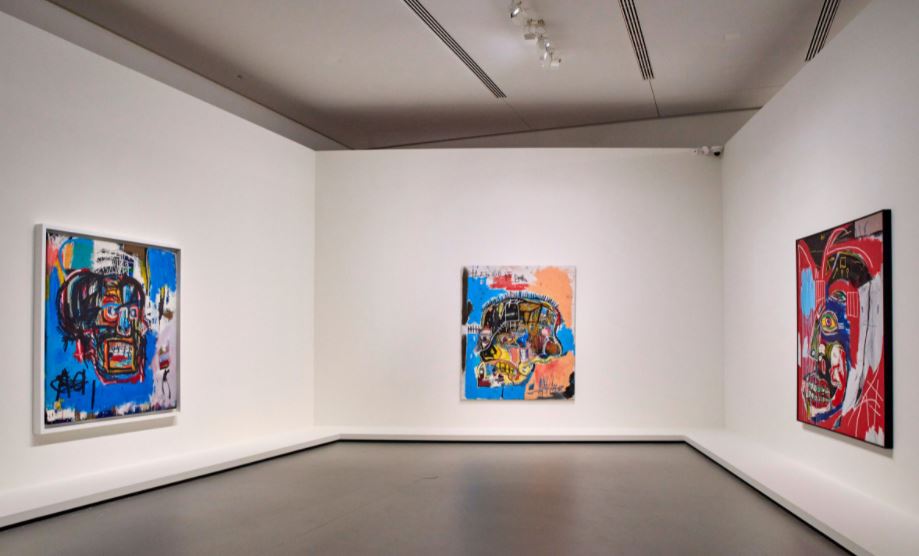
Prior to its exhibition at the Fondation Louis Vuitton, In This Case was shown in The Jean-Michel Basquiat Show at the Triennale de Milano in 2006, and starred in a major 2013 survey at New York’s Gagosian Gallery. As the punning title implies, the head is a “case”, a container; the “case” may also allude to the death of Michael Stewart, an African-American graffiti artist killed by New York police officers in September 1983. Inside its fractured, calligraphic, ruby-red framework, we see a blooming blue splash worthy of Cy Twombly, cog-like mechanisms, oilstick scrawls of white and yellow, and, at the center, an astonishing polychrome eye set, jewel-like, in a slick of midnight blue. Windows of raw canvas frame teeth and bone in luminous cross-section. From Renaissance anatomies to the primal gestures of Abstract Expressionism, Picasso’s Cubism and the vigor of contemporary street art, a chorus of impulses collide in this broken, brutal death’s-head of creative power. It meets our gaze with furious intensity.
While he was in hospital following a childhood car accident, Basquiat’s mother had given him a copy of Gray’s Anatomy. It helped him to understand his body as it healed, and later became a key touchstone for his art. Many of his figures reveal their bones, muscles and internal workings, as if dissected or seen through an X-ray. This gaze finds its most piercing expression in the image of the head: a charged, multivalent form in which Basquiat combined elements of portraiture, scientific drawing and the symbolic skulls of the vanitas still-life tradition. The Broad Museum’s Untitled of 1981 represents one of his earliest significant treatments of the motif and prefigures In This Case’s kaleidoscopic force. This “power and energy” only mounted as Basquiat completed his trio of heads over the following two years. In In This Case, the impact reaches fever pitch. Graphic rays, sparks and bolts of color erupt from the confines of the skull, igniting the canvas with light and heat; seismic swathes of scarlet flood the picture plane.
In 1983, at just twenty-two years old, Basquiat was an international star. He had held solo exhibitions in Los Angeles, Zurich, Rome and Rotterdam, and in October 1982 had become the youngest artist to show at Documenta VII in Kassel, among a line-up of contemporary masters including Gerhard Richter, Joseph Beuys and Cy Twombly. New York, however, remained the center of his life and art. The city was a furnace of visual and aural information where everything was available, and where the influences of Haitian voodoo and TV advertisements, Picasso and subway graffiti, the Old Masters and Andy Warhol alike could meet on equal footing. From downtown billboards to the treasures of the Metropolitan Museum, Basquiat poured images, ideas and words into his works, cataloguing and juxtaposing what he saw and heard. His shamanic approach captured the city’s energy at a time when the worlds of art, fashion, music, poetry and performance frequently overlapped. Basquiat himself performed in a noise band, dated Madonna, deejayed at nightclubs and, in the winter of 1983, collaborated on canvases with Warhol. He was at the beating heart of a thrilling cultural moment, and its joyous dynamism can be felt throughout his frenetic, richly polyvocal paintings.
In many of his major paintings, Basquiat portrayed his heroes. Black athletes—boxers such as Muhammad Ali and Joe Louis, and the baseball player Hank Aaron—joined jazz musicians including Charlie Parker, Miles Davis and Duke Ellington in a pantheon of personal worship, with their names repeated mantra-like across his canvases. They were men of incendiary talent, risen to positions of greatness despite the racism of American society. In his pictures, Basquiat blurred their identities with his own. He adorned them with haloes and crowns to celebrate their glory, calling on the angels, saints, messiahs and kings of art history. Yet these towering images were laced with vulnerability. Whether through rapacious promoters, personal demons or the bigotry of the industries in which they worked, Basquiat knew that many of his idols had been destroyed or burnt out by their fame: pressures he himself felt all too keenly. If many of his early self-portraits seem bedeviled by death, as the scholar bell hooks observes, even his hero-pictures are bruised and broken. “It is much too simplistic a reading”, she writes, “to see works like Jack Johnson (1982), Untitled (Sugar Ray Robinson) (1982), and the like, as solely celebrating black culture. Appearing always in these paintings as half-formed or somehow mutilated, the black male body becomes, iconographically, a sign of lack and absence … these figures have been worked down to the bone” (b. hooks, “Altars of Sacrifice, Re-membering Basquiat”, Art in America, June 1993). In This Case exhibits this same fragility. Like a mask cracking under pressure, it reveals an image in overdrive, a body on the verge of breakdown.
While shadowed by mortality, In This Case buzzes with the vitality of Basquiat’s own nervous system. His physical instincts zip feverishly across the canvas. “[Basquiat] constructs an intensity of line which reads like a polygraph report, a brain-to-hand ‘shake’”, writes Diego Cortez (D. Cortez, quoted in R. D. Marshall and J-L. Prat, Jean-Michel Basquiat, vol. 1, Paris, 2000, p. 160). These synaptic convulsions are played out in the volatile eloquence of Basquiat’s brushwork, which moves seamlessly between abstraction and figuration, the past and the present, the streets and the studio. “If Cy Twombly and Jean Dubuffet had a baby and gave it up for adoption it would be Jean-Michel”, Rene Ricard wrote in 1981. “The elegance of Twombly is there from the same source (graffiti) and so is the brut of the young Dubuffet” (R. Ricard, “The Radiant Child”, Artforum, Volume XX, No. 4, December 1981, p. 43). Both Twombly’s lyrical scrawl and Dubuffet’s vivid, primitivist figuration resound in In This Case. The work equally plays with the overlaid Cubist perspectives of Picasso—whom Basquiat both admired and sought to challenge, finding irony in his own “discovery” of African art through a European artist—and the exuberant, gestural paintwork of Abstract Expressionists such as de Kooning, Pollock and Rauschenberg. If Basquiat’s line is emotional, it is also critical, with a sharp eye on his own place among the masters.
Self-representation, if not self-portraiture per se, was central to Basquiat’s practice. Whether depicting himself directly or not, he stamped his work with an unambiguous black presence. The early work We Have Decided the Bullet Must Have Been Going Very Fast (1979-80) features the artist’s blood literally spilled on the page, and in 1981, with more than a hint of voodoo magic, he made a sculpture by adorning a painted football helmet with clippings of his hair. As a memorial to Michael Stewart and a statement of Basquiat’s own existence, In This Case is an image of beauty as well as pain. Occupying a space historically reserved for whiteness, it asserts a radical incursion into Western art, not unlike the ghostly “body prints” of David Hammons, or, in a more painterly vein, the black subjects of Kerry James Marshall. Like Basquiat, these artists move beyond the white gaze to depict African-American experience in all its variety, nuance and splendor. “The black person is the protagonist in most of my paintings,” Basquiat told the journalist Cathleen McGuigan in 1985. “I realized that I didn’t see many paintings with black people in them” (J-M. Basquiat, quoted in C. McGuigan, “New Art, New Money”, New York Times, February 10, 1985).
Beyond his anatomy books and his autopsies of art history, Basquiat’s attention to the head’s internal workings can be viewed as part of a broader interest in looking beneath the surfaces of the exterior world. In In This Case, he conjures a living, self-conscious picture of his own mind and his layered, multi-channeled cognition of reality at large: his treatment of the head is conceptual as well as pictorial, gazing both inward and outward. The painting’s brilliant complexity speaks to the process of an artist who sampled, organized and synthesized data from a dizzying array of sensory dimensions—movies, music, books, paintings, New York street life, his own memories—onto a single plane. Its cranial anatomy provides a structure on which Basquiat builds and improvises, like a jazz soloist riffing on an underlying theme. The mechanical elements make the head into a cyborg-like hybrid of man and machine, echoing the cogs, wheels and reels of recording equipment. Basquiat’s audiovisual intelligence whirs into life. The eye, the window to the soul, stares out from the picture’s fiery core.