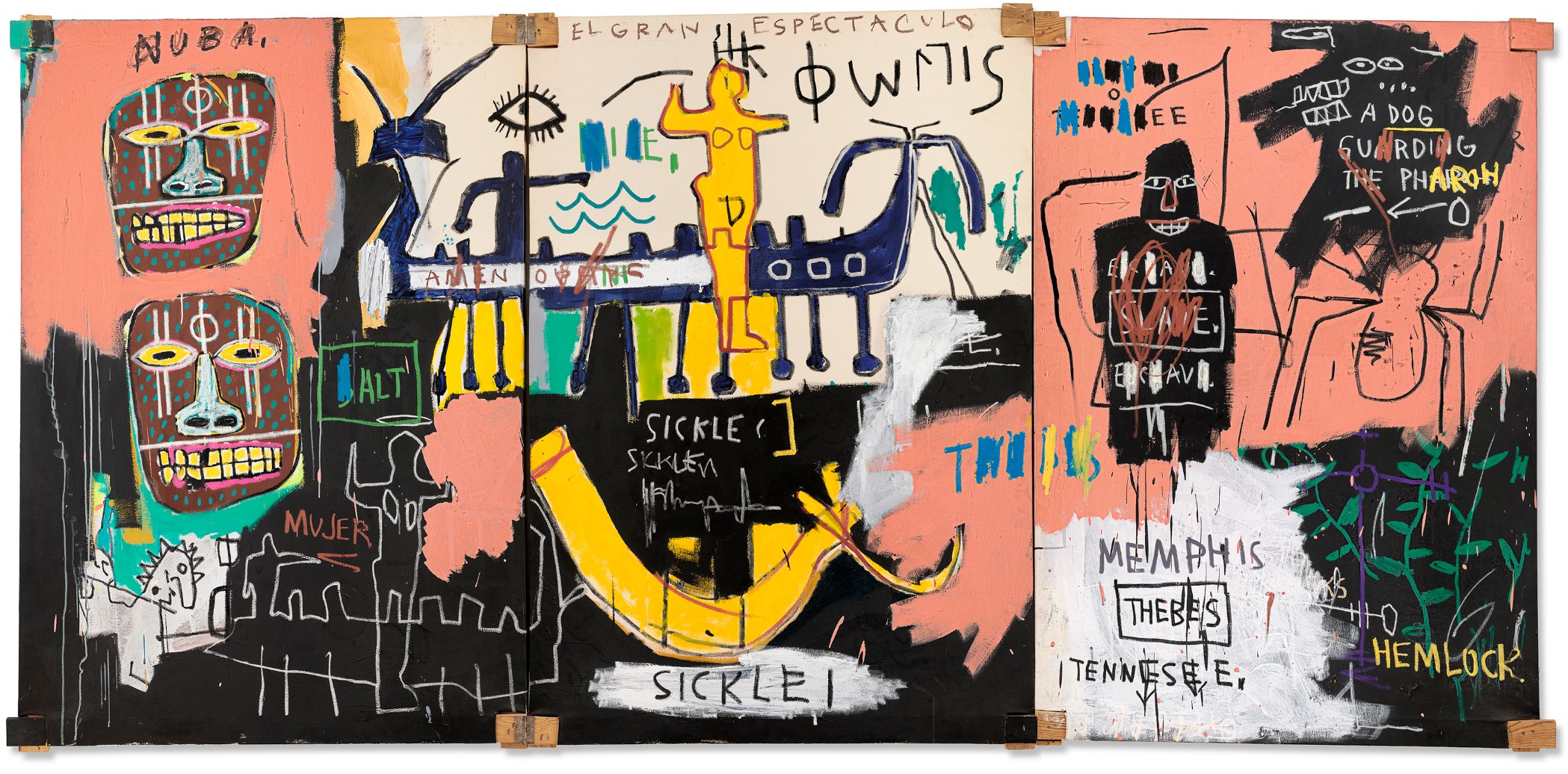
JEAN-MICHEL BASQUIAT (1960-1988)
El Gran Espectaculo (The Nile), 1983
Acrylic and oilstick on canvas mounted on wooden supports, in three parts
Overall: 68×141 inches (172.7 x 358 cm.)
Titled ‘EL GRAN ESPECTACULO’ (upper center)
Signed, titled and dated ‘“THE NILE” 1983 Jean-Michel Basquiat’ (on the reverse)
Provenance
Annina Nosei Gallery, New York
Enrico Navarra, Paris
Anon. sale; Sotheby’s, New York, 9 November 2005, lot 38
Acquired at the above sale by the present owner
Auction History
Christie’s New-York: 15 May 2023
Estimate On Request
USD 67,110,000
JEAN-MICHEL BASQUIAT (1960-1988) (christies.com)
Painted when the artist was just 22 years-old, El Gran Espectaculo (The Nile) stands as one of the most important paintings in Jean-Michel Basquiat’s short but explosive career. It is one of three large-scale canvases executed in 1983 in which the artist ambitiously and audaciously proclaims that his central concern from this point on is to use painting to address issues of representation within the grand theater of world history. Thus, the present work becomes Basquiat’s quintessential history painting, as across its highly animated surface an intoxicating array of signs and signifiers unlocks the history of the Black diaspora. From Ancient Egypt to present day America, Basquiat’s employs his unique visual language to chart the Black experience as part of Western Civilization. “

Previously owned by Enrico Navarra, a prominent collector of the artist’s work and the co-author of what is widely considered to be the most comprehensive catalogue of Basquiat’s paintings, El Gran Espectaculo (The Nile) is discussed at length in the wider scholarly literature on the artist. It has been exhibited in numerous critically acclaimed retrospectives including one organized by the Whitney Museum of American Art, New York in 1992 and the Brooklyn Museum of Art in 2006. Held in the same private collection for the past fifteen years, this is a rare opportunity to acquire one of Basquiat’s seminal works.
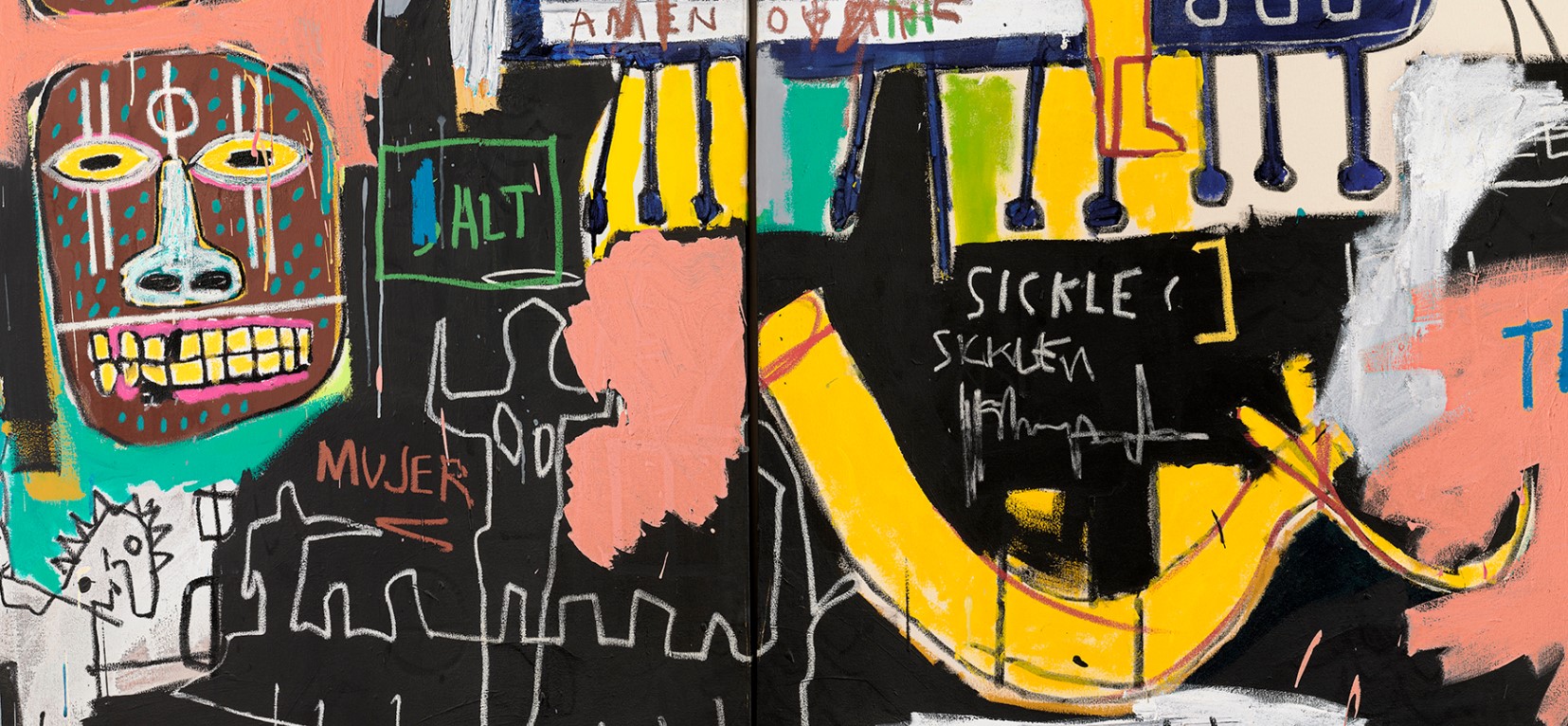
With the present work, Basquiat joins a distinguished group of artists who have confronted humanity’s darkest forces through the power of art. From Picasso’s Guernica to Francis Bacon’s 1944 painting Three Studies for Figures at the Base of the Crucifixion, and Andy Warhol’s Race Riot, artists have employed the visual and emotional resonance of art to process events which seem unfathomable. Yet what is remarkable about El Gran Espectaculo (The Nile) is that this highly complex and accomplished painting was completed by someone so young; Picasso was 56 years old when he executed his treatise on the horrors of the Spanish Civil War, Basquiat painted the present work when he was barely out of his teenage years. Across one of the artist’s hand-constructed canvases, Basquiat choreographs a heady arrangement of evocative graphic symbols, scrawled words, and painterly drips; all characteristic elements of his unique painterly language. Often painting late into—and through—the night, what at first appears to be a chaotic composition, is in fact a highly organized assembly of symbolic signifiers.
El Gran Espectaculo (The Nile) sits alongside other important paintings by the artist from this period that tackle issues of race and the Black experience. At a point in his life when his fame climbed ever higher, Basquiat remained keenly aware of his precarity as a young black man in the United States. His works reflected on the violence and injustice which continue to haunt American society to this day. Also in 1983, he completed a monumental painting called In This Case, which curator Dieter Buchhart has suggested is a tribute to Michael Stewart, a young African-American graffiti artist killed by police officers following his arrest at a subway station in September 1983. “One thing that affected Jean-Michel greatly was the Michael Stewart story,” fellow artist and friend Keith Haring worte, “… Suzanne [Basquiat’s ex-girlfriend] was now going out with Michael Stewart, who was a skinny black kid. He was an artist. He looked much like Jean-Michel” (K. Haring, quoted in D. McClinton, “Defacement: the tragic story of Basquiat’s most personal painting”, The Guardian, June 28, 2019). Stewart’s death sent shockwaves through New York’s creative scene. For Basquiat, the event brought the whole debate about race in America very close to home.
In addition to being a profoundly moving painting in narrative terms, the present work is also a highly accomplished painting technically. Another aspect of Basquiat’s often overlooked skills was his ability as a colorist. The artist deeply admired Jackson Pollock’s chromatic masterpiece Guardians of the Secret (1943, San Francisco Museum of Modern Art), in particular the way that Pollock used passages of color to conjure up figurative imagery. Just as El Gran Espectaculo (The Nile) is carefully constructed in compositional terms, the artist’s use of color as part of that structure is also important, as curator Marc Mayer notes, “…he used unmixed color structurally, like a seasoned abstractionist, but in the service of a figurative and narrative agenda….Basquiat deployed his color architecturally, at times like so much tinted mortar to bind a composition, at other times like opaque plaster to embody it. Color holds his pictures together, and through it they command a room” (M. Mayer, “Basquiat in History,” Basquiat, exh. cat., Brooklyn Museum of Art, 2005, p. 46.).
Painted in 1983, Basquiat’s work that year found favor with many influential critics who had been yearning for the return of ‘the expressive’ ever since the triumph of Minimalism in the late 1960s and 1970s. In Basquiat they found a new champion who clearly reveled in the joy of the artist’s hand. “What has propelled him so quickly,” extolled Lisa Liebmann in her Art in America review of Basquiat’s 1982 exhibition at Nosei’s gallery, “is the unmistakable eloquence of his touch. The linear quality of his phrases and notations…shows innate subtlety—he gives us not gestural indulgence, but an intimately calibrated relationship to surface instead” (L. Liebmann, quoted in M. Franklin Sirmans, ‘Chronology,’ in R. Marshall (ed.), Jean-Michel Basquiat, exh. cat., Whitney Museum of American Art, New York, 1992, p. 239). Although Basquiat died in 1988, when he was just 27 years old, his impact on the art world lasted far beyond his short career. Fifty years on, the legacy of Basquiat’s work has afforded the work of other established—but often overlooked—Black artists such as Kerry James Marshall, Robert Colescott, and Glen Ligon much greater visibility. Together, their work has reclaimed art history, and given a voice to those who have been silenced for too long.
El Gran Espectaculo (The Nile) is a justly important painting, both in terms of its physical scale and its intellectual scope. It reproduces the landscape of Basquiat’s lived experience with those who went before him. A ‘history painting’ in the true sense of the phrase, it stands as an encyclopedia of his masterly technique, his unique motifs, and his sophisticated understanding of history. Basquiat, never one to contradict himself, remained confident in his thematic decisions throughout his career, maintaining a steady focus on issues of identity, racism, classicism, culture, mortality, and street art. The result was that during his brief but turbulent career, he produced an outstanding body of work rich in highly expressive paintings which addressed both the artist’s own personal search for self-identity, and also his place in a wider history. In such an important oeuvre, El Gran Espectaculo (The Nile) sits at the very top.