KEITH HARING
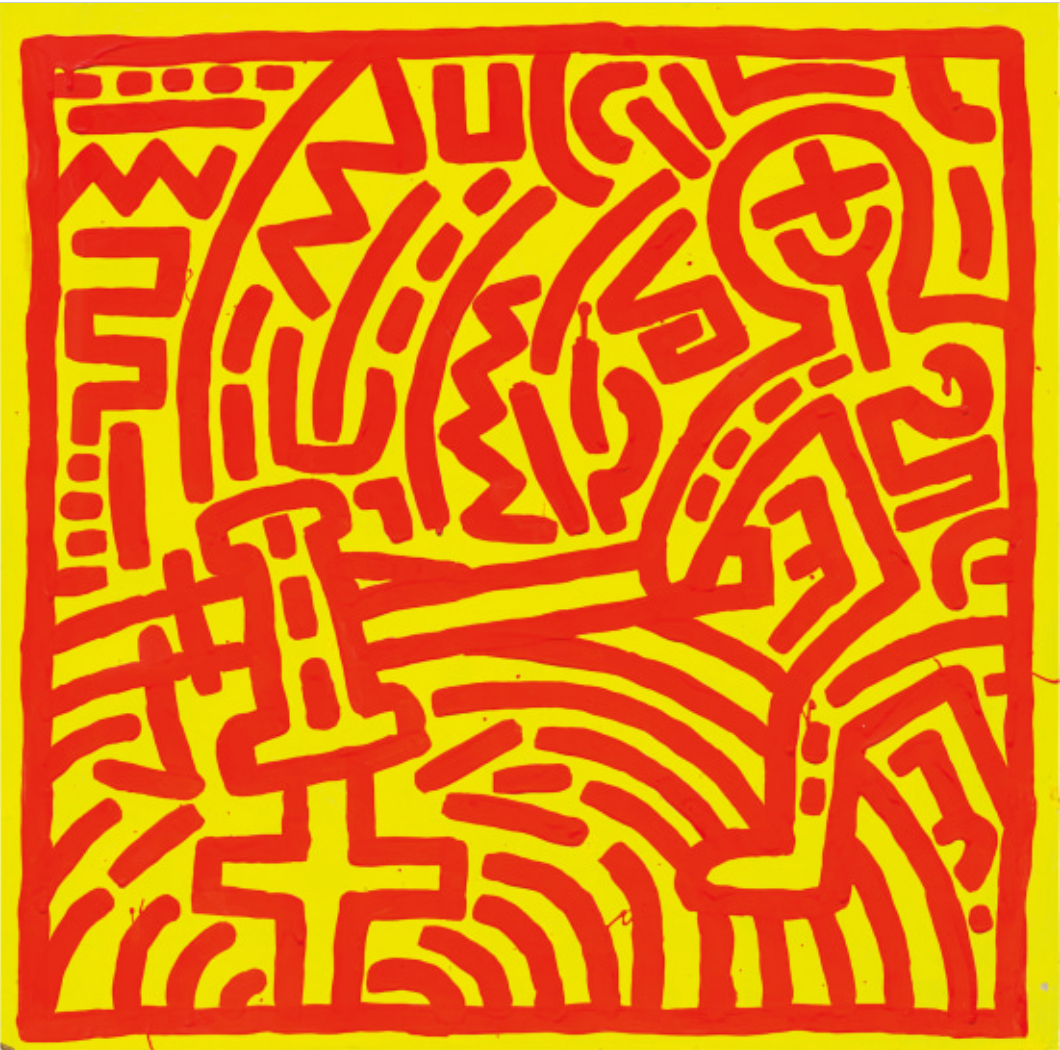
Untitled (For John Sex), 1982
Acrylic and Day-Glo on wood
23.2 x 23.2 inches (59.1 x 59.1 cm)
Signed, dedicated and dated “FOR JOHN SEX K. Haring JAN. 24, 1982 ⨁” on the reverse
Provenance
John Sex (gifted by the artist)
Private Collection, New York
Acquired from the above by the present owner circa 1987
Phillips New-York: 23 June 2021
USD 899,000
Source: Phillips
Keith Haring – 20th Century & Contempor… Lot 24 June 2021 | Phillips
Keith Haring’s Untitled (For John Sex) is an electric composition packed with vibrant color and energetic dynamism that was a personal gift to one of the artist’s closest friends, John McLoughlin, better known by his stage name, John Sex. The present work is rendered in Haring’s signature lexicon of symbols and cyphers and depicts a figure hammering a cross into the ground, perhaps a reference to Club 57—the critical locale that would nurture their careers as well as their close friendship. Created in January 1982, just months before Haring’s breakout inclusion alongside Jean-Michel Basquiat and Andy Warhol at documenta 7 in Kassel and his first solo show at Tony Shafrazi Gallery, the work encapsulates the vivacious energy of the 1980s New York art scene.
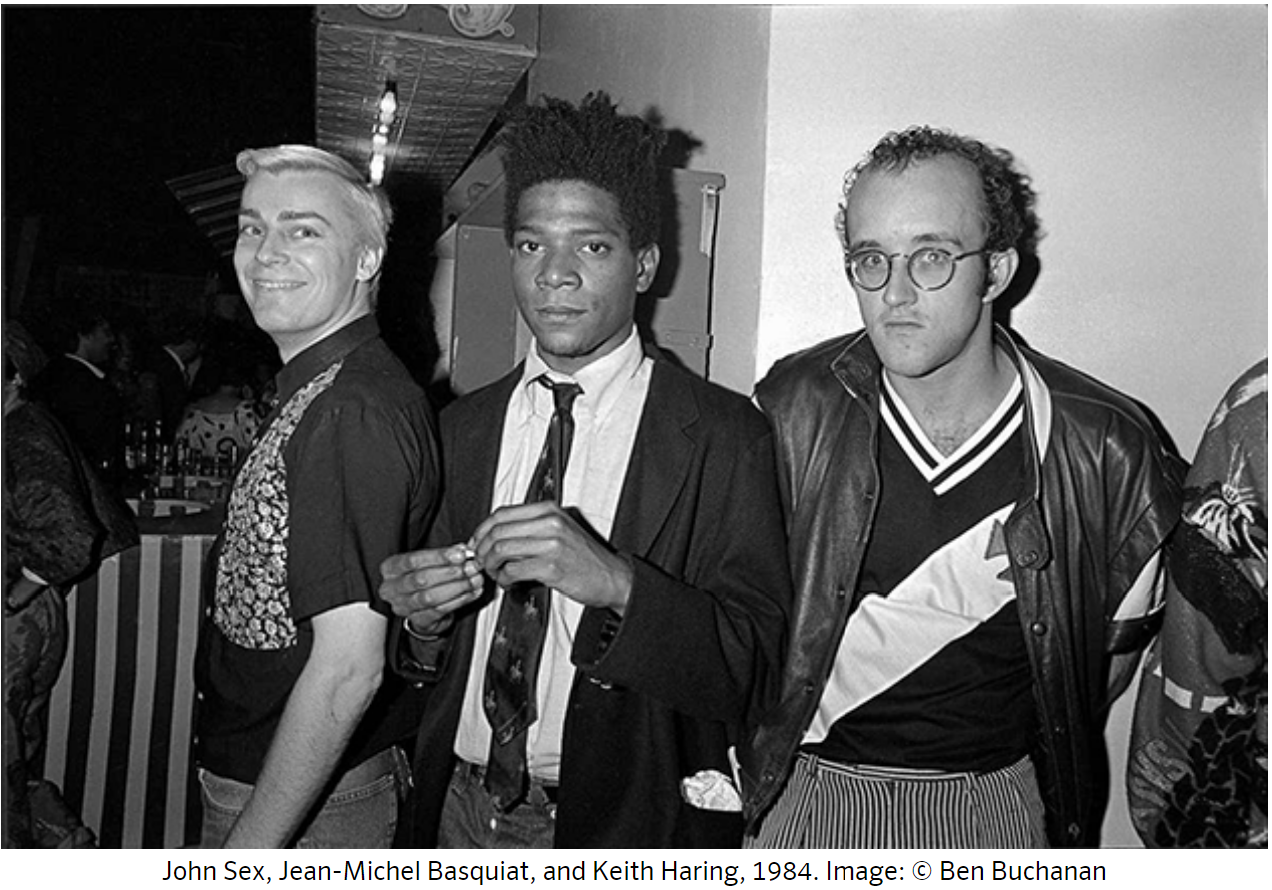
Haring moved to New York in the late 1970s after enrolling in the School of Visual Arts, where he met Kenny Scharf, Jean-Michel Basquiat, and John Sex, who studied graphic design at the school and later launched a successful career as a performance artist. On first meeting Haring, Sex recalled, “There was this little gallery space on the first floor, and Keith had painted it from floor to ceiling. I looked at it and said, “This person is really doing something!” Although Sex “had achieved a reputation as the leading poster artist of the East Village” by the summer of 1980, he “got sick of doing posters for other people….I started making posters of myself and putting them on the street.” That same summer, Sex and Haring made 500 Xerox posters for Gay Pride Week and posted them around the city, just before Haring took his drawings to the streets and subways of New York that fall. That same summer, Sex also collaborated with Basquiat, creating a painting that Basquiat frisbeed into the street, on which Scharf reflected, “Jean-Michel was making a painting with John Sex, and they made this wet oil painting and cars were driving over it – it was so cool and punk rock.”
“[Club 57] became the neighborhood hangout….We hung out there almost every night, and it could get pretty wild.”
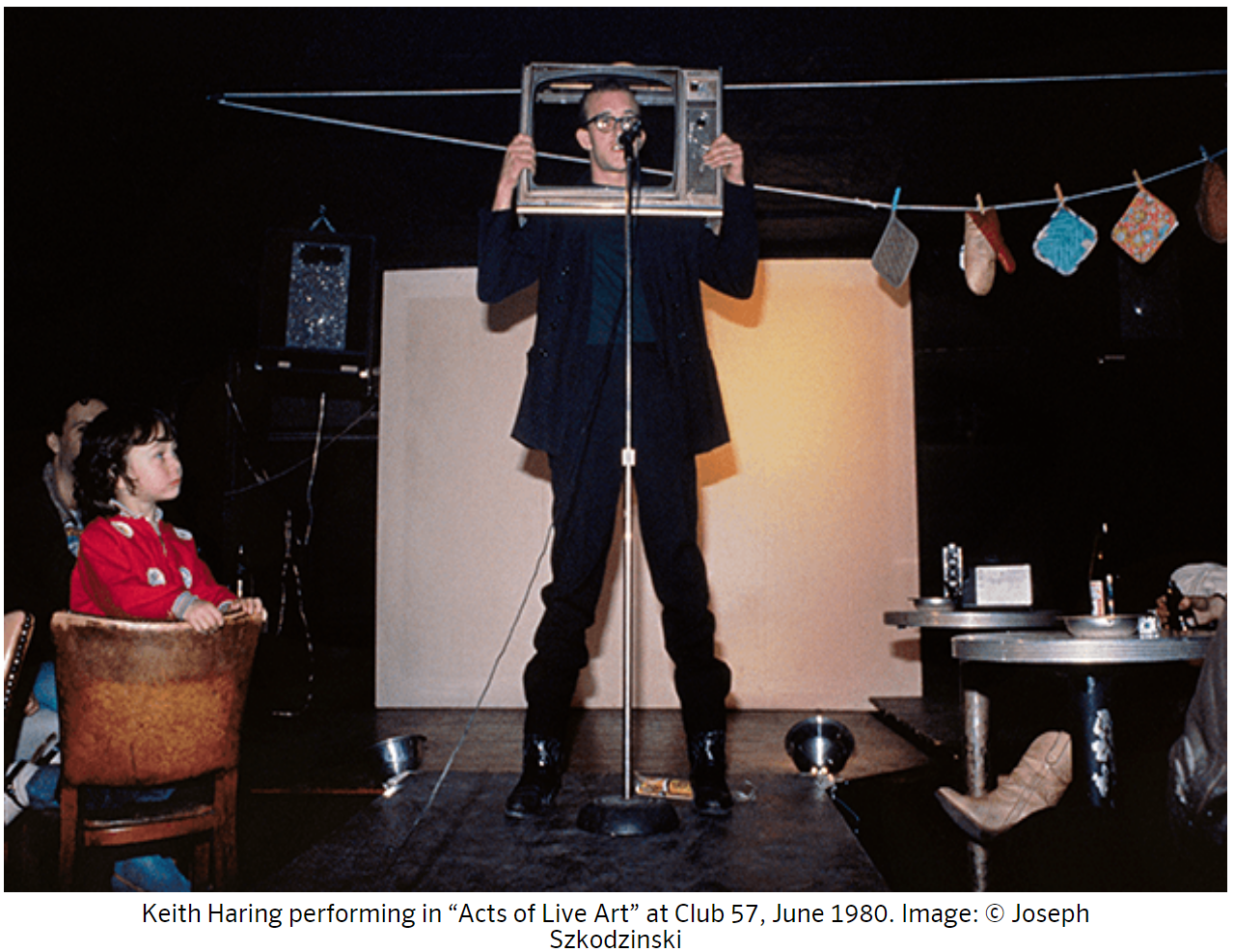
Their time at the SVA proved to be a period of prolific experimentation that matched the fever of artistic activity prevalent in the East Village. As the downtown nightclub scene blossomed with the appearances of the Mudd Club, Danceteria, and particularly Club 57, Haring and his contemporaries began dominating New York’s underground creative communities where artists and intellectuals banded together in decadent parties exploring sexual liberation, psychedelics, and artistic freedom. Located at the basement of a church on St. Marks Place in the East Village, Club 57 transformed from religious property to a hedonistic temple home to creative activity by the rising artists of the ‘80s. Haring curated erotic Day-Glo art shows and other visual arts exhibitions at Club 57, which would lead to his studio residency with P.S. 122 and his later curated shows at the Mudd Club. Haring recalled, “Club 57 not only meant dancing and drinking and sex and fun and craziness, but the beginning of a whole career as the organizer and curator of some really interesting art shows.” Sex became famous for his sensational performances at Club 57 and “went on from the club to become one of downtown’s leading men, performing […] at bigger clubs like Danceteria, the Saint, and Limelight.” He also produced dynamic silkscreen posters for club events and organized the club’s most pivotal event series, “Acts of Live Art,” in which Haring performed permutation poetry while holding a television cutout.
Despite its short-lived existence between 1979 and 1983, Club 57 was “the louche headquarters for a now-legendary art movement,” drawing in the likes of Futura 2000, Klaus Nomi, Frank Holliday, Madonna, and other creative spirits. On the club’s significant impact, Jenny Schlenzka observed that “the compressed event calendar and closely packed space generated a creative pressure cooker, bringing together some of the generation’s most imaginative young artists and offering them opportunities to make new work collectively, and in front of supportive audiences, night after night.” Imbued with personal resonance and the explosive vitality of New York’s notorious underground arts community, Untitled (For John Sex) captures the ebullient world of Haring’s milieu.