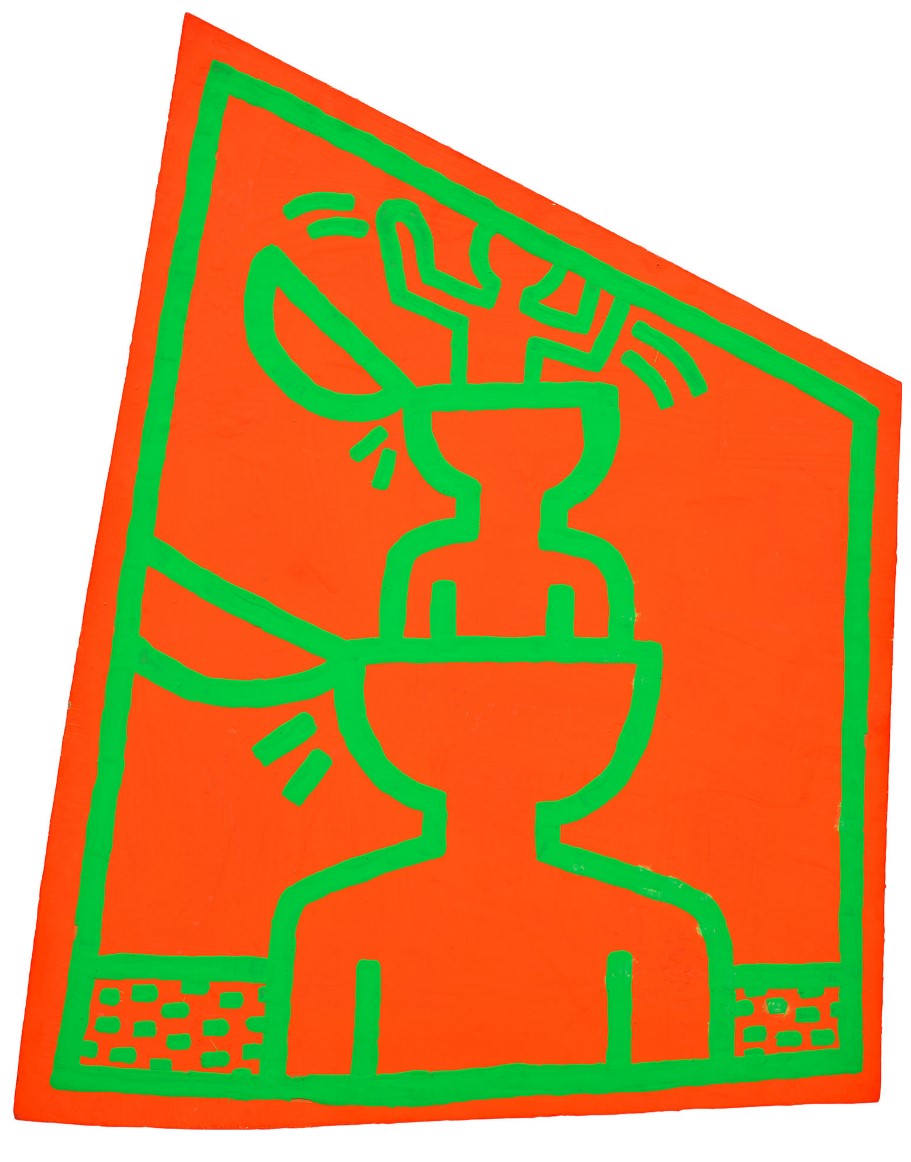
KEITH HARING
Untitled, 1982
DayGlo paint on wood
32×25 inches (81.3 x 63.5 cm)
Signed and dated “K. Haring SEPT. 1 1982 ⨁” on the reverse
Provenance
Tony Shafrazi Gallery, New York
Per Skarstedt Fine Art, New York
Christie’s Private Sales, New York
Acquired from the above by the present owner
Auction History
Phillips New-York: 16 May 2023
Estimated: USD 600,000 – 800,000
USD 952,500
Keith Haring – 20th Century & Contempor… Lot 116 May 2023 | Phillips
Representative of Keith Haring’s signature practice, Untitled, 1982 explores the interplay of graffiti and fine art, a juxtaposition which defined the artist’s practice. Through his signature use of symbolic hieroglyphs to create his own unique visual vocabulary, the present work contains playful motifs on a shaped, Plywood support rendered in fluorescent DayGlo.
“It was first when I started to draw images which could be read as signs that I went into public space. Because these paintings made sense in the streets – all people, all languages could read them. After studying the theory of communication, information and drawing and how meaning speaks through signs and how this language – because that’s what it is – works – I chose a primitive code.”
Featured in Haring’s groundbreaking, first solo exhibition at Tony Shafrazi Gallery in the same year 1982, the present work and others in the show cemented Haring’s place within popular culture and the vibrant downtown New York art scene. As if resembling a nightclub, the works were presented under ultraviolet light, popping off the striped wallpaper, and the opening was soundtracked by a hip hop DJ. This important exhibition served as a jumping off point in Haring’s career, and would soon solidify his place as one of the premier artists in the 20th century. In addition to the Shafrazi exhibition, the present work has been exhibited in major exhibitions at the Museé d’Art Moderne, Paris, The de Young Museum, San Francisco, Tate Liverpool, the UCCA Center for Contemporary Art, Beijing, and more.
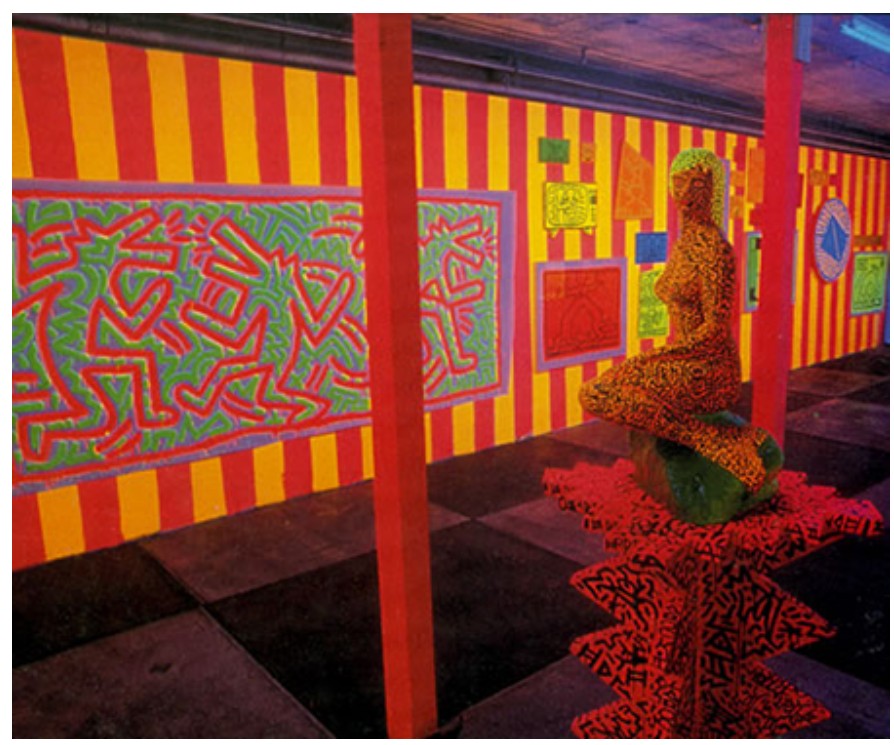
The present work installed at Keith Haring, Tony Shafrazi Gallery, New York, 1982
Throughout the early part of the 1980s, Haring consistently relied on found objects as his chosen supports. Utilizing otherwise discarded elements that he would gather from New York’s streets, Haring gave the objects a new life and meaning. The irregularly-shaped Plywood on which the present work was painted is emblematic of this. This act of taking a usually discarded piece of wood and using it as an art object mimics the ideas put forth by Marcel Duchamp in the early 20th century.
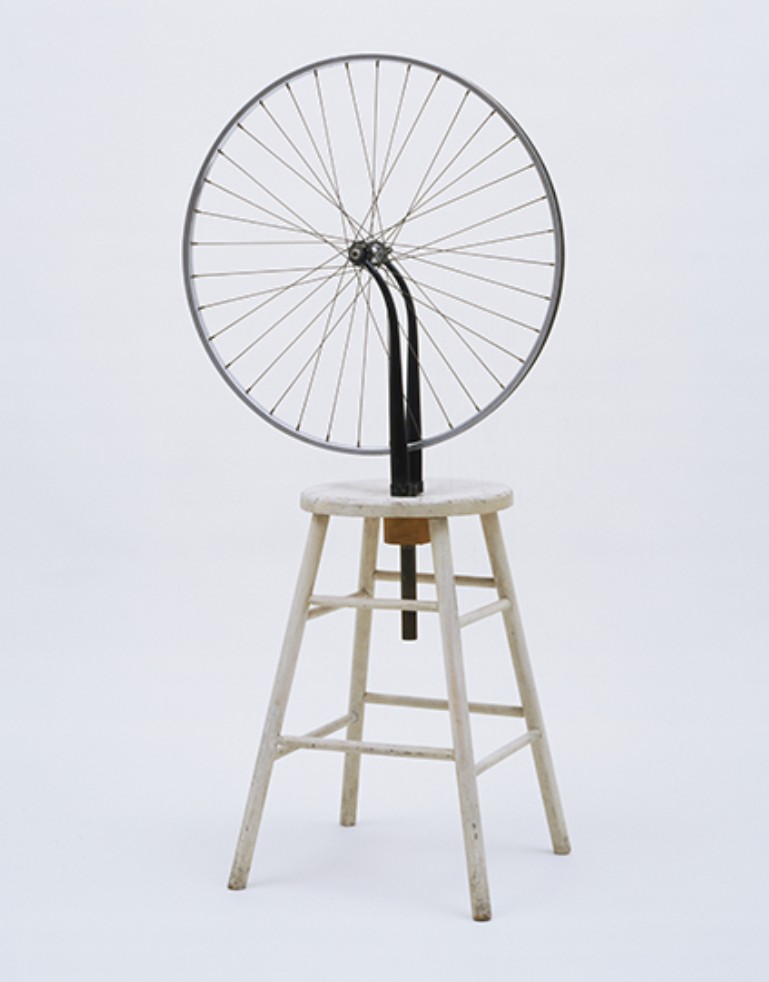
Marcel Duchamp, Bicycle Wheel, 1951, The Museum of Modern Art, New York. Image: © The Museum of Modern Art/Licensed by SCALA / Art Resource, NY, Artwork: © 2023 Artists Rights Society (ARS), New York / ADAGP, Paris / Estate of Marcel Duchamp
Exploring an unconventional style of artmaking, Duchamp removed mass-produced, commonplace items from their intended settings and elevated them to the status of fine art. This notion undoubtedly inspired Haring, who decades later used found materials to function as his own kind of readymades. Almost all of Haring’s early works from this period were done on such supports, ranging from wood, to tarps and pots, which he chose over canvas—something he would not use until around 1985.
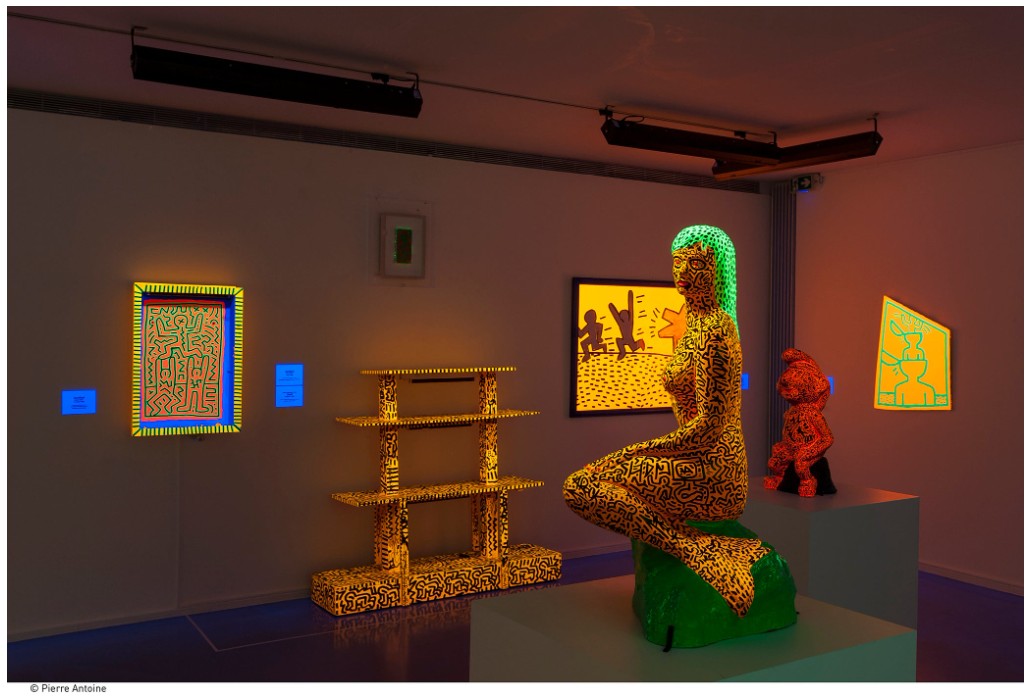
The present work installed at Keith Haring: The Political Line, Musée d’Art Moderne, Paris, 2013
Developing an interest in semiotics, or the study of signs, while a student at the School of Visual Arts, New York, Haring was fascinated with the ways in which different cultures used symbols to communicate. Though seemingly simple upon first look, Haring’s motifs and images “reveal an intense emotional backdrop to his creative energy with recurring themes of love, sex, compassion, fear, birth and death.” Using symbols resembling hieroglyphics, the present work represents Haring’s preoccupations with different systems of language and representation. With simplified, almost primitive lines to render his figures, Haring seems to disguise his signs among the playful and energetic backgrounds that he chooses.
“I am intrigued with the shapes people choose as their symbols to create language. There is within all forms a basic structure, an indication of the entire object with a minimum of lines, that becomes a symbol. This is common to all languages, all people, all times.”
One such sign, the stacking doll motif, is depicted in Untitled. Drawn to the brightly colored, hand-painted Matryoshkas, Haring interprets the motif as signifying change, transition and transformation. Such an interpretation was not unusual for the artist – the reference to and call for change consistently appears throughout Haring’s practice. Identifying the dolls as almost talisman-like, Haring imbues the symbol with a deeper meaning, and would use this motif repeatedly throughout his career.
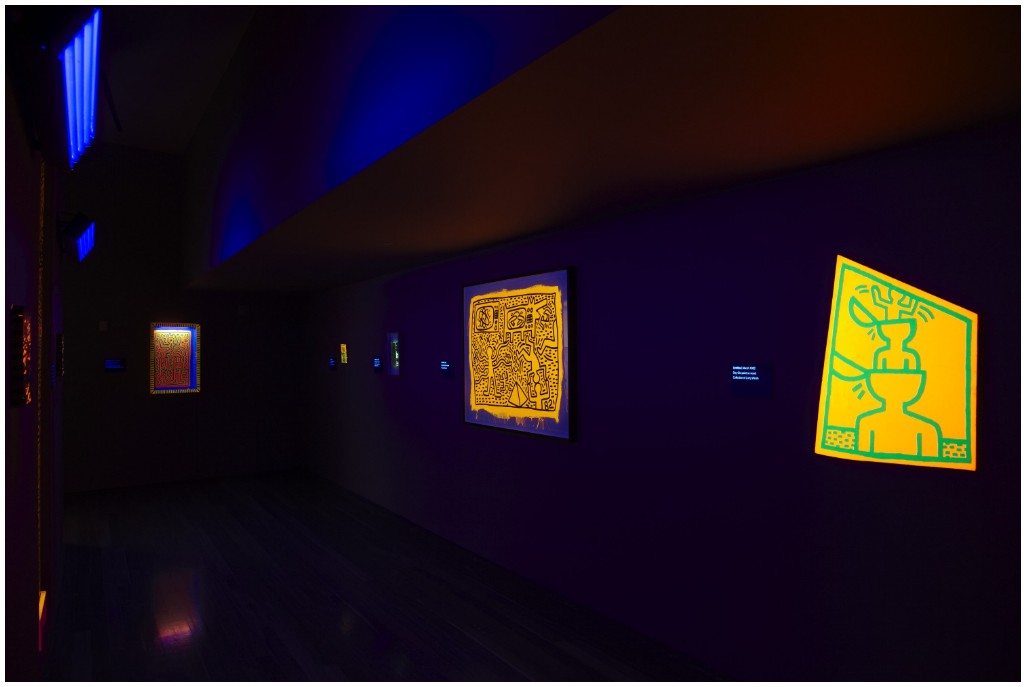
The present work installed at Keith Haring: The Political Line, The de Young Museum, San Francisco, 2014
Inspired by the “energy and dynamism he had witnessed in the streets,” Haring used DayGlo paint to depict Untitled’s coded composition. Frequently used in club interiors, DayGlo fluoresces brightly under both ambient and ultraviolet light. Further bridging the gap between art and popular culture, the vibrant green and orange hues in the present work brings a dynamic element to an otherwise flat composition. The figures seem to jump off the face of the wooden support, giving the work an energetic, almost three-dimensional quality, achieved with the use of this luminous paint. This effect is furthered with the artist’s quintessential use of rhythmic, cartoonish lines surrounding forms to suggest their movement.
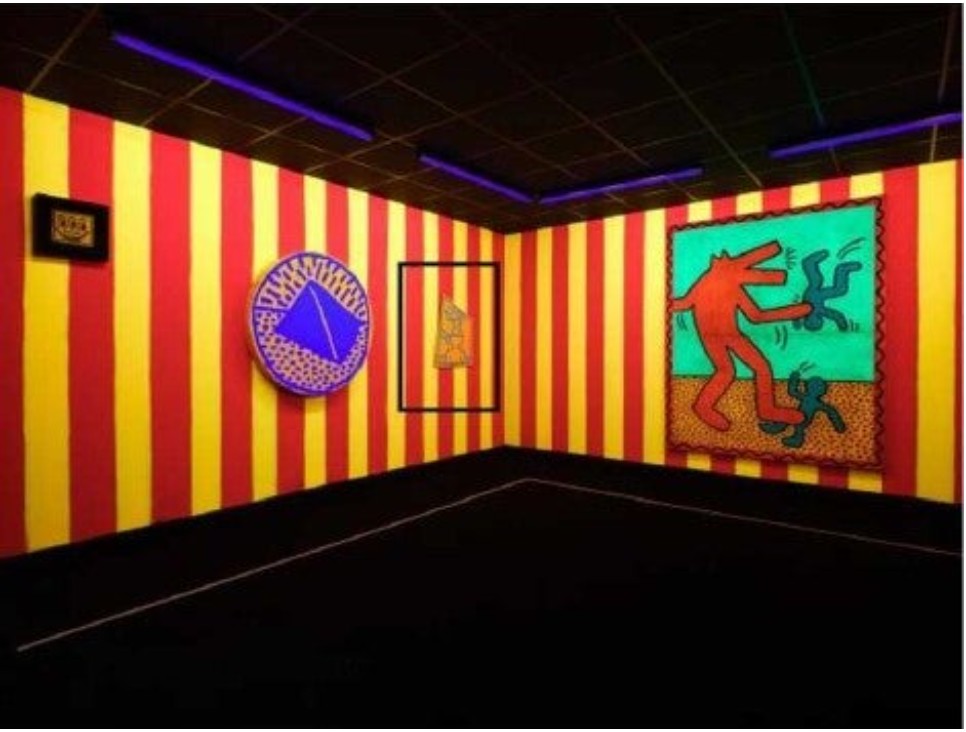
The present work installed at Keith Haring, Tate Liverpool, 2019
The use of these forms on a DayGlo surface would persist throughout his practice; Haring would go on to curate exotic DayGlo art shows at Club 57 and other venues in downtown Manhattan. This connection with the New York scene is evident in his work and exaggerated with Untitled’s vibrancy. Other DayGlo paintings can be found in such esteemed museum collections as the Art Institute of Chicago, the Broad Foundation, Los Angeles and the Keith Haring Foundation, New York.