KEITH HARING
Untitled, 1982
Baked enamel on metal
43×43 inches (109.2 x 109.2 cm)
Signed, inscribed and dated “K. Haring SEPT. 26-27 1982 ⨁” on the reverse
Provenance
Tony Shafrazi Gallery, New York
Private Collection (acquired from the above)
Sotheby’s, New York, November 15, 2006, lot 627
Private Collection
Sotheby’s S|2 Gallery, New York
Acquired from the above by the present owner in 2012
Auction History
Phillips New-York: 19 November 2024
Estimated: USD 1,500,000 – 2,000,000
USD 2,238,000
Keith Haring – Modern & Contemporar… Lot 10 November 2024 | Phillips
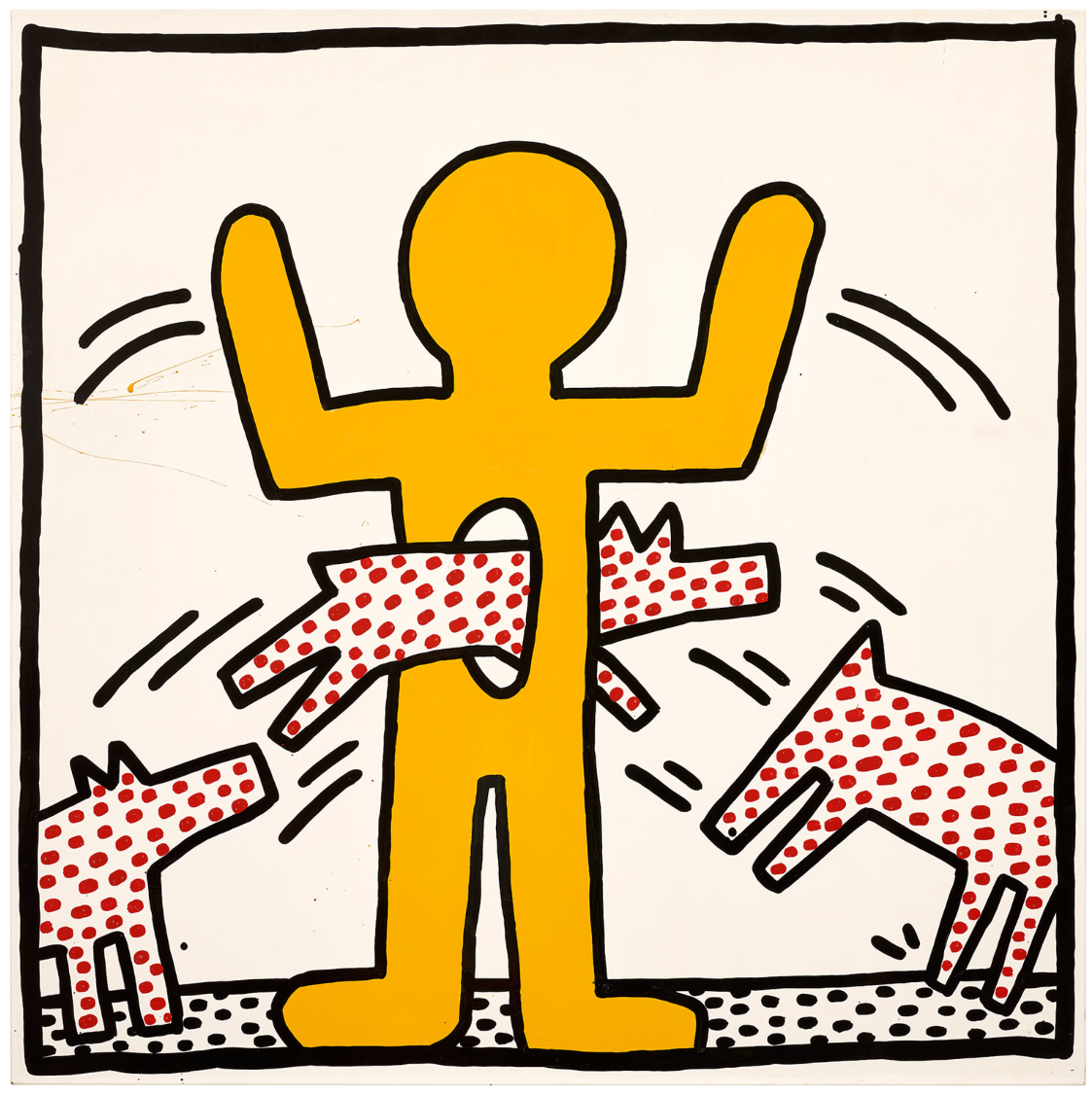
Keith Haring’s Untitled, 1982, vividly encapsulates his unique fusion of street art and high culture, capturing the electric energy of New York City’s early 1980s art scene. Created during his breakthrough year, this work—executed in baked enamel on metal—evokes the DIY spirit, punk exuberance, and transience of Haring’s public murals and subway art while embodying his iconic style and socially resonant themes. The present work premiered in Haring’s first solo exhibition at the Tony Shafrazi Gallery in 1982, a historic event that launched his career and solidified his status as a leading voice in contemporary art.
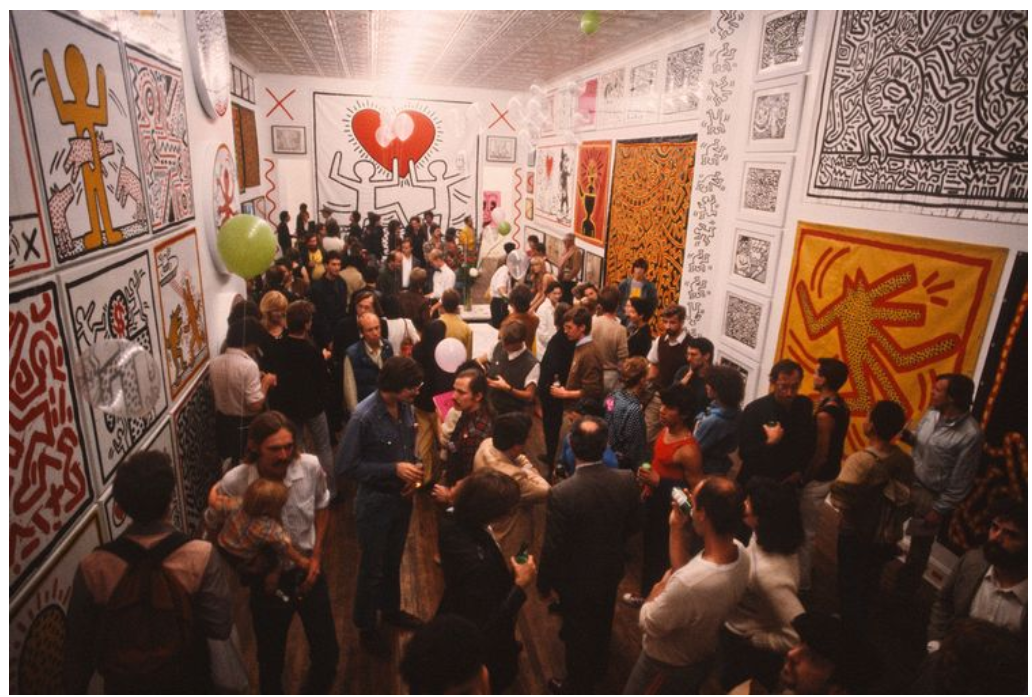
The present work installed at Tony Shafrazi Gallery, New York in October 1982. Image: Allan Tannenbaum, Artwork: © Keith Haring Foundation
Haring’s use of nontraditional materials, along with his iconic dog motif—an evolving figure rooted in his early graffiti tags and central to his visual language—establishes a direct connection to his roots as a street artist, while the bold colors, scale, and dynamic forms exemplify his transition into the gallery space. The composition’s importance to Haring is further evidenced by his revisiting of the theme across formats, including another work from the same year rendered on a massive 12-by-12-foot vinyl tarpaulin. Since its debut, Untitled has been exhibited globally in major retrospectives of Haring’s work at institutions including the Albertina Museum in Vienna, Tate Liverpool, and the National Gallery of Victoria in Melbourne. Most recently, the painting featured in the landmark exhibition Keith Haring: Art is for Everybody, which opened at The Broad in Los Angeles in May 2023 and toured to Toronto before concluding at the Walker Art Center in Minneapolis this fall. Through its bold expression and global exhibition history, Untitled continues to resonate as a testament to Haring’s ability to transcend boundaries and convey profound social messages through a universally accessible visual language.
“I am intrigued with the shapes people choose as their symbols to create a language.”
Beginning in the winter of 1980, Haring began using graffiti as a way to communicate publicly. He tagged these works with a pictograph that started as a general animal form but soon morphed into a recognizable dog, which he continued to use as his signature throughout his career. As he explained, “The way it began was to draw my tag… So my tag was an animal, which started to look more and more like a dog.”1 This symbol became one of his most important icons, appearing alongside the “radiant baby” as a reflection of both Haring’s persona and his response to the social and cultural issues around him. With time, the dog motif became a central element through which Haring explored themes of power, authority and social dynamics.
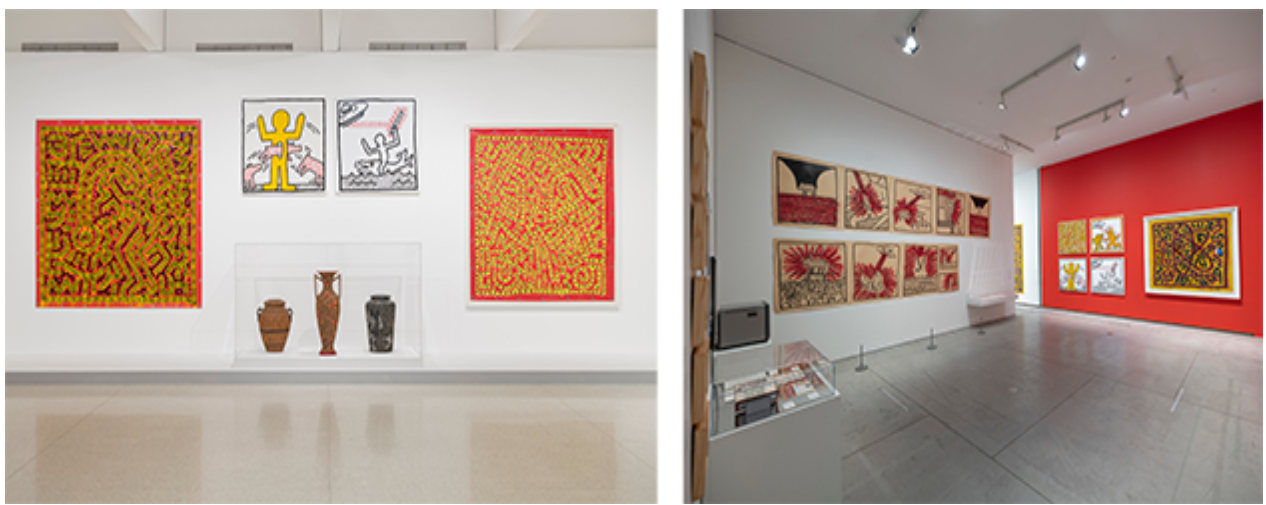
[Left]The present work installed at the Walker Art Center from April 27 – September 8, 2024.
[Right] The present work installed at the AGO Toronto from November 11, 2023 – March 17, 2024. Image: Tracey Owusu, © AGO Toronto, Artwork: © Keith Haring Foundation.
Haring often depicted his dogs barking, with open mouths and alert stances, which imbued them with a primal sense of urgency and defiance; an emblem of resistance, embodying the chaotic energy of urban life. In Untitled, however, Haring shifts this portrayal, presenting the dogs with closed mouths—a choice that introduces a contemplative layer to their presence. The silent dogs in this painting imply a restrained power, a silent vigilance that contrasts with the more overt aggression of Haring’s barking dogs. This nuanced transformation imbues the dogs with a dual nature, one that speaks to the latent, unspoken forces of authority and control in society. These dogs do not need to bark to exert influence; their mere presence—emphasized by their red-dotted bodies—commands attention and adds a layer of tension to the composition. By shifting the dogs’ expression from loud to quiet, Haring explores the idea of power that is felt rather than heard, underscoring the pervasive and often invisible pressures exerted by social forces on the individual.
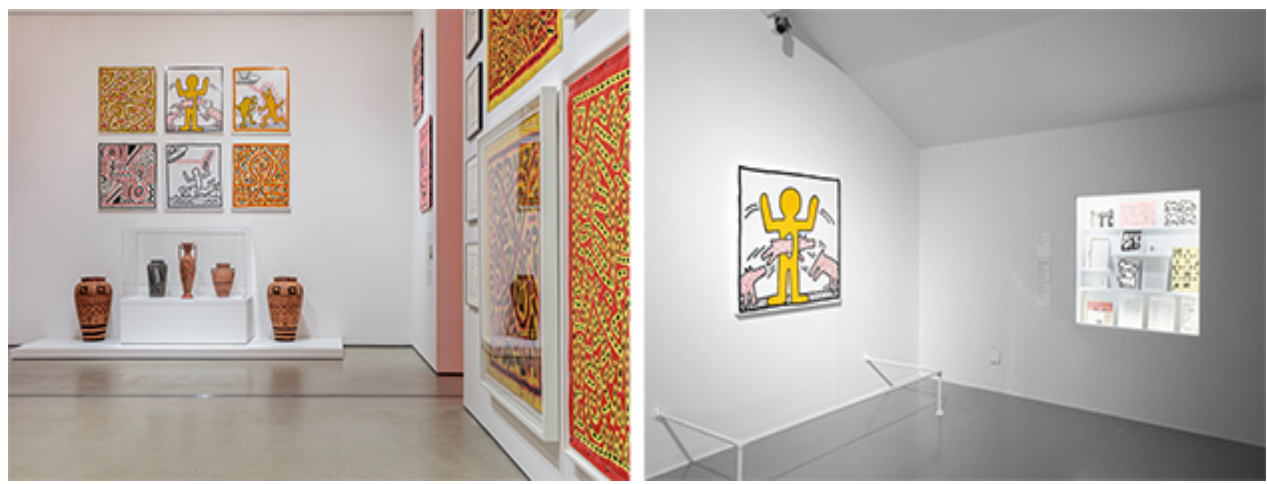
[Left] The present work installed at The Broad, Los Angeles from May 20 – October 8, 2023. Image: The Broad, Los Angeles, Artwork: © Keith Haring Foundation.
[Right] The present work installed at Tate Liverpool, London from June 14 – November 10, 2019.
Haring’s dog figures in Untitled also recall the Egyptian god Anubis, who guarded the dead, adding another layer of meaning. His interest in Egyptian hieroglyphics influenced his creation of a universally resonant visual language, where his dogs serve as modern-day symbols that bridge past and present. In evoking Anubis, these silent, watchful dogs transcend their immediate form to embody a protective, almost mythic authority, imbuing the painting with themes of guardianship and transformation. Haring’s use of baked enamel on metal in Untitled reflects his commitment to pushing the boundaries of conventional art-making by incorporating textures and materials from the urban environment into his gallery paintings. Moving beyond canvas, Haring painted on unconventional surfaces like wood, found objects, and fiberglass clay vases, blending his signature line work and characters with traditional vase motifs to create “an ironic mixture of opposites” that merged historical painting traditions with his contemporary style and themes.
“I had an aversion to canvas. I always felt I would be impeded by canvas, because canvas seemed to have a certain value before you even touched it.”
Through his rejection of traditional materials, Haring was able to preserve the immediacy and accessibility of his street art, even as he adapted his practice for gallery spaces. In Untitled, the central figure with a gaping hole in its torso and the three red-dotted dogs starkly embody themes of vulnerability, otherness, and the impacts of social marginalization. The hollowed torso signifies a profound absence or wound, addressing the collective trauma tied to pivotal events like John Lennon’s murder—a tragedy that deeply impacted Haring and marked his generation—and the early years of the AIDS crisis. This form first emerged in Haring’s work after Lennon’s death, which he recorded in his diary as a moment of profound loss, later translating it into a recurring motif that expressed a sense of emptiness at the heart of humanity.
“It was December 1981 when the body image actually came. I was working at the Mudd Club and someone came in and told people that John Lennon had just been shot, which was a traumatic, incredible moment for New York and for everyone… I woke up the next morning with this image in my head of the man with the hole in his stomach. I had drawn the dogs before, and I had drawn the man with the hole, but I had never put them together. I woke up with that burning image in my head and did drawings of it and from then on associated that image with the death of John Lennon.”
The red dots on the dogs add further complexity, symbolizing the physical markers of illness, specifically AIDS, while also evoking broader social stigmas. The dots connect to a visual language seen in both art and popular culture, such as the Pointillism of Georges Seurat and Yayoi Kusama’s polka dots, which explore infinity, mental health, and other facets of otherness. By incorporating these red dots, Haring infuses his dogs with layered meaning, transforming them into symbols of both physical vulnerability and social isolation. The interaction between the hollow figure and the dotted dogs in Untitled underscores Haring’s ability to create symbols that operate on multiple levels. These silent dogs, leaping through the void in the hollow figure, convey the invisible pressures exerted by society on personal identity, sometimes hollowing out the individual. Through these layered symbols, Haring explores themes of resilience, vulnerability, and the ongoing struggle for visibility and acceptance within a society marked by prejudice and fear.
Executed in 1982, just as the AIDS epidemic began to haunt and take hold of New York, Untitled captures the era’s pervasive fear as rumors spread of a “gay-related immunodeficiency disease” (GRID) ravaging communities. The unpredictable assault of AIDS, both absurd and fatal, is allegorically represented by the central figure consumed by an intangible, destructive energy, symbolizing how the epidemic intruded bodies and devastated lives without warning. Haring’s portrayal of this visceral struggle underscores his sensitivity to the vulnerabilities of marginalized communities—particularly LGBTQ+ individuals—who were disproportionately affected and stigmatized during the crisis.