KEITH HARING (1958-1990)
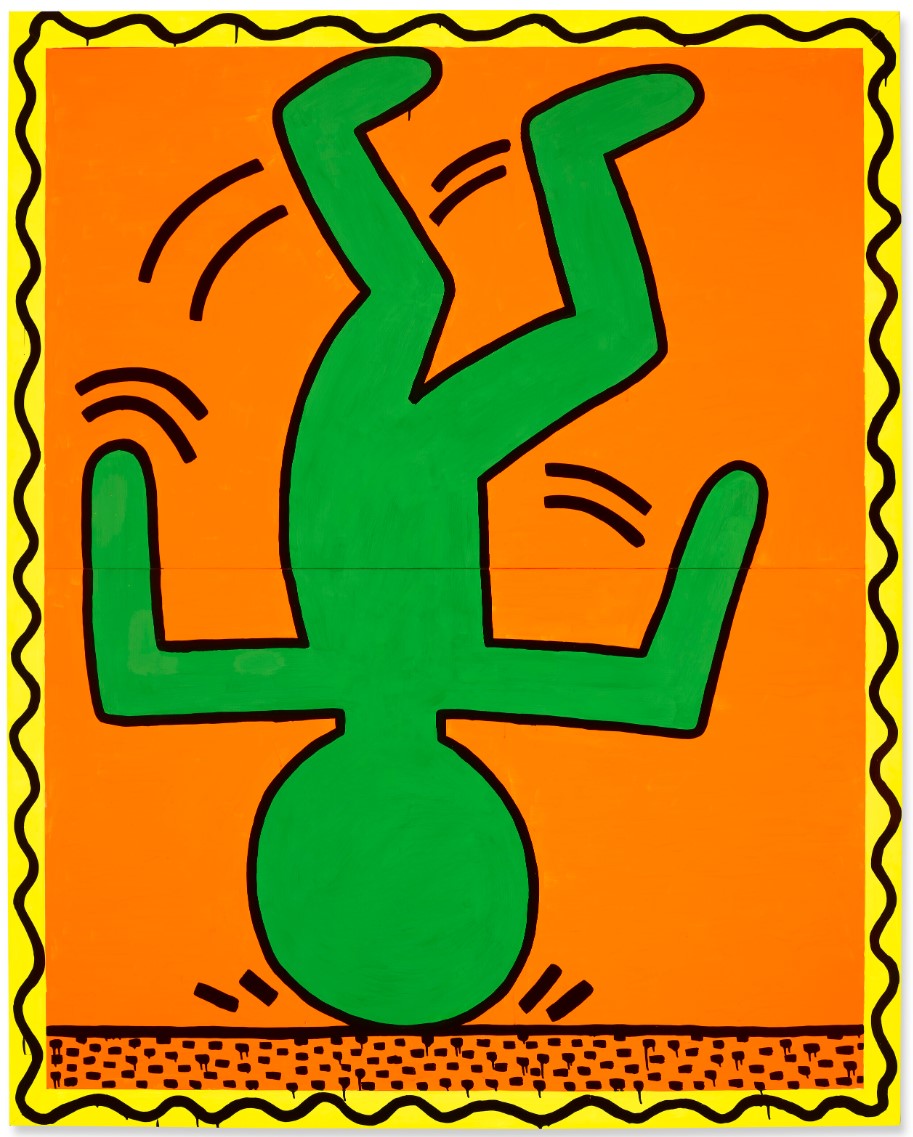
Untitled, 1982
Enamel and DayGlo on metal, in artist’s painted frame
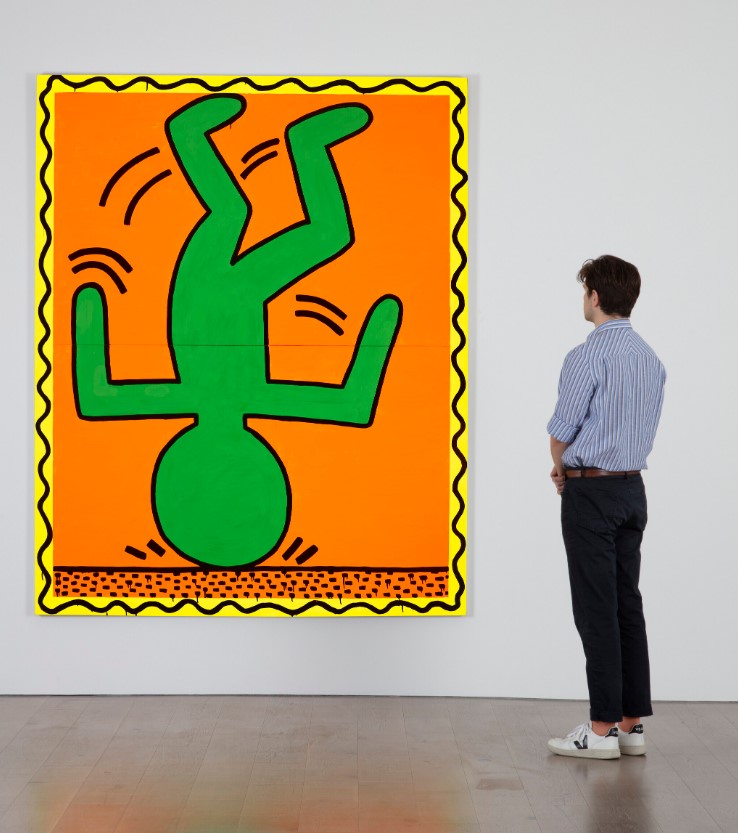
90 1/4 x 72 inches (229.2 x 182.9 cm)
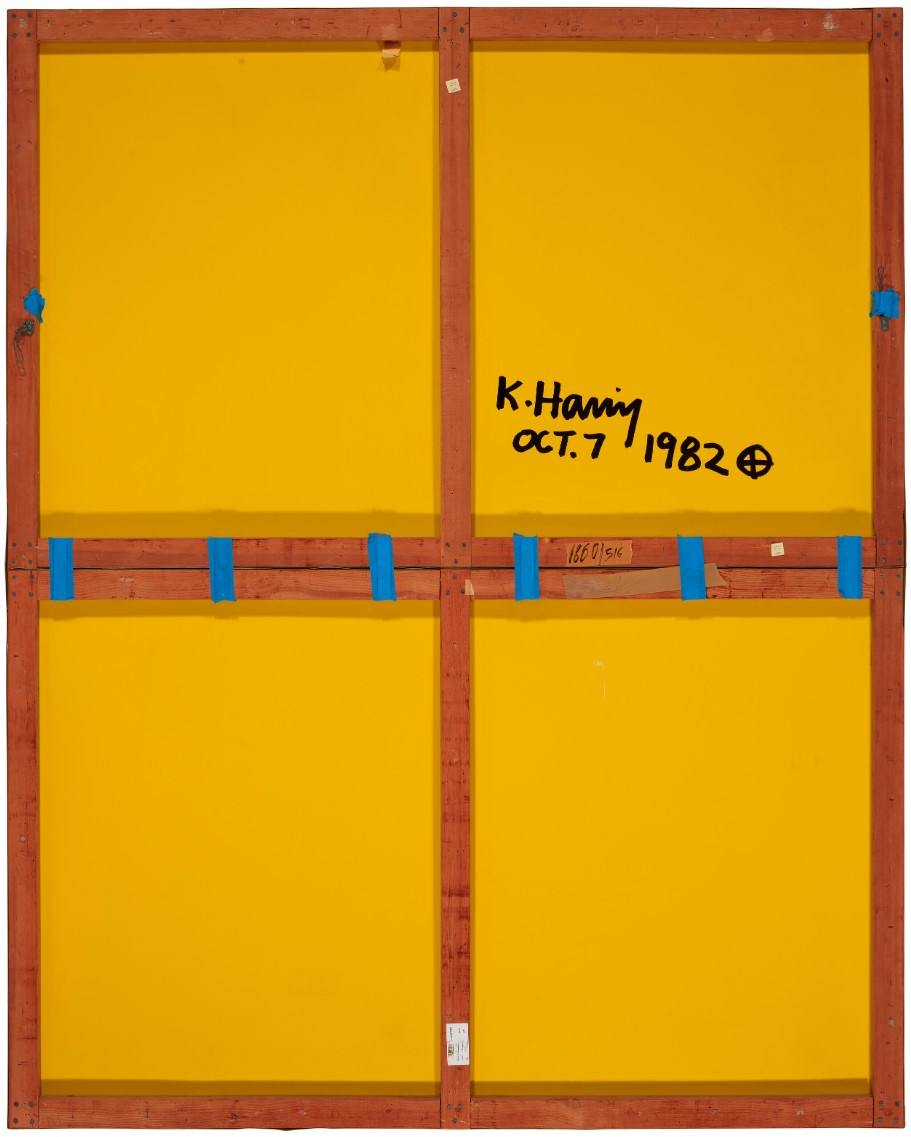
Signed and dated ‘K. Haring OCT. 7 1982’ (on the reverse)
Provenance
Tony Shafrazi Gallery, New York
Private collection, New York
Anon. sale; Christie’s, New York, 12 November 1998, lot 40
Private collection, Palm Beach
Anon. sale; Christie’s, New York, 10 May, 2006, lot 516 (USD 553,600)
Acquired at the above sale by the present owner
Auction History
Christie’s New-York: 17 November 2022
Estimated: USD 4,000,000 – 6,000,000
USD 5,820,000
KEITH HARING (1958-1990) (christies.com)
A singular visionary of the early 1980s New York City art world, Keith Haring established a dazzling personal iconography that continues to inspire generations decades after his untimely passing. Untitled is a dynamic example of the artist’s ability to connect with audiences through seemingly simple forms that contain multitudes of meaning. Beginning as a street artist painting on walls, billboards, and train cars, Haring crafted his career from quick marks on nontraditional surfaces but ultimately built a global language recognized by many regardless of their cultural upbringing. The artist wanted to break barriers and diversify what generations before had prescribed as an audience for art.
“I am painting a more holistic and basic idea of wanting to incorporate [art] into every part of life, less as an egotistical exercise and more natural somehow. I don’t know how to exactly explain it. Taking it off the pedestal. I’m giving it back to the people, I guess”
By transcending the walls of the art institutions through installations, clothing, site-specific paintings, and his Pop Shop, Haring was able to spread his vision outward and become a towering icon of American creativity.
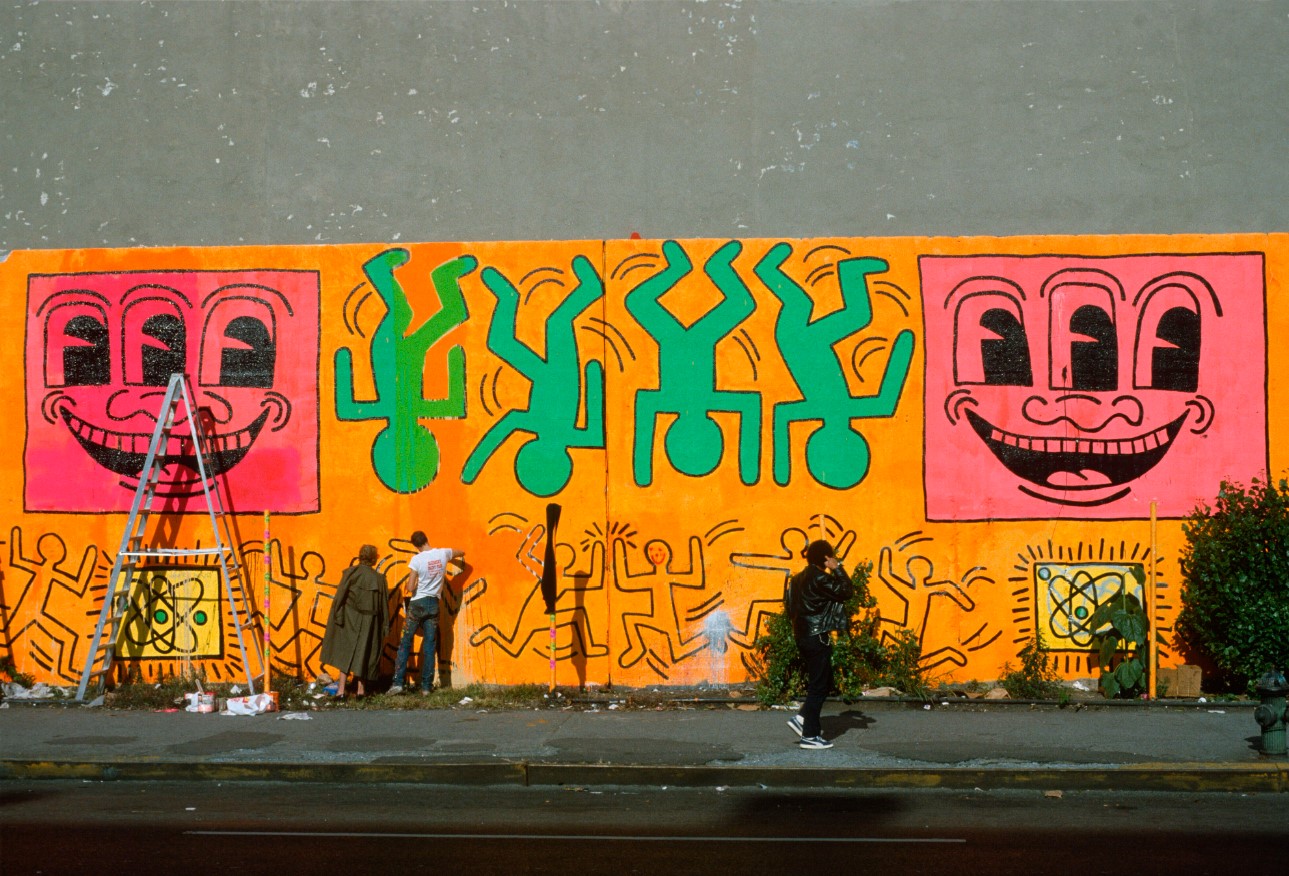 Keith Haring and Juan Dubose working on Houston and Bowery mural, 1982. Photo: © Allan Tannenbaum. Artwork: © The Keith Haring Foundation.
Painted on aluminum in the artist’s unmistakable style, a green figure spins on its head against a speckled floor. Using cartoon-like signifiers such as motion and impact lines, Haring establishes an air of frenetic movement within the two-dimensional composition. The green of the body is enclosed by an even black outline that separates it from the vivid orange atmosphere of the work, its surface unbroken by even the slightest brushstroke or mottling in the paint. The left toe just kisses the upper edge of the picture plane while the head is planted firmly on the ground line full of short, dripping black strokes. Across the center of the piece, one notices the line where two sections of the support are joined, and Haring has made certain that the custom frame is incorporated with his overall aesthetic by painting it brilliant yellow and covering it with a snaking squiggle that encompasses the vivacious scene. Though the forms are clear and the image is straightforward, the ability of Untitled and its brethren to fully absorb the viewer is nothing short of wondrous. Haring himself explained that he actively sought this immersive element in the finished product as well as during the creation process.
“See, when I paint, it is an experience that, at its best, is transcending reality,” he noted. “When it is working, you completely go into another place, you’re tapping into things that are totally universal, of the total consciousness, completely beyond your ego and your own self. That’s what it’s all about”
Haring never strayed too far from his graffiti roots, and the youthful energy of illegal painting in public areas always bubbled just below the surface of his works even when presented in a gallery or museum context.
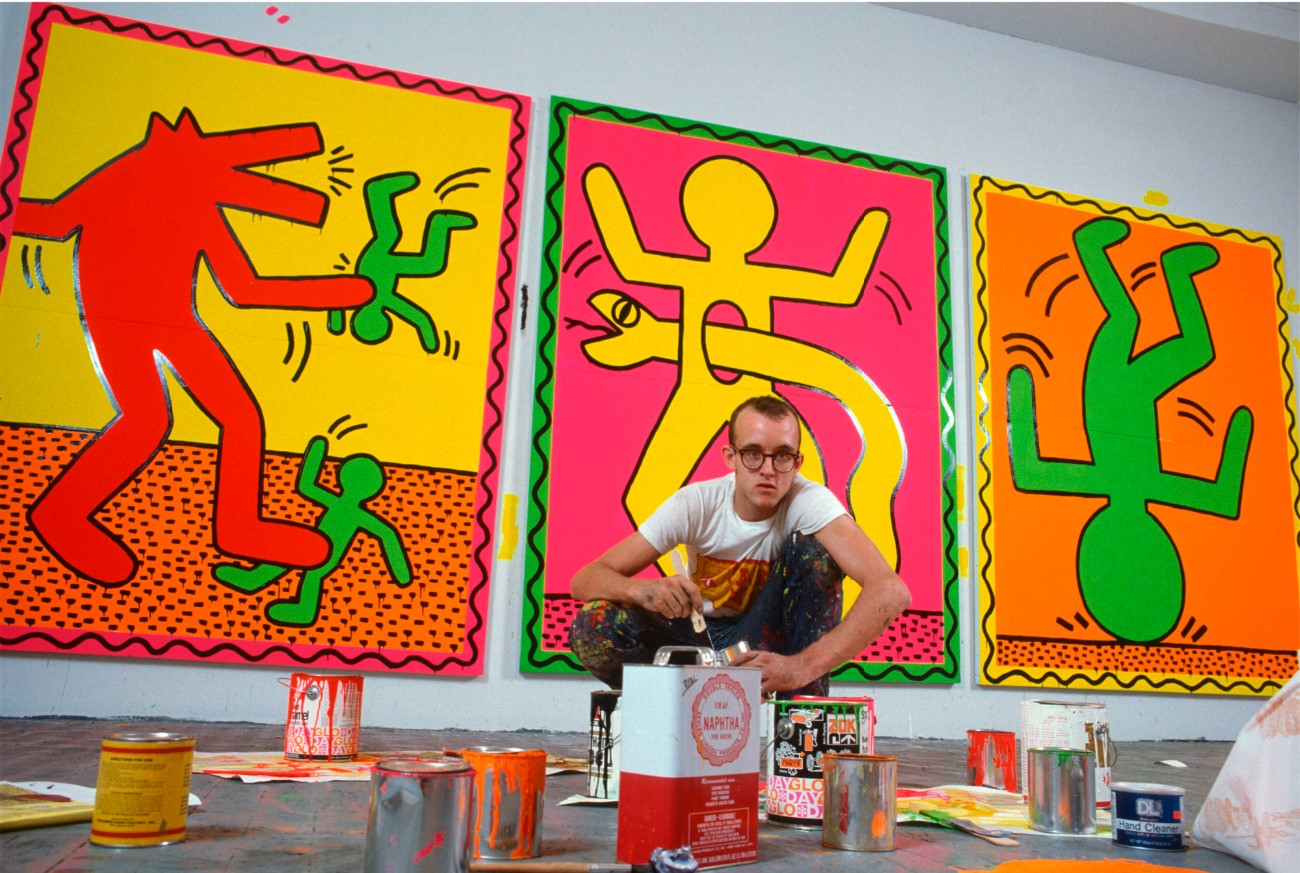 Keith Haring in his studio, 1982. Photo: © Allan Tannenbaum. Artwork: © The Keith Haring Foundation.
Realized in 1982, Untitled is one of the earlier examples of Haring responding to a veritable menagerie of new artforms that were growing and changing within New York City.
“1982 to 1984 was the peak of rap music and breakdancing, breaking and spinning on the floor and doing these athletic, gymnastic dances on the floor. It included spray graffiti because there was a graffiti scene. Part of the hip-hop scene at the time was the visual equivalent, so you had the music—which was scratching and rapping—and the dance, from breakdancing to electric boogie…. Graffiti was the visual tie-in. I incorporated things that I saw in breakdancing, electric boogie, and deejays into my drawings…A lot of my inspiration was coming out of watching break-dancers, so my drawings started spinning on their heads and twisting and turning all around. The work directly referenced hip-hop culture”
A direct amalgam of both breakdancing and his roots in street art, the present example pulls inspiration from the creative scene thriving in Manhattan during the 1980s. Enthralled by the diversity of creative outlets he was surrounded with, Haring coalesced a variety of influences and subjects into a truly inclusive and timely oeuvre that acts as a snapshot of that particular era and place.
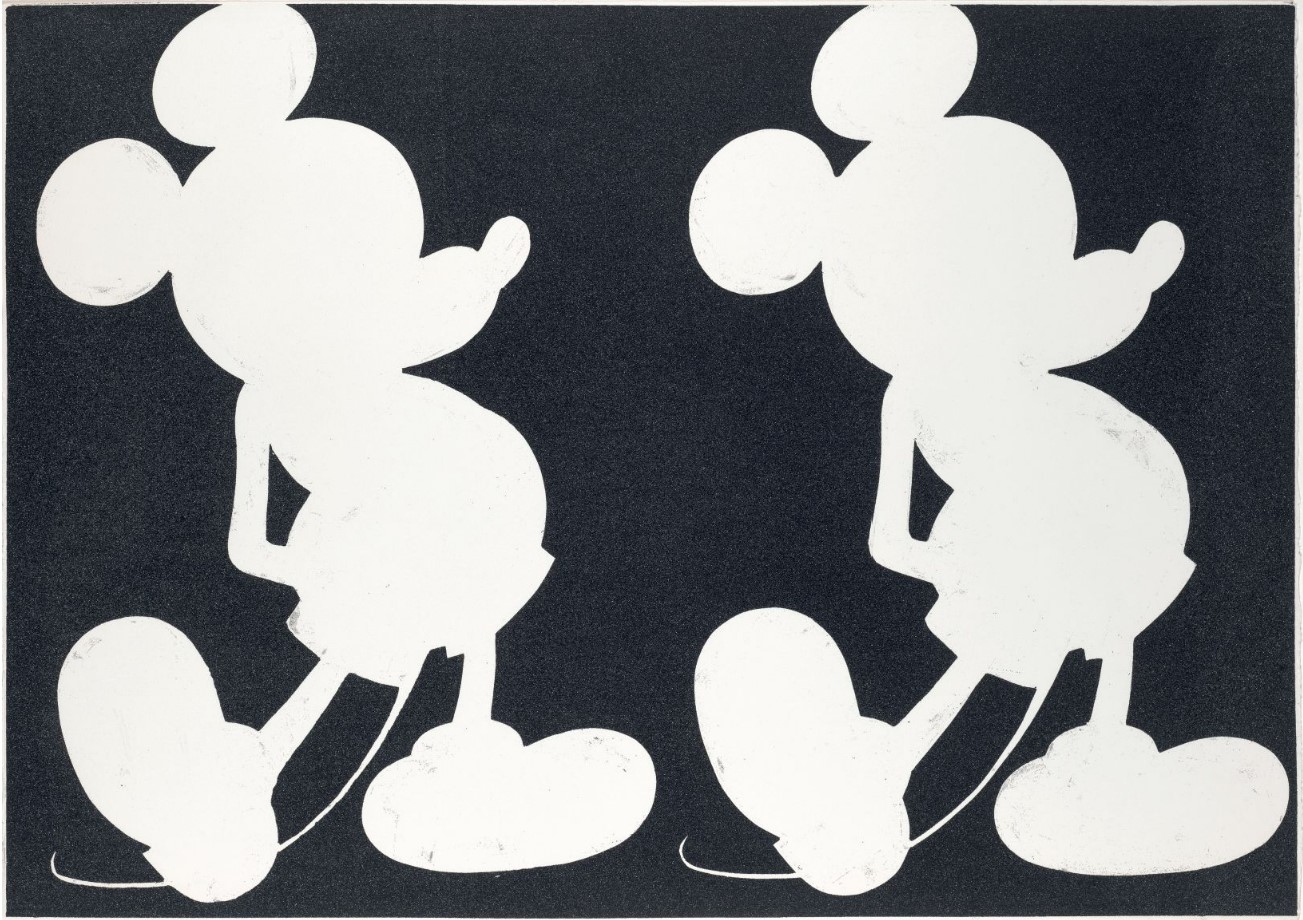
Andy Warhol, Double Mickey Mouse, 1981. Metropolitan Museum of Art, New York. © 2022 The Andy Warhol Foundation for the Visual Arts, Inc. / Licensed by Artists Rights Society (ARS). Photo: © The Metropolitan Museum of Art / Art Resource, New York.
Haring moved to New York City in 1978 to study at the School of Visual Arts. Upon his arrival, he quickly became a fixture of the thriving club scene where he met many of the artists and tastemakers that would shape the avant-garde culture of the era. Keen to interact and learn from them, he often worked alongside fellow creatives as they shared in the infectious energy of the day. During this time he became close with the inspirational and outspoken Andy Warhol as well as the wunderkind painter Jean-Michel Basquiat. Together, the three questioned the very foundations of art while navigating the ever-changing decade.
“You see, whatever I’ve done would not have been possible without Andy. Had Andy not broken the concept of what art is supposed to be, I just wouldn’t have been able to exist.”
Creating a more democratic mode of art, Haring subverted common symbols and cartoon elements in service of a style that was highly relatable and charged with energy. Works like Untitled rely on simplified figures that bear a resemblance to the rounded characters on safety signs and crosswalk lights. By introducing DayGlo orange and a set of curved action lines culled from comic strips, the painter sets these otherwise stayed symbols in motion. Whereas previous generations held tight to inimitable gestures and vivacious abstraction, Haring sought to convey his own experiences and the worlds of those luminaries around him with everyone who saw his work.