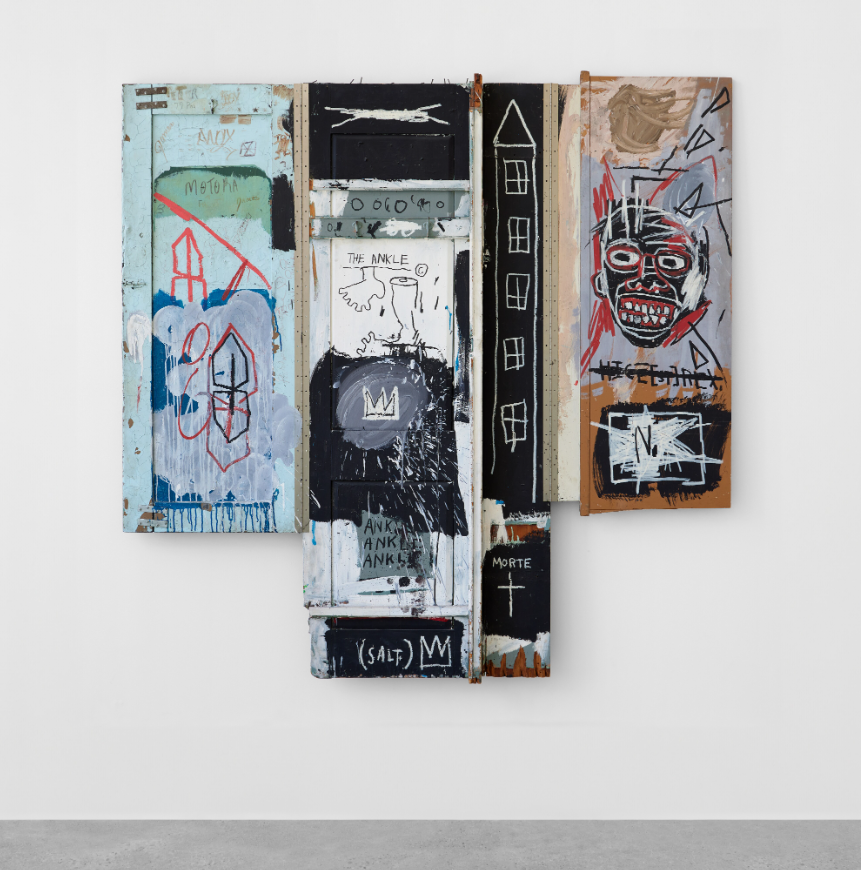
JEAN-MICHEL BASQUIAT (1960 – 1988)
Portrait of the Artist as a Young Derelict, 1982
Oil, oil stick, and acrylic on wood and metal
80×82 inches (203.2 x 208.3 cm)
Signed, titled and dated 1982 (on the reverse of the left panel)
Provenance
Fun Gallery, New York
Galerie Jacques Mostini, Paris
Acquired from the above by the present owner
Auction History
Sotheby’s London: 25 June 2024
Estimated: GBP 15,000,000 – 20,000,000
GBP 16,016,832 / USD 20,309,343
Pulsating with raw energy and a compelling visceral strength, Portrait of the Artist as a Young Derelict is a masterpiece of Jean-Michael Basquiat’s oeuvre, painted when the artist was at the magisterial height of his creative powers. Reminiscent of a Renaissance altarpiece in its imposing scale and triptych format, this is a seminal and utterly unique construction; through this devotional totem the artist seeks to ennoble the street and enshrine himself and his graffiti artist peers as heroes and martyrs.
Befitting its importance, the work is widely referenced in literature and has been included in several major exhibitions worldwide, including the artist’s 1992 retrospective at the Whitney Museum of American Art, New York; solo exhibitions at the Museum of Contemporary Art, Los Angeles; Museum of Fine Arts, Houston; and Fondation Beyeler, Basel; and most recently, Jean-Michel Basquiat at Fondation Louis Vuitton in Paris in 2018. It was painted for the artist’s pivotal exhibition at Fun Gallery in the crucial year of 1982, and it belongs to a select group of compelling works that utilize quotidian objects as support for the artist’s expressionistic vision, articulately synthesizing a wealth of divergent influences into a cohesive magnum opus.
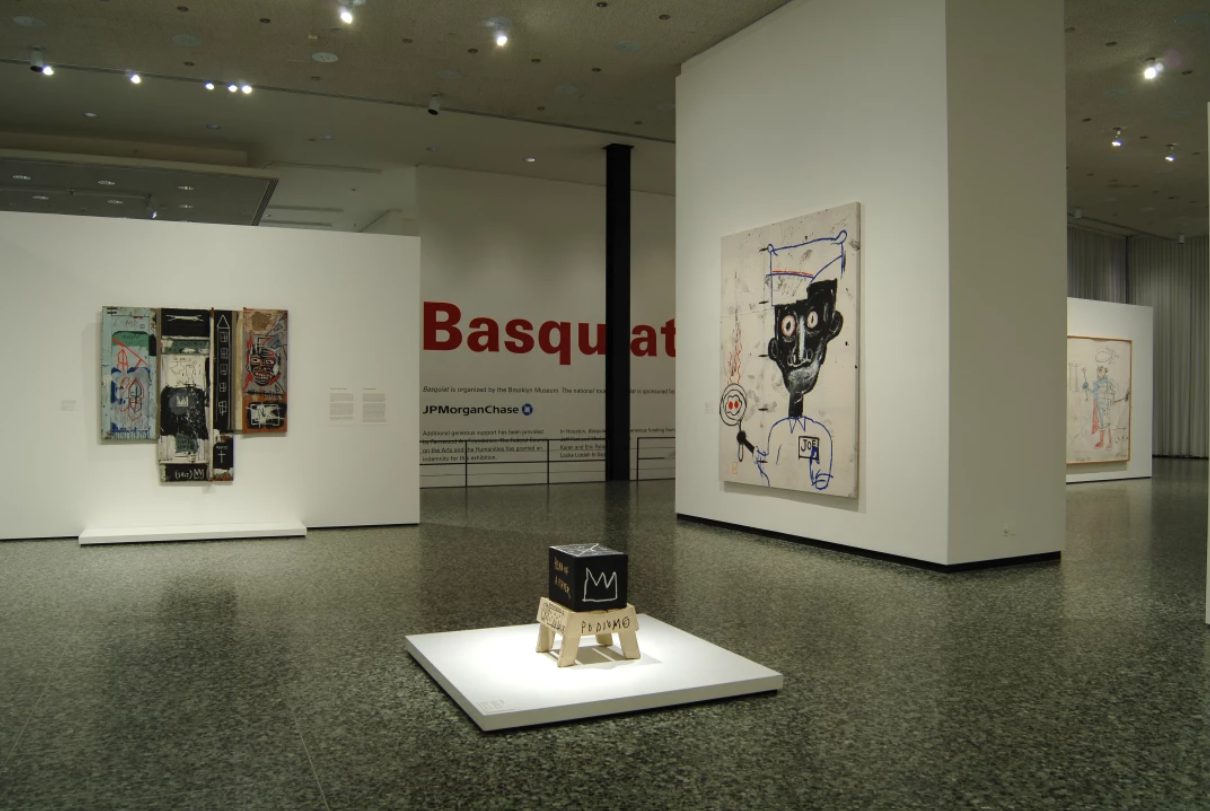
THE PRESENT WORK INSTALLED IN BASQUIAT, MUSEUM OF FINE ARTS, HOUSTON, 2005
Appropriating found materials including a domestic door – an object which Basquiat cited as one of his earliest painted surfaces prior to his commercial success – the artist orchestrates an emotively complex and richly self-referential representation of his experience as a Black artist navigating the transition from living on the street to fame and fortune. Executed with the swift facility of graffiti and the masterful ingenuity of a painterly virtuoso, this work is a consummate example of Basquiat’s genius for sampling and synthesizing the cultural tumult of a very modern kind of existence.
Befitting its importance, the work is widely referenced in literature and has been included in several major exhibitions worldwide, including the artist’s 1992 retrospective at the Whitney Museum of American Art, New York; solo exhibitions at the Museum of Contemporary Art, Los Angeles; Museum of Fine Arts, Houston; and Fondation Beyeler, Basel; and most recently, Jean-Michel Basquiat at Fondation Louis Vuitton in Paris in 2018. It was painted for the artist’s pivotal exhibition at Fun Gallery in the crucial year of 1982, and it belongs to a select group of compelling works that utilize quotidian objects as support for the artist’s expressionistic vision, articulately synthesizing a wealth of divergent influences into a cohesive magnum opus. Appropriating found materials including a domestic door – an object which Basquiat cited as one of his earliest painted surfaces prior to his commercial success – the artist orchestrates an emotively complex and richly self-referential representation of his experience as a Black artist navigating the transition from living on the street to fame and fortune. Executed with the swift facility of graffiti and the masterful ingenuity of a painterly virtuoso, this work is a consummate example of Basquiat’s genius for sampling and synthesizing the cultural tumult of a very modern kind of existence.
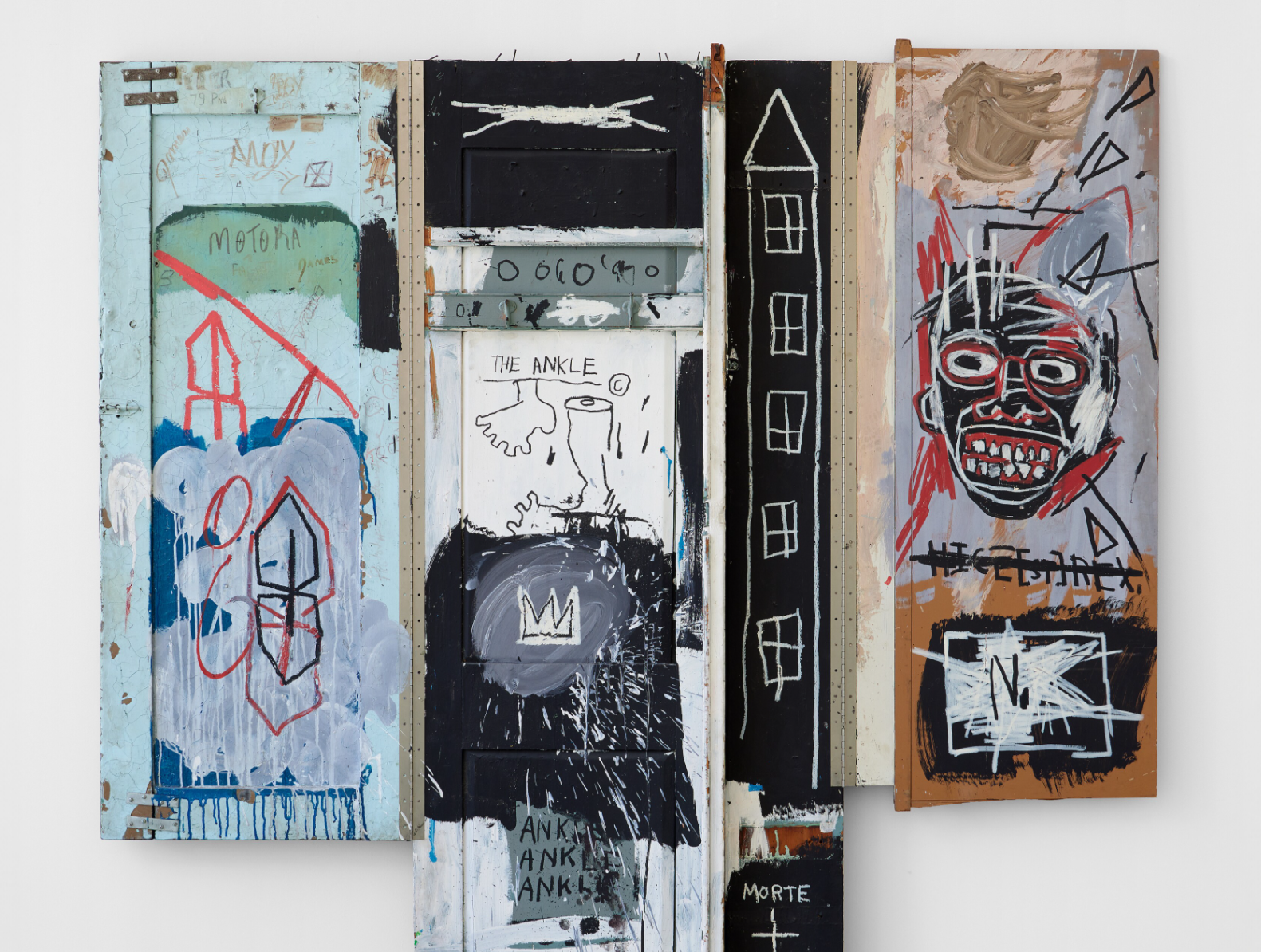
Though maintaining the spontaneity of graffiti in its paroxysmal execution, by the time this work was created in 1982 (when the artist was just 22 years old), Basquiat had fully transitioned from street to studio. With few resources other than sheer determination, within just four years the young artist progressed from intermittent bouts of homelessness and the ubiquitous dissemination of his “SAMO” graffiti tag across the city, to being introduced to an enamored art world as “The Radiant Child” through René Ricard’s seminal Artforum article of December 1981. Basquiat’s early success provided him with the confidence to be more ambitious in scale, structure, and technique, as evidenced by the large-scale format and richly complex surface of Portrait. However, he maintained close ties to his artist peers who continued as graffitists; as Hoffman again notes, “For Basquiat, graffiti was not only part of his artistic foundation, but also a culture he continued to embrace and support… While Basquiat’s techniques result in a highly resolved and compelling pictorial composition, aspects of this work are strongly reminiscent of the actions of the graffitist. Reinforced by Basquiat’s reference to the urban milieu in his depiction of a skyscraper on the right edge of the central panel, Portrait of the Artist as a Young Derelict may be seen as Basquiat’s tribute to his fellow artist[s] and [their] radical undertaking” (Ibid., pp. 211-212).
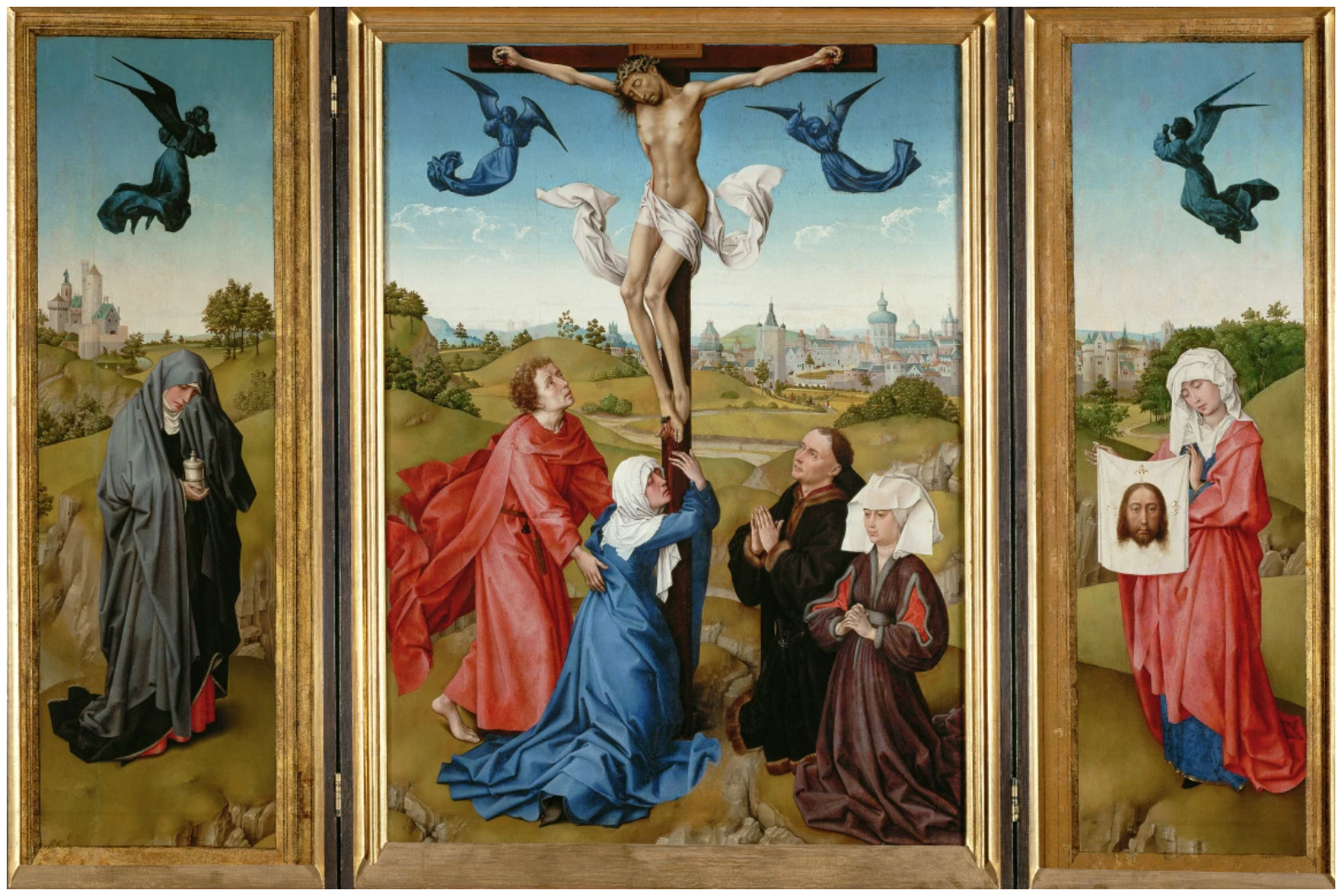
ROGIER VAN DER WEYDEN, TRIPTYCH: THE CRUCIFIXION, CIRCA 1440. KUNSTHISTORISCHES MUSEUM WIEN. IMAGE: © KUNSTHISTORISCHES MUSEUM WIEN, GEMÄLDEGALERIE
Executed on three found panels joined with hinges, the unique structure of Portrait draws upon Basquiat’s extraordinary familiarity with centuries of tradition by echoing the time-honored format of the tripartite altarpiece, and references the religious and political powers that were associated with them. Assembled from discarded wood – including a once-functional door complete with coat hooks – the quotidian materials are thus elevated to the status of worshipped icon. Basquiat noted how “the first paintings” he ever made were on the ad-hoc surfaces of doors and windows.
“I used the window shape as a frame and I just put the painting on the glass part and on doors I found on the street.”
Even after his transition to studio artist, doors and shutters became favored supports for the artist’s visions throughout the rest of his career; thus the present work undoubtedly references his earlier involvement in graffiti culture through the intentional use of found media. Recalling the makeshift aesthetic of Rauschenberg’s revered Combine paintings, here a variety of sources and materials are collaged onto the wooden panels, evoking the frenetic strata of stimuli that characterized the metropolitan cacophony of Basquiat’s New York surrounds.
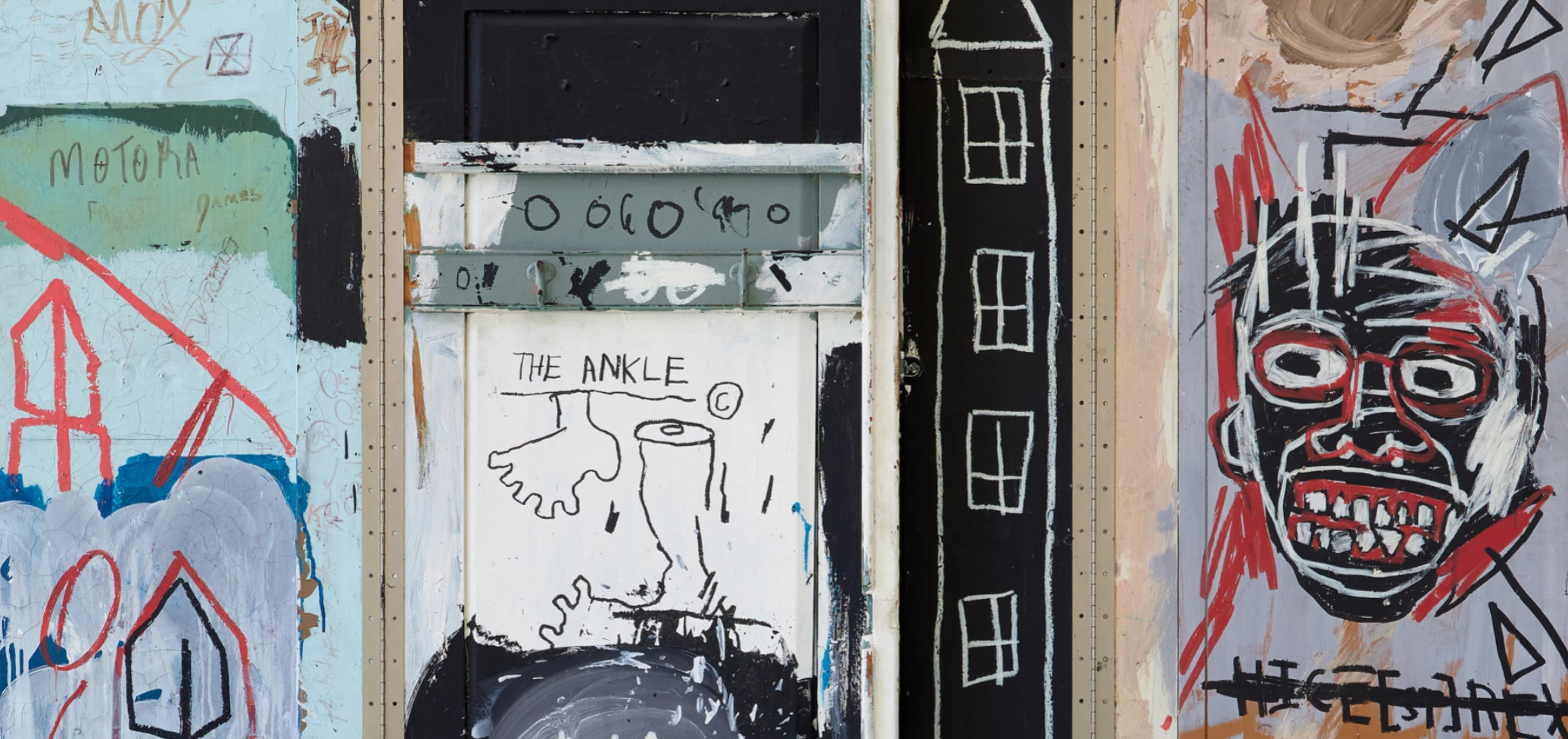
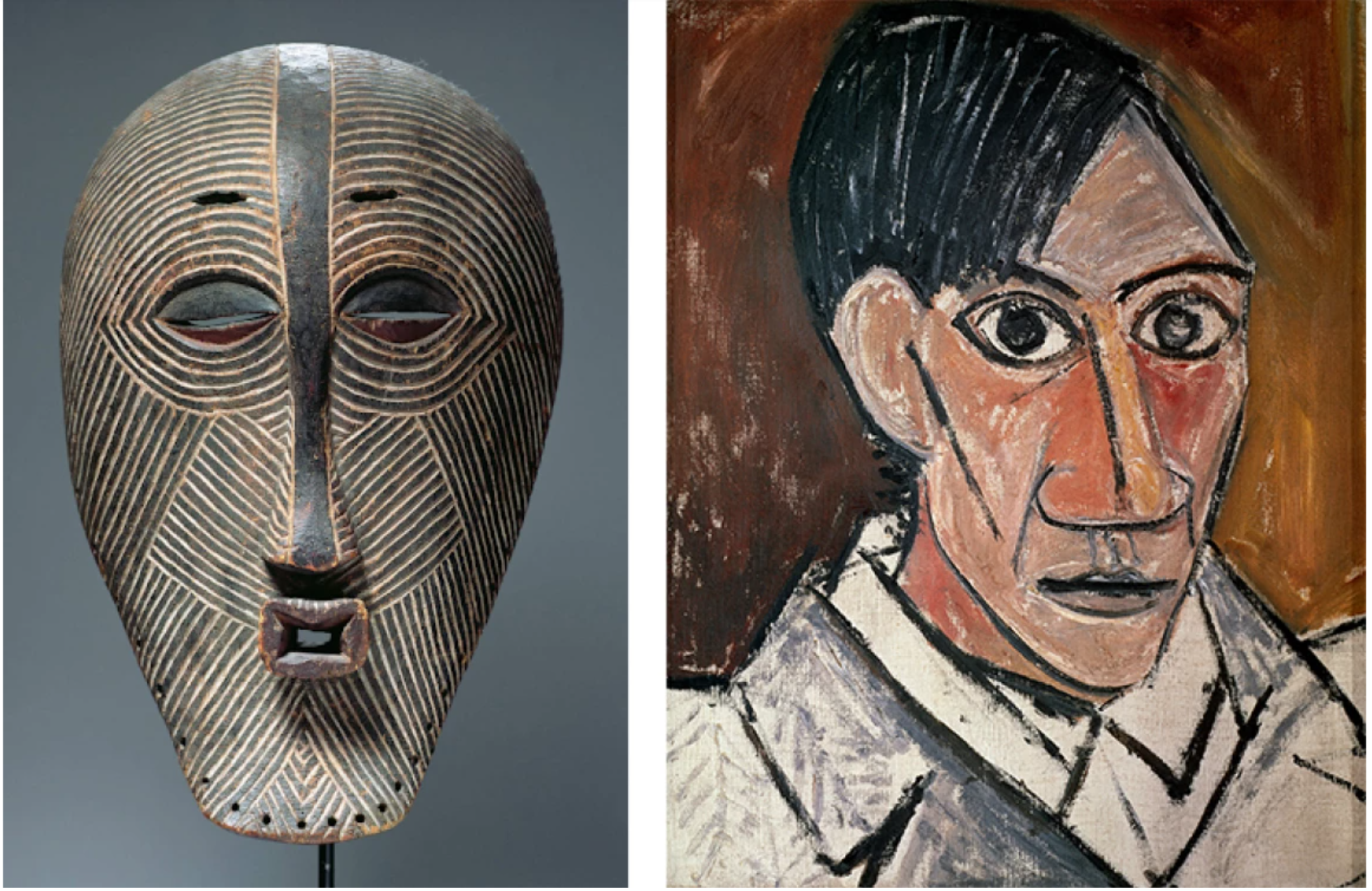
Art for Basquiat was a means of self-discovery and a voyage into the troubled depths of his own identity. Born in Brooklyn in 1960 to a Haitian father and New York Puerto Rican mother, Basquiat’s mixed ethnic heritage instilled in him the mentality of an outsider and with it a rebellious freedom that invigorates his art. He absorbed influences and references from both the Western and African traditions of his roots, from voodoo and tribal rituals, African masks and mysticism to Renaissance genre painting and Modern painters like Pablo Picasso and Cy Twombly, all the way to contemporary street slang and sports and musical stars of American pop culture. With a typically post-modern flair, Basquiat cut and pasted, mixed and matched these diverse and often conflicting elements of his identity to construct powerfully vital and evocative psychological portraits. In the present example, he inserts one of his characteristic mask-like faces, a dreadlocked, shamanistic portrait that confronts our gaze with wide, glaring eyes and gritted teeth. Inserted into the alter-like construction, the head becomes deified, even Christ-like: taken as the titular “artist,” set amongst the chaotic melee of street and graffiti references, the portrait can be read as a Romantic celebration of the street artist as martyr. Read alongside the central, haloed symbol of the three-pointed crown – one of Basquiat’s defining and most recognizable motifs – there is little doubt that this modern-day altar is intended to enshrine the bohemian spirit of the tortured artist as a fallen hero.
This reading is underscored by the panoply of words and phrases that adorn the surface of Portrait. For instance, under the red and black portrait: “HICE[ST]REX,” a Latin phrase for “Here is the King,” directly referring to the crucifixion of Jesus in the New Testament. The bracketed “[ST]” – a classic abbreviation – reinforces Basquiat’s self-proclamation as King of the Street, at once celebrating his graffiti heritage as he ascends to a new throne in the wider commercial art world, while also once again positioning the artist as a martyr. Coupled with the white cross and inscription “MORTE” on the center panel, Basquiat underlines the tragic destiny of the street artist. Risking arrest, harm, even death – as in the case of the artist’s friend Michael Stewart, a young Black graffitist who was killed while in custody of the New York City police – these artists were seen as outsiders and threats.