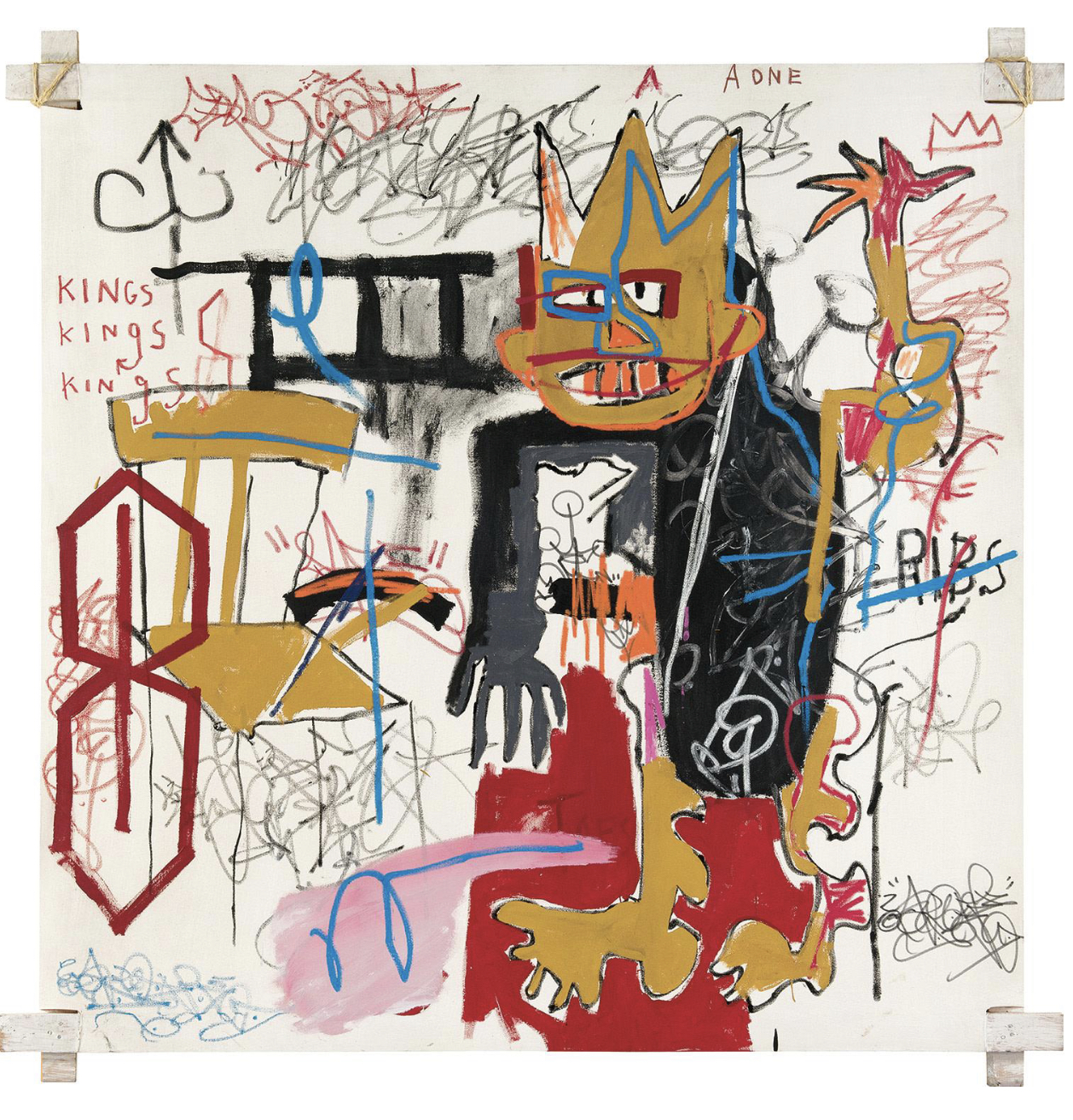
JEAN-MICHEL BASQUIAT
Portrait of A-One A.K.A. King, 1982
Acrylic, oilstick and marker on canvas mounted on tied wood supports
72 x 72.4 inches (182.9 x 183.8 cm)
signed, titled and dated “”PORTRAIT OF A ONE A.K.A. KINGS” Jean Michel Basquiat SEPT 1982″
on the reverse
Provenance
Bonlow Gallery, New York
Private Collection
Sotheby’s, New York, November 11, 1986, lot 274
Sidney Janis Gallery, New York
Mugrabi Collection (acquired from the above in the early 1990s)
Private Collection (acquired from the above)
Acquired from the above by the present owner in 2014
Phillips New-York: 7 December 2020
USD 11,500,000
Source: Phillips
Jean-Michel Basquiat – 20th c. & Co… Lot 16 December 2020 | Phillips
Arriving to auction for the first time in over three decades, Portrait of A-One A.K.A. King exemplifies the gestural, painterly prowess and distinctive iconography that denoted the peak of Jean-Michel Basquiat’s career. Executed during his meteoric rise to fame in 1982, the painting features the same interrogation of “high” and “low” culture that would typify the rest of his too-brief oeuvre. In both its depiction of legendary New York street artist A-One as well as its unique construction, Portrait of A-One A.K.A. King harkens back to Basquiat’s past as a graffiti artist in the late 1970s, during which he emerged as a street poet hidden behind the pseudonym SAMO, a relentless tagger whose nom de plume began appearing all over the city’s disintegrating infrastructure. Indeed, with its various drips, scrawls, and fields of paint, the work is emblematic of the same vigor and immediacy that characterized the much-cherished art he executed in his days as SAMO.
According to curator Richard Marshall, “From 1980 to late 1982, Basquiat used painterly gestures on canvases, most often depicting skeletal figures and mask-like faces, and imagery derived from his street existence.”i In this translation—from concrete walls to canvases—Portrait of A-One A.K.A. King betrays at first glance no tentativeness or hesitation on behalf of Basquiat. However, despite his prolificacy, the artist was known to meticulously edit and rework his paintings, a tendency evidenced by the multiple layers of paint washes and marks present in the painting.
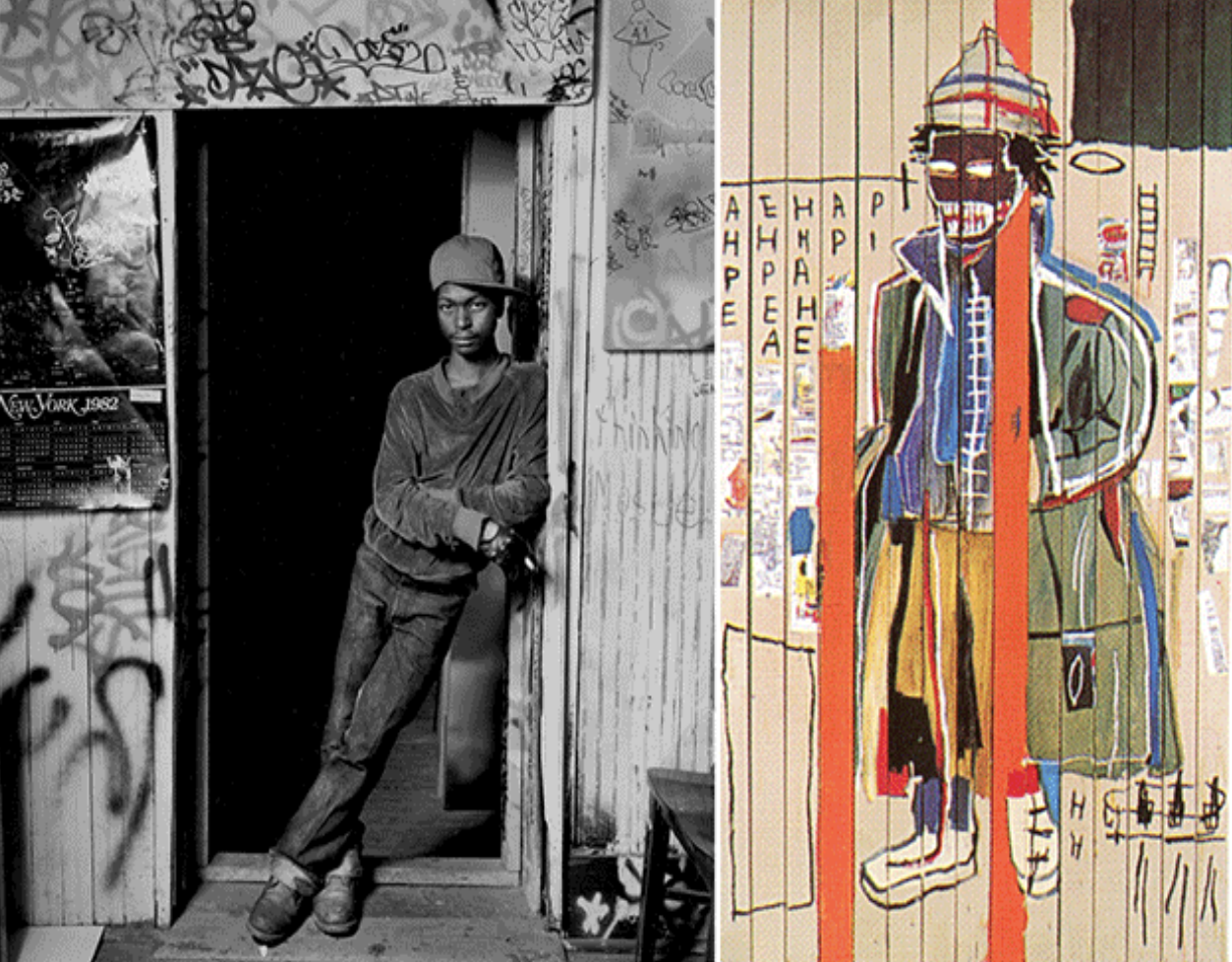
The most central element in these layers—and perhaps of the artist’s artistic lexicon overall—is the human figure, which Basquiat used as an iconographic device to coalesce art history, pop culture, and the Black experience. A nod to Basquiat’s community and own past as a street artist, Portrait of A-One A.K.A. King is one of just two paintings Basquiat made which portray his close friend and collaborator, graffiti artist A-One (Anthony Clark); in the present work, he stands crowned in an ambiguous space covered in tags and “cool S’s.”
Speaking of the frequent visits he took to the Brooklyn Museum—his local museum growing up—the artist told Henry Geldzahler, “I realized that I didn’t see many paintings with black people in them.” In confronting this perennial lacuna, the artist expounded that “the black person is the protagonist in most of my paintings.”ii Basquiat thus sought to anoint pop culture icons, his friends, and himself in his own distinctive form of royal portraiture, just as Western art history valorized saints and kings for millennia. Bringing together as diverse figures as jazz luminary Charlie Parker, boxing phenomenon Muhammad Ali, hip-hop artist Rammellzee, and A-One, Basquiat consecrated his community and personal heroes in his pantheon of Black kings, which challenged conventional class-based conceptions of royalty: to Basquiat, the crown instead indexed skill or authenticity of expression.
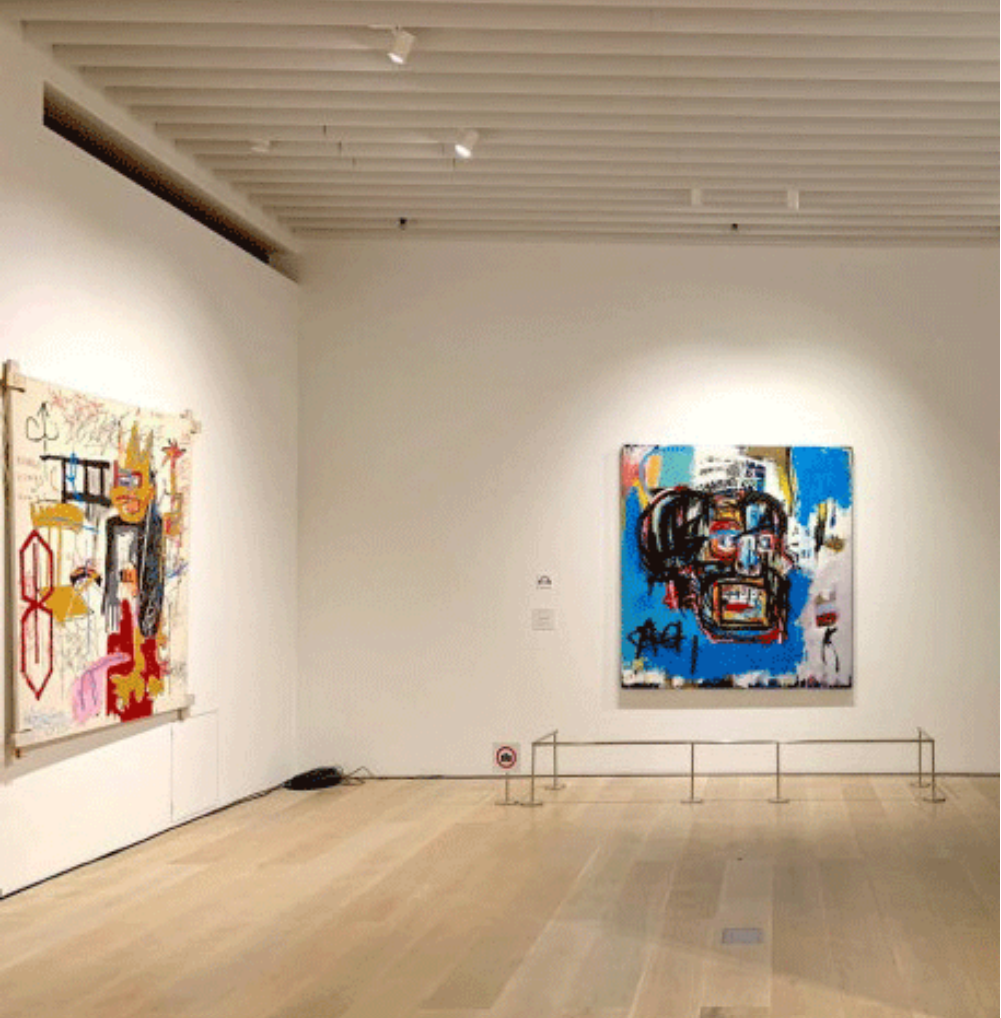
When Geldzahler asked Basquiat what his subject matter was, the artist paused for a moment, then responded “royalty, heroism, and the streets.” Indeed, this duality—as well as the artist’s signature word play—is present in both the Portrait of A-One A.K.A. King’s title and motifs: in street vernacular, a “king” refers to a highly-regarded graffiti writer that’s renowned in a particular region for his skill, and self-declared “kings” often insert crowns into their work. One of Basquiat’s most enduring and recognizable pictorial tropes, the crown cleverly memorializes A-One with the double meaning of the title “king,” evoking both street culture and the art historical genre of royal portraiture.
A superb example from “one of [Basquiat’s] most important groups of paintings,” Portrait of A-One A.K.A. King is one of the artist’s iconic “exposed stretcher-bar” works, many of which are held in the most prestigious museums in the world, including the Montreal Museum of Fine Arts; the Whitney Museum of American Art, New York; The Broad, Los Angeles; and the Menil Collection, Houston. In 1982, Basquiat instructed his assistant Stephen Torton to assemble stretchers from found wood and twine. “I would go out in the middle of the night and find the stuff,” recalled Torton. “I was making things that looked like what the circus leaves behind…It was such a relief to climb into dumpsters and pull things out of them and make sculptures.”iv The resulting paintings formed a bridge between the painted doors and found objects that littered his early oeuvre and his later, more conventional canvases he used later.
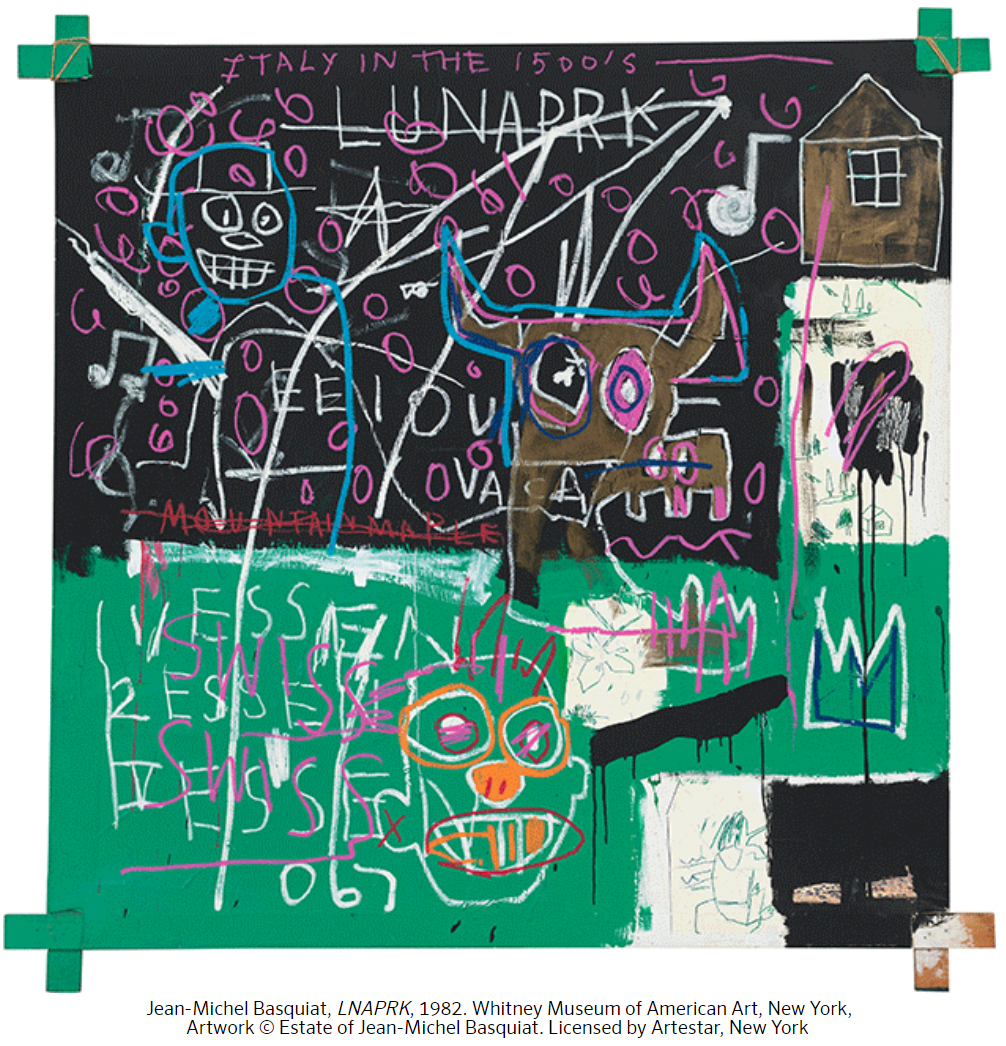
The exposed stretcher-bar paintings were immediately acclaimed as poetic evocations of Basquiat’s graffiti past, especially by prominent art critic Rene Ricard. “For a while it looked as if the very early stuff was primo, but no longer. He’s finally figured out a way to make a stretcher…that is so consistent with the imagery,” Richard declared. “They do look like signs, but signs for a product modern civilization has no use for.” The raw construction of these works blur distinctions between art made in the studio and imagery from the streets—the very division Basquiat’s career was obfuscating in 1982