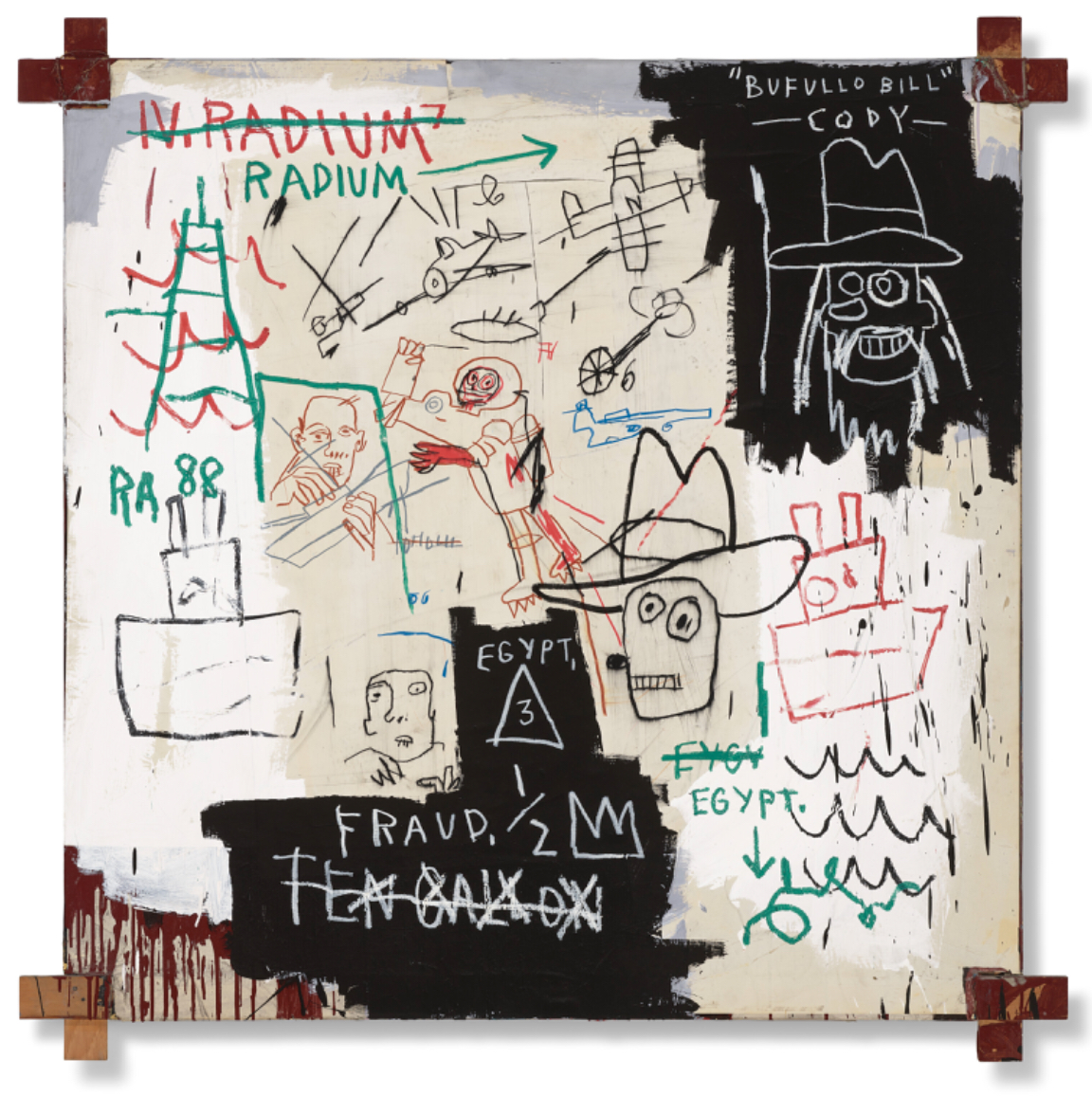
JEAN-MICHEL BASQUIAT (1960-1988)
Future Sciences Versus the Man, 1982
Acrylic, oilstick and paper collage on canvas with tied wood supports
60×60 inches (152.5 x 152.5 cm)
Signed, titled and dated ‘“FUTURE SCIENCES VERSUS THE MAN” JEAN MICHEL BASQUIAT 1982’ (on the reverse)
Provenance
Larry Gagosian Gallery, Los Angeles
John Seed Collection, Los Angeles
Larry Gagosian Gallery, Los Angeles
Galerie Daniel Templon, Paris
Hannelore B. Schulhof Collection, New York (acquired from the above in 1985)
Acquired from the above by the present owner in 2011
Auction History
Christie’s London: 13 October 2023
Estimated: GBP 9,000,000 – 12,000,000
GBP 10,430,000 / USD 12,707,119
Jean-Michel Basquiat (christies.com)
A masterpiece dating from Jean-Michel Basquiat’s finest period, Future Sciences Versus the Man is an outstanding work from his celebrated series of ‘stretcher’ paintings. A virtuosic meditation on the dreams and downfalls of humankind, it is an electrifying history painting that confronts the myths, marvels and mendacity of scientific progress. Astronauts and cowboys, warships and fighter jets, cannons and chemicals explode across the picture plane; Basquiat invokes the wonders of Egypt, the aspirations of America’s goldrush, the exploration of the cosmos and the threat of nuclear destruction. The work was begun in New York, where it was shown in the artist’s landmark exhibition at the Fun Gallery. It was embellished in Los Angeles later that year, where Basquiat made his stellar debut with Larry Gagosian, and featured on the invitation card for his second exhibition there in 1983. For over twenty years the work was owned by Hannelore B. Schulhof, whose extraordinary collection of post-war masterworks now resides in the Peggy Guggenheim Collection. More recently, it formed part of the spectacular display of stretcher paintings shown as part of the Brant Foundation’s major Basquiat exhibition in 2019.
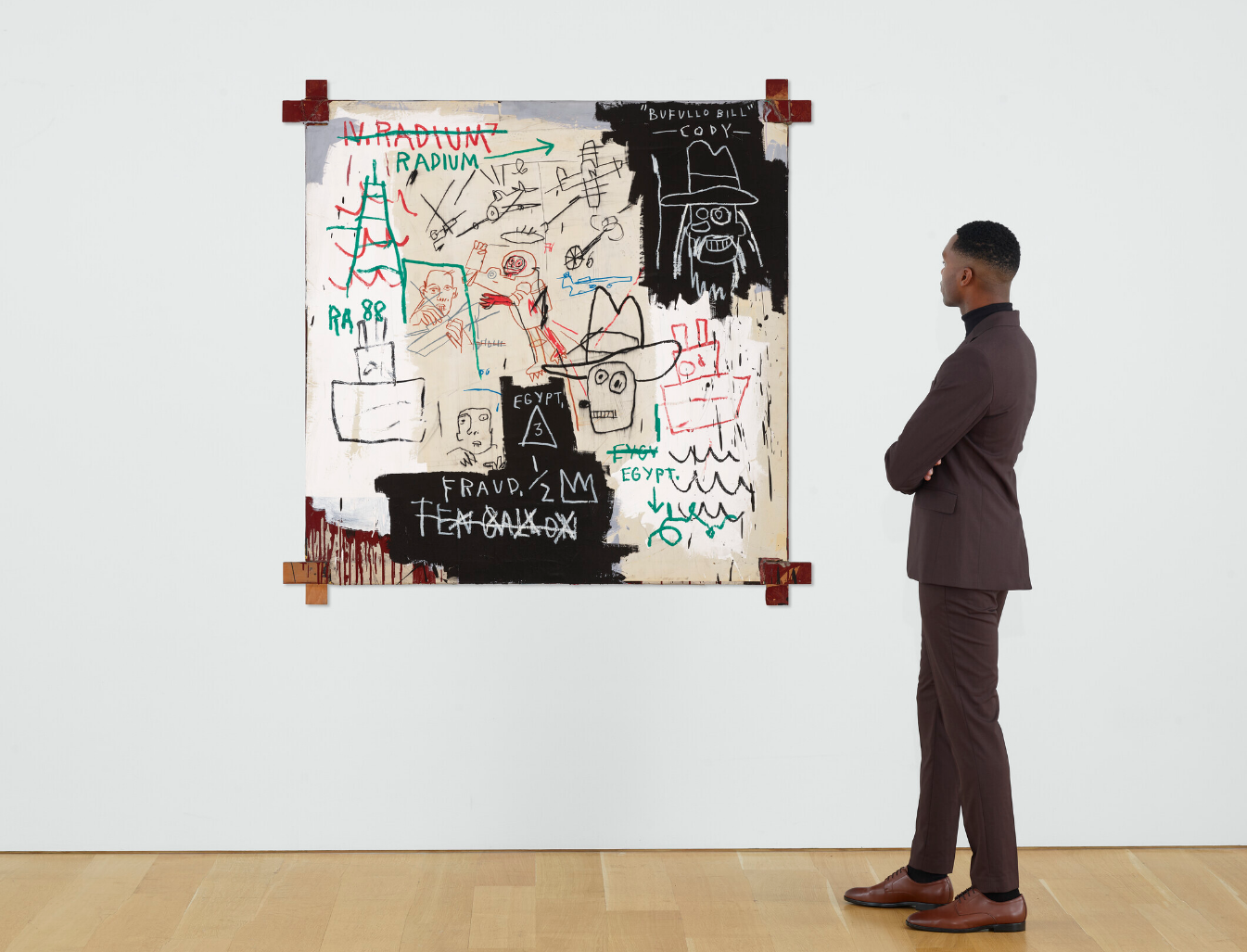
The work takes its place alongside Basquiat’s epic history paintings such as El Gran Espectaculo (The Nile) (1983). Woven into its survey of human civilization, however, is an ecstatic hymn to art. Basquiat conjures the work of painting’s own heroes and visionaries: from the visceral textures of Abstract Expressionism to the raw impulses of street art. There are echoes of Franz Kline’s black and white canvases, Clyfford Still’s jagged color fields and the rich, expressive impasto of Willem de Kooning. Its cryptic diagrams and numbers evoke Cy Twombly’s Bolsena paintings, wrought amid the scientific euphoria surrounding the Apollo moon landings in 1969. There are strains of Pablo Picasso’s Guernica in its elegy to human conflict; in its tactile, collaged surface are ghosts of Robert Rauschenberg’s Combines. At the same time, Basquiat ultimately overwrites these voices with his own. Paint drips, spatters and smears across the canvas, alive with his touch. His trademark symbols—the three-pointed crown, and the halo of thorns above the astronaut’s head—are quietly but unmistakably present. Painting, in the end, triumphs over science, with Basquiat emerging as its great pioneer.
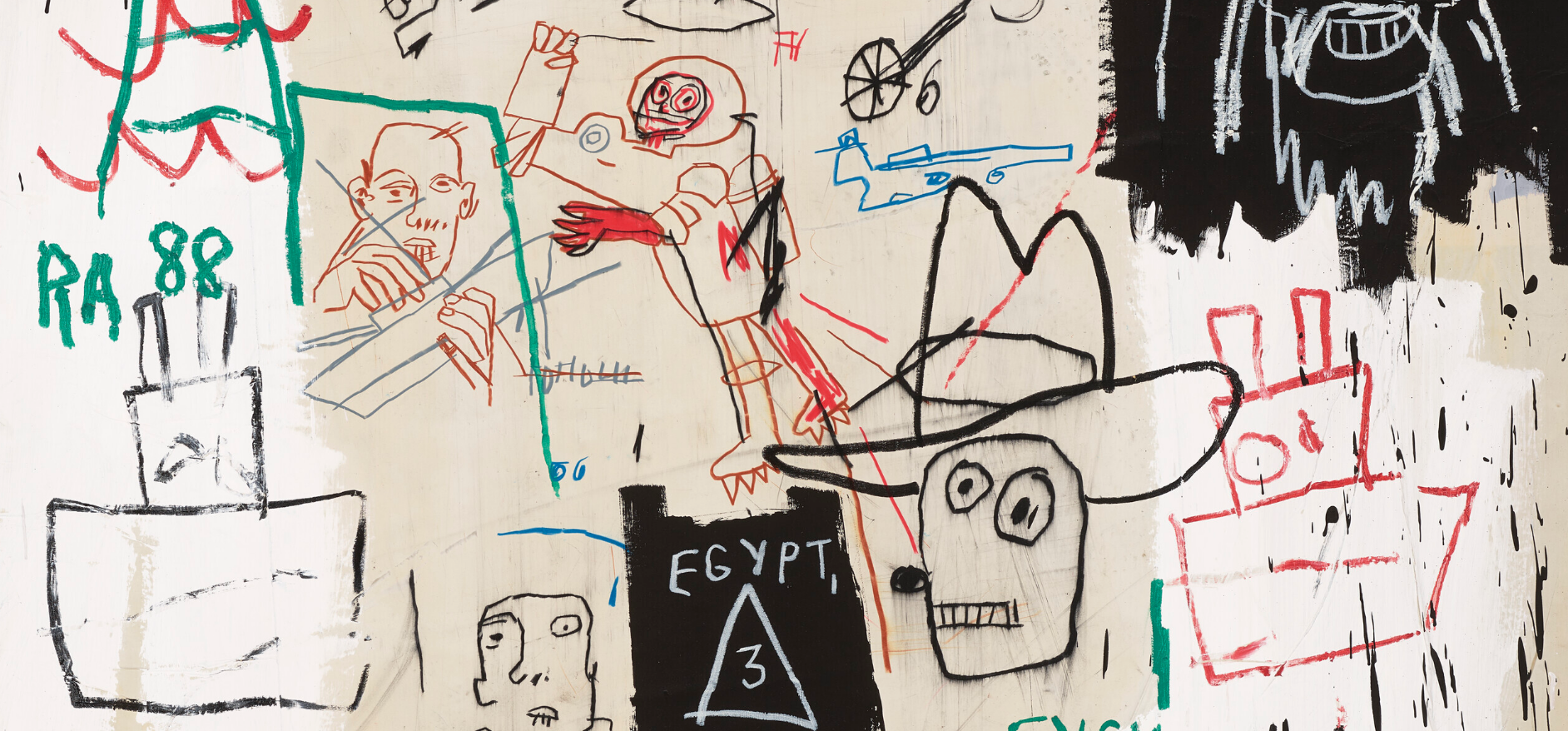
As the artist himself ascended to the stars in 1982, aged just twenty-two, thoughts of progress and invention were undoubtedly on his mind. At the center of his rise to fame were the stretcher paintings themselves. Defined by their exposed wooden bars, salvaged from the streets of the Lower East Side, these bold, near-sculptural icons have been described as ‘one of Basquiat’s original innovations’, and ‘one of his most important groups of paintings’. Examples are held in major institutions including the Whitney Museum of American Art, the Broad Art Foundation, the Menil Collection, the Museum of Art, Kochi, the Museum Boijmans Van Beuningen, the Ludwig-Forum, Aachen and the Montreal Museum of Fine Arts. These structures confront the viewer like urban architectural relics, alive with the spirit of the city in its post-punk heyday. Many of the stretcher paintings, including the present, also formed part of Basquiat’s exhibition at the Fun Gallery, or Fun Factory, in November 1982.