DAVID HOCKNEY (B. 1937)
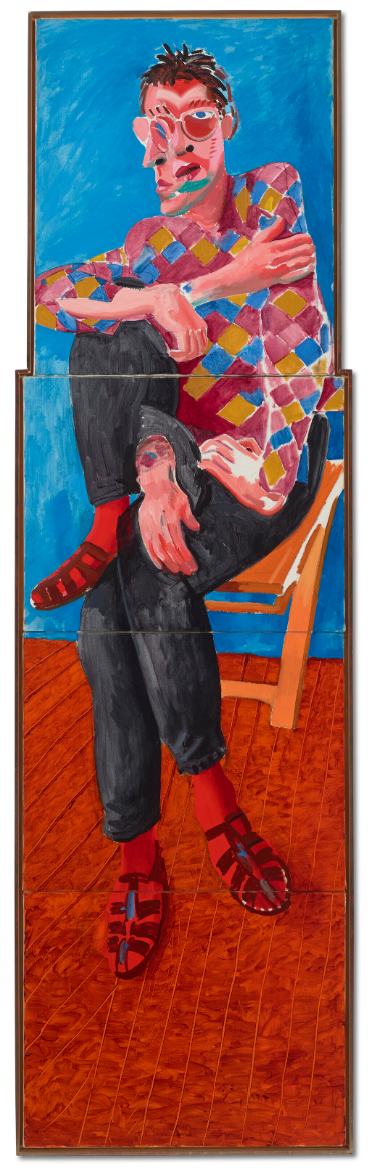
David Graves in a Harlequin Shirt, 1982
Oil on canvas, in four parts
Overall: 106 1/2 x 30 inches (270.5 x 76 cm)
Provenance
L.A. Louver, Venice, California
Private Collection, Los Angeles (acquired from the above in 1983)
Private Collection, La Jolla (acquired from the above in 1984)
Private Collection, Los Angeles (acquired from the above in 1988)
Acquired from the above by the present owner
Auction History
Christie’s London: 1 March 2022
Estimated: GBP 3,000,000 – 5,000,000
GBP 2,682,000 / USD 3,571,715
DAVID HOCKNEY (B. 1937) (christies.com)
Occupying extraordinary territory in the history of portraiture, David Graves in a Harlequin Shirt (1982) is a monumental work dating from a pivotal moment in David Hockney’s practice. The finest of the artist’s 1980s portraits ever to come to auction—and among the largest he has ever made—it offers a virtuosic thesis on space, perception and perspective, marking a thrilling chapter in Hockney’s dialogue with the work of Pablo Picasso. The work comprises four canvases, stacked vertically like a totemic sculpture. Seated against a luminous sky-blue backdrop, Hockney’s friend and studio assistant David Graves towers before the viewer, wearing a vivid diamond-patterned shirt reminiscent of Picasso’s celebrated harlequins. Captured from numerous angles simultaneously—his face and limbs multiplied in entangled configurations—Graves’ portrait bears witness to the profound impact of Cubism upon Hockney’s practice. The work’s composite structure and compound perspectives, informed by close study of his Spanish forebear, would fuel the evolution of the artist’s practice: from his photocollages and set designs—areas in which Graves played a vital role—to his vast multipartite landscapes. Not seen publicly since 1983, it is a portrait of the man, the master, the muse and the method that would allow Hockney to conquer vital new ground in his interrogation of human vision.
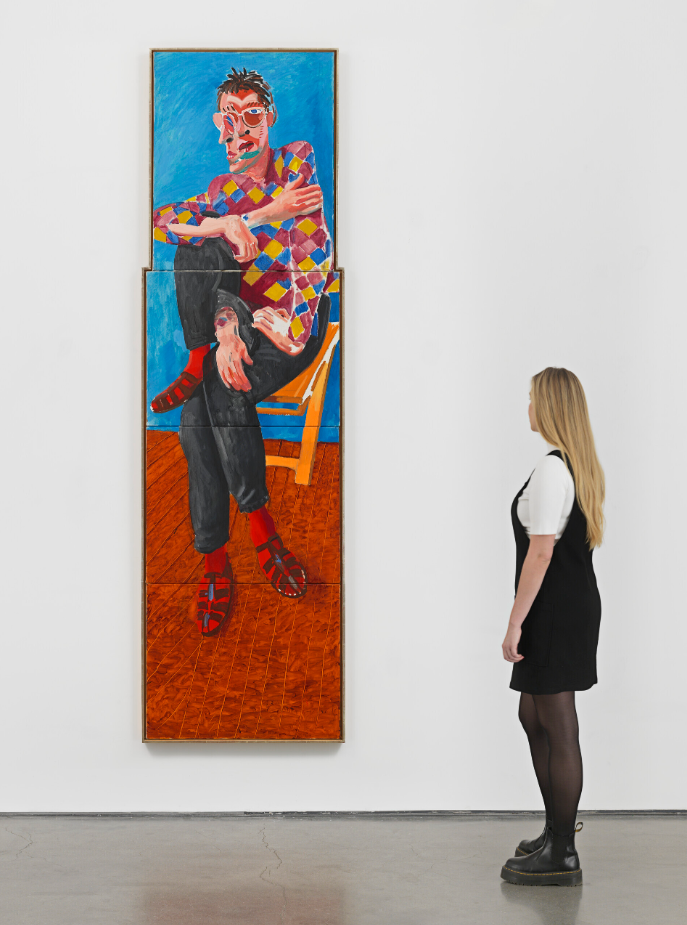
Painted just two years after Picasso’s major retrospective at the Museum of Modern Art had sent Hockney—and the wider art world—into a frenzy, David Graves in a Harlequin Shirt stands among the artist’s most ambitious conversations with his idol. For Hockney, Cubism represented a vital historical turning point, marking the moment that art first began to capture how we truly see the world. The artificial focus of long, extended sittings was replaced by a complex, composite view that accounted for the rapid-fire activity of the human eye and brain. Hockney had toyed with some of these ideas in his seminal suite of ‘double portraits’ during the late 1960s and early 1970s, where subtle warping and manipulation of perspective invited the viewer to move through the picture as if in real time. Here, Hockney’s engagement with Cubism reaches new heights: two faces and two sets of limbs entwine—a double portrait in one—as the kaleidoscopic patterns of shirt and floorboards merge seamlessly into a single hybrid vision. It is a remarkable engagement with Picasso’s legacy, taking its place alongside other major post-war responses to his work: from Francis Bacon’s shifting, multifaceted portraits, to Jean-Michel Basquiat’s electrifying visions of human anatomy.