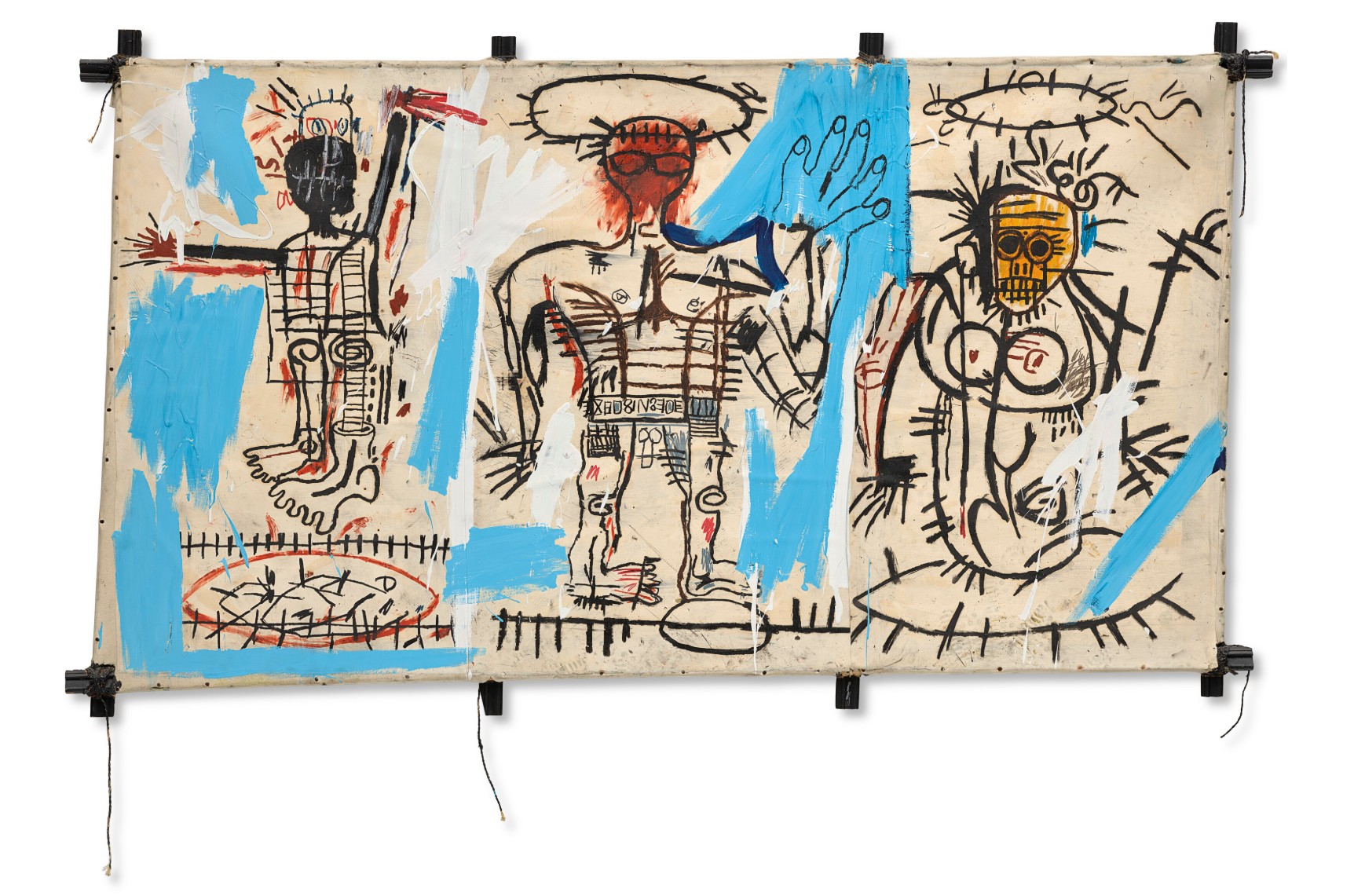
JEAN-MICHEL BASQUIAT (1960-1988)
Baby Boom, 1982
Acrylic, oilstick and paper collage on canvas mounted on tied wood supports
49×84 inches (125 x 213.5 cm)
Signed, titled and dated ‘‘Baby Boom’ Jean-Michel Basquiat Aug. 1982’’ (on the reverse)
Provenance
Galerie Bruno Bischofberger, Zurich
Akira Ikeda Gallery, Tokyo
Galerie Enrico Navarra, Paris
Private collection, New York
Anon. sale; Phillips de Pury & Luxembourg, New York, 15 May 2001, lot 31
Acquired at the above sale by the present owner
Auction History
Christie’s New-York: 14 May 2025
Estimated: USD 20,000,000 – 30,000,000
USD 24,310,000
JEAN-MICHEL BASQUIAT (1960-1988), Baby Boom | Christie’s
Phillips New-York: 13 May 2001
Estimated: USD 700,000 – 900,000
USD 1,160,000
Painted in 1982, Baby Boom is one of the most significant works in Jean-Michel Basquiat’s early oeuvre. Exhibited in his now legendary show at New York’s Fun Gallery that same year, it is a work that helped to establish his reputation as one of the most revolutionary artists of the twentieth century. Depicting three figures, and rendered using Basquiat’s unique iconography, the painting also utilizes one of the artist’s hand-made supports. Constructed using discarded pieces of wood tied together with string, these unique supports attest to Basquiat’s revolutionary spirit. Identified by the Whitney Museum of American Art curator Richard D. Marshall as a representation of the artist together with his mother and father, Baby Boom becomes a particularly poignant example of the artist’s famed autobiographical paintings. A mark of this importance can be seen in its inclusion in many of Basquiat’s most important retrospective exhibitions, including those organized by the Brooklyn Museum of Art in 2005, the Fondation Beyeler and the Museé d’Art moderne d la Ville de Paris in 2010 (where it was illustrated on the cover of the catalogue), and the Fondation Louis Vuitton in 2019. In the same collection for the past twenty-five years, Baby Boom stands as a pivotal work in the canon of one of the twentieth-century’s most important and influential artists.
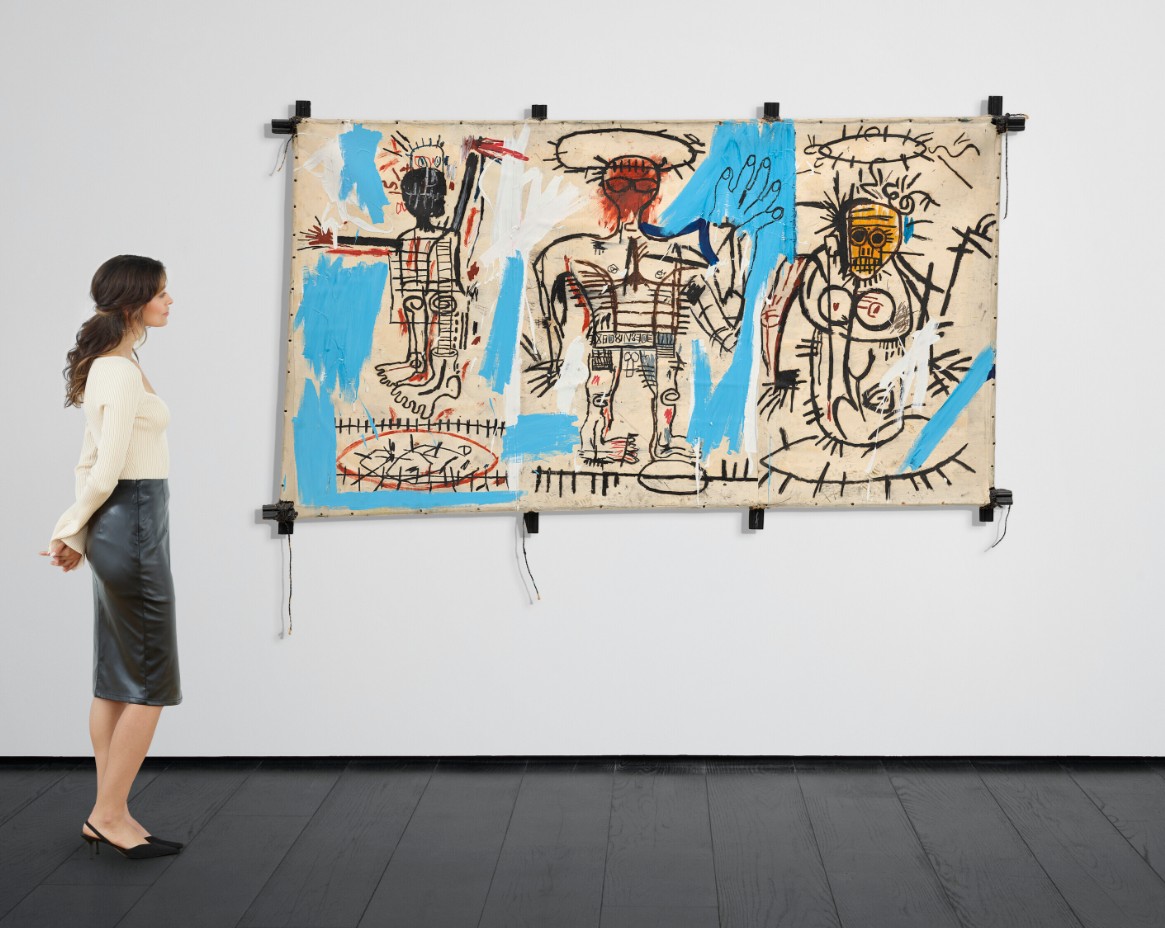
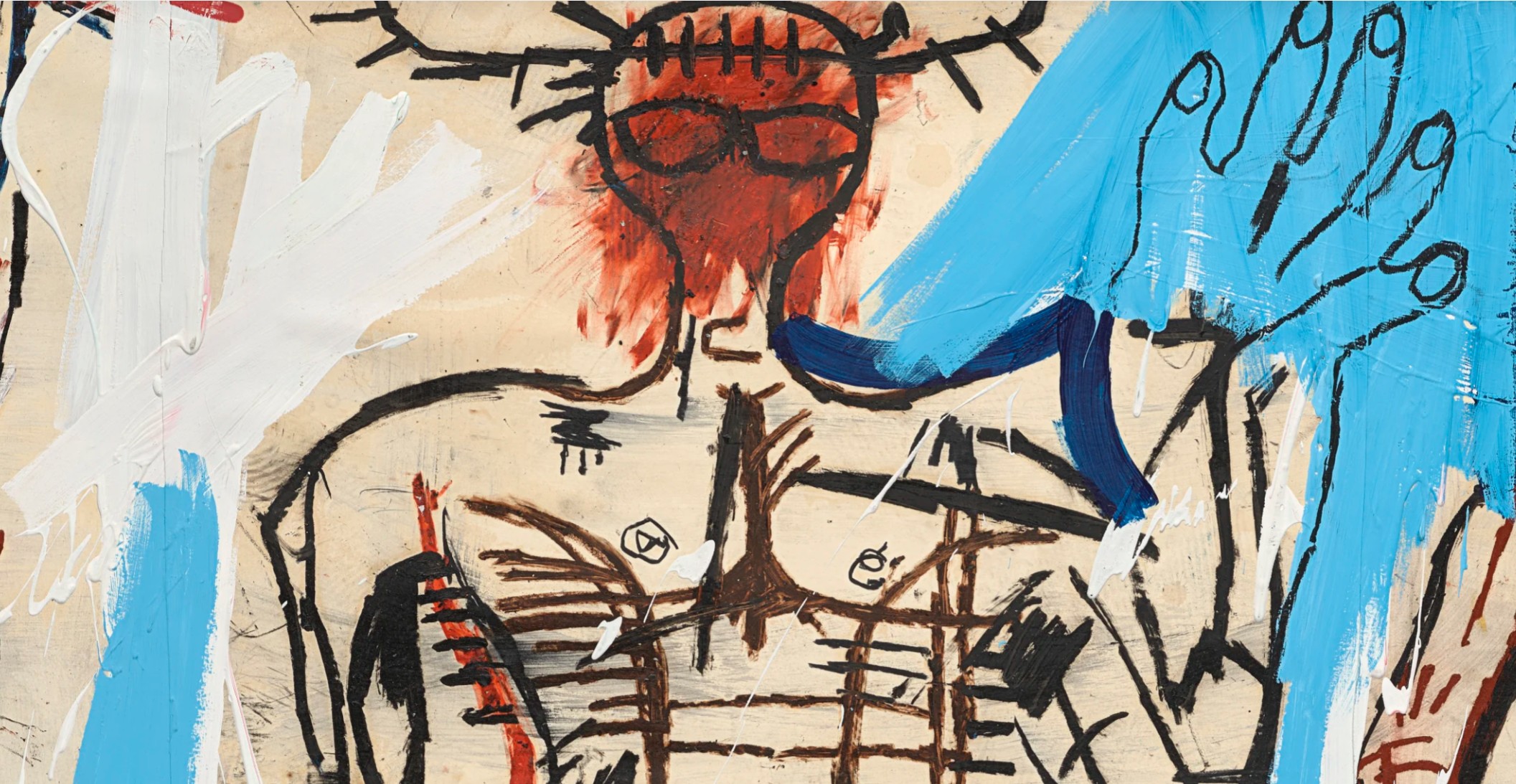
Across this expansive canvas, Basquiat renders three of his iconic figures. Comprised of fundamental gestures executed in oilstick, they are highly sophisticated drawings of the human figure. The central character is distinguished by its highly complex portrayal, in common with the most distinguished paintings in the artist’s oeuvre. Standing tall, with the right arm raised in an outsized greeting, this substantial figure is an exemplar of what curator Dieter Buchhart called Basquiat’s “existential line” (D. Buchhart, “Jean-Michel Basquiat: The Existential Line,” in Jean-Michel Basquiat, exh.cat., Fondation Louis Vuitton, Paris, 2018, p. 16). It traces out precise details of the figure, both skeletal and muscular and even what appears to be the individual motifs on a decorative belt.
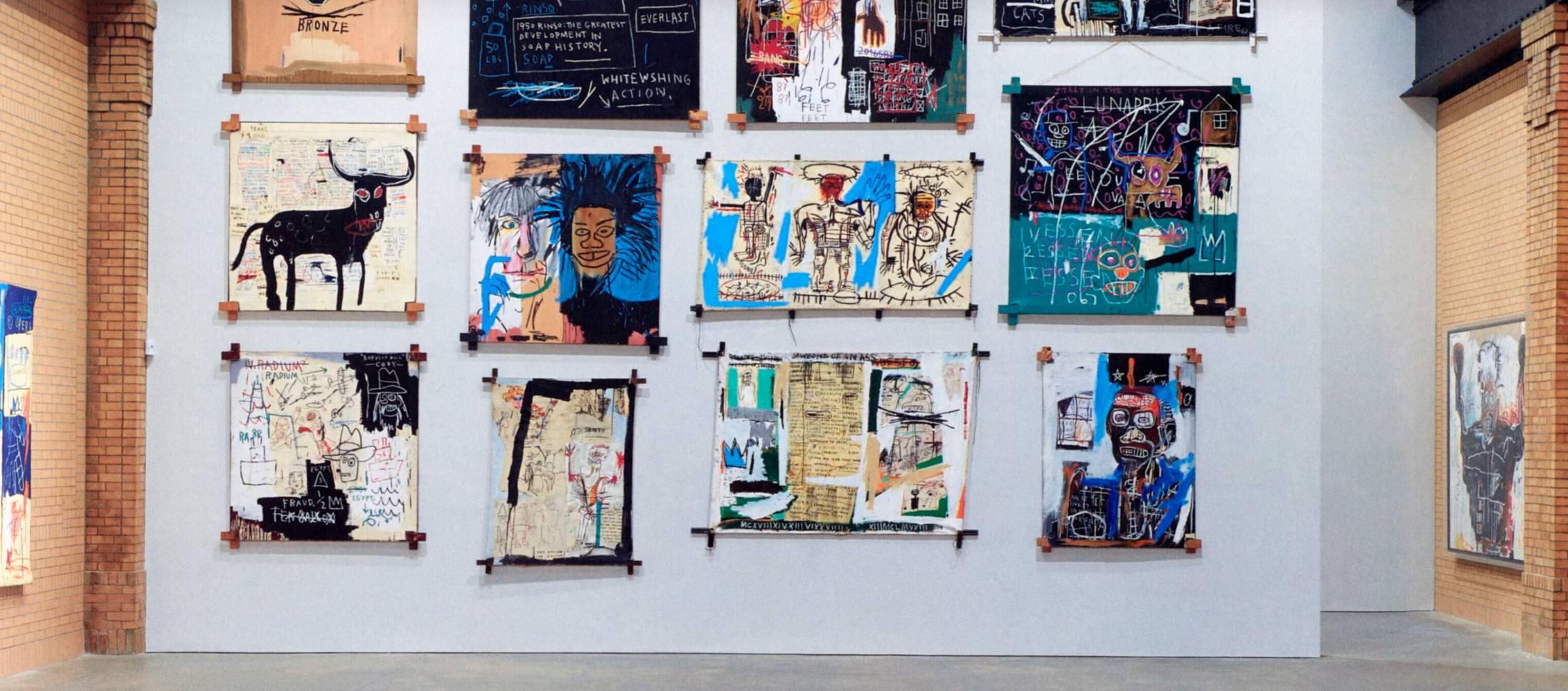
Installation view, Jean-Michel Basquiat, March 6 – May 14, 2019, Brant Foundation, New York (present lot illustrated). Photo: Tom Powel Imaging. Artwork: © Estate of Jean-Michel Basquiat. Licensed by Artestar, New York.
On the right of the canvas is a figure which is clearly female. While overall less intensively worked than the central figure, in this figure Basquiat concentrates his efforts on the head, as he does with many of his most accomplished paintings. On a foundation of yellow pigment, the artist draws the piercing gaze of a pair of dark eyes. Together with the flared nostrils and excited smile, this is by far the most expressive face of the trio, with the torso and arms of this vigorously depicted figure are finished to a high degree of animated detail.
The final figure, on the left, is a rendering of a smaller, almost childlike, figure. Arguably a self-portrait, the complex depiction of the face and body is in keeping with other representations that are thought to be of the artist himself. This figure is dominated by two large feet, drawn as if separated from the body. The dislocated nature of these limbs recalls Leonardo da Vinci’s notebooks of anatomical drawings, while also recalling the childhood injuries that Basquiat received after being hit by a car, and the subsequent gift of a copy of Gray’s Anatomy that he was given as a child to keep him occupied in hospital. Basquiat traces out the silhouettes of his figure using a complex array of thick black outlines and more sophisticated graphic marks. The substantial passages of black oilstick mark out the heads and limbs, while a more intricate pattern of grids fills out the torso. This figure is further animated by flourishes of vibrant red that adorn the limbs and body. Elsewhere, the composition is embellished with generous flourishes of blue and white acrylic paint.
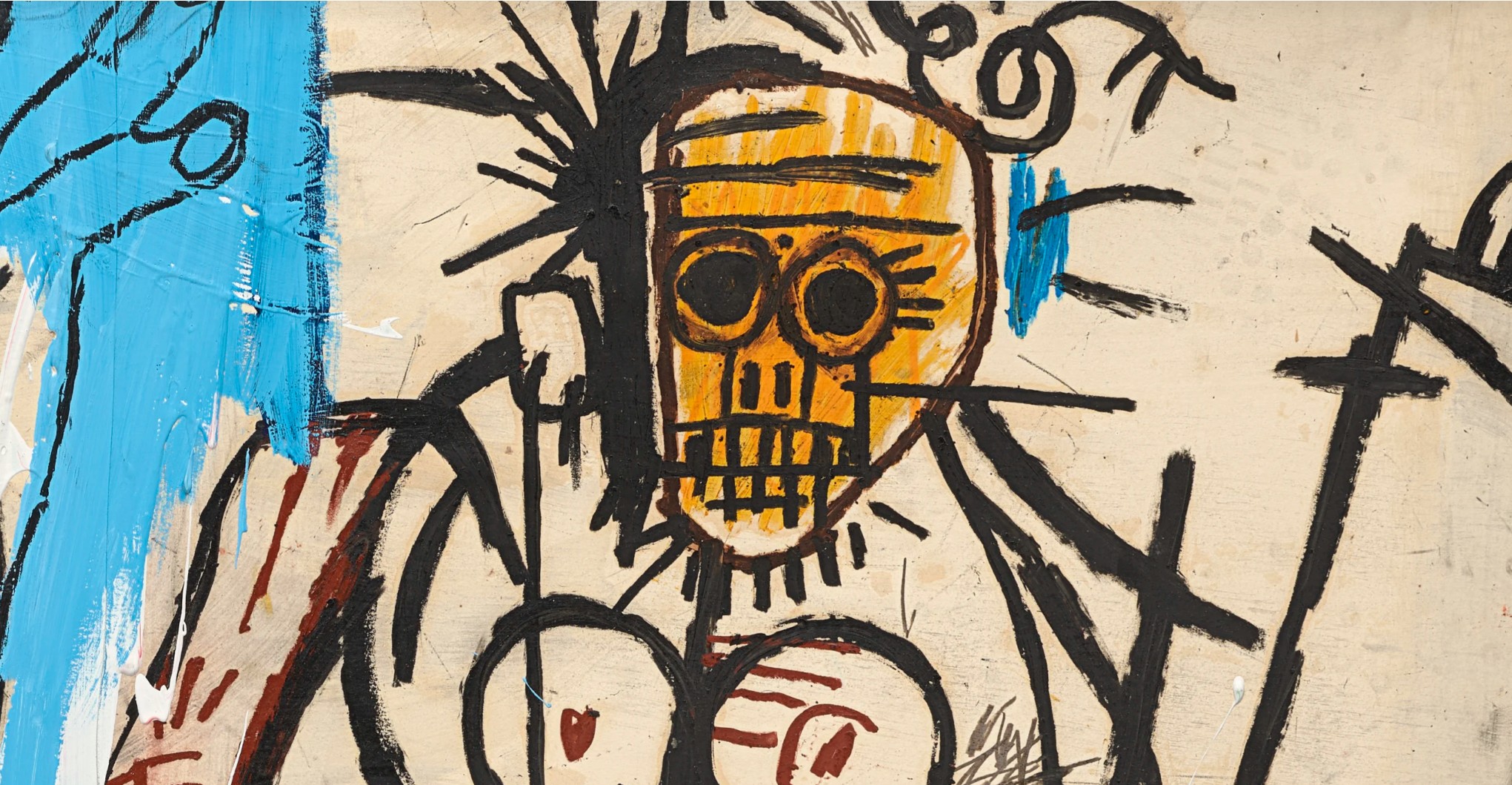
In the catalogue to his 1999 Basquiat retrospective organized by Museo Civico Castel Nuovo in Naples, the curator Richard D. Marshall identifies Baby Boom as a family portrait of the artist with his parents. “The title refers to the increased birth rate and family growth in America after 1950,” Marshall writes,” and the painting shows a prominent, skeletal-like father figure in the center, flanked by his mother on the right side, and the child artist at the left—all three figures crowned with the reverential and respectful halo” (R. D. Marshall, in A. B. Oliva, Basquiat A Napoli, exh. cat., Museo Civico Castel Nuovo, Naples, 1999, p. 46).
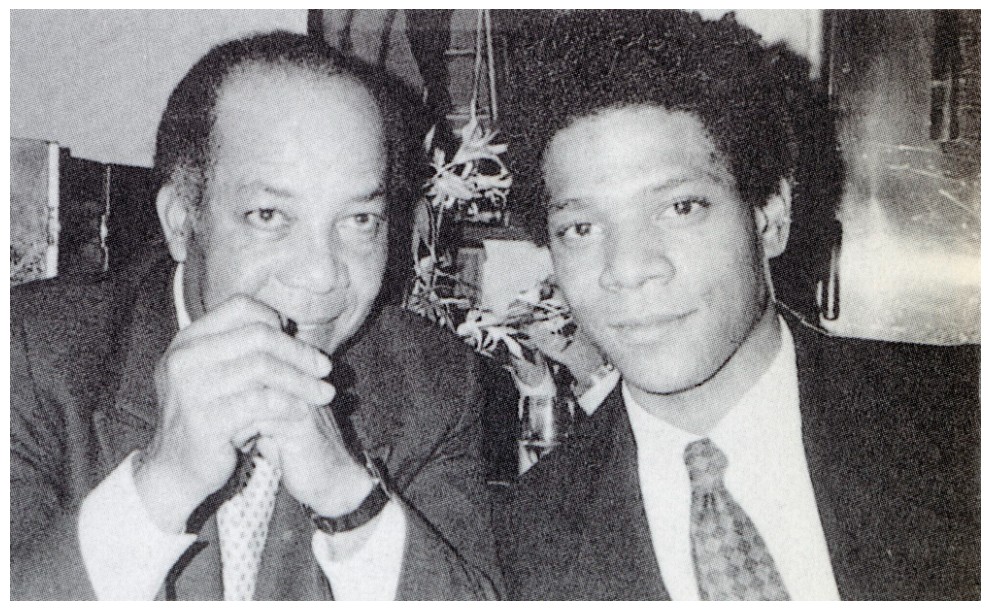
Gerard and Jean-Michel Basquiat, New York, 1985. Photo: Zindman / Fremont.
As such this is a rare painting. Although Basquiat often alludes to himself in his paintings, and occasionally to father- and mother-like figures, it is rare to see all three in one painting. Although Basquiat had a challenging youth, his parents were central to his life. He was born the second of four children to Matilde Basquiat (neé Andrades) and Gérard Basquiat. His father was born in Port-au-Prince, Haiti, and his mother was born in Brooklyn to Puerto Rican parents. His mother instilled in Basquiat a love of art, taking him to museums as a child and encouraging him to become a junior member of the Brooklyn Museum of Art. At the age of seven, Basquiat was hit by a car while playing in the street, and while convalescing in hospital his mother brought him a copy of the medical reference book, Gray’s Anatomy. This would prove to be far-sighted, as Basquiat’s later anatomical drawings would become one of the defining aspects of his career. After his mother and father separated when Basquiat was just seven, Basquiat and his two younger sisters were raised by their father. While Basquiat’s relationship with Gérard was complicated, Basquiat senior remained an important and influential part of his son’s life, as his gallerist Annina Nosei attested.
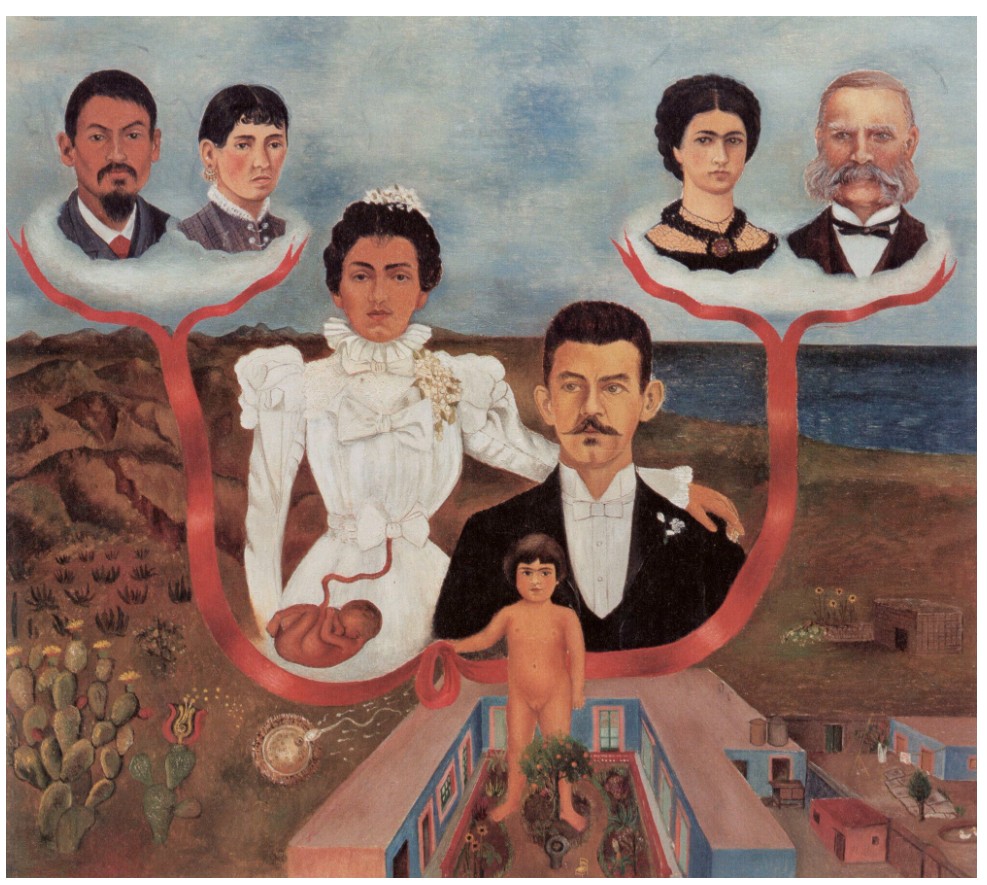
Frida Kahlo, My Grandparents, My Parents and I, 1936. Museum of Modern Art, New York. © 2025 Banco de México Diego Rivera Frida Kahlo Museums Trust, Mexico, D.F. / Artists Rights Society (ARS), New York.
In addition to its personal iconography, Baby Boom is also a remarkable example of the unique structures Basquiat often adopted as his supports. From his earliest days as a street artist, he had sequestered a wide range of objects and materials to use as surfaces for his paintings: from walls and wooden doors, to more unusual surfaces such as radiators and refrigerators, the artist embraced any and every surface as a place to make his mark. In the present work Basquiat, constructed this support consisting of strips of wood that are more often used as a dado or chair rail in interior decoration, tied together with pieces of string. Dividing the canvas support into three ‘sections’ recalls the altarpieces of the European Northern Renaissance. Art historian Fred Hoffman argues that these ‘multi-panel’ structures are a deliberate, rather than inadvertent choice. It is designed to link his work to that of the Renaissance masters, and the gravity of the themes and issues they were tackling. The critic John Berger points out the altarpiece was originally planned to encompass the totality of life and provide an explanation of the world. In that context, the present work becomes a votive experience, and like its predecessors that drew people from the temporal to the spiritual, Basquiat’s work helps to explain his vision of the world and proposes that the viewer approach his subject with a degree of reverential submission.
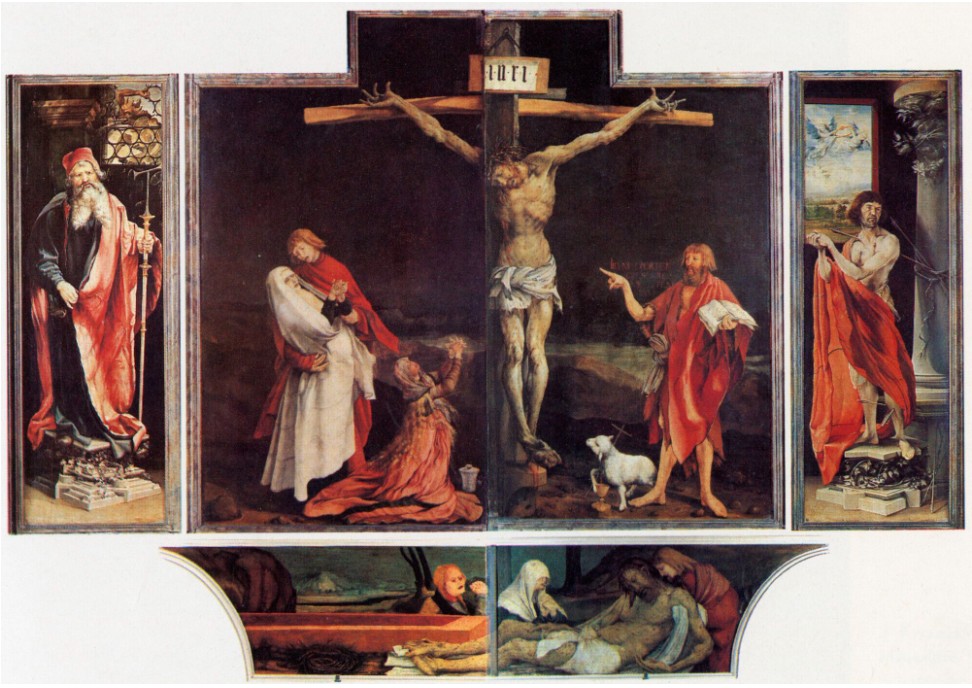
Matthias Grünewald and Niclaus of Haguenau, Isenheim Altarpiece, 1512-1516. Musée Unterlinden, Colmar.
This unusual format has few equals in twentieth-century art. Francis Bacon was among the celebrated proponents of this format, although both conceptually and philosophically they differ from Basquiat’s work. The British artist’s multi-paneled paintings often imply the passage of time or some form of linear transformation, whereas Basquiat’s paintings reveal all their meanings at once. Executed in 1982, Baby Boom was included in Basquiat’s now legendary show at the FUN Gallery in New York. Started in 1981 by Patti Astor and Bill Selling on East 10th Street on the city’s Lower East Side, the gallery soon became known for showing a new generation of street artists. The first gallery in the East Village, it quickly emerged as the place where art, hip hop, and breakdancing came together, attracting the city’s hippest and coolest crowd. According to Astor, when she first met Basquiat, the artist was homeless but the pair soon struck up a strong friendship which resulted in her offering him a show at the gallery. Basquiat built custom walls in the space for his show of about 30 works, many of which featured custom supports. Astor claimed that this show was the only formal show where the artist was totally free, and felt that it contained some of his best work ever. Baby Boom belongs to a special group of paintings created in that summer and fall of 1982, shortly after Basquiat’s solo exhibitions with Annina Nosei in New York and Larry Gagosian in Los Angeles. Many of these works, which include the earliest iteration of Basquiat’s now iconic exposed stretcher bars, were then exhibited at FUN Gallery in November 1982, establishing its reputation as one of the most consequential art exhibitions in a generation. In the chronology of Basquiat’s life, he regarded this raw and ambitiously creative period as the zenith of his career.