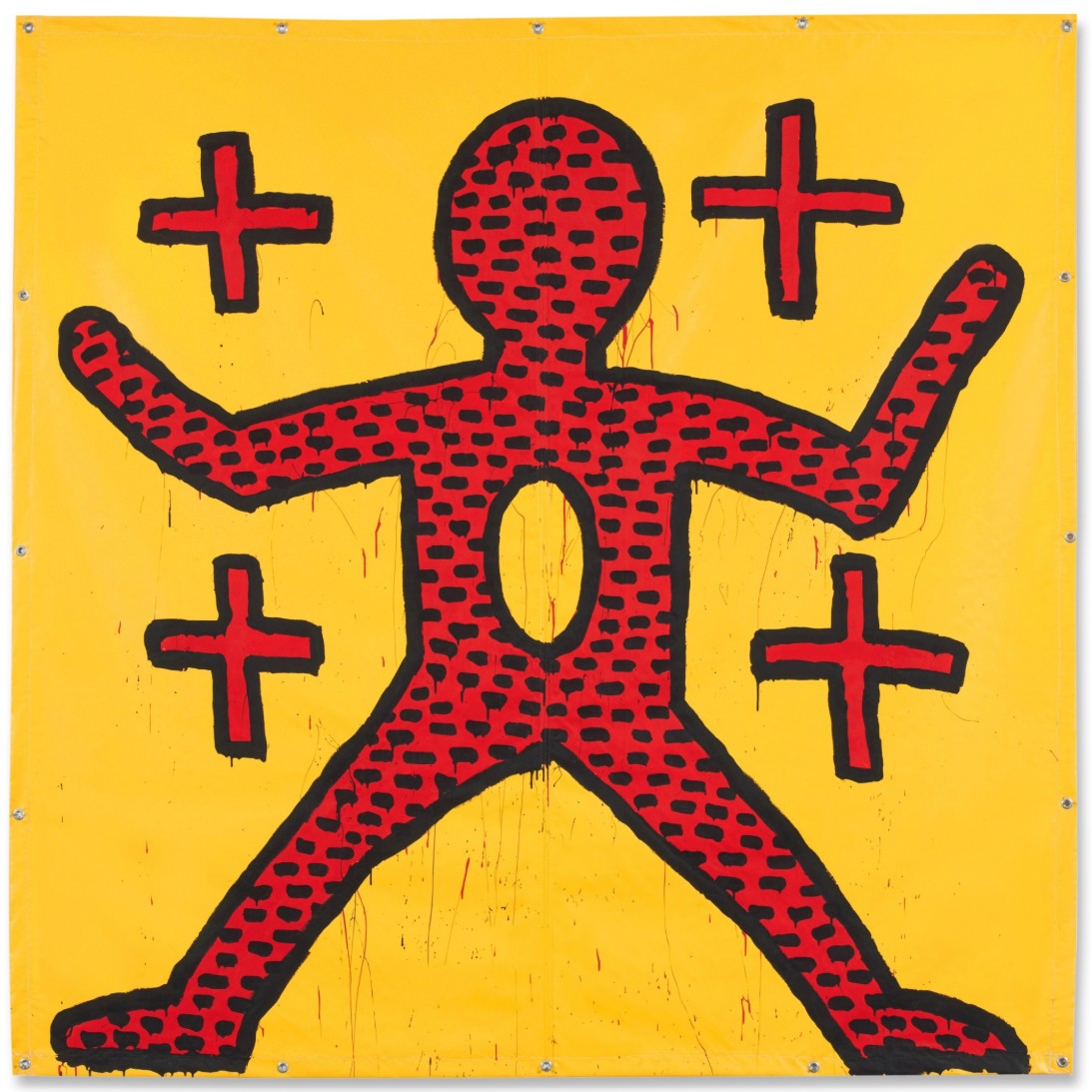
KEITH HARING (1958 – 1990)
Untitled, 1981
Acrylic on vinyl tarpaulin
97 1/4 x 96 1/2 inches (247 x 245.1 cm)
Signed and dated 1981 (on the reverse)
Provenance
Tony Shafrazi Gallery, New York
Acquired from the above in 1983 by the present owner
Auction History
Works from the Collection of Kamran Diba
Sotheby’s New-York: 19 November 2025
Estimated: USD 2,200,000 – 3,200,000
USD 2,246,000
Untitled | Contemporary Day Auction | 2025 | Sotheby’s
Painted in 1981, Untitled stands among the earliest and most historically significant of Keith Haring’s iconic tarpaulin works. Executed shortly after his move to New York in 1978 to study semiotics at the School of Visual Arts, Untitled represents Haring’s crystallization of his visual language in the subways and streets of downtown Manhattan. This work embodies this critical period of production for the artist, distinguished by Haring’s guerrilla-style artistic practice that transformed urban walls into sites of dialogue between the artist and his captive audience. Untitled captures this urgency and immediacy: a single and searing red figure, pulsating with energetic brushstrokes of dazzling red and black against a vibrant yellow ground. The figure’s open and punctuated center creates a void charged with symbolic power, dripping with pathos and an overwhelming sense of immediacy.
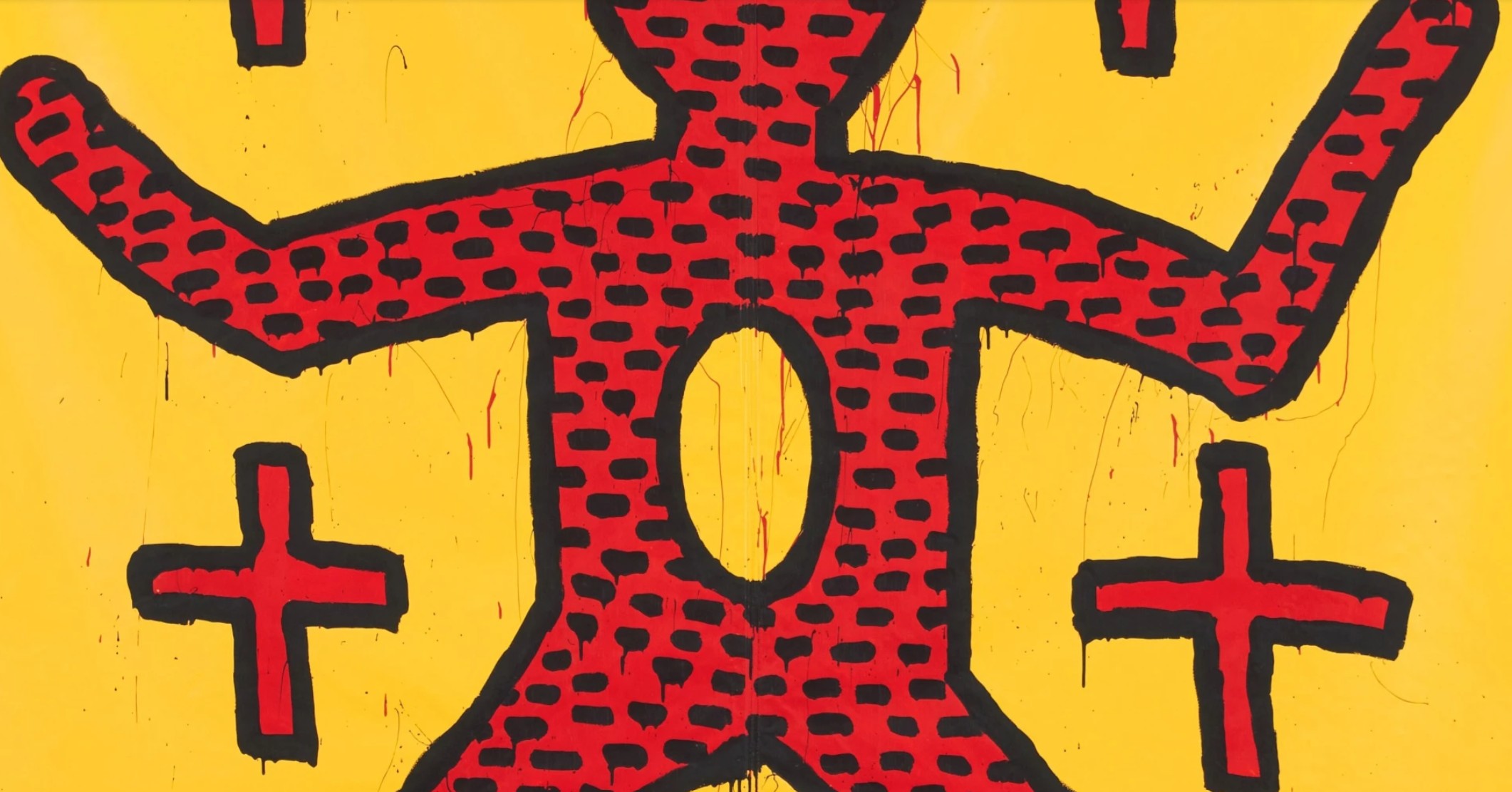
Haring’s choice of industrial tarpaulin was a groundbreaking and inventive move by the artist, who began transforming and engaging with found objects early within his artistic practice. By appropriating a material more commonly used for street signage, Haring collapsed the boundary between high art and the everyday, democratizing the very surface of painting. Untitled was among the first works Haring created on tarpaulin, signaling his radical approach to materiality and visual storytelling. The physicality of the medium evokes the grit and texture of the urban landscape while affirming Haring’s belief that art should be accessible, public and alive with social energy.
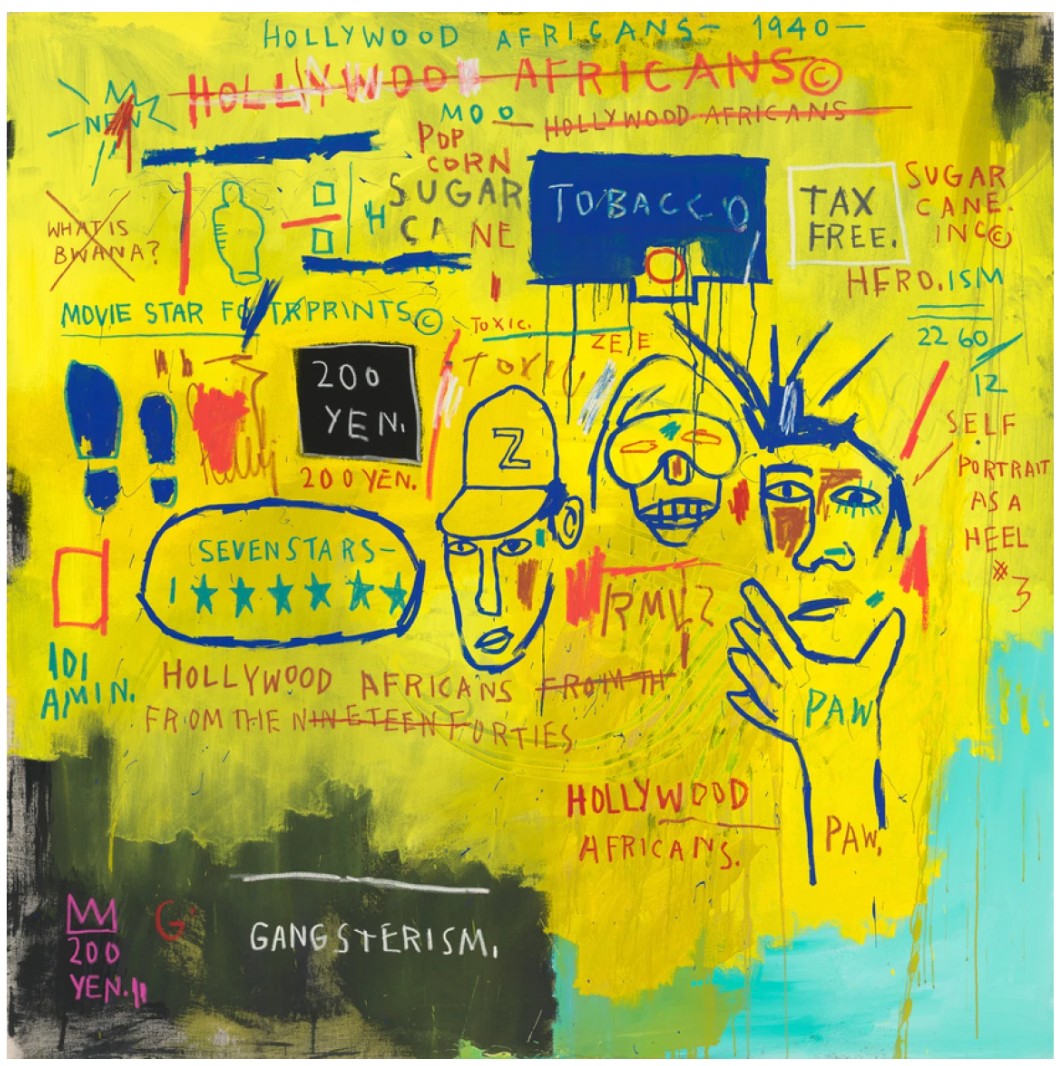
Jean-Michel Basquiat, Hollywood Africans, 1983. Whitney Museum of American Art, New York.
© The Estate of Jean-Michel Basquiat. Licensed by Artestar, New York
The composition of Untitled resonates deeply with the cultural and political climate of early 1980s New York. The figure’s hollowed torso and the surrounding crosses are charged symbols of both violence and transcendence. The present work channels the public anguish that followed the assassination of John Lennon, an event Haring learned about while at the Mudd Club. Haring translated the overwhelming collective grief into a universal form of language, as evidenced in only his most compelling artworks, a powerful visual language distills and captures the public conscience. In Untitled, the image of the hollowed torso came to Haring in a dream after Lennon’s assassination. Haunted by the profound loss of a celebrated creative and artistic icon, Haring utilized the public outcry to create this impassioned masterwork, that distills not only this distinctive moment in New York history, it typified Haring’s visual vernacular as a champion and conduit to his audience. The crosses, recurring motifs in his early iconography, suggest the burden of power structures that Haring sought to subvert throughout his storied career. The symbols that punctuate the surface of Untitled operate as signs through which Haring urged his generation to live freely and authentically in defiance of dogma and conformity.
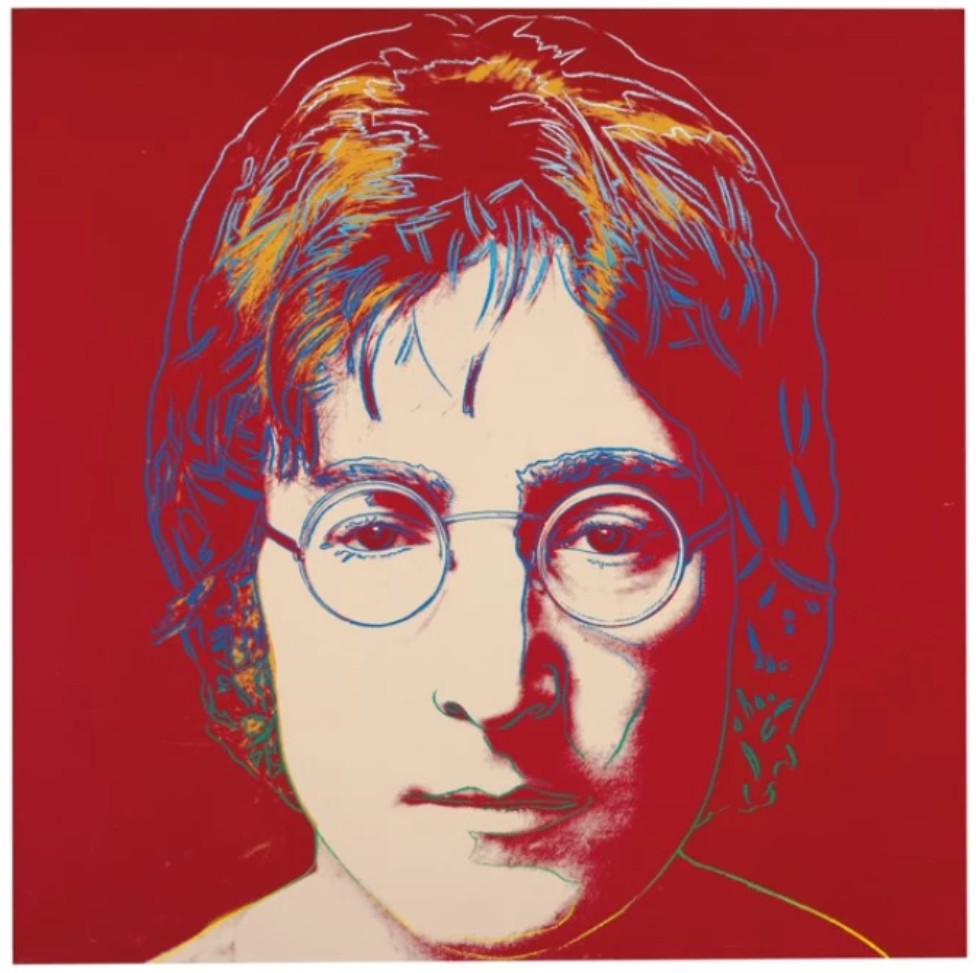
Andy Warhol, John Lennon, 1985-86. Private Collection.
Art © The Andy Warhol Foundation for the Visual Arts, Inc. / Licensed by Artists Rights Society (ARS), New York
As one of the earliest manifestations of Haring’s signature vocabulary, Untitled encapsulates the artist’s transition from the streets to the studio. Having famously debuted his visual lexicon with subway drawings in the New York City subway, Haring transitioned to canvas and monumental scaled works designed for gallery and institutional contexts. In 1982, Haring was formally represented by Tony Shafrazi Gallery, which created a shift in his formal practice, by refining the balance between his street-born immediacy and the formal discipline required to produce artworks for exhibitions. The present work represents a critical point of artistic evolution retaining the raw energy of the streets while asserting the compositional rigor and symbolic depth that would define his mature practice.
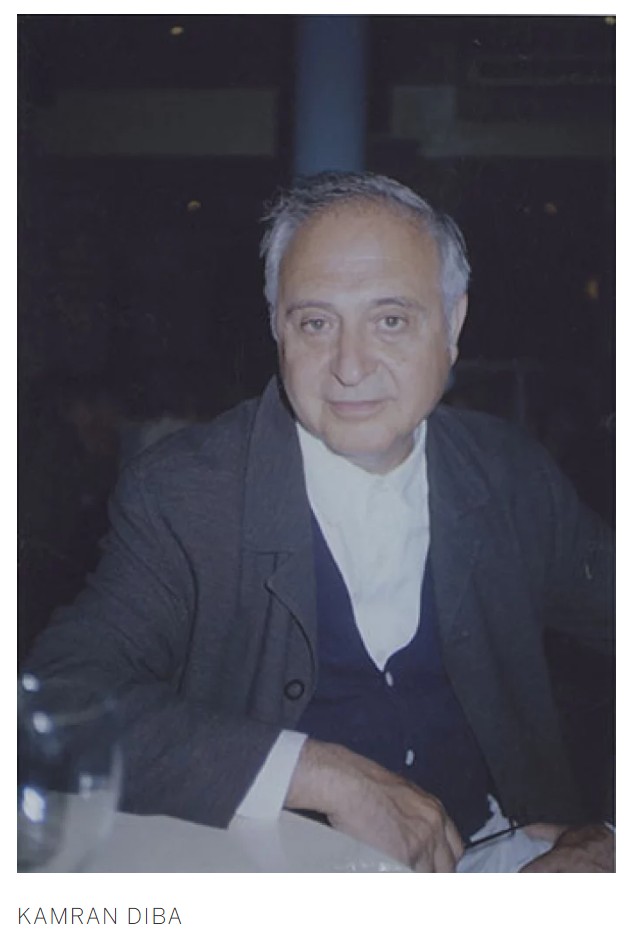
That Untitled entered the collection of Kamran Diba, the visionary architect and founding director of the Tehran Museum of Contemporary Art, enriches its resonance. Diba’s pioneering vision – grounded in cultural dialogue between East and West and in the democratization of art through architecture – finds a natural kinship with Haring’s ethos of accessibility and universal communication. Diba’s affinity for artists whose work carries a social pulse and graphic immediacy is embodied in his acquisition of this painting. Both figures shared a conviction that art could transcend borders, whether geographical, social, or ideological. Diba’s own architectural legacy – particularly the Tehran Museum’s subterranean galleries inspired by Persian vernacular forms – reflects the same synthesis of tradition and modernity that animates Haring’s art.
Untitled has been widely exhibited internationally, including at the Castello di Rivoli in Turin, the Deichtorhallen in Hamburg, the Musée d’Art Moderne de Paris, and the de Young Museum in San Francisco. Bearing a robust exhibition history and its inclusion in major retrospectives such as Keith Haring: The Political Line (2013 – 15) and About Art (2017) underscores its status as an exceptional, early example within Haring’s oeuvre.
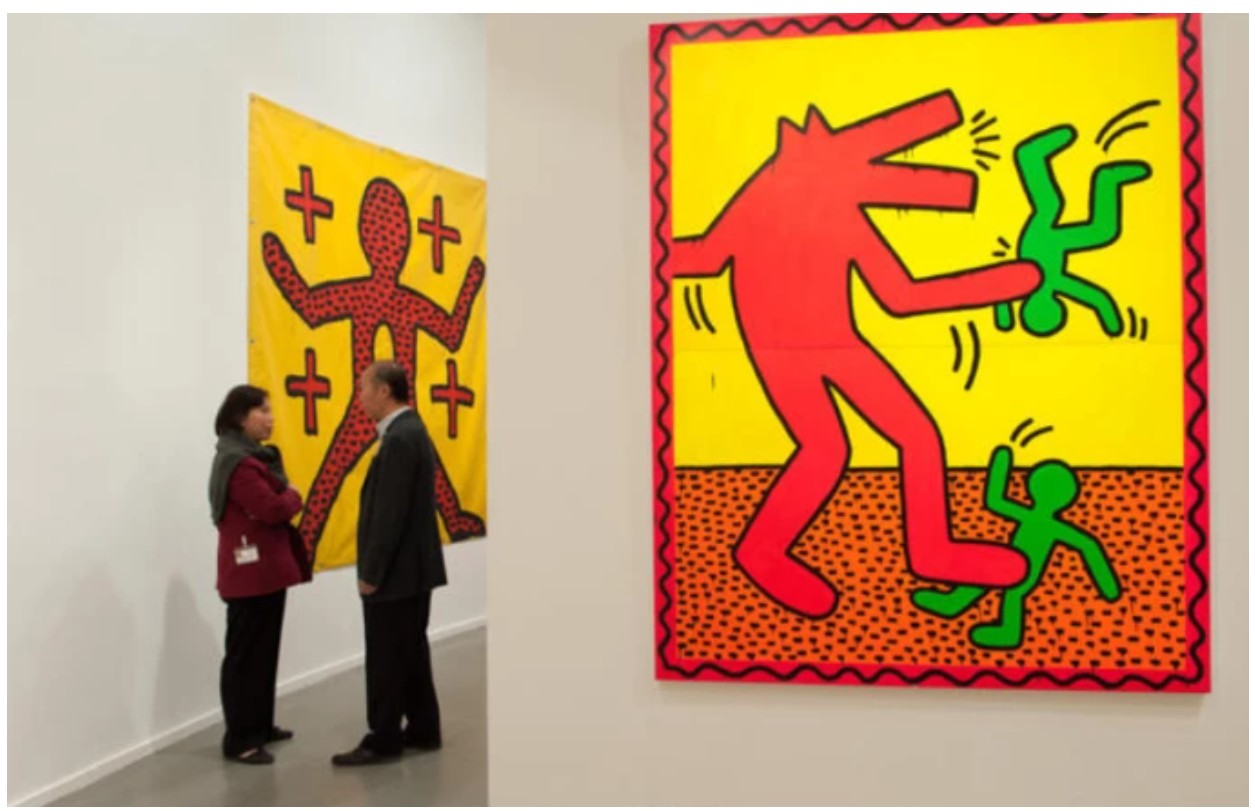
The present work installed in Keith Haring: The Political Line at the Musée d’Art Moderne de Paris, 2013.
As both an artifact of early 1980s New York and a timeless image of human resilience, Untitled embodies the intersection of art and social consciousness. Its union of formal simplicity, spiritual symbolism, and political immediacy situates it among the most compelling expressions of Haring’s belief that art could act as a conduit for empathy and transformation, bolsters his enduringly relevant legacy.