Andy Warhol’s first important enterprise at the Factory are early box sculptures that came to define Pop art. Between March and April of 1964, Warhol executed about 100 iterations of his Campbell’s Tomato Juice Box, replicating the cardboard packaging used to ship the consumer staple that became Warhol’s most iconic subject. At once facsimile and original, those sculptures situate themselves between Marcel Duchamp’s readymades and the hand-crafted qualities of Jasper Johns’ sculptural ale cans. Alongside six other branded box sculptures he produced, the Campbell’s Tomato Juice Box series was presented at the artist’s groundbreaking exhibition at the Stable Gallery, New York in April that year.
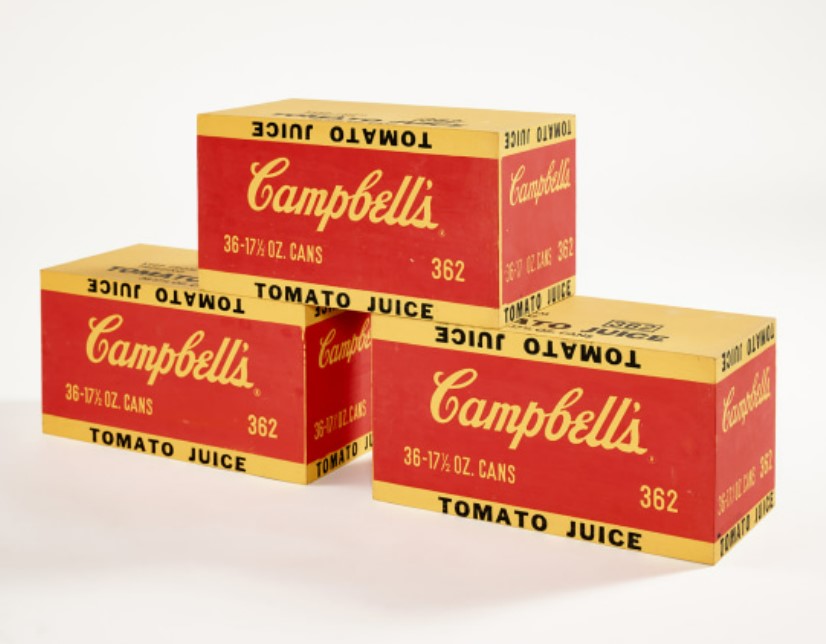
“Paintings are too hard. The things I want to show are mechanical. Machines have less problems. I’d like to be a machine, wouldn’t you?”
Introduction
The seeds of Warhol’s box sculptures were laid in early 1962 when he created a three-dimensional version of his serial Campbell’s Soup Can paintings. In November 1963, after Warhol expressed to John Weber from Dawn Gallery the possibility of advancing his soup can sculptures into sculptures of their packaging in which they arrive at supermarkets, Weber exclaimed, “Your idea of making cardboard boxes is sensational!” Over the course of the next five months, Warhol produced seven series of Campbell’s Tomato Juice, Heinz Tomato Ketchup, Kellogg’s Corn Flakes, Del Monte Peaches, Mott’s Apple Sauce, and two types of Brillo packaging in anticipation of his Stable Gallery exhibition. Upon the show’s opening, eager visitors lined up outside as attendees wriggled their way through the small rooms packed with Warhol’s boxes. As critic Lawrence Campbell described of the show, “Andy Warhol is the most extreme of the Pop artists, and his shows are invariably more interesting as ideas…There was a curious effect on the gallery; it became the storage room of an A&P. And the A&P became an art gallery—one found oneself avoiding the cartons as though they had suddenly become valuable.”
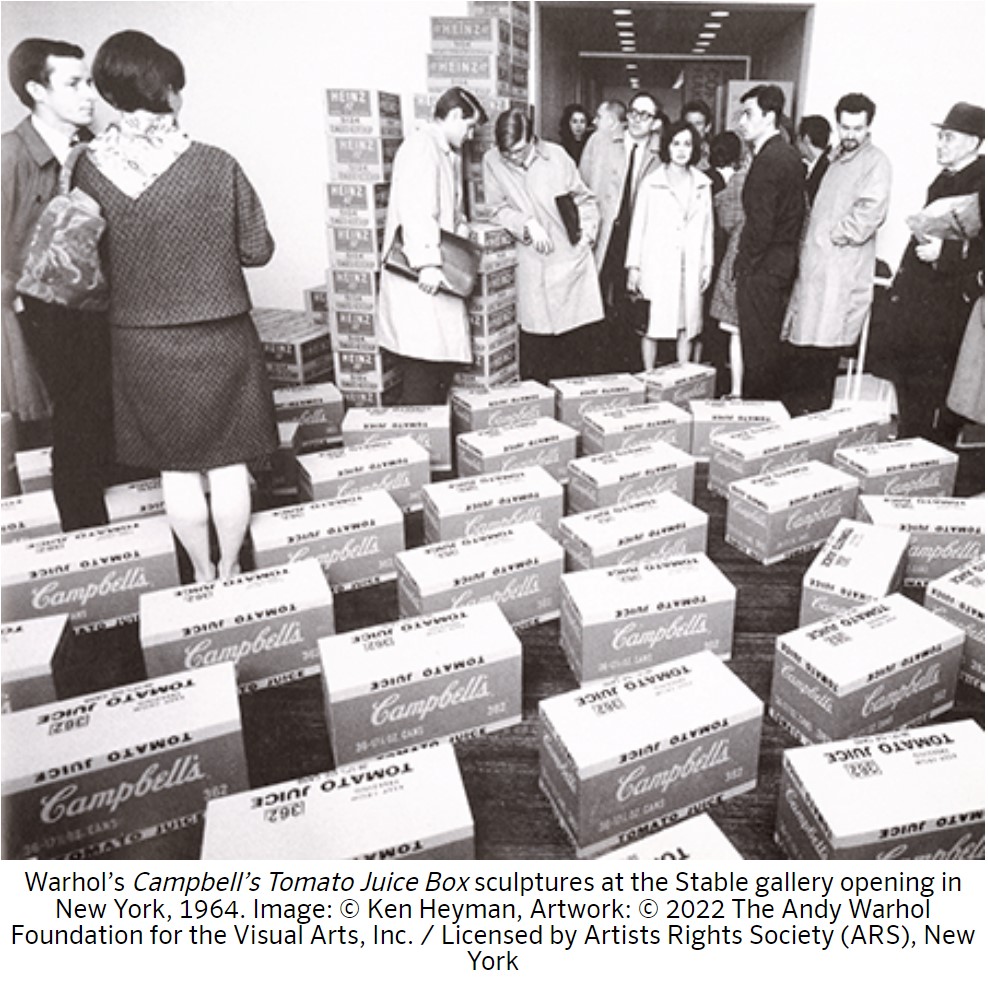
The box sculptures marked the first major series produced at the artist’s revolutionary studio, the Factory on East 47th Street in Manhattan which he had just set up earlier that year. Georg Frei and Neil Printz noted in the artist’s catalogue raisonné that the rows of boxes “suggest[ed] an assembly line. Indeed, considering the quantity of their works, their typology as package, and the mode of their production, the box sculptures…seem to provide the probable context in which Warhol’s studio first came to be known as The Factory.”A perfect embodiment of this observation, the present set of three boxes reflects how Warhol’s fascination with factory-produced objects resulted in the conception of his Silver Factory, where his artistic process of producing dozens at a time in an assembly line mirrored the mass manufacturing of consumer goods. As Warhol’s assistant Gerard Malanga recalled, “Andy was fascinated by the shelves of foodstuffs in supermarkets and the repetitive, machine-like effect they created.
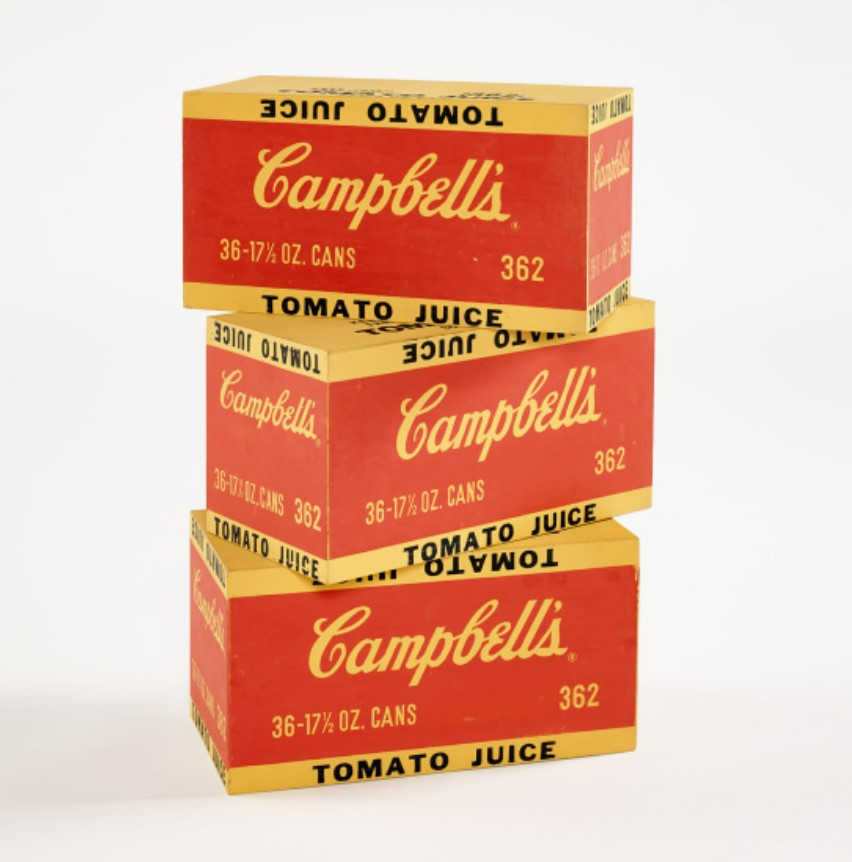
As hand-crafted facsimiles, Warhol’s box sculptures are both exact copies of their real-life counterparts and products of his own creation. Unlike Duchamp’s readymades, Warhol’s boxes were not objects found, but built. As the artist found cardboard unfeasible to work with, he hired carpenters to build plywood boxes that maintained the exact specifications of the actual cardboard packaging. Laying out stretches of brown paper on the studio floor, Warhol and Malanga then painted the backgrounds—in this case, yellow—and silkscreened the sides of the wooden boxes. Completing at least two sides a day and ultimately over a hundred sculptures within a month’s time, the speed of their screening process gave way to painterly drips and splatters, Duchampian chance slippages in the “manufacturing” process.
Campbell’s Tomato Juice Box
Three works: (i-iii) Campbell’s Tomato Juice Box, 1964
Phillips New-York: 18 May 2022
Estimated: USD 700,000 – 900,000
USD 1,058,500
Andy Warhol 20th Century & Contemporary Art Evening Sale
ANDY WARHOL
Three works: (i-iii) Campbell’s Tomato Juice Box, 1964
Silkscreen ink and house paint on plywood
(i, iii) 10 x 19 x 9.5 inches (25.4 x 48.3 x 24.1 cm)
(ii) 10 x 19 x 9.4 inches (25.4 x 48.3 x 23.8 cm)
Each stamped by the Estate of Andy Warhol
Respectively numbered “[SC 12.003, SC 12.004, SC 12.005]” on the underside
Provenance
The Andy Warhol Foundation for the Visual Arts, Inc., New York
Gagosian Gallery, New York (sold via Christie’s Private Sale)
Acquired from the above by the present owner
Emerging from Andy Warhol’s first important enterprise at the Factory, the present set of three Campbell’s Tomato Juice boxes belongs to the artist’s early box sculptures that came to define Pop art. Between March and April of 1964, Warhol executed about 100 iterations of his Campbell’s Tomato Juice Box, replicating the cardboard packaging used to ship the consumer staple that became Warhol’s most iconic subject. At once facsimile and original, the present sculptures situate themselves between Marcel Duchamp’s readymades and the hand-crafted qualities of Jasper Johns’ sculptural ale cans. Alongside six other branded box sculptures he produced, the Campbell’s Tomato Juice Box series was presented at the artist’s groundbreaking exhibition at the Stable Gallery, New York in April that year.
Campbell’s Tomato Juice Box, 1964
THE COLLECTION OF THOMAS AND DORIS AMMANN
Christie’s New-York: 18 November 2022
Estimated: USD 400,000 – 600,000
USD 554,400
ANDY WARHOL (1928-1987), Campbell’s Tomato Juice Box | Christie’s
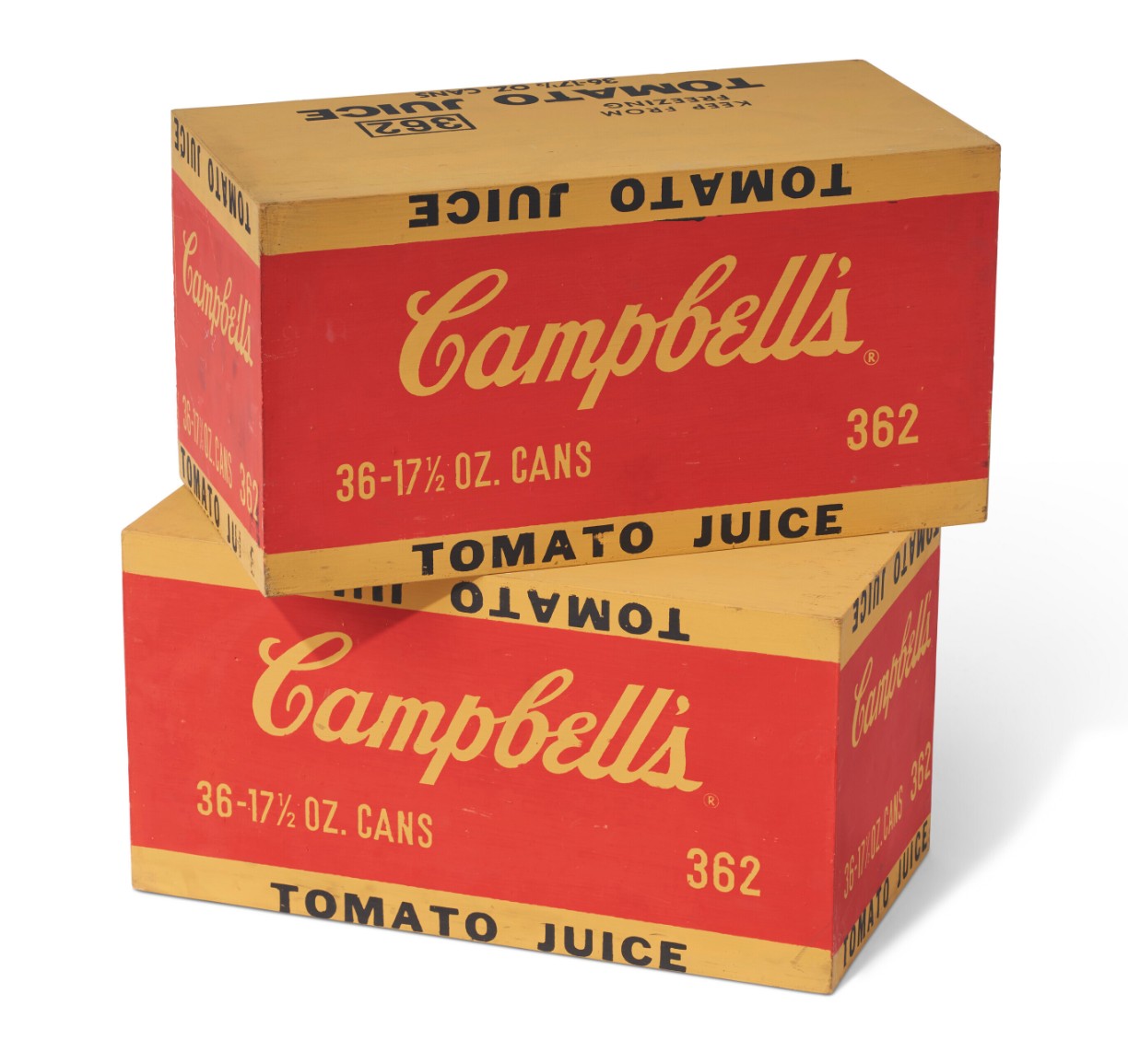
ANDY WARHOL (1928-1987)
Campbell’s Tomato Juice Box, 1964
Silkscreen ink and house paint on plywood
10 x 19 x 9 1/2 inches (25.4 x 48.2 x 24.1 cm)
Signed ‘Andy Warhol’ (on the underside)
Provenance
Jed Johnson, New York
Jay Johnson and Tom Cashin, New York
Thomas Ammann Fine Art AG, Zurich, 2013
Acquired from the above by the present owner
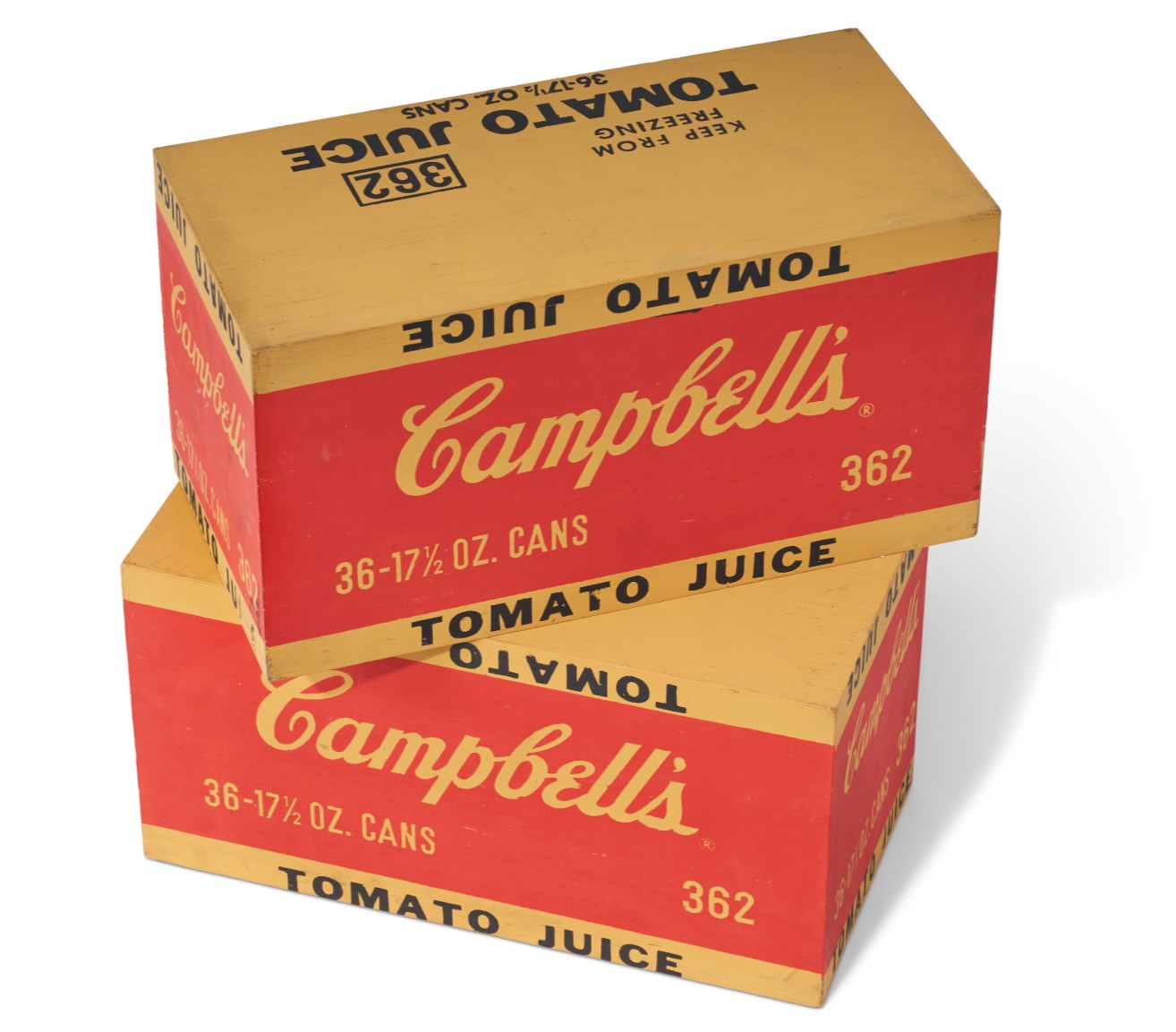
Campbell’s Tomato Juice Box, 1964
Christie’s New-York: 2 December 2020
Estimated: USD 200,000 – 300,000
USD 237,500
Andy Warhol (1928-1987), Campbell’s Tomato Juice Box | Christie’s
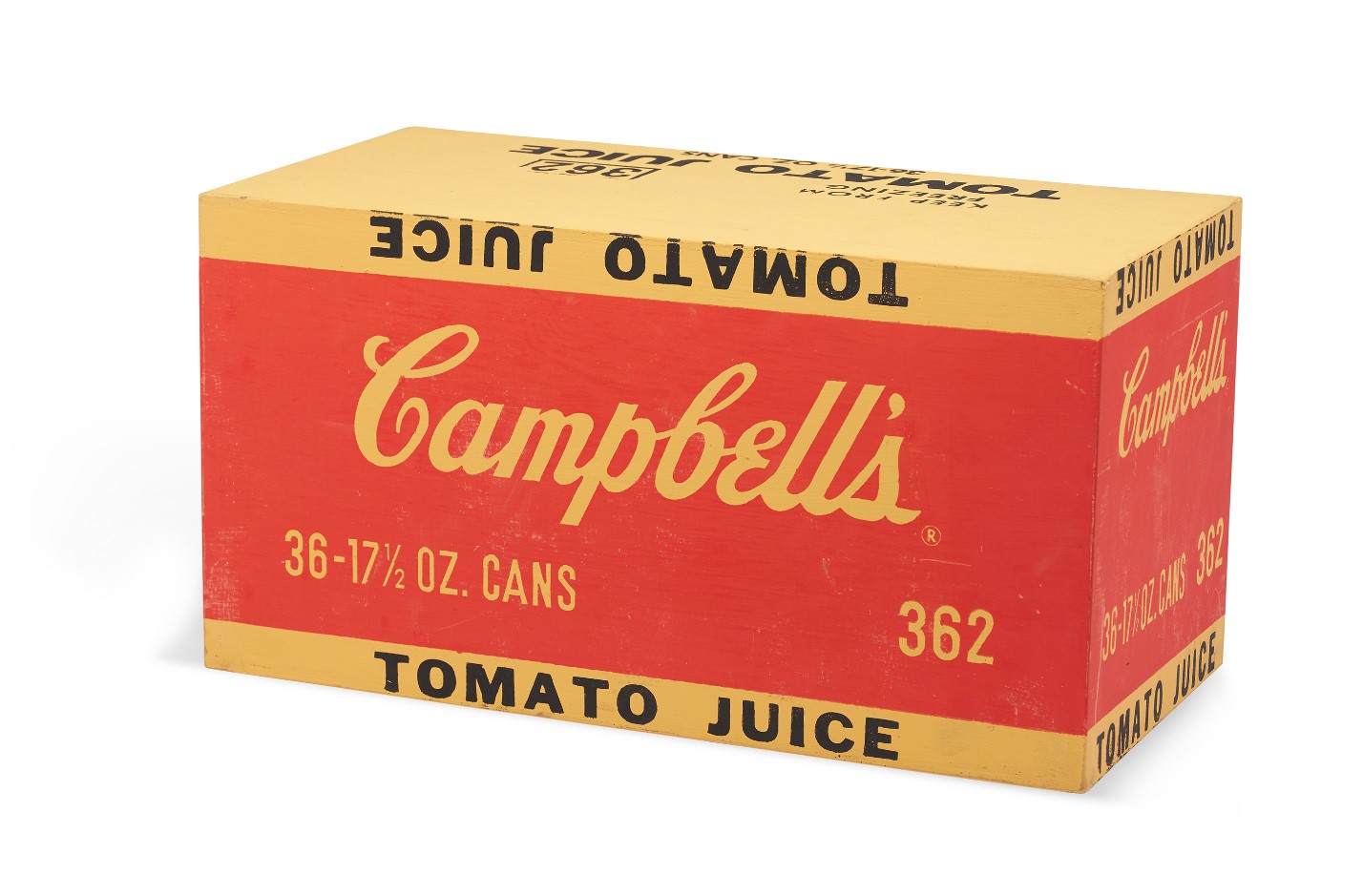
ANDY WARHOL
Campbell’s Tomato Juice Box, 1964
silkscreen ink and house paint on plywood
10 x 19 x 9.5 inches (25.4 x 48.3 x 24.1 cm)
An iconic piece of Pop Art, Campbell’s Tomato Juice Box was made as part of The Factory’s first series in the Spring of 1964. Warhol worked on seven branded boxes for this project, which also included Heinz Tomato Ketchup, Del Monte Peaches and the iconic Brillo boxes. Rendered in the brilliant red of the Campbell’s logo, Campbell’s Tomato Juice Box builds upon the 1962 Campbell’s Soup Cans, continuing Warhol’s deft perception between low culture and high art, the combination of arrestingly simple visual graphics with conceptual complexity. Representative of this much larger series, this particular box serves as an early example in Warhol’s development of his most remarkable achievement: the revolutionary silk-screening technique, in combination with his most famous brand partnership: “Andy was fascinated by the shelves of foodstuffs in supermarkets and the repetitive, machine-like effect they created” (G. Malanga, Archiving Warhol: Writings and Photographs, New York, 2002, p. 94).
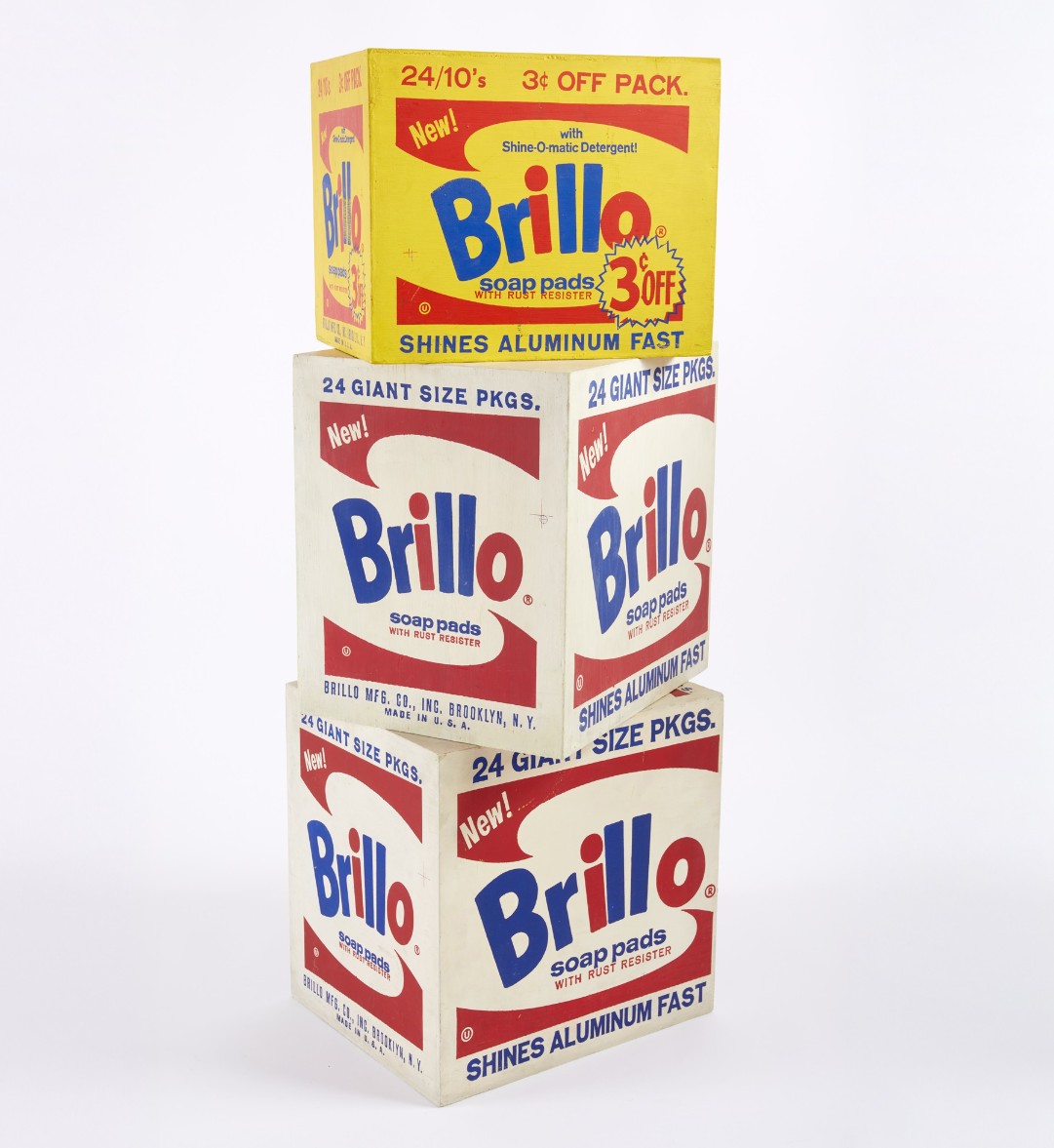
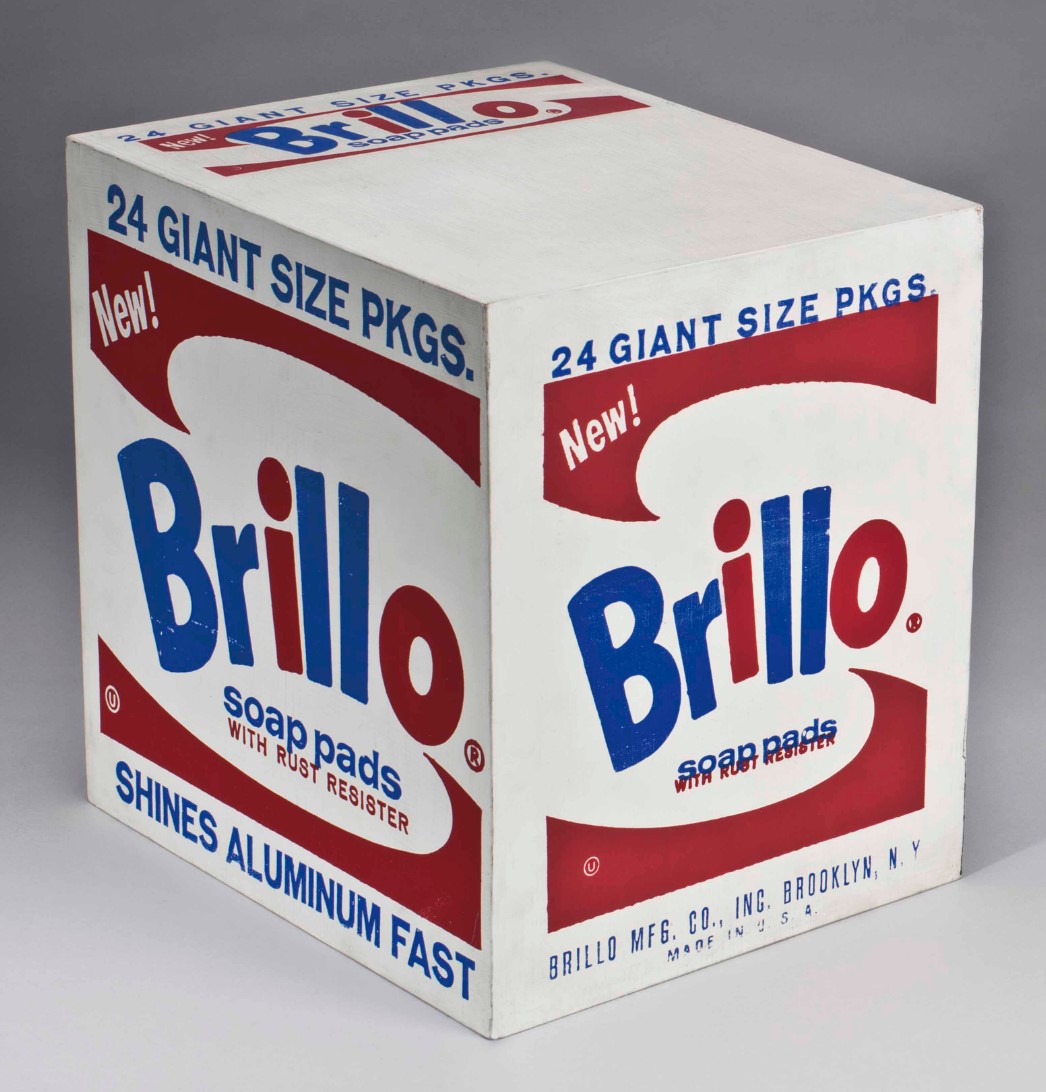
Brillo Boxes
Brillo Boxes, 1964
The Evelyn D. Farland Collection
Doyle New-York: 19 November 2025
Estimated: USD 900,000 – 1,500,000
USD 1,633,500
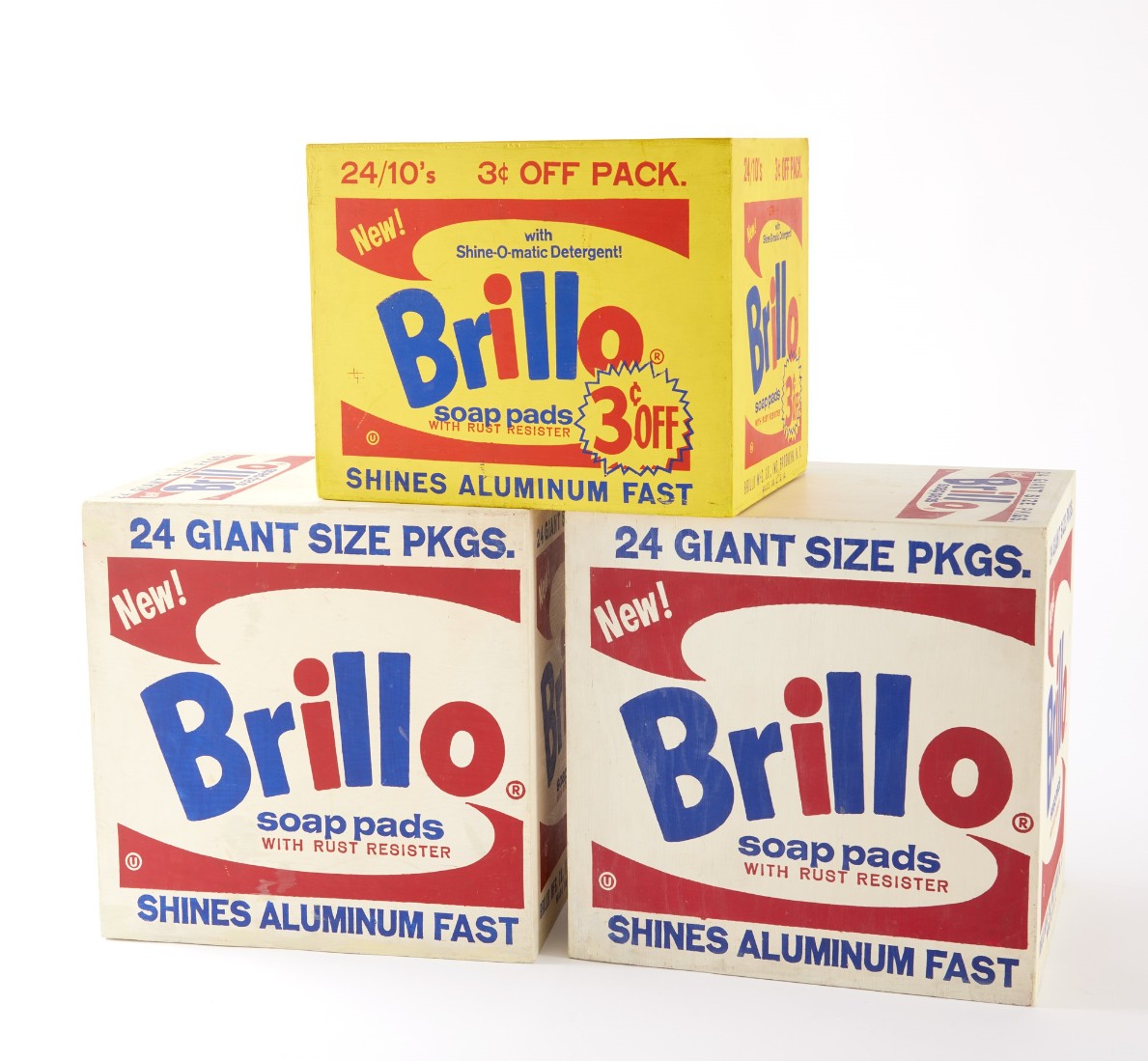
ANDY WARHOL (American, 1928-1987)
Brillo Boxes, 1964
Silkscreen on wood
White boxes, each: 17x17x14 inches (43.2 x 43.2 x 35.5 cm)
Yellow box: 13 x 16 x 11 1/2 inches (33 x 40.5 x 29.2 cm)
Signed Andy Warhol on the bottom of the yellow box
Provenance
Leo Castelli Gallery, New York
Mr. and Mrs. Peter M. Brant, New York
Sotheby Parke Bernet, Contemporary Paintings, Drawings and Sculpture, May 12-13, 1981, lot 233, illus.
Acquired from the above sale by Mr. and Mrs. Leo and Evelyn D. Farland, New York
Brillo Soap Pads Box, 1964
Christie’s New-York: 13 November 2014
Estimated: USD 300,000 – 400,000
USD 869,000
Andy Warhol (1928-1987), Brillo Soap Pads Box | Christie’s
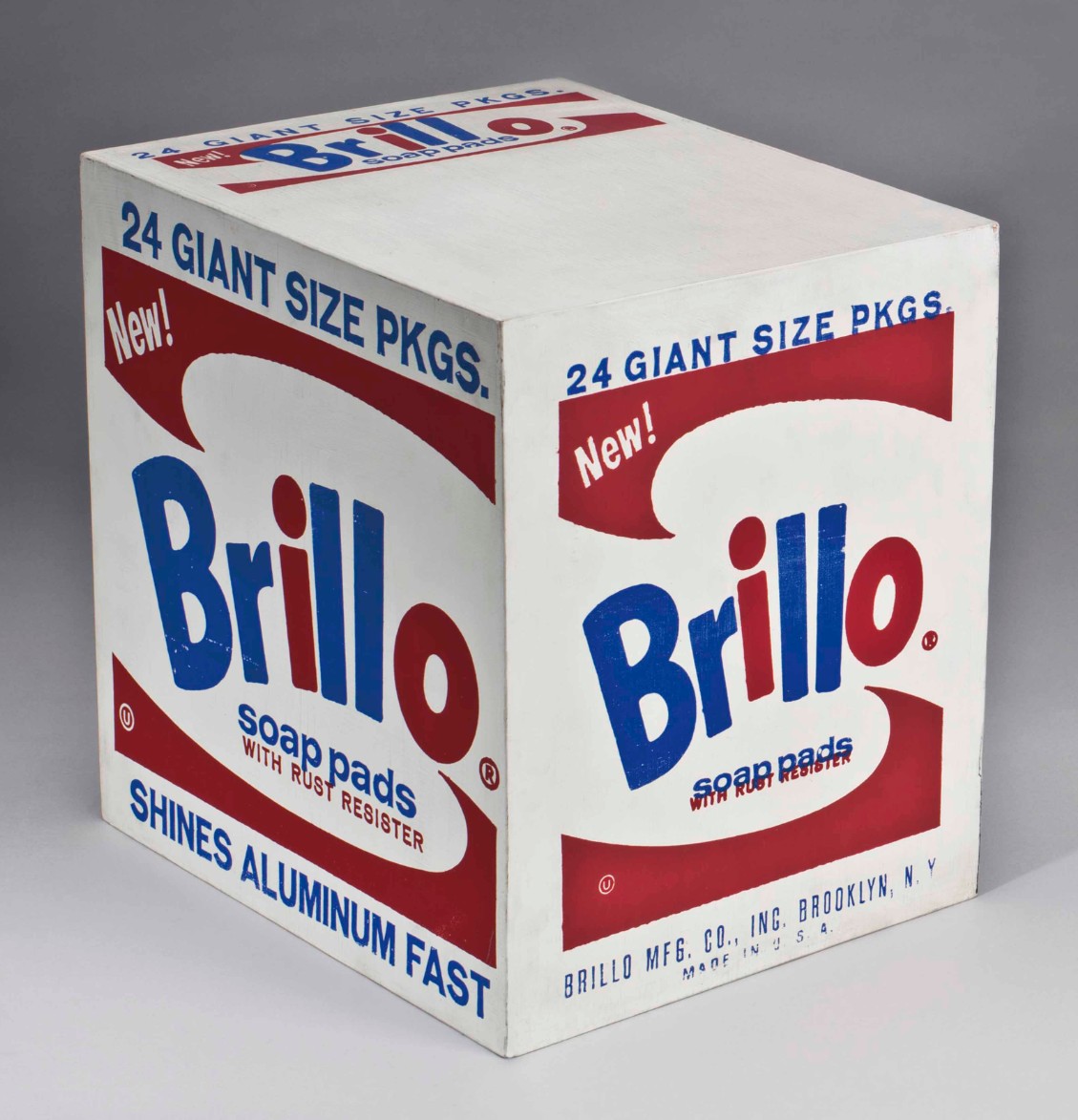
ANDY WARHOL (1928-1987)
Brillo Soap Pads Box, 1964
Silkscreen inks and house paint on plywood
17x17x14 inches (43.1 x 43.1 x 35.5 cm)
Provenance
Leo Castelli Gallery, New York
Acquired from the above by the present owner
In 1962, Andy Warhol began exploring the idea of creating a three-dimensional version of his serial paintings of Campbell’s soup cans. At around the same time, Warhol’s friend and photographer Edward Wallowitch took photographs for Warhol of supermarket boxes stacked on top of each other as part of the preparations for another sculpture that was ultimately never produced. Eighteen months later, Warhol had still not acted on his aspirations to create sculptures, but his desire was reignited after Dwan Gallery’s John Weber paid a visit to the artist’s studio and expressed great interest in Warhol starting a three-dimensional series, specifically one of wooden box sculptures. It was through this encouragement that Warhol finally started work on creating Brillo Soap Pads Box, a series that would forever alter the trajectory of art and its criticism.
By expanding his work into the sculptural realm with Brillo Soap Pads Box, Warhol successfully created art that went one step further than his previous two-dimensional work, such as Campbell’s soup cans. While the two-dimensional soup prints acted as representations of the kitchen staple, Brillo Soap Pads Box were not a representation, but rather an exact replica. As a result, Warhol’s Brillo Soap Pads Box questioned the role of popular culture and consumerism in fine art, while also further blurring the lines between art and reality. Later that same year, Arthur C. Danto dedicated a chapter of his essay for Art Forum to the time-honored question, ‘What is Art?’ and how Brillo Soap Pads Box in particular further complicated the answer to that question: “How is it possible for something to be a work of art when something else, which resembles it to whatever degree of exactitude, is merely a thing, or an artifact, but not an artwork? Why is Brillo Box art when the Brillo cartons in the warehouse are merely soap-pad containers?” (A.C. Danto, Artforum, September 1993). Danto’s question perfectly exemplifies the way in which Warhol’s decision to reproduce boxes with strikingly ordinary and recognizable imagery forever changed the way we value and define art. While some may view Warhol’s decision to recreate mundane, commonplace, mass-produced items and place them in a gallery setting as his way of poking fun at the art market, Warhol actually never intended it as an offense. On the contrary, Warhol was bravely choosing to celebrate, not ridicule, the commercial nature of the art market, something he greatly revered.
Brillo Soap Pads Box, 1964
Christie’s New-York: 13 November 2014
Estimated: USD 300,000 – 400,000
USD 869,000
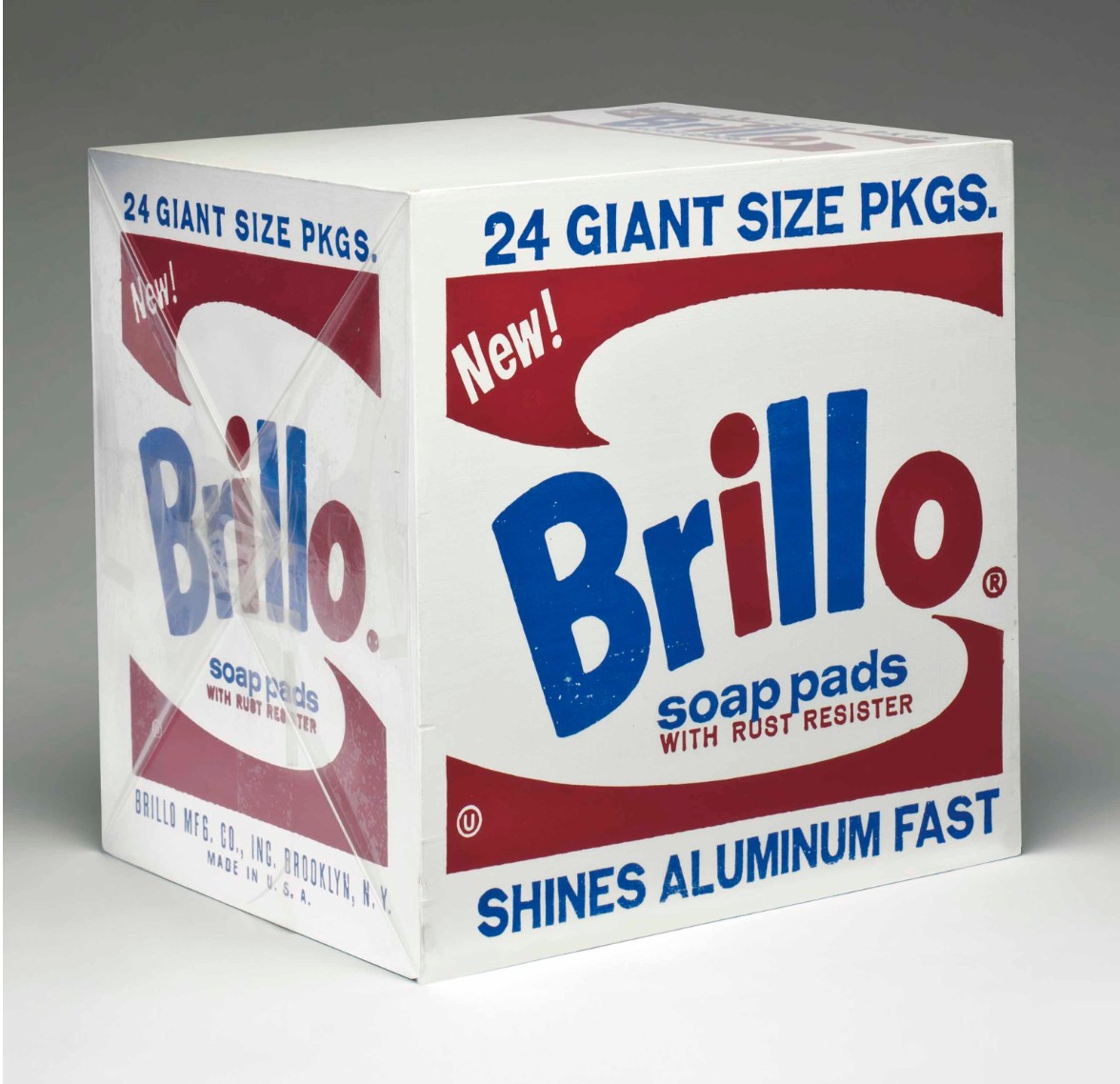
ANDY WARHOL (1928-1987)
Brillo Soap Pads Box, 1964
Silkscreen ink and house paint on plywood with original plastic wrapping
17 1/8 x 17 1/8 x 14 1/8 inches (43.4 x 43.4 x 35.8 cm)
Provenance
Leo Castelli Gallery, New York
Estate of Charles H. Carpenter, Jr.
His sale; Christie’s, New York, 16 November 2006, lot 133
Acquired at the above sale by the present owner
Brillo Box (3 cents off), 1963-1964
Christie’s New-York: 10 November 2010
Estimated: USD 600,000 – 800,000
USD 3,050,500
Andy Warhol (1928-1987) , Brillo Box (3 cents off) | Christie’s
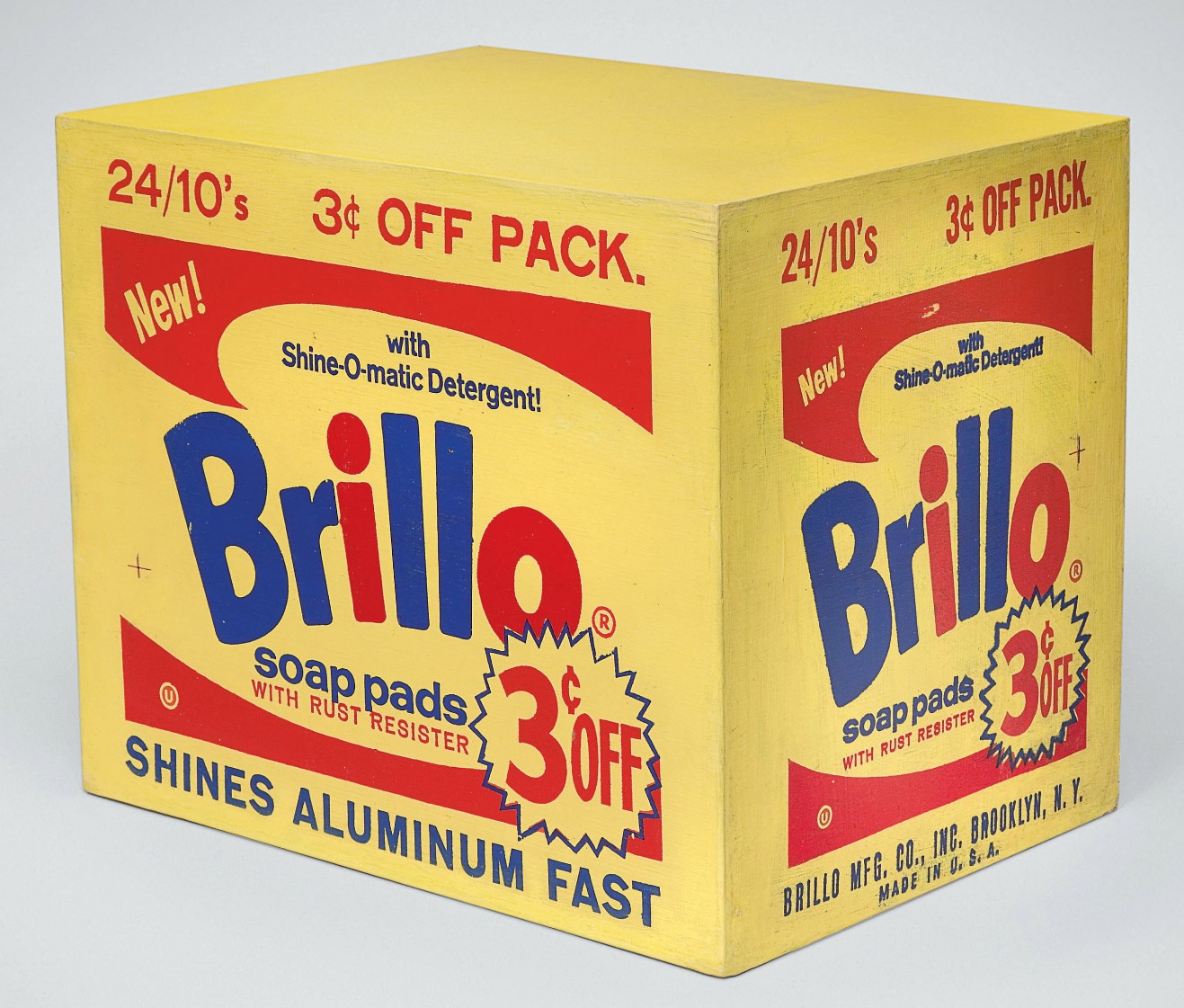
ANDY WARHOL
Brillo Box (3 cents off), 1963-1964
Silkscreen ink and house paint on plywood
13.1 x 16 x 11.5 inches (33.3 x 40.6 x 29.2 cm)
Signed ‘Andy Warhol’ (on the underside)
Stamped by the Andy Warhol Art Authentication Board, Inc.
Numbered ‘A102.965’ (on the underside)
Brillo Box (3c off) is one of only a handful of yellow Brillo boxes that Andy Warhol produced for an exhibition at the Dwan Gallery in February 1964 and was the first series of wooden box sculptures he ever produced. Warhol first began discussing the idea of a series of wooden boxes in 1962 when he was working on a three-dimensional version of his serial paintings of Campbell soup cans. At about the same time, Warhol’s friend and photographer, Edward Wallowitch, took photographs of supermarket boxes stacked one on top of one another, for another sculpture that was never produced. Eighteen months later, Dawn Gallery’s John Weber visited Warhol in his studio, and was immediately excited about Warhol’s idea of producing the wooden box sculptures. “Your idea of making cardboard boxes is sensationalif they could be finished in three weeks it would help me outif, per chance, you can’t make them in time I would like to use the Campbell’s soup sculpture” (J. Weber, quoted in G. Frei and N. Printz, eds., The Andy Warhol Catalogue Raisonné of Paintings and Sculptures 1964-1969, vol. 2A, New York, 2004, p. 53.).
The first major discussion of the Brillo Boxes occurred not in any of the art journals, but instead in The Journal of Philosophy. There, as early as 1964, Arthur C. Danto spent a chapter of his essay ‘The Artworld’, exploring the impact of the Brillo Boxes on the analysis of the time-honored and unanswerable question, ‘What is Art?’:
‘Mr. Andy Warhol, the Pop artist, displays facsimiles of Brillo cartons, piled high, in neat stacks, as in the stockroom of the supermarket. They happen to be made of wood, painted to look like cardboard, and why not? To paraphrase the critic of the Times, if one may make a facsimile of a human being out of bronze, why not the facsimile of a Brillo carton out of plywood?’ (A. C. Danto, ‘The Artworld’ in S. H. Madoff, ed., Pop Art: A Critical History, Berkeley & London, 1997, p. 275).
While this passage appears to vindicate Warhol’s choice of subject matter and medium, there was still a public uproar at the nature of these works. However, absurdity was a key ingredient of Warhol’s art. By taking the act of representation to this new level, Warhol was managing to question the entire nature of representation and the value of art. Warhol expressly used humble, everyday boxes as his subject matter, in the same way that he had previously used humble, everyday Campbell’s Soup cans in his paintings. However, Warhol’s sculpture tested the bounds of art in far more dramatic ways. While the Soup Cans shocked the art establishment when they were first exhibited in the Ferus Gallery in 1962 they were clearly pictures, but Brillo Boxes (3c off) and their context in an art gallery combined with their scale and their medium made it clear that they were not imitations of their subjects. Warhol was testing the bounds of suitable subject matter. The Brillo Boxes, which almost completely resemble the cartons that they imitate, are designed to make the judgments about where art begins and ends far more complicated.
Heinz Tomato Ketchup Box
Heinz Tomato Ketchup Box, 1964
Christie’s New-York: 8 May 2022
Estimated: USD 250,000 – 350,000
USD 478,800
ANDY WARHOL (1928-1987), Heinz Tomato Ketchup Box | Christie’s
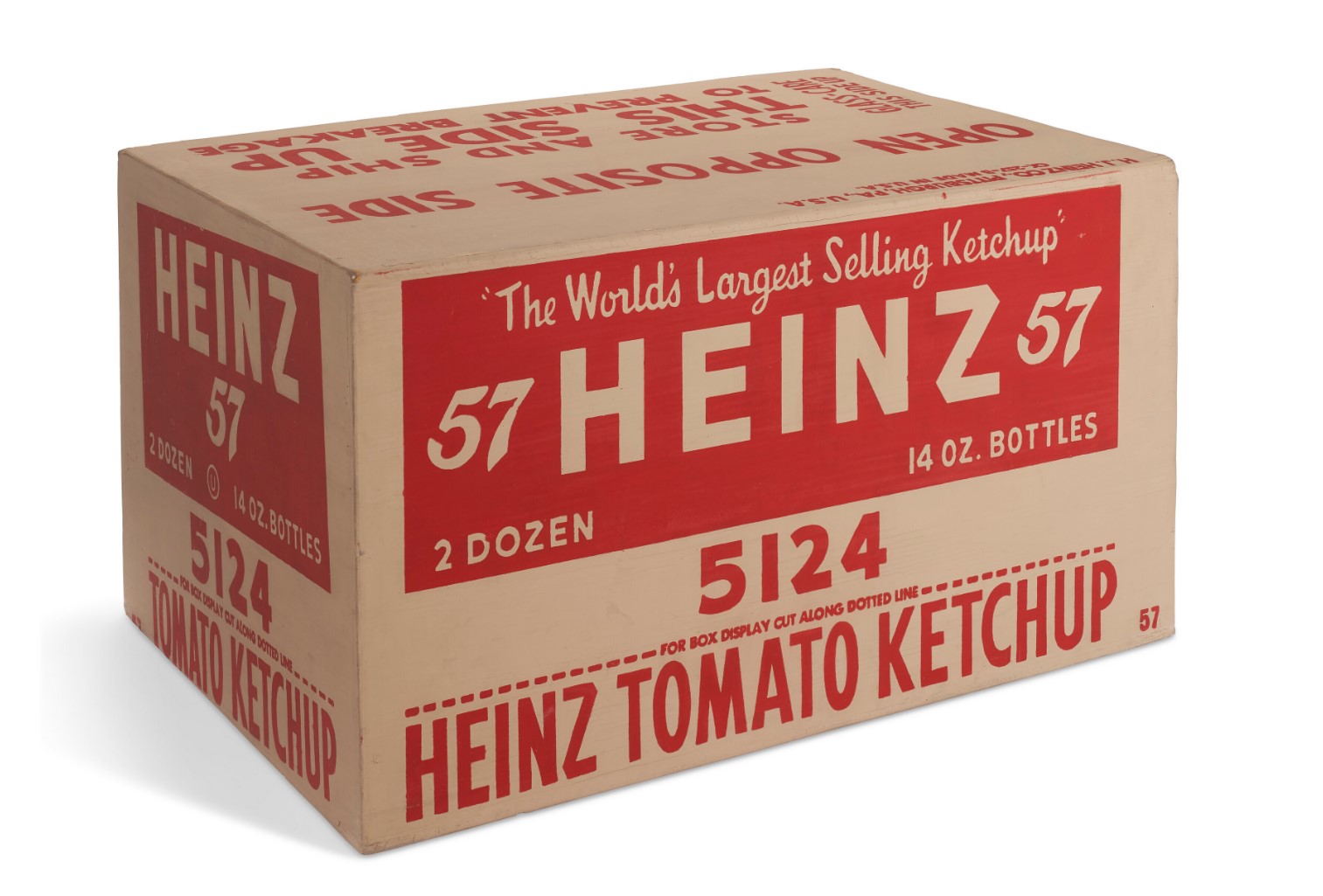
ANDY WARHOL
Heinz Tomato Ketchup Box, 1964
Silkscreen ink and house paint on plywood
8.5 x 15.5 x 10.5 inches (21.6 x 39.4 x 26.7 cm)
Andy Warhol’s box sculptures are—in their purest sense—the most Pop of all his works. Taking his inspiration from the burgeoning American consumer culture, Warhol continued his replication of the bold and colorful graphics that he first produced with his Coca-Cola bottles and Campbell’s Soup cans but this time, instead of silkscreening the images onto canvas, he turned them into three-dimensional sculptural objects. Moving his images from the wall to the floor challenged the sanctity of the art gallery, and turned the space into something closer to a supermarket. Selecting brands for the quality of their graphic design as much as their iconic status, Warhol transformed seemingly every day object into classic Warhol works of art.
Warhol’s first Heinz Tomato Ketchup Box was shown at the Boxes exhibition at the Dwan Gallery in Los Angeles in 1964, and was one of the artist’s first sculptures. This now legendary exhibition also included works by Marcel Duchamp, Louise Nevelson, and Robert Rauschenberg, but it was Warhol’s revolutionary silkscreened boxes that caused a sensation. Following their successful debut, the artist made a number of other examples which were exhibited at New York’s Stable Gallery later the same year.
Although forming part of the artist’s wry commentary on the ubiquitousness of 1960s consumer culture, as with much of his art, Warhol’s Boxes have a strong biographical element which runs through the very heart of the work. He grew up in a deprived area of Pittsburgh, raised by immigrant parents who struggled to survive in their newly adopted home country. Warhol was a sickly child and spent many days off school at home with his mother, who doted on him. The breakfast cereal and warm, tasty and nourishing soup, familiar condiments that his mother scraped-by to provide was a daily treat for him in an otherwise bleak childhood. Also, by choosing to reproduce the bulk-sized wholesale boxes, rather than the individual retail boxes that they contained, Warhol could be making an ironic comment on the wealth and prosperity that his family never enjoyed.
Warhol’s boxes are a continuation of one of the key themes in his art—the celebration of the democratic nature of American society. In his work Warhol celebrated ordinary American life and the homogenizing effect of the burgeoning mass consumer culture, “What’s great about this country is that America started the tradition where the richest consumers buy essentially the same thing as the poorest. You can be watching TV and see Coca Cola, and you can know that the President drinks Coke, Liz Taylor drinks Coke, and just think, you can drink Coke too. A Coke is a Coke and no amount of money can get you a better Coke than the bum on the corner is drinking. All Cokes are the same and all the Cokes are good. Liz Taylor knows it, the President knows it, and you know it” (A. Warhol, Andy Warhol: A Retrospective, New York, 1983, p. 458).
Warhol deliberately chose to reproduce boxes of only the most strikingly ordinary and recognizable supermarket products: Brillo Soap pads, Kellogg’s cornflakes, Campbell’s tomato juice, and Heinz Tomato ketchup. Developing the Duchampian notion of the ready-made, Warhol’s box sculptures were in fact hand-crafted by carpenters who rebuilt in wood exact replicas of the cardboard originals. These were then placed on sheets of brown paper on the floor in Warhol’s studio on 231 East 47th Street in Manhattan. Executed the same time at his iconic Brillio Soap Pads boxes, the catalogue raisonné records that these Heinz boxes where made as Warhol was waiting for the paint on the Brillo boxes to dry. They were painted with a background color and their sides finally silkscreened by Warhol and his assistant Gerard Malanga so that they looked exactly like their grocery store counterparts. Because of the speed in which each box was screened, the screens often became clogged and the boxes were splashed with drips of paint. Warhol regarded these “blemishes” as part of the artistic process and did not remove them, thereby adding a new dimension that was to become an integral feature in much of his later work, “For Warhol these mistakes were part of the process. So he never edited anything out. And these two qualities – unedited but mechanically reproduced – became part of the Warhol aesthetic, whatever the medium he might work in” (A. Danto, Andy Warhol, New Haven, 2009, p.60).
When Warhol exhibited his Heinz boxes at New York’s Stable Gallery for the first time in 1964, he accentuated their utilitarian nature by placing the works on the floor and stacking them up them high. Thus the gallery was transformed into the semblance of a warehouse, filled with crates with people walking around them to look at them from every angle. This installation has been interpreted as an ironic critique by Warhol on the commercial nature of the art world. However, Warhol although was very much a man of his time, he also had an almost prophetic ability to look into the future. With his Boxes he hoped to create art that was open to the public, and rather than lampooning art, his boxes celebrate their commercial nature, trying to create a more democratic form of art that everyone can relate too.
Del Monte Peach Halves
Sotheby’s New-York: 15 November 2018
Estimated: USD 200,000 – 300,000
USD 312,500
(#153) ANDY WARHOL | Del Monte Peach Halves
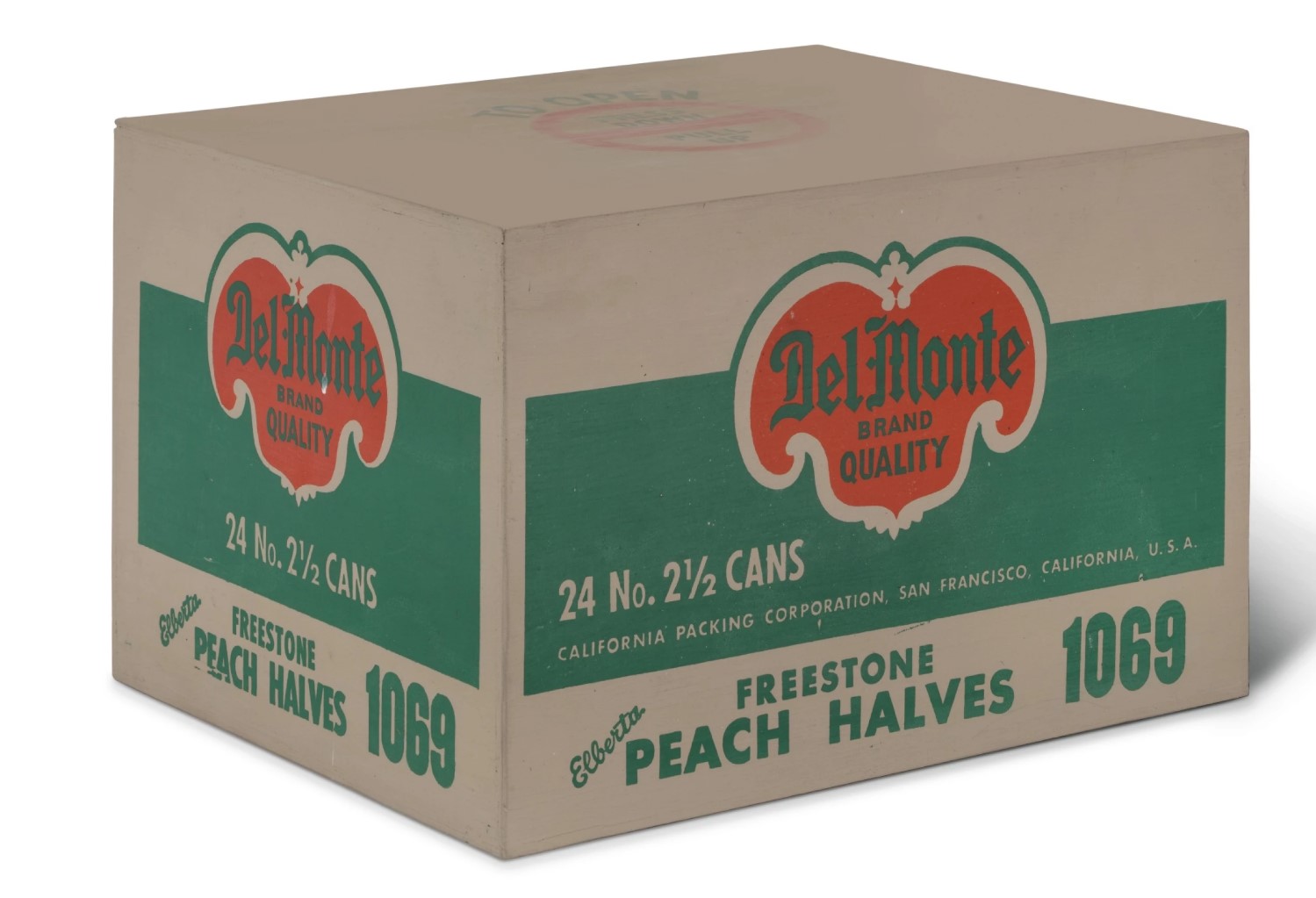
ANDY WARHOL
Del Monte Peach Halves, 1964
Silkscreen ink and house paint on wood
9.5 x 12 x 15 inches (24.1 x 30.5 x 38.1 cm)
Combos
Brillo Box, Campbell’s Tomato Juice Box, Heinz Tomato Ketchup Box, Del Monte Peach Halves Box, 1964
Christie’s New-York: 11 November 2014
Estimated: USD 3,500,000 – 4,500,000
USD 4,197,000
REPEAT SALE
Sotheby’s New-York: 14 May 2008
Estimated: USD 2,000,000 – 3,000,000
USD 4,745,000
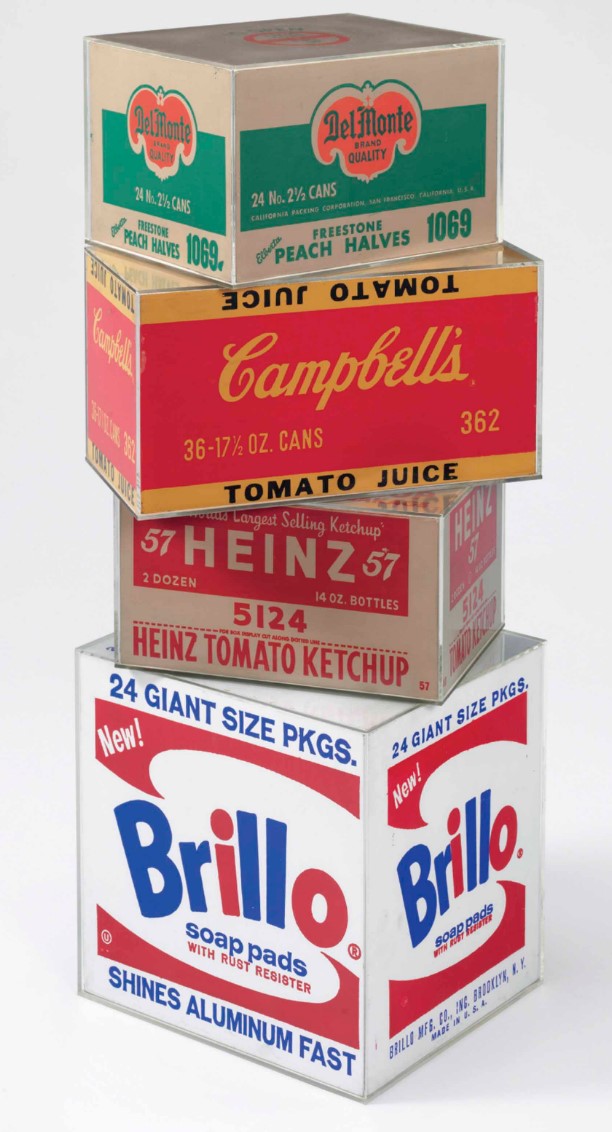
ANDY WARHOL
Brillo Box, Campbell’s Tomato Juice Box, Heinz Tomato Ketchup Box, Del Monte Peach Halves Box, 1964
Four boxes-silkscreen inks and house paint on plywood
Brillo: 17 x 17 x 14 inches (43.2 x 43.2 x 35.6 cm)
Campbell’s: 10 x 19 x 9 1/2 inches (25.4 x 48.3 x 24.1 cm)
Heinz: 8 1/2 x 15 1/2 x 10 1/2 inches (21.6 x 39.4 x 26.7 cm)
Del Monte: 9 1/2 x 15 x 12 inches (24.1 x 38.1 x 30.5 cm)
Provenance
Galerie Schmela, Düsseldorf
Collection of Helga and Walther Lauffs, Germany, June 1969
Their sale; Sotheby’s, New York, 14 May 2008, lot 31
Acquired at the above sale by the present owner
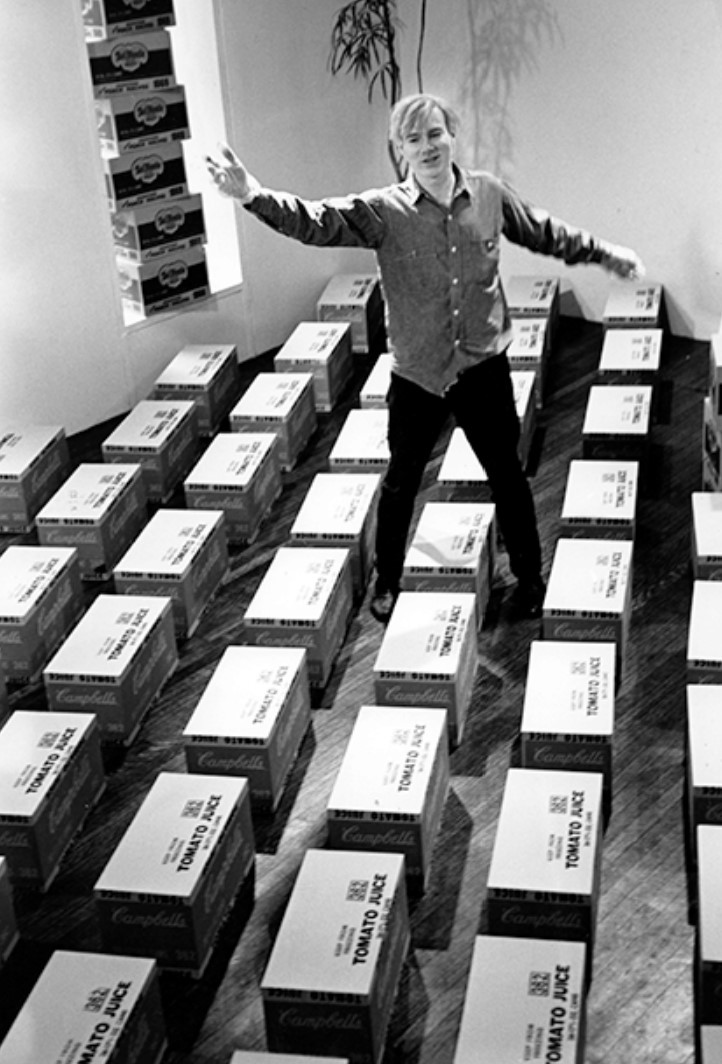
In early 1964, Andy Warhol embarked upon an elaborate and meticulously executed project—his first significant undertaking in the now-famous Factory on East 47th street in Manhattan—which became known as the Brillo box sculptures. The scope of this project could be termed “epic” in scale, and resulted in hundreds of hand-crafted and painted boxes, which were then displayed in a groundbreaking exhibition at the Stable Gallery in New York, on April 21, 1964. The present set of four boxes, all hand-painted and signed by the artist, were produced in the Factory during the months of March and April of that year. These boxes feature alongside Warhol in the famous photograph of the artist by Ken Heyman and remarkably have remained as a group since 1969, the year they were acquired by their original owners, Helga and Walter Lauffs.
On January 28, 1964, several hundred wooden boxes arrived at the Factory, ordered by Malanga from a woodworking shop on East 17th street. The working process that Warhol instigated very much mimicked a factory production line. Malanga recalled: “A few days after the move to our workspace, January 28th, a truckload of wood boxes arrive, individually wrapped and taped in clear plastic sheeting. And so would begin the arduous task of taping the floor with rolls of brown paper and setting out each box in a grid-like pattern of eight rows lengthwise. …Billy Name and I would take turns painting with Liquitex all six sides of each box. …We waited until the paint dried. Andy and I repeated this process silkscreening all five sides again down the line. The sixth side—the bottom side—remained blank. …Completing the work took nearly six weeks, from early February well into mid-April” (G. Malanga, Archiving Warhol: Writings and Photographs, New York, 2002, pp. 147-8).
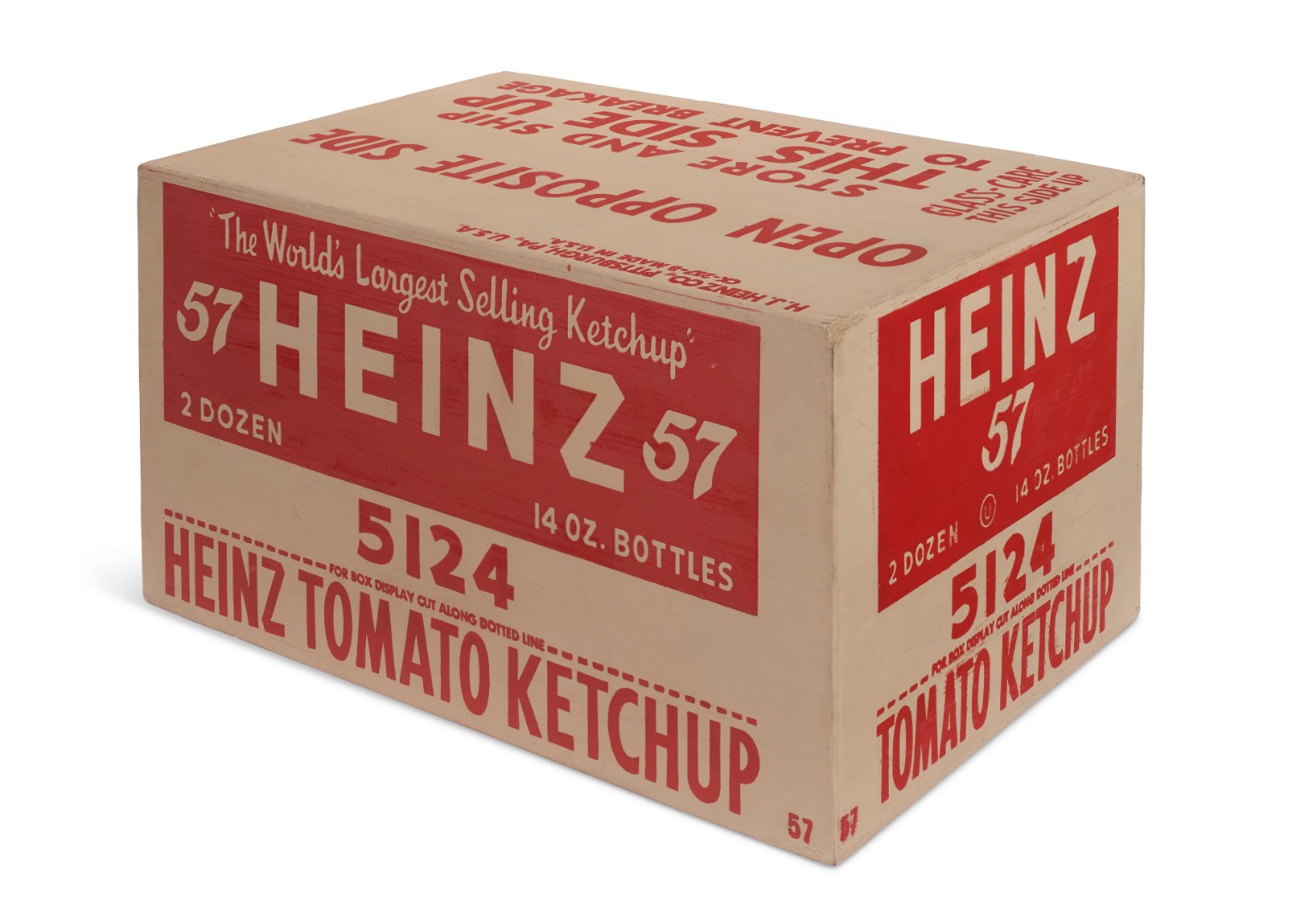
That Warhol would select such an industrious project as the first major series to be created in the Factory, which he moved into earlier that year, illustrates the importance of the Brillo boxes in Warhol’s oeuvre, and expands upon the ideas he first developed with his Campbell’s Soup Cans of 1962. Warhol designated seven boxes for the enterprise (four of which are included in the present lot)—Heinz Tomato Ketchup, Del Monte Peaches, Kellogg’s Corn Flakes, Campbell’s Tomato Juice, Mott’s Apple Sauce and two types of Brillo Box. According to Malanga, “Andy was fascinated by the shelves of foodstuffs in supermarkets and the repetitive, machine-like effect they created” (G. Malanga, quoted in ibid., p. 94). The homogenized, factory-produced nature of the products—each conveniently packaged in shelf-stable cartons—must have appealed to him.
Some of the boxes were exhibited at the Dwan Gallery in Los Angeles from February 2nd until February 29th in a show called Boxes, but the majority were shown at Eleanor Ward’s Stable Gallery in New York on April 21, 1964. The Stable show proved to be truly revolutionary, adding another level of notoriety to Warhol’s growing reputation. In what might be termed the first instance of “installation art,” Warhol packed literally hundreds of boxes inside the gallery’s 74th street location. The front room included about 100 Brillo box sculptures, all rendered in red and blue on white, while Kellogg’s Corn Flakes were in the rear gallery. Campbell’s Tomato Juice boxes were scattered along the floor and Heinz Ketchup boxes were stacked neatly as in a grocery stockroom. On opening night, a line stretched down the block and gallery-goers giggled as they squeezed into the small rooms that were packed with Warhol’s boxes. Critics were utterly flabbergasted. Lawrence Campbell, writing for Art News, described the show: “Andy Warhol is the most extreme of the Pop artists, and his shows are invariably more interesting as ideas. …The result is that his exhibitions have the power of shocking and arousing indignation. …There was a curious effect on the gallery; it became the storage room of an A&P. And the A&P became an art gallery—one found oneself avoiding the cartons as though they had suddenly become valuable” (L. Campbell, “Andy Warhol,” Art News, vol. 63, no. 4 (Summer 1964), p. 16).
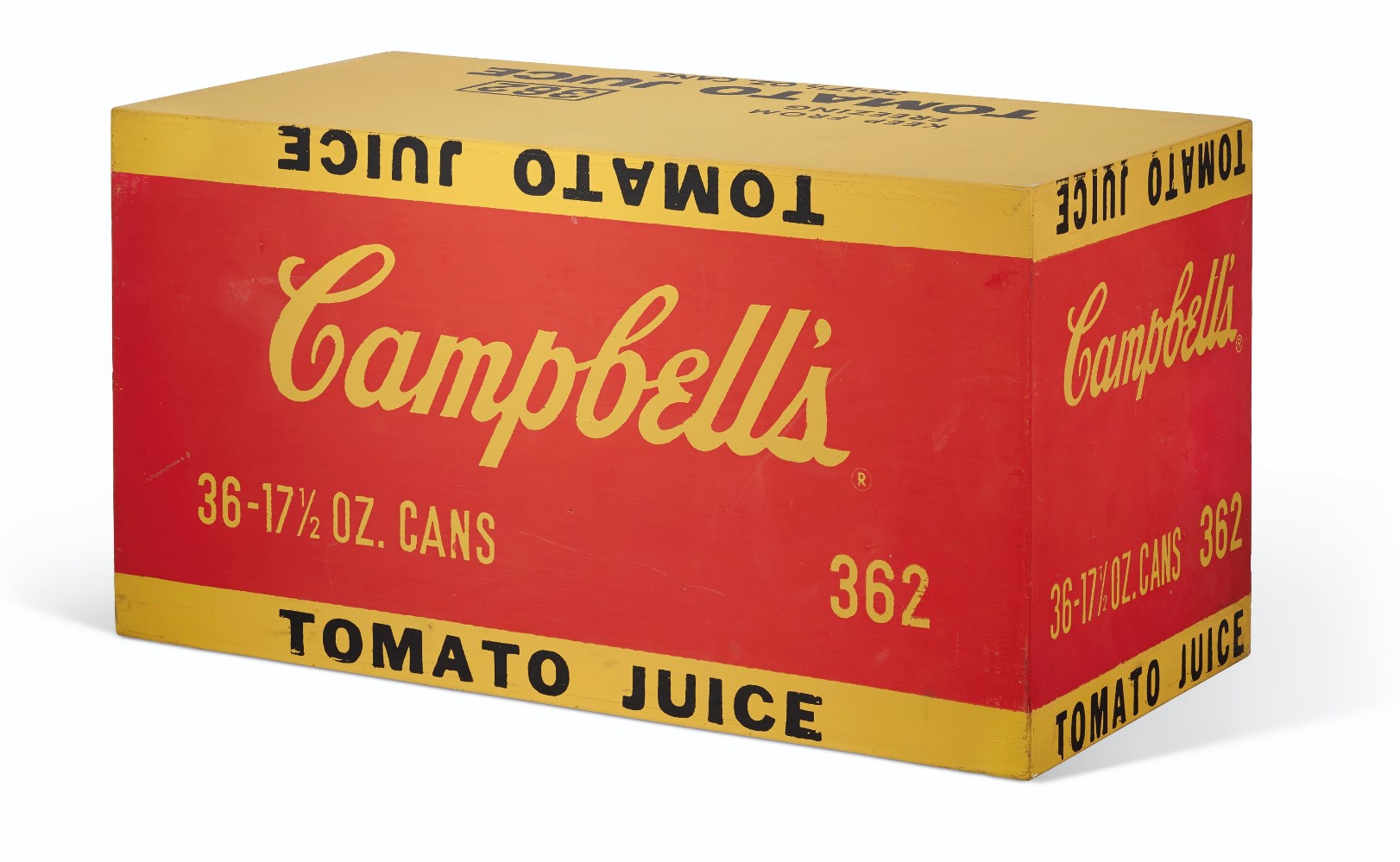
Though Warhol’s boxes deliberately copy their real-life cardboard counterparts, it is telling to note that Warhol did not simply exhibit the original boxes, but rather created a hand-crafted facsimile. Unlike Duchamp, whose readymades were exhibited simply as they were, with no direct artist involvement, Warhol’s boxes were hand-crafted in wood and painted in a way that still displays the unique hand of the artist. True, Warhol employed silkscreens to render the box logos, but each box is unique, in that the imperfections and variations of Warhol’s technique vary from box to box. Further, because they are constructed of wood rather than cardboard, the boxes can never be opened. They exist in a perpetual state of newness.