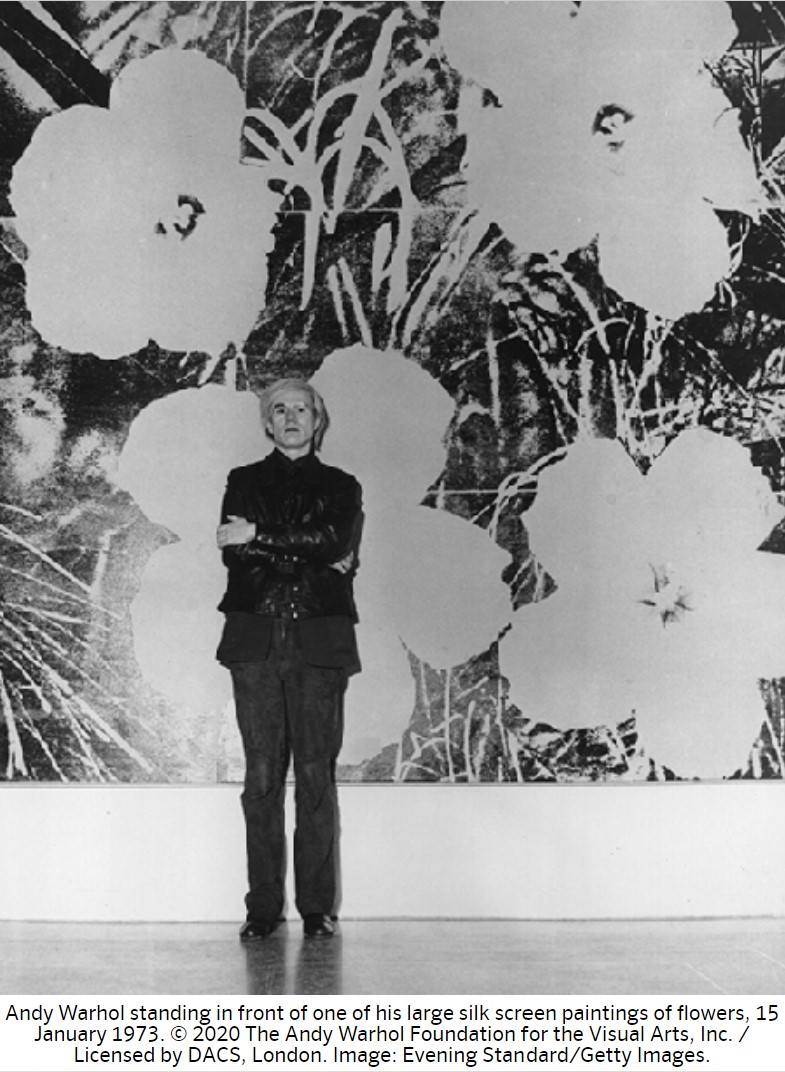
Andy Warhol’s Flowers are most probably Pop Art’s most iconic bodies of work…. In the half century since its creation, Warhol’s Flowers have infiltrated global consciousness as an emblem of classic American Pop and a moniker of sorts for the notoriously fame-obsessed artist. During the summer of 1964, Warhol executed canvases portraying this composition in formats measuring 82-, 48- and 24-inches square, intended for an exhibition with his new dealer Leo Castelli to open in New York in November. Castelli already represented the leading artists of the day, including Robert Rauschenberg, Jasper Johns, and Frank Stella; Warhol’s introduction into Castelli’s exclusive circle catapulted him into the highest echelons of artistic eminence and cemented his place in the canon of twentieth-century art history. Embracing a distinctive hyper-flatness that presaged Warhol’s later explorations in wallpaper, this body of work represented the culmination of his iconic Pop aesthetic before announcing his short-lived “retirement” from painting. Electric yet macabre, distinctive but mechanical, the Flowers marked a seminal chapter in Warhol’s career and are iconic relics of 20th century art history.
WORK IN PROGRESS
Introduction
Following a string of high-profile exhibitions that had cemented Warhol’s reputation as one of the leading figures of the burgeoning Pop movement, the artist joined Leo Castelli Gallery in early 1964. His previous attempt at showing with the pioneering gallerist in 1961 was rejected, but he was now granted the opportunity to share a historic roster with formidable art world personalities such as Robert Rauschenberg, Jasper Johns, and Frank Stella. Expertly talented in self-marketing, Warhol had cleverly focused his gallery presentations on a single subject or theme, including his 32 Campbell’s Soup Cans and Elvis shows at Ferus Gallery in 1962 and 1963; the Death and Disaster series which debuted at Galerie Ileana Sonnabend in January 1964; and his Brillo Box sculptures at Stable Gallery in April of that year.
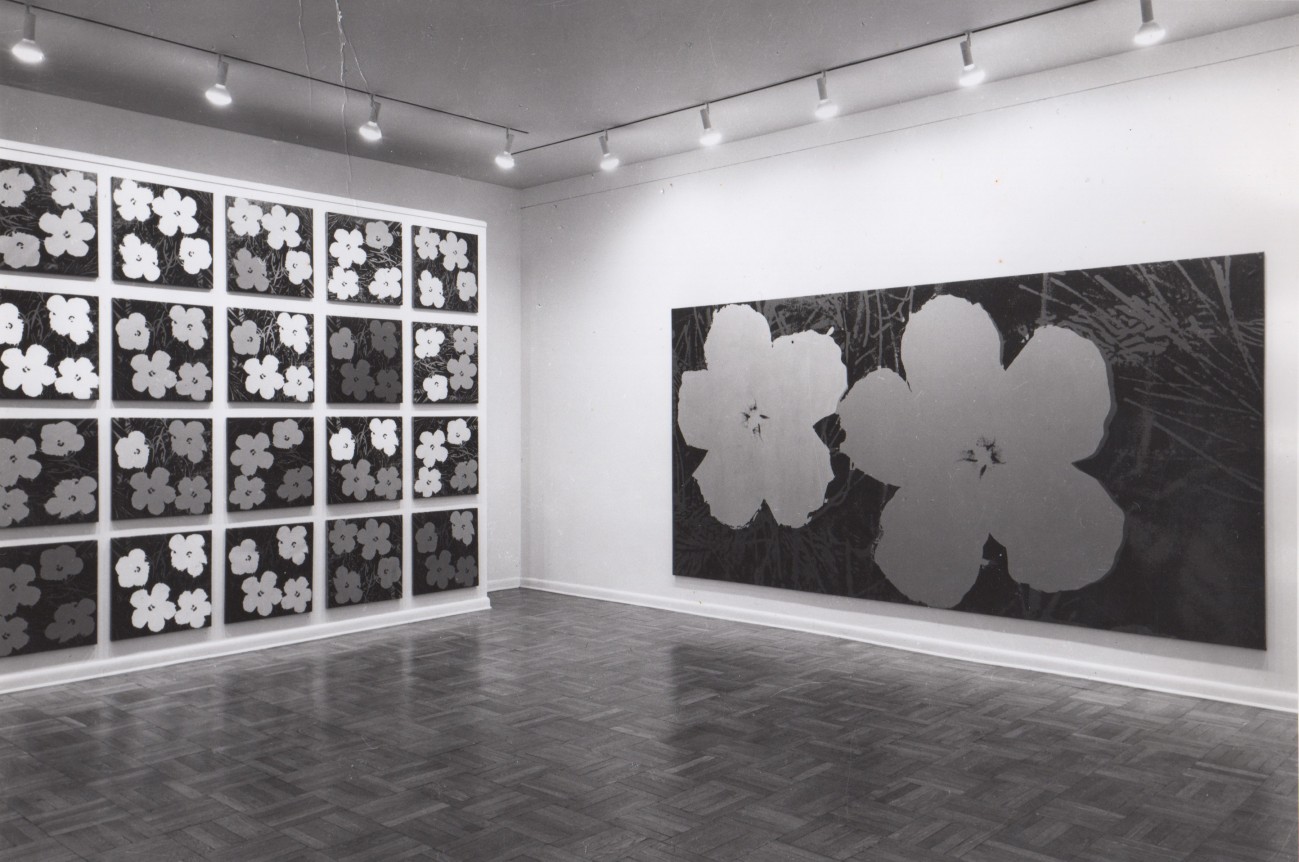 ANDY WARHOL, Flower Paintings, Castelli 4 EAST 77, December 1964
With his inaugural Castelli exhibition slated for autumn 1964, the summer afforded Warhol the time and space to conceptualize a new body of work to symbolize this major professional turning point. Henry Geldzahler, the artist’s friend and then-curator at the Metropolitan Museum of Art, visited Warhol while he was mulling over ideas at the Factory. “I looked around the studio and it was all Marilyn and disasters and death,” Geldzahler recalled. “I said, ‘Andy, maybe it’s enough death now.’ He said, ‘What do you mean?’ I said, ‘Well, how about this?’ I opened a magazine to four flowers.” Flipping to a page in the June 1964 issue of Modern Photography, the two saw a foldout of four photographs of seven hibiscus blossoms captured by the magazine’s executive editor, Patricia Caulfield.
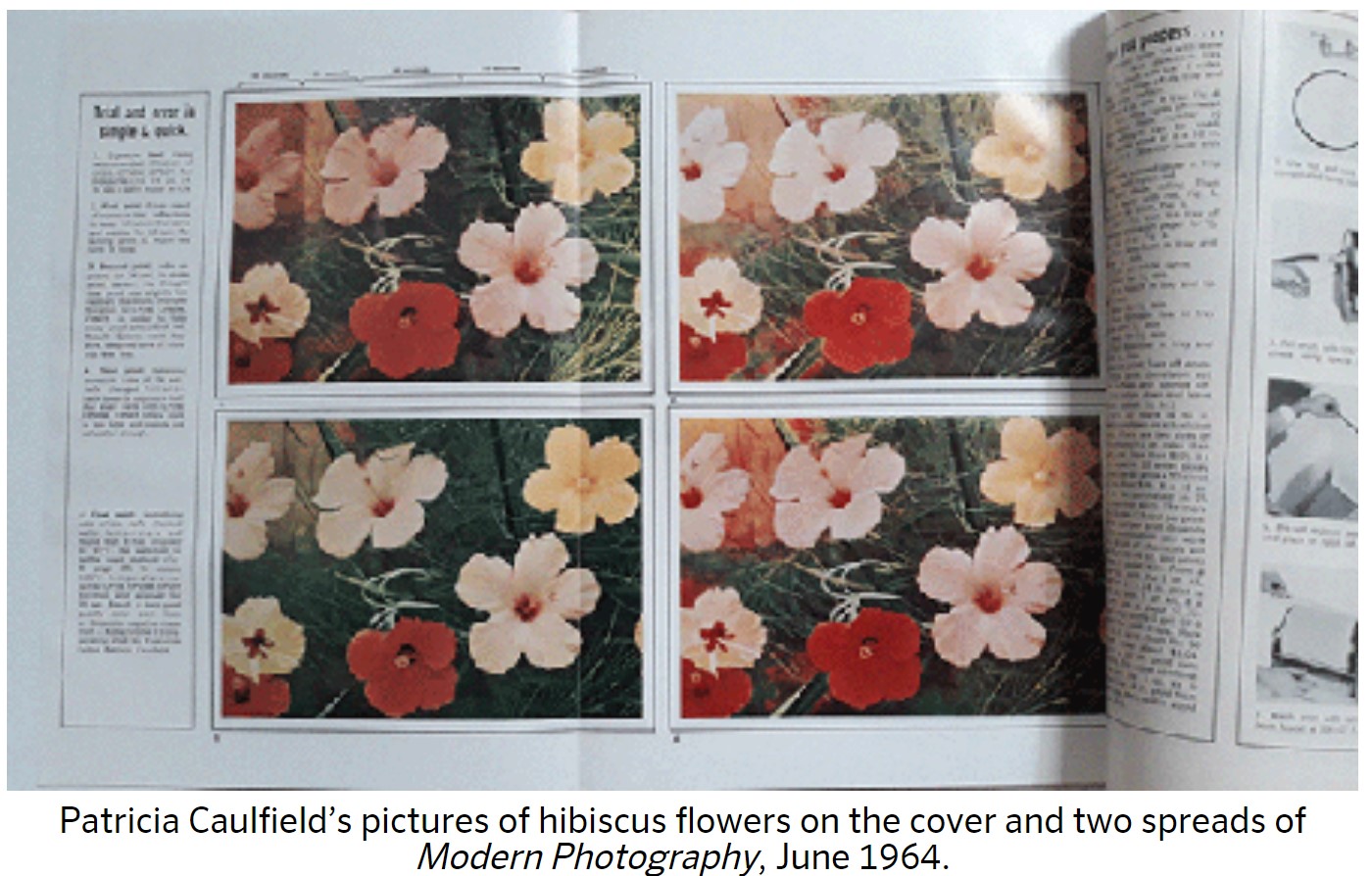
Rather than directly quote the entire page of the magazine, Warhol isolated four of the flowers in a more compressed crop, which he then transferred onto acetate and polarized the tonal range in order to increase sharpness. The original image accompanied an article about different Kodak processors and featured a glossy fold-out showing the same photograph, taken by executive editor Patricia Caulfield, repeated to illustrate chromatic variations corresponding to the different chemical processes, the repetitious nature of which no doubt appealed to Warhol’s particular interest in seriality. By 1965, Warhol was manufacturing up to 80 Flowers canvases per day, a tremendous feat in response to the heightened consumerist culture of the 1950s and 60s. The somewhat brighter subject matter was a soothing relief from the unrelentingly morbid 1962-63 Death and Disaster series, in which the artist depicted photographs of car crashes, electric chairs, and suicides. Yet, the motif of the hibiscus is laden with the tragedy that permeates Warhol’s entire oeuvre. Hibiscuses signify beauty, and especially the fleeting nature of fame or personal glory, a symbolic meaning that would not have escaped Warhol.
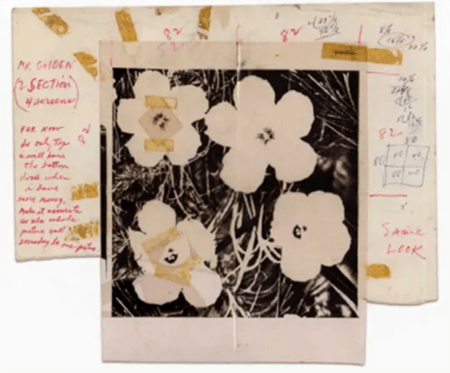
While adapting the source photograph for painting, the artist made substantial alterations: he cropped it into a square composed of only four large flowers, rotated the individual blossoms, and then transferred his new composition to several non-uniformly sized screens. During this process, Warhol requested his assistant Billy Name-Linich “run the photo repeatedly through the Factory’s new photo stat machine” at least a dozen times because he “didn’t want it to look like a photo at all. He just wanted the shape, the basic outline, of the flowers.” Subsequently, the artist and his assistants applied continuous, flat planes of paint to the canvases before silkscreening the photographic representation on top.
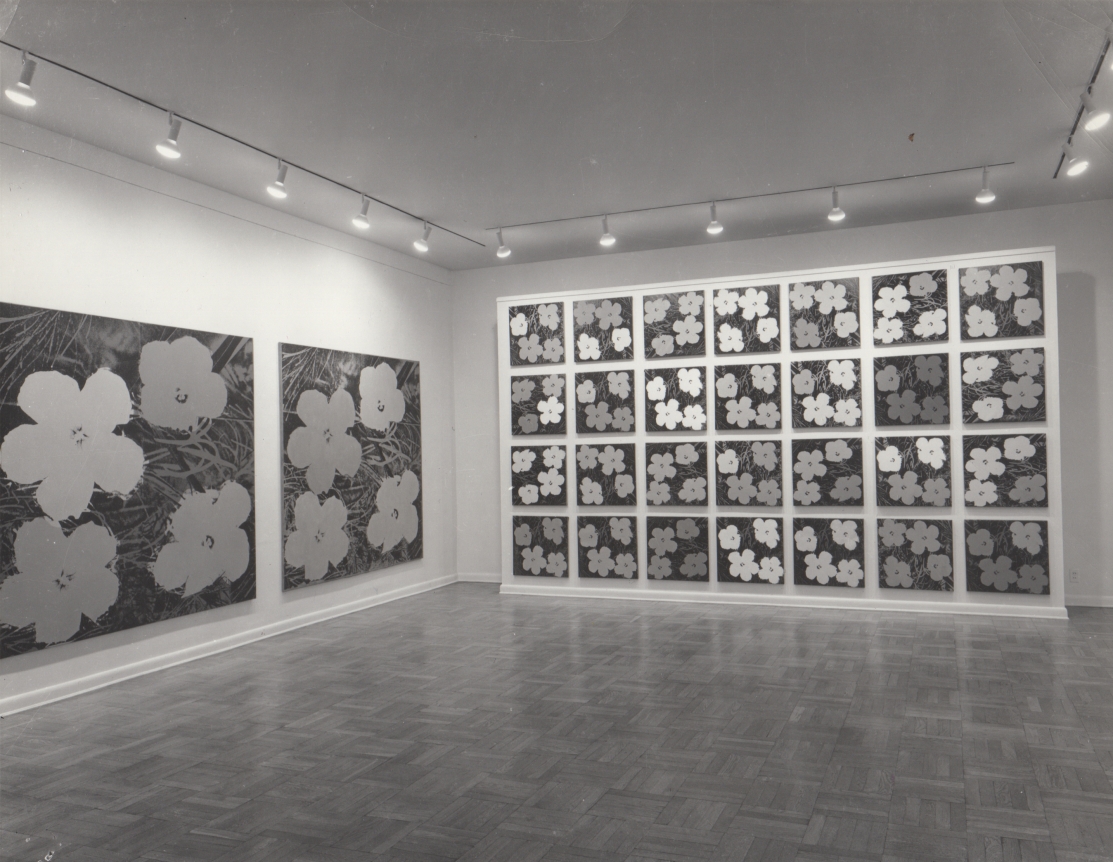
ANDY WARHOL, Flower Paintings, Castelli 4 EAST 77, December 1964
The Flowers were met with both critical and commercial acclaim, in addition to an intense legal debate. Claiming that Warhol made unauthorized use of her photograph, Caulfield sued Warhol in 1966 for copyright infringement. The polarizing litigation attracted wide interest thanks to its deep-seated irony: the artist had built his career appropriating ubiquitous yet patented logos such as Coca-Cola bottles and cans of Campbell’s soup, but judicial issues arose only after his use of a photograph of a garden flower that he had heavily altered. Though she won her case, Caulfield’s suit paradoxically seemed to double down on the very concerns of post-modernism—questions of image ownership, reproduction, and originality—that had preoccupied Warhol throughout his oeuvre.
Imbued with Warhol’s idiosyncratic visual language, the Flowers are his contribution to one of art history’s richest genres: the age-old aesthetic heritage of flower painting. Less interested in portraying a realist or gestural representation of blossoms than a modern, mechanical reproduction of a representation of them, Warhol’s flora are rendered in synthetic, fluorescent hues that eschew any evocation of nature.
“Now We’re Doing My Flower Period!”
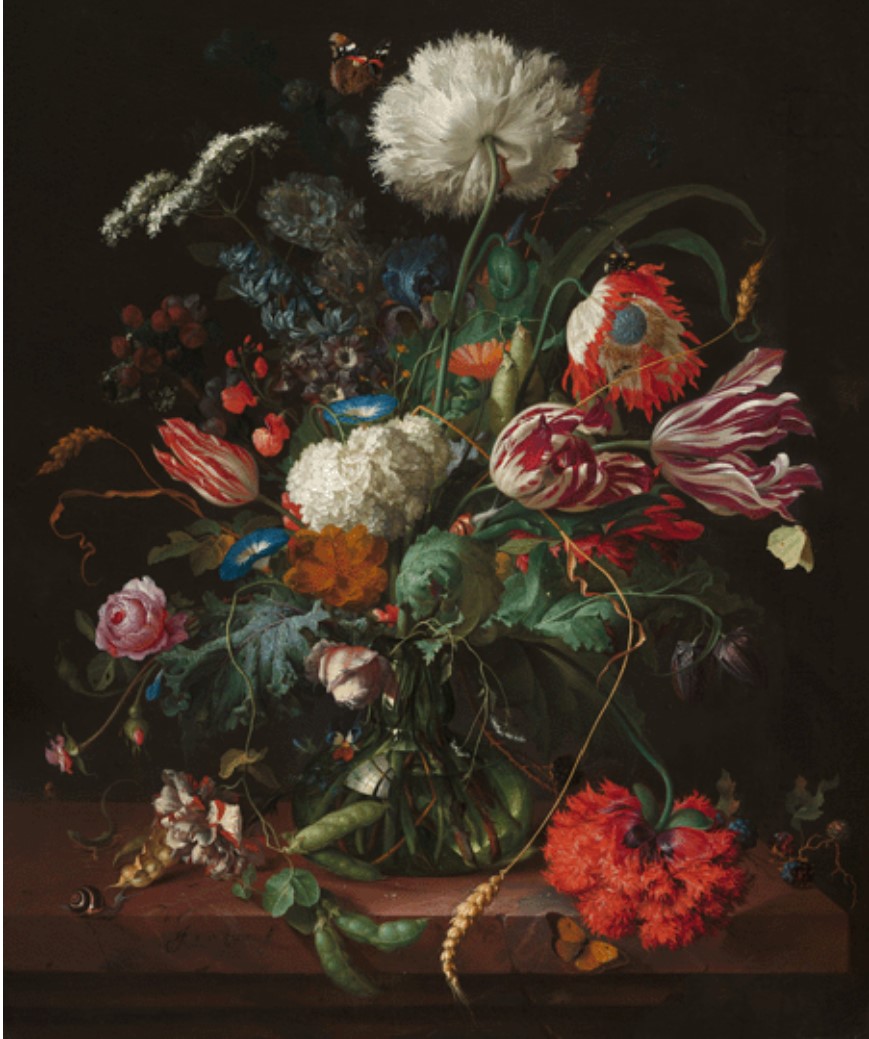
Jan Davidz de Heem, Vase of Flowers, c. 1660, National Gallery of Art, Washington D.C. Image: National Gallery of Art, Washington, D.C. 1961.6.1, Andrew W. Fund
The artificiality of Flowers is reminiscent of 17th century Dutch “impossible bouquets”—marvelous collections of flowers that, at the time, could never be found together due to geographical and seasonal restraints. The impossibility of these arrangements no longer resonates with viewers today, as global trade and mass consumerism have made them not only plausible but commonplace. Similarly, despite their synthetic color and exaggerated flatness that would seem to have no corollary in reality, Warhol’s manufactured flowers are redolent of the representations of nature that feel most familiar in the post-modern era.
Despite Geldzahler’s hope that this seemingly ebullient subject matter would index a departure from Warhol’s death and tragedy tropes, Flowers has been interpreted as a funereal coda to his earlier work. The pitch-black background acts as a memento mori to the lively vibrancy of the blossoms it envelops, and Warhol’s macabre inclusion of his Jackie Kennedy portraits, which were appropriated from a photograph captured soon after her husband’s assassination, in the Castelli Flowers show lend them a similarly devastating connotation.
Despite the apparent decorative quality of Flowers, which doubtlessly appealed to Warhol in his effort to create truly popular art, the motif is laced with a preoccupation with mortality that permeates the artist’s entire oeuvre. 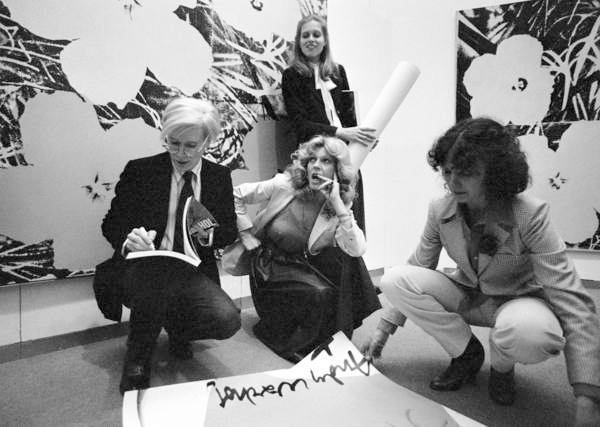
At Sonnabend in 1965, Warhol hung the new 48-inch canvases at the gallery entrance as the visitors’ first impression. Invoices reveal that Warhol’s earliest Flowers silkscreens, purchased June 22, 1964, were 48×48 inch; in September Warhol achieved a professional watershed by consigning these pieces to the Leo Castelli Gallery, joining an elite sphere of Pop artists including Roy Lichtenstein and Robert Rauschenberg. Castelli subsequently consigned many magnitudes of Flowers, but the original 48″ format memorializes Warhol’s early success. At Sonnabend, few and large such canvases were in juxtaposition to a proliferation of smaller Flowers: whereas the littlest work at Castelli’s show measured 24×24 inch, the Flowers at Sonnabend were comparatively diminished, shrinking by increments to as little as 5×5 inch. Warhol thereby established, within a single series, a metaphorical relationship between the exceptional, more monumental icon and its attending host of miniaturized, even talismanic imitations that underlies the contemporary reproduction of celebrity portraits in portable and cheap formats, and mirroring logic of brand-based consumption. Assigning each wall within the gallery a single canvas size, Warhol recombined the paintings like battalions of tesserae, eliciting subtle variances and rhythmic patterns across the matrix of square paintings. In its immersive ambition, this display impressively anticipated the turn towards installation and environmental art. Ground-breaking both in its content and its innovative installation, this exhibition profoundly impacted European critics, establishing Warhol as the foremost Pop Artist in Europe.
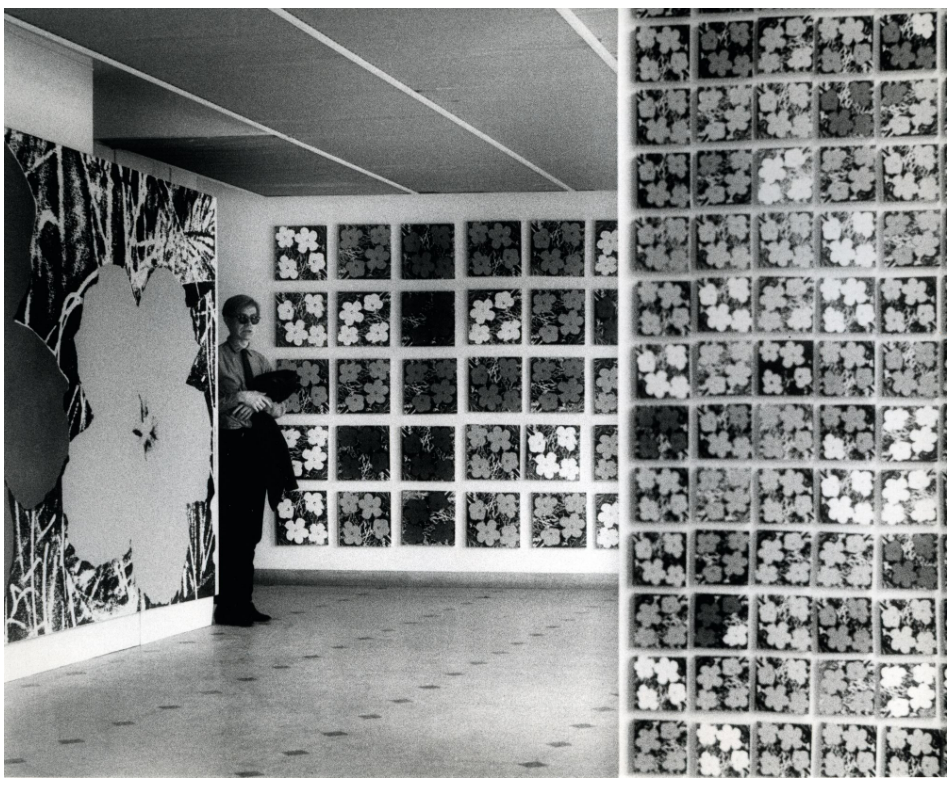
Andy Warhol at his exhibition of Flowers at Ileana Sonnabend Gallery, Paris, May 1965. Photo: Shunk-Kender © J. Paul Getty Trust. Getty Research Institute, Los Angeles. Artwork: © 2023 The Andy Warhol Foundation for the Visual Arts, Inc. / Artists Rights Society (ARS), New York.
Ever since the Ethel Scull commission, Warhol found great freedom in working on multiple small canvases that could be rearranged into endless configurations. He particularly liked the square format of the Flowers canvases which denied a fixed upright, thereby affording a range of four potential orientations. Arranging the canvases like tesserae on the walls of the Galerie Ileana Sonnabend, Warhol elicited subtle variances and rhythmic patterns across the matrix of square canvases, the amorphous curvilinear forms of the quasi-abstract petals dematerializing the rectilinear grid-like structure created by the gaps between the canvases. With the smaller 5-inch Flowers, the gaps between the canvases was extremely narrow, creating an almost mosaic effect covering the entire wall. As revealed in an installation photograph of the Sonnabend exhibition, the gallery wall was hung with ninety canvases of this 5 by 5 inch size.
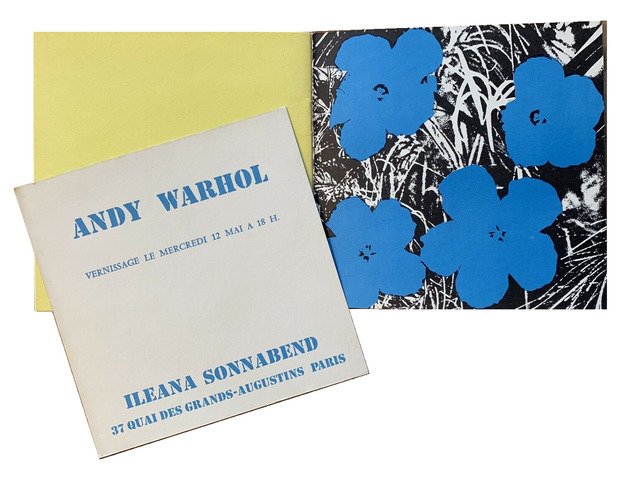
Ever since their inception, Warhol’s Flowers cemented their position as one of the most iconic formulations of Pop imagery. Their effervescent beauty became emblematic of the rapidly changing post-war culture, and the manner in which it was manifested in social, political, and cultural realms. Unlike Warhol’s legendary subjects of that period – consumerism, celebrity, death and disasters – his corpus of Flowers was a significant departure to the realm of abstraction, not only in terms of aesthetic character, but also with regard to philosophical import. While the paintings that immediately preceded Flowers typically represented narrative facts recorded through the objectivity of the camera lens and re-contextualized through the artist’s characteristic silkscreen support, this series presented a quotidian subject devoid of context. There was no story of a spectacular rise to fame or untimely death behind these petals, no self-evident critique of the agents of celebrity culture or the manipulation of collective psychology through mass-media. Even the Dollar Bills and Campbell’s Soup Can pictures that pioneered Warhol’s concept of endlessly proliferating imagery were wedded to the specific cultural inheritance of the American Dream and consumer culture. With the Flowers’ indeterminate content, Warhol invited, for the first time, a far greater degree of interpretation, prompting reflection from the spectator, and thereby driving a far grander range of individual responses.
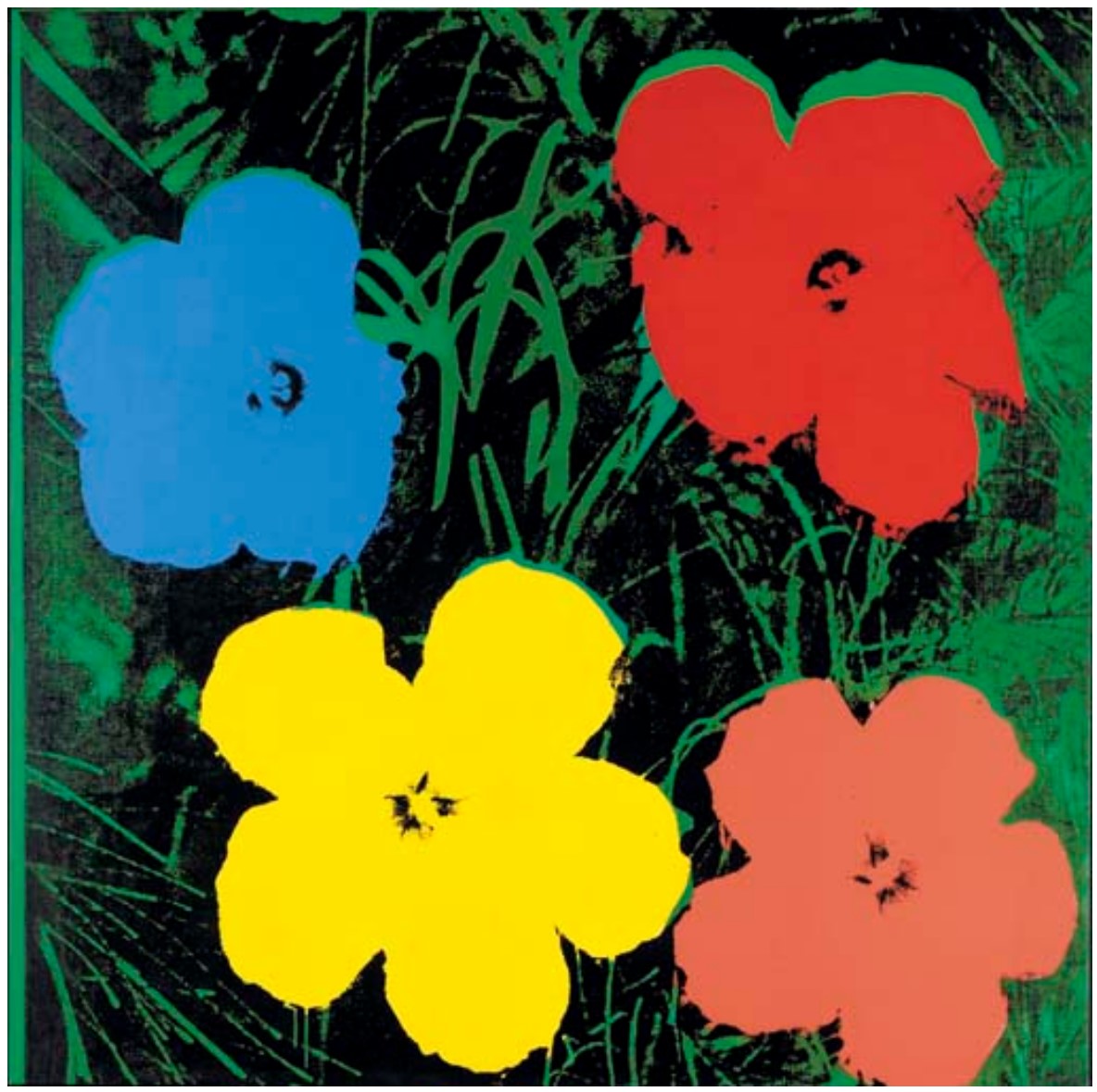
The square format of the paintings particularly satisfied Warhol because its regular shape allowed the flower paintings to be hung ‘any side up.’
“I like painting on a square because you don’t have to decide whether it should be longer-longer or shorter-shorter or longer-shorter: it’s just a square.”
In addition to its repositioning in a square-format Warhol flattened the original image by translating the background – through the silkscreen medium – into a night-sight-like two-tone image of the grass undergrowth. Flattening color and form in this way generated what is probably the most abstract of all of Warhol’s 1960s images and indeed a certain relishing of the abstract painterliness of his creation can be seen in these works in much the same way as it later appears in his Shadow paintings of the late 1970s. Warhol had, of course, developed as an artist under the shadow of the Abstract Expressionists, whose heady blend of machismo, tortuous soul-searching and insistence on painterly gesture as a means of inner expression was anathema to him. Concerned throughout his life that such bombast actually represented the ‘real’ painting, Warhol often reveled in the purely abstract nature of his art, greatly enjoying placing empty monochrome canvases next to his image-laden ones and, as in his Flowers, in the flat vacancy of monochrome color.
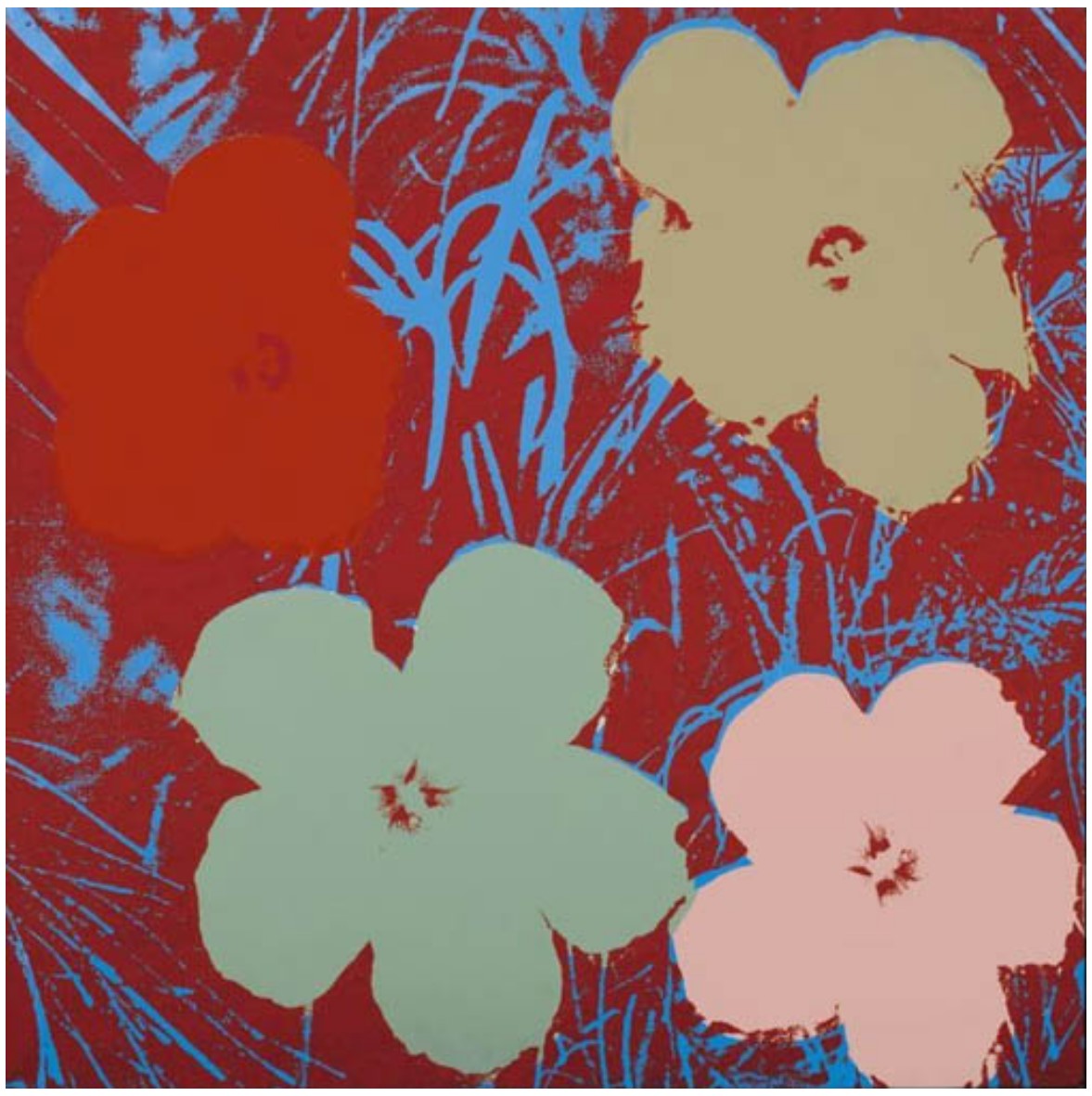
In the selection of color for his flowers, Warhol deliberately chose unnatural-looking hues of brilliant synthetic color. Often referred to as Day-glo or cosmetic coloring, the clearly man-made splashes of vibrant color that form the flowers of his pictures seem to mock the gestural splashes of abstract expressionist painting as much as they do the romanticism and pantheist sense of wonder usually associated the art historical genre of flower painting. These paintings also look like an attack on nature as if such natural wonder has here been subordinated and synthesized by a simple mechanical process. The abstract manufactured look of Warhol’s Flowers emphasizes both their commercial application as a saleable commodity and the mass-produceable process by which these natural symbols of beauty have come into. In this, these works echo his portraits of other mass-produced beauties such as Marilyn and Liz, Elvis and Marlon. They are an extension of Warhol’s synthetic vision of the universe into the realm of nature.
Essay
WORK IN PROGRESS
Andy Warhol’s ability to transform ubiquitous images into American icons is legendary. His investigation of consumer culture and advertisement practices launched the Pop art movement in the United States, and his work has become synonymous with the movement. Flowers is a pivotal example of his work with photographic sources filtered through the machinations of commercial imagery. By transforming a photograph of something in the real world to a symbol, he teased out the separation between everyday life and the constructed reality of capitalism in the late twentieth century. Flowers was a radical departure for the artist at the time; eschewing the shocking drama of his Death and Disaster paintings, Warhol turned to something seemingly more traditional, yet infusing the subject matter with his own radical Pop sensibility. Using a photograph from a popular photography magazine, in his signature style Warhol subtly manipulated the image to produce one of his most celebrated and recognizable works.
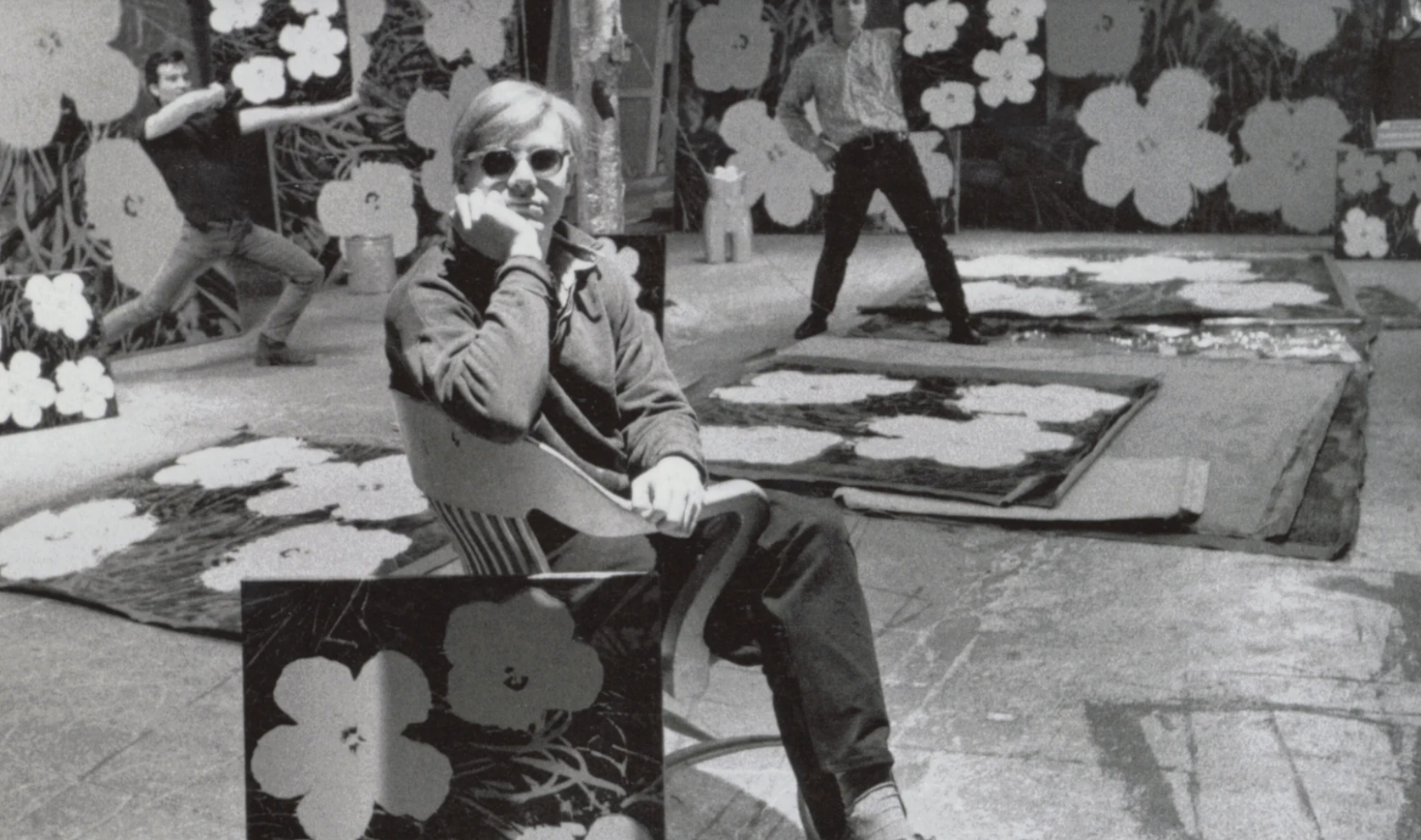
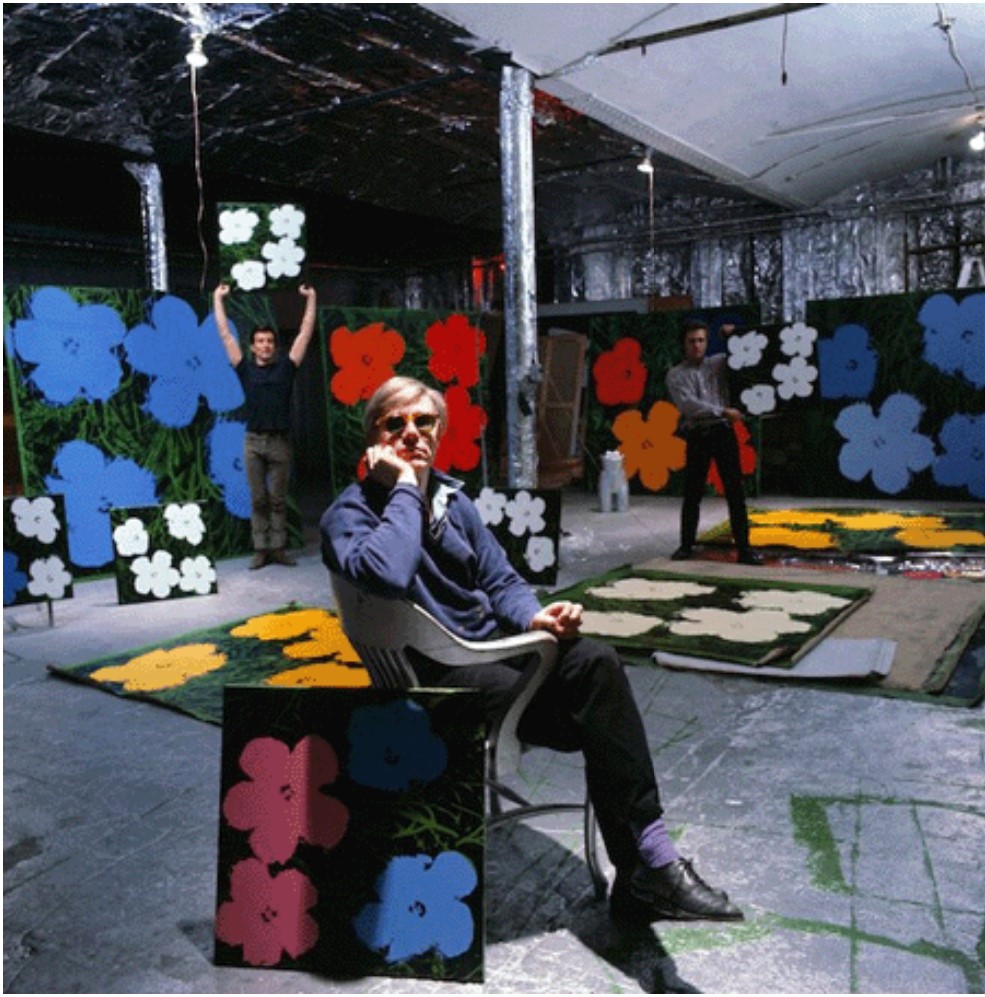
Andy Warhol in his studio, New York, 1964. Photo: Ugo Mulas © Ugo Mulas Heirs. All rights reserved. Artwork: © 2023 The Andy Warhol Foundation for the Visual Arts, Inc. / Licensed by Artists Rights Society (ARS).
The series was first exhibited at the Leo Castelli Gallery in 1964 in an exhibition that took the New York art world by storm as it connected with a public ready for something less shocking than the electric chairs and car crashes of the previous years. With his Flowers, Warhol also engages with the established canon of still-life painting, aligning himself with the romantic renderings of flowers by painters like the Dutch Golden Age painter Rachel Ruysch, Claude Monet or Vincent van Gogh. However, Warhol transformed the age-old genre with his color-blocked blossoms, utterly removed from nature. With an aerial viewpoint, he collapses space into one flat plane—making no distinction between horizon or ground. His style is adamantly the artist’s hand and treats his traditional subject matter with the same detachment as his commercial imagery—in this way, he distills his reputation as a creative wunderkind on the level of the master painters before him.
“[Warhol’s Flowers create] a virtual, painful stillness. Since they seemingly only live on the surface, in the stasis of their coloration, they also initiate only the one metamorphosis which is a fundamental tenet of Warhol’s work: moments in a notion of transience. The flower pictures were for Everyman, they embodied Warhol’s power of concretization, the shortest possible route to stylization, both open to psychological interpretation and an ephemeral symbol. But the flowers…were also to be read as metaphors for the flowers of death. Warhol’s flowers resist every philosophical transfiguration as effectively as the pictures of disasters and catastrophes, which they now seem ever closer to.”
HEINER BASTIEN QUOTED IN EXH. CAT., BERLIN, NEUE NATIONALGALERIE (AND TRAVELLING), ANDY WARHOL: RETROSPECTIVE, 2002, P. 33
Warhol’s shrewd recontextualization of a photograph published in the June 1964 issue of Modern Photography evinces a nascent interest in a more abstract, philosophical vernacular, one preceded by his Death and Disaster series and extended through the skulls, shadows, and religious iconography of his mature corpus. The flower motif’s resounding significance in the history of art, from the Dutch Vanitas to Claude Monet’s water lilies to Van Gogh’s sunflowers, also proved a fitting, intellectual subject for the Pop idiom he had explosively introduced earlier that decade. Warhol also borrows from the Modernist innovations of Henri Matisse, who in La Gerbe considered the floral subject as a vehicle for chromatic exploration and formal abstraction. Despite its vital, decadently saturated palette and ostensibly decorative aesthetic, which undoubtedly appealed to Warhol in his program of developing a truly popular art form, this is a motif laced with a preoccupation with mortality that permeates Warhol’s entire oeuvre, all the way through to his final self portraits. Late Four-Foot Flowers summarizes Warhol’s greatest contribution to twentieth century artmaking—the balance between appropriation and ingenuity—and endures today as a vibrant moniker for the artist, one that epitomizes the fragility of life and intangible transience of fame.

LEFT; HENRI MATISSE, LA GERBE, 1953. LOS ANGELES COUNTY MUSEUM OF ART. IMAGE © 2024 MUSEUM ASSOCIATES / LACMA. LICENSED BY ART RESOURCE, NY. ART © 2024 SUCCESSION H. MATISSE / ARTISTS RIGHTS SOCIETY (ARS), NEW YORK. RIGHT: ROY LICHTENSTEIN, BLACK FLOWERS, 1961. IMAGE © 2024 THE BROAD, LOS ANGELES. ART © ESTATE OF ROY LICHTENSTEIN
Warhol first approached the flowers at the suggestion of the legendary Henry Geldzahler, then assistant curator at the Metropolitan Museum of Art, who encouraged the artist to engage directly in the art historical tradition of still-life painting. The subsequent flowers Warhol created in summer 1964 would be the paintings he chose to exhibit in his inaugural show with Leo Castelli, a shift in representation that cemented his place at the artistic fore of his generation. Over the next few years, Warhol would return to the subject, such as in his solo installation at Galerie Ileana Sonnabend in Paris in 1965 and again in the present work. The source image for the Flowers originated in a series of color photographs of seven hibiscus blossoms printed in the June 1964 issue of Modern Photography, taken by editor Patricia Caulfield to demonstrate the varying visual effects of different exposure times and filter settings. The seriality of the images in Modern Photography undoubtedly appealed to Warhol’s acute sensitivity to repetition and mechanization, though rather than transfer the entire page of the magazine with four rectangular images of flowers, he isolated and cropped a square composition that included four flowers from one of the reproduced photos. This crop was then transferred onto acetate and its tonal range polarized to increase sharpness and provide the optimum template for the silkscreen mechanical to be made. Warhol chose the square format because of the four possible orientations available.

LEFT: GUSTAV KLIMT, BAUERNGARTEN (BLUMENGARTEN), 1907. PRIVATE COLLECTION. SOLD AT SOTHEBY’S, LONDON FOR £48 MILLION IN MARCH 2017. RIGHT: LUCIAN FREUD, DAFFODILS AND CELERY, 1947-48. SOLD AT SOTHEBY’S LONDON FOR £1.2 MILLION IN FEBRUARY 2006. PRIVATE COLLECTION. ART © 2024 LUCIAN FREUD
Warhol’s updated interpretation of this age-old motif, however, is consciously unimpassioned: he first rejected the hierarchical compositions of the grand tradition of still-life painting in Western art history in favor of an overhead perspective, which banishes the horizon and flattens and distorts the shape of each petal. Further, subtle modulations in light, shadow, and hue are eschewed in favor of planar zones of flat pigment, rendered in artificial Day-Glo and fluorescent ink and acrylic. After the Death and Disasters series of 1962-1963, which depicted sensational images of electric chairs, atomic bombs, and car crashes, the motif of four brightly blooming hibiscus flowers was almost anodyne, a palliative to the horror and violence of his previous imagery. However innocuous the Flowers seem, however, Warhol inescapably inherits historic concerns around time and temporality presented by the floral still life. Mortality would remain an obsessive, constant theme throughout the artist’s life, and his canvases—though they have succeeded in concretizing his artistic legacy in collective consciousness—betray his desperation to render the ephemeral permanent, frozen at moments of optimal beauty, even when undercut by terror.

The Flowers create “a virtual, painful stillness,” notes Heiner Bastian. “Since they seemingly only live on the surface, in the stasis of their coloration, they also initiate only the one metamorphosis which is a fundamental tenet of Warhol’s work: moments in a notion of transience. The flower pictures were for Everyman, they embodied Warhol’s power of concretization, the shortest possible route to stylization, both open to psychological interpretation and an ephemeral symbol. But the flowers…were also to be read as metaphors for the flowers of death. Warhol’s Flowers resist every philosophical transfiguration as effectively as the pictures of disasters and catastrophes which they now seem ever closer to.” (Heiner Bastian cited in: Exh. Cat., Berlin, Neue Nationalgalerie, Andy Warhol: Retrospective, 2002, p. 33) Exuberant now, but soon to perish, the Flowers are Warhol’s confrontation of the art historical lineage he so tirelessly worked to become a part of, and Late Four-Foot Flowers serves as a metaphor for the fleeting transience of everything Warhol loved: beauty, greatness, and celebrity.
At the same time that he was creating dramatic compositions of soup, soap, and celebrities, Warhol was also looking at the darker side of American life with his images of electric chairs, race riots, and other scenes of calamity. During this time, the curator of the Metropolitan Museum of Art, Henry Geldzahler, purportedly suggested that the artist create something with a less morbid theme. When Warhol asked him what he meant, Geldzahler remembers offering up the June 1964 issue of Modern Photography magazine opened to a page displaying a repeated color photograph of seven hibiscus flowers. The image, taken by the magazine’s editor Patricia Caulfield as an illustration for a new Kodak color processor, was repeated four times in a block with different tonal variations and seemed “ripe for Warholian plucking” (M. Lobel, “In Transition: Warhol’s Flowers,” in Andy Warhol Flowers, exh. cat., Eykyn Maclean, New York, 2012, n.p.). The artist seized upon the image as a catalyst for a new creative direction and reduced Caulfield’s original image to emphasize the four flowers on the right-hand side, while at the same time shifting the position of one of the blooms in order to more aesthetically fill the square shape of his intended composition. Next, Warhol rotated the scene and rearranged the floral centers to his liking. Lastly, in order to prepare it for the screen printing process, Warhol directed his assistant Billy Name “to run the photo repeatedly through the Factory’s new photostat machine—‘a dozen times, at least,’ said Billy, to flatten out the blossoms, removing their definition, the shadow that lent the photo its illusion of three-dimensionality. ‘He didn’t want it to look like a photo at all. He just wanted the shape, the basic outline, of the flowers’” (T. Scherman and D. Dalton, op. cit., p. 247). By altering the original in such a way, the artist converted a seemingly generic photograph into an iconic image. Through manipulation and repetition, he was able to separate the end result from its origin and create a more universal symbol.
As a series, the Flowers represent a peak Warholian moment. The artist often highlighted the glamor of consumer culture, celebrity, and fame that were part and parcel of the glittering, shiny subjects favored by Pop artists. However, an ever-present darkness ran throughout Warhol’s oeuvre and often emerged in his images of skulls, celebrities, and series like his Death and Disaster paintings. While the idea of the memento mori, and a deeper conversation about human mortality is somewhat easier to pull from pieces like the Car Crashes or Skulls, it is somewhat surprising that the Flowers paintings are where Warhol actually reaches a poignant duality. “What is incredible about the best of the flower paintings,” wrote the critic John Coplans, “is that they present a distillation of much of the strength of Warhol’s art—the flash of beauty that suddenly becomes tragic under the viewer’s gaze” (J. Coplans, Andy Warhol, Pasadena, 1970, p. 52). Extensively quoted and well-known for his views on the fleeting nature of fame and its correlation to life, Warhol was fascinated by the razor edge that separates both renown and obscurity as well as life and death. Like the still-lifes of the Dutch Golden Age, the blooming Flowers represent a perfect illustration of the apex of beauty and life caught in the dazzling moment before they are doomed to fade and wither.

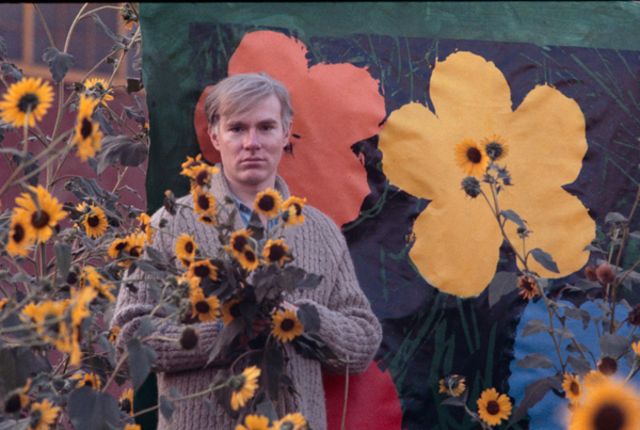
William John Kennedy, Andy Warhol with Flower and His Flowers Canvas, 1964. © William John Kennedy; Courtesy of KIWI Arts Group. Artwork: © 2024 The Andy Warhol Foundation for the Visual Arts, Inc. / Licensed by Artists Rights Society (ARS).
Though many of his canvases deal with more universal subjects, it is also worth noting a deeply personal side to Warhol’s investigation into human fragility. After an attempt on his life in 1968, the already shy artist became more reclusive and his themes turned inward even more. His self-portraits, done at various times throughout his career, are markers of the artist’s identity as he merged with a constructed persona and the very media he used in his work. The icons he created, whether Coca-Cola bottles, soup cans, skulls, or Marilyn Monroe’s beaming face, will last for eternity, and the insertion of his own visage into the mix can be seen as an attempt at establishing a legacy. In his book The Philosophy of Andy Warhol, the artist spoke about death, saying: “I don’t believe in it, because you’re not around to know that it’s happened. I can’t say anything about it because I’m not prepared for it” (A. Warhol, The Philosophy of Andy Warhol (From A to B and Back Again), Orlando, 1975, p. 123). The Flowers are a telling representation of Warhol’s two sides, and they show an unexpected kinship with his more macabre images of disaster. They typify both the ornamental beauty and glamour of twentieth-century consumerism while also connecting directly to a universal human need to be remembered after we fade away.

Rachel Ruysch, Flowers in a Glass Vase, 1704. Detroit Institute of Arts. Photo: © Detroit Institute of Arts / Bridgeman Images.
Auction Market Overview
2025 Auction Highlights
5 Flowers Paintings sold at auction in 2025 for a total turnover of USD 9,753,470. With no lot failing to sell, the sell-through rate is 100%.
The highest price was achieved by a 24-inch Flowers that sold at Sotheby’s in New-York, on 15 May 2025 for USD 4,076,000. Another 14-inch Flowers, from The Collection of Barbara Gladstone, sold at Sotheby’s, in New-York, on 15 May 2025 for USD 3,832,000.
Flowers Paintings Sold in 2025
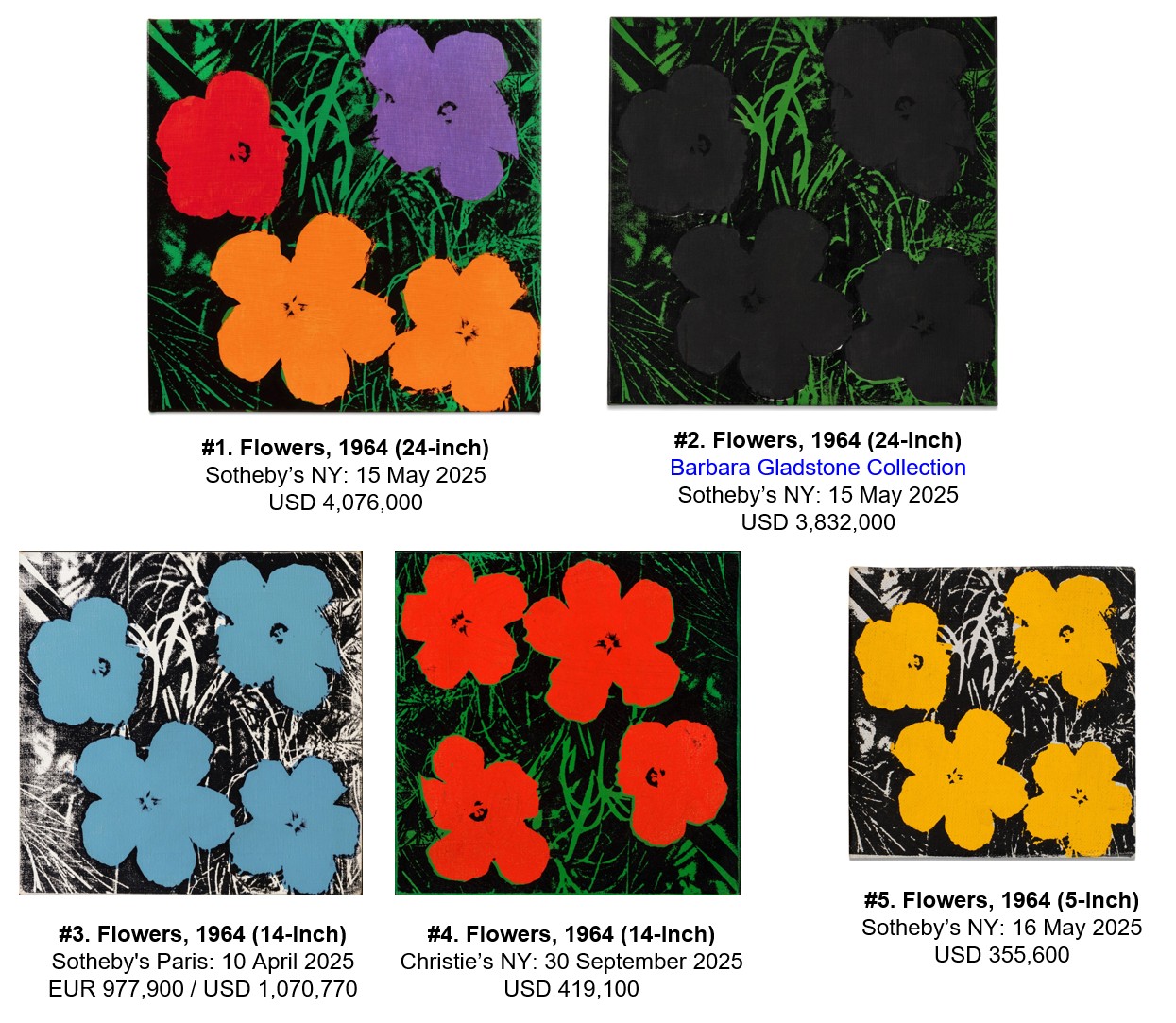
2 14-inch Flowers sold at auction in 2025, the highest price of EUR 977,900 (USD 1,070,770) was achieved at Sotheby’s, in Paris, on 10 April 2025.
Finally, one 5-inch Flowers sold at Sotheby’s in New-York on 16 May 2025 for USD 355,600.
2024 Auction Highlights
7 Flowers Paintings sold at auction in 2024 for a total turnover of USD 59,755,081. With 2 lots failing to sell, the sell-through rate is 77.8%.
The highest price was achieved at Christie’s in New-York on 14 May 2024, when Flowers, an 82-inch painting dated 1964 sold for USD 35,485,000. Another 82-inch Flowers sold at Christie’s in Hong-Kong, on 28 May 2024 for HKD 66,625,000 (USD 8,529,638).
A Late Four-Foot Flowers, dated 1967, sold at Sotheby’s in New-York, on 13 May 2024 for USD 11,250,000.
Flowers Paintings Sold in 2024
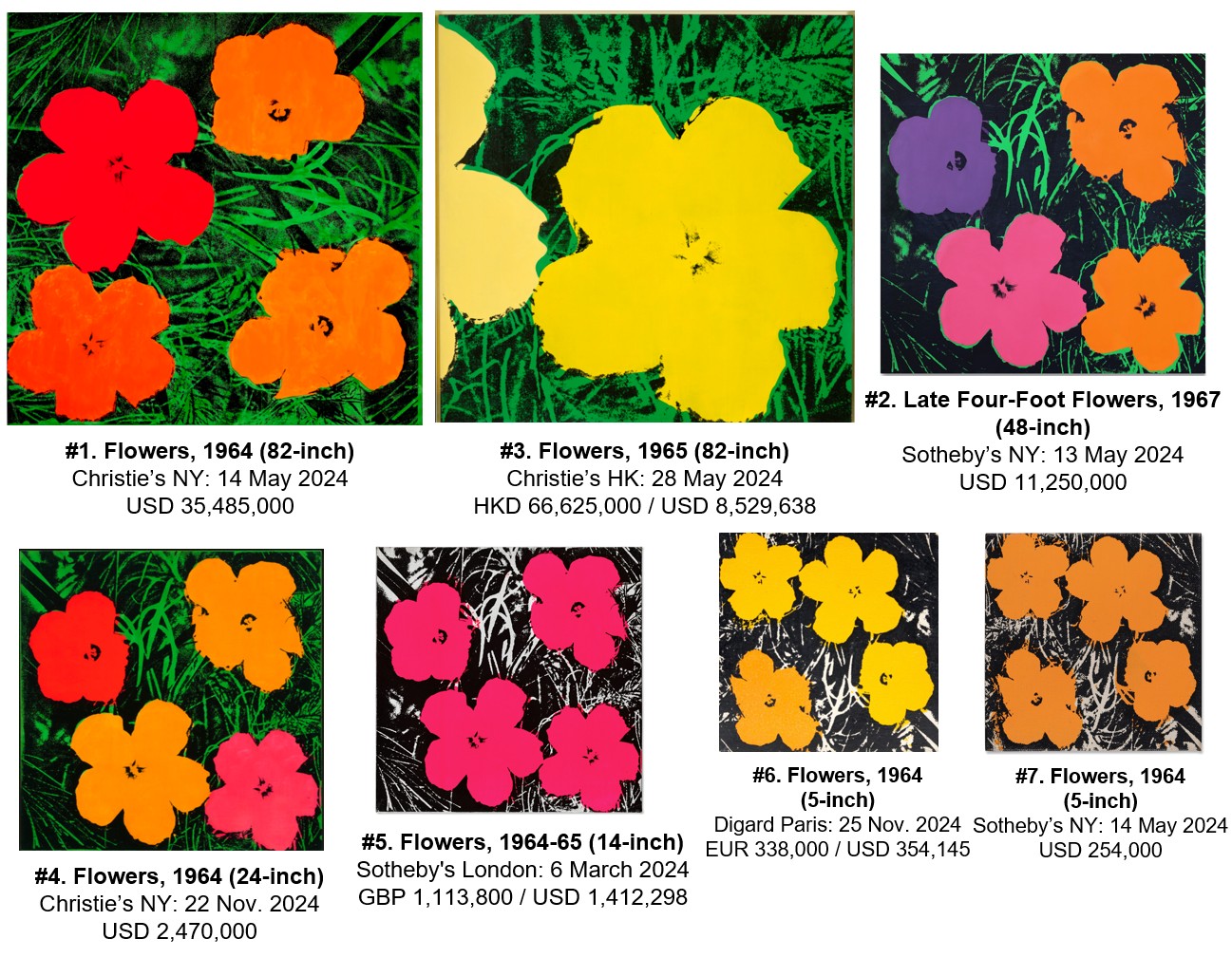
One 24-inch and one 14-inch Flowers also sold at auction in 2024, respectively at Christie’s, in New-York, on 22 November 2024, for USD 2,470,000, and at Sotheby’s, in London, on 6 March 2024, for GBP 1,113,800 (USD 1,412,298). Finally, 2 5-inch Flowers sold at an average price of USD 304,072.
2023 Auction Highlights
10 Flowers Paintings sold at auction in 2023 for a total turnover of USD 9,002,195. With no lot failing to sell, the sell-through rate is 100%.
The highest price was achieved at Christie’s in New-York on 9 November 2023 for a 24-inch Flowers painting sold for USD 3,438,000. Another 24-inch Flowers sold at Christie’s, in Hong-Kong, on 28 November 2023, for HKD 14,985,000 (USD 1,912,277).
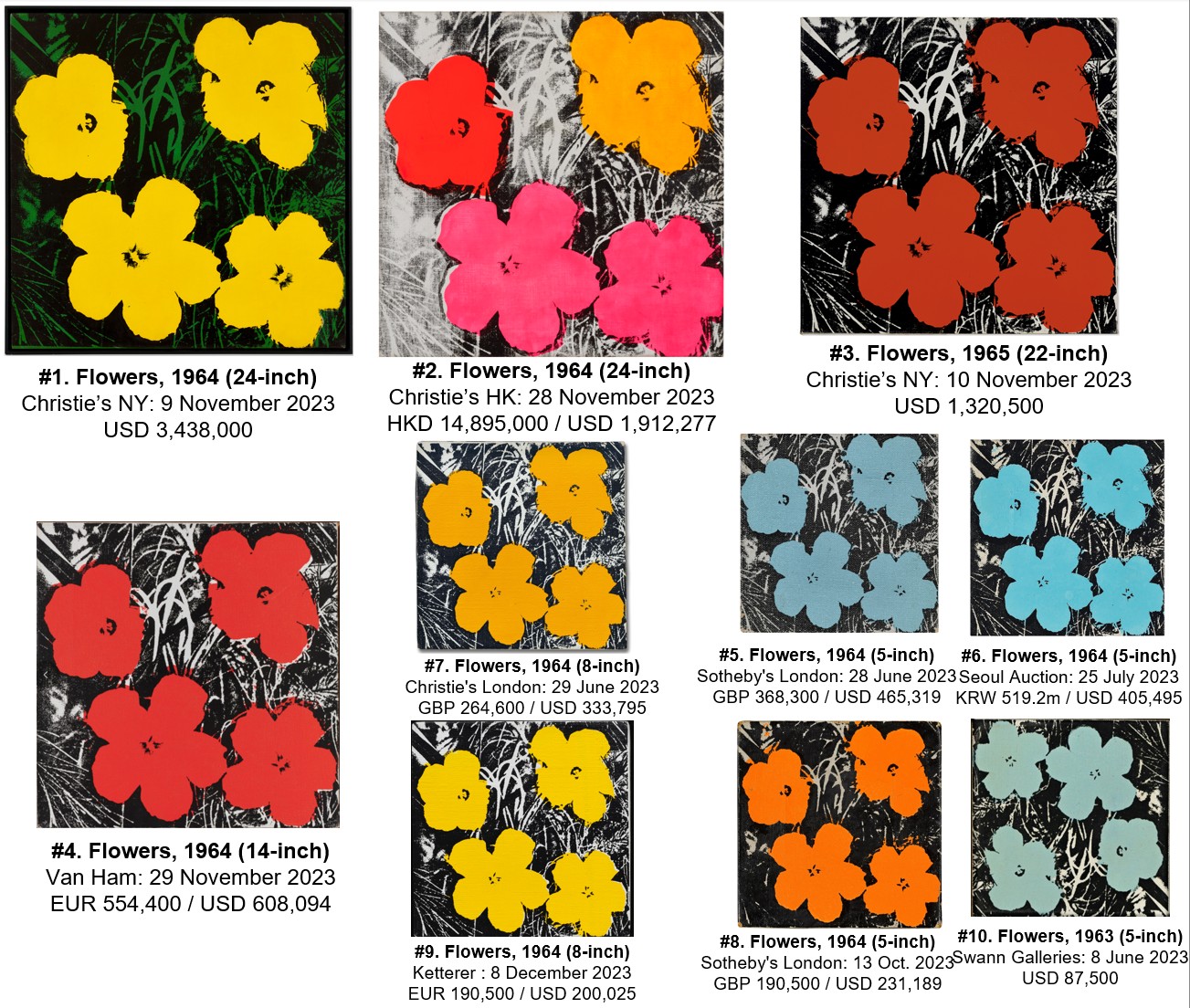
3 lots sold for more than USD 1 million, including a 22-inch Flowers sold at Christie’s in New-York, on 10 November 2023, for USD 1,320,500. 4 5-inch Flowers sold at auction in 2023, and 2 8-inch Flowers.
2023 Auction Highlights
COMING SOON
2026 Auction Results
Flowers, 1964
Contours of Modernity | A Private European Collection
Sotheby’s London: 4 March 2026
Estimated: GBP 800,000 – 1,200,000
GBP 1,792,000 / USD 2,393,935
Flowers | Modern & Contemporary Evening Auction | 2026 | Sotheby’s
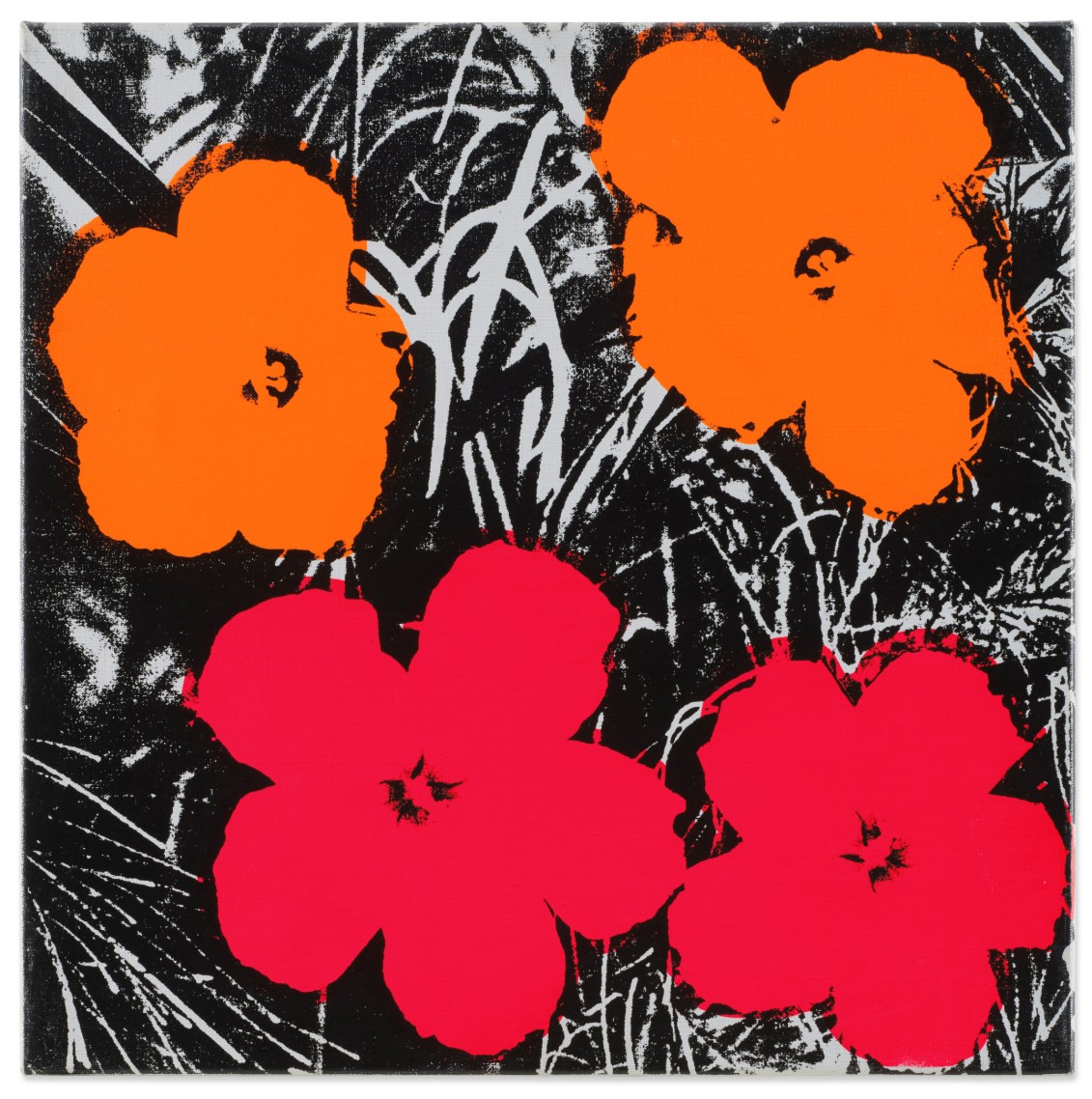
ANDY WARHOL (1928 – 1987)
Flowers, 1964
Acrylic and silkscreen ink on canvas
22×22 inches (56×56 cm)
Signed and dated 64 (on the overlap)
Flowers, 1964
AN EYE FOR COLOUR: WORKS FROM A PRIVATE COLLECTION
Christie’s London: 7 March 2026
Estimated: GBP 120,000 – 180,000
GBP 203,200 / USD 271,455
ANDY WARHOL (1928-1987), Flowers | Christie’s
REPEAT SALE
Sotheby’s New-York: 15 May 2013
Estimated: USD 120,000 – 180,000
USD 197,000
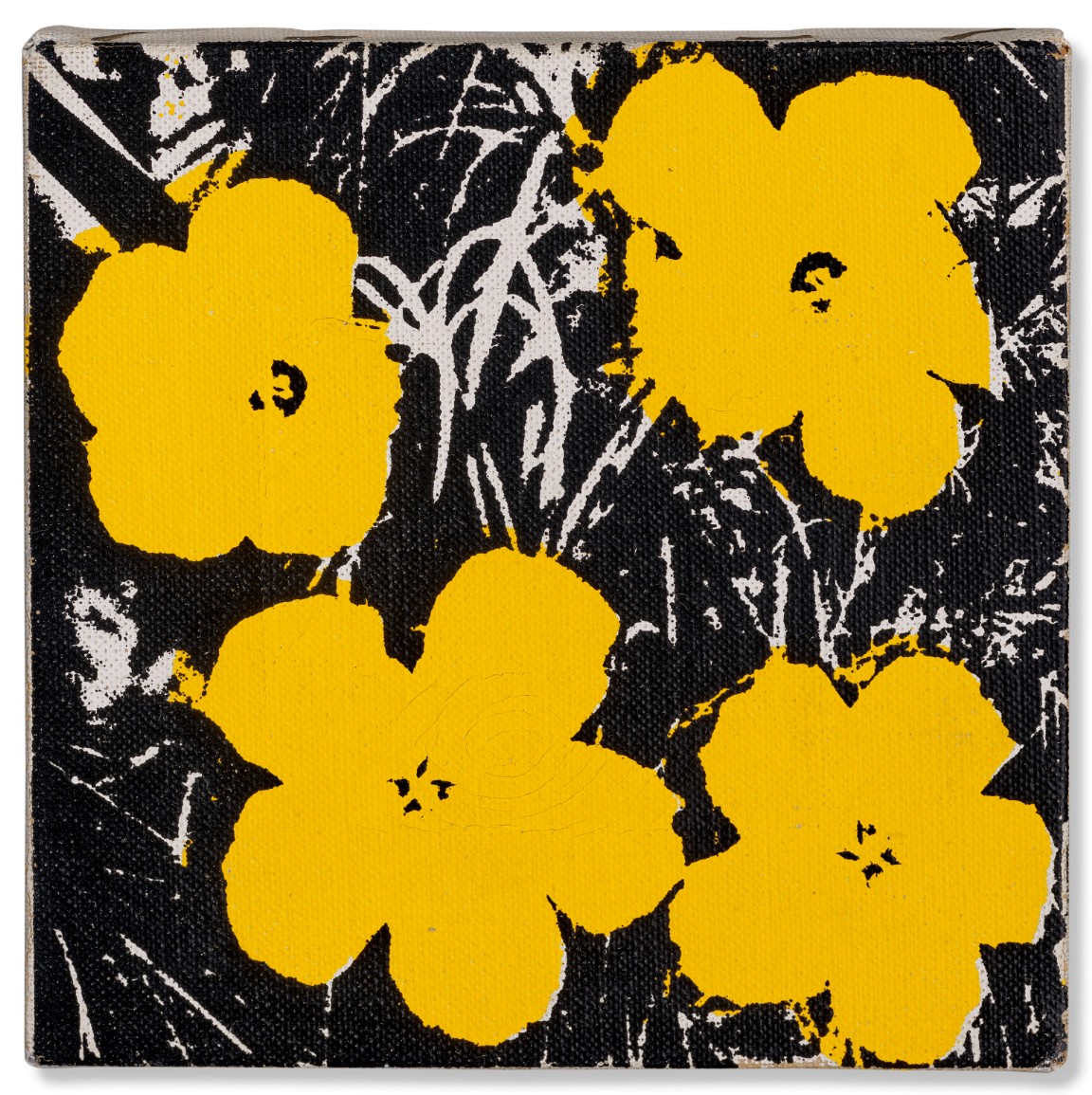
ANDY WARHOL (1928-1987)
Flowers, 1964
(Frei and Printz, The Andy Warhol Catalogue Raisonné: no. LC249)
Acrylic and silkscreen ink on canvas
5×5 inches (12.8 x 12.8 cm)
Signed with the artist’s initials and dated ‘A. W. 64’ (on the overlap)
Flowers, 1964
AN EYE FOR COLOUR: WORKS FROM A PRIVATE COLLECTION
Christie’s London: 7 March 2026
Estimated: GBP 120,000 – 180,000
GBP 342,900 / USD 458,080
ANDY WARHOL (1928-1987), Flowers | Christie’s
REPEAT SALE
Sotheby’s London: 9 March 2017
Estimated: GBP 120,000 – 180,000
GBP 246,350 / USD 299,650
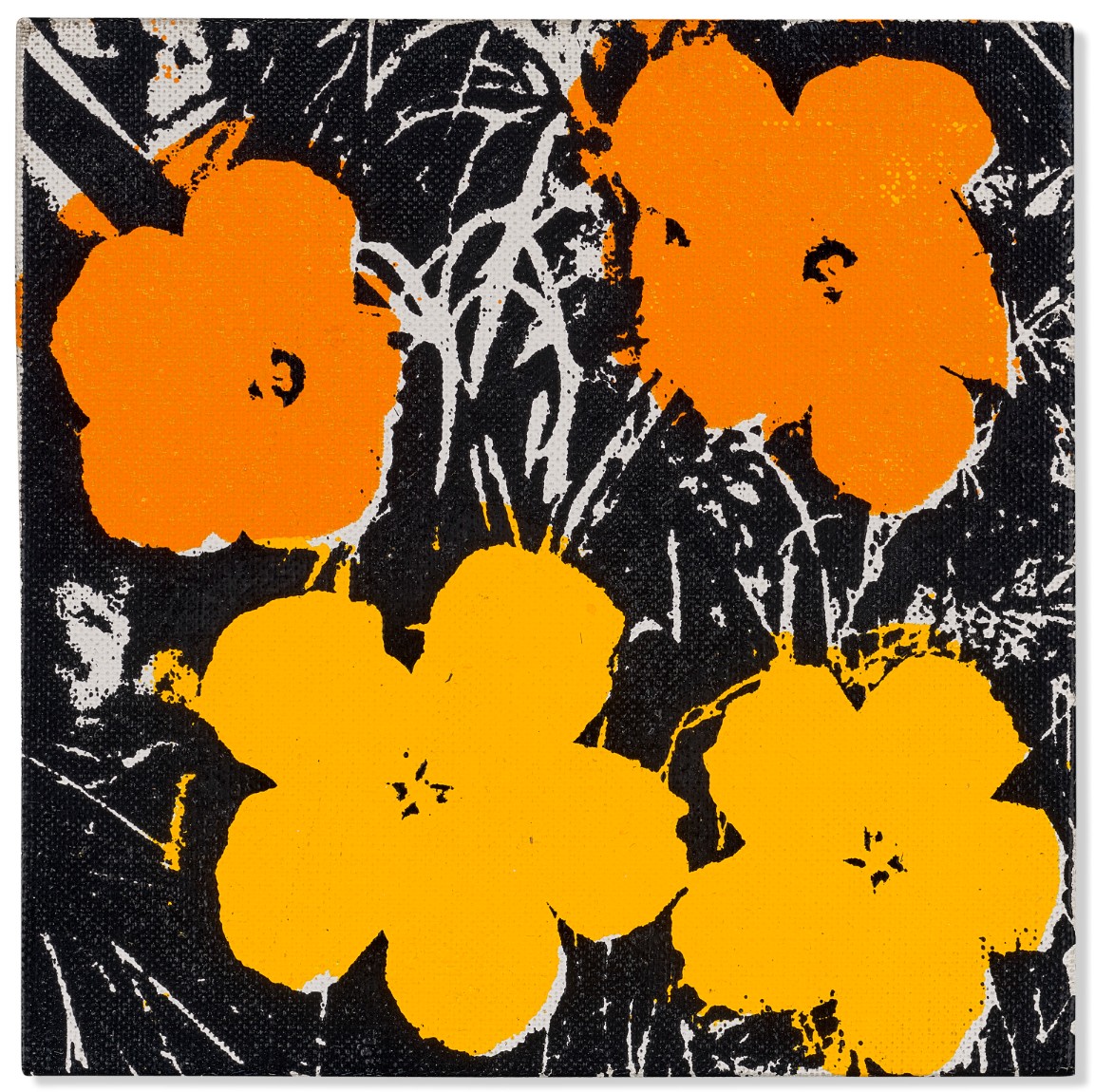
ANDY WARHOL (1928-1987)
Flowers, 1964
Acrylic and silkscreen ink on canvas
5×5 inches (12.8 x 12.8 cm)
Signed and dated ‘Andy Warhol 64’, stamped with the Andy Warhol Art Authentication Board, Inc. stamp
Numbered ‘A100.089’ (on the overlap)
Flowers, 1964-1965
AN EYE FOR COLOUR: WORKS FROM A PRIVATE COLLECTION
Christie’s London: 7 March 2026
Estimated: GBP 180,000 – 250,000
GBP 355,600 / USD 475,045
ANDY WARHOL (1928-1987), Flowers | Christie’s
REPEAT SALE
Christie’s New-York: 13 November 2013
Estimated: USD 150,000 – 200,000
USD 341,000
Andy Warhol (1928-1987), Flowers | Christie’s
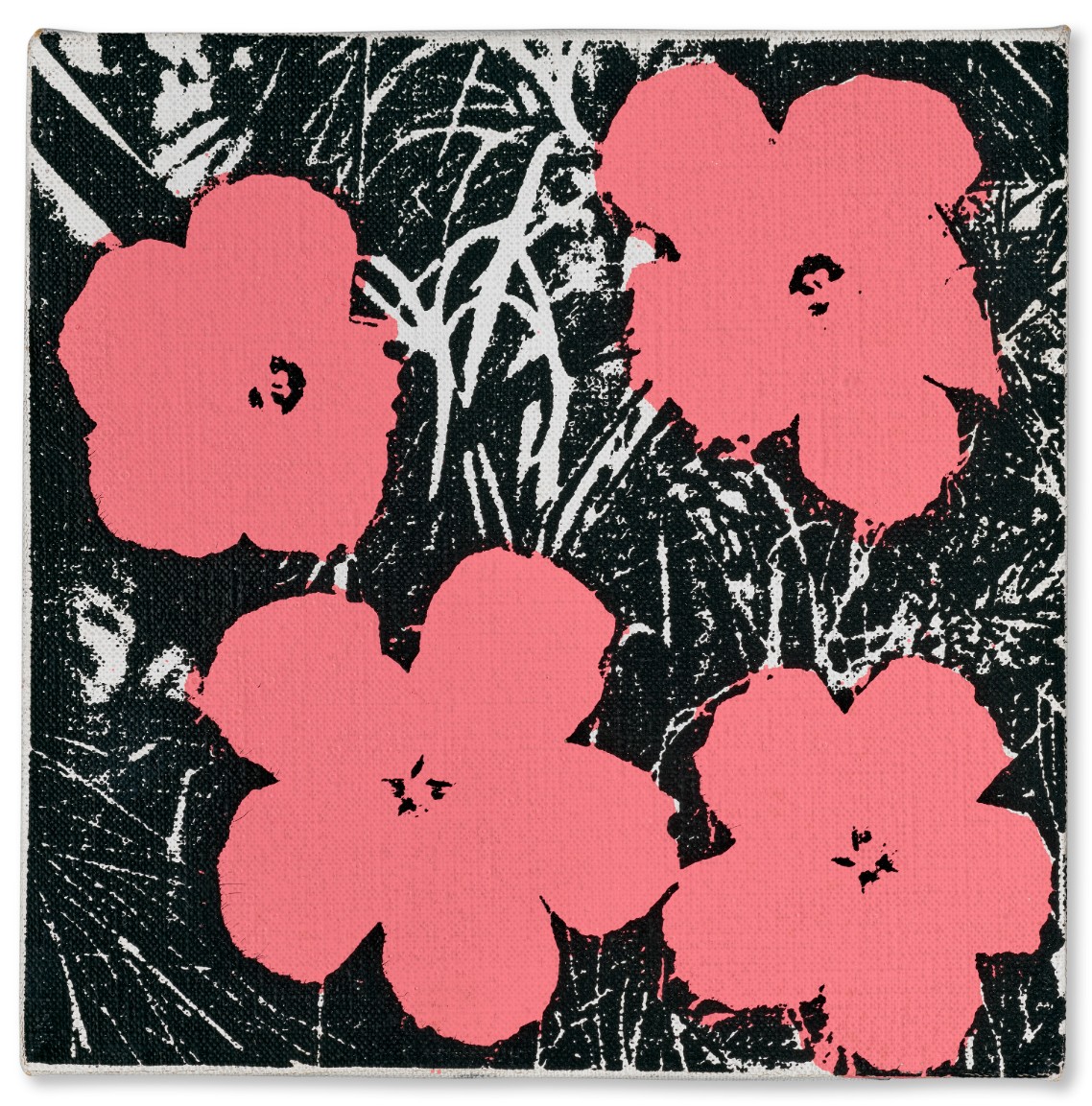
ANDY WARHOL (1928-1987)
Flowers, 1964-1965
(Frei and Printz, The Andy Warhol Catalogue Raisonné: no. 1655)
Acrylic and silkscreen ink on canvas
8-1/8 x 8-1/8 inches (20.5 x 20.5 cm)
Signed and dated ‘Andy Warhol 64’ (on the overlap)
2025 Auction Results
#1. Flowers, 1964
Sotheby’s New-York: 15 May 2025
Estimated: USD 1,000,000 – 1,500,000
USD 4,076,000
Flowers | The Now and Contemporary Evening Auction | 2025 | Sotheby’s
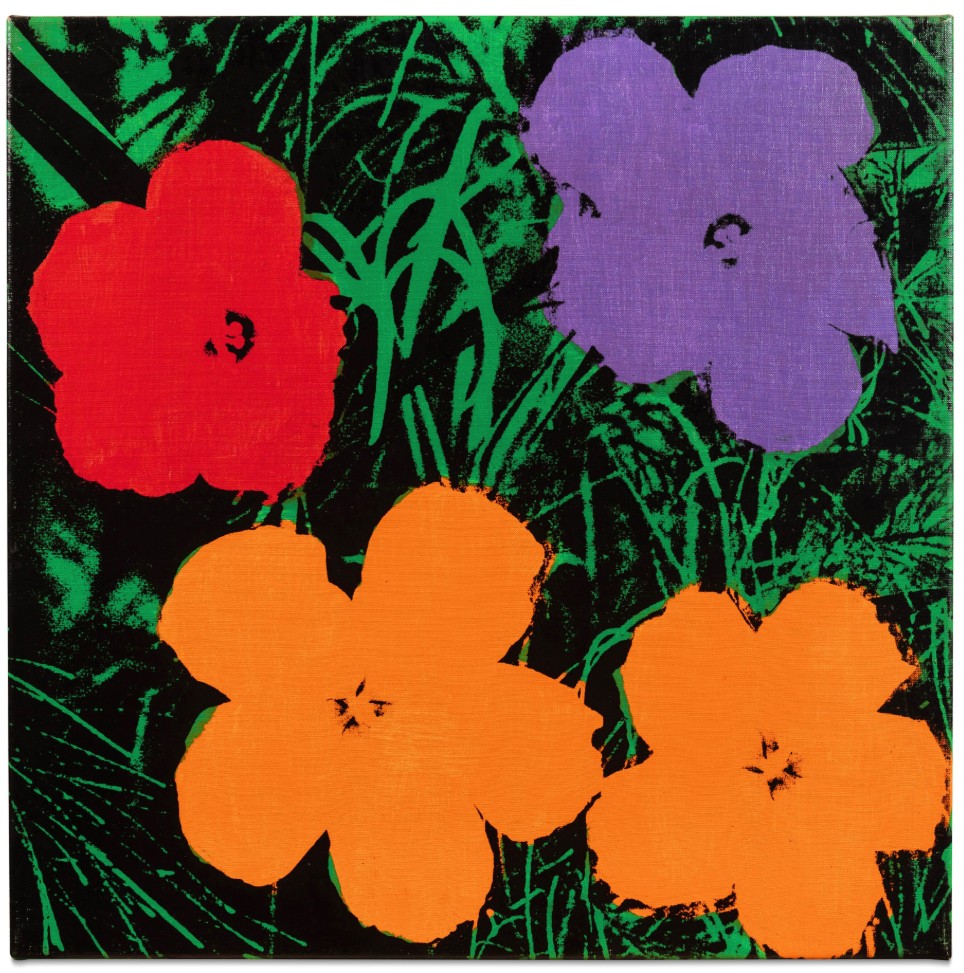
ANDY WARHOL (1928 – 1987)
Flowers, 1964
Acrylic and silkscreen ink on canvas
24×24 inches (61×61 cm)
Signed and dated 64 (on the overlap)
#2. Flowers, 1964
Selections from The Collection of Barbara Gladstone
Sotheby’s New-York: 15 May 2025
Estimated: USD 1,000,000 – 1,500,000
USD 3,832,000
Flowers | Selections from The Collection of Barbara Gladstone | Contemporary Art | Sotheby’s
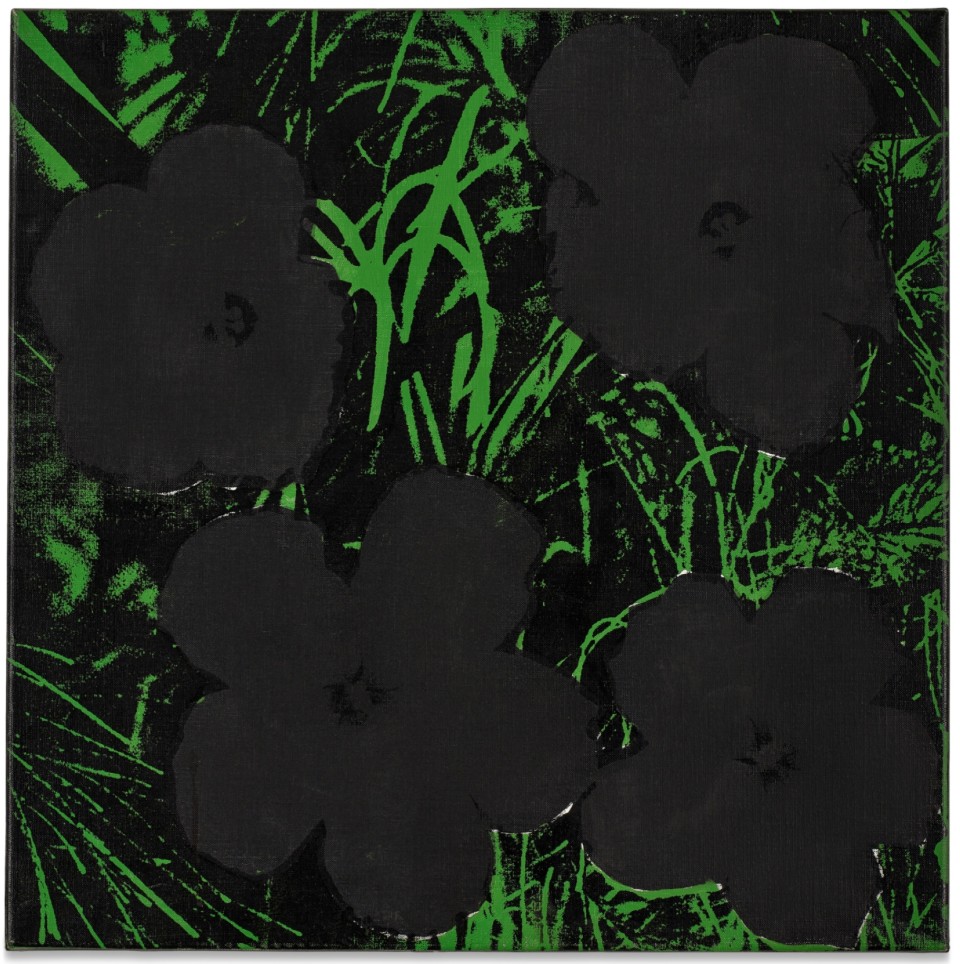
ANDY WARHOL (1928 – 1987)
Flowers, 1964
Acrylic and silkscreen ink on canvas
24×24 inches (61×61 cm)
Signed and dated 1964 twice (on the reverse)
#3. Flowers, 1964
Sotheby’s Paris: 10 April 2025
Estimated: EUR 200,000 – 300,000
EUR 977,900 / USD 1,070,770
Flowers | Art Moderne et Contemporain Evening Auction | 2025 | Sotheby’s
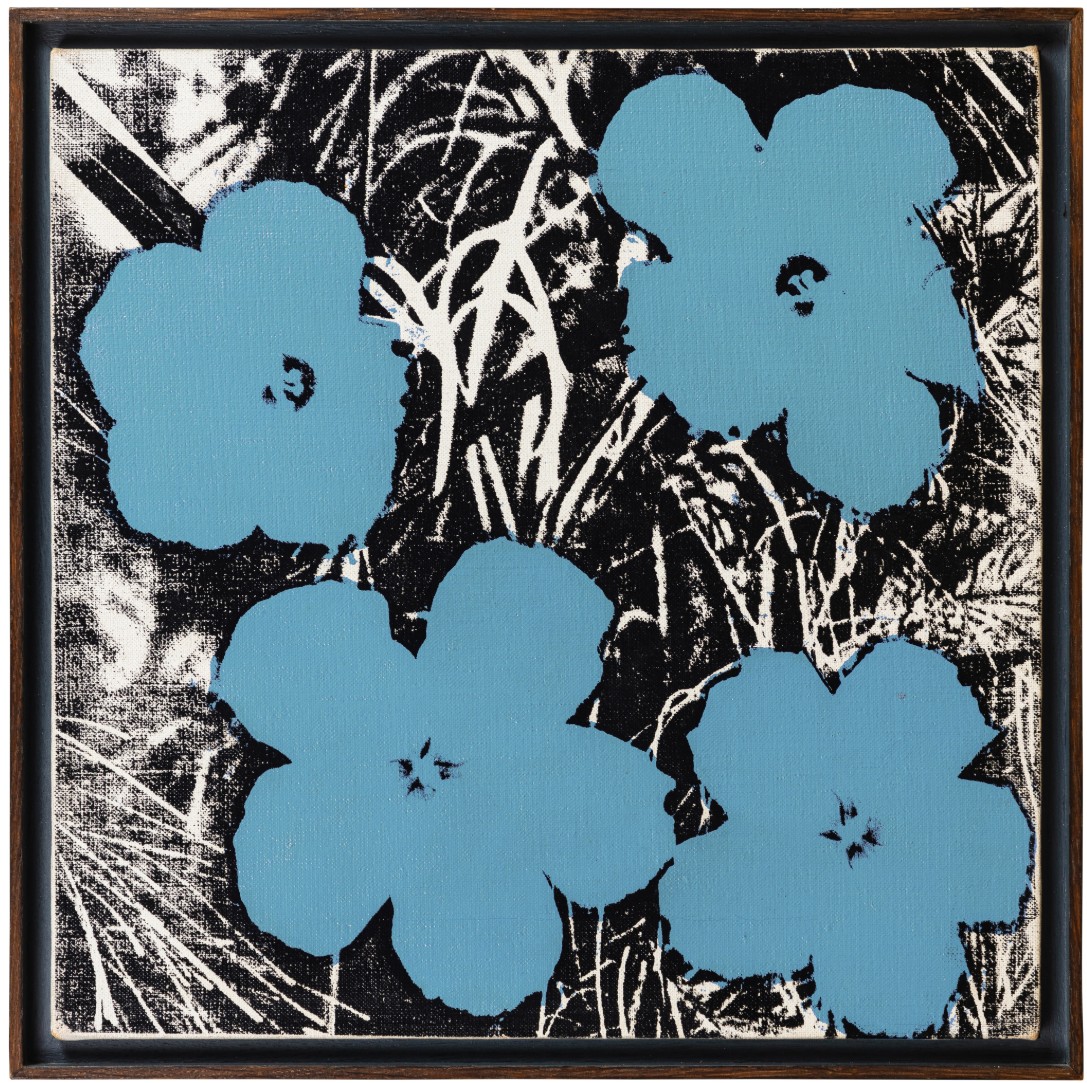
ANDY WARHOL (1928 – 1987)
Flowers, 1964
Silkscreen ink on linen
14×14 inches (35.6 x 35.6 cm)
Signed, dedicated and dated twice 64 and 1964 (on the overlap)
#4. Flowers, 1964
Christie’s New-York: 30 September 2025
Estimated: USD 150,000 – 200,000
USD 419,100
ANDY WARHOL (1928-1987), Flowers | Christie’s
REPEAT SALE
Christie’s New-York: 9 March 2021
Estimated: USD 200,000 – 300,000
USD 300,000
Andy Warhol (1928-1987) (christies.com)
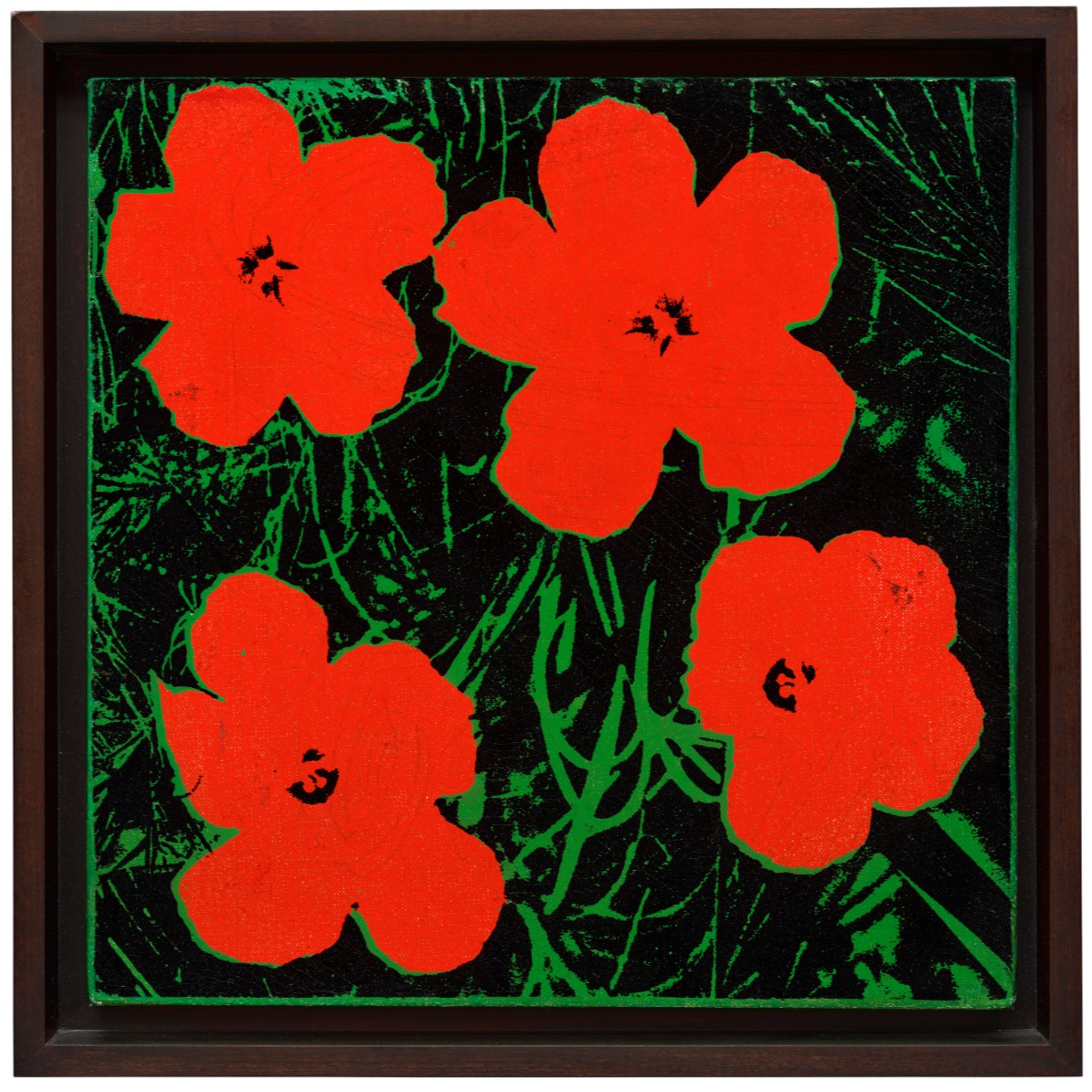
ANDY WARHOL (1928-1987)
Flowers, 1964
Acrylic and silkscreen ink on canvas
14×14 inches (35.6 x 35.6 cm)
Signed indistinctly ‘Andy Warhol’ (on the overlap)
#5. Flowers, 1964
Sotheby’s New-York: 16 May 2025
Estimated: USD 180,000 – 250,000
USD 355,600
Flowers | Contemporary Day Auction | 2025 | Sotheby’s
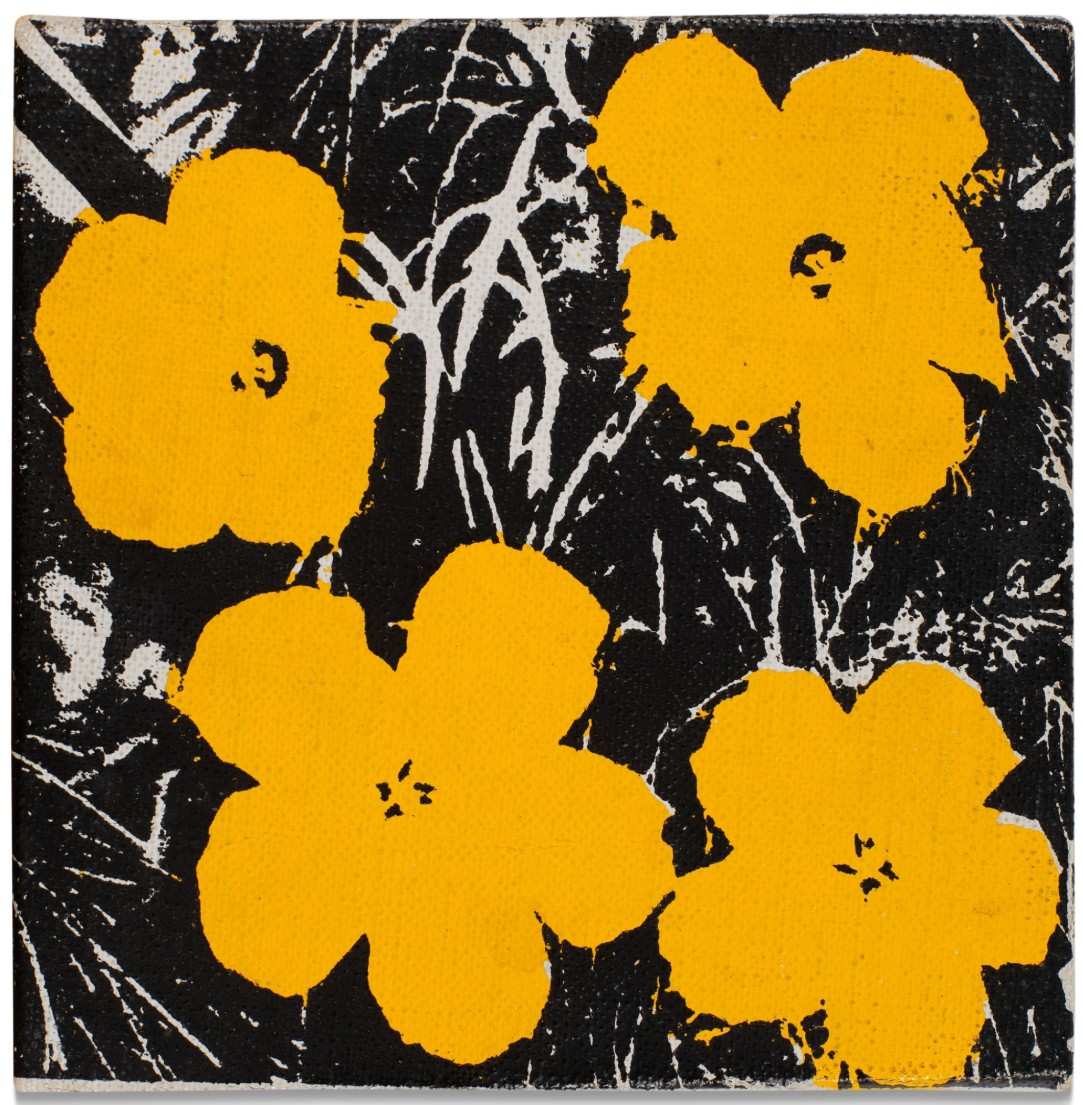
ANDY WARHOL (1928 – 1987)
Flowers, 1964
Acrylic and silkscreen ink on canvas
5×5 inches (12.7 x 12.7 cm)
Signed and dated 64 (on the overlap)
Stamped by the Estate of Andy Warhol and the Andy Warhol Foundation for the Visual Arts, Inc.
Numbered A102.015 on the overlap
2024 Auction Results
#1. Flowers, 1964
Christie’s New-York: 14 May 2024
Estimated: USD 20,000,000 – 30,000,000
USD 35,485,000
ANDY WARHOL (1928-1987), Flowers | Christie’s (christies.com)

ANDY WARHOL (1928-1987)
Flowers, 1964
Acrylic, fluorescent paint and silkscreen ink on linen
82×82 inches (208.3 x 208.3 cm)
Signed twice and dated later ‘Andy Warhol Andy Warhol 65’ (on the overlap)
#2. Late Four-Foot Flowers, 1967
Sotheby’s New-York: 13 May 2024
Estimated: USD 7,000,000 – 10,000,000
USD 11,250,000
Late Four-Foot Flowers | Contemporary Evening Auction | 2024 | Sotheby’s (sothebys.com)

ANDY WARHOL (1928 – 1987)
Late Four-Foot Flowers, 1967
Acrylic, silkscreen ink and graphite on canvas
48×48 inches (121.9 x 121.9 cm)
#3. Flowers, 1965
Christie’s Hong-Kong: 28 May 2024
Estimated: HKD 62,800,000 – 92,800,000
HKD 66,625,000 / USD 8,529,638
ANDY WARHOL (1928-1987)
Flowers, 1965
Acrylic and silkscreen ink on canvas
82×82 inches (208.3 x 208.3 cm)
Numbered ‘PA 53.002’ (on the stretcher)
#4. Flowers, 1964
Christie’s New-York: 22 November 2024
Estimated: USD 1,200,000 – 1,800,000
USD 2,470,000
ANDY WARHOL (1928-1987), Flowers | Christie’s
REPEAT SALE
Phillips London: 20 October 2020
Estimated: GBP 1,400,000 – 1,800,000
GBP 1,595,500 / USD 2,066,175
Andy Warhol – 20th Century & Contemp… Lot 18 October 2020 | Phillips
REPEAT SALE
Christie’s New-York: 17 May 2018
Estimated: USD 1,800,000 – 2,500,000
USD 2,112,500
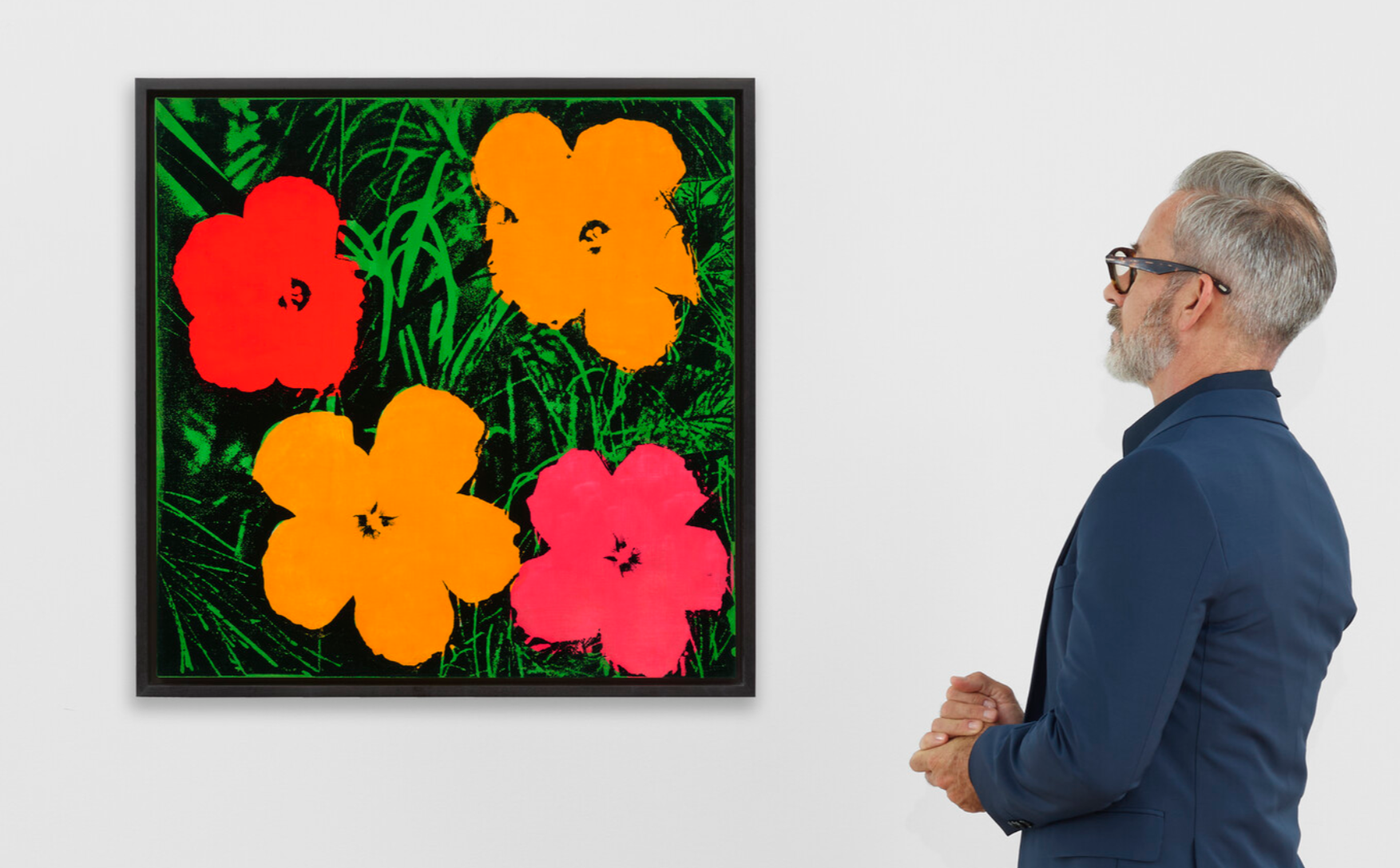
ANDY WARHOL (1928-1987)
Flowers, 1964
Acrylic and silkscreen ink on canvas
24×24 inches (61×61 cm)
Signed twice and dated ‘ANDY WARHOL 64 Andy Warhol’ (on the overlap)
#5. Flowers, 1964-65
Sotheby’s London: 6 March 2024
Estimated: GBP 1,200,000 – 1,800,000
GBP 1,113,800 / USD 1,412,298
Flowers | Modern & Contemporary Evening Auction featuring The Now | 2024 | Sotheby’s (sothebys.com)
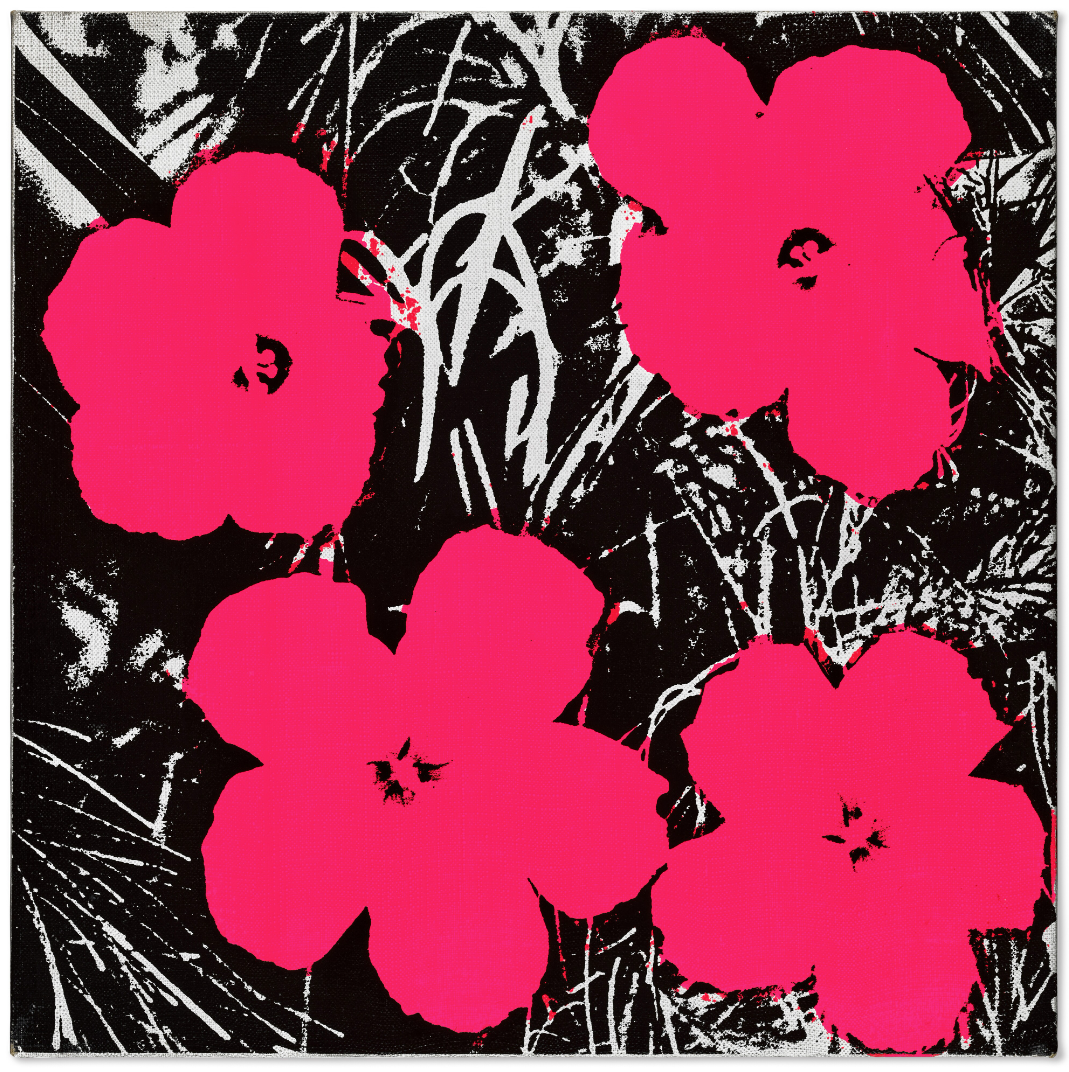
ANDY WARHOL (1928 – 1987)
Flowers, 1964-65
Acrylic and silkscreen ink on canvas
14×14 inches (35.6 x 35.6 cm)
Signed and dated 64 (on the overlap)
#6. Flowers, 1964
Digard Paris: 25 November 2024
Estimated: EUR 250,000 – 300,000
EUR 338,000 / USD 354,145
Andy WARHOL (1928 – 1987) – Lot 21
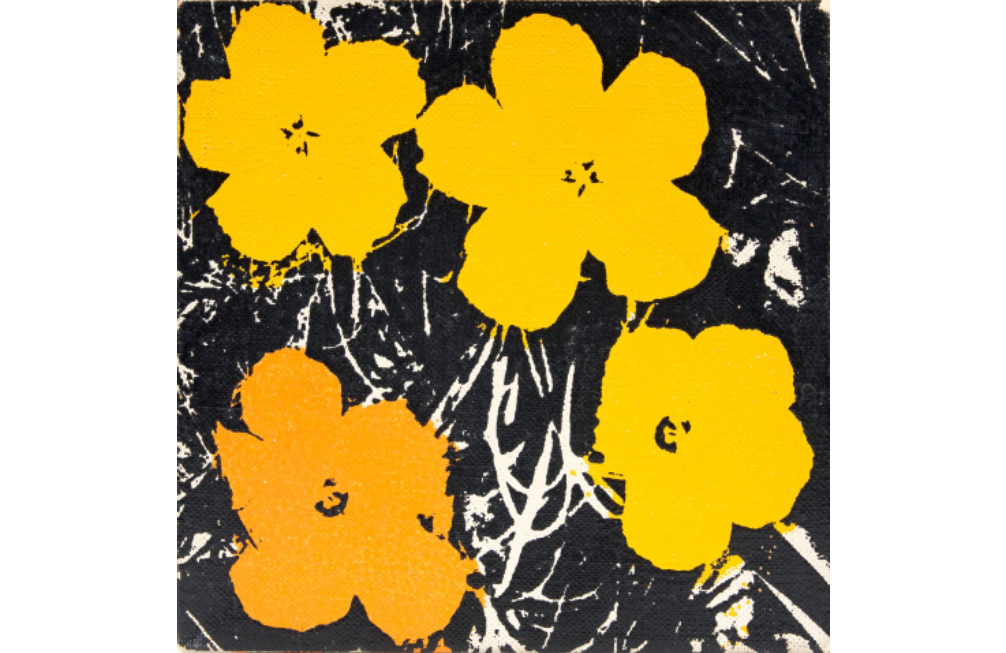
Andy WARHOL (1928 – 1987)
Flowers, 1964
Acrylic and silkscreen ink on canvas
5×5 inches (12.7 x 12.7 cm)
Monogrammed and dated on reverse
#7. Flowers, 1964
Estimated: USD 180,000 – 250,000
USD 254,000

ANDY WARHOL (1928 – 1987)
Flowers, 1964
Acrylic and silkscreen ink on canvas
5×5 inches (12.7 x 12.7 cm)
Signed with the artist’s initials and dated ’64 (on the overlap)
2023 Auction Results
#1. Flowers, 1964
Christie’s New-York: 9 November 2023
Estimated: USD 1,500,000 – 2,000,000
USD 3,438,000
ANDY WARHOL (1928-1987), Flowers | Christie’s
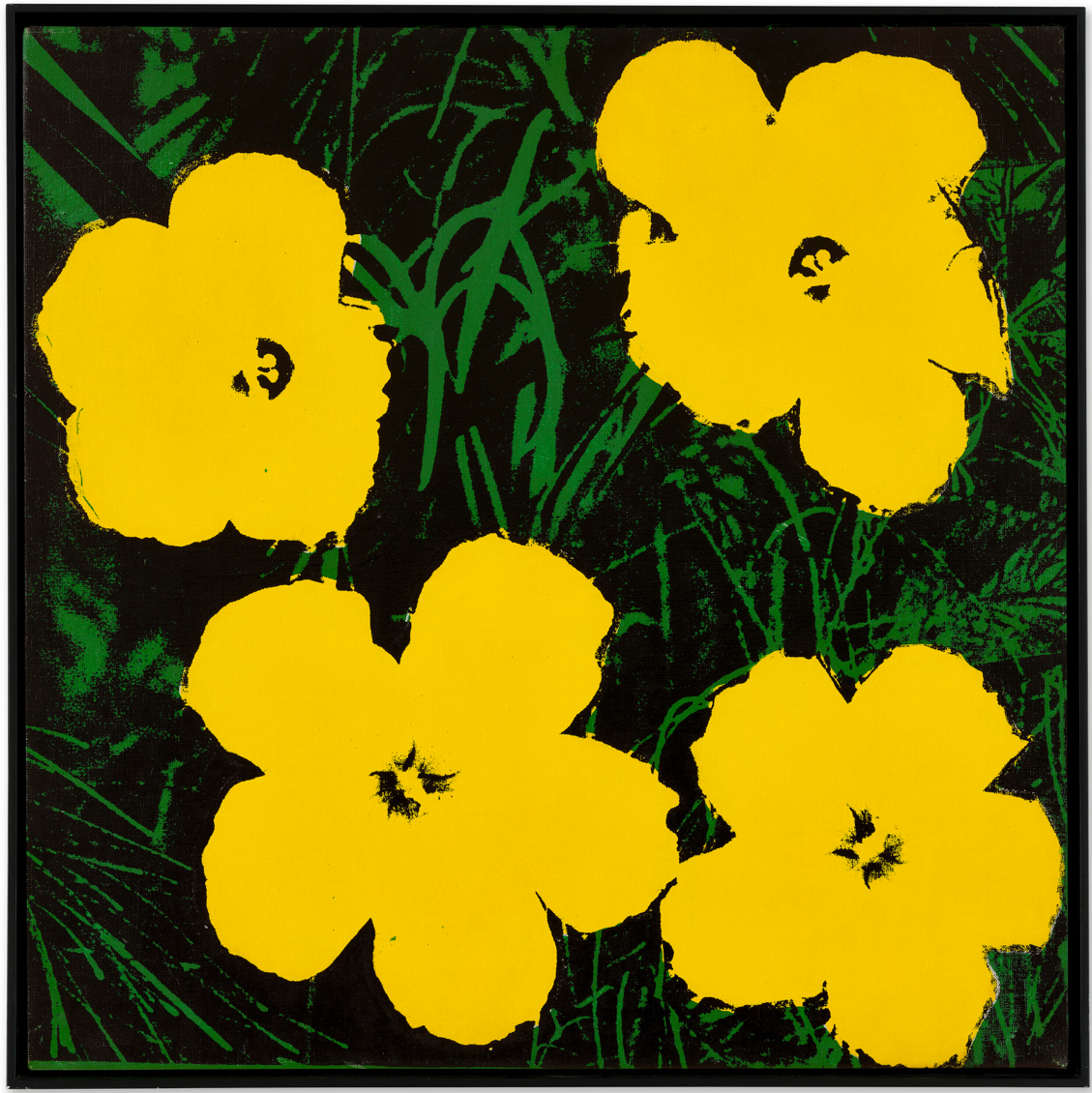
ANDY WARHOL (1928-1987)
Flowers, 1964
Acrylic and silkscreen ink on canvas
24×24 inches (61×61 cm)
Signed ‘Andy Warhol’ (on the overlap)
#2. Flowers, 1964
Christie’s Hong-Kong: 28 November 2023
Estimated: HKD 12,000,000 – 18,000,000
HKD 14,895,000 / USD 1,912,277
ANDY WARHOL (1928-1987), Flowers | Christie’s
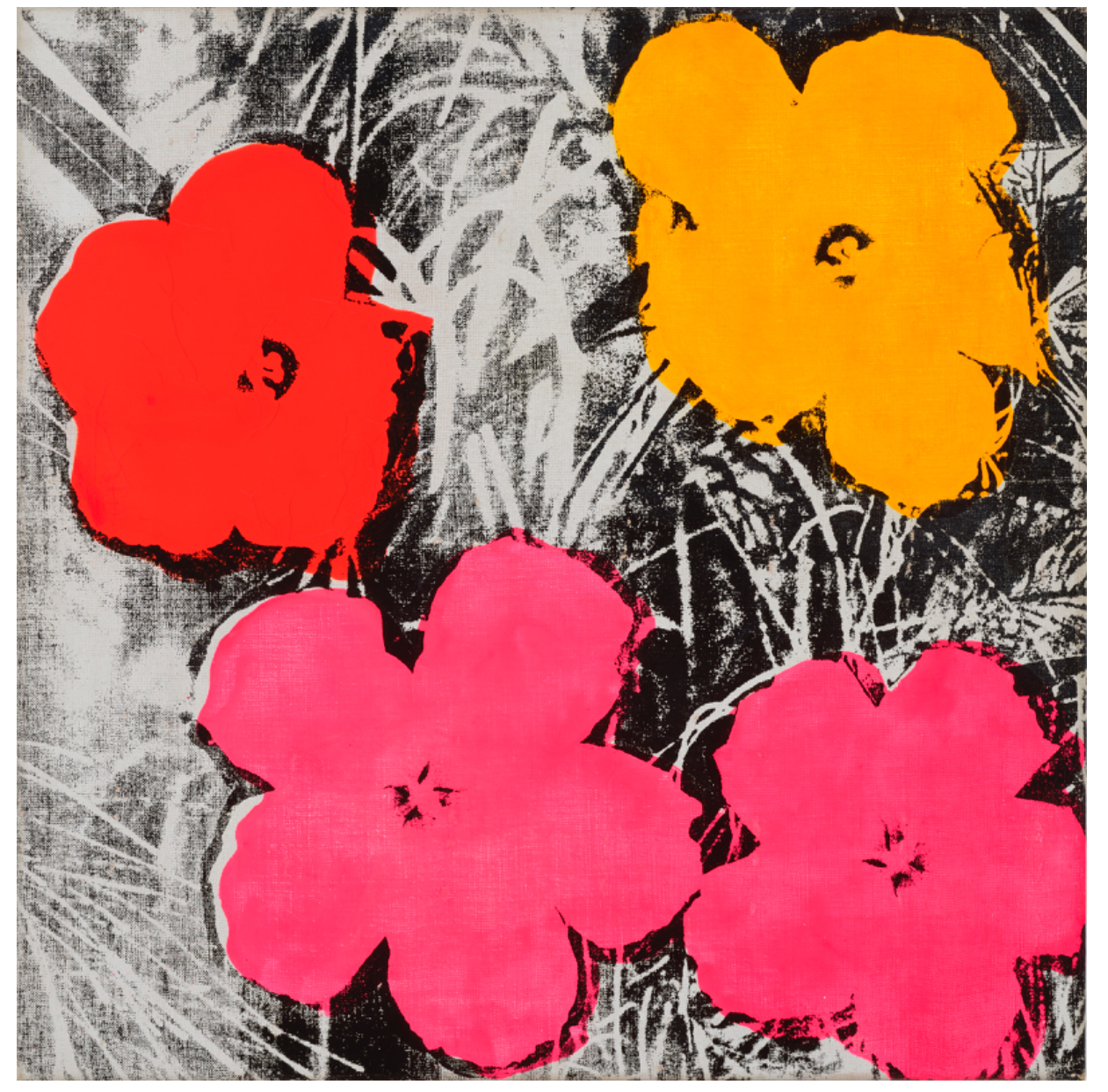
ANDY WARHOL (1928-1987)
Flowers, 1964
Acrylic and silkscreen ink on canvas
23 1/2 x 23 5/8 inches (59.7 x 60 cm)
#3. Flowers, 1965
Christie’s New-York: 10 November 2023
Estimated: USD 1,200,000 – 1,800,000
USD 1,320,500
ANDY WARHOL (1928-1987), Flowers | Christie’s
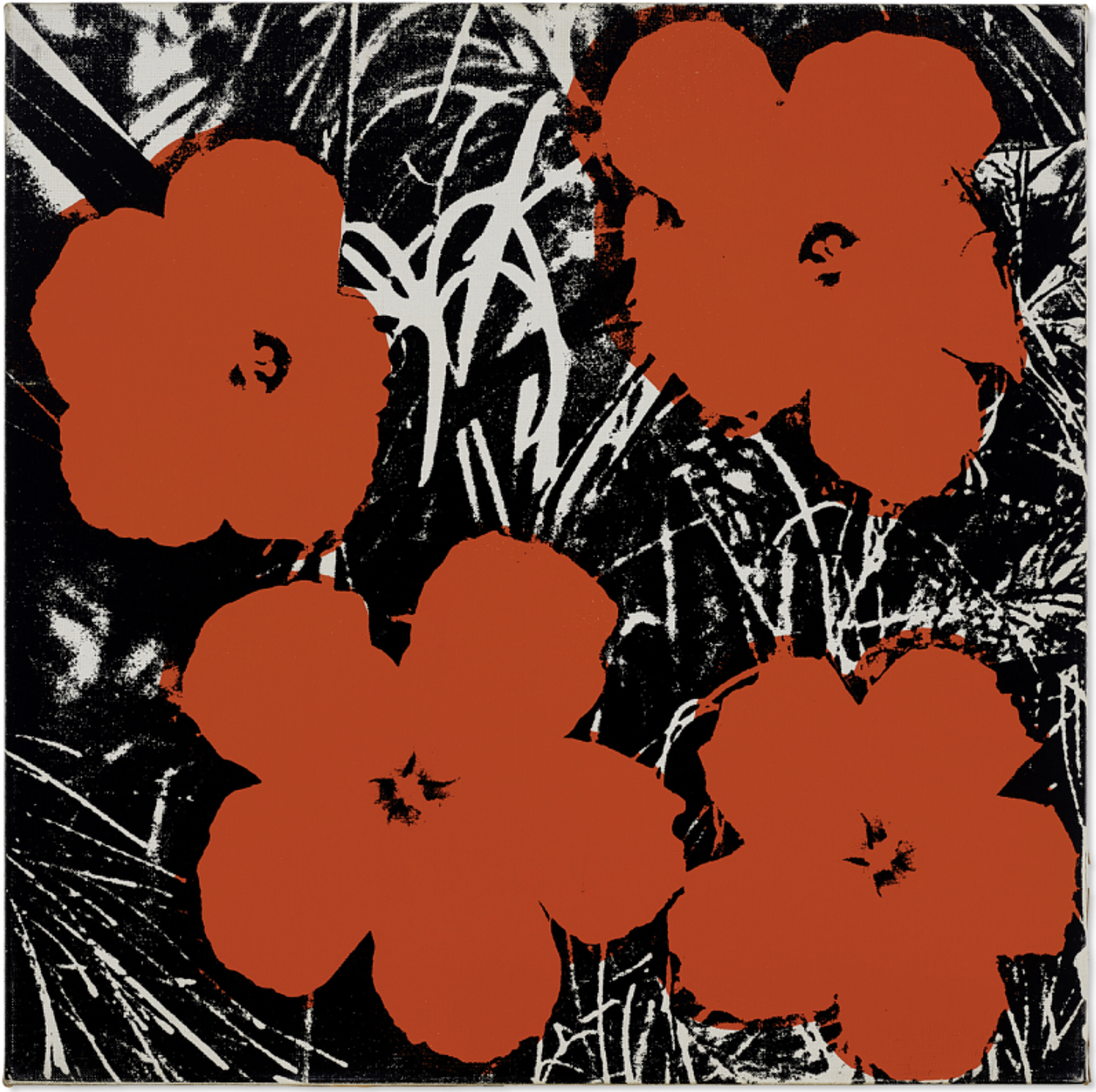
ANDY WARHOL (1928-1987)
Flowers, 1965
Silkscreen ink on canvas
22×22 inches (55.9 x 55.9 cm)
#4. Flowers, 1964
Van Ham: 29 November 2023
Estimated: EUR 300,000
EUR 554,400 / USD 608,094
Andy Warhol – Buy & Sell | VAN HAM Art Auctions (van-ham.com)
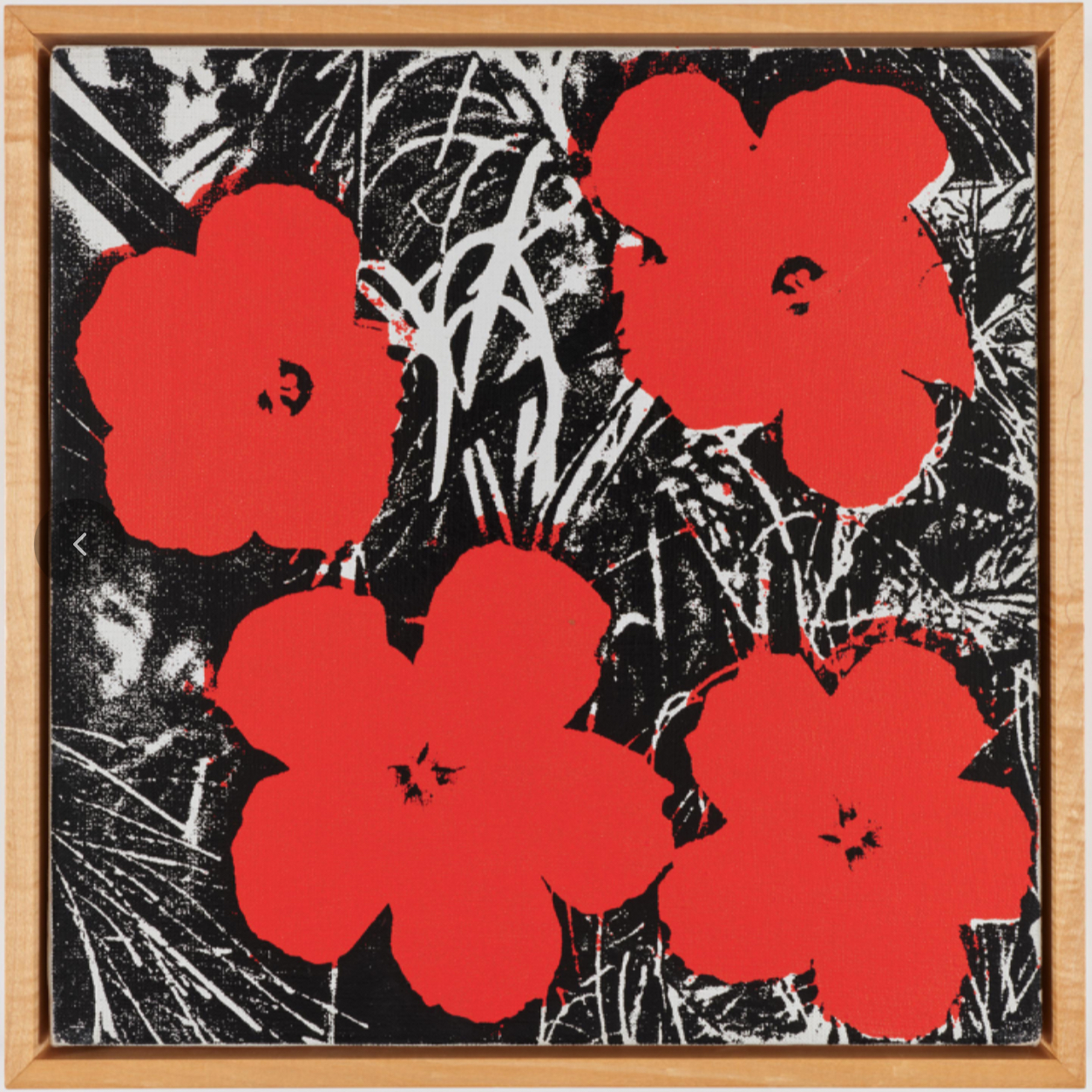
ANDY WARHOL
Flowers, 1964
Synthetic polymer paints on canvas
14×14 inches (36×36 cm)
Signed and dated verso top on folded canvas: ANDY WARHOL 64
Stamped with the estate stamp and the stamp of the Andy Warhol Foundation for the Visual Arts
Numbered A1094.101 VF
#5. Flowers, 1964
Sotheby’s London: 28 June 2023
Estimated: GBP 150,000 – 200,000
GBP 368,300 / USD 465,319
Flowers | Modern & Contemporary Day Auction | 2023 | Sotheby’s (sothebys.com)
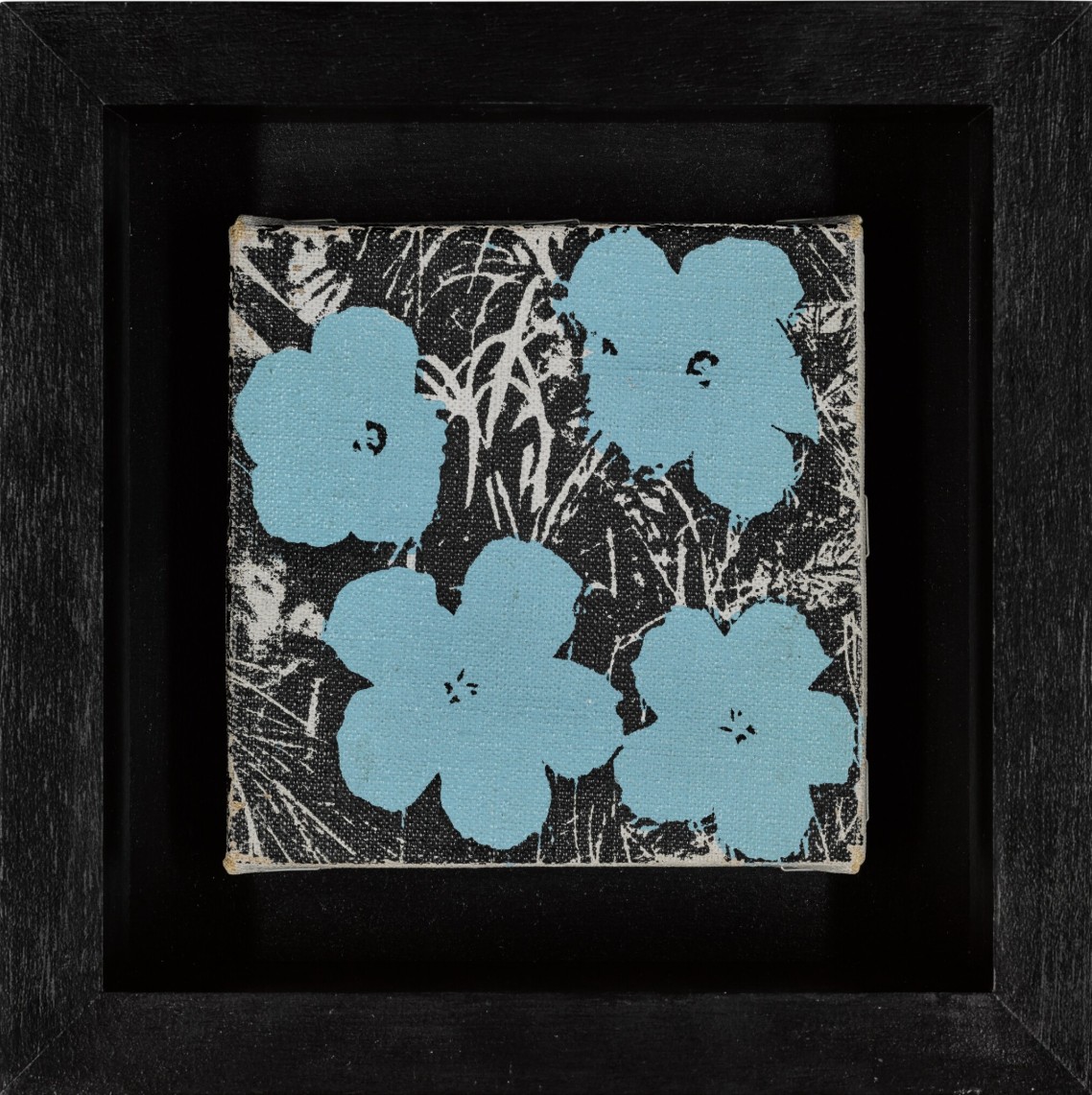
ANDY WARHOL (1928 – 1987)
Flowers, 1964
Acrylic and silkscreen ink on canvas
5×5 inches (12.7 x 12.7 cm)
Signed and dedicated Drue 75 LOVE on the overlap
#6. Flowers, 1964
Seoul Auction: 25 July 2023
Estimated: KRW 440,000,000 – 600,000,000
KRW 440,000,000 (Hammer)
KRW 519,200,000 / USD 405,495
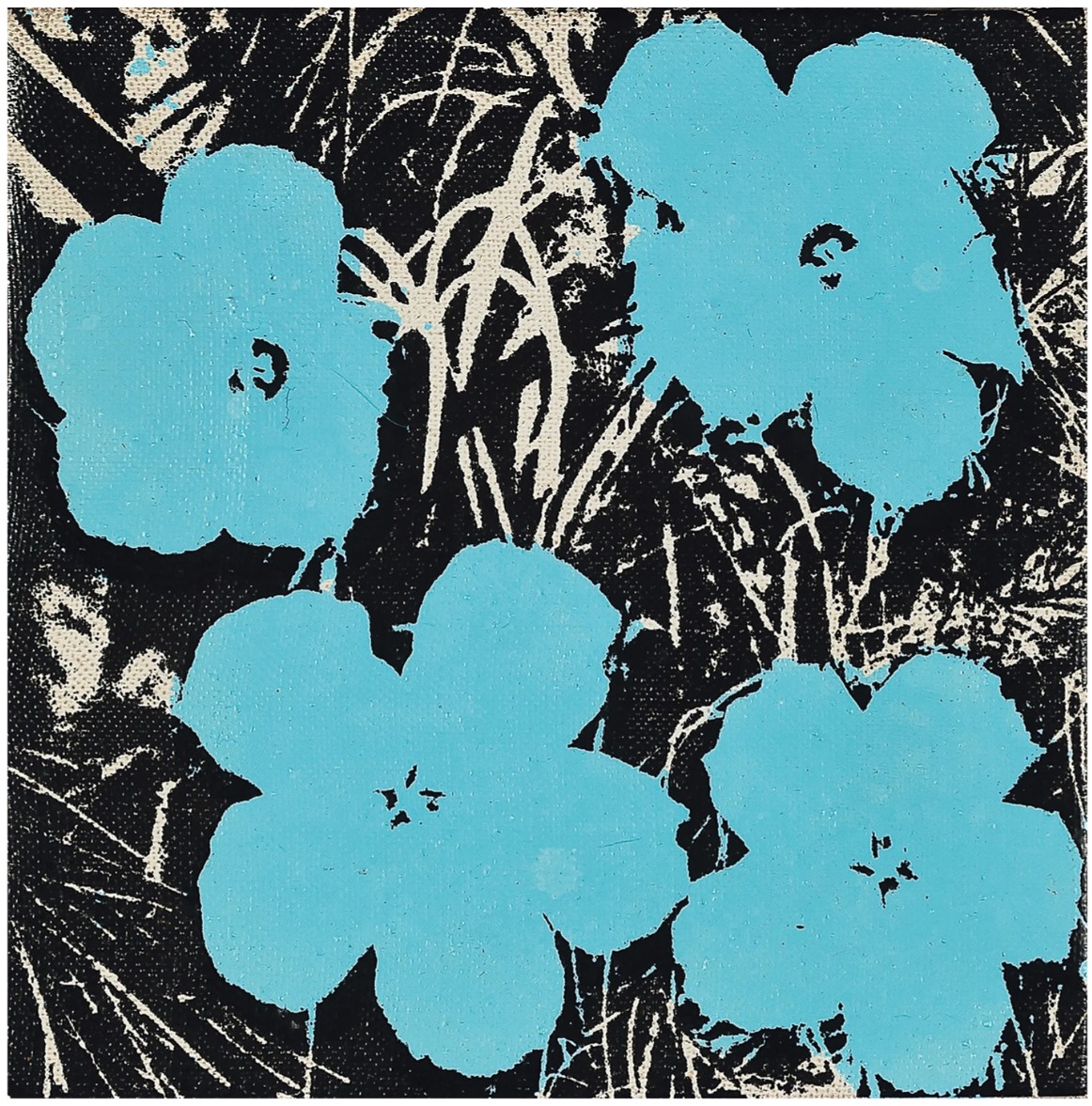
ANDY WARHOL (1928 – 1987)
Flowers, 1964
Silkscreen ink on linen
5×5 inches (12.7 x 12.7 cm)
Signed on verso
#7. Flowers, 1964
Christie’s London: 29 June 2023
Estimated: GBP 200,000 – 300,000
GBP 264,600 / USD 333,795
ANDY WARHOL (1928-1987) (christies.com)
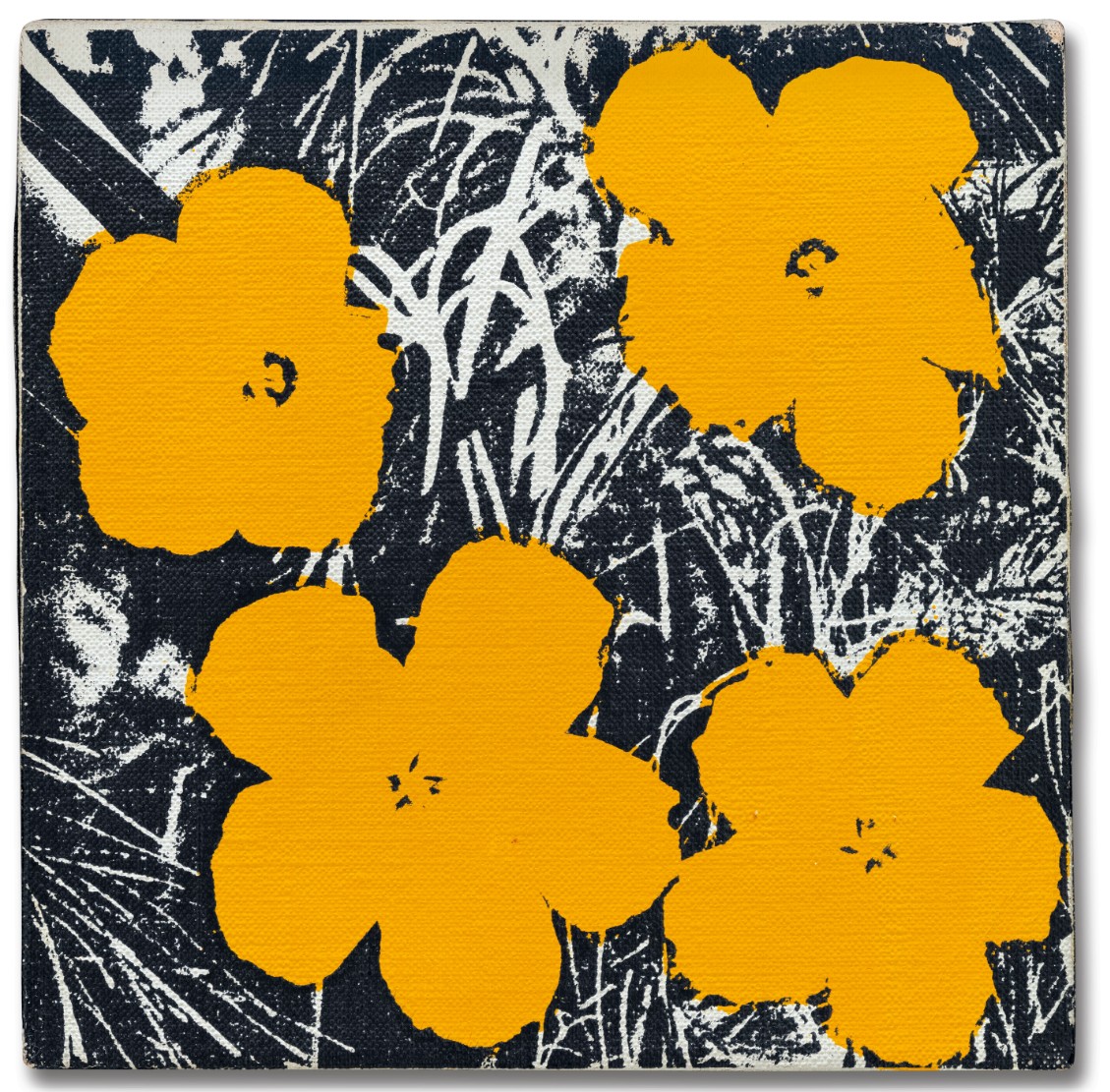
ANDY WARHOL (1928-1987)
Flowers, 1964
Acrylic and silkscreen ink on canvas
8×8 inches (20.3 x 20.3 cm)
Signed and dated ‘Andy Warhol 64’ (on the overlap)
#8. Flowers, 1964
Sotheby’s London: 13 October 2023
Estimated: GBP 150,000 – 200,000
GBP 190,500 / USD 231,189
Flowers | Contemporary Day Auction | 2023 | Sotheby’s (sothebys.com)
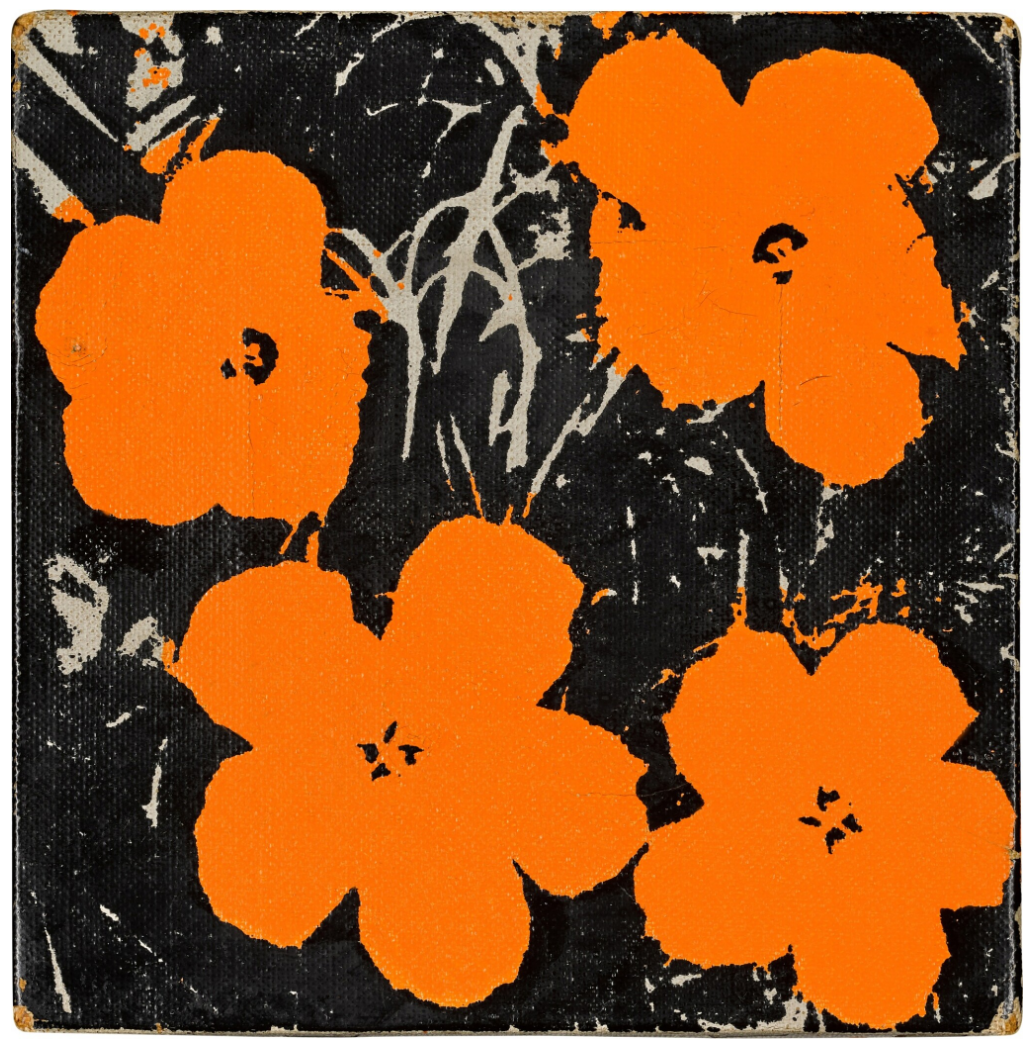
ANDY WARHOL (1928 – 1987)
Flowers, 1964
Acrylic on canvas
5×5 inches (12.7 x 12.7 cm)
Signed and dated 64 (on the overlap)
#9. Flowers, 1964
Ketterer : 8 December 2023
Estimated: EUR 180,000
EUR 190,500 / USD 200,025
Ketterer Kunst, Art auctions, Book auctions Munich, Hamburg & Berlin
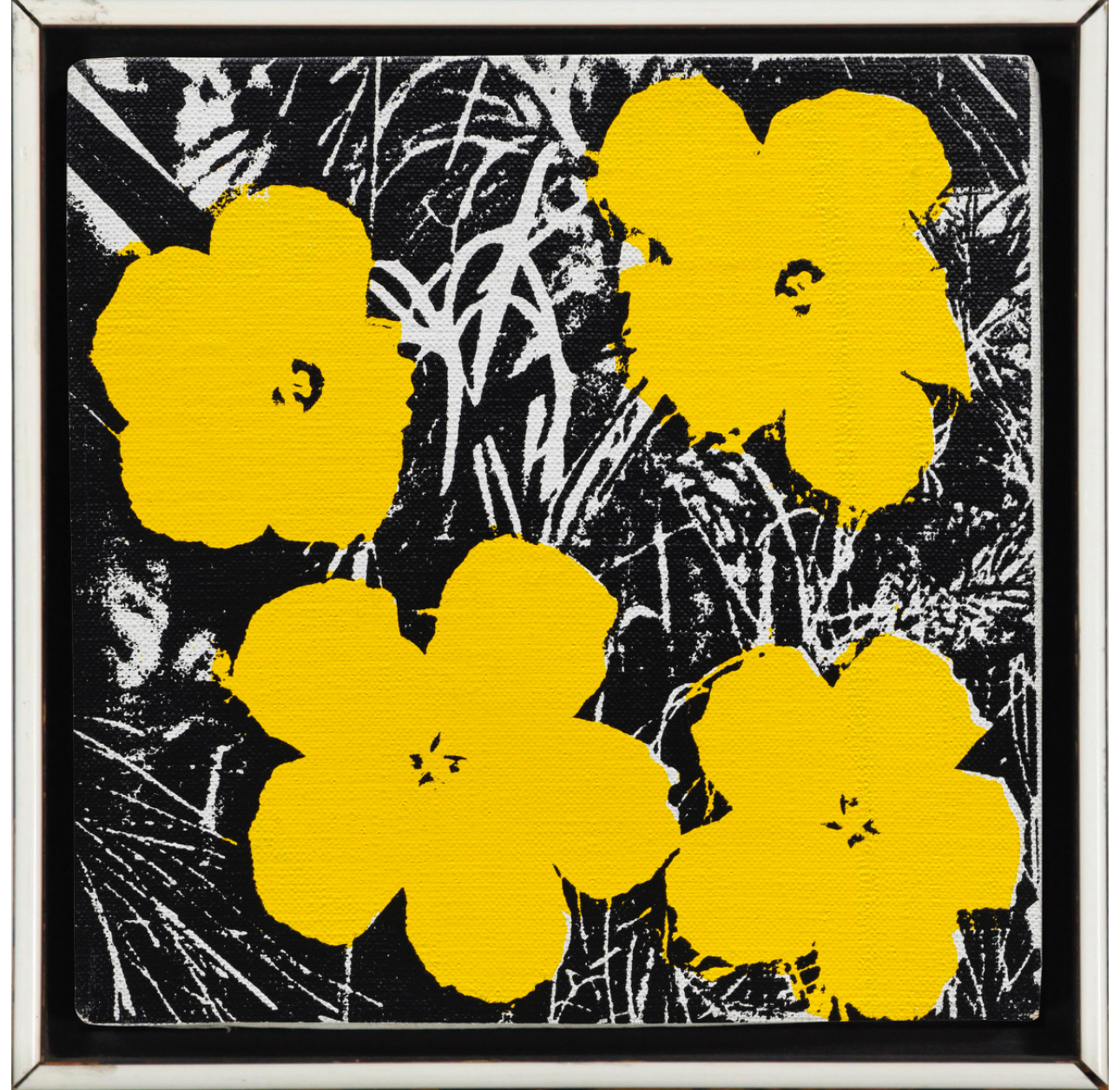
ANDY WARHOL
Flowers, 1964
Silkscreen in colors on canvas
8×8 inches (20.5 x 20.5 cm)
Monogrammed, dated and inscribed “Top” on the folded canvas
#10. Flowers, 1963
Swann Galleries: 8 June 2023
Estimated: USD 100,000 – 150,000
USD 87,500
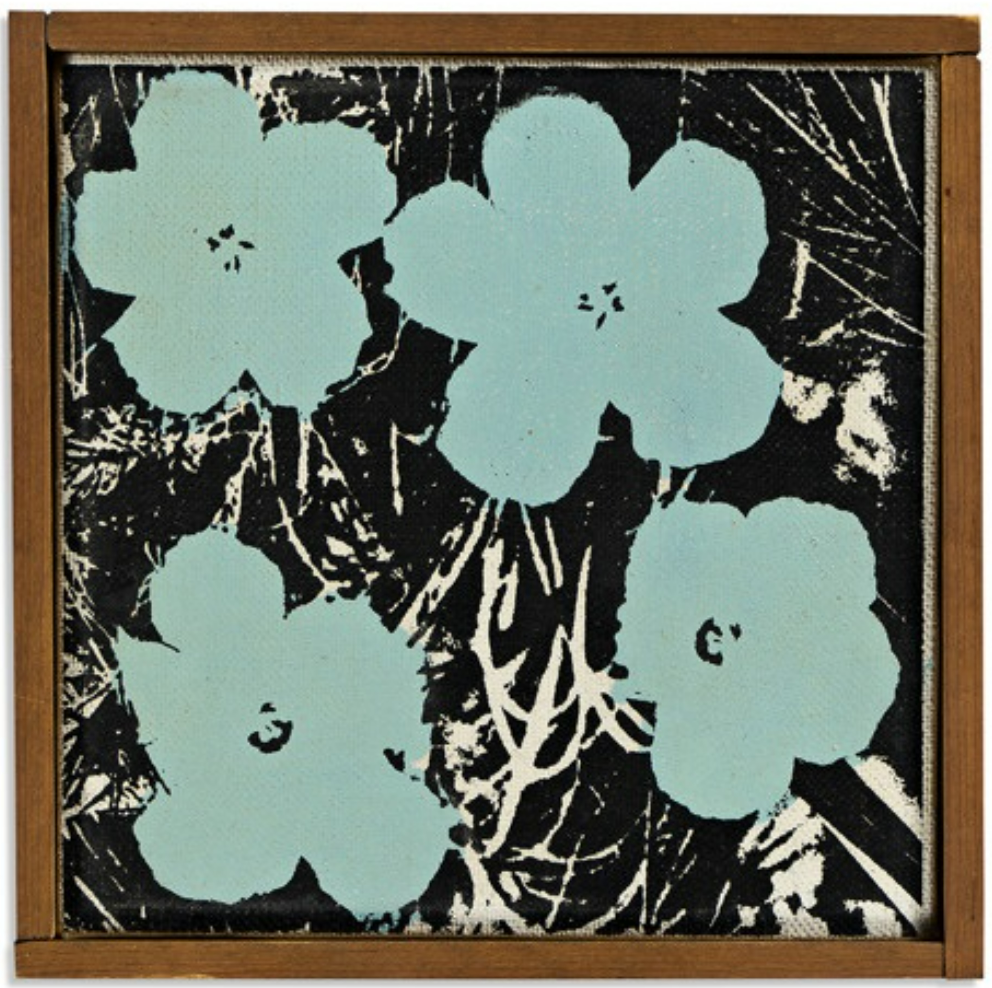
ANDY WARHOL (1928 – 1987)
Flowers, 1963
Acrylic and silkscreen ink on canvas
5×5 inches (12.7 x 12.7 cm)
2022 Auction Results
#1. Flowers, 1964
Christie’s New-York: 9 May 2022
Estimated: USD 15,000,000 – 20,000,000
USD 15,847,000
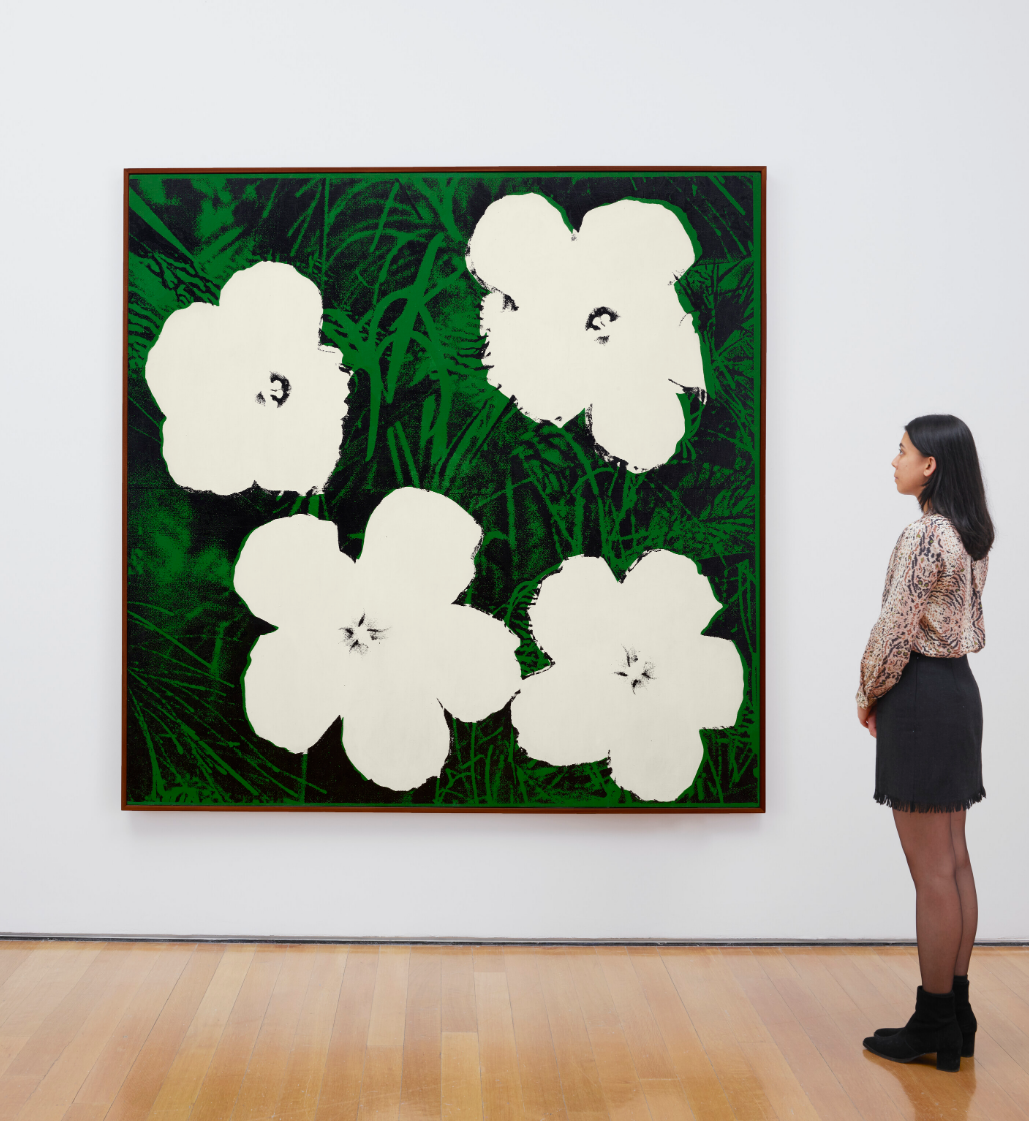
ANDY WARHOL
Flowers, 1964
Acrylic and silkscreen ink on linen
82x 81.5 inches (207.6×207 cm)
#2. Flowers, 1964
Phillips New-York: 18 May 2022
Estimated: USD 8,000,000 – 12,000,000
USD 9,351,000
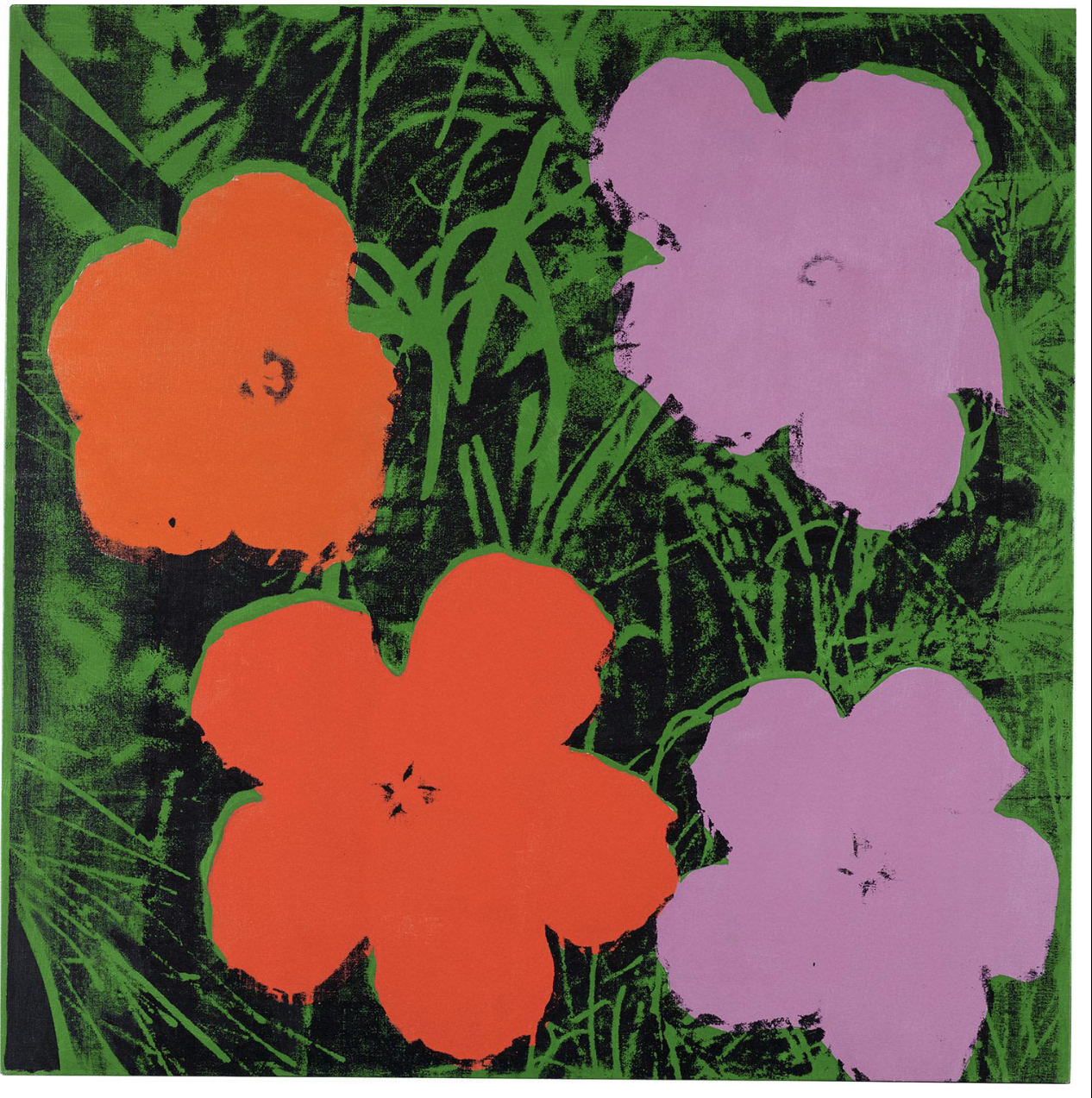
ANDY WARHOL
Flowers, 1964
Acrylic and silkscreen ink on canvas
48 x 47.9 inches (121.9 x 121.6 cm)
#3. Flowers, 1965
Christie’s New-York: 13 May 2022
Estimated: USD 250,000 – 300,000
USD 529,200
ANDY WARHOL (1928-1987) (christies.com)
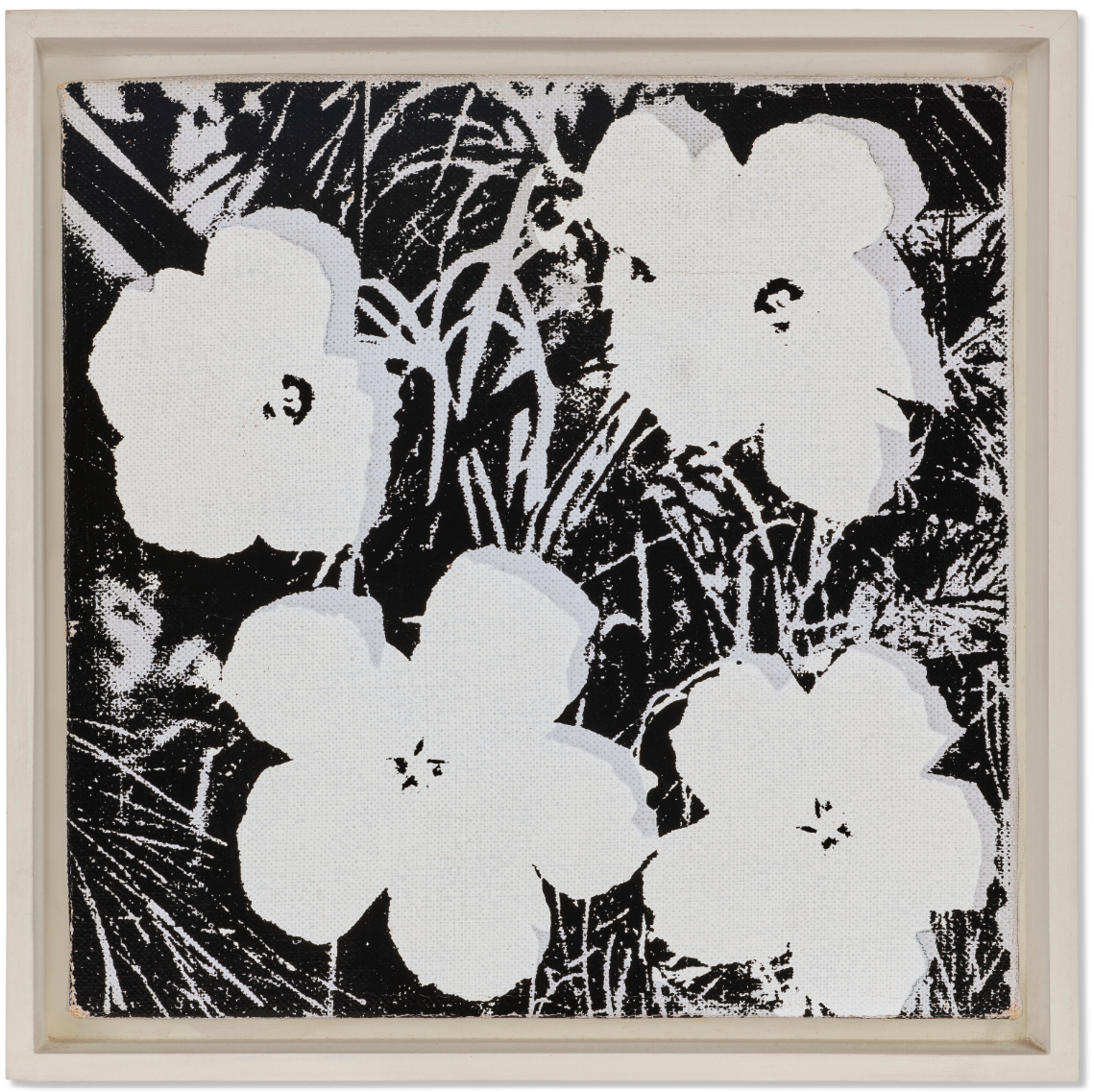
ANDY WARHOL
Flowers, 1965
Acrylic, silkscreen ink and graphite on linen
8×8 inches (20.3 x 20.3 cm)
#4. Flowers, 1964
Christie’s New-York: 9 March 2022
Estimated: USD 180,000 – 220,000
USD 302,400
ANDY WARHOL (1928-1987) (christies.com)
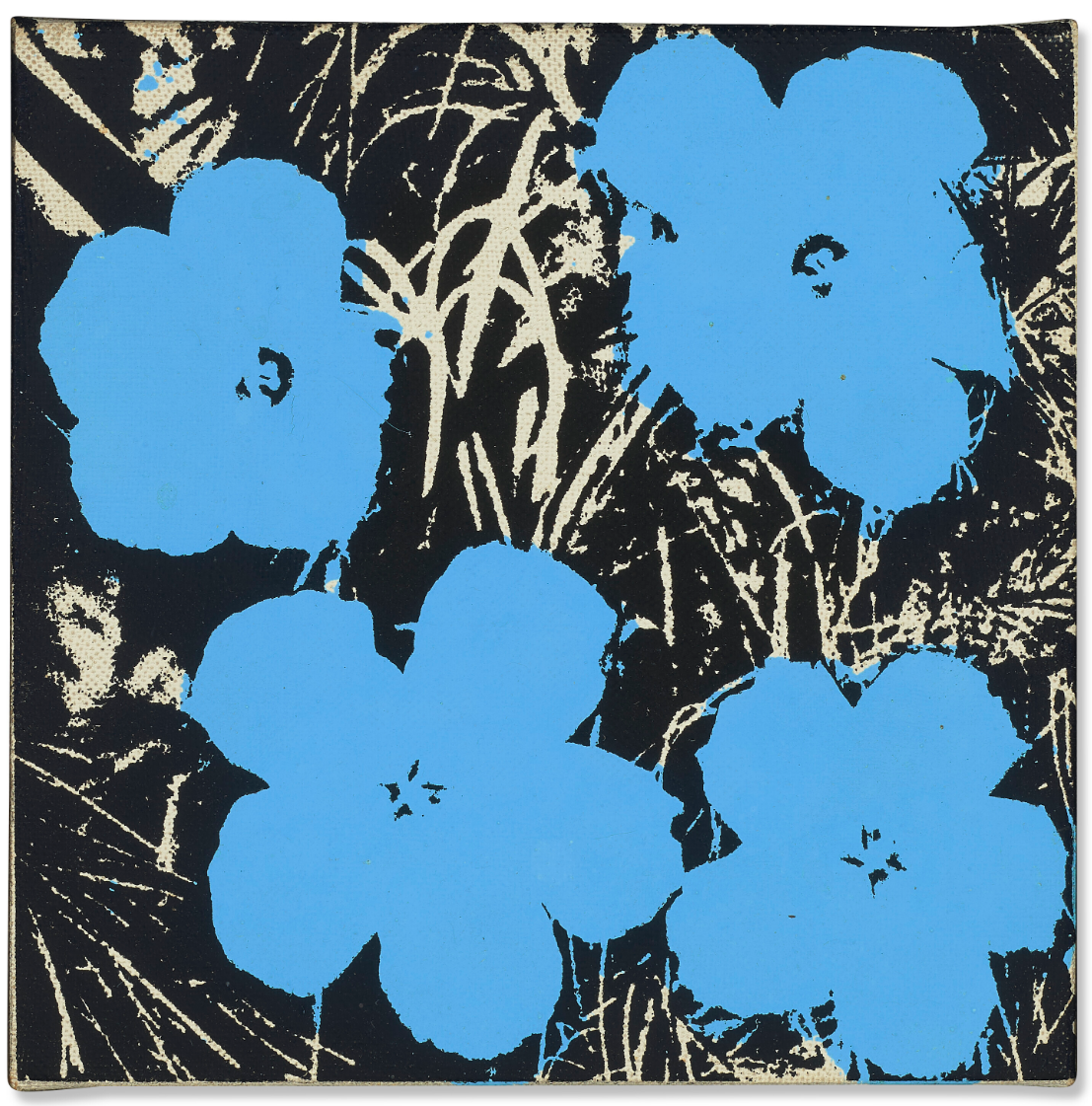
ANDY WARHOL
Flowers, 1964
Silkscreen ink on linen
5×5 inches (12.7 x 12.7 cm)
#5. Flowers, 1965
SBI Art Auction: 12 March 2022
Estimated: JPY 15,000,000 – 25,000,000
JPY 33,350,000 / USD 284,241
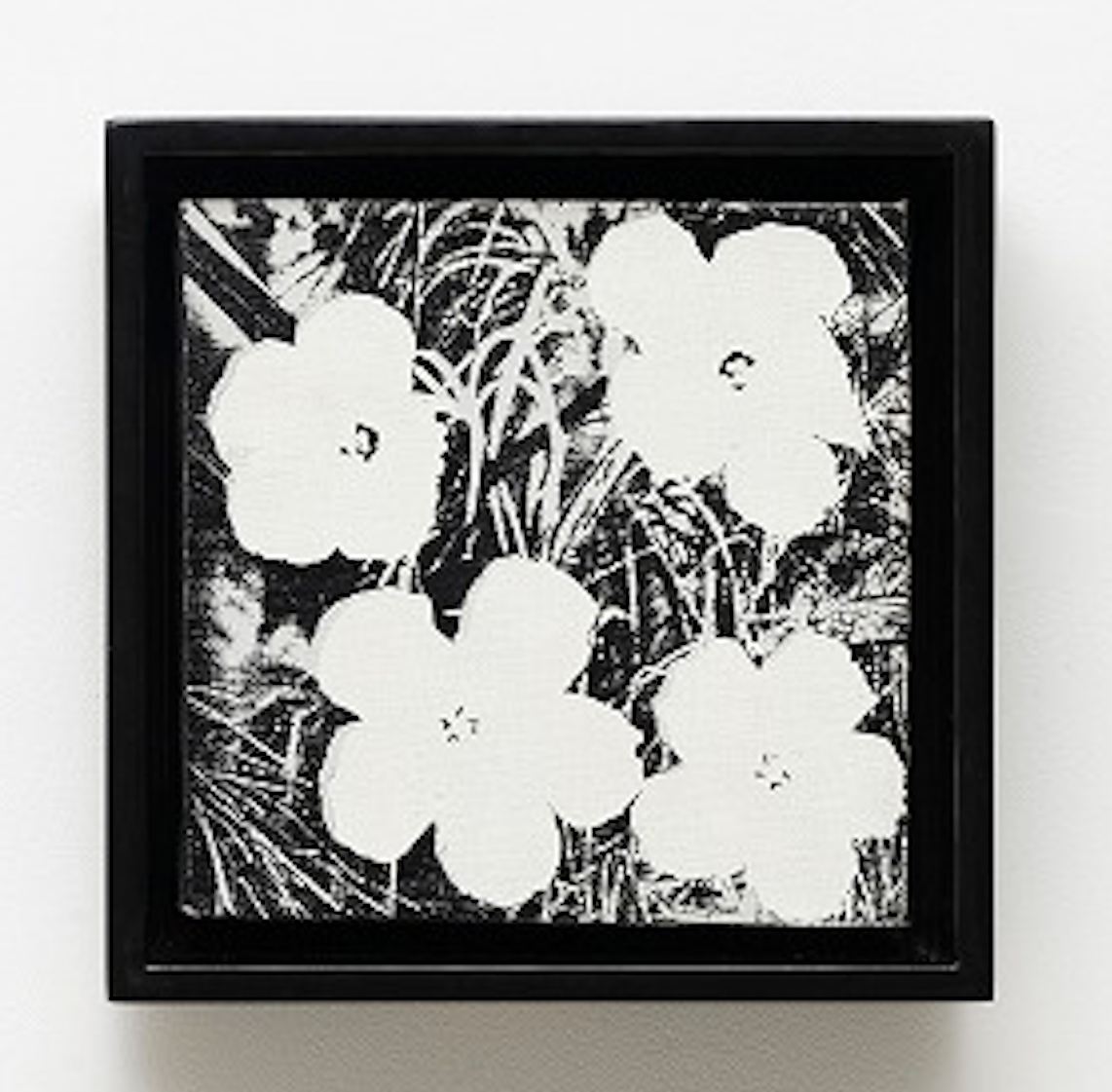
ANDY WARHOL
Flowers, 1965
Acrylic and silkscreen ink on canvas
8×8 inches (20.3 x 20.3 cm)
Signed and dated (1964) on the reverse
2021 Auction Results
#1. Flowers, 1965
Christie’s New-York: 12 November 2021
Estimated: USD 1,000,000 – 1,500,000
USD 3,330,000
ANDY WARHOL (1928-1987) (christies.com)
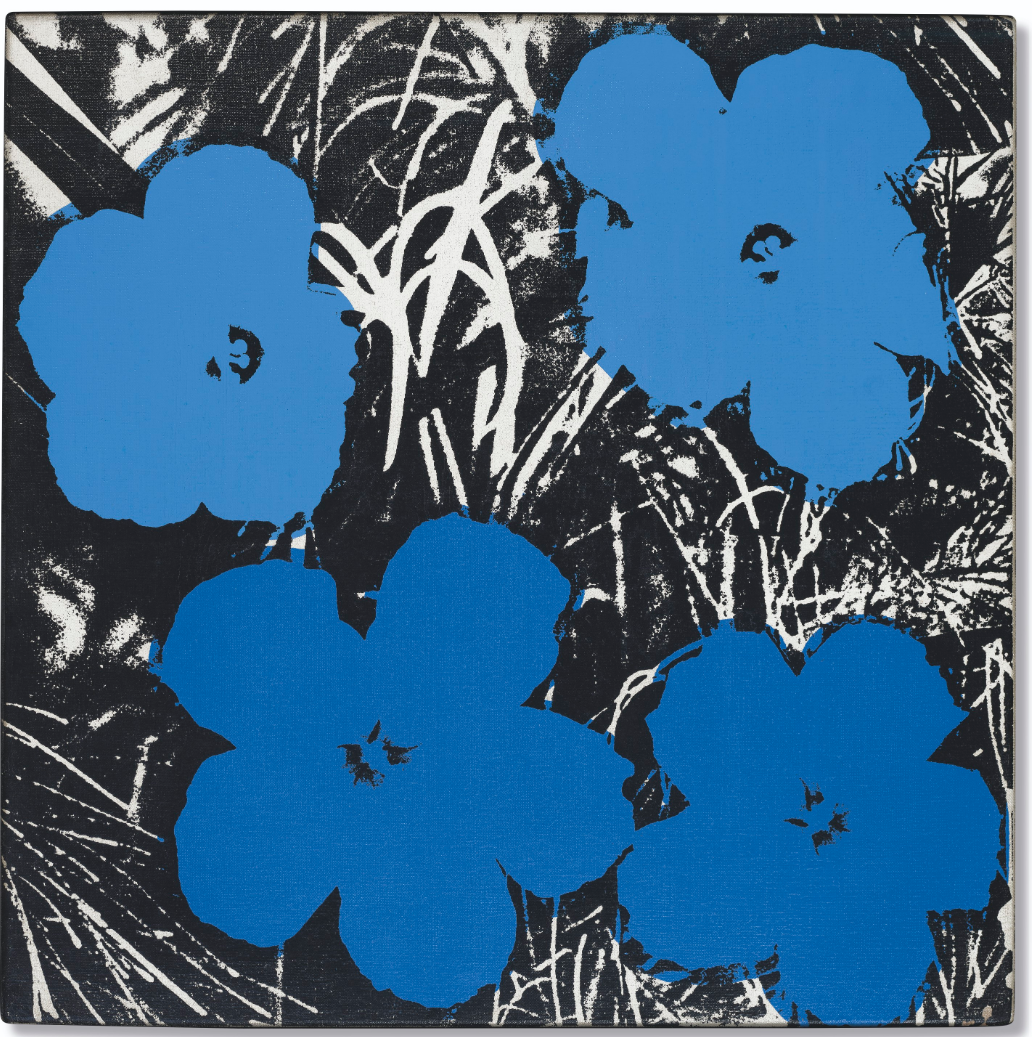
ANDY WARHOL
Flowers, 1965
Acrylic and silkscreen ink on canvas
22×22 inches (55.9 x 55.9 cm)
Signed ‘Andy Warhol’ (on the overlap)
#2. Flowers, 1964-65
Phillips London: 13 July 2021
Estimated: GBP 1,000,000 – 1,500,000
GBP 1,353,500 / USD 1,874,135
Andy Warhol – New Now London Lot 23 July 2021 | Phillips
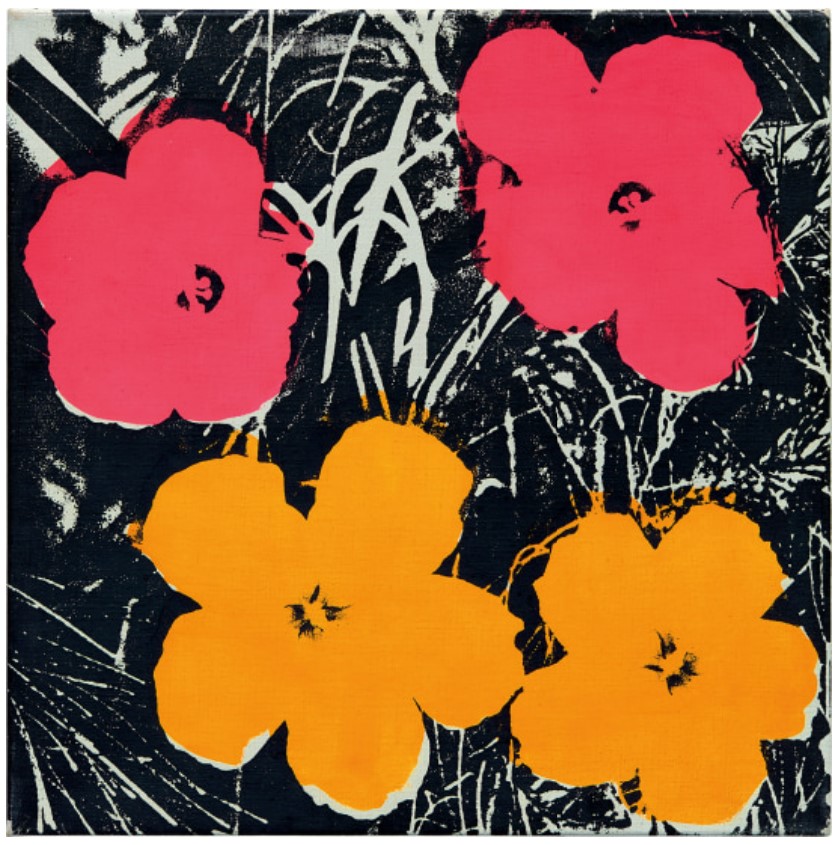
ANDY WARHOL
Flowers, 1964-65
Acrylic and silkscreen ink on canvas
23 7/8 x 23 7/8 inches (60.9 x 60.9 cm)
Signed and dated ‘Andy Warhol 64’ on the overlap
Stamped by the Andy Warhol Authentication Board and numbered ‘A100.0911’
#3. Flowers, 1964
Christie’s New-York: 12 November 2021
Estimated: USD 250,000 – 350,000
USD 487,500
ANDY WARHOL (1928-1987) (christies.com)
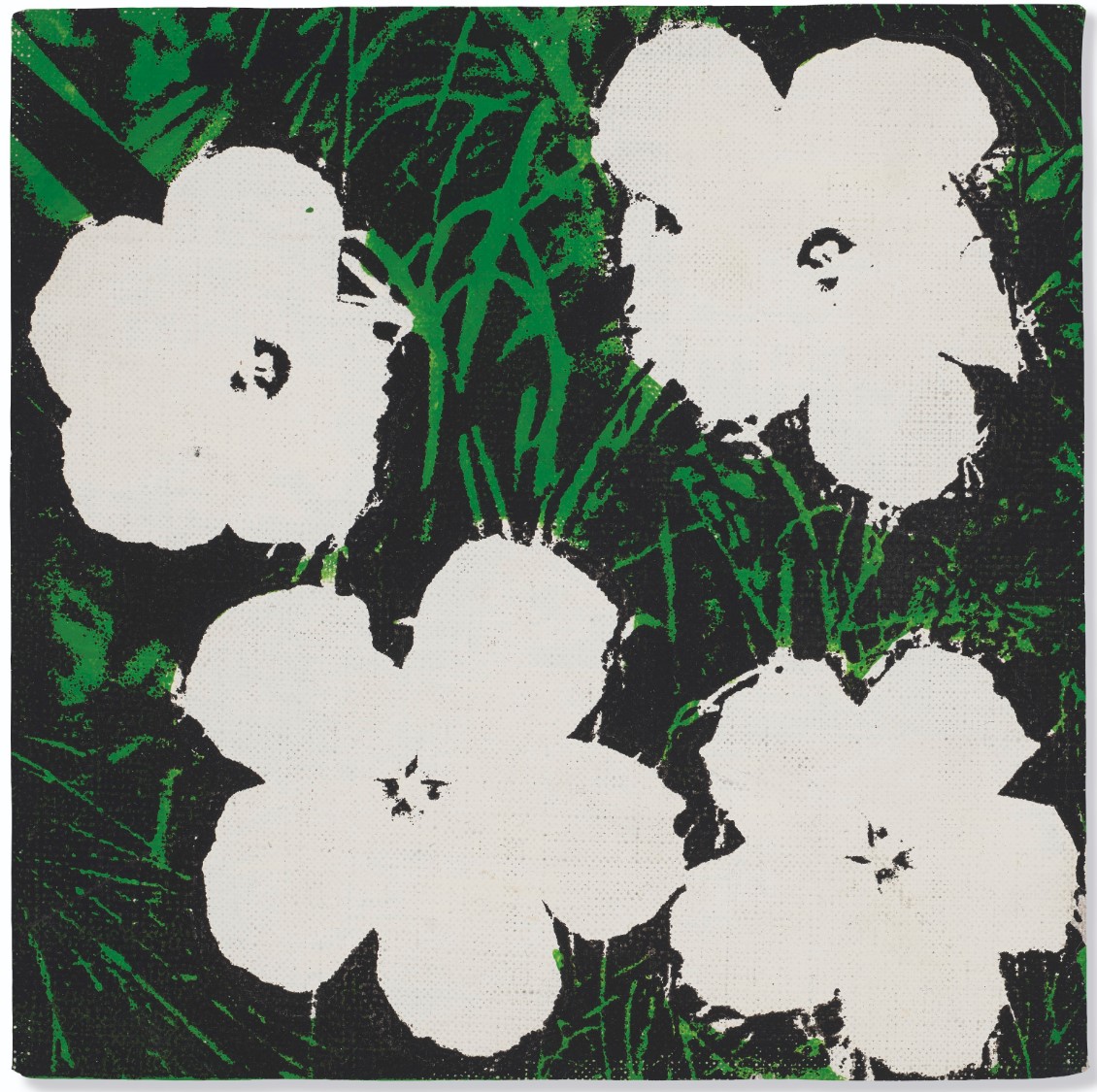
ANDY WARHOL (1928-1987)
Flowers, 1964
Acrylic and silkscreen ink on canvas
8×8 inches (20.3 x 20.3 cm)
Signed, dedicated and dated ‘to PHILIP MY LOVE ANDY DEC. 64’ (on the overlap)
#4. Flowers, 1964
Sotheby’s New-York: 19 November 2021
Estimated: USD 150,000 – 200,000
USD 441,000
Flowers | Contemporary Day Auction | 2021 | Sotheby’s (sothebys.com)
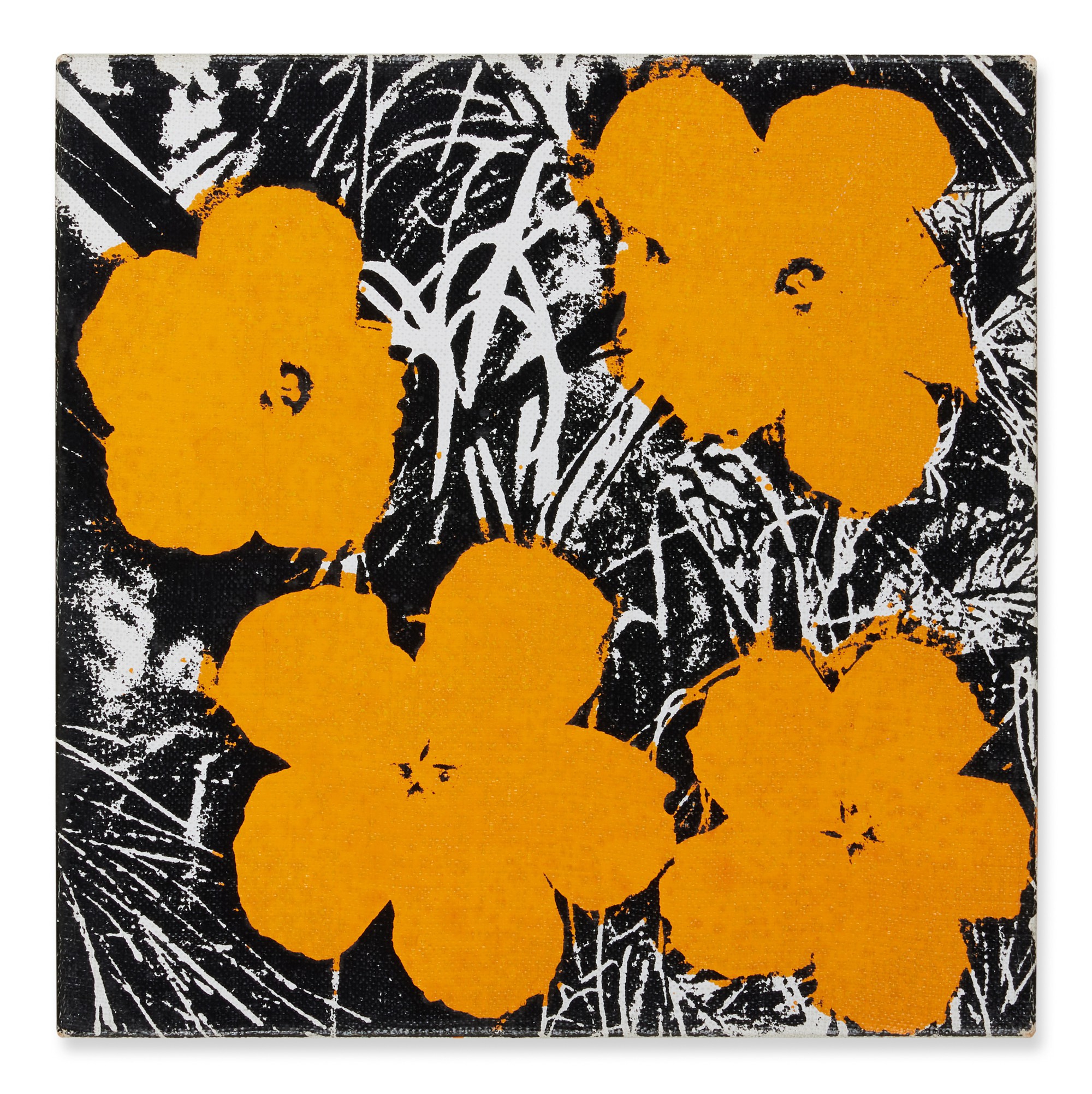
ANDY WARHOL
Flowers, 1964
Acrylic and silkscreen ink on canvas
8×8 inches (20.3 x 20.3 cm)
#5. Flowers, 1964
Sotheby’s New-York: 19 November 2021
Estimated: USD 180,000 – 250,000
USD 403,200
Flowers | Contemporary Day Auction | 2021 | Sotheby’s (sothebys.com)
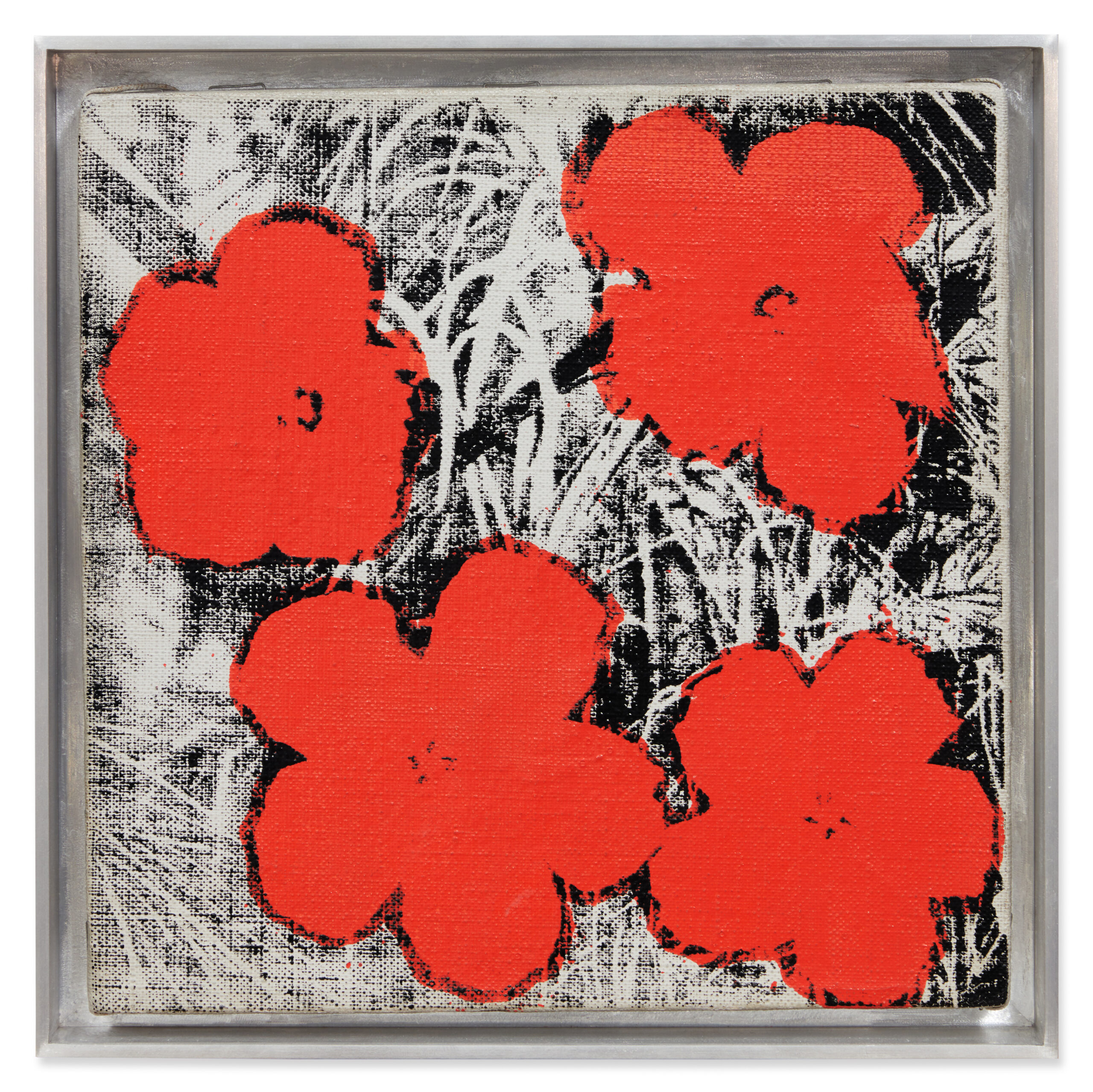 ANDY WARHOL
Flowers, 1964
Acrylic and silkscreen ink on canvas
8×8 inches (20.3 x 20.3 cm)
#6. Flowers, 1965
Christie’s New-York: 12 November 2021
Estimated: USD 150,000 – 250,000
USD 325,000
ANDY WARHOL (1928-1987) (christies.com)
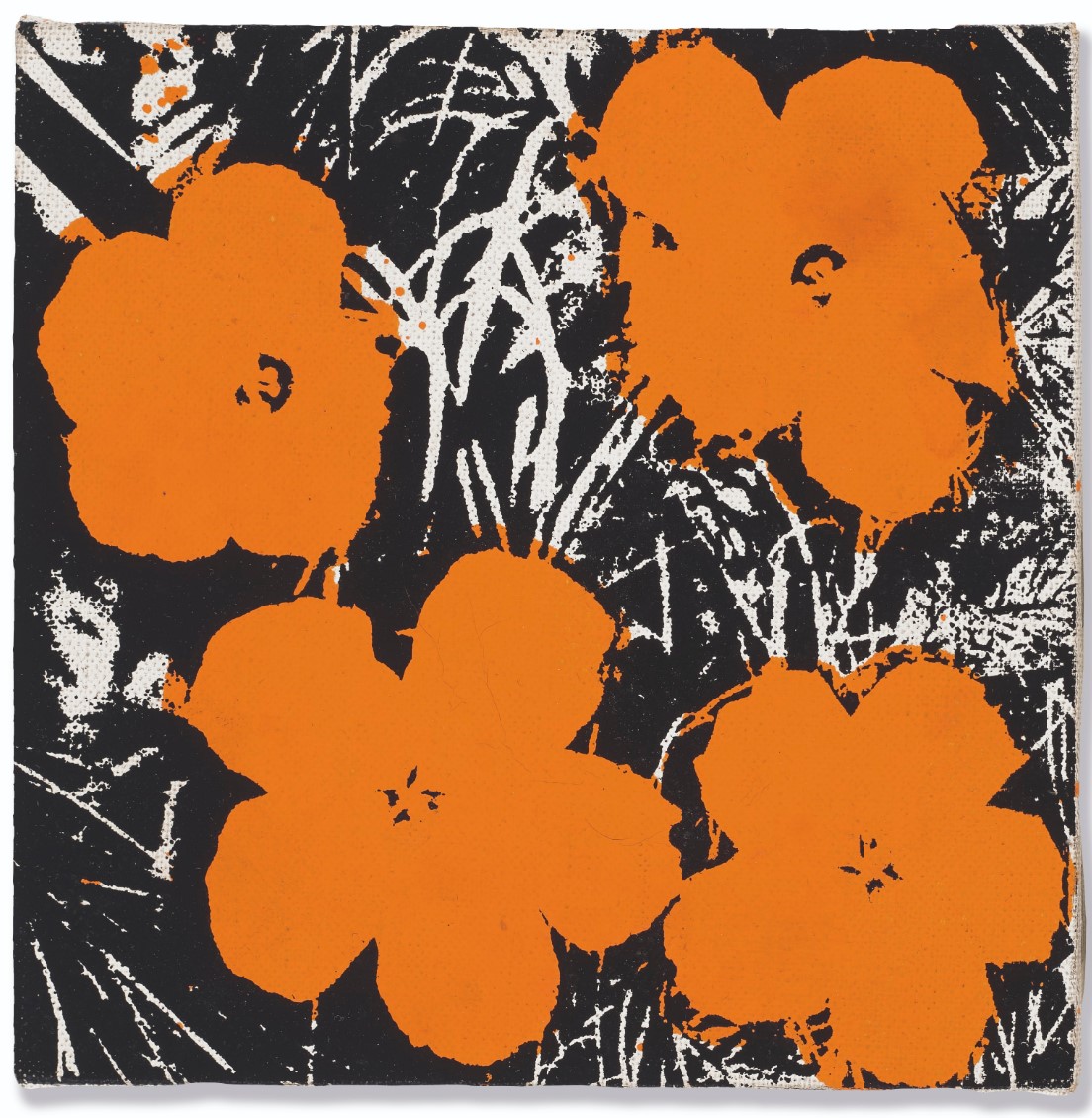
ANDY WARHOL
Flowers, 1965
Acrylic and silkscreen ink on canvas
5×5 inches (12.7 x 12.7 cm)
#7. Flowers, 1964
Sotheby’s New-York: 19 November 2021
Estimated: USD 150,000 – 200,000
USD 277,200
Flowers | Contemporary Day Auction | 2021 | Sotheby’s (sothebys.com)
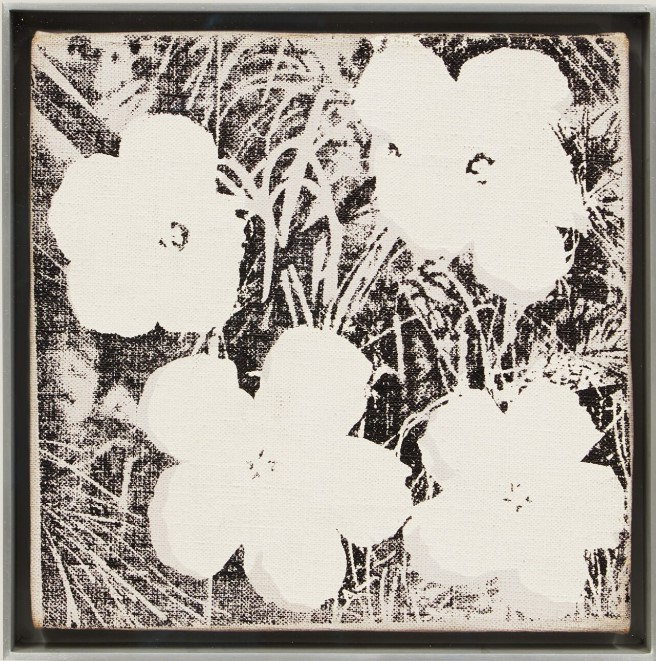
ANDY WARHOL (1928 – 1987)
Flowers, 1964
Acrylic and silkscreen ink on canvas
8×8 inches (20.3 x 20.3 cm)
Signed Andy Warhol and dated 64 (on the overlap)
2020 Auction Results
WORK IN PROGRESS
#1. Flowers, 1964
Christie’s London: 11 February 2020
Estimated: GBP 1,000,000 – 1,500,000
GBP 2,111,250 / USD 2,739,415
Andy Warhol (1928-1987), Flowers | Christie’s
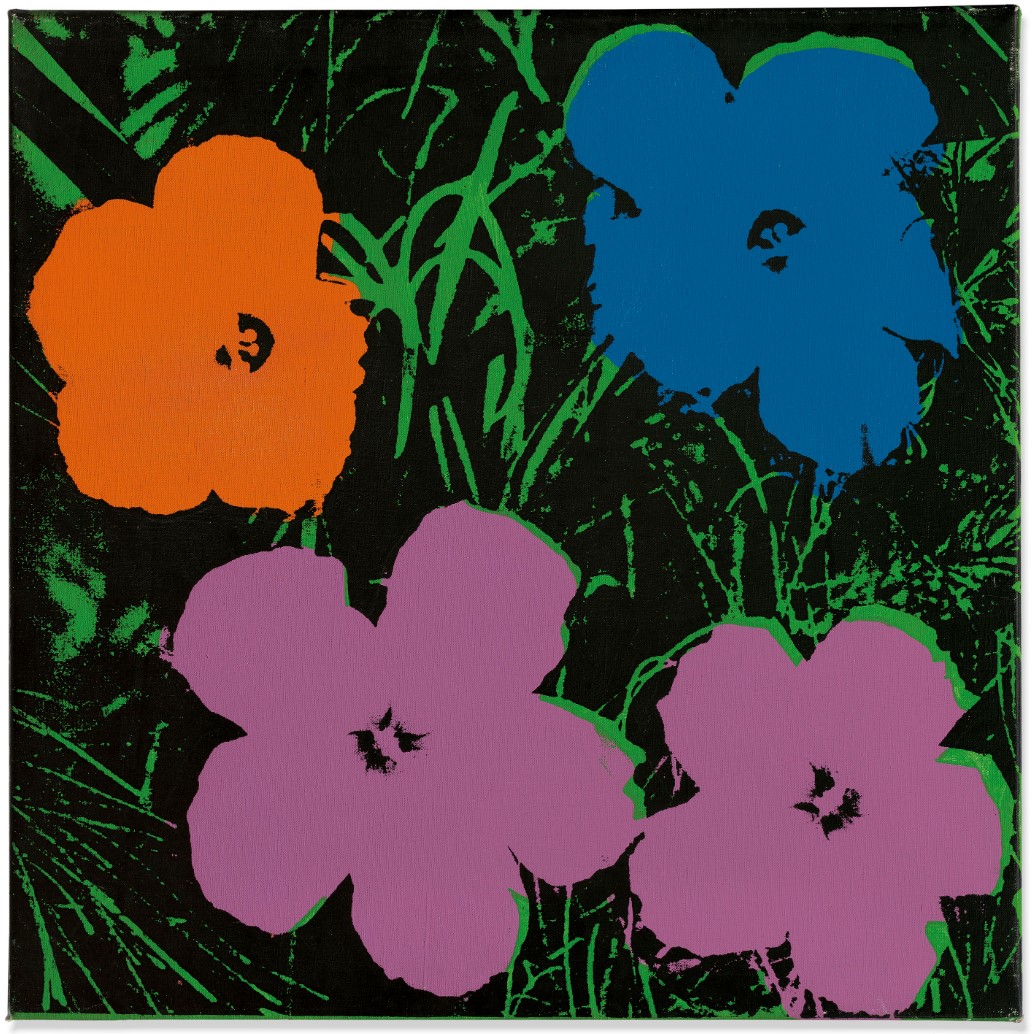
ANDY WARHOL
Flowers, 1964
Acrylic and silkscreen ink on canvas
24×24 inches (61×61 cm)
Signed and dated ‘Andy Warhol 64’ (on the overlap)
#2. Flowers, 1964
Phillips London: 20 October 2020
Estimated: GBP 1,400,000 – 1,800,000
GBP 1,595,500 / USD 2,066,175
Andy Warhol – 20th Century & Contemp… Lot 18 October 2020 | Phillips
REPEAT SALE
Christie’s New-York: 17 May 2018
Estimated: USD 1,800,000 – 2,500,000
USD 2,112,500
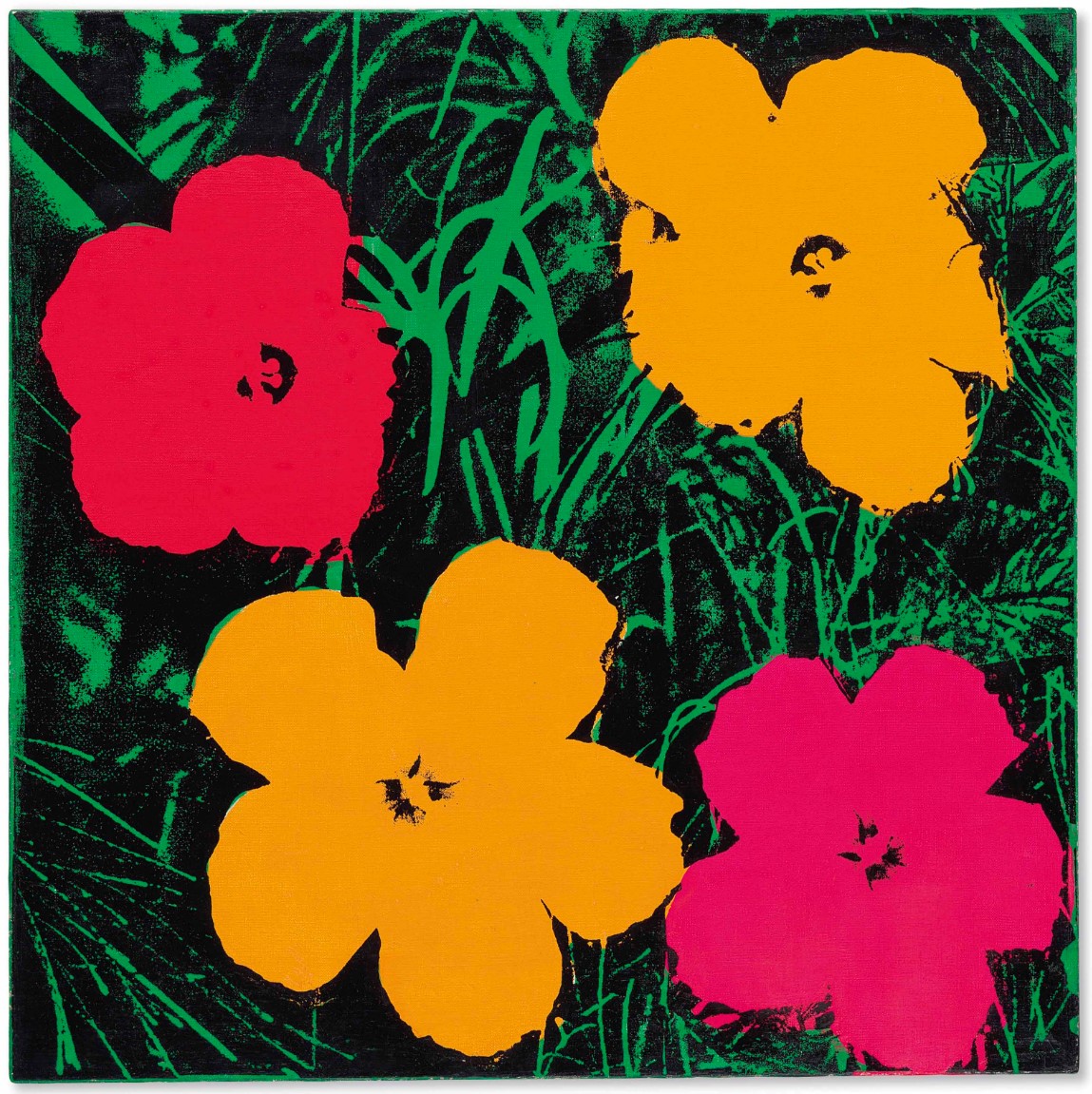
ANDY WARHOL
Flowers, 1964
Synthetic polymer and silkscreen ink on canvas
24×24 inches (61×61 cm)
Signed and dated ‘ANDY WARHOL 64 Andy Warhol’ on the overlap
#3. Flowers, 1964
Tajan Paris: 1 July 2020
Estimated: EUR 1,400,000 – 1,800,000
EUR 1,445,600 / USD 1,619,070
Lot – ƒ ANDY WARHOL (1928-1987)
REPEAT SALE
Christie’s New-York: 13 November 2013
Estimated: USD 1,400,000 – 1,800,000
USD 1,685,000
Andy Warhol (1928-1987), Flowers | Christie’s
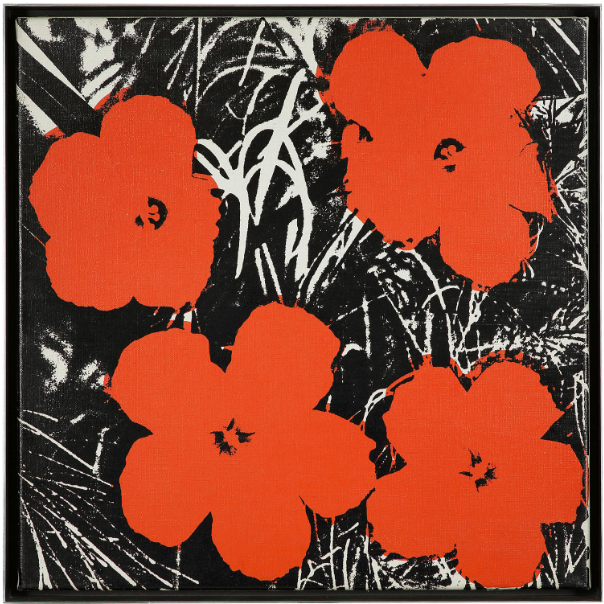
ANDY WARHOL (1928-1987)
Flowers, 1964
Synthetic polymer and silkscreen ink on canvas
22×22 inches (56×56 cm)
Signed and dated on the overlap
Flowers, 1964
Sotheby’s New-York: 6 March 2020
Estimated: USD 150,000 – 200,000
USD 231,250
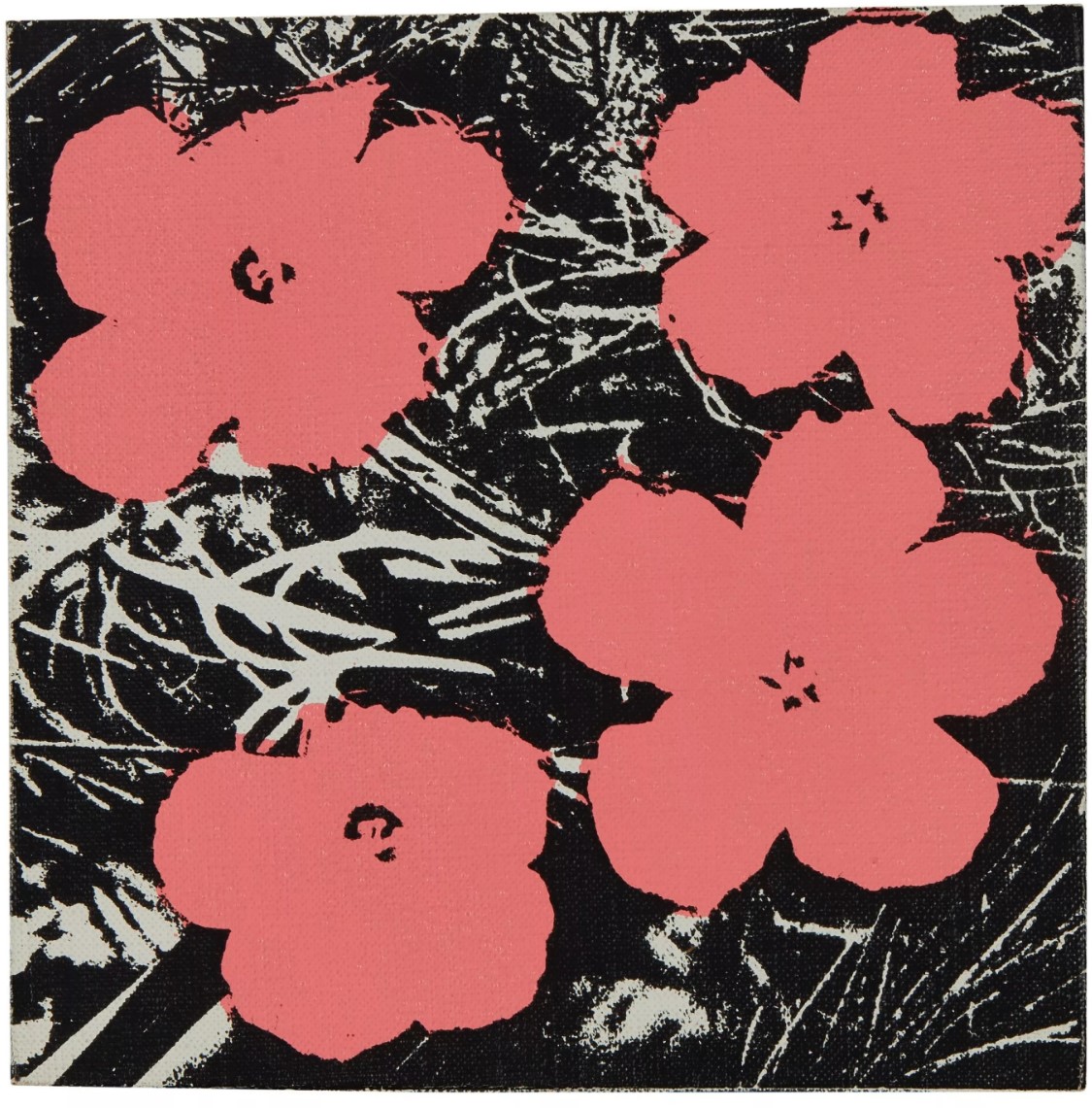
ANDY WARHOL
Flowers, 1964
Acrylic and silkscreen ink on canvas
8×8 inches (20.3 x 20.3 cm)
2019 Auction Results
WORK IN PROGRESS
#1. Late Four Foot Flowers, 1967
Phillips New-York: 14 November 2019
Estimated: USD 6,000,000 – 8,000,000
USD 7,430,500
Andy Warhol – 20th C. & Contemporar… Lot 17 November 2019 | Phillips
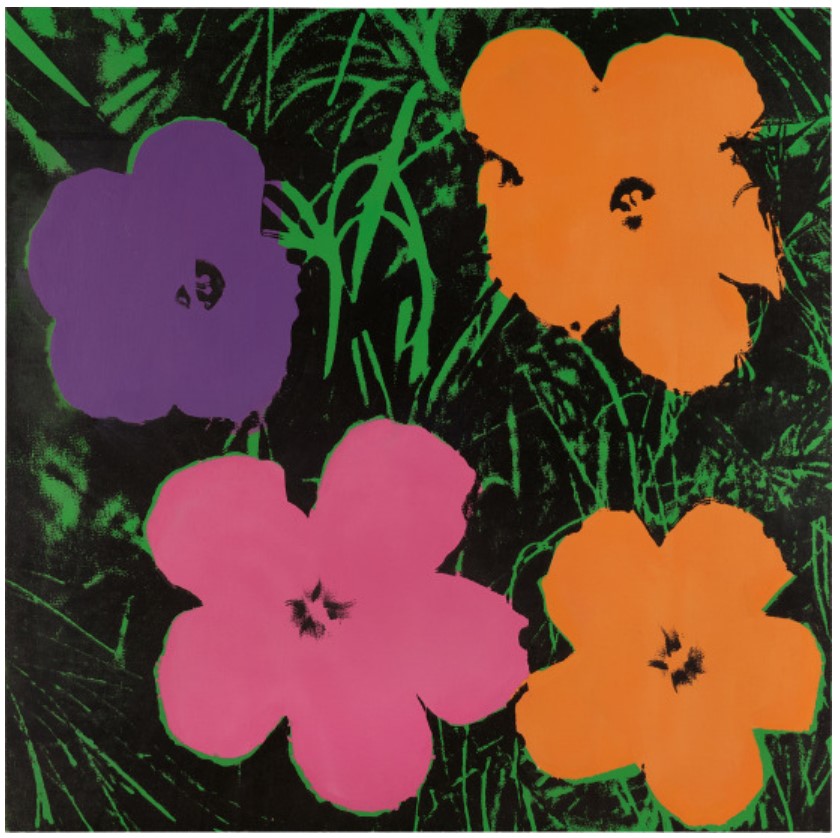
ANDY WARHOL
Late Four Foot Flowers, 1967
Acrylic, silkscreen ink and graphite on canvas
48×48 inches (121.9 x 121.9 cm)
#2. Flowers, 1964
Sotheby’s New-York: 16 May 2019
Estimated: USD 1,500,000 – 2,000,000
USD 5,674,250
REPEAT SALE
Sotheby’s London: 30 June 2014
Estimated: GBP 1,000,000 – 1,500,000
GBP 1,762,500 / USD 3,014,220
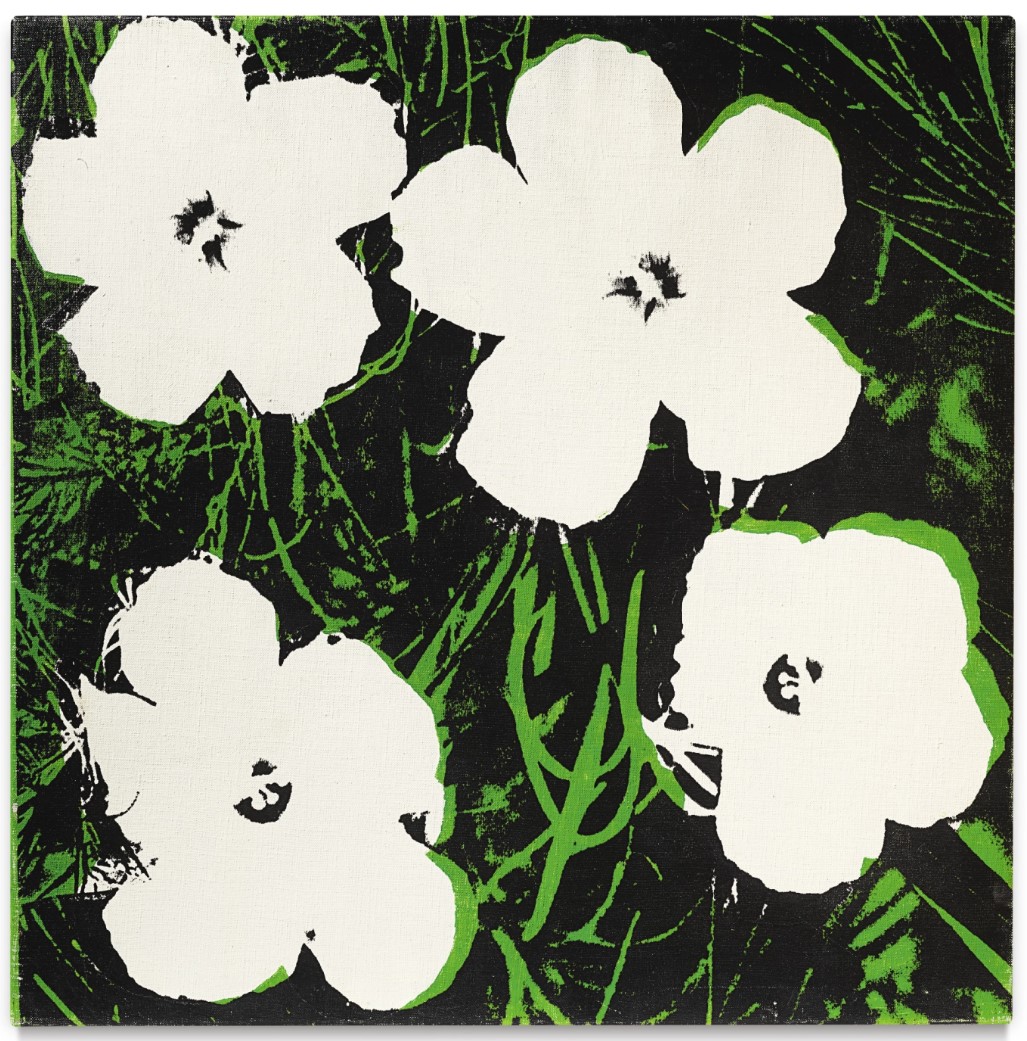
ANDY WARHOL
Flowers, 1964
Acrylic and silkscreen ink on canvas
24×24 inches (61×61 cm)
Signed and dated 64 on the overlap
Stamped by The Andy Warhol Art Authentication Board and numbered A100.076 on the overlap
#3. 9 Flowers, 1964
Phillips New-York: 16 May 2019
USD 2,500,000 – 3,500,000
USD 2,600,000
Andy Warhol – 20th Century & Contemporary… Lot 9 May 2019 | Phillips
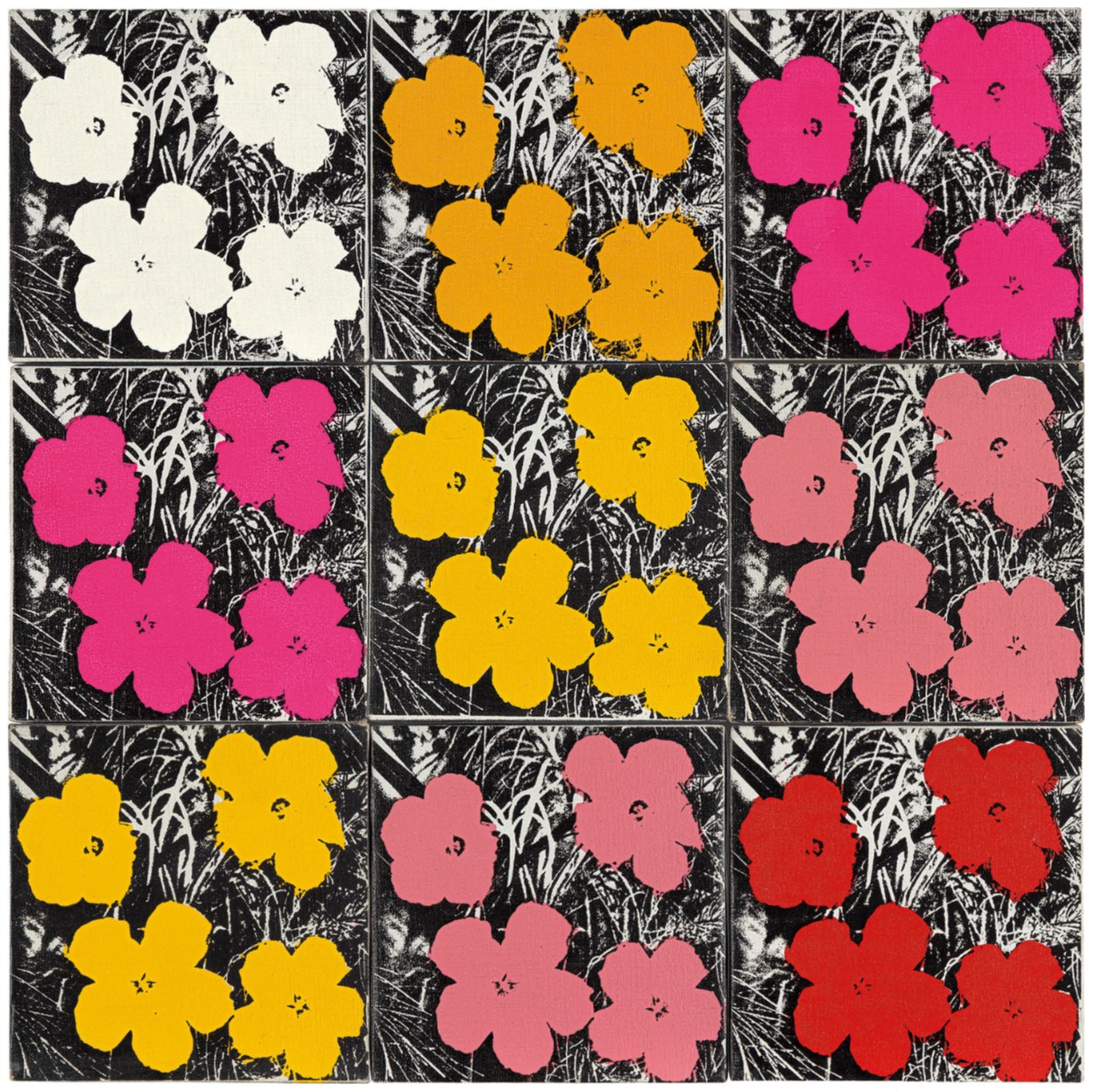
ANDY WARHOL
9 Flowers, 1964
Silkscreen ink on canvas
Each: 8×8 inches (20.3 x 20.3 cm)
Overall: 24 1/2 x 24 3/8 inches (62.2 x 61.9 cm)
#4. Flowers, 1965
Christie’s New-York: 13 November 2019
Estimated: USD 1,200,000 – 1,800,000
USD 2,415,000
Andy Warhol (1928-1987), Flowers | Christie’s
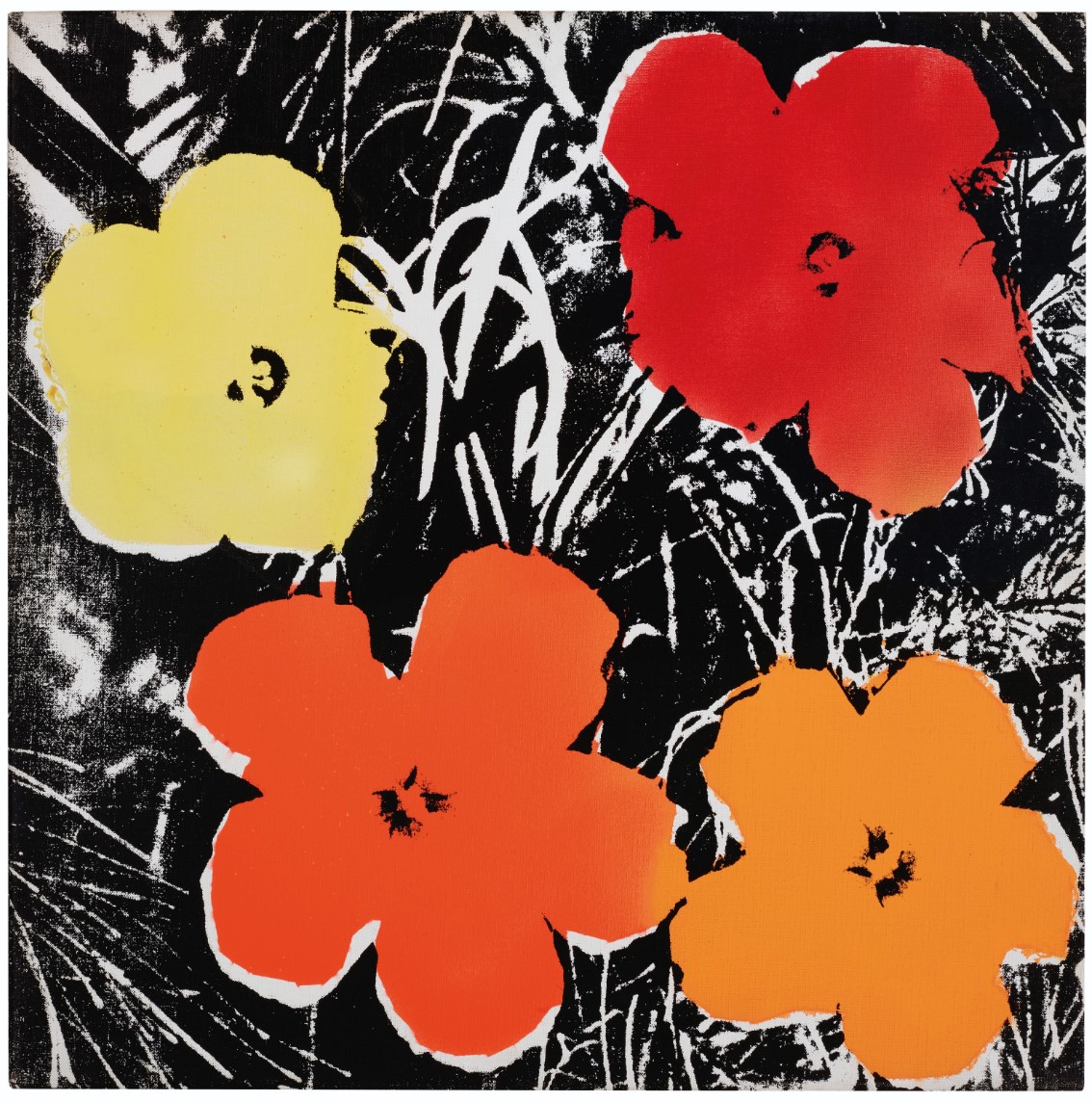
ANDY WARHOL
Flowers, 1965
Acrylic and silkscreen ink on canvas
24×24 inches (61×61 cm)
Signed, stamped with the Andy Warhol Art Authentication Board, Inc. stamp
Numbered and dated ‘Andy Warhol 65 A111.011’ (on the overlap)
#5. Flowers, 1964
Christie’s New-York: 26 September 2019
Estimated: USD 1,500,000 – 2,000,000
USD 1,395,000
Andy Warhol (1928-1987) (christies.com)
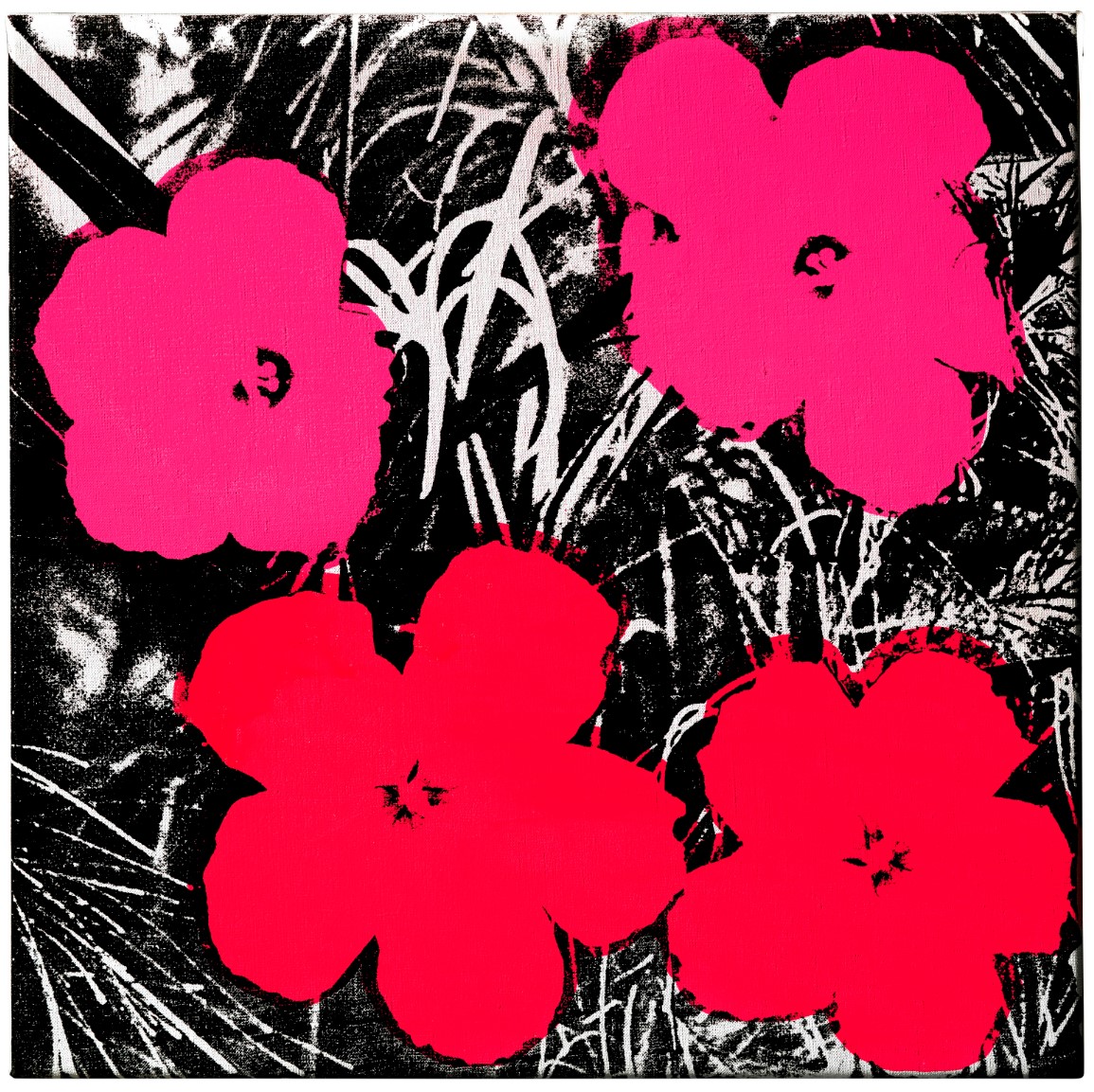
ANDY WARHOL
Flowers, 1964
Acrylic and silkscreen ink on canvas
22×22 inches (55.9 x 55.9 cm)
Signed, stamped with the Andy Warhol Authentication Board, Inc. stamp
Numbered and dated ‘Andy Warhol 64 A110.979’ (on the overlap)
#6. Flowers, 1964
Christie’s London: 24 June 2019
Estimated: GBP 400,000 – 600,000
GBP 671,250 / USD 851,865
Andy Warhol (1928-1987), Flowers | Christie’s
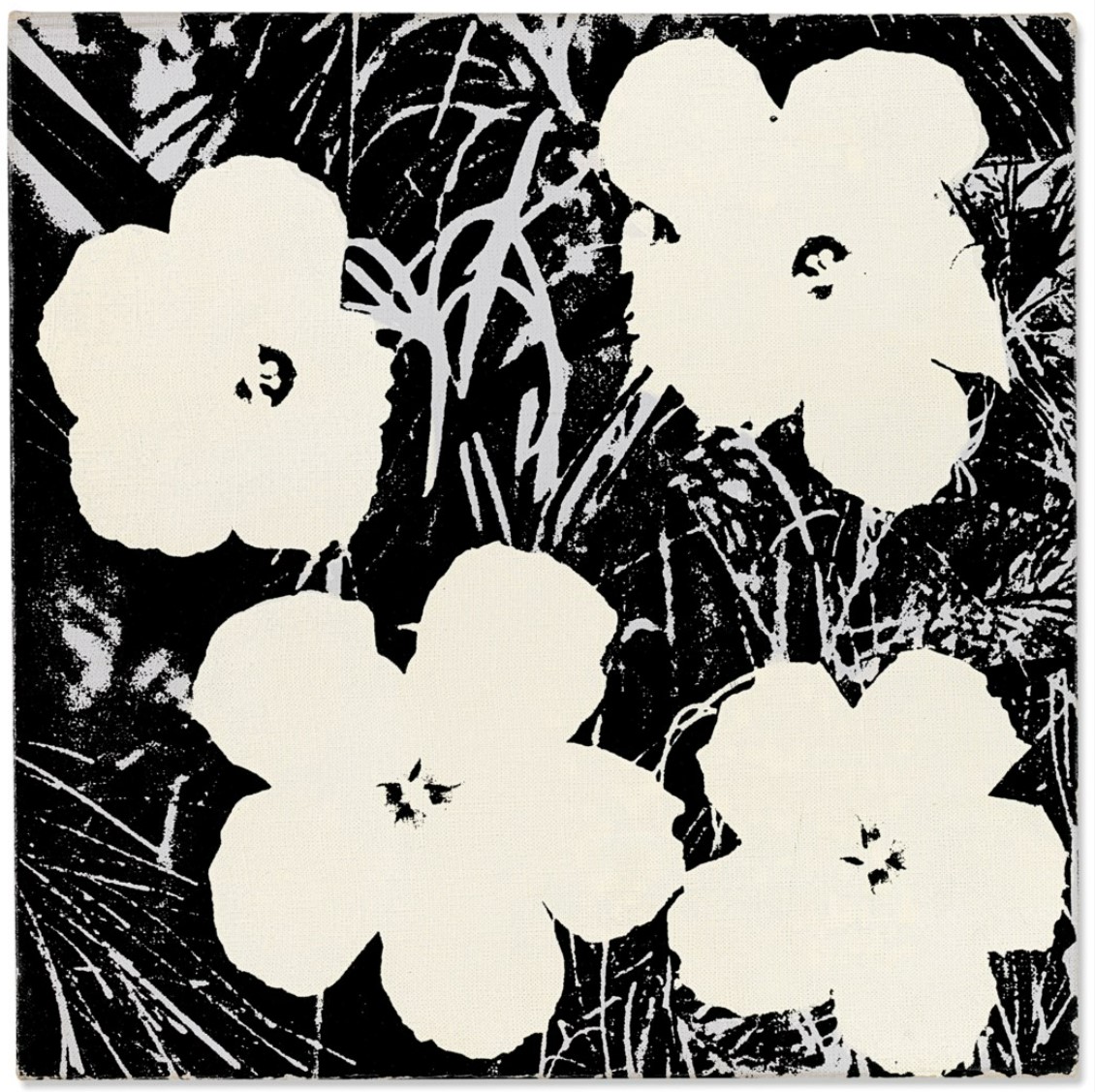
ANDY WARHOL
Flowers, 1964
Acrylic and silkscreen inks on canvas
14×14 inches (35.6 x 35.6 cm)
Signed and dated ‘Andy Warhol 64’ (on the overlap)
#7. Flowers, 1964
Property from the Miles and Shirley Fiterman Collection
Phillips Hong-Kong: 26 May 2019
Estimated: HKD 6,500,000 – 8,500,000
HKD 6,150,000 / USD 783,525
Andy Warhol 20th Century & Contemporary Art Evening Sale
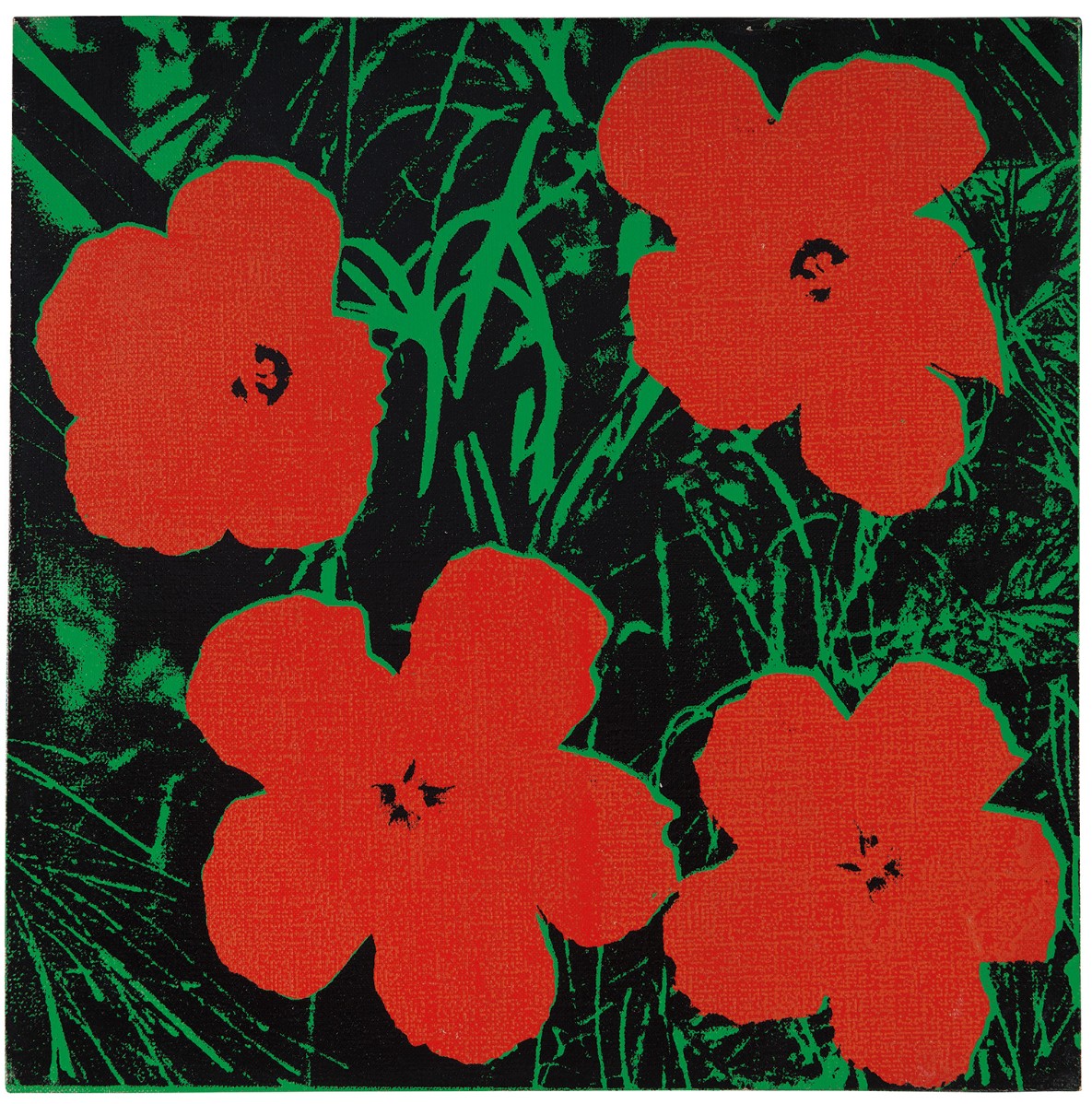
ANDY WARHOL
Flowers, 1964
Silkscreen ink on linen
14×14 inches (35.6 x 35.6 cm)
Signed, dedicated and dated ‘Andy Warhol 64 To Mr. and Mrs. Fiterman ♡’ on the overlap
#8. Flowers (Three Works), 1964
Sotheby’s Hong-Kong: 6 October 2019
Estimated: HKD 2,800,000 – 3,600,000
HKD 5,815,000 / USD 741,495
(#1152) ANDY WARHOL | Flowers (Three Works)
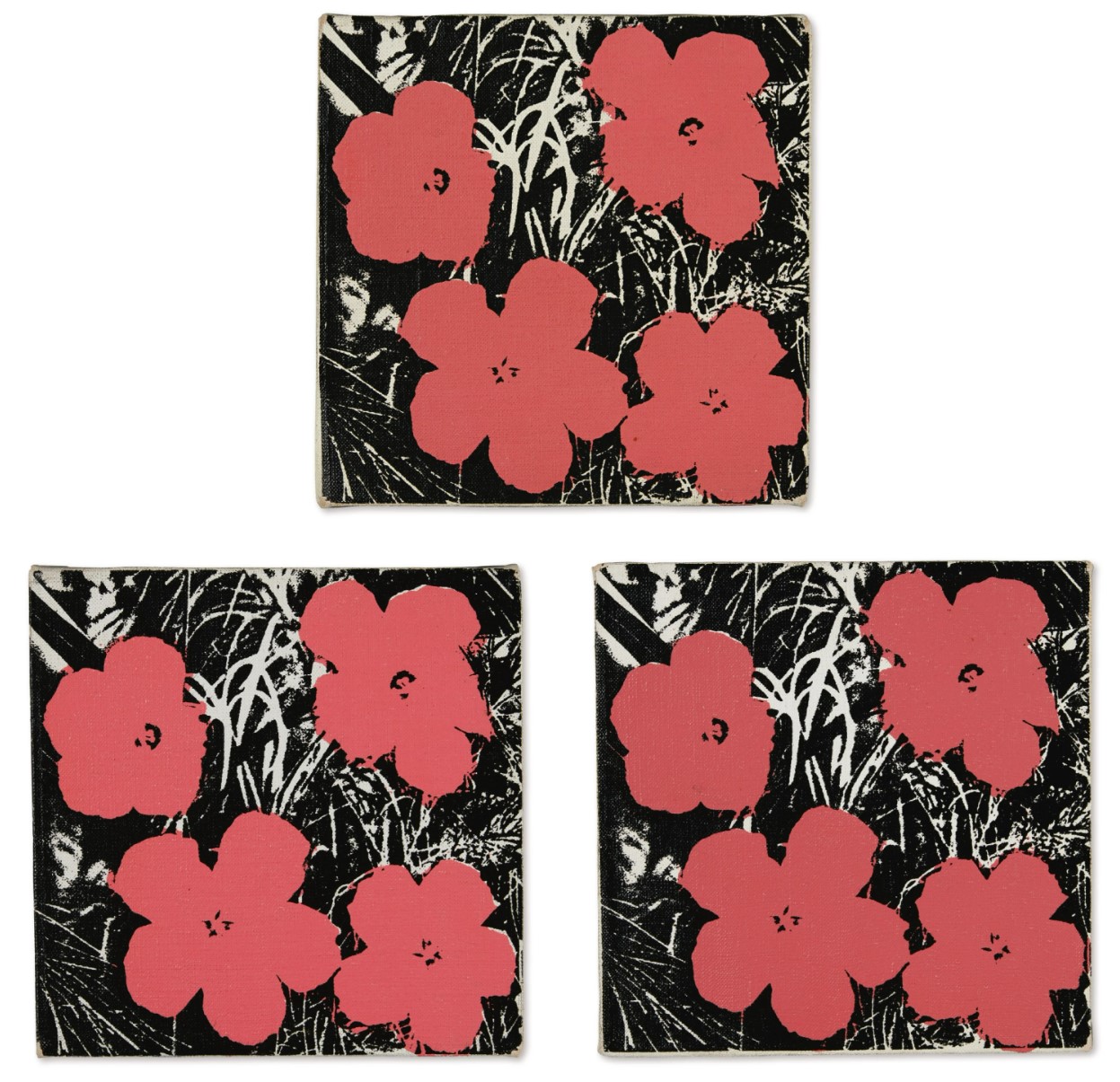
ANDY WARHOL
Flowers (Three Works), 1964
Acrylic and silkscreen ink on linen
Each 8×8 inches (20.3 x 20.3 cm)
#9. Flowers, 1964
Christie’s New-York: 16 May 2019
Estimated: 600,000 – 800,000
USD 639,000
Andy Warhol (1928-1987), Flowers | Christie’s
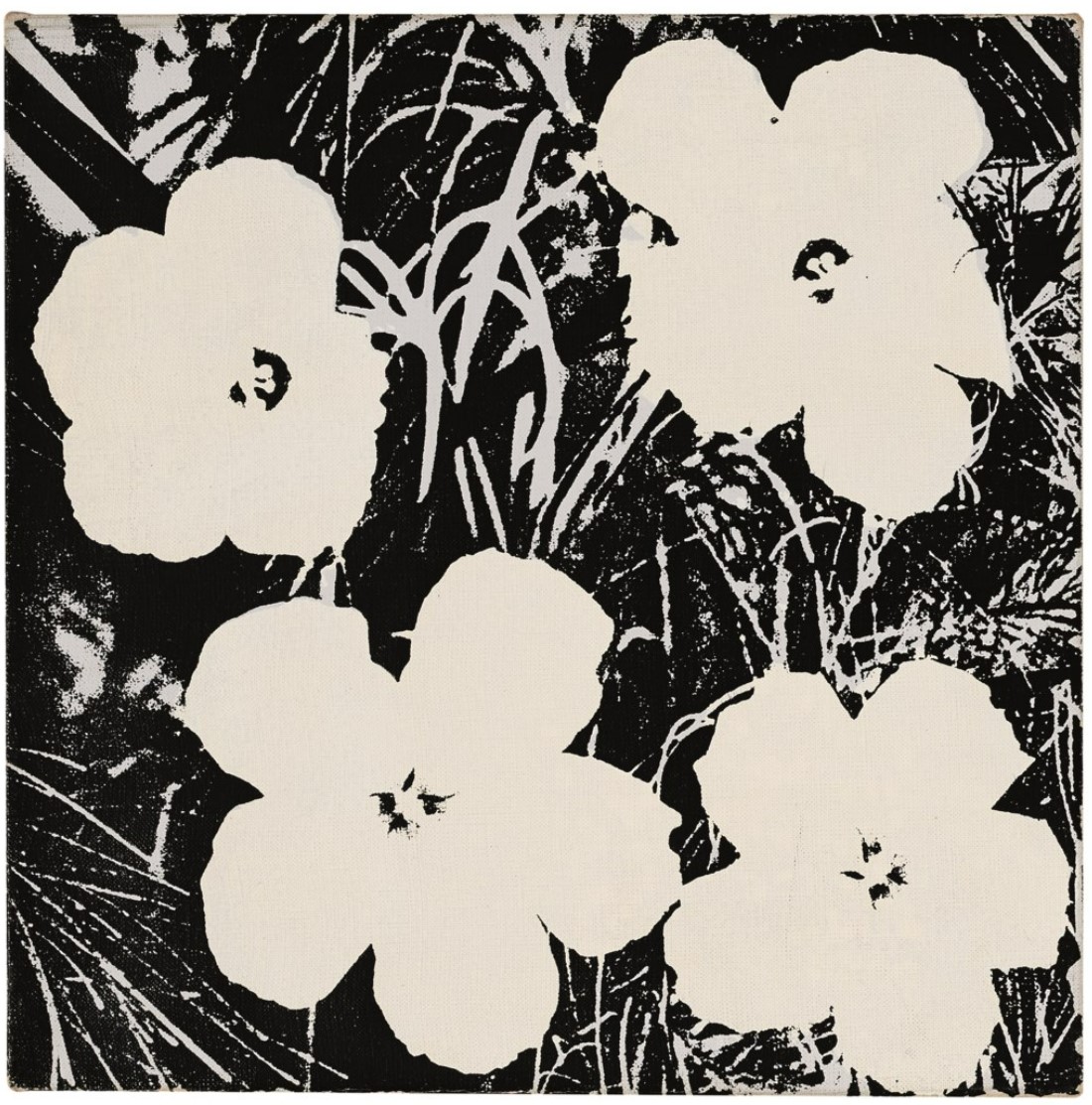
ANDY WARHOL
Flowers, 1964
Acrylic and silkscreen ink on canvas
14×14 inches (35.6 x 35.6 cm)
Signed and dated ‘Andy Warhol 64’ (on the overlap)
Stamped with the Andy Warhol Art Authentication Board, Inc. stamp and numbered ‘A103.025’ (on the overlap)
#10. Flowers, 1964
Christie’s New-York: 28 February 2019
Estimated: USD 200,000 – 300,000
USD 325,000
Andy Warhol (1928-1987), Flowers | Christie’s
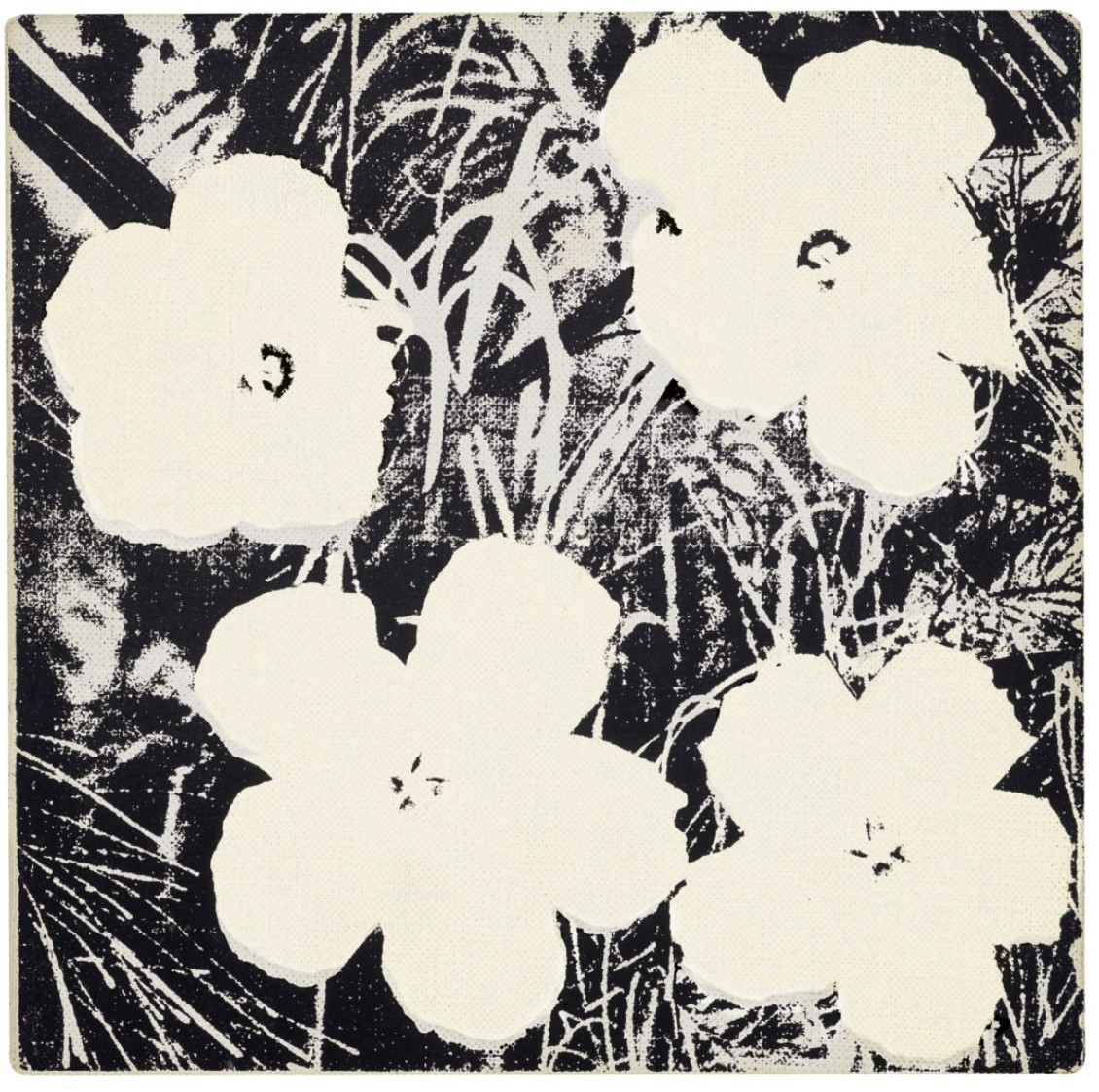
ANDY WARHOL
Flowers, 1964
Acrylic and silkscreen ink on canvas
8×8 inches (20.3 x 20.3 cm)
#11. Flowers, 1965
Christie’s New-York: 28 February 2019
Estimated: USD 150,000 – 200,000
USD 250,000
Andy Warhol (1928-1987), Flowers | Christie’s
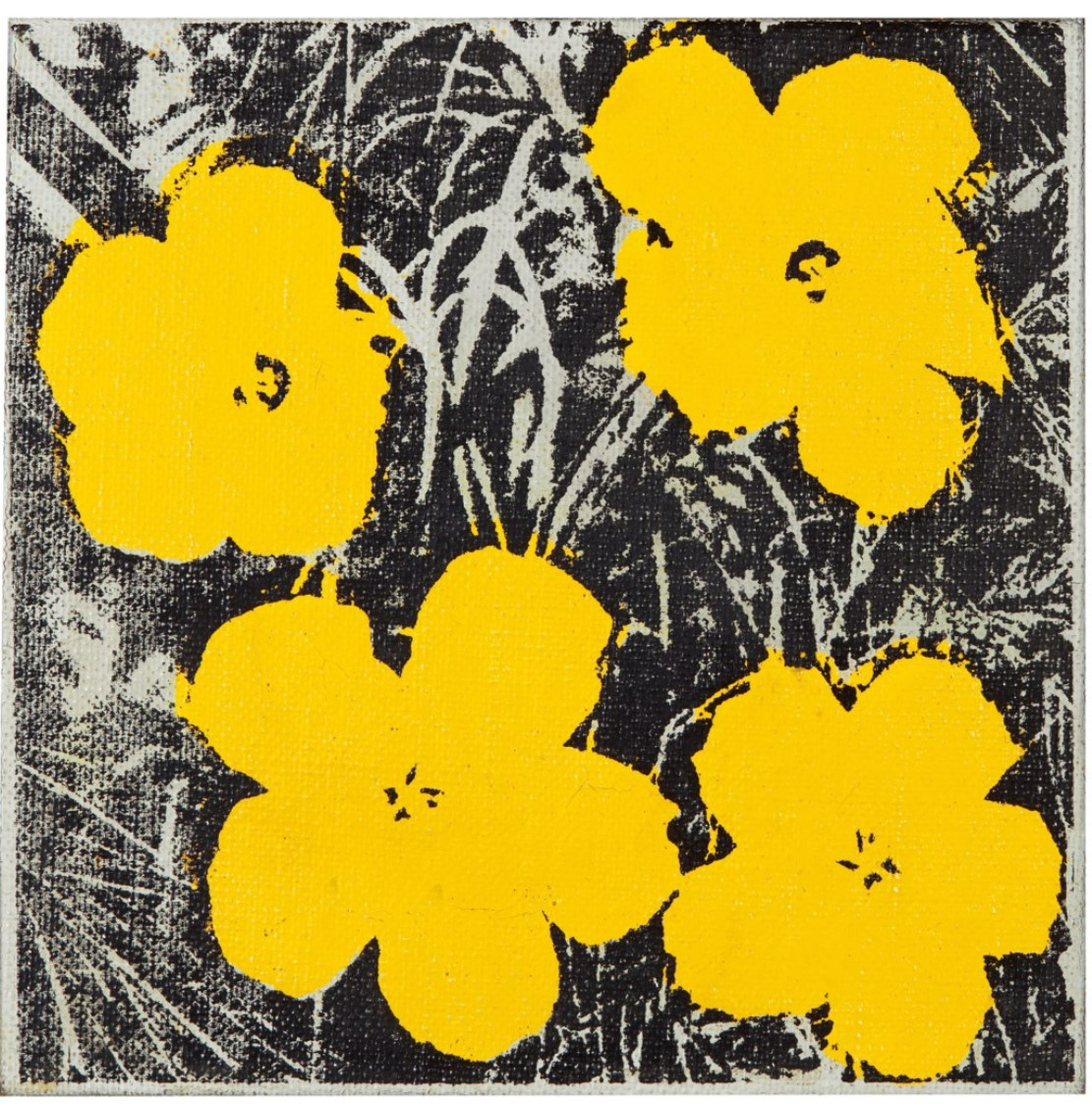
ANDY WARHOL
Flowers, 1965
Acrylic and silkscreen ink on canvas
5×5 inches (12.7 x 12.7 cm)
Flowers, 1965
Christie’s New-York: 14 November 2019
Estimated: USD 150,000 – 200,000
USD 187,500
Andy Warhol (1928-1987), Flowers | Christie’s
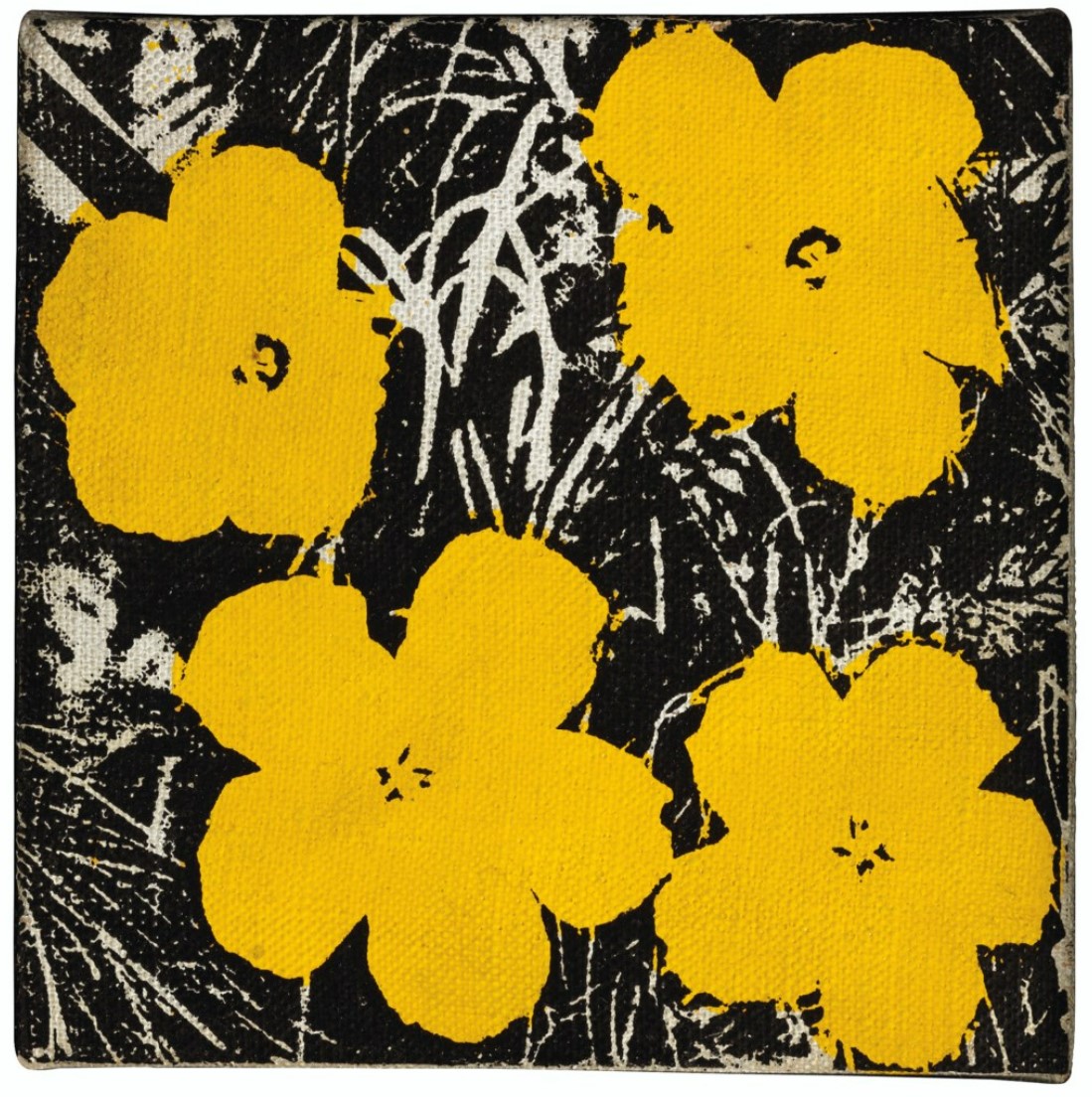
ANDY WARHOL
Flowers, 1965
Acrylic and silkscreen ink on canvas
5×5 inches (12.7 x 12.7 cm)
Flowers, 1964
Christie’s New-York: 16 May 2019
Estimated: USD 100,000 – 150,000
USD 200,000
Andy Warhol (1928-1987), Flowers | Christie’s
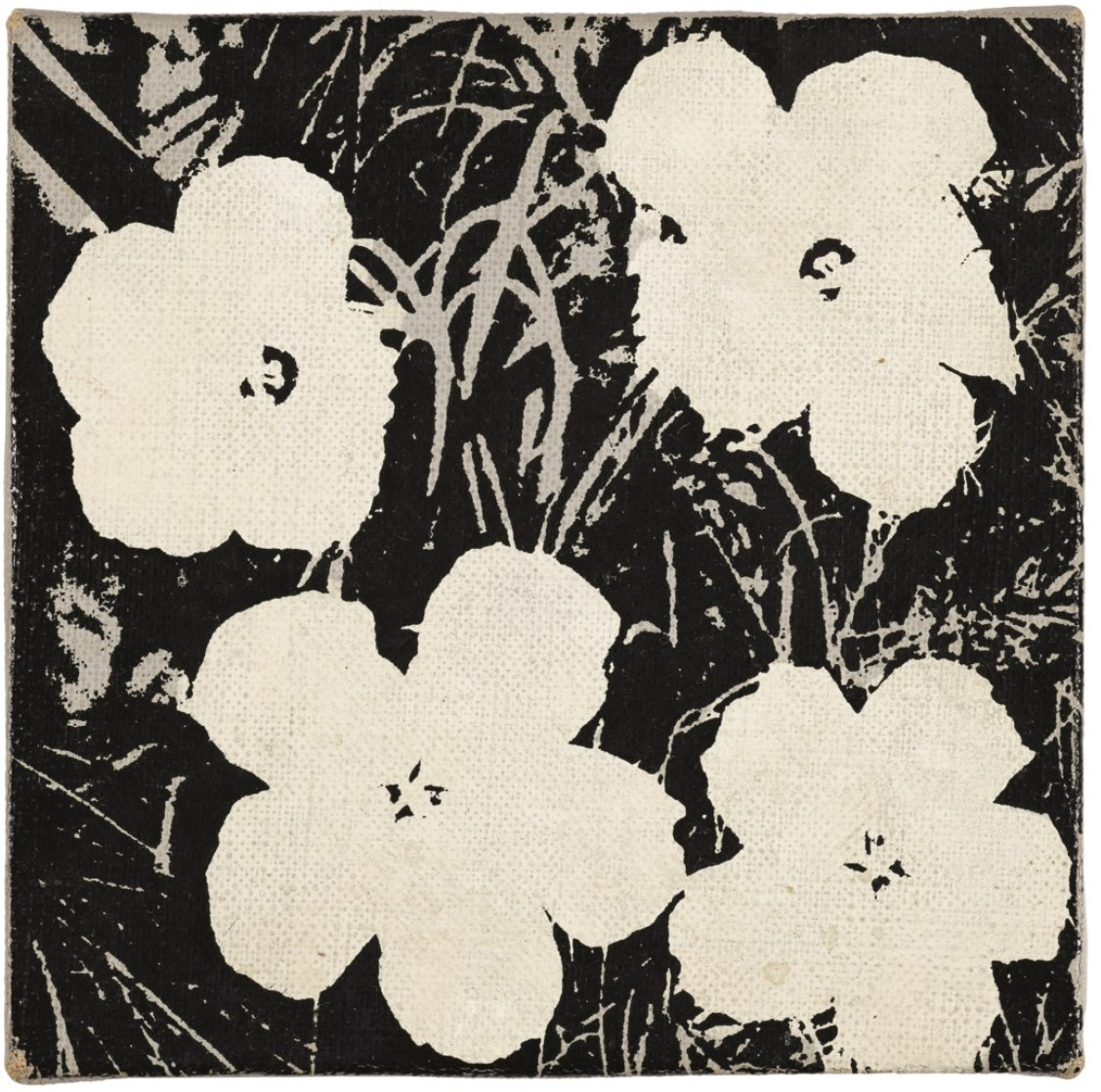
ANDY WARHOL
Flowers, 1964
Acrylic and silkscreen ink on canvas
5×5 inches (12.7 x 12.7 cm)
Flowers, 1964
Christie’s New-York: 16 May 2019
Estimated: USD 150,000 – 200,000
USD 212,500
Andy Warhol (1928-1987), Flowers | Christie’s
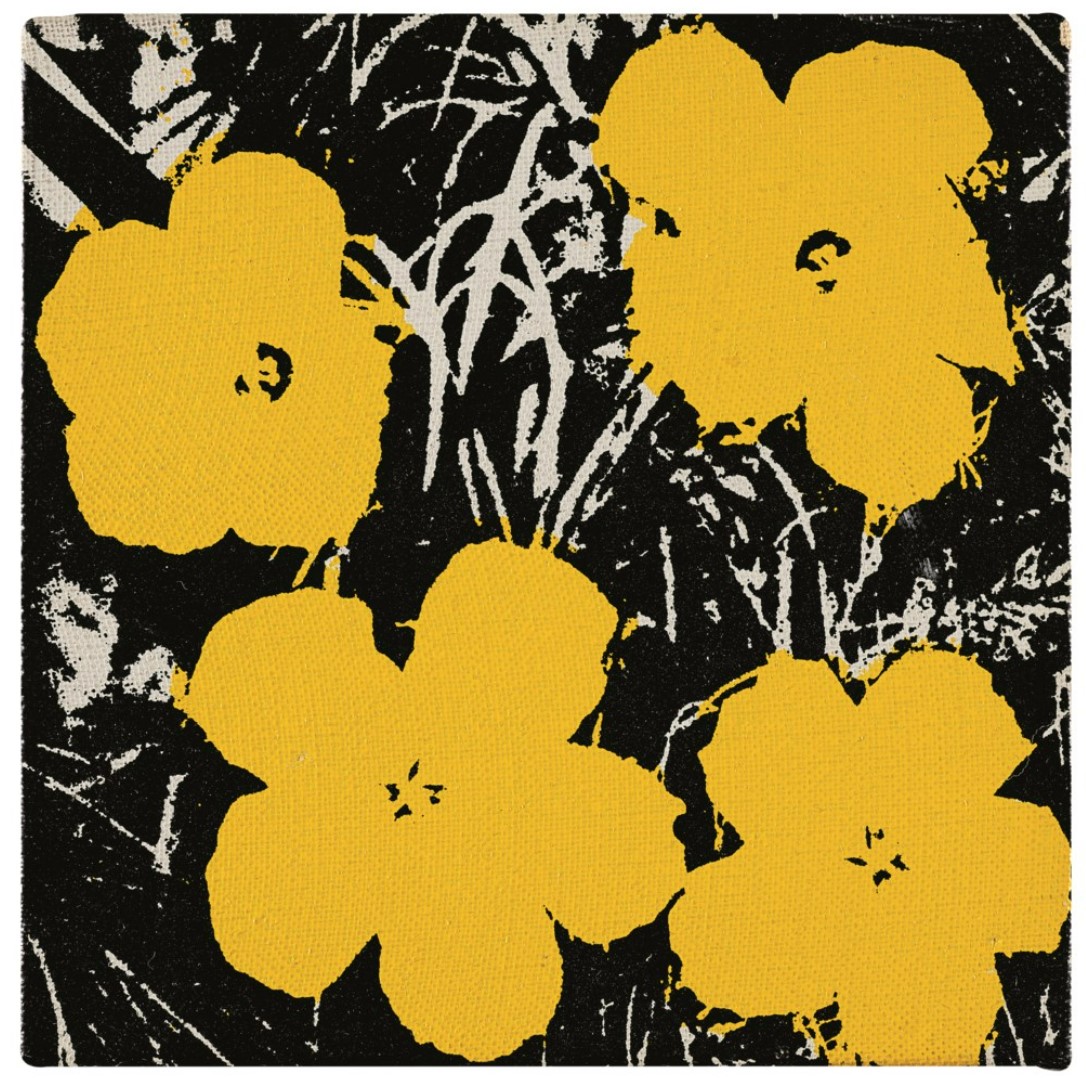
ANDY WARHOL
Flowers, 1964
Acrylic and silkscreen ink on canvas
5×5 inches (12.7 x 12.7 cm)
Flowers, 1964
Sotheby’s New-York: 15 November 2019
Estimated: USD 150,000 – 200,000
USD 175,000
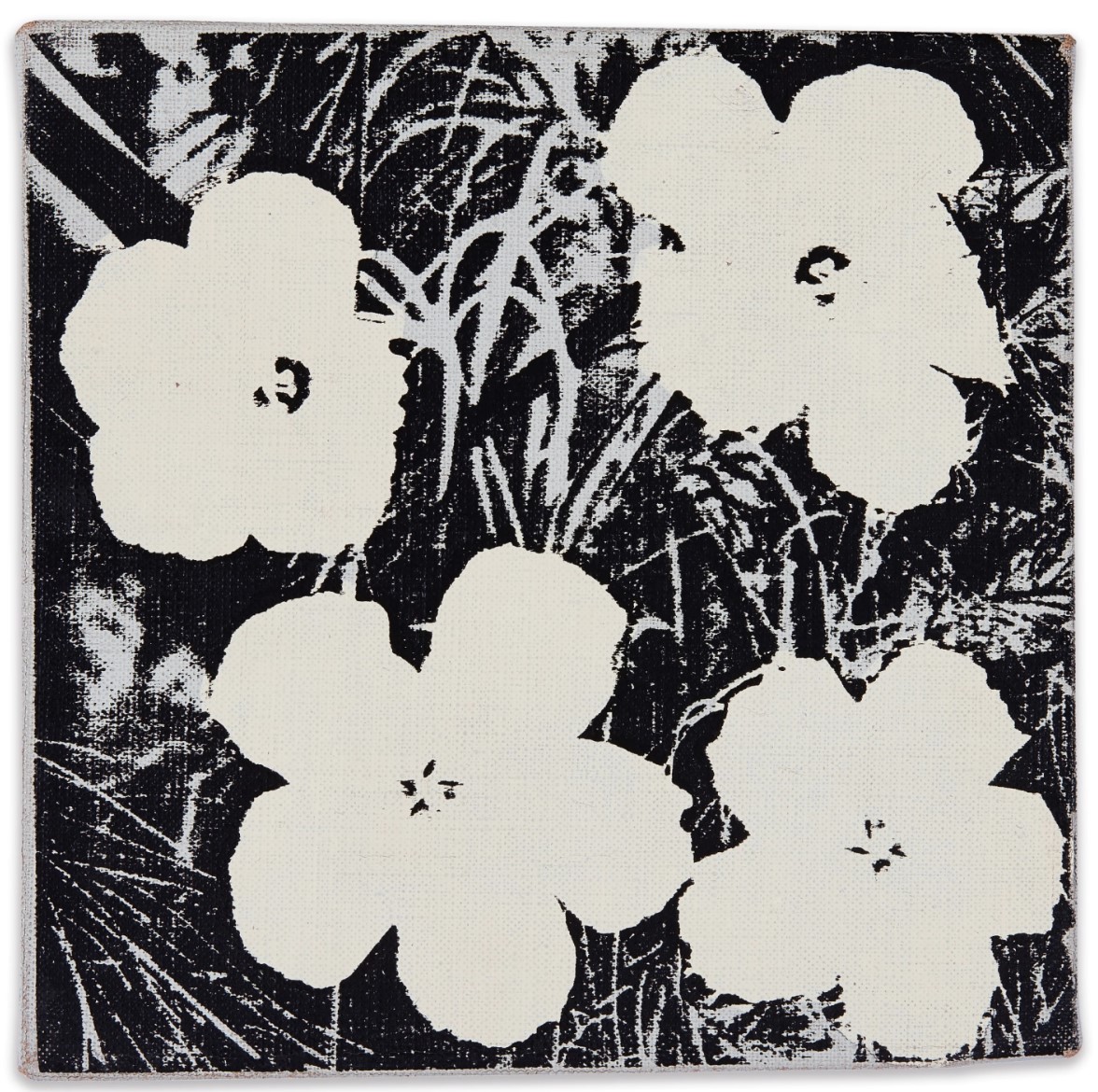
ANDY WARHOL
Flowers, 1964
Acrylic and silkscreen ink on canvas
8×8 inches (20.3 x 20.3 cm)
Repeat Sales
WORK IN PROGRESS
Flowers, 1964
Christie’s New-York: 30 September 2025
Estimated: USD 150,000 – 200,000
USD 419,100
ANDY WARHOL (1928-1987), Flowers | Christie’s
REPEAT SALE
Christie’s New-York: 9 March 2021
Estimated: USD 200,000 – 300,000
USD 300,000
Andy Warhol (1928-1987) (christies.com)
ANDY WARHOL (1928-1987)
Flowers, 1964
Acrylic and silkscreen ink on canvas
14×14 inches (35.6 x 35.6 cm)
Signed indistinctly ‘Andy Warhol’ (on the overlap)
Flowers, 1964
Christie’s New-York: 22 November 2024
Estimated: USD 1,200,000 – 1,800,000
USD 2,470,000
ANDY WARHOL (1928-1987), Flowers | Christie’s
REPEAT SALE
Phillips London: 20 October 2020
Estimated: GBP 1,400,000 – 1,800,000
GBP 1,595,500 / USD 2,066,175
Andy Warhol – 20th Century & Contemp… Lot 18 October 2020 | Phillips
REPEAT SALE
Christie’s New-York: 17 May 2018
Estimated: USD 1,800,000 – 2,500,000
USD 2,112,500
ANDY WARHOL (1928-1987)
Flowers, 1964
Acrylic and silkscreen ink on canvas
24×24 inches (61×61 cm)
Signed twice and dated ‘ANDY WARHOL 64 Andy Warhol’ (on the overlap)
Flowers, 1964
Tajan Paris: 1 July 2020
Estimated: EUR 1,400,000 – 1,800,000
EUR 1,445,600 / USD 1,619,070
Lot – ƒ ANDY WARHOL (1928-1987)
REPEAT SALE
Christie’s New-York: 13 November 2013
Estimated: USD 1,400,000 – 1,800,000
USD 1,685,000
Andy Warhol (1928-1987), Flowers | Christie’s
ANDY WARHOL (1928-1987)
Flowers, 1964
Synthetic polymer and silkscreen ink on canvas
22×22 inches (56×56 cm)
Signed and dated on the overlap
Flowers, 1964
Sotheby’s New-York: 16 May 2019
Estimated: USD 1,500,000 – 2,000,000
USD 5,674,250
REPEAT SALE
Sotheby’s London: 30 June 2014
Estimated: GBP 1,000,000 – 1,500,000
GBP 1,762,500 / USD 3,014,220
ANDY WARHOL
Flowers, 1964
Acrylic and silkscreen ink on canvas
24×24 inches (61×61 cm)
Signed and dated 64 on the overlap
Stamped by The Andy Warhol Art Authentication Board and numbered A100.076 on the overlap
Auction Results Analysis
WORK/UPDATE IN PROGRESS
Flowers were created in varying sizes, including 48-inch (Four Foot), 24-inch (Two Foot), 22-inch, 14-inch, 8-inch, and 5-inch paintings, of which the 22-inch series was commissioned by Ethel and Robert Scull. The remaining sizes were executed for Warhol’s second exhibition that was to be held at Sonnabend in Paris in 1965. Engaging with the motif in a spectral range of color including fluorescent paints manufactured by the Day-Glo color corporation. The 24-inch paintings were amongst the most numerous in Warhol’s production, eight-one in total are noted in the catalogue raisonné.
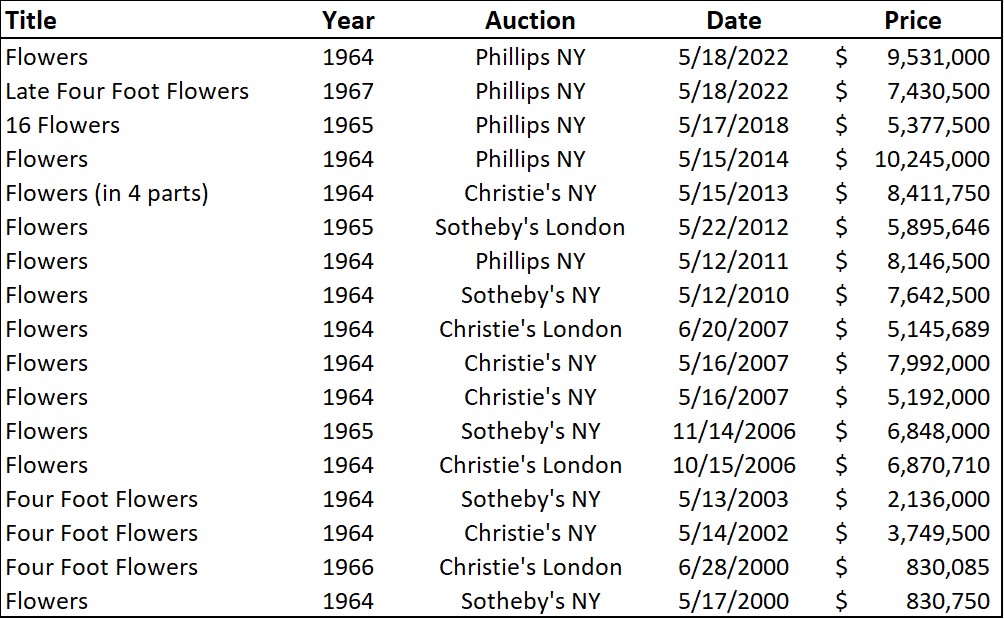
2. Four-Foot Flowers
17 Four-Foot Flowers paintings sold since January 2000 for a total of USD 102,275,130. The highest price ever paid for a Flowers painting of that particular size is USD 10,245,000, achieved at Phillips in New-York on 15 May 2014.
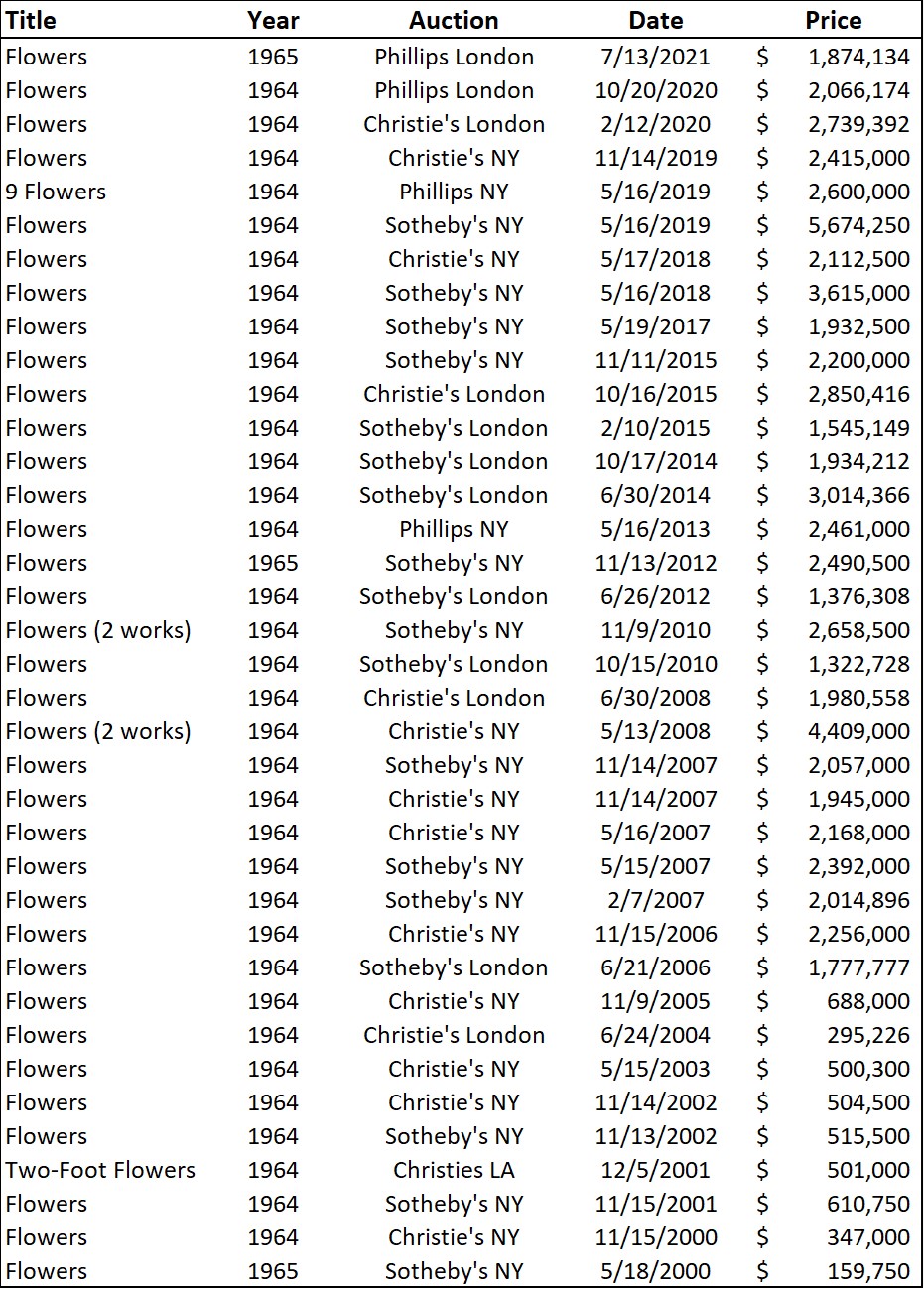
3. Two-Foot Flowers (24×24)
37 Four-Foot Flowers paintings sold since January 2000 for a total of USD 72,004,336. The highest price ever paid for a Flowers painting of that particular size is USD 5,674,250, achieved at Sotheby’s in New-York on 16 May 2019.
6. Flowers (8×8)
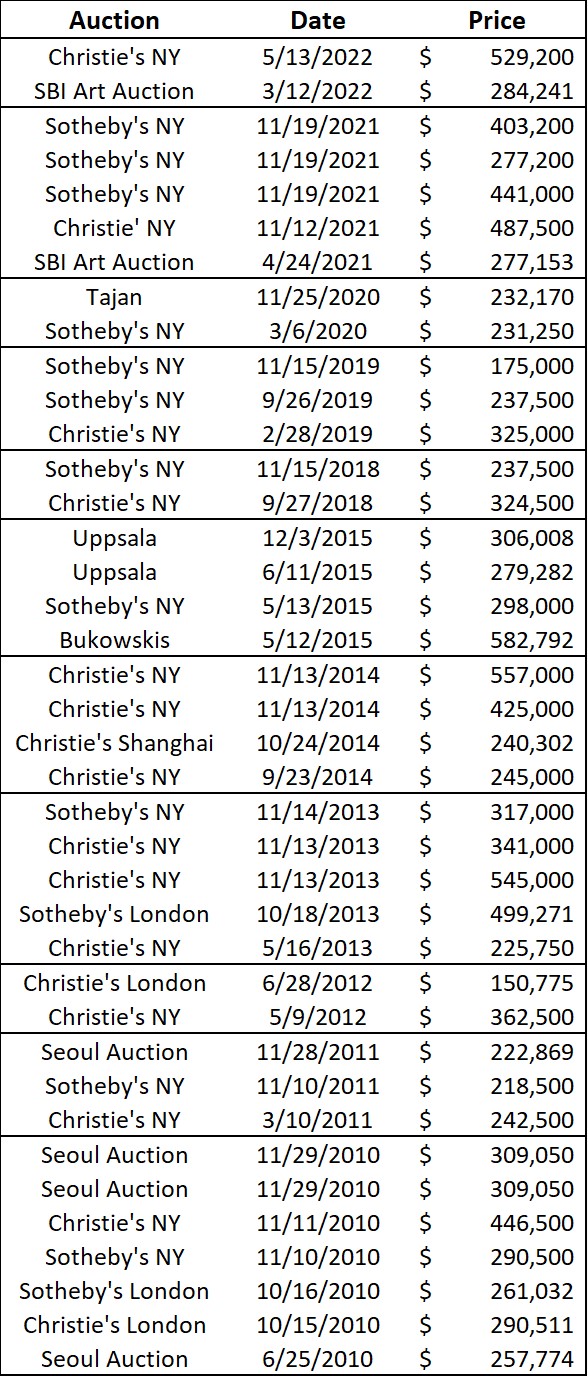
39 8×8-inch Flowers paintings sold since January 2010 for a total of USD 12,685,381. Pricing is highly dependent on the colors used, condition and provenance.
REFERENCING BY SIZE
Ten Foot Flowers
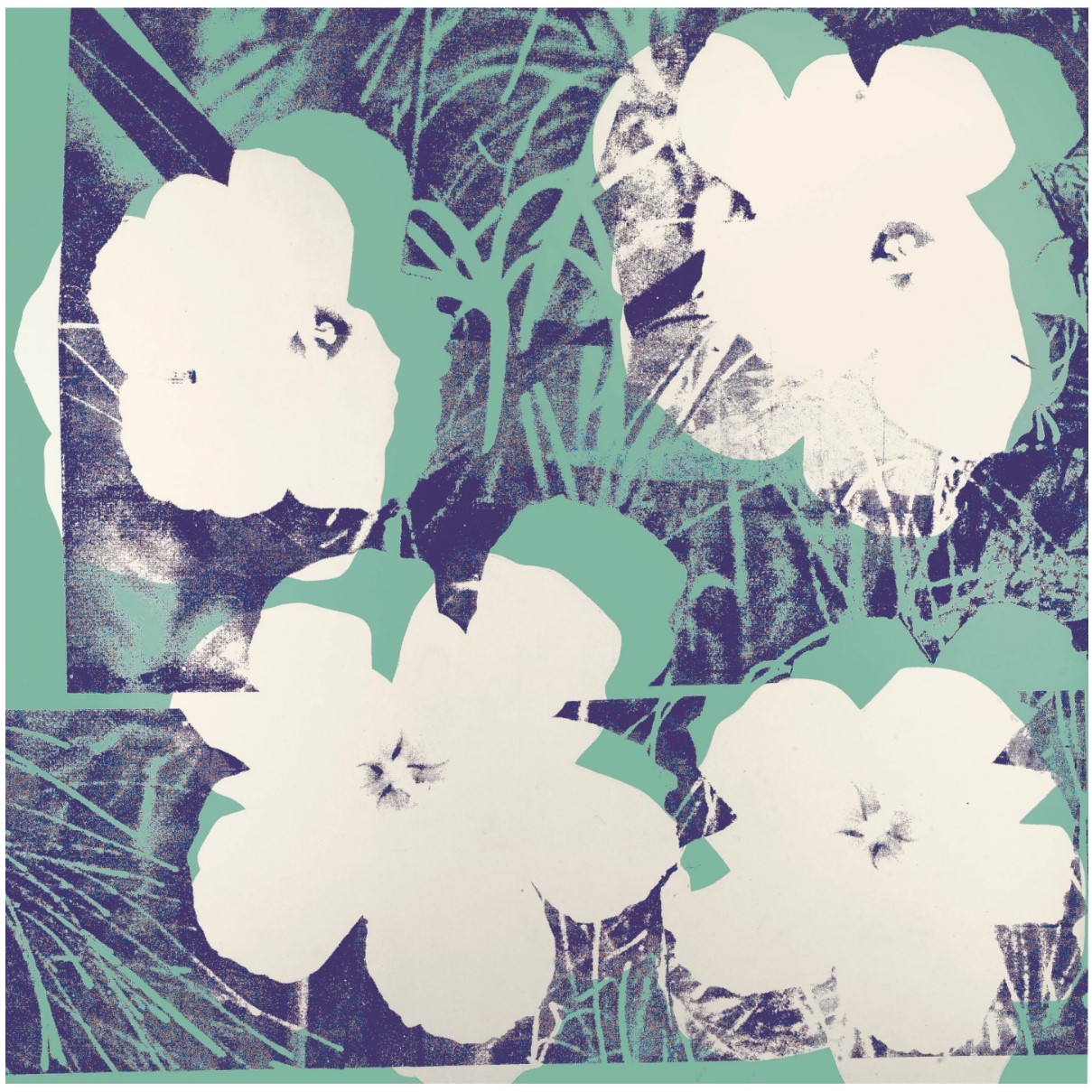
Sotheby’s New-York: 10 May 2012
Estimated: USD 9,000,000 – 12,000,000
USD 10,722,500
(#12) Andy Warhol (sothebys.com)
ANDY WARHOL
Ten-Foot Flowers, 1967-68
Acrylic, silkscreen ink, and pencil on canvas
114.5 x 114.5 inches (290.9 x 290.9 cm)
Announcing one of the most indisputably iconic images of Pop Art on a quite astounding scale, Andy Warhol’s immense Ten-Foot Flowers of 1967 utterly consumes our field of vision and is the artist’s monumental realization of a conceptually infinite art. Composed upon a canvas nearly one hundred square feet in size, this painting was conceived specifically for his first retrospective exhibition in Europe and was always intended for a setting of museum eminence. Thus, it is no surprise that today other works of the cycle are held in the most prestigious institution collections. It is one of just eleven Flower paintings in this 10×10 foot format, others being housed in The Metropolitan Museum of Art, New York; The Museum of Modern Art, New York; the Menil Collection, Houston; the Museum of Contemporary Art, San Diego; the Hamburger Bahnhof, Berlin, Collection Marx; the Kunstmuseum Basel; Moderna Museet, Stockholm; and the Museu Colecção Berardo, Lisbon. The present painting belongs to the ten works in this cycle that were created for Warhol’s inaugural European survey show, held at Moderna Museet, Stockholm in 1968. Through the remaining year, this work travelled to the Stedelijk Museum, Amsterdam; the Kunsthalle Bern; the Kunstnernes Hus, Oslo; and was presented alongside Karl Ströher’s collection at the Nationalgalerie Berlin in 1969, where it hung edge to edge with three other works in a vast twenty by twenty-foot tableau suspended from the ceiling of the cavernous space, designed by Mies van der Rohe. Created after Warhol had publicly declared his increasing devotion to filmmaking, Ten-Foot Flowers broadcasts itself on the register of the cinema screen. In scale, composition, execution and conceptual ambition it is, quite simply, the fully resolved quintessence of Pop Art and its presentation here represents a moment of exceptional rarity.
Large Flowers
Flowers, 1965
Christie’s Hong-Kong: 28 May 2024
Estimated: HKD 62,800,000 – 92,800,000
HKD 66,625,000 / USD 8,529,638

ANDY WARHOL (1928-1987)
Flowers, 1965
Acrylic and silkscreen ink on canvas
82×82 inches (208.3 x 208.3 cm)
Numbered ‘PA 53.002’ (on the stretcher)
Provenance
The Andy Warhol Foundation for the Visual Arts, New York
Gagosian Gallery, New York (acquired from the above)
Private collection, New York, 1994
Gagosian Gallery, New York
Acquired from the above by the present owner
With its huge central bloom ablaze in glorious yellow, the present work is a rare and spectacular Flowers painting by Andy Warhol. It is exceptional among the series, standing as the larger of just two examples of this single-flower composition. One of a group of seven monumental Flowers canvases Warhol made in 1965, it marks the climax of his initial phase creating these works. At 2 x 2 meters, it rivals the visual grandeur of the abstract Color Field painting that was in vogue in New York at the time. Its figurative content, however—transformed by Warhol from a found photograph to a bold and luminous icon in silkscreen and paint—is alive with significance, touching on visual languages from patterned 1960s décor to art-historical still life painting. Emblematic of a key moment in Warhol’s practice, the work was included in his seminal 1965 survey at the ICA Philadelphia—his first museum show, whose opening was famously mobbed by legions of fans—and also in his major posthumous retrospective at New York’s Museum of Modern Art in 1989, which travelled to the Art Institute of Chicago, the Hayward Gallery, London and the Centre Georges Pompidou, Paris.

Warhol’s Flowers series began following a suggestion by the curator Henry Geldzahler, who paid a visit to the artist’s Factory studio in mid-1964. ‘… I looked around the studio and it was all Marilyn and disasters and death’, recalled Geldzahler. ‘I said, “Andy, maybe it’s enough death now.” He said, “What do you mean?” I said, “ Well, how about this?” I opened a magazine to four flowers’ (H. Geldzahler quoted in T. Scherman and D. Dalton, Andy Warhol: His Controversial Life, Art and Colourful Times, London 2010, p. 225). The magazine in question was the June 1964 issue of Modern Photography, in which a spread by editor Patricia Caulfield demonstrated the effects of different Kodak color processes on a photograph of hibiscus flowers. Warhol heavily manipulated this found image to create the ensuing silkscreen series. Working collages show how he cropped it to a square composition—the original depicted seven flowers, contrary to Geldzahler’s memory—repositioned one of the blooms and duplicated the better-defined stamens. He had his assistant Billy Name run the design through the Factory’s new Photostat copier multiple times to flatten its definition, before sending it to his screen-maker to be enlarged into screens of different sizes. This complex process resulted in a striking image of petals starkly silhouetted against a dark, grassy background.

Warhol used these screens to create Flowers canvases varying from just 5 x 5 inches to mural-sized. The flowers were filled in with a variety of different colors, and the backgrounds variously painted green or left black-and-white. The largest early examples are wide-format compositions showing two flowers, effectively halving the four-flower image. Warhol made two such works in 1964 using a single 82 x 160-inch screen, which was later possibly damaged or rejected as too cumbersome. His large Flowers of 1965 were instead made from pairs of 82 x 82-inch and slightly smaller 72 x 72-inch screens. Uniquely among this group, the present painting was created from a single 82 x 82-inch screen. Warhol painted both the green background and the yellow flowers by hand, using a red masking film known as Rubylith to stencil their shapes, before finally applying black ink through the screen. The resulting surface features visible brushstrokes that contrast with the more mechanical layer of stenciled black, which sits gently off-register against the flowers’ outlines.

Warhol debuted the Flowers series in his first exhibition at Leo Castelli Gallery, New York, in November 1964. The show was a triumph for Warhol, who had set his sights on the prestigious gallery early in his career. ‘They are like cut-out gouaches by Matisse set adrift on Monet’s lily-pond’, enthused David Bourdon. ‘… The flower paintings are very beautiful. The artist is a mechanical Renaissance man, a genius’ (D. Bourdon, ‘Art: Andy Warhol’, The Village Voice, 3 December 1964, Vol. X, No. 7, p. 11). The Flowers were next shown in May 1965, when Warhol staged his first European exhibition at Galerie Ileana Sonnabend in Paris. There they were seen by the young American art critic Peter Schjeldahl, who later recalled the encounter as life-changing. ‘They are so goddamn beautiful. And so simple. And their glamour was so intense’, Schjeldahl said. For him, the Flowers seamlessly resolved the formal debates around abstraction, flatness and surface that were dominating contemporary discussions of painting. ‘… That’s why we reach for the word “genius.” Genius is what goes, “That’s not a problem.” He sees clearly. He just does it’ (P. Schjeldahl quoted in T. Scherman and D. Dalton, ibid., p. 227). Years later, Schjeldahl would open his review of Warhol’s posthumous retrospective at MoMA in 1989—which featured the present painting—with the lament that ‘There aren’t enough Flowers’ (P. Schjeldahl, ‘Warhol’, in Hot Cold, Heavy, Light: 100 Art Writings 1988 – 2018, New York 2019, p. 8).

Vincent van Gogh, Sunflowers, 1888. The National Gallery, London.
The present work had a still more memorable outing as part of Warhol’s legendary first museum retrospective, which opened to the public at the Institute of Contemporary Arts, Philadelphia, on 8 October 1965. Following a boisterous preview the night before, curator Samuel Green—who had organized a major publicity drive for the exhibition—had taken the precaution of removing most of the paintings from the walls, leaving only a handful of works including some Flowers and grocery-carton sculptures. Over one thousand visitors crowded into the galleries for two hours before the arrival of Warhol and his associates, including actress and ‘It’ girl Edie Sedgwick, who had become part of the Factory entourage earlier that year. They were mobbed for autographs. ‘Escorted by campus police, the Warhol party swept back to the front room where they scrambled up a corner stairway’, recounted David Bourdon. ‘“We want Andy,” the crowd chanted. “Well now I’ve seen Andy Warhol,” one boy crooned, while another screamed, “Get his clothing!”’ (D. Bourdon, ‘Help!’, The Village Voice, 14 October 1965, Vol. X, No. 52, p. 13). The group eventually escaped when a security team broke through the boarded-up ceiling above. A remarkable photograph from the scene captures Sedgwick high up the staircase, trailing the long sleeves of her pink Rudi Gernreich dress over the heads of the crowd. The present painting, with its distinctive single bloom, can be seen on the wall behind.


At the same time, the Flowers prompted comparison to the patterned floral fabrics popular during the ‘Flower Power’ 1960s, particularly those of the Finnish brand Marimekko, which were famously worn by Jackie Kennedy—herself another Warhol subject—early in that decade. They engaged with aspects of kitsch popular culture as well as more rarefied painterly themes. The works’ square format allowed Warhol to present the smaller Flowers in grids—arrayed almost like wallpaper in his Castelli and Sonnabend shows—with their compositions rotated at will. These modular blooms appeared mass-produced, like another consumer commodity in his Pop universe. While flowers in painting have historically been associated with the gravitas and memento mori symbolism of the still-life, they have in fact often entwined such seemingly opposed notions of ‘serious’ and merely ‘decorative’ art. Vincent van Gogh created his sunflower paintings as ‘decorations’ for Paul Gauguin’s bedroom in Arles; Claude Monet called his vast, climactic water-lily paintings his grandes décorations.


With its exceptional composition and spectacular scale, the present painting distils the complexities of Warhol’s vision into a luminous, unforgettable image. The work is at once an appealing picture of a flower and a bold composition of pure shape and color: a subversive riff on a decorative motif, and a floral firework thrown into the art-historical canon. In 1965, visiting Paris for the Sonnabend exhibition, Warhol declared that he was giving up painting to focus on making movies. While that never came to pass, the Flowers remain testament to a vital moment of change, transition and growth in his work. The present work’s yellow petals glow with an almost solar radiance, capturing the blossoming of Warhol’s Pop practice into brilliant new life.
Flowers, 1964
Christie’s New-York: 14 May 2024
Estimated: USD 20,000,000 – 30,000,000
USD 35,485,000
ANDY WARHOL (1928-1987), Flowers | Christie’s (christies.com)

ANDY WARHOL (1928-1987)
Flowers, 1964
Acrylic, fluorescent paint and silkscreen ink on linen
82×82 inches (208.3 x 208.3 cm)
Signed twice and dated later ‘Andy Warhol Andy Warhol 65’ (on the overlap)
Provenance
Leo Castelli Gallery, New York
Frederick R. Weisman, Los Angeles
Thomas Ammann Fine Art, Zurich
Top Search Investment Ltd., London
Acquired from the above by the present owner, 1990
A towering achievement of Pop Art, Andy Warhol’s Flowers epitomizes the seismic effects of the twentieth-century’s most significant art movement. Bringing together the essential elements of Warhol’s oeuvre, this monumental painting displays the artist’s bold aesthetic vision alongside his deeply considered conceptual rigor. Measuring 82” square, this is among Warhol’s largest canvases and was one of just three Flowers of this size to be included in the seminal exhibition at the Leo Castelli Gallery which unveiled this body of work to an astonished public. “[The Flowers] are so goddamn beautiful,” wrote the critic Peter Schjeldahl. “And so simple. And their glamour was so intense … That’s why we reach for the word ‘genius’” (P. Schjeldahl, quoted in T. Scherman and D. Dalton, Pop: The Genius of Andy Warhol, New York, 2009, pp. 236-237). Later selected for inclusion in the 2020 Warhol retrospective at Tate Modern, Warhol’s Flowers marks a pivotal point in the artist’s career, as he shifted from his powerful Death and Disaster series into a more seemingly palatable subject, but one that nonetheless retained the ability to rock the art world.
From a series of nine 82 inch Flowers painted in 1964, all set against lush green backgrounds, the present work is undoubtably one of the most striking. It boasts three dazzling Indo-orange blooms and a fourth rendered in a fiery cadmium red, all set against a verdant green ground, and all rendered in Day-Glo paint. The present work is the only 82” Flowers in which all the flowers and the foliage are painted with Day-Glo pigments. All of these oscillate against one another in natural light, but the effect is magnified when viewed under ultra-violet light. The hand-painted petals are the result of Warhol projecting an image of the flowers onto the canvas using a acetate sheet and then tracing their outlines in pencil before applying their vivid colors by hand. Though later works would see the artist eschewing this ‘handmade’ quality in favor of full mechanical reproduction, the present work is still adorned by his brush, however imperceptibly. By reducing the entire composition down to a few choice colors, Warhol creates a graphic intensity that has more in common with mass media billboards and printed periodicals than the subtle beauty of the source photograph.

The early 1960s was a time of dramatic innovation and veracious production for Warhol. In 1964 alone, he moved into a studio that would become his first ‘factory’, at 231 E 47th Street in Manhattan, he also exhibited his Death and Disaster series at Ileana Sonnabend’s gallery in Paris to rave reviews. In the spring and summer, he filled the Stable gallery in New York with Brillo boxes and Campbell’s soup cans and also completed his now-iconic film Empire. The juxtaposition of the everyday objects en masse in the former, and the intense—almost meditative observation—of the latter, highlighted the fact that Warhol was not merely a superficial purveyor of popular imagery but had actually tapped into the deeper concepts surrounding our relationship with commercialism as a society. By carefully and methodically choosing his subjects, the artist was able to create a personal treatise on human existence from seemingly anonymous reproductions, mass media techniques, and the appropriation of images and styles from design and advertising.

The ubiquitous nature of Warhol’s floral arrangements is what makes the present work such an insightful interrogation of the way in which we consume mass media. The Flowers exist perfectly within the divide between journalistic depictions of the real world and stylized images used in logos, cartoons, and advertisements. They are both real and constructed at the same time. Warhol’s genius lies in his ability to bridge the expanse between the realm of fine art and one of deeper conceptual thought. By creating works that occupy multiple spaces at once, he problematized our relationship to images and questioned how we exist as fragile human beings in an increasingly prescribed world.

Installation view, Andy Warhol, Leo Castelli Gallery, New York, 1964(present lot illustrated). Artwork: © 2024 The Andy Warhol Foundation for the Visual Arts, Inc. / Licensed by Artists Rights Society (ARS).
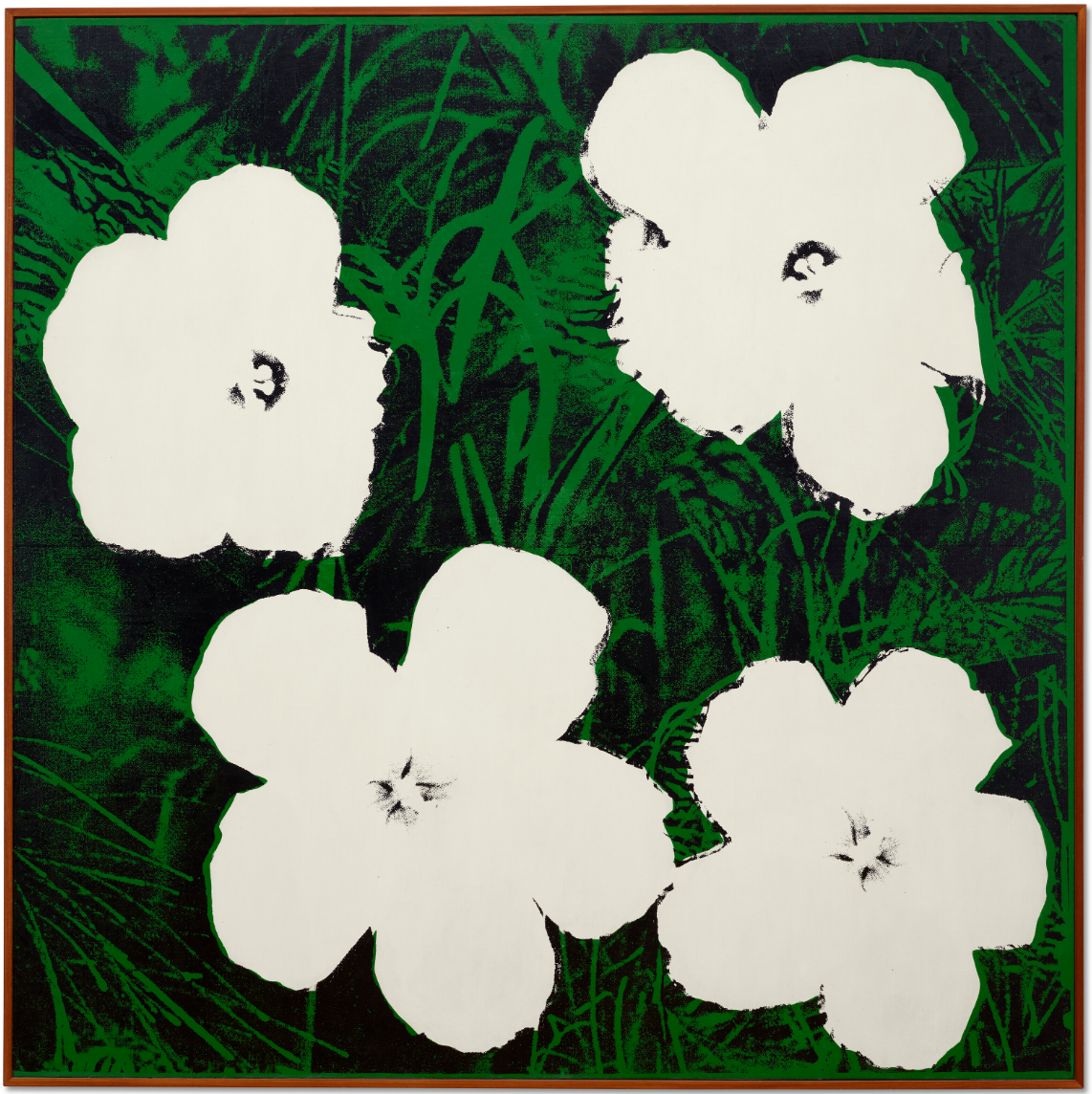
Flowers, 1964
Christie’s New-York: 9 May 2022
Estimated: USD 15,000,000 – 20,000,000
USD 15,847,500
ANDY WARHOL (1928-1987) (christies.com)
ANDY WARHOL
Flowers, 1964
Acrylic and silkscreen ink on linen
81 3/4 x 81 1/2 inches (207.6 x 207 cm)
Provenance
Leo Castelli Gallery, New York
Kimiko & John Powers, Houston
Private collection, New York
Anon. sale; Sotheby’s, New York, 9 November 1983, lot 56
Thomas Ammann Fine Art AG, Zurich
Acquired from the above by the present owner
With its dazzling arrangement of four white blooms rendered on a spectacular 82×82 inch scale, Andy Warhol’s Flowers is a rare and majestic painting from one of the twentieth century’s most iconic bodies of work. Representing the largest square format within Warhol’s original 1964 series, it is one of just nine hand-embellished Flowers of this scale and crop recorded in the artist’s catalogue raisonné—two reside in the Andy Warhol Museum, Pittsburgh, with a further example held in the Hirshhorn Museum and Sculpture Garden, Washington D. C. The work was one of three of this size selected for Warhol’s historic show at Leo Castelli Gallery in 1964: a landmark, sell-out exhibition that would go on to become synonymous with the heyday of American Pop Art. Here, in bold, luminous tones, was an image that spoke to the beauty and tragedy of modern life: a thrilling encounter between humankind and nature, riddled with tantalizing Warholian enigma. The present work is the only example of its scale to feature four white flowers, gleaming brightly like beacons against their deep green roots. Other smaller works with this color scheme are held in collections including the Solomon R. Guggenheim Museum, New York and the Menil Collection, Houston.
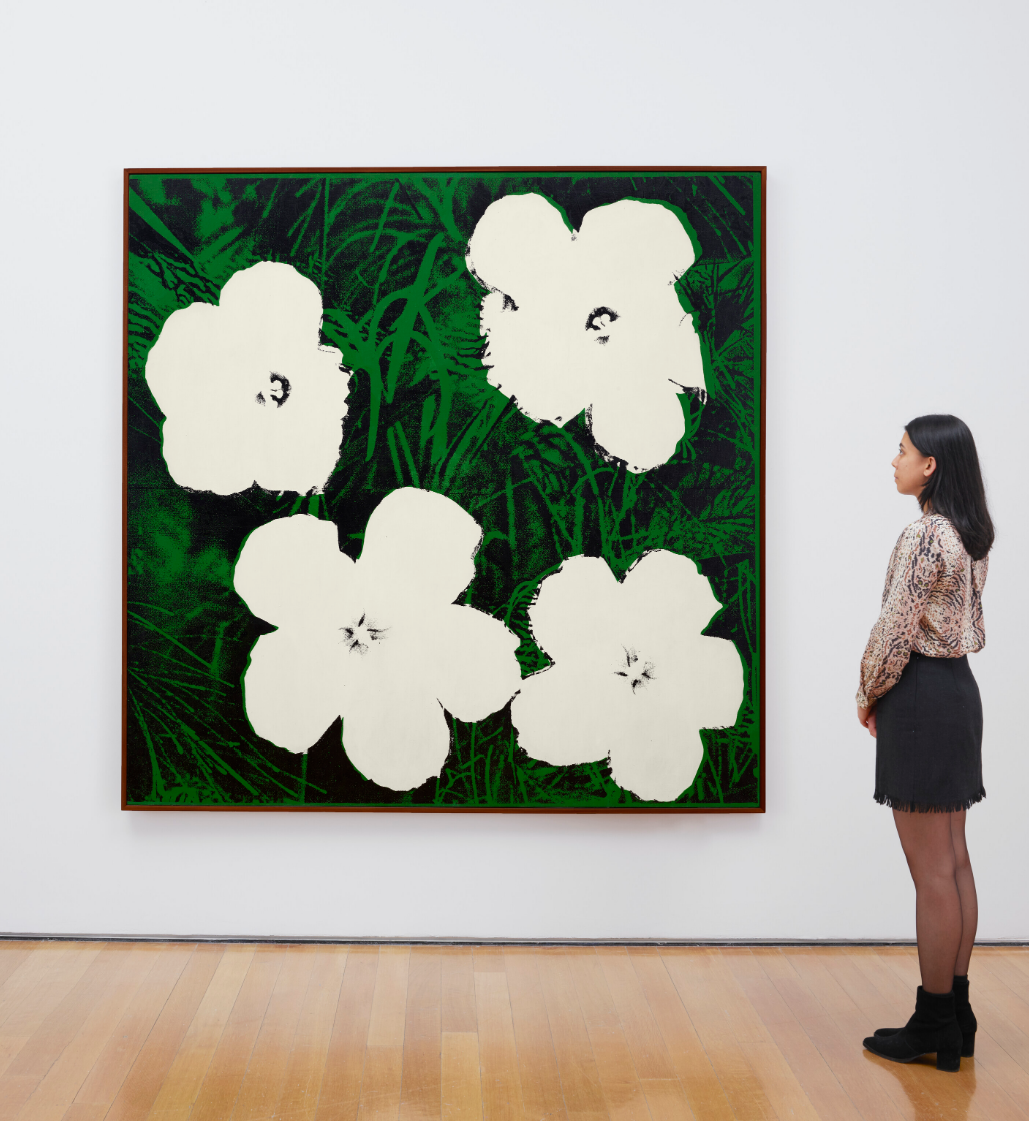 The 82-inch Flowers, created in August and September 1964, represent the second size category that the artist produced, following on from the original group of 48-inch canvases. According to Georg Frei, they were created using two 40×80 inch screens, giving rise to a single transverse seam visible in each painting. Warhol delighted in the tension between the hand and machine, relishing the friction between the reproductive nature of silkscreen and the minute slippages in tone, texture and saturation that resulted as part of the painterly process. As well as the nine hand-embellished examples, Warhol produced a further two 82-inch canvases some months later, using spray paint over a primed black and white ground that dispensed with the tinted green of the grass. Only one further example from 1965 exists on this scale, featuring an unusual, tighter crop that zooms in upon two of the four flowers. In the present work, this tension is magnified to epic proportions. Like an overexposed photograph, or a celebrity caught in a spotlight, the white blooms gleam from their verdant nest, each an open eye onto the world.
Flowers, 1964
Christie’s New-York: 10 May 2005
Estimated: USD 7,000,000 – 10,000,000
USD 7,856,000
Andy Warhol (1928-1987) (christies.com)
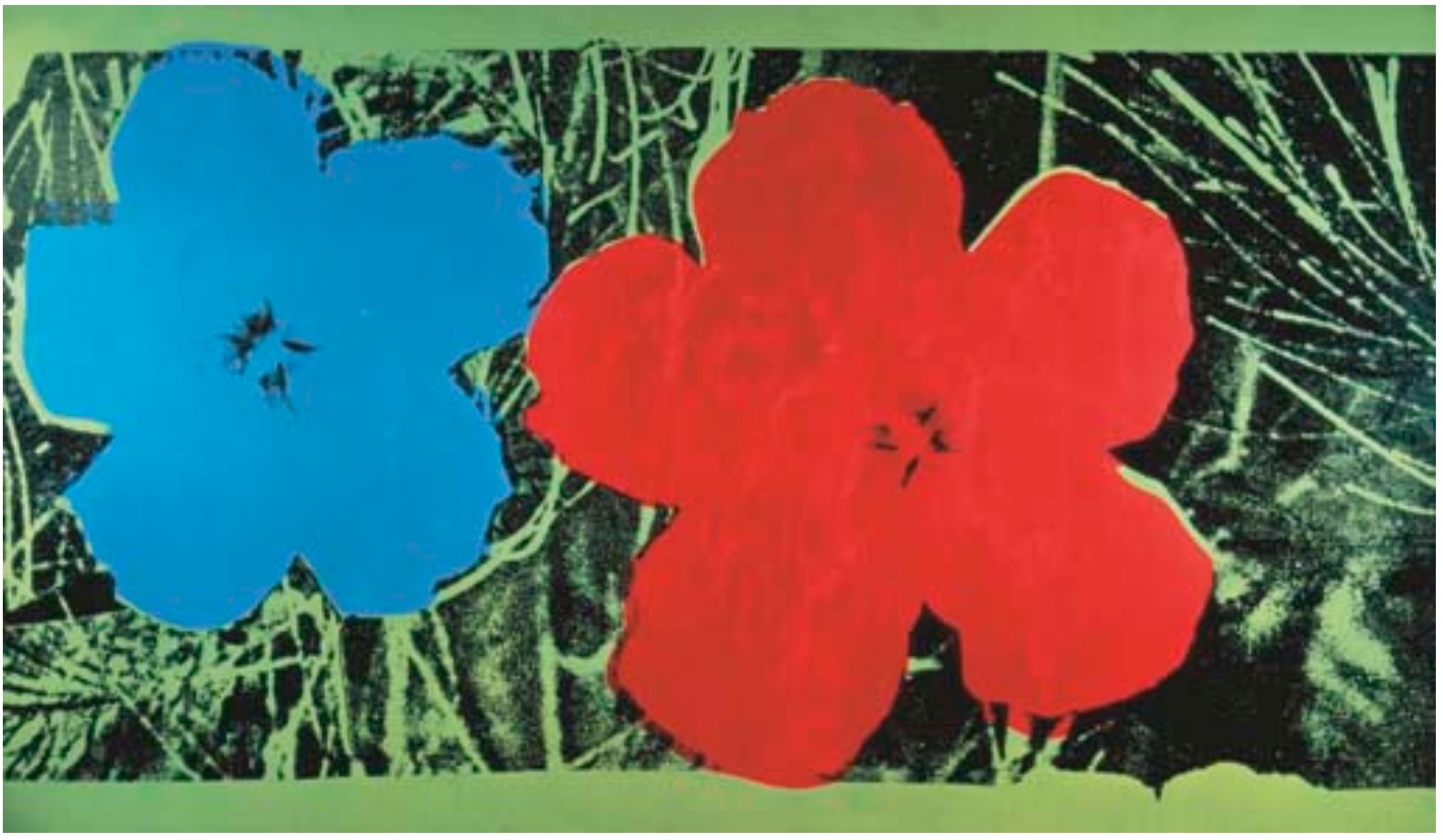
ANDY WARHOL
Flowers, 1964
Acrylic and silkscreen ink on canvas
81.7 x 140.5 inches (207.7 x 356.9 cm)
The present work is one of only seven monumental-scale paintings from Andy Warhol’s famous Flowers series, which the artist showed at a sell-out exhibition at the Leo Castelli Gallery in New York in 1964 and with Galerie Sonnabend in Paris in May 1965. The two shows comprised of densely hung canvases of flowers in various sizes and brilliant Day-Glo hues, all appropriated by Warhol from a photograph of hibiscus blossoms that had appeared in the June 1964 issue of Popular Photography. Warhol was at the height of his creative powers and international fame.
Large Flowers, 1964
Christie’s New-York: 10 May 2004
Estimated: USD 6,500,000 – 8,500,000
USD 6,725,500
Andy Warhol (1928-1987) (christies.com)
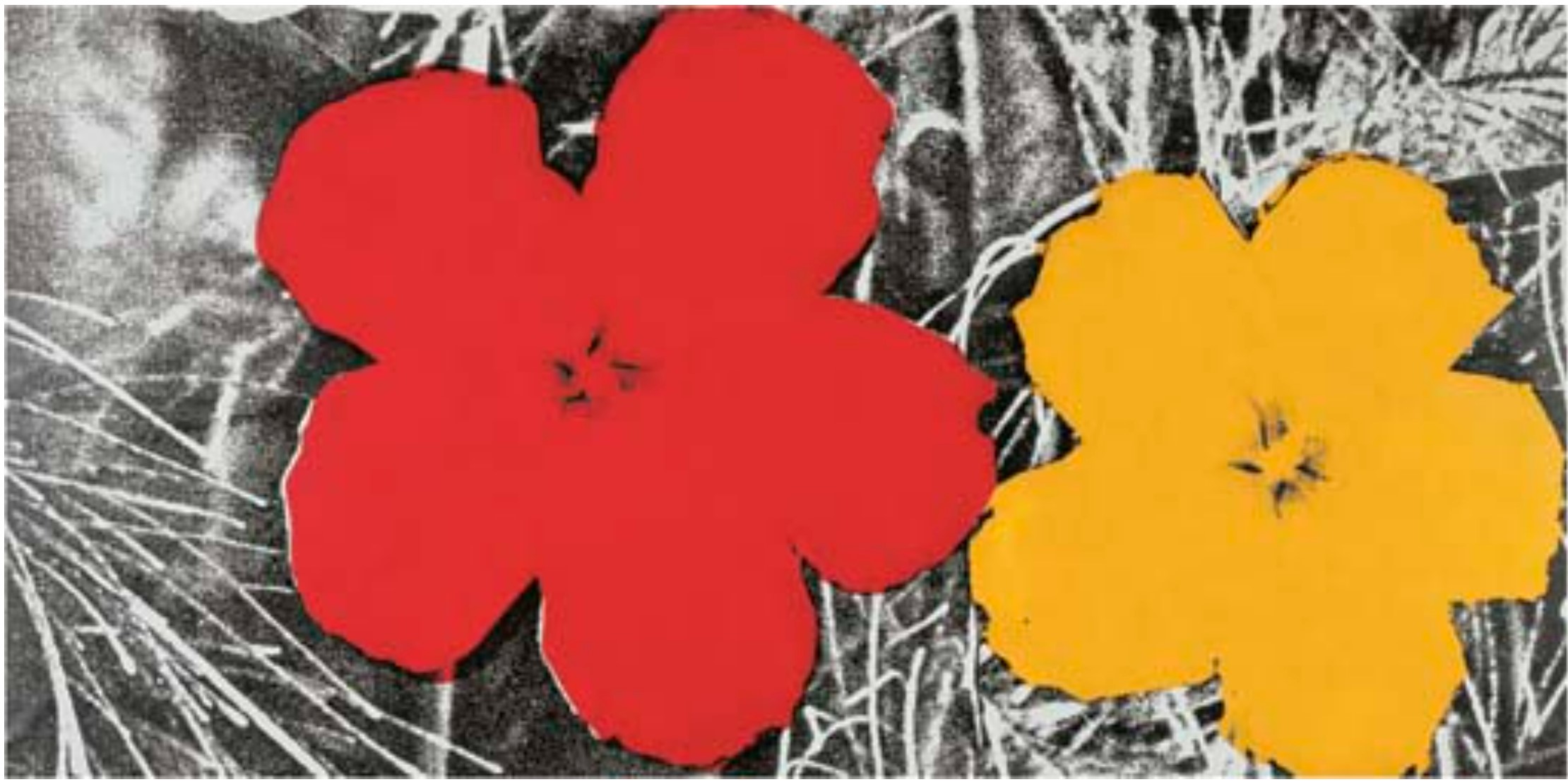
ANDY WARHOL
Large Flowers, 1964
Synthetic polymer and silkscreen inks on canvas
82×162 inches (208 x 411.5 cm)
The present work is one of only five monumental-scale paintings from Andy Warhol’s famous Flowers series, which the artist showed at a sell-out exhibition at the Leo Castelli Gallery in New York in 1964 and with Galerie Sonnabend in Paris in May 1965. The two shows comprised of densely hung canvases of flowers in various sizes and brilliant Day-Glo hues, all appropriated by Warhol from a photograph of hibiscus blossoms that had appeared in the June 1964 issue of Popular Photography.
Five Foot Flowers
Flowers (Five Foot Flowers), 1964
Sotheby’s New-York: 13 November 2013
Estimated: USD 10,000,000 – 15,000,000
USD 11,365,000
(#21) Andy Warhol (sothebys.com)
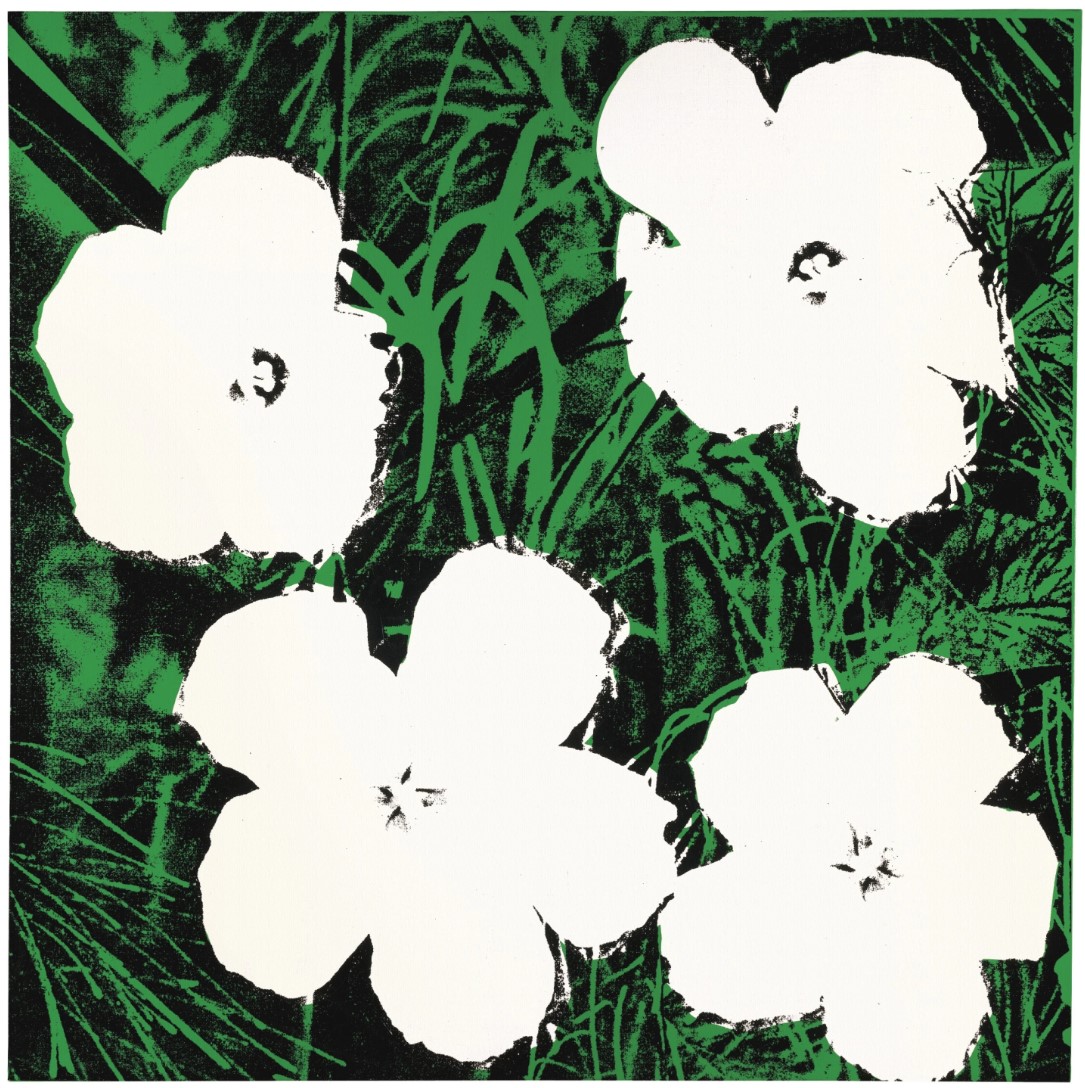 ANDY WARHOL
Flowers (Five Foot Flowers), 1964
Acrylic and silkscreen ink on canvas
60×60 inches (152.4 x 152.4 cm)
Signed twice on the overlap
Sublimely composed of four perfectly pure, crisp white petals immaculately registered on a brilliant green and black ground, Andy Warhol’s Flowers (Five Foot Flowers) of 1964 encapsulates the indisputably iconic profile of Pop Art. Previously selected by John and Kimiko Powers, the renowned collectors who were foremost among Warhol’s earliest patrons, to be held in their esteemed collection, this painting represents the very essence of the artistic movement to which this artist is so indelibly integral. During the half century since their creation, Warhol’s Flower paintings have pervaded our global consciousness as the totemic standard of classic American Pop; their imagery acting as a metaphor for a generation that changed not only artistic but also social and political topographies in a supremely transformative decade. Warhol’s production of Flower paintings has become the stuff of legend: during the summer of 1964 he created canvases in square formats measuring 82, 48 and 24 inches respectively, intended for a show with his new dealer Leo Castelli opening in New York in November of that year. While the series proliferated in order to fill the walls of the gallery, in October he ordered a silkscreen mechanical for a 60 by 60 inch, or five foot square format. With this screen he made only four canvases, the rarest and most limited corpus of the entire original series of Flowers to which the present work belongs.
Four Foot Flowers
Flowers, 1964
Phillips New-York: 18 May 2022
Estimated: USD 8,000,000 – 12,000,000
USD 9,531,000
Andy Warhol – 20th Century & Contemporar… Lot 22 May 2022 | Phillips
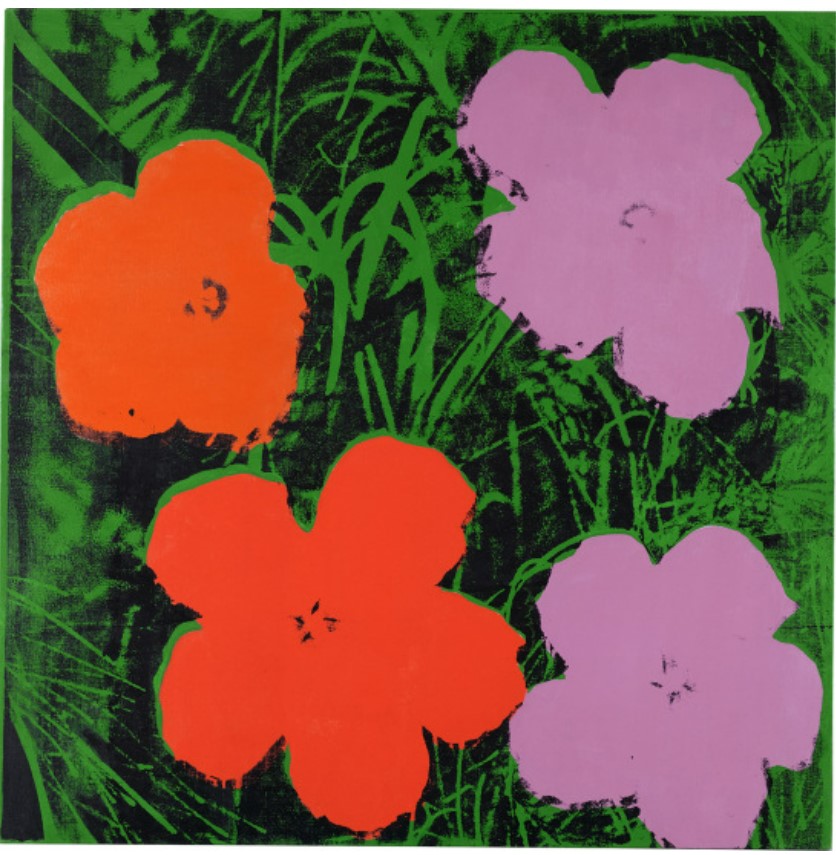
ANDY WARHOL
Flowers, 1964
Acrylic and silkscreen ink on canvas
48 x 47.9 inches (121.9 x 121.6 cm)
Stamped twice by the Estate of Andy Warhol
and the Andy Warhol Foundation for the Visual Arts, Inc.
Numbered “PA53.012” on the overlap
Numbered “PA53.012” on the stretcher
An exceptionally vibrant example from one of Andy Warhol’s most iconic series, Flowers radiates bursts of scarlet, cadmium red, and violet against a sea of emerald green. The present work, which was executed among Warhol’s Flowers in 1964, signaled a shift from his depictions of timely, instantly-recognizable branding to a more abstracted and timeless imagery—though, of course, still seizing source material mediated by popular culture and print magazines. Embracing a distinctive hyper-flatness that presaged Warhol’s later explorations in wallpaper, this body of work represented the culmination of his iconic Pop aesthetic before announcing his short-lived “retirement” from painting. Electric yet macabre, distinctive but mechanical, the Flowers marked a seminal chapter in Warhol’s career and are iconic relics of 20th century art history.
16 Flowers, 1965
Phillips New-York: 17 May 2018
Estimated: USD 5,000,000 – 7,000,000
USD 5,377,500
Andy Warhol – 20th Century & Contemporar… Lot 30 May 2018 | Phillips
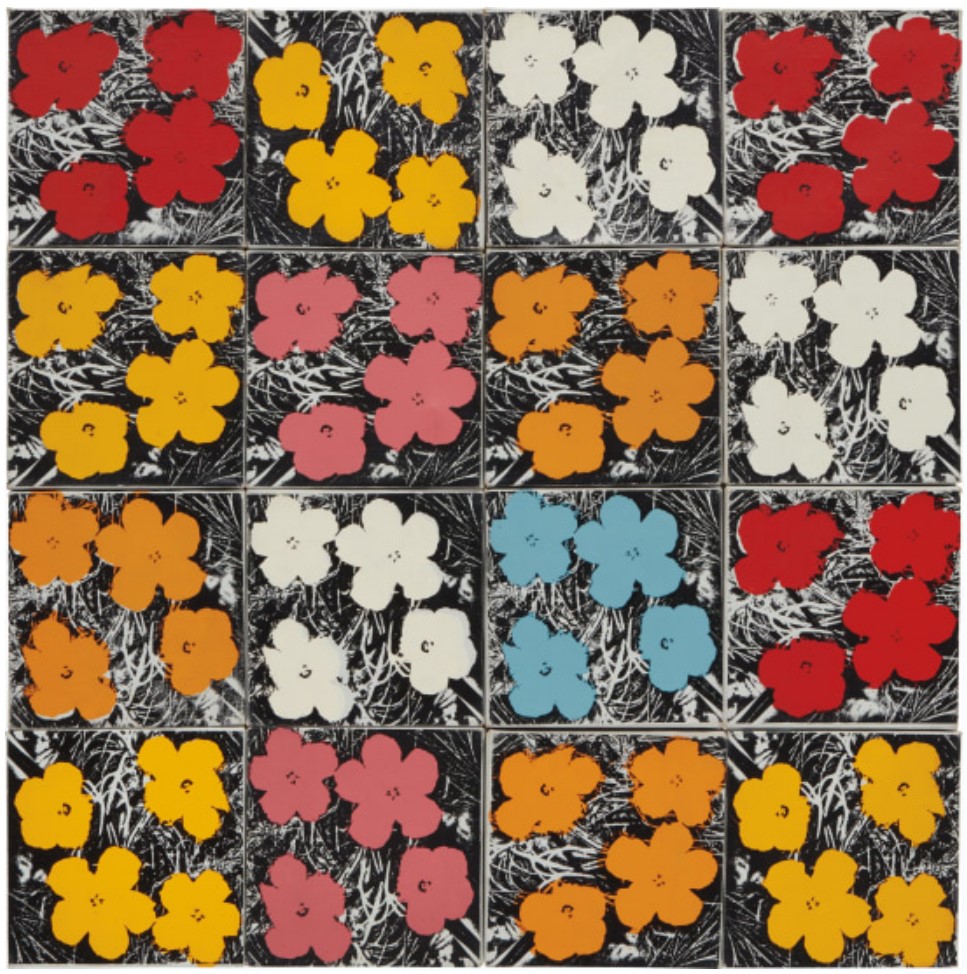
ANDY WARHOL
16 Flowers, 1965
Silkscreen ink on canvas
(i) 8 1/4 x 8 1/4 in. (21 x 21 cm.)
(ii), (iii), (xi), (xvi) 8 1/4 x 8 1/8 in. (21 x 20.6 cm.)
(iv), (vi), (ix), (x) 8 x 8 in. (20.3 x 20.3 cm.)
(v), (xv) 8 x 8 1/4 in. (20.3 x 21 cm.)
(vii), (viii), (xiv) 8 1/8 x 8 1/8 in. (20.6 x 20.6 cm)
(xii) 8 3/8 x 8 1/8 in. (21.3 x 20.6 cm.)
Previously held in the illustrious private collection of the late Ileana Sonnabend, 16 Flowers is among the last silkscreened canvases Andy Warhol created prior to his self-imposed hiatus from painting. The present grouping of 8×8 inch canvases belong to the Flowers Warhol specifically conceived for his second solo exhibition at the Galerie Ileana Sonnabend in Paris in May 1965. Just as the canvases in that seminal exhibition coalesced into a powerful, all-consuming installation, so, too, do the present 16 multi-colored canvases envelop the viewer into Warhol’s universe. Not only do these works epitomize the culmination of the revolutionary strategies Warhol had examined since the early 1960s, these works also celebrate the crucial role the legendary art dealer and collector Ileana Sonnabend played in building Warhol’s career.
One of the most influential art dealers and collectors of her time, Ileana Sonnabend was a fervent early supporter of Warhol. While she was likely aware of his work in the 1950s, she first invited him to show at her new Paris gallery in September 1962 for the upcoming group exhibition Pop art américain scheduled for the next year. In addition to giving Warhol his first international solo exhibition when she presented his Death and Disasters series in her Paris Gallery in January 1964, Sonnabend fervently collected his work herself. As Brenda Richardson noted, “Ileana couldn’t live without Andy’s art” (Brenda Richardson, Warhol from the Sonnabend Collection, exh. cat., Gagosian Gallery, New York, 2009, p. 36). Within Sonnabend’s remarkable private collection, which included Robert Rauschenberg, Donald Judd, Roy Lichtenstein and others, Warhol’s Flowers took a prime position as the chosen few works she selected to live with in her modestly sized New York and Venice residences.
Flowers, 1964
Phillips New-York: 15 May 2014
Estimated: USD 10,000,000 – 15,000,000
USD 10,245,000
Andy Warhol – Contemporary Art Evening Sale Lot 25 May 2014 | Phillips
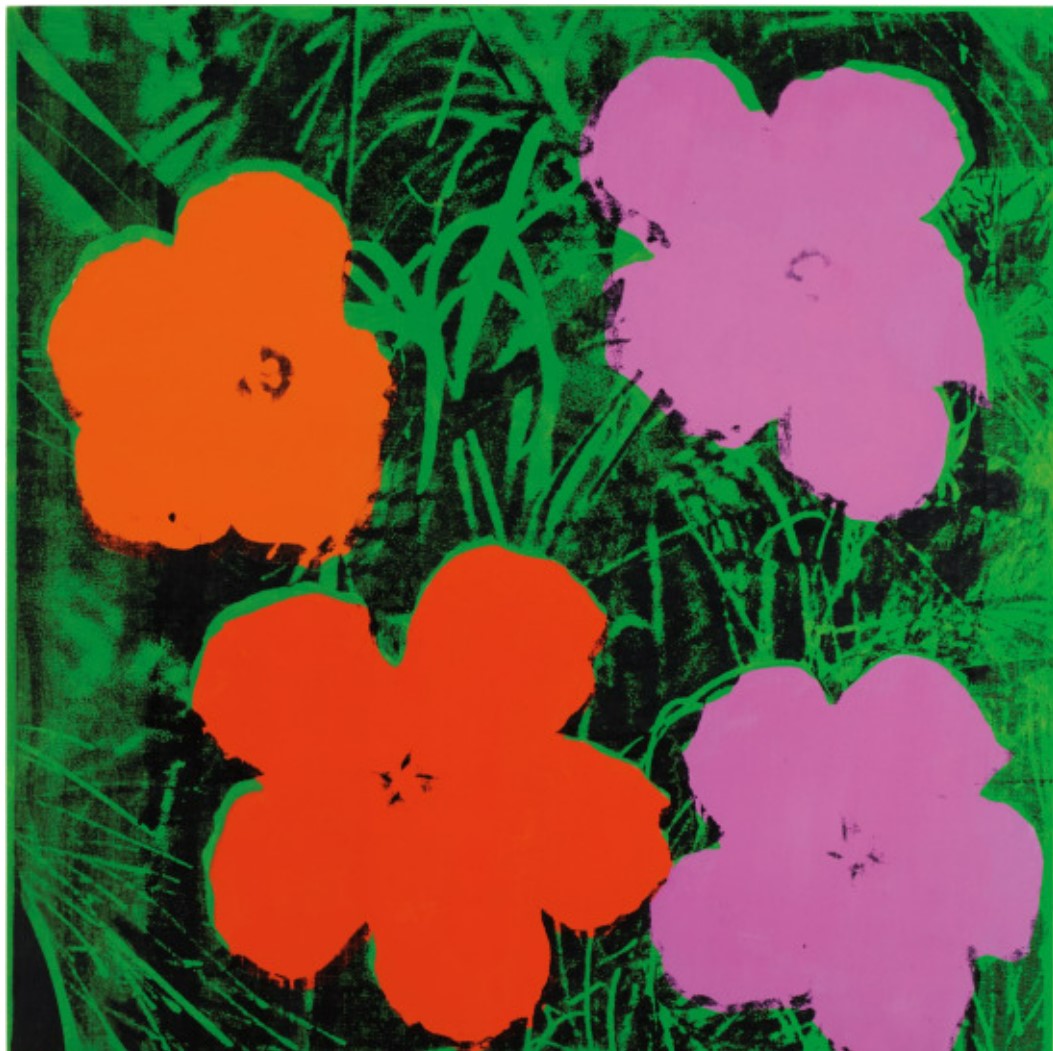
ANDY WARHOL
Flowers, 1964
Acrylic, silkscreen ink on canvas
48×48 inches (121.9 x 121.9 cm)
Stamped by the Estate of Andy Warhol and the Andy Warhol Foundation for the Visual Arts, Inc.
Numbered “PA53.012” along the overlap and stretcher bar
As the most recognizable Pop motif by the artist, and arguably one of the most identifiable paintings in the canon of Western art, Andy Warhol’s Flowers from 1964 is the icon of an era. The broad swath of electric green ground, overlaid with the black screen of grass and other brush, all punctuated by four large, non-specific flowers is at once representational and abstract, sunny and dark, uplifting and somber.
Flowers, 1964
Christie’s New-York: 15 May 2013
Estimated: USD 6,000,000 – 9,000,000
USD 8,411,750
Andy Warhol (1928-1987) , Flowers | Christie’s
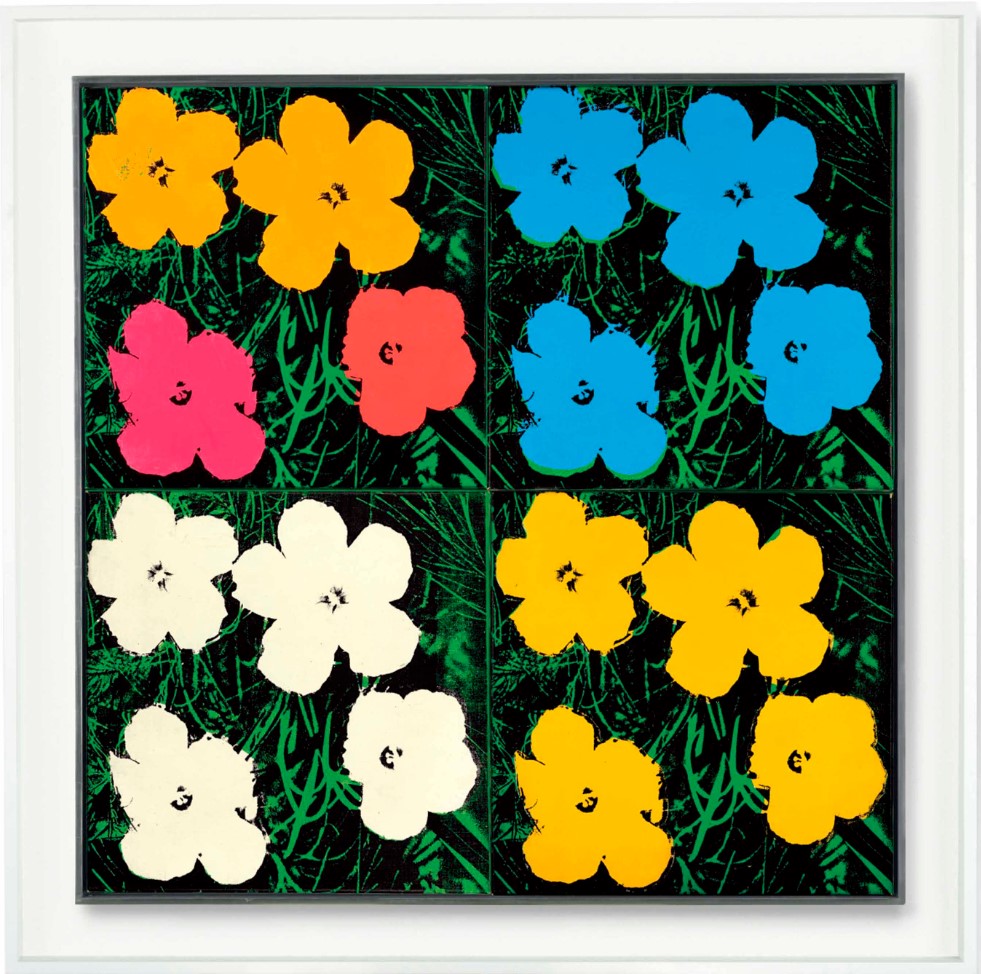
ANDY WARHOL
Flowers, 1964
Synthetic polymer and silkscreen inks on canvas in four parts
Each: 24×24 inches (60.9 x 60.9 cm)
Overall: 48×48 inches (121.9 x 121.9 cm)
Signed and dated ‘ANDY WARHOL 64’
(on the overlap of the upper left and lower right panels)
Flowers, 1964-65
Sotheby’s London: 22 May 2012
Estimated: GBP 3,000,000 – 4,000,000
GBP 3,737,250
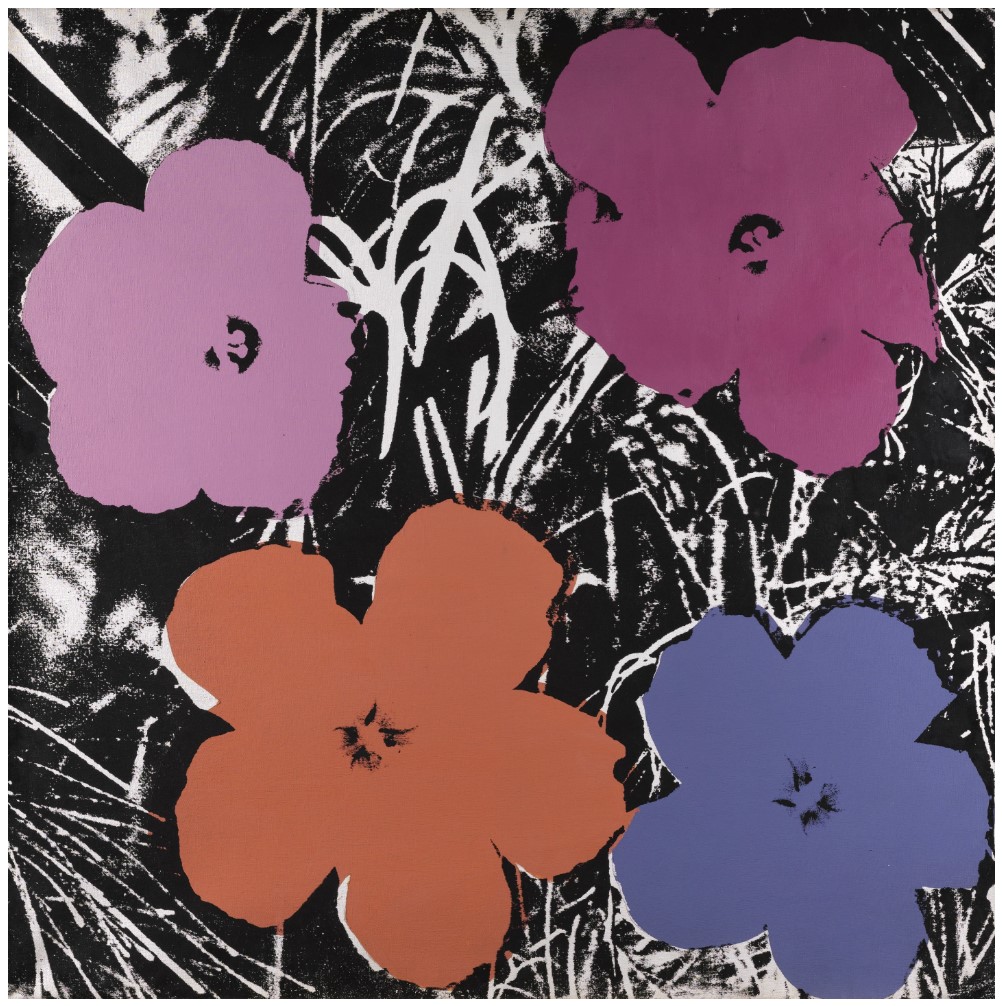 ANDY WARHOL
Flowers, 1964-65
Acrylic, silkscreen ink and pencil on canvas
48.1 x 48 inches (122.3 x 121.8 cm)
Jubilantly rare in the unique color adorning each flower, the present work is one of only two paintings in Warhol’s immortal Flowers series boasting the tantalizing appeal of four distinct inks laid upon a black and white background. Executed between December 1964 and January 1965, it is also one of only six single 48×48 inch canvases created for Warhol’s Flowers exhibition at the Galerie Ileana Sonnabend in Paris in May 1965. Fabricated while Leo Castelli Gallery’s show Flowers – their debut – was selling out in New York, this work signifies a process of experimentation wherein Warhol pioneered and honed his craft, making revolutionary use of screen printing and establishing his Factory’s hyper-productive parody of industrial mass culture. Gunter Sachs acquired Flowers in 1979 from Bruno Bischofberger, Warhol’s main dealer since 1968 and co-founder of Interview Magazine. In 1971, it was through Bischofberger that Sachs became the second-ever patron to commission a portrait from Warhol: Gunter Sachs (1972), offered in this sale. Sachs met Warhol at the Cannes Film Festival in 1967, at the Bar Gorille at St. Tropez. Warhol spied him and Brigitte Bardot from across the room and introduced himself. Of course, the effortless charisma, athleticism and artistic flair exuded by Sachs’ public persona – and his heady love affair with the world’s most beautiful woman – rendered Sachs entirely the sort of personality to captivate Warhol. Instantly affined by their aesthetic tastes for the erotic, remotely perfect female subject, and Sachs’ growing expertise in Pop art, their friendship found expression in the legendary vernissage of Sachs’ Hamburger Milchstrasse gallery in 1972. His inaugural foray as a gallerist, the show was also Warhol’s first major European retrospective. Sachs infamously purchased roughly a third of this show to single-handedly compensate for the reticence of Hamburg’s conservative glitterati, hiding his maneuver from Warhol.
Phillips New-York: 12 May 2011
USD 8,146,500
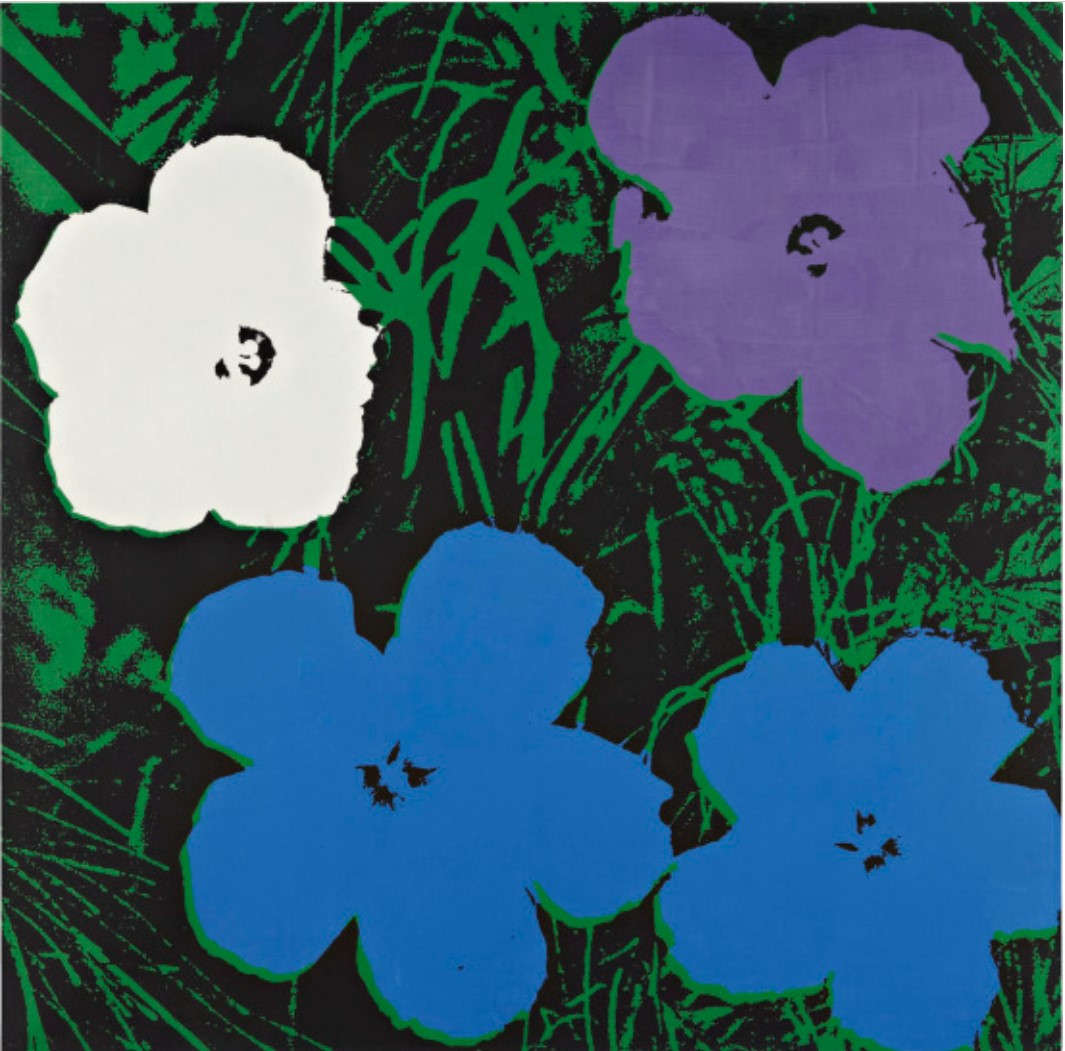
ANDY WARHOL
Flowers, 1964
Acrylic and silkscreen ink on linen.
48×48 inches (121.9 x 121.9 cm)
Signed “Andy Warhol ©” and inscribed by Frederick Hughes “I certify that this is an authentic painting by Andy Warhol completed by him in 1964, Frederick Hughes” on the overlap
The present canvas is meticulously executed, using the same composition of the four hibiscus flowers against a green and black background. Each uniquely colored; their petals in jewel-like vibrant hues of phthalo green, rich aubergine and opalescent white. This work updates the age-old genre of still life; Warhol’s choice of a vibrant palette is consciously synthetic and an outright rejection of the complex color harmonies normally associated with the genre
Sotheby’s New-York: 12 May 2010
USD 7,642,500
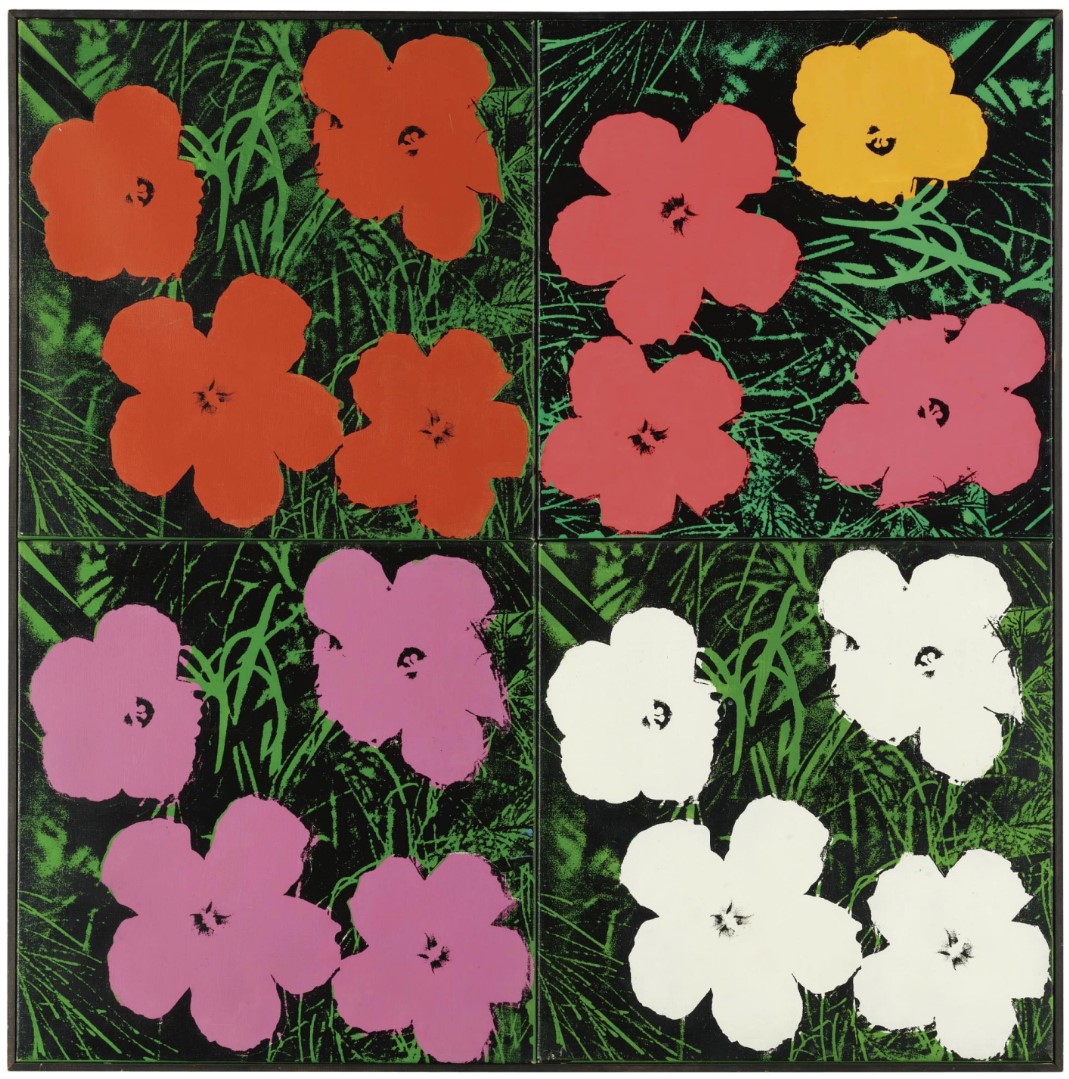 ANDY WARHOL
Flowers, 1964
Acrylic and silkscreen ink on canvas in four panels
Overall: 48×48 inches (122×122 cm)
Each signed and dated 64 on the overlap
Christie’s London: 19 June 2007
GBP 2,596,000
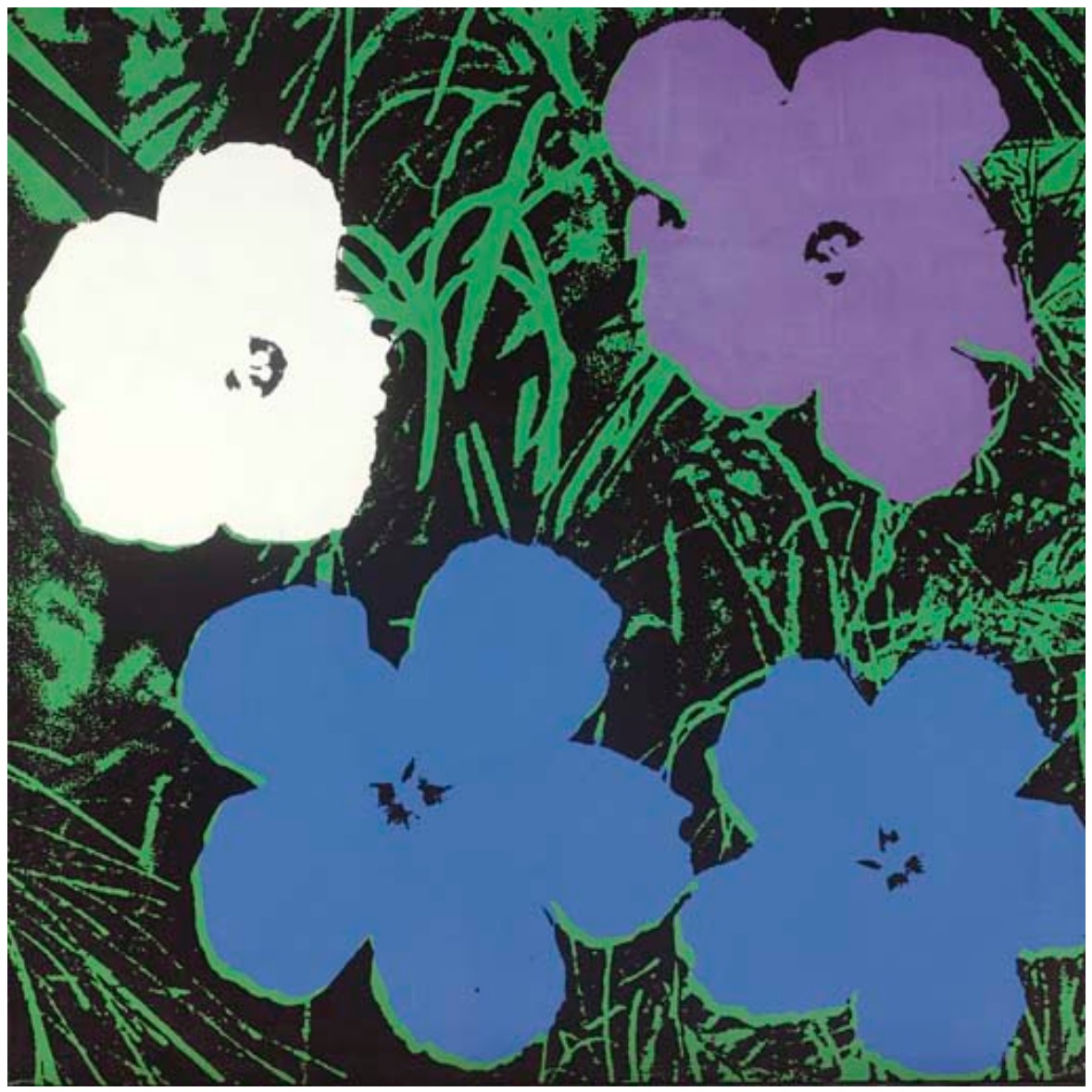
ANDY WARHOL
Four-Foot Flowers, 1964
Synthetic polymer paint and silkscreen inks on canvas
48×48 inches (122×122 cm)
Signed ‘Andy Warhol’ and inscribed by Frederic Hughes ‘I certify that this is an authentic painting by Andy Warhol completed by him in 1964, Frederic Hughes’ (on the overlap)
This 48-inch square four-color flower painting is one of the series of ‘four-foot’ flower paintings that Warhol made between July and August 1964 in preparation for his first show at Castelli’s. The flowers on the paintings were derived from a color photograph of hibiscus blossoms that appeared in a two-page spread of the June 1964 issue of Modern Photography which had been used to illustrate an article on a Kodak color processor designed for amateurs. Wrongly and repeatedly identified by homophobic critics as ‘pansies’, Warhol’s four hibiscus flower heads have been cropped from the original image and through the repositioning of one of the flowers – by rotating it through 180 degrees – transcribed by Warhol into a more pattern-like square format.
Sotheby’s New-York: 13 November 2006
USD 6,840,000
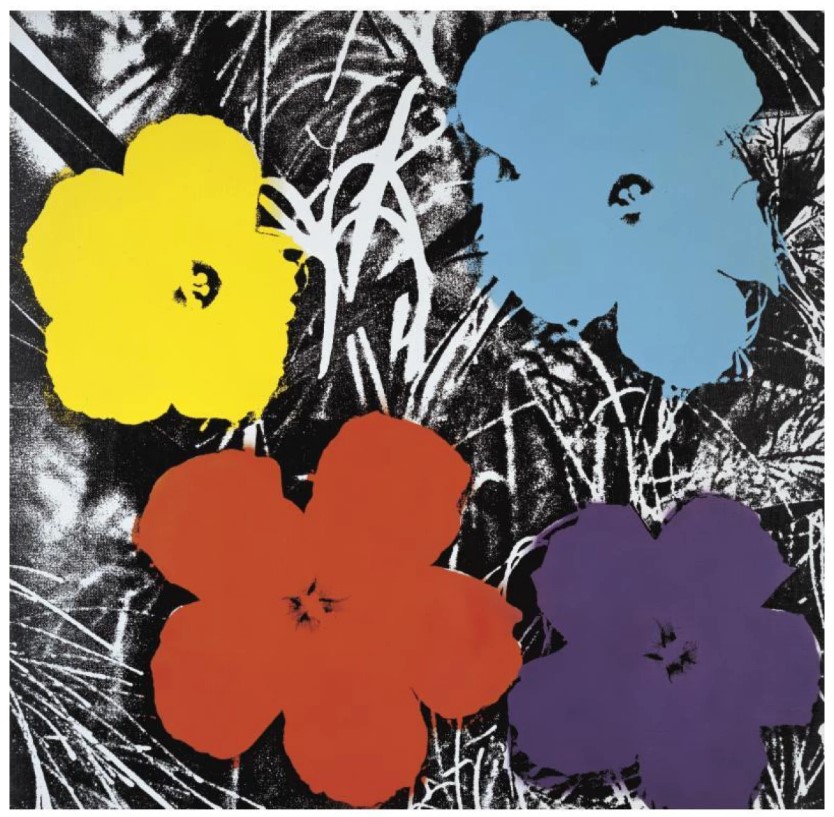
ANDY WARHOL
Flowers, 1964-65
Spray paint and silkscreen ink on canvas
48×48 inches (121.9 x 121.9 cm)
Signed and dated 64 on the overlap
Flowers, 1964
Christie’s London: 15 October 2006
Estimated: GBP 2,500,000 – 3,500,000
GBP 3,704,000
Andy Warhol (1928-1987) , Flowers | Christie’s
ANDY WARHOL
Flowers, 1964
Acrylic and silkscreen inks on canvas
48×48 inches (122×122 cm)
This 48-inch square four-color flower painting is one of the series of ‘four-foot, four-colour’ flower paintings that Warhol made between July and August 1964 in preparation for his first show at Castelli’s. The flowers on the paintings were derived from a color photograph of hibiscus blossoms that appeared in a two-page spread of the June 1964 issue of Modern Photography which had been used to illustrate an article on a Kodak color processor designed for amateurs. Wrongly and repeatedly identified by homophobic critics as ‘pansies’, Warhol’s four hibiscus flower heads have been cropped from the original image and through the repositioning of one of the flowers – by rotating it through 180 degrees – transcribed by Warhol into a more pattern-like square format. In the selection of colour for his flowers, Warhol deliberately chose unnatural-looking hues of brilliant synthetic colour. Often referred to as Day-glo or cosmetic colouring, the clearly man-made splashes of vibrant colour that form the flowers of his pictures seem to mock the gestural splashes of abstract expressionist painting as much as they do the romanticism and pantheist sense of wonder usually associated the art historical genre of flower painting. These paintings also look like an attack on nature as if such natural wonder has here been subordinated and synthesized by a simple mechanical process. The abstract manufactured look of Warhol’s Flowers emphasizes both their commercial application as a saleable commodity and the mass-produceable process by which these natural symbols of beauty have come into. In this, these works echo his portraits of other mass-produced beauties such as Marilyn and Liz, Elvis and Marlon. They are an extension of Warhol’s synthetic vision of the universe into the realm of nature.
Four-foot Flowers, 1964
Christie’s New-York: 14 May 2002
Estimated: USD 1,800,000 – 2,200,000
USD 3,749,500
Andy Warhol (1928-1987) , Four-foot Flowers | Christie’s
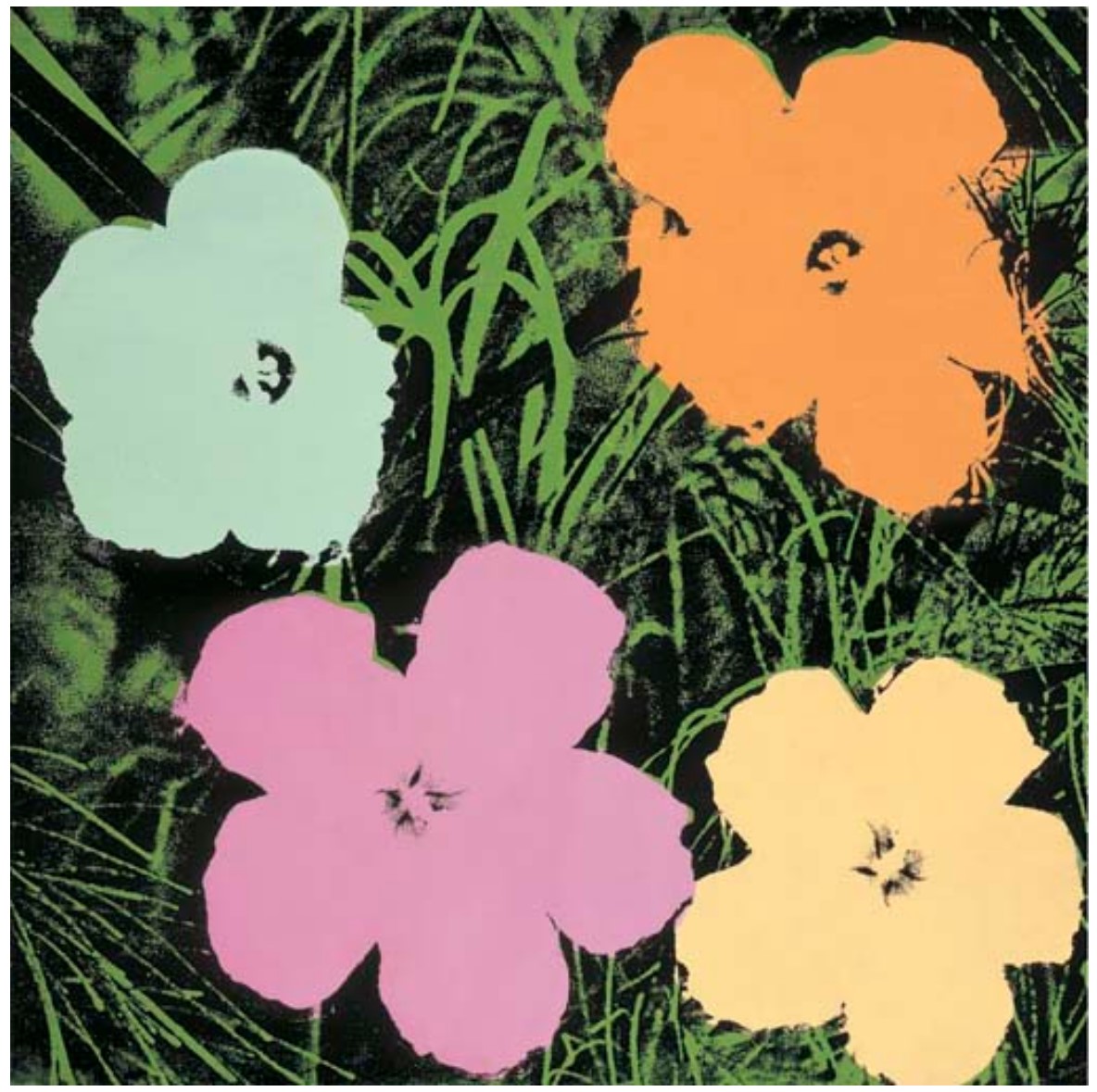
ANDY WARHOL
Four-foot Flowers, 1964
Synthetic polymer and silkscreen inks on canvas
48×48 inches (122×122 cm)
Signed and dedicated ‘to Roy L. Andy Warhol’ (on the reverse)
Once owned by Roy Lichtenstein and later donated to the Solomon R. Guggenheim Museum, Four-foot Flowers is a rare four-color version from the celebrated series of flower paintings that Warhol painted for his first show at the Leo Castelli gallery in November 1964. Seeming like new cosmetic shades from an Avon lady’s catalogue, the man-made colors of the four flowers of this work deliberately mock the romanticism and sense of pantheist wonder usually associated with paintings of flowers by subordinating their color and imagery to a simple mechanical process. The manufactured look of Warhol’s flowers emphasizes the process by which they have come into being and their ability to be mass-produced. The flower paintings hereby announce Warhol’s synthetic vision of the universe. Having moved in his use of imagery from the supermarket to celebrity and its flip-side in disaster, the flower paintings extract the kitsch and the plastic from man’s vision of natural beauty and present the mechanical under-side of popular taste.
Late Four Foot Flowers
Late Four Foot Flowers form an exclusive group of Flowers that were made to settle a legal claim filed by the photographer Patricia Caulfield in 1967. The claim disputed the ownership of the original image. Reproduced as a two-page color foldout in the June 1964 issue of Modern Photography, Patricia Caulfield’s photograph of seven hibiscus flowers inspired the work that resulted in Warhol’s continued blossoming in the New York art world. The first Flowers series was exhibited for Warhol’s debut at Leo Castelli Gallery in November 1964 and sold out quickly. Adding to its importance, the history of Four-Foot Flowers represents an early example of artistic appropriation encountering legal trouble; Warhol seems to have presciently anticipated the heated discussions about postmodern art and appropriation that surrounded the so-called “Pictures” generation of the 1980s. Warhol eventually settled Caulfield’s suit out of court, and Caulfield was awarded two paintings and royalties from subsequent use of the image. Not part of this settlement, the present work was consigned to Leo Castelli, who loaned it to the Four Seasons Restaurant for exhibition on its walls.
Late Four-Foot Flowers, 1967
Sotheby’s New-York: 13 May 2024
Estimated: USD 7,000,000 – 10,000,000
USD 11,250,000
Late Four-Foot Flowers | Contemporary Evening Auction | 2024 | Sotheby’s (sothebys.com)
ANDY WARHOL (1928 – 1987)
Late Four-Foot Flowers, 1967
Acrylic, silkscreen ink and graphite on canvas
48×48 inches (121.9 x 121.9 cm)
Four hibiscus in fluorescent shades of pink, orange, and violet bloom across the emerald surface of Late Four-Foot Flowers, in which Andy Warhol imposes his Pop idiom on one of the most storied genres in art history: the floral still life. The present work, executed in 1967, emerges from Warhol’s revisitation and expansion of the flower motif, during which time he diversified the palette, scale, and screens of the image he first debuted three years earlier, which today has become synonymous with American Pop.
Late Four Foot Flowers, 1967
Phillips New-York: 14 November 2019
Estimated: USD 6,000,000 – 8,000,000
USD 7,430,500
Andy Warhol – 20th C. & Contemporar… Lot 17 November 2019 | Phillips
ANDY WARHOL
Late Four Foot Flowers, 1967
Acrylic, silkscreen ink and graphite on canvas
48×48 inches (121.9 x 121.9 cm)
Provenance
Patricia Caulfield, New York
Leo Castelli Gallery, New York
Roger J. Davidson, Toronto
Jared Sable, Toronto
Locksley Shea Gallery, Minneapolis
Acquired from the above by the present owners
A canonical addition to Miles and Shirley Fiterman’s compendium of Pop Art, Late Four-Foot Flowers is a superb example from Andy Warhol’s Flowers series. One of only five iterations conceived in this impressive four-foot scale, the work is one of the most vibrant Flowers of its size, as it radiates bursts of orange, pink, and mauve. Late Four-Foot Flowers signaled Warhol’s brief return to the subject matter that had brought him great fortune a few years earlier. In their simultaneous embrace of seriality and flatness and betrayal of Pop Art’s propensity for replication through a lack of similitude to their source imagery, Warhol’s Flowers have become iconic relics of postmodernism. Vibrant yet macabre, distinctive but mechanical, Late Four-Foot Flowers is a remarkable example from a Pop genius equally concerned with reinvention as he was with replication. Despite being an indisputable idol of postmodernism, the work’s execution three years after the success of the artist’s first Flowers is redolent of the practice of the Italian modernist beloved by Warhol, Giorgio de Chirico, who famously produced a series of paintings nearly identical to ones from his critically-acclaimed early metaphysical period during the final chapter of his career. Late Four-Foot Flowers thus harkens back to modernism while embracing the “modern”: all in all, its arresting, conceptually rigorous, and ironically macabre blossoms have garnered the motif a place as one of Pop Art’s most iconic images.
Four-Foot Flowers, 1967
Christie’s New-York: 15 May 2007
Estimated: USD 4,000,000 – 6,000,000
USD 5,192,000
Andy Warhol (1928-1987) , Four-Foot Flowers | Christie’s
ANDY WARHOL
Four-Foot Flowers, 1967
Synthetic polymer and silkscreen inks on canvas
48×48 inches (121.9 x 121.9 cm)
Christie’s New-York: 15 May 2007
USD 5,192,000
One of only three Four-Foot Flowers to employ a red background, the present work continues one of Warhol’s most iconic motifs in an exceedingly rare blend of scale and hue.
Two-Foot Flowers (24×24)
Ten days prior to the Castelli exhibition, Warhol delivered 45 Flower paintings in the 24-inch format to the gallery from which 28 were hung in the show in four rows of seven. Produced during a period of fervent activity in the month preceding the famous 1964 Leo Castelli Flowers exhibition, the extant 24-inch Flowers are relatively numerous; approximately one hundred were recorded in the Castelli inventory. Warhol used fluorescent paint in around one-third of these canvases. Hand painted by Warhol using acetate stencils, the fluorescent colors are more intensely high-key and translucent than acrylics. They dried unevenly, creating an irregular and rather textured surface, which suggests a significant painterly concern beyond Warhol’s fundamentally unmodulated machine aesthetic.
Flowers, 1964
Sotheby’s New-York: 15 May 2025
Estimated: USD 1,000,000 – 1,500,000
USD 4,076,000
Flowers | The Now and Contemporary Evening Auction | 2025 | Sotheby’s
ANDY WARHOL (1928 – 1987)
Flowers, 1964
Acrylic and silkscreen ink on canvas
24×24 inches (61×61 cm)
Signed and dated 64 (on the overlap)
Provenance
Leo Castelli Gallery, New York (LC# 233)
William Zierler Gallery, New York
Betty Unger, New York
Perry Rubenstein Gallery, New York
Galerie Daniel Templon, Paris
Acquired from the above by the present owner
An elegantly rendered icon of Pop, Flowers from 1964 deftly embodies the enduring influence and captivating beauty of Andy Warhol’s artistic practice, merging popular culture and fine art to interrogate familiar aesthetics of mass media, art history and advertising. Here, Warhol takes as his subject among the most storied genres in art history: the floral still life. In spite of its archetypal subject, apparent chromatic vibrancy, and joyous composition, Flowers fervently embodies Warhol’s preoccupation with transience and mortality, seriality and mass production, subjects preceded by his Death and Disaster series and extended through the skulls, shadows, and self-portraits of his mature corpus.
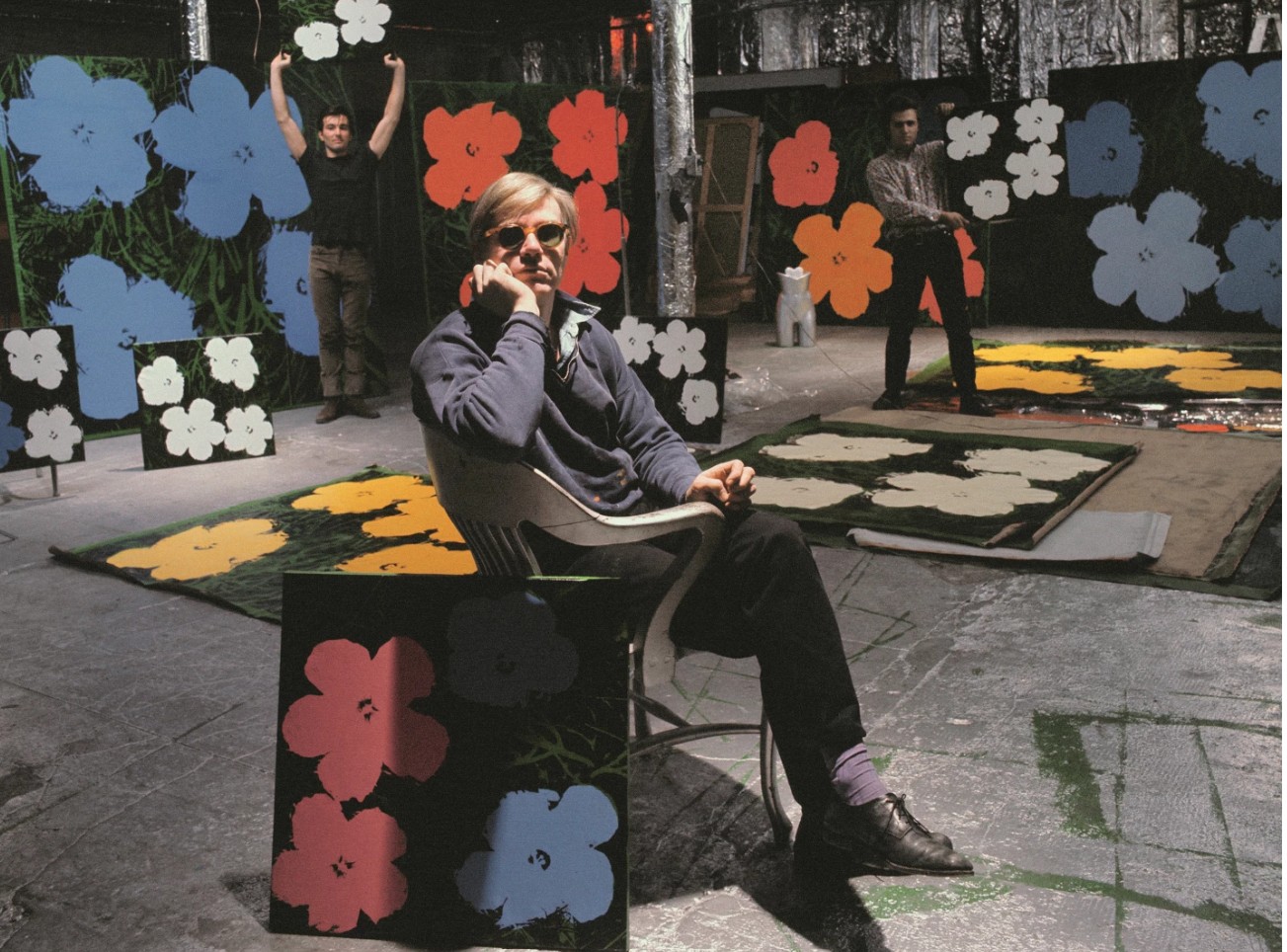
ANDY WARHOL, PHILIP FAGAN AND GERARD MALANGA, NEW YORK, 1964. PHOTO UGO MULAS © UGO MULAS HEIRS. ALL RIGHTS RESERVED. ART © 2025 Andy Warhol Foundation for the Visual Arts / Artists Rights Society (ARS), New York
The constellation of crimson, orange, and lilac hibiscus, each depicted in a crisply rendered silkscreen, set against an abstracted backdrop of blades of emerald grass, make the present work a particularly striking example of one of Warhol’s most beloved and renowned series.
In the summer of 1964, Warhol produced a series of canvases portraying his iconic Flowers, executing canvases portraying this composition in formats measuring eighty-two, forty-eight- and twenty-four-inches square, intended for an exhibition with his new dealer Leo Castelli to open in New York in November. Employing his archetypical appropriation of mass-produced source material, Warhol’s Flowers series comes from a sequence of photographs in the June 1964 issue of Modern Photography. The original images accompanied an article about different Kodak processors. They featured a glossy fold-out showing the same photograph, taken by executive editor Patricia Caulfield, repeated to illustrate chromatic variations corresponding to the various chemical processes. The seriality of the images undoubtedly appealed to Warhol’s acute sensitivity to repetition and mechanization, though rather than transfer the entire magazine page with four rectangular pictures of flowers, he isolated and cropped a square composition that included four flowers from one of the reproduced photos. This crop was then transferred onto acetate, and its tonal range was polarized to increase sharpness and provide the optimal template for the silkscreen mechanical to be made. Warhol chose the square format because of the four possible orientations available.
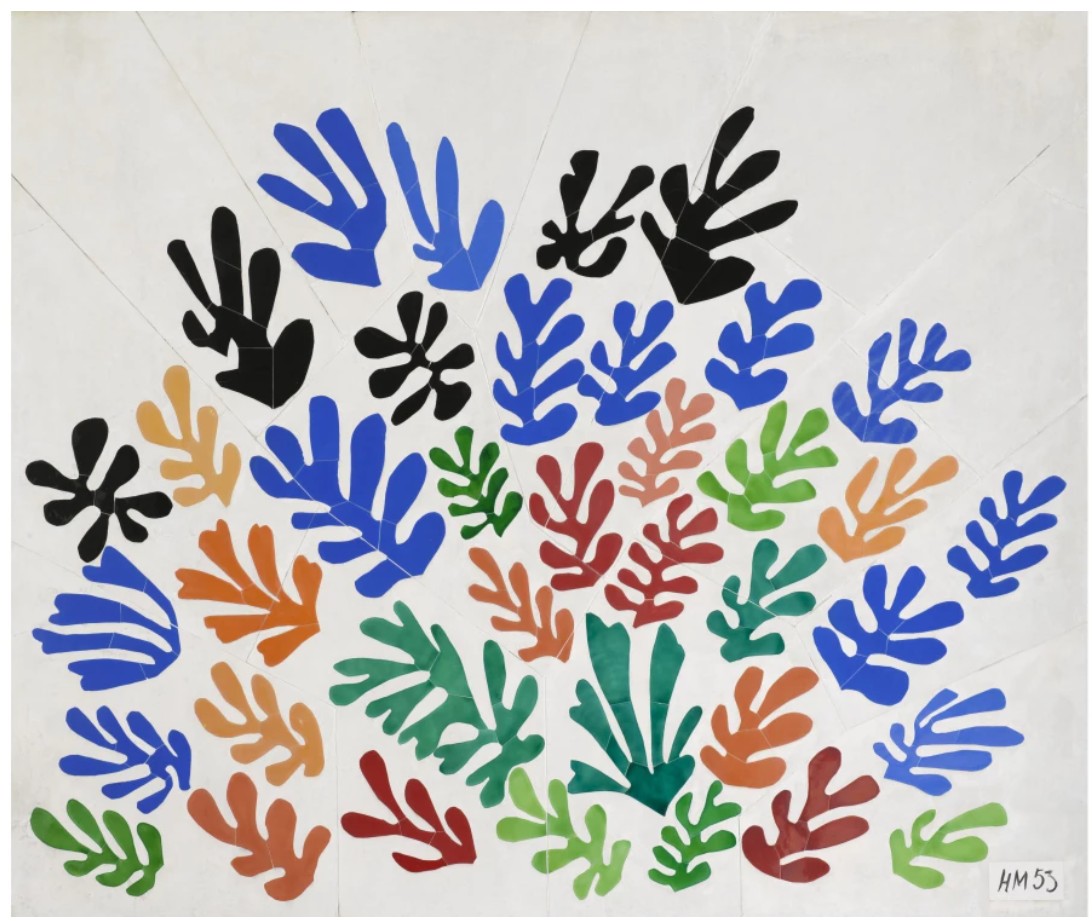
Henri Matisse, La Gerbe, 1953. Los Angeles County Museum of Art. Image © 2025 Museum Associates / LACMA.
Licensed by Art Resource, NY. Art © 2025 Succession H. Matisse / Artists Rights Society (ARS), New York
Whilst Warhol’s previous series—Death and Disaster—exploited photographs of car crashes, the electric chair and suicide, the Flowers seem to be distanced from this morbidity with their bright palette. In their decadent palette and ostensibly decorative aesthetic, Warhol also seems to borrow from the Modernist innovations of Henri Matisse, who in La Gerbe considered the floral subject as a vehicle for chromatic exploration and formal abstraction. Yet, the motif of the hibiscus is laden with tragedy that permeates Warhol’s entire oeuvre. Hibiscuses signify beauty, and especially the fleeting nature of beauty and fame, a symbolic meaning that wouldn’t have escaped Warhol. Warhol first approached the flowers at the suggestion of the legendary Henry Geldzahler, then assistant curator at the Metropolitan Museum of Art, who encouraged the artist to engage directly in the art historical tradition of still-life painting. The Flowers became metaphors for a generation that changed artistically, socially and politically in a supremely important decade. The flower motif’s resounding significance in the history of art, from the Dutch Vanitas to Claude Monet’s water lilies to Van Gogh’s sunflowers, also proved a fitting, intellectual subject for the Pop idiom he had explosively introduced earlier that decade. Warhol also borrows from the Modernist innovations of Henri Matisse, who in La Gerbe considered the floral subject as a vehicle for chromatic exploration and formal abstraction.
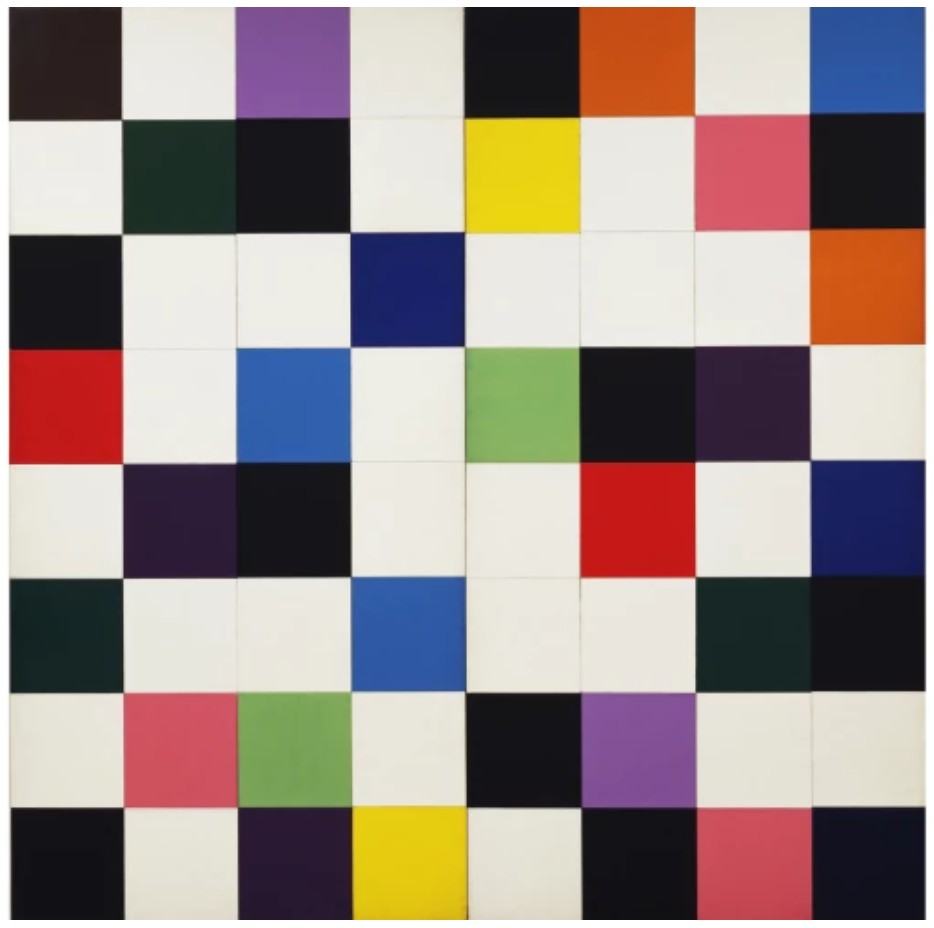
Ellsworth Kelly, Colors for a Large Wall, 1951. The Museum of Modern Art, New York.
Image © The Museum of Modern Art/Licensed by SCALA / Art Resource, NY. Art © Ellsworth Kelly Foundation
Measuring just twenty-four by twenty-four inches, Flowers is a spectacular feat distinguished from the group by its crisply rendered screen and vivid, highly saturated color, giving the image an unparalleled clarity and graphic force. In sum, delivering Warhol’s most enduring inquiries—death, mass production and beauty—the Flowers transformed the practice of still life painting and ignited the key debate of appropriation for the post-modern era. As John Coplans notes, “What is incredible about the best of the flower paintings…is that they present a distillation of much of the strength of Warhol’s art – the flash of beauty that suddenly becomes tragic under the viewer’s gaze. The garish and brilliantly colored flowers always gravitate toward the surrounding blackness and finally end in a sea of morbidity. No matter how much one wishes these flowers to remain beautiful they perish under one’s gaze, as if haunted by death.” (John Coplans, Andy Warhol, New York 1978, p. 52).
Flowers, 1964
Selections from The Collection of Barbara Gladstone
Sotheby’s New-York: 15 May 2025
Estimated: USD 1,000,000 – 1,500,000
USD 3,832,000
Flowers | Selections from The Collection of Barbara Gladstone | Contemporary Art | Sotheby’s
ANDY WARHOL (1928 – 1987)
Flowers, 1964
Acrylic and silkscreen ink on canvas
24×24 inches (61×61 cm)
Signed and dated 1964 twice (on the reverse)
Provenance
Leo Castelli Gallery, New York (LC # 173)
G. Borgos
J.L. Hudson Gallery, Detroit
Mayfair Gallery London
Ora and Silvain Zucker, Belgium
Christie’s New York, 22 February 1996, lot 75
Private Collection (acquired at the above sale)
Acquired from the above by the present owner
One of only four known examples from the series to feature inky black blossoms against a vivid green ground, Andy Warhol’s Flowers is a rare and striking iteration of one of the artist’s most iconic motifs. Profoundly elegant in its 24-inch scale, Flowers is distinguished for its poignant simplicity, iconic palette, and extraordinary provenance, having been held in the collection of Barbara Gladstone.
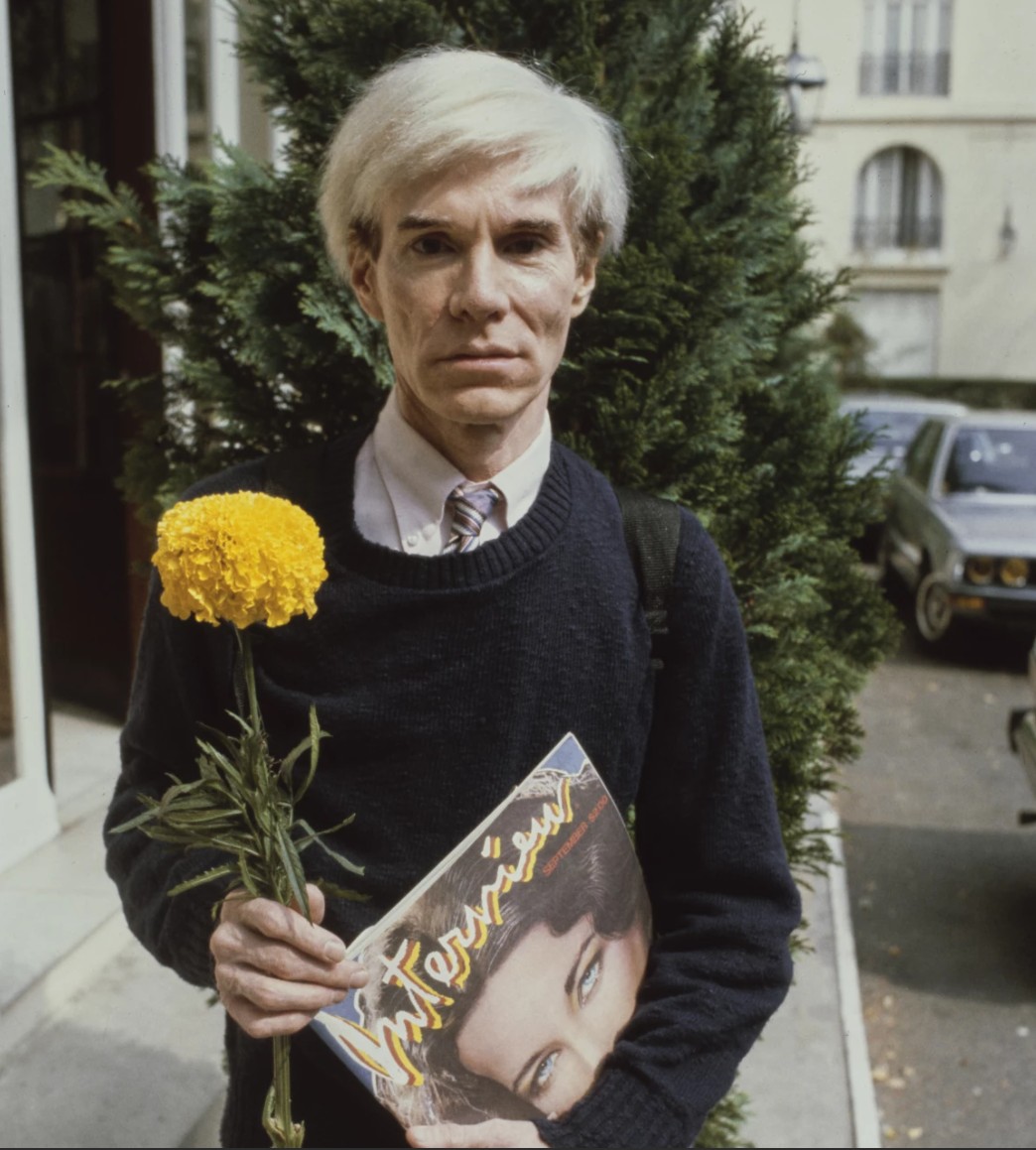
The artist with a flower at the Deauville American Film Festival, 1981. Photo © Steve Wood/Popperfoto via Getty Images
Created in 1964— the same year as his landmark debut at Leo Castelli Gallery—this work belongs to the celebrated series that helped cement Warhol’s position at the forefront of American Pop Art. Based on a photograph by Patricia Caulfield, first published in Modern Photography, the image was cropped, flattened, and silkscreened onto canvas in a gesture of transformation that pushed the still life genre firmly into the age of mechanical reproduction. Executed at a pivotal moment in the artist’s career and marked by its extreme rarity, Flowers stands as a poignant reflection of a generation and a masterwork of postmodern appropriation.
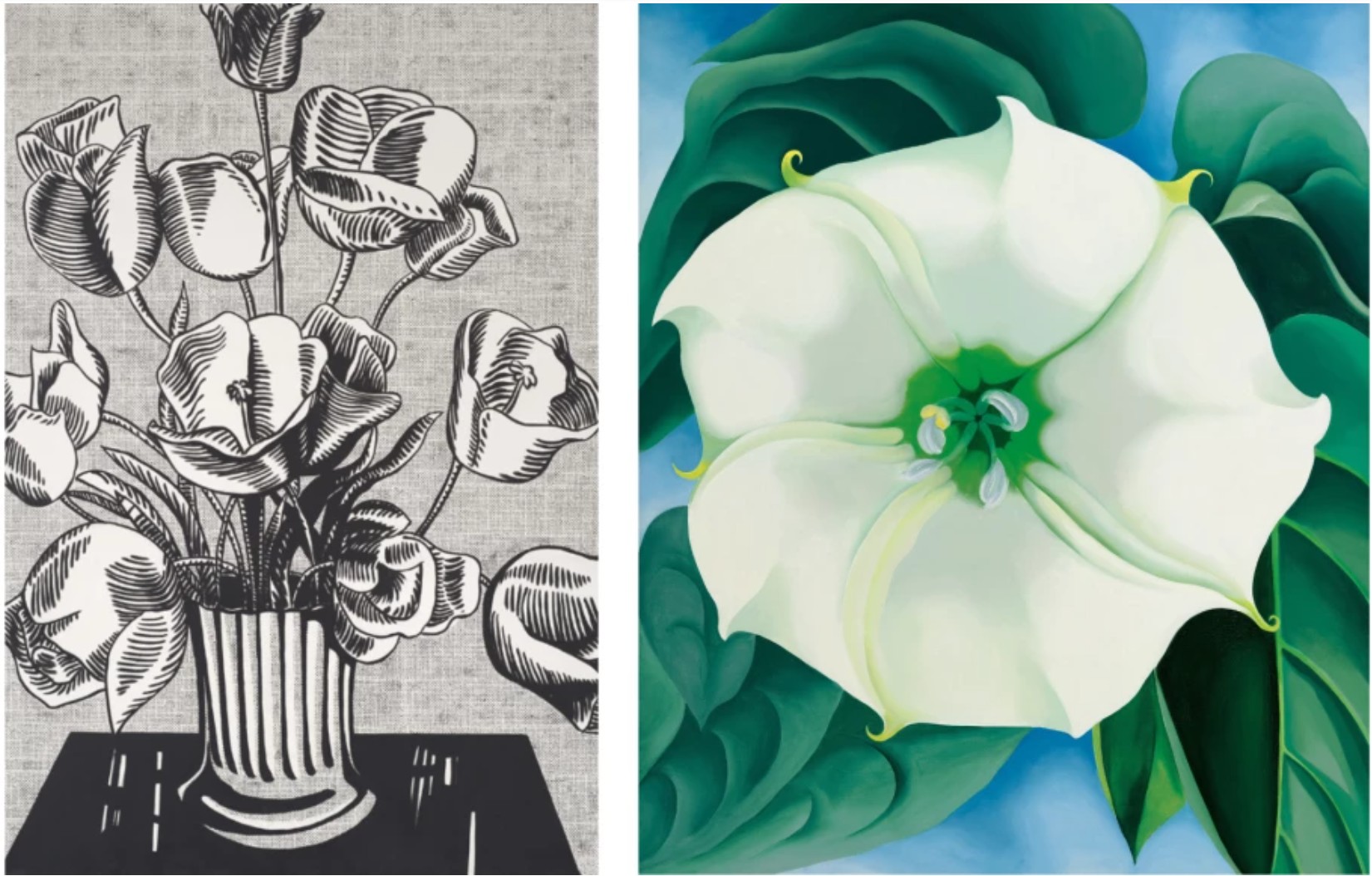
Left: Roy Lichtenstein, Black Flowers, 1961. The Broad, Los Angeles. Art © Estate of Roy Lichtenstein. Right: Georgia O’Keeffe, Jimson Weed/White Flower No. 1, 1932. Private Collection. Sold at Sotheby’s New York in November 2014 for $44.4 million. Art © 2025 Georgia O’Keeffe Museum / Artists Rights Society (ARS), New York
The Flowers series emerged at the suggestion of curator Henry Geldzahler, who encouraged Warhol to engage with the art historical tradition of still life painting. Warhol responded with a body of work that recasts the classical Vanitas through a Pop lens—serial, synthetic, and hauntingly detached. While visually seductive, the present work also carries a sense of impermanence and loss, underscoring Warhol’s preoccupations with mortality, beauty, and repetition. Directly following his Death and Disaster series and anticipating the shadows, skulls, and self-portraits of his later years, Flowers delivers Warhol’s most enduring themes with clarity and force. The Flowers create “a virtual, painful stillness,” notes Heiner Bastian. “Since they seemingly only live on the surface, in the stasis of their coloration, they also initiate only the one metamorphosis which is a fundamental tenet of Warhol’s work: moments in a notion of transience.
The flower pictures were for Everyman, they embodied Warhol’s power of concretization, the shortest possible route to stylization, both open to psychological interpretation and an ephemeral symbol. But the flowers…were also to be read as metaphors for the flowers of death. Warhol’s Flowers resist every philosophical transfiguration as effectively as the pictures of disasters and catastrophes which they now seem ever closer to.” (Heiner Bastian cited in: Exh. Cat., Berlin, Neue Nationalgalerie, Andy Warhol: Retrospective, 2002, p. 33)
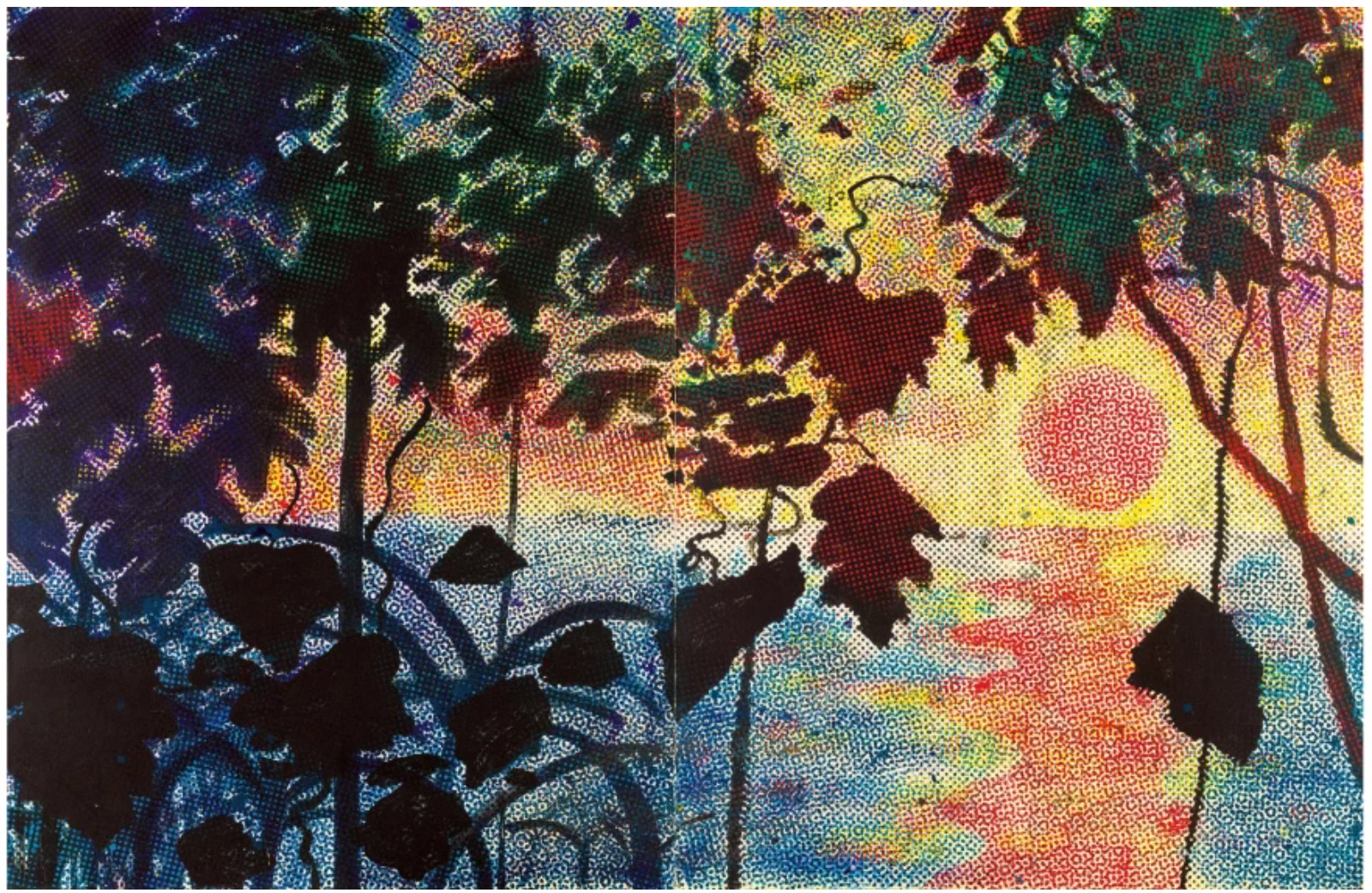
Sigmar Polke, Dschungel (Jungle), 1967. Private Collection. Sold at Sotheby’s New York in May 2015 for $27.1 million. Art © 2025 Estate of Sigmar Polke / Artists Rights Society (ARS), New York / VG Bild-Kunst, Bonn, Germany
Exuberant now but soon to perish, the Flowers are Warhol’s confrontation of the art historical lineage he so tirelessly worked to become a part of, and Late Four-Foot Flowers serves as a metaphor for the fleeting transience of everything Warhol loved: beauty, greatness, and celebrity. During the over half-century since their creation, Warhol’s Flowers have infiltrated our global consciousness as the emblem of classic American Pop; their imagery acts as a metaphor for a generation that changed not only artistic but also social and political topographies in a supremely transformative decade. As is mythologized in art history, during the summer of 1964, he created canvases in square formats measuring 82, 48, and 24 inches, respectively, intended for a show with his new dealer Leo Castelli due to open in New York in November of that year. Michael Lobel emphasizes this exhibition’s significance: “The show, his first with the gallery, represented a career milestone, since his first attempt at showing with Castelli, in 1961, had been met with rejection… Now he was joining the gallery that represented the cream of the crop of American vanguard art, including such leading lights as Robert Rauschenberg, Jasper Johns and Frank Stella” (Michael Lobel, ‘In Transition: Warhol’s Flowers’ in: Exhibition Catalogue, New York, Eykyn Maclean, Andy Warhol Flowers, 2012, n.p.). The creation of his enigmatic flower paintings thus marked the apogee of artistic recognition for Warhol and truly served to carve out his position as a colossal force amongst a pantheon of artistic luminaries. The epitome of elegance, captivating black flowers set upon matte black and emerald ground, the present work is an icon of Andy Warhol’s inimitable practice.
Flowers, 1964
Christie’s New-York: 22 November 2024
Estimated: USD 1,200,000 – 1,800,000
USD 2,470,000
ANDY WARHOL (1928-1987), Flowers | Christie’s
REPEAT SALE
Phillips London: 20 October 2020
Estimated: GBP 1,400,000 – 1,800,000
GBP 1,595,500 / USD 2,066,175
Andy Warhol – 20th Century & Contemp… Lot 18 October 2020 | Phillips
REPEAT SALE
Christie’s New-York: 17 May 2018
Estimated: USD 1,800,000 – 2,500,000
USD 2,112,500
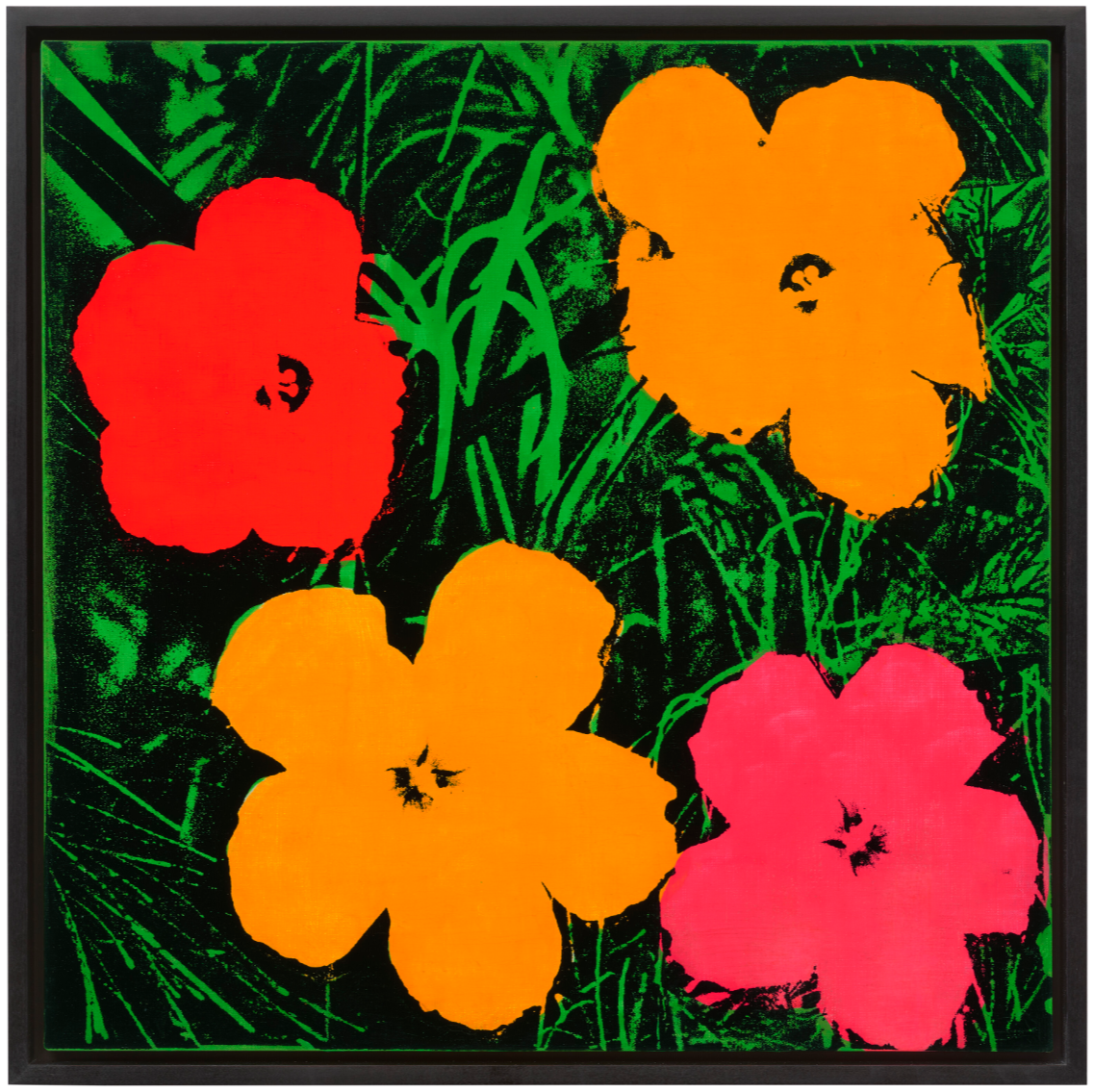
ANDY WARHOL (1928-1987)
Flowers, 1964
Acrylic and silkscreen ink on canvas
24×24 inches (61×61 cm)
Signed twice and dated ‘ANDY WARHOL 64 Andy Warhol’ (on the overlap)
Provenance
Paul Warhola Family Collection, Pittsburgh, acquired directly from the artist
Their sale; Christie’s, New York, 8 November 1989, lot 341
Private collection, Europe
Private collection, Paris
Private collection, New York
Anon. sale; Christie’s, New York, 17 May 2018, lot 63B
Private collection, New York
Anon. sale; Phillips, London, 20 October 2020, lot 18
Acquired at the above sale by the present owner
A particularly vibrant and engaging example from Andy Warhol’s 1964 Flowers series, the present work exemplifies this particularly innovative and veracious period in which the artist attained full maturity. In the same year, Warhol established his first ‘Factory’ at 231 E 47th Street in Manhattan, held his iconic Death and Disaster exhibition at Sonnabend gallery in Paris, exhibited his iconic film Empire at Stable Gallery; to culminate this celebrated year, Warhol inaugurated his winning collaboration with Leo Castelli with the first exhibition of Flowers, the works epitomizing the artist’s energetic movement from Pop towards abstraction.
The present work contains a dazzling arrangement of four vividly colored hibiscus flowers—two yellow, one pink, and one orange—rendered onto an abstracted herbaceous green background. The variety and combination of this example is unique among the series in the twenty-four by twenty-four scale. These bright beaming bulbs gleam like beacons against their deep green roots, providing a thrilling encounter between humanity and nature.
While Warhol developed the Flowers works in this scale specifically to form a mosaic for the Castelli exhibition, the present lot was gifted directly to the artist’s brother, Paul Warhola, further accentuating the work’s special status within the series. Metropolitan Museum curator Henry Geldzahler allegedly inspired Warhol to initiate the series after complaining about the morbidity of his Death and Disaster works. The curator offered up the June 1964 issue of Modern Photography magazine opened to a page displaying a repeated color photograph of seven hibiscus flowers. The image, taken by the magazine’s editor Patricia Caulfield as an illustration for a new Kodak color processor, was repeated four times in a block with different tonal variations, perfect for Warhol’s appropriative practice of repetition.
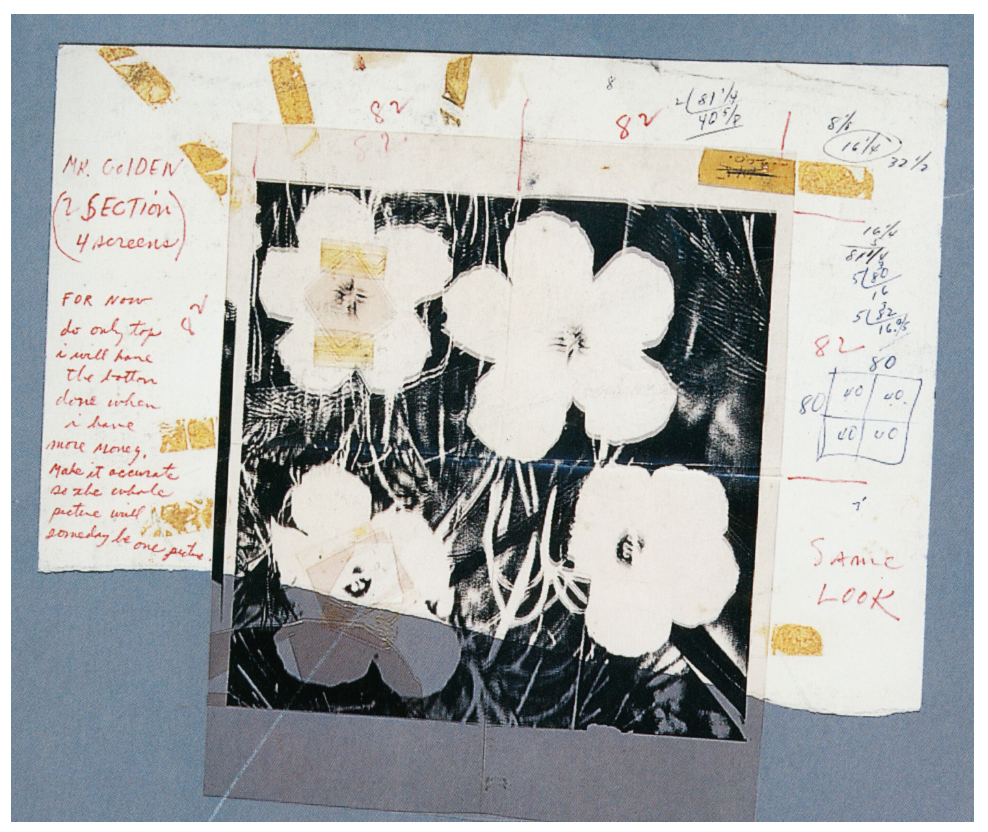
Andy Warhol’s silkscreen mechanical for Flower paintings, 1964. © 2024 The Andy Warhol Foundation for the Visual Arts, Inc. / Licensed by Artists Rights Society (ARS), New York.
The flower photograph was ideal for Warhol’s new silkscreen process, which granted him meticulous control over the work’s composition and execution whilst removing the appearance of the artist’s hand from the final canvas. Warhol altered the original image by cropping it into a square format, rotating one of the flowers and slightly disrupting the background’s pattern. This square format, closely resembling the aspect ratio of televisions at the time, appealed to Warhol’s aesthetic by distancing the work from traditional portrait or landscape orientations and offering multiple viewing perspectives. After this manipulation, Warhol had the work prepared for the screen printing process by directing his assistant Billy Name “to run the photo repeatedly through the Factory’s new photostat machine—‘a dozen times, at least,’ said Billy, to flatten out the blossoms, removing their definition, the shadow that lent the photo its illusion of three-dimensionality. ‘He didn’t want it to look like a photo at all. He just wanted the shape, the basic outline, of the flowers’” (T. Scherman and D. Dalton, op. cit., p. 247). By altering the original in such a way, the artist converted a seemingly generic photograph into an iconic image. Through manipulation and repetition, he was able to separate the end result from its origin and create a more universal symbol.
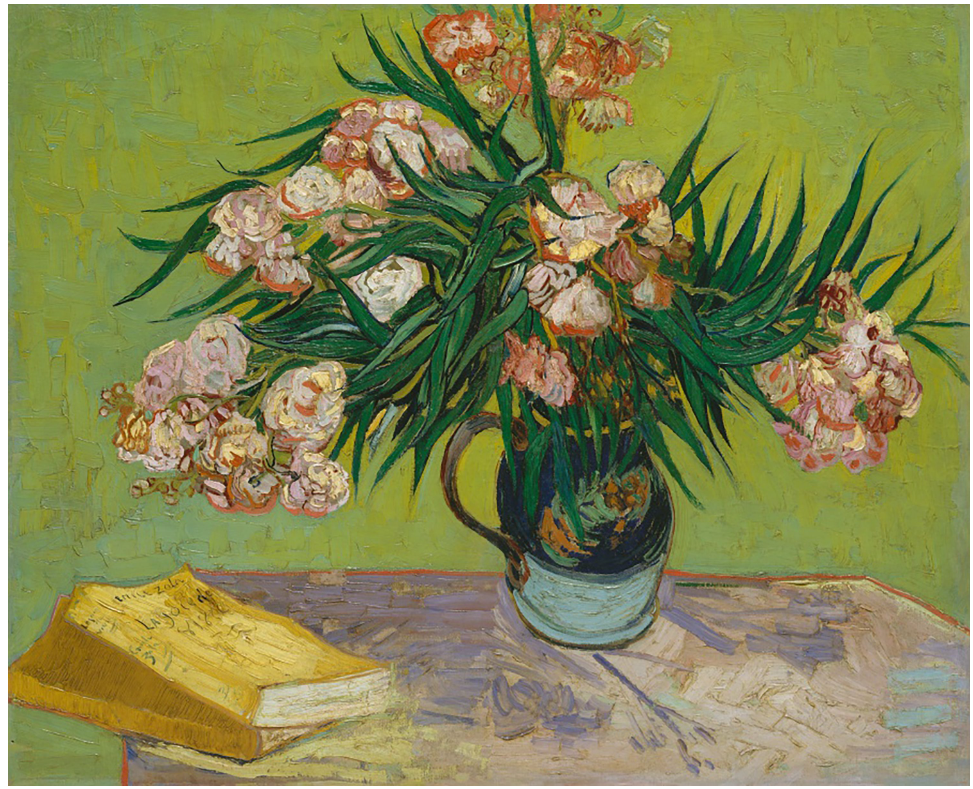
Vincent van Gogh, Oleanders, 1888. Metropolitan Museum of Art, New York.
Ostensibly—as per Geldzahler’s recommendation—the cheerful, bright allure of the Flowers marked a departure from Warhol’s previous output, where the tragic gazes of Marilyn, Jackie, Liz and Elvis had sat alongside images that highlighted the perils of a consumerist, image-obsessed society. However, the beauty and glamour of the Flowers was underscored by a familiar sense of dark trepidation. If floral subjects had long symbolized life’s transience—from the Dutch Golden Age to Van Gogh and beyond—the hibiscus blooms in Modern Photography seemed laden with foreboding. Flattened and compressed by the camera lens, these flowers were merely another subject for the consumer to devour: the wonders of nature were here subservient to the wonders of technology. Warhol’s ruthless manipulation and repetition of the photograph served to enhance this point, transforming an image of nature’s miraculous chaos into a serial icon. The mechanics of contemporary image production, these works seemed to say, had the power to turn anything and everything into a consumable, bite-sized entity. Only the spectral trace of the artist’s hand, evident to the keenest observers, betrayed the unique creative thrill that lay at their core.
Flowers, 1964
Christie’s Hong-Kong: 28 November 2023
Estimated: HKD 12,000,000 – 18,000,000
HKD 14,895,000 / USD 1,912,277
ANDY WARHOL (1928-1987) (christies.com)
ANDY WARHOL (1928-1987)
Flowers, 1964
Acrylic and silkscreen ink on canvas
23 1/2 x 23 5/8 inches (59.7 x 60 cm)
Provenance
Galerie Bruno Bischofberger, Zurich
Private collection, Europe
Christie’s London, 24 June 2004, lot 24
Private collection
Acquired from the above by the present owner
Flowers, 1964
Christie’s New-York: 9 November 2023
Estimated: USD 1,500,000 – 2,000,000
USD 3,438,000
ANDY WARHOL (1928-1987) (christies.com)
ANDY WARHOL (1928-1987)
Flowers, 1964
Acrylic and silkscreen ink on canvas
24×24 inches (61×61 cm)
Signed ‘Andy Warhol’ (on the overlap)
Flowers, 1964-65
Phillips London: 13 July 2021
Estimated: GBP 1,000,000 – 1,500,000
GBP 1,353,500 / USD 1,874,135
Andy Warhol – New Now London Lot 23 July 2021 | Phillips
ANDY WARHOL
Flowers, 1964-65
Acrylic and silkscreen ink on canvas
23 7/8 x 23 7/8 inches (60.9 x 60.9 cm)
Signed and dated ‘Andy Warhol 64’ on the overlap
Stamped by the Andy Warhol Authentication Board and numbered ‘A100.0911’
Provenance
Marco Fila Collection, Italy
Gagosian, New York
Acquired from the above by the present owner in 2010
Flowers, 1964
Christie’s London: 11 February 2020
Estimated: GBP 1,000,000 – 1,500,000
GBP 2,111,250 / USD 2,739,415
Andy Warhol (1928-1987), Flowers | Christie’s
ANDY WARHOL
Flowers, 1964
Acrylic and silkscreen ink on canvas
24×24 inches (61×61 cm)
Signed and dated ‘Andy Warhol 64’ (on the overlap)
Provenance
Leo Castelli Gallery, New York (Leo Castelli number (LC 82) listed)
William Zierler Gallery, New York
Galleria La Medusa, Rome
Banca di Roma, Rome (acquired from the above in 1974)
Against a rich, green ground, four vibrant flowers bloom in Andy Warhol’s Flowers (1964). Painted during the same year as his legendary exhibition of Flower paintings at Leo Castelli’s New York gallery – then the centre of the post-war art world – it stems from one of his most iconic series of works. Created at the apex of his artistic powers, Warhol’s Flowers represent the culmination of his painterly development during the 1960s. Based on a seemingly innocuous image from a magazine, their subject was something of a reversal for the artist, who had for so long trained his eye on celebrity culture and consumerist iconography. Though their bright, joyful appearance ostensibly offered a departure from his recent Death and Disaster paintings, these serial reductions of nature ultimately gave rise to one of his most subversive critiques of contemporary image production. Their abstract, flattened petals and vivid cosmetic colouring undermine the romantic sense of wonder usually associated with the art-historical genre of flower painting. Like his portraits of Marilyn Monroe and Elizabeth Taylor, they shed a disarming and enthralling light on the notion of mass-produced beauty.
Flowers, 1965
Christie’s New-York: 13 November 2019
Estimated: USD 1,200,000 – 1,800,000
USD 2,415,000
Andy Warhol (1928-1987), Flowers | Christie’s
ANDY WARHOL
Flowers, 1965
Acrylic and silkscreen ink on canvas
24×24 inches (61×61 cm)
Signed, stamped with the Andy Warhol Art Authentication Board, Inc. stamp
Numbered and dated ‘Andy Warhol 65 A111.011’ (on the overlap)
Provenance
Maxwell Davidson Gallery, New York
Acquired from the above by the present owner, circa 1999
The present work features individually distinct flowers with each flower color-blocked in a vivid, warm color palate. In this particular work, the edges of the color-blocked passages and hibiscus petals do not align perfectly, alluding to the imperfect human touch that underlies Warhol’s fascination with mechanical production and autonomy.
Painted in 1965, Andy Warhol’s Flowers are a seminal example of one of his most iconic motifs. Part of the larger Flowers series, this particular work layers bright, lively colors within a context of darker, more melancholic undertones that serve as a reminder of commercialism and the ephemerality of nature. The series was inspired by Henry Geldzahler, then curator of Contemporary Art at the Metropolitan Museum of Modern Art. Following Warhol’s Death and Disaster series, Geldzahler became frustrated by Warhol’s obsession with mortality. He suggested the artist turn towards a simpler subject matter, pointing towards a seemingly innocuous image of hibiscus blossoms in a 1964 copy of Modern Photography. Though this series allowed Warhol to move away from the electric chair, car crash, and race riot imagery that defined his early career, it is still permeated by a more macabre reminder of ominous themes within American society at the time. Warhol’s Flowers feature his iconic four-flower motif where each flower is strikingly color-blocked to seemingly hover above shadowy blades of grass. With yellow, orange, and red, Warhol purposefully chose cosmetic colors that would fascinate and absorb viewers in a sensory experience. While Warhol’s color palate draws attention, it is the flowers’ positioning against a black-and-white background that achieves high contrast and drama, making this work truly Pop. Combining bright and flat imagery, Flowers evokes a simplicity that is instantly accessible, heightening Warhol’s attempt to create truly “popular” art while subverting foreboding musings on mortality and the ephemerality of beauty.
Flowers, 1964
Sotheby’s New-York: 16 May 2019
Estimated: USD 1,500,000 – 2,000,000
USD 5,674,250
REPEAT SALE
Sotheby’s London: 30 June 2014
Estimated: GBP 1,000,000 – 1,500,000
GBP 1,762,500 / USD 3,014,220
ANDY WARHOL
Flowers, 1964
Acrylic and silkscreen ink on canvas
24×24 inches (61×61 cm)
Signed and dated 64 on the overlap
Stamped by The Andy Warhol Art Authentication Board and numbered A100.076 on the overlap
Provenance
Leo Castelli Gallery, New York (LC #148)
Mr. and Mrs. Albert Gartenberg, New York
Stellan Holm Gallery, New York
Private Collection (acquired from the above)
Sotheby’s London, June 30, 2014, Lot 26 (consigned by the above)
Acquired by the present owner from the above
Executed in a crisply registered palette of bright white flowers against a bold green background, the present work embodies one of Pop Art’s most iconic bodies of work: Andy Warhol’s Flowers. In the half century since its creation, Warhol’s Flowers have infiltrated popular culture as a touchstone of classic American Pop. During the summer of 1964, Warhol executed canvases portraying this exact composition in formats measuring twenty-four, forty-eight, and eighty-two inches square, intended for an exhibition with his new dealer Leo Castelli. At that inaugural exhibition, Warhol responded to the architecture of each gallery and installed the works in repetitive grids, creating an immersive environment of this signature motif, a display that was recently appropriated at the Whitney Museum of American Art’s retrospective Andy Warhol: From A to B and Back Again, where examples from the Flowers series – among others – were hung in a gallery wallpapered from floor to ceiling with similarly serial reproductions of the artist’s work. This dizzying and heady display echoed the initial environment in which these paintings were hung, at once anchoring them in the historical moment of their inception, but nevertheless proving the timeless appeal of this symbolic painting.
9 Flowers, 1964
Phillips New-York: 16 May 2019
USD 2,500,000 – 3,500,000
USD 2,600,000
Andy Warhol – 20th Century & Contemporary… Lot 9 May 2019 | Phillips
ANDY WARHOL
9 Flowers, 1964
Silkscreen ink on canvas
Each: 8×8 inches (20.3 x 20.3 cm)
Overall: 24 1/2 x 24 3/8 inches (62.2 x 61.9 cm)
Provenance
(i), (ii), (iv), (v), (viii), (ix) Billy Name-Linich, New York
Acquired from the above by the present owner
(vi) Leo Castelli Gallery, New York
Acquired from the above by the present owner
(vii) Leo Castelli Gallery, New York
Kornblee Gallery, New York
Acquired from the above by the present owner
The composite format presented here in 9 Flowers reflects Warhol’s aesthetic choice to hang these canvases edge to edge at the Castelli show. Acquired individually, and later assembled as a multi-part work, the grid presentation of the 8-inch square canvases in 9 Flowers reflects the Fitermans’ nuanced understanding of Warhol’s idiosyncratic predilection for serial repetition, as well as of the aesthetics of mass production that underpin Pop Art’s potency. As the first nine-canvas configuration to come to auction in almost 30 years, 9 Flowers presents a rare opportunity to acquire a preeminent example of Warhol’s definitive motif, arranged in a manner so true to its original context.
Warhol employs the symbolic weight of the hibiscus to represent the fleeting quality of beauty and the transience of life – themes that underpinned the Vanitas tradition of 17th century Netherlandish art. At the same time, 9 Flowers also sits in dialogue with the wider tradition of still life painting. Even contemporary critics were quick to note how the flowers appeared “like cut-out gouaches by Matisse set adrift on Monet’s lily pond” (David Bourdon, “Andy Warhol”, Village Voice, December 3, 1964, p. 11). With an astute knowledge of the canon, and an enduring effort to situate his Pop aesthetic within it, Warhol tactfully acknowledges the flower as an enduring motif in the history of painting. As Gerard Malanga, who also assisted in the production of the Flowers series recalls: “In a funny way, he was kind of repeating the history of art. It was like now we’re doing my Flower period! Like Monet’s Waterlilies, Van Gogh’s Flowers” (Gerard Malanga, quoted in David Dalton and David McCabe, A Year in the Life of Andy Warhol, New York, 2003, p. 74).
In 9 Flowers, like in the retouched photographs behind his iconic portraits of Marilyn Monroe and Elizabeth Taylor, Warhol employed commercial photo editing techniques to foreground the mediation of images as a point of philosophical consideration. As triumphant as Warhol’s flowers appear, they also represent a passing vitality and the insurmountable fragility of life.
Flowers, 1964
Sotheby’s New-York: 16 May 2018
Estimated: USD 2,000,000 – 3,000,000
USD 3,615,000
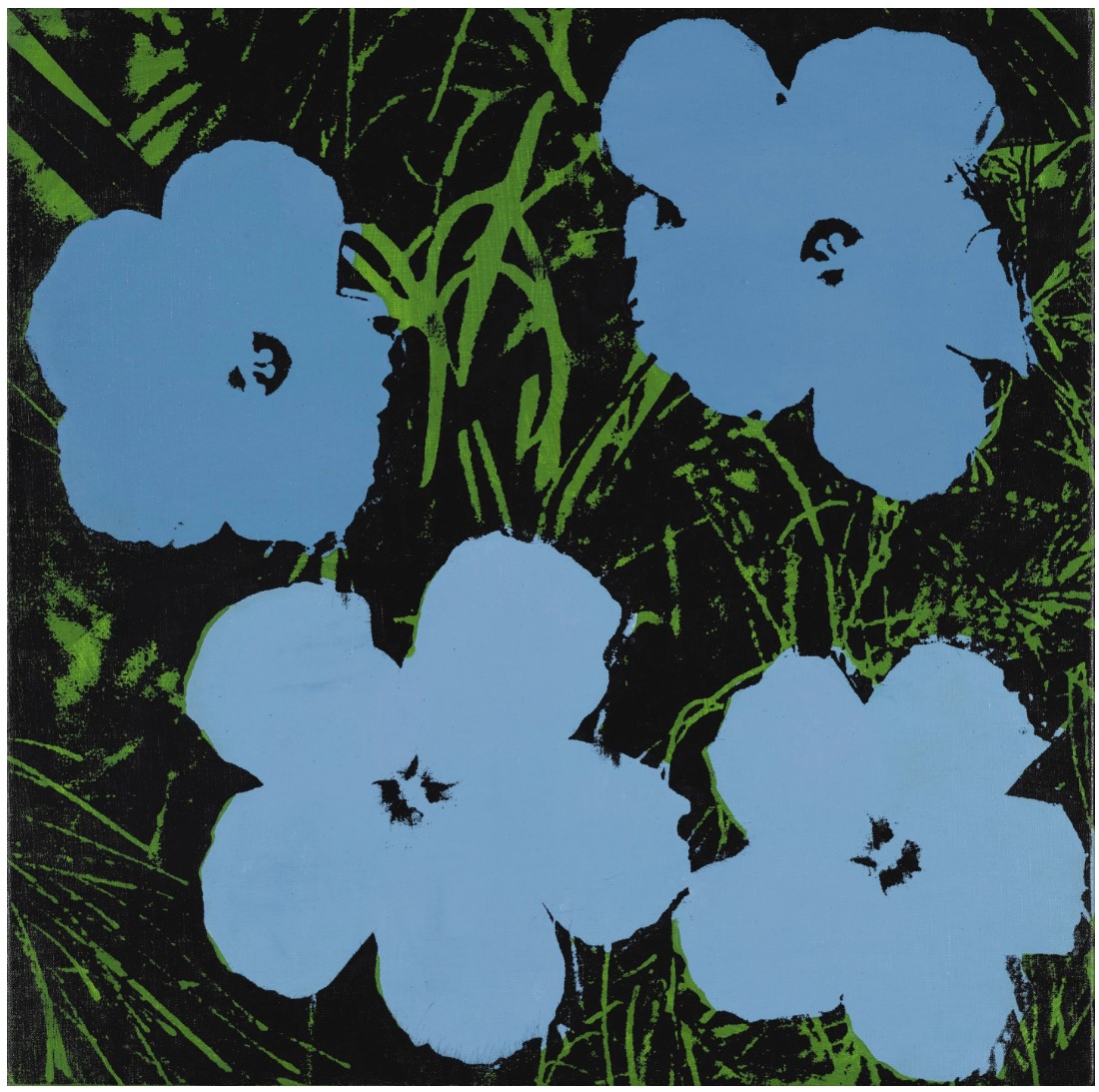
ANDY WARHOL
Flowers, 1964
Acrylic and silkscreen ink on canvas
24×24 inches (61×61 cm)
Signed and dated 64 on the stretcher
Executed in a brilliant and arresting palette of bold cerulean against a bright green background, the present work enchantingly illustrates one of Pop Art’s most iconic bodies of work: Andy Warhol’s Flowers. In the half century since its creation, Warhol’s Flowers have infiltrated global consciousness as an emblem of classic American Pop and a moniker of sorts for the notoriously fame-obsessed artist. During the summer of 1964, Warhol executed canvases portraying this composition in formats measuring eighty-two, forty-eight and twenty-four inches square, intended for an exhibition with his new dealer Leo Castelli to open in New York in November. Flowers is distinguished from the group by its crisply rendered screen and vivid, highly saturated color, giving the image an unparalleled clarity and graphic force. Furthermore, the present work bears impeccable provenance, having first belonged to John Bedenkapp, an architect and close friend of Eleanor Ward, founder of Stable Gallery in New York and one of Warhol’s earliest champions. For its esteemed ownership history and iconic value within Warhol’s immense corpus, Flowers is a significant treasure from the collection of Morton and Barbara Mandel.
Flowers, 1964
Sotheby’s New-York: 19 May 2017
Estimated: USD 800,000 – 1,200,000
USD 1,932,500
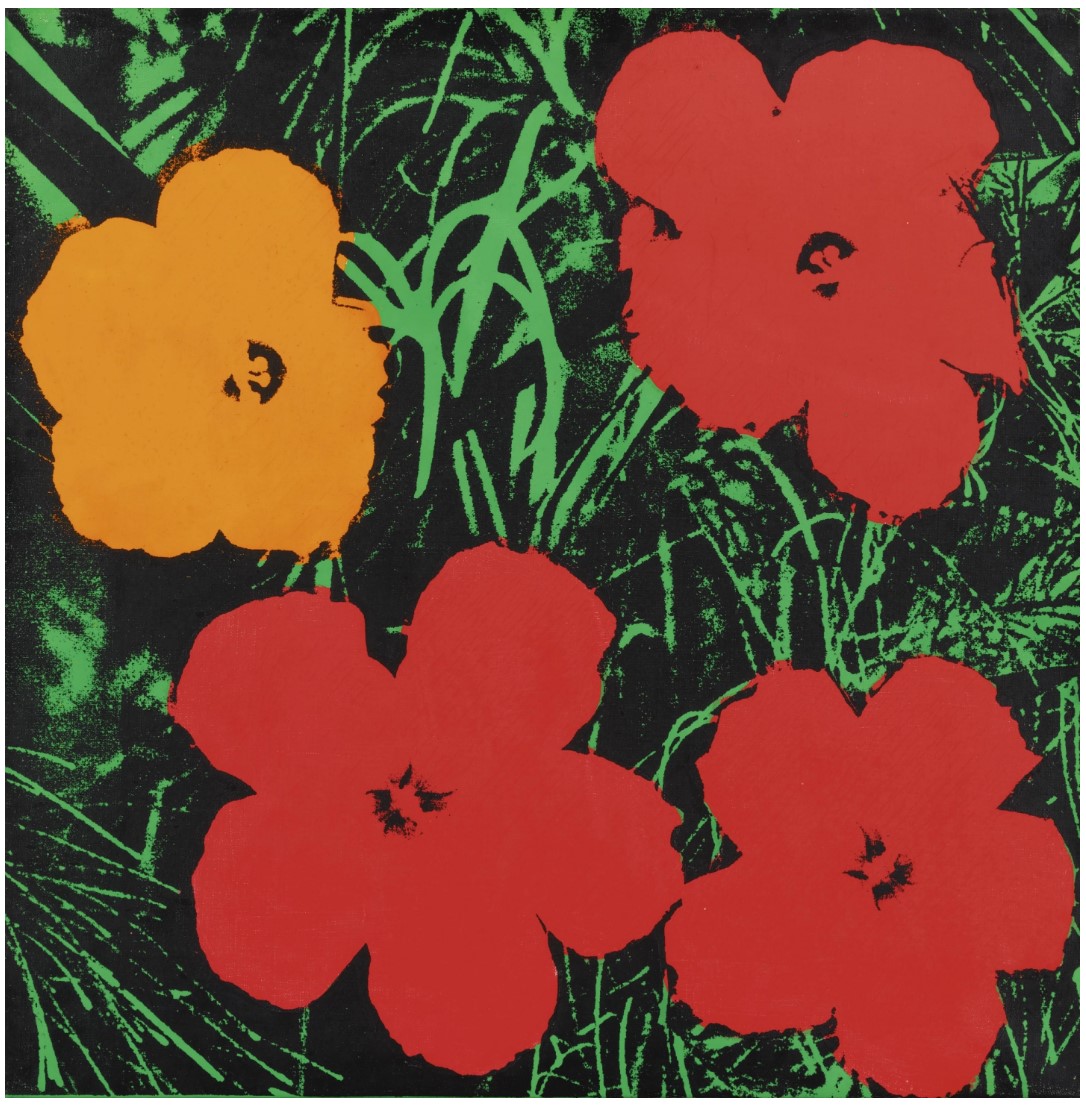
ANDY WARHOL
Flowers, 1964
Fluorescent paint, acrylic and silkscreen ink on canvas
24×24 inches (61×61 cm)
Signed and dated 64 on the overlap
Flowers, 1964
Sotheby’s New-York: 11 November 2015
Estimated: USD 2,200,000 – 3,200,000
USD 2,200,000
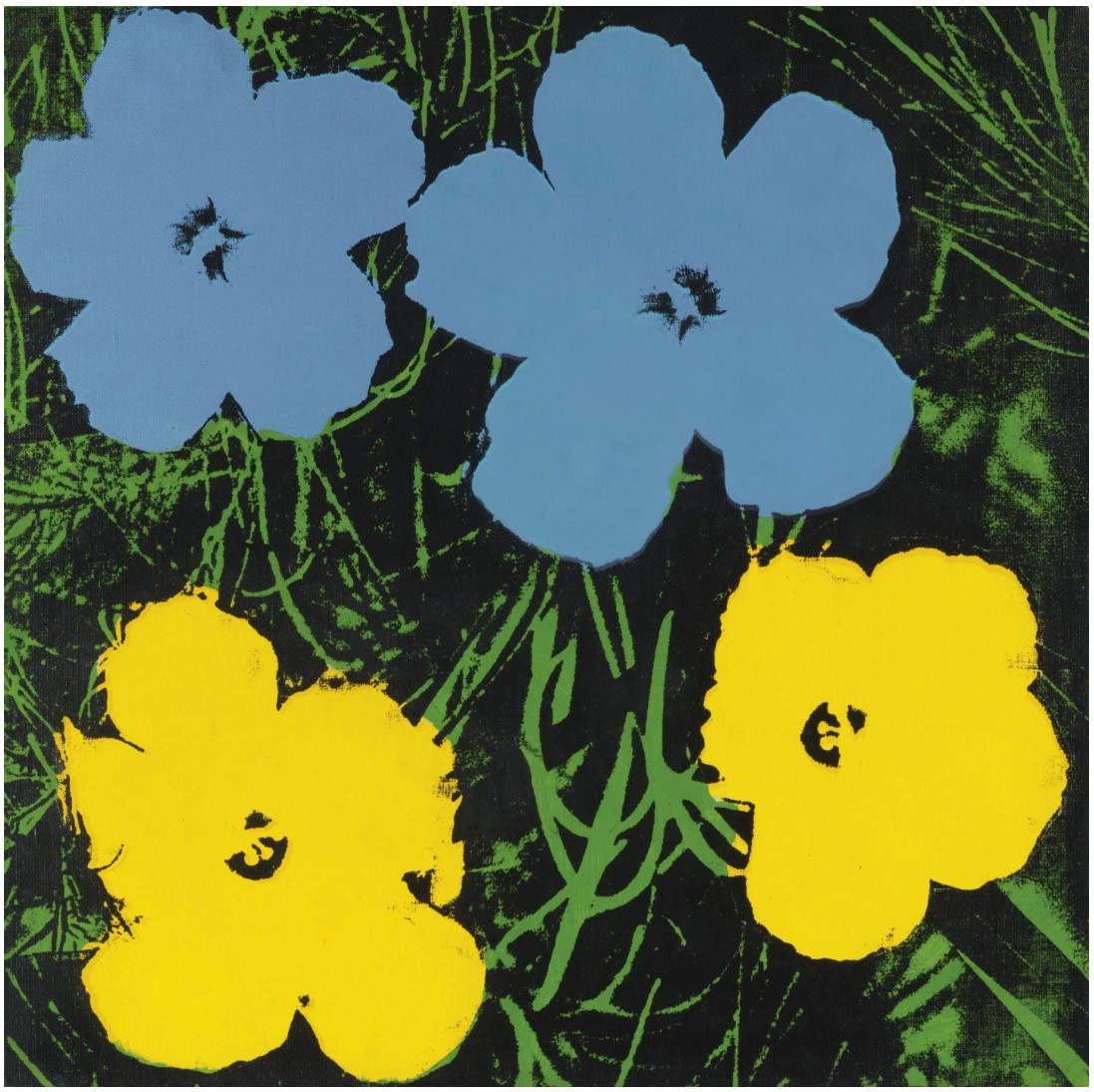
ANDY WARHOL
Flowers, 1964
Acrylic and silkscreen ink on canvas
24×24 inches (61×61 cm)
Signed and dated 64 on the overlap
Sublimely composed of four technicolor petals, immaculately registered on a brilliant green and black ground, Andy Warhol’s Flowers of 1964 encapsulates the indisputably iconic profile of Pop Art and represents the very essence of that artistic movement to which this artist is so indelibly integral. During the half century since their creation, Warhol’s Flower paintings have pervaded our global consciousness as the totemic standard of classic American Pop; their imagery acting as a metaphor for a generation that changed not only artistic but also social and political topographies in a supremely transformative decade.
Flowers, 1964
Christie’s London: 16 October 2015
Estimated: GBP 1,500,000 – 2,000,000
GBP 1,846,500
Andy Warhol (1928-1987), Flowers | Christie’s
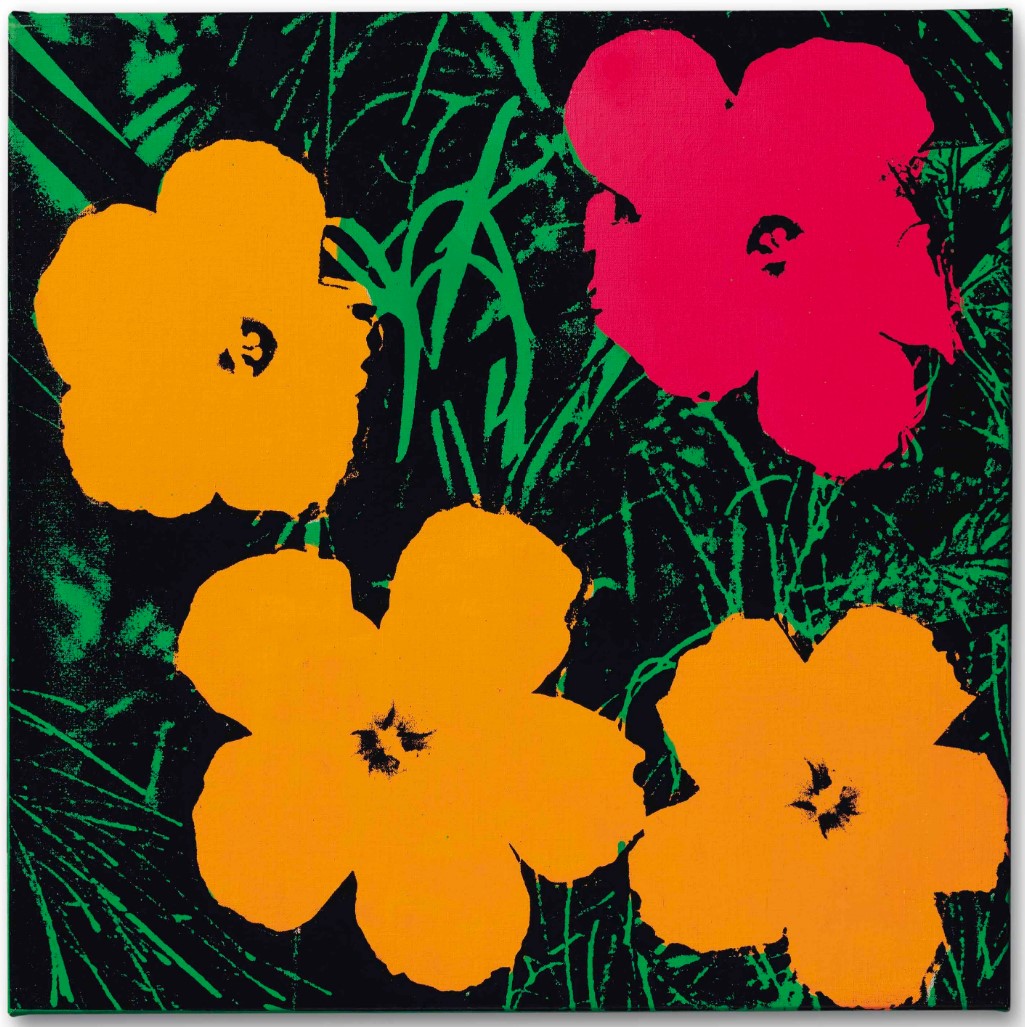
ANDY WARHOL
Flowers, 1964
Acrylic, silkscreen ink and pencil on linen
24×24 inches (61×61 cm)
Signed and dated ‘ANDY WARHOL 64’ (on the overlap)
Acquired from Andy Warhol’s legendary exhibition of Flower paintings at Leo Castelli’s New York gallery in 1964, and held in the same collection ever since, the present work is an exceptional example of the 24-inch square canvases that have come to define the series. According to the artist’s catalogue raisonné, it is believed to be one of the original twenty-eight works selected to hang on a floating wall that covered the gallery’s windows facing East 77th Street.
Flowers, 1964
Sotheby’s London: 15 February 2015
Estimated: GBP 600,000 – 800,000
GBP 1,013,000
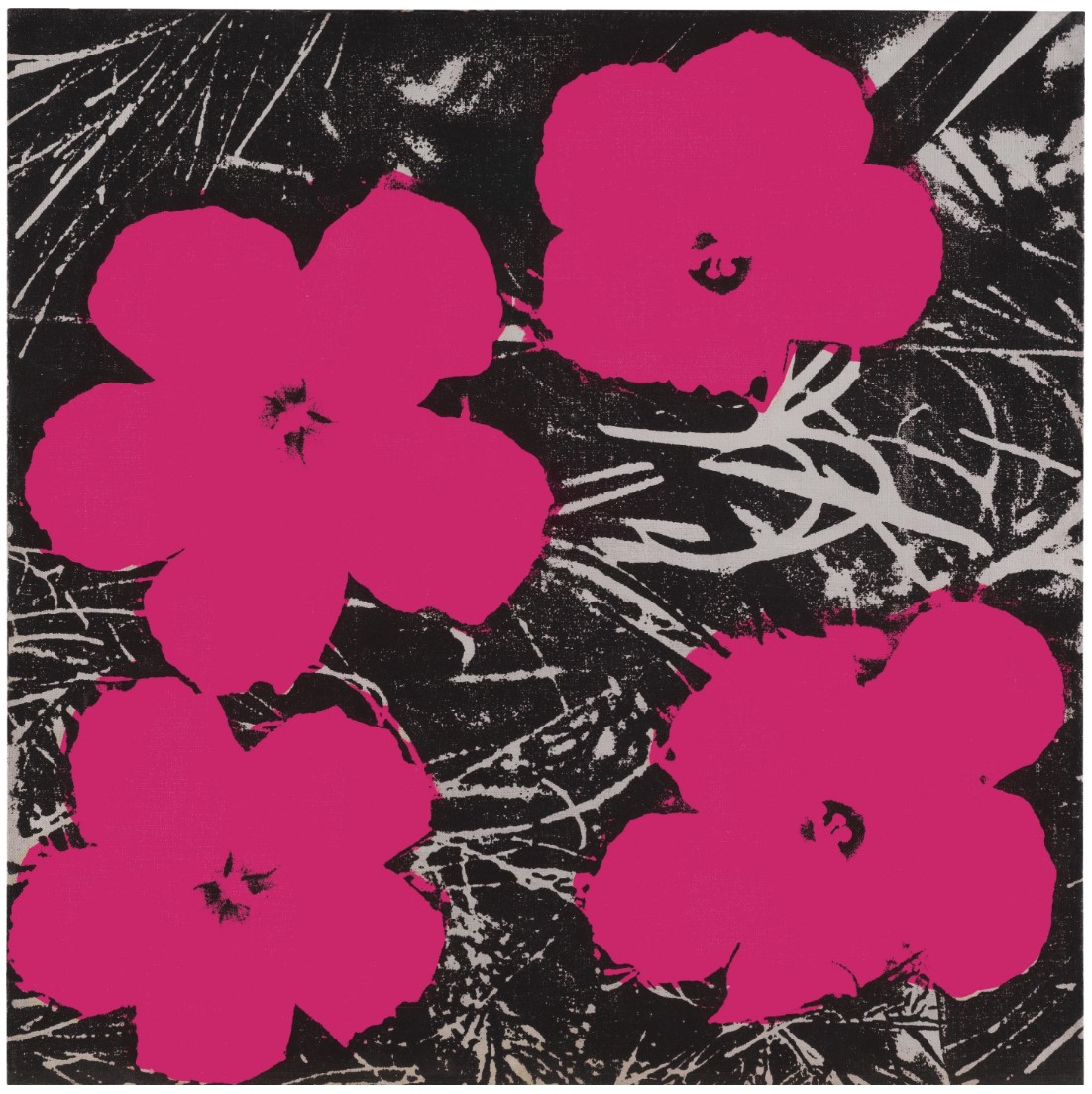
ANDY WARHOL
Flowers, 1964
Acrylic and silkscreen ink on linen
24×24 inches (61×61 cm)
The Flowers are cropped, rotated, and printed versions of an extract from Modern Photography magazine. Warhol articulated the images in various colours and orientations and reproduced them in 82, 48, and 24 inch canvases for the aforementioned Castelli show, as well as for an exhibition at Ileana Sonnabend Galerie in Paris. Flowers on white backgrounds are rare: only six were made in this 24 inch format, along with seven 48 inch examples, and two sized at 82 inches.
Flowers, 1964
Sotheby’s London: 17 October 2014
Estimated: GBP 700,000 – 1,000,000
GBP 1,202,500
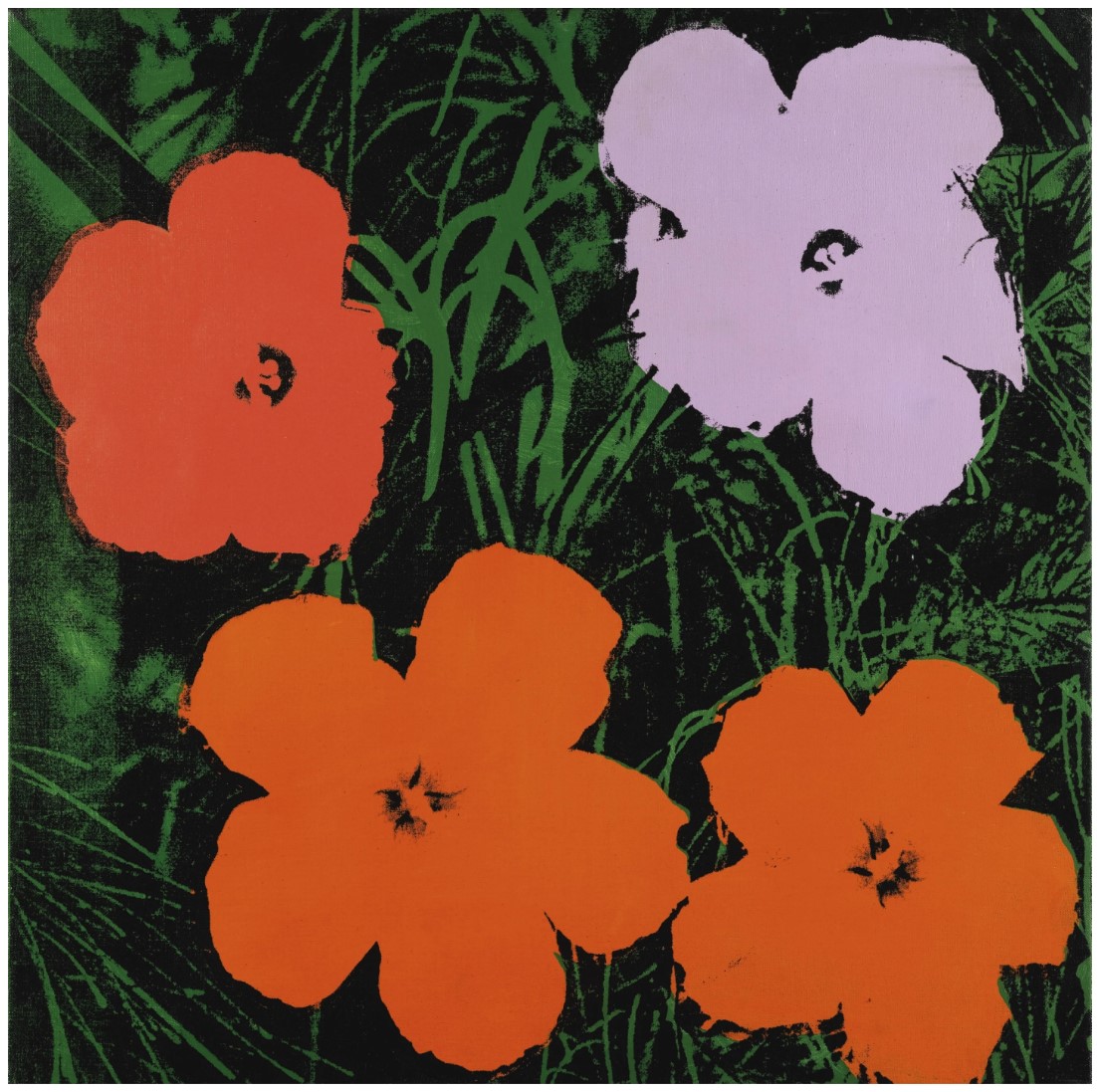
ANDY WARHOL
Flowers, 1964
Acrylic and silkscreen ink on linen
24×24 inches (61×61 cm)
Flowers, 1964
Sotheby’s London: 30 June 2014
Estimated: GBP 1,000,000 – 1,500,000
GBP 1,762,500
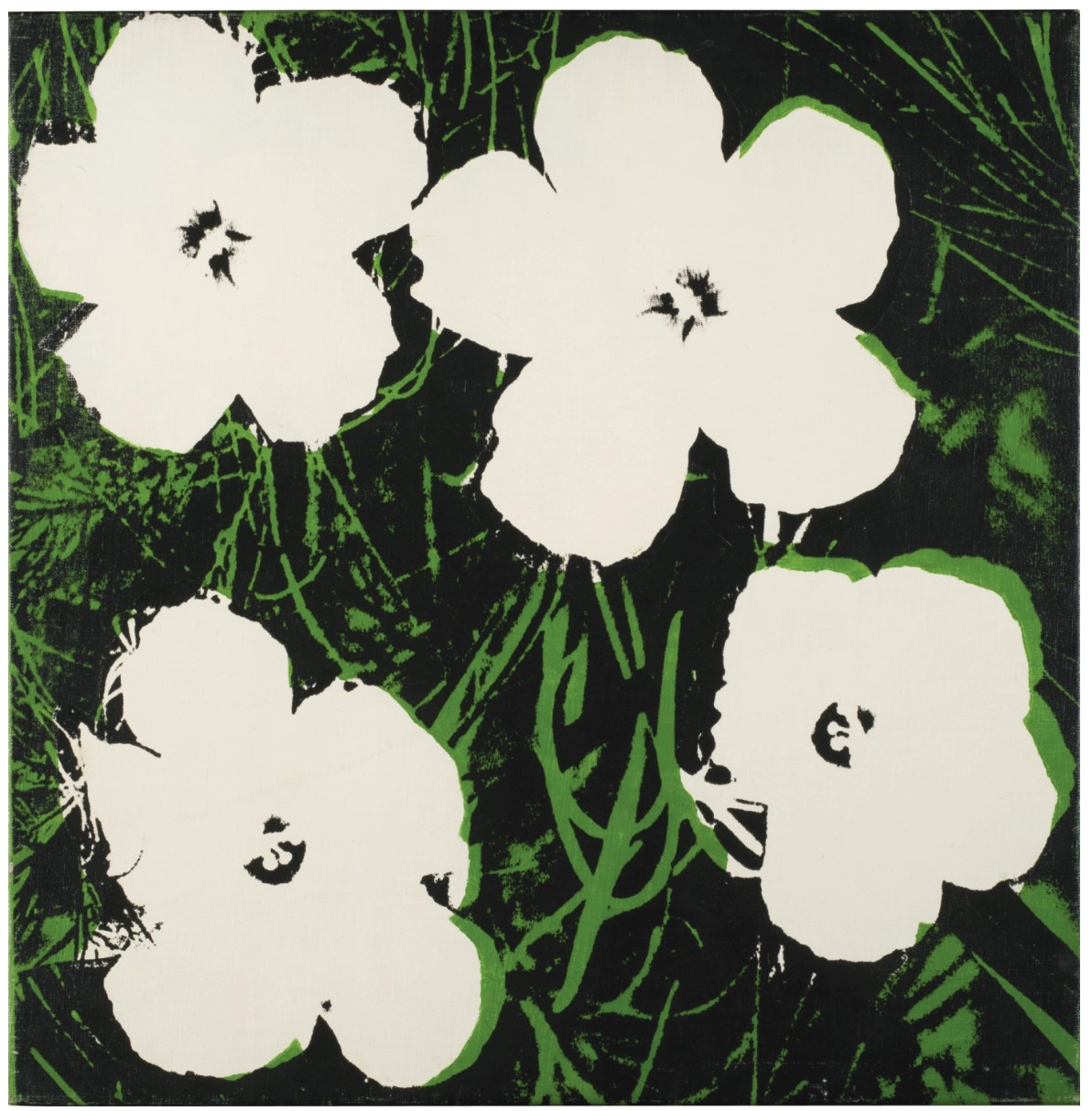
ANDY WARHOL
Flowers, 1964
Acrylic and silkscreen ink on canvas
24×24 inches (61×61 cm)
With pure white blooms gleaming against the verdant green of the foliage beneath, Flowers belongs to one of Andy Warhol’s most celebrated and beloved series, the flower paintings of 1964. The source image originated in a series of colour photographs of seven hibiscus blossoms printed in the June 1964 issue of Modern Photography, taken by Patricia Caulfield in an attempt to demonstrate the varying visual effects of different exposure times and filter settings. The seriality of the images in Modern Photography undoubtedly appealed to Warhol’s acute sensitivity to image repetition. However, rather than transferring the entire page of the magazine with four rectangular images of flowers, he isolated and cropped a square composition that included four flowers from one of the reproduced photos. This meant that ultimately the artist would control the terms of replication, variation and manipulation in his paintings more closely in multi-panel arrangements. This crop was then transferred onto acetate and its tonal range polarised to increase sharpness and provide the optimum template for the silkscreen to be made. Warhol chose the square format because of its refutation of a fixed orientation and the four possible compositional options available. Of course, this also perfectly suited the variable alignment of the flowers themselves, which had been shot on film from an overhead perspective and could hence be viewed any way up. Warhol commented on the efficacy of the square format: “I like painting on a square because you don’t have to decide whether it should be longer-longer or shorter-shorter or longer-shorter: it’s just a square” (Andy Warhol quoted in: David Bourdon, Warhol, New York 1989, p. 191).
Flowers, 1964
Phillips New-York: 16 May 2013
Estimated: USD 2,000,000 – 3,000,000
USD 2,461,000
Andy Warhol – Contemporary Art Evening Sale Lot 17 May 2013 | Phillips
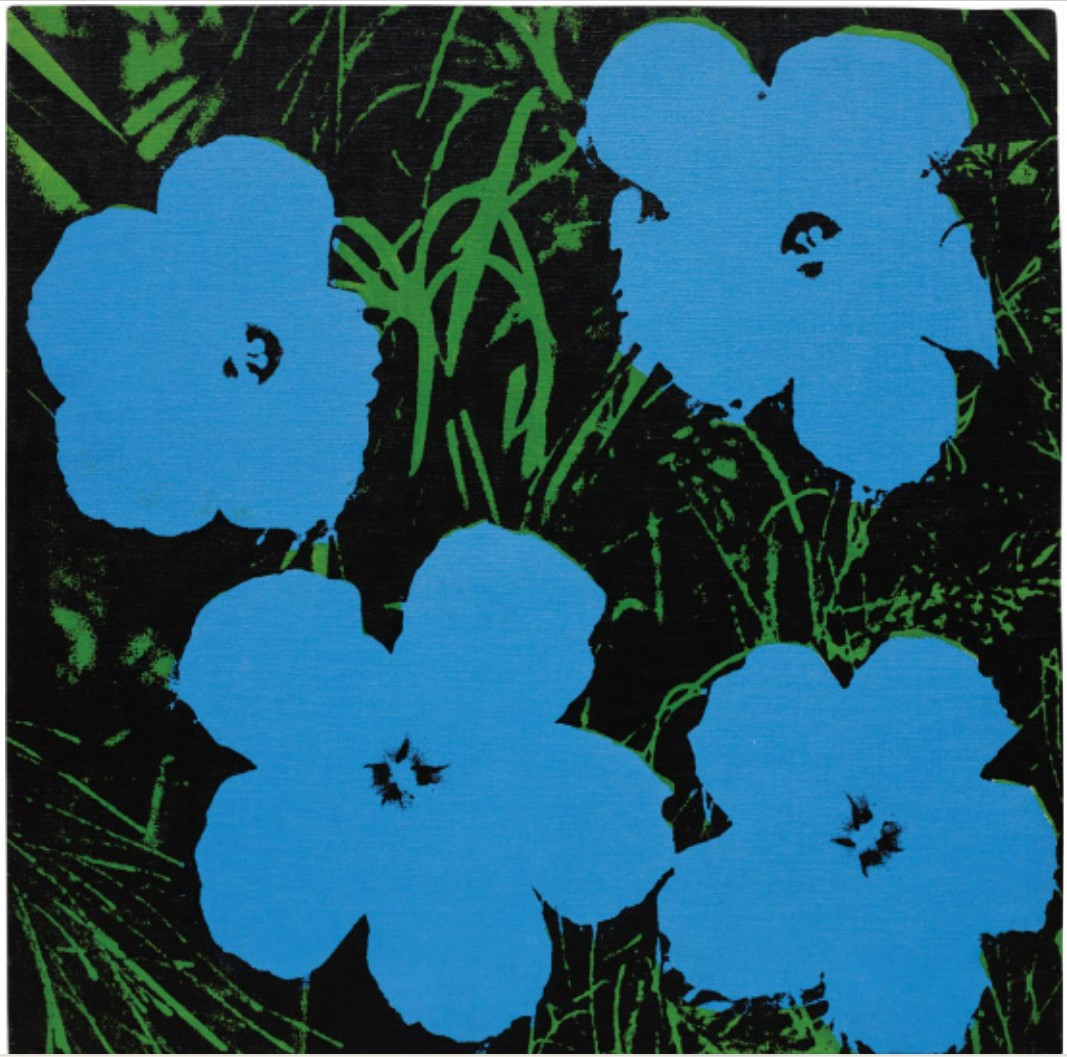
ANDY WARHOL
Flowers, 1964
Acrylic and silkscreen ink on canvas
24×24 inches (61×61 cm)
Signed and dated “Andy Warhol 64” along the overlap
Numbered LC 177 on the stretcher
Flowers, 1964, was exhibited amongst the first collection of this series at Castelli in November through December. Installed on a floating wall panel at the front of the gallery, Warhol adorned the entire wall with his 24-inch Flower paintings, each frame evenly spaced, culminating into a mural- a veritable field of flowers in the gallery.
Flowers, 1964
Sotheby’s New-York: 13 November 2012
Estimated: USD 1,500,000 – 2,000,000
USD 2,490,500
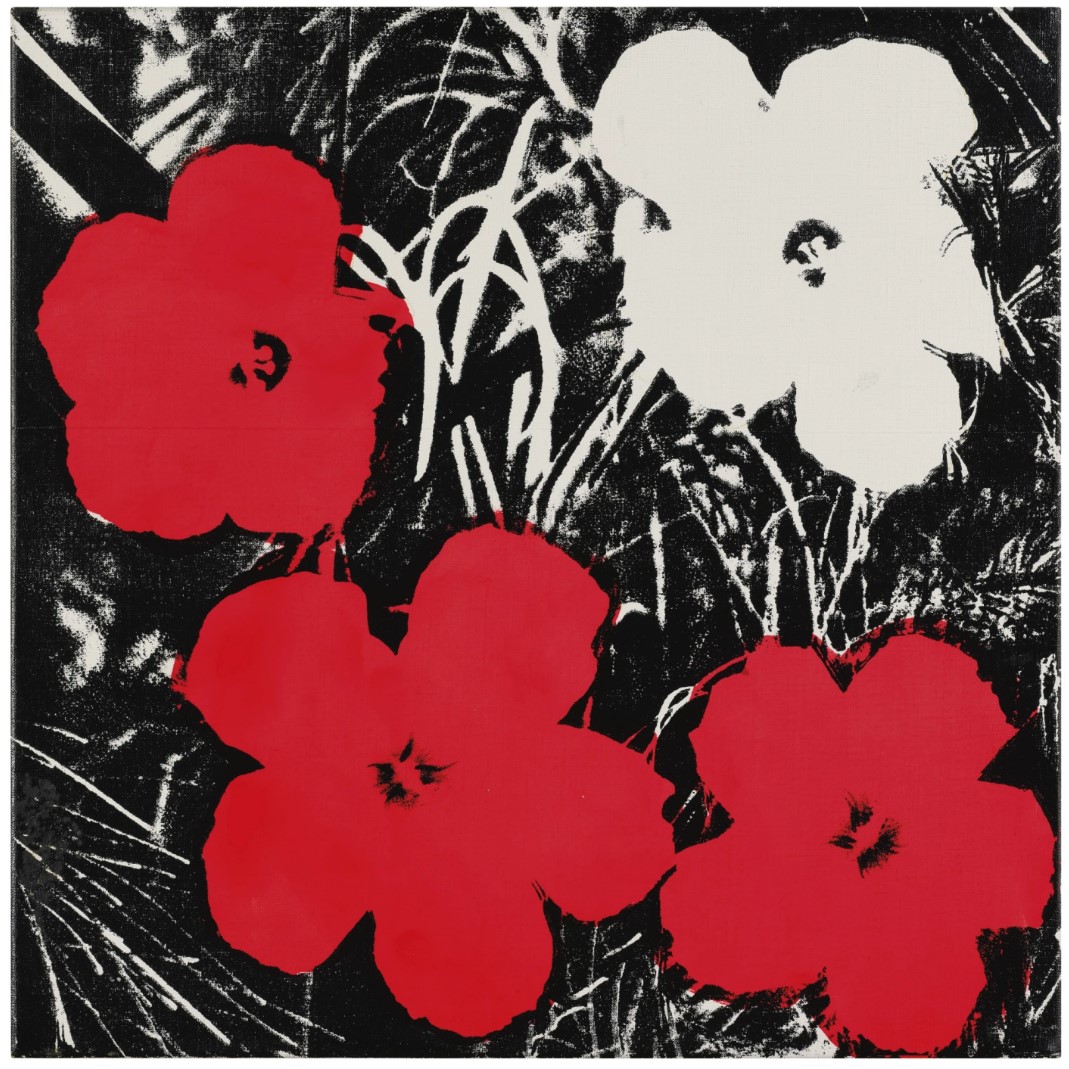
ANDY WARHOL
Flowers, 1964
Fluorescent paint and silkscreen ink on linen
24×24 inches (61×61 cm)
Broadcasting one of the most indisputably iconic images of Pop Art in a spectacularly arresting palette of brilliant pinkish red, black and white, Andy Warhol’s twenty-four inch Flowers is a vestige of the artist’s monumental realization of a conceptually infinite art. It is central to a small group of Flowers that Warhol created at the end of 1964 and beginning of 1965 incorporating the pared-down elegance of a pure white background rather than the more figurative literal green background. Indeed, it was the white background that would subsequently become ubiquitous for the series he showed at the legendary exhibition at Galerie Ileana Sonnabend in Paris later in 1965. Created at a moment between two of the most renowned Warhol exhibitions of the 1960s where he showed just Flowers canvases – with Leo Castelli in November 1964 and Sonnabend in May 1965 – the present work embodies the quintessence of Pop Art in each of composition, execution and conceptual ambition.
Flowers, 1964
Sotheby’s London: 26 June 2012
Estimated: 800,000 – 1,200,000
GBP 881,250
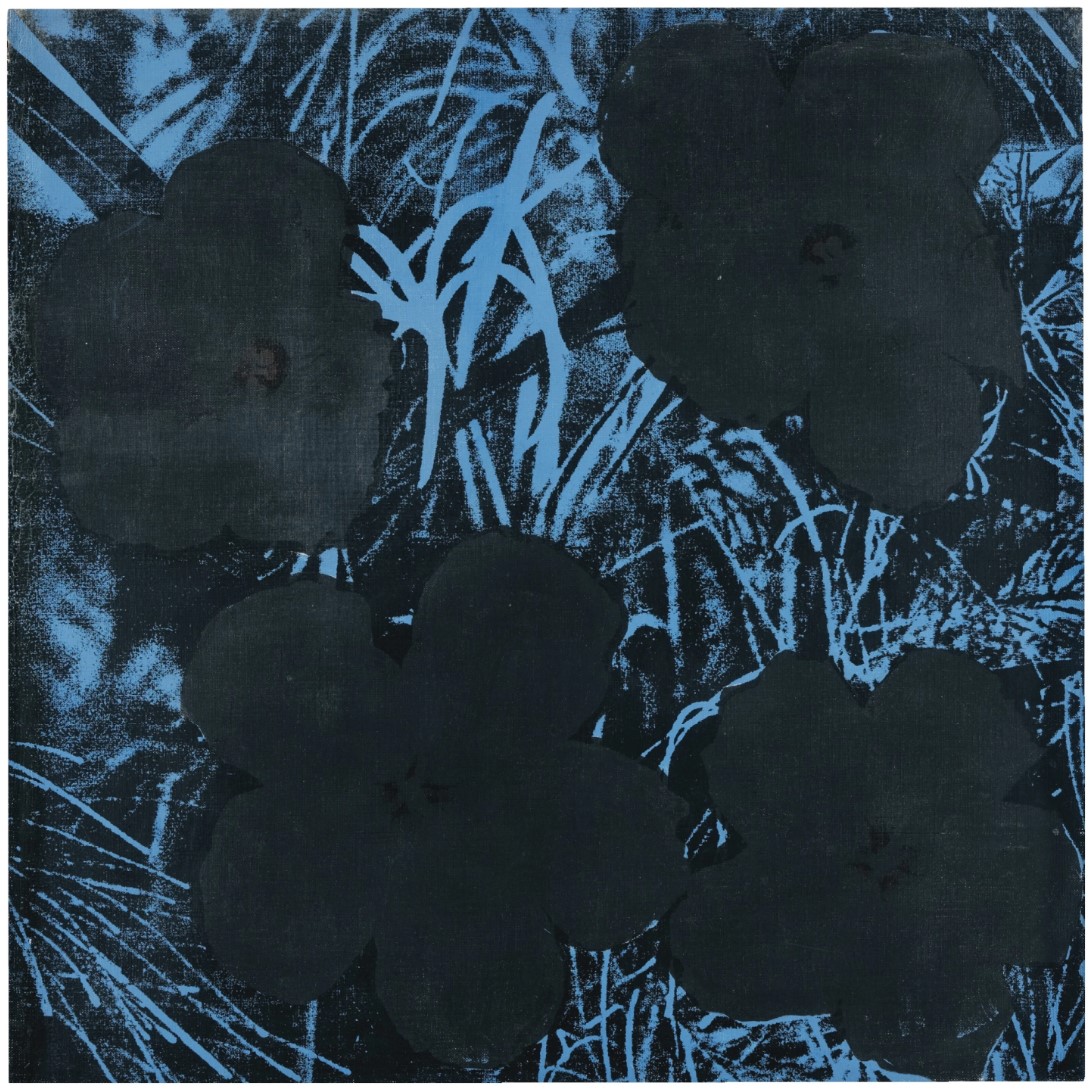
ANDY WARHOL
Flowers, 1964
Acrylic and silkscreen ink on linen
23.6 x 23.6 inches (60×60 cm)
Alluringly rendered in saturated deep blue tones, the present work is one of only two 24-inch Flowers created in 1964 to forgo Warhol’s default green background and is the only black and blue composition recorded. Most likely executed between October and November of 1964, it was one of the roughly eighty 24-inch canvases produced by Warhol specifically for his first exhibition at Leo Castelli Gallery in late November. This event premiered the Flowers series and cemented Warhol’s relationship with the gallery that represented Pop icons like Roy Lichtenstein and Robert Rauschenberg. In the unique choice of colour, Flowers evinces the process of experimentation wherein Warhol pioneered and honed his craft, making revolutionary use of screen printing and establishing his Factory’s hyper-productive parody of industrial mass culture. Wishing to formally communicate the single-minded pursuit of speed, the vast majority of Flowers came to exhibit only one or two colors, playfully imitating the banal look of popular 1960s textiles.
Flowers, 1964
Sotheby’s New-York: 9 November 2010
Estimated: 2,500,000 – 3,500,000
USD 2,658,500
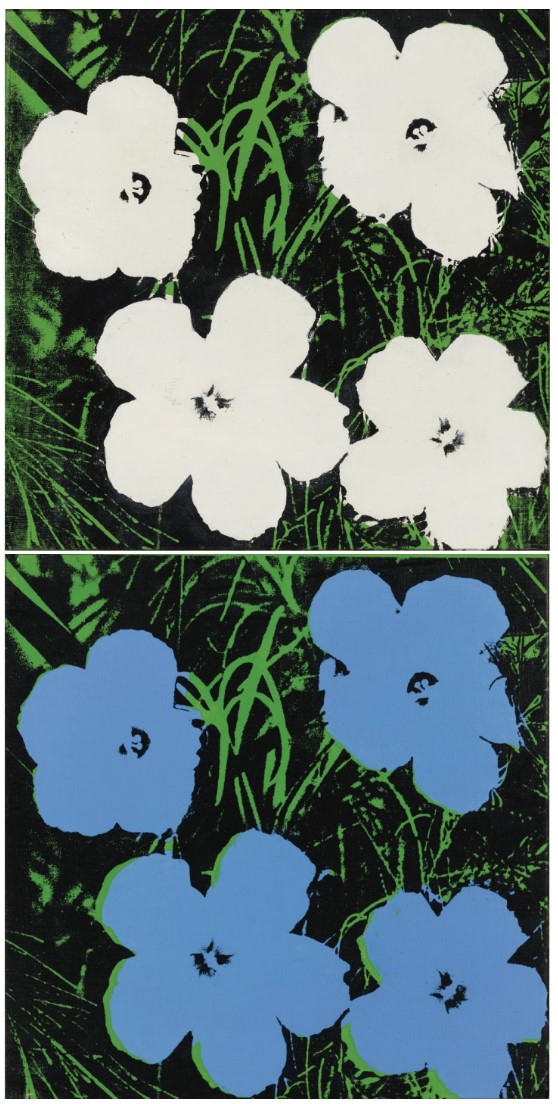 ANDY WARHOL
Flowers, 1964
Acrylic and silkscreen ink on canvas in two parts
Each: 24×24 inches (61×61 cm)
Stamped by the Andy Warhol Authentication Board
Numbered A112.107 (white) and A111.107 (blue) on the respective overlaps
Each: signed and dated 64 on the overlap
Flowers, 1964
Christie’s New-York: 13 May 2008
Estimated: USD 3,000,000 – 4,000,000
USD 4,409,000
Andy Warhol (1928-1987) , Flowers | Christie’s
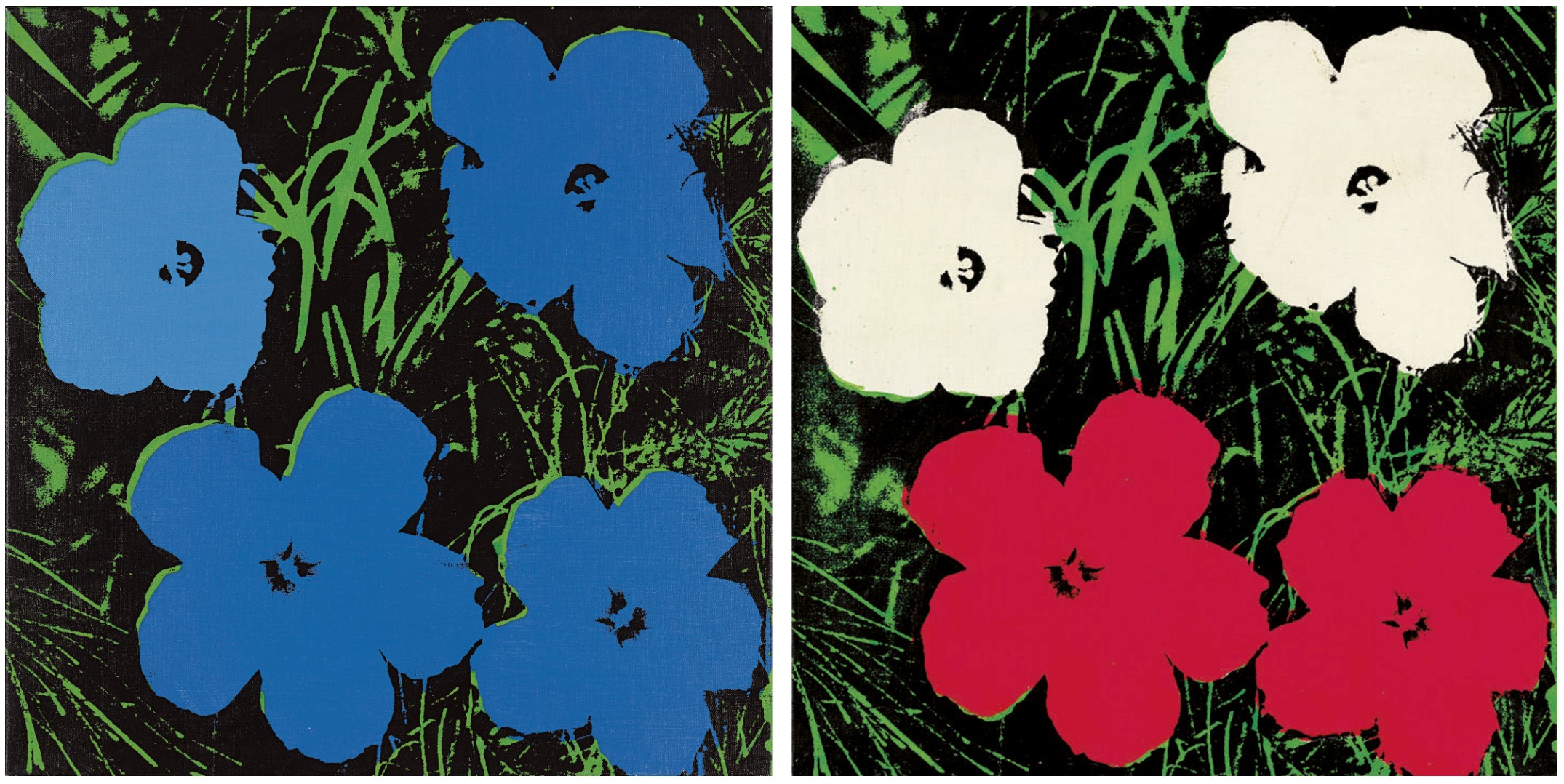
ANDY WARHOL
Flowers, 1964
Left panel: synthetic polymer, acrylic, fluorescent paint and silkscreen ink on linen
Right panel: synthetic polymer, acrylic and silkscreen ink on linen
Each: 24×24 inches (61×61 cm)
Overall: 24×48 inches (61 x 121.9 cm)
Left panel: signed and dated ‘Andy Warhol 64’ (on the overlap)
Right panel: signed ‘Andy Warhol’ (on the reverse)
Flowers, 1966
Sotheby’s New-York: 14 November 2007
Estimated: 1,600,000 – 2,000,000
USD 2,057,000
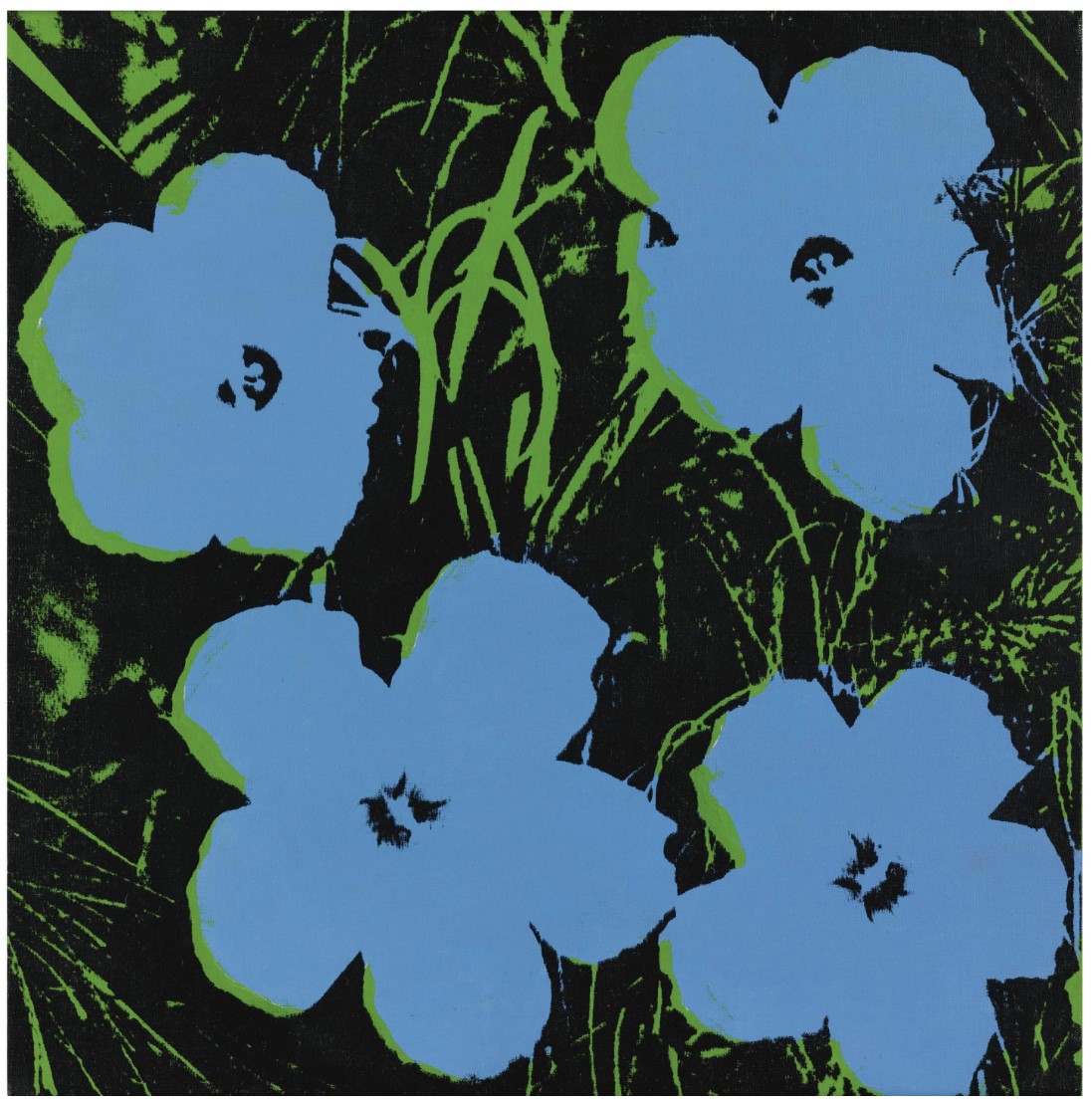 ANDY WARHOL
Flowers, 1966
Acrylic and silkscreen ink on canvas
24×24 inches (61×61 cm)
Signed, dated 66, inscribed
Stamped A103.0610 by the Andy Warhol Art Authentication Board on the overlap
Flowers, 1964
Sotheby’s New-York: 15 May 2007
Estimated: USD 1,600,000 – 2,000,000
USD 2,392,000
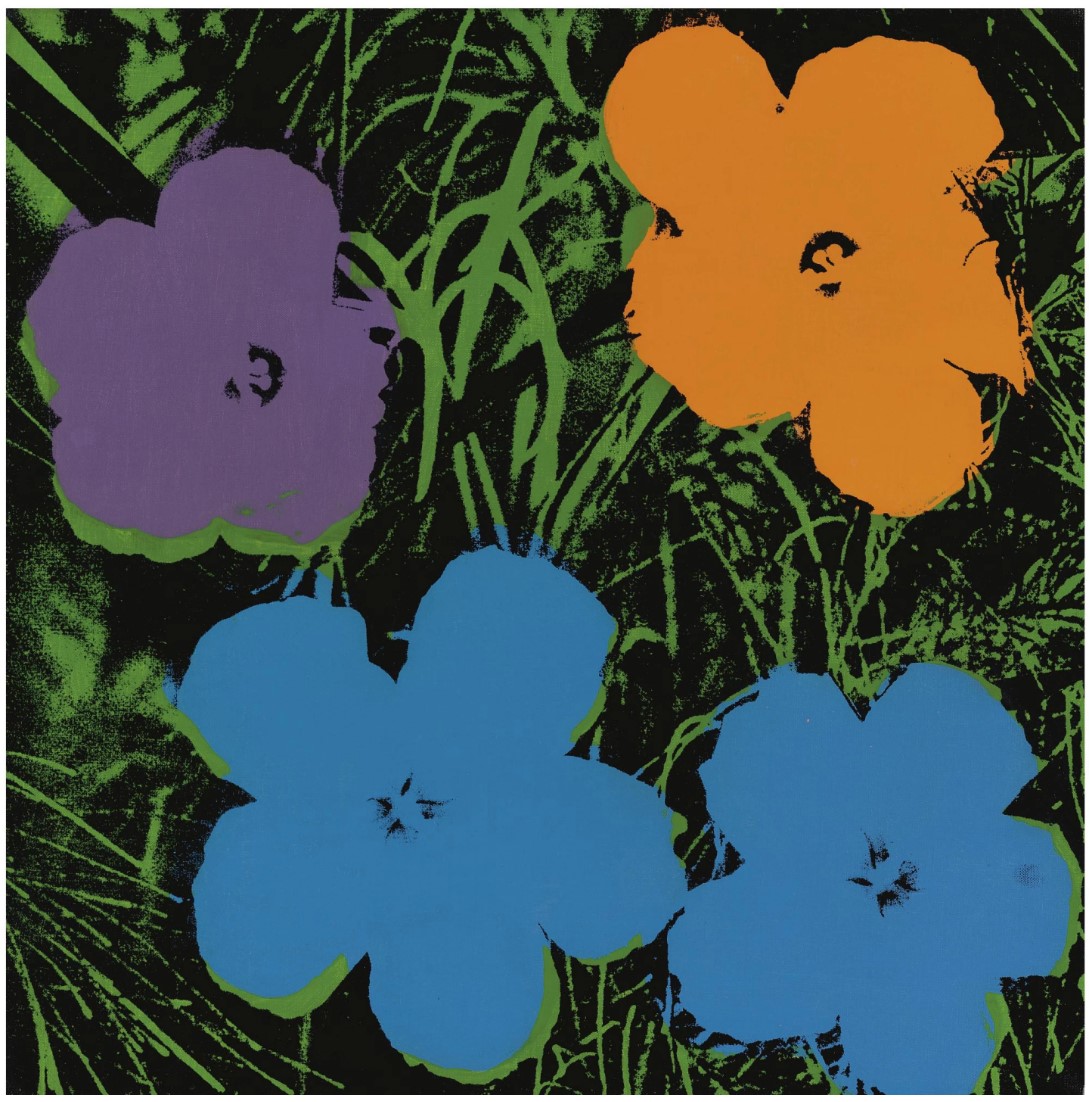 ANDY WARHOL
Flowers, 1964
Acrylic and silkscreen ink on linen
24×24 inches (61×61 cm)
Signed and dated 64 on the overlap
Flowers (22×22)
It is believed that Warhol created 35 Flowers screened directly onto a 22-inch primed canvas, differentiated in technique and dimensions from the collection of Flowers that overtook New York’s Leo Castelli Gallery in 1964 and in dimensions along from the works that adorned Ileana Sonnabend’s Paris space in 1965. 24 of these 22-inch works were set apart for installation in the Sculls’ second home, before being returned to Castelli for inventorying. Good business was first outfitting Ethel and Robert Scull with a set of thirty-five canvas portraits of Ethel for their New York apartment, inciting the desire for a second wall of Warhol, this time in the recently revealed flower motif.
Flowers, 1964
Contours of Modernity | A Private European Collection
Sotheby’s London: 4 March 2026
Estimated: GBP 800,000 – 1,200,000
GBP 1,792,000 / USD 2,393,935
Flowers | Modern & Contemporary Evening Auction | 2026 | Sotheby’s
ANDY WARHOL (1928 – 1987)
Flowers, 1964
Acrylic and silkscreen ink on canvas
22×22 inches (56×56 cm)
Signed and dated 64 (on the overlap)
Executed in 1964, at the height of his Pop ascendancy, Andy Warhol’s Flowers series marks a decisive turning point in his practice, crystallizing the formal and conceptual concerns that had come to define his engagement with mass culture. Initially commissioned by New York collectors Ethel and Robert Scull, the intimate twenty-two by twenty-two inch format was conceived for a group of works intended for their residences, yet the scale soon transcended this private origin, becoming an established dimension within the wider Flowers series itself. Earlier that year Warhol produced larger canvases measuring eighty-two by eighty-two, sixty by sixty, forty-eight by forty-eight, and twenty-four by twenty-four inches in advance of the Leo Castelli Gallery exhibition; while the show remained on view, he developed a sequence in diminishing sizes of twenty-two by twenty-two, fourteen by fourteen, eight by eight, and five by five inches. Although the twenty-two inch paintings were originally conceived as a mural for the Sculls, likely inspired by the immersive floral installation at Castelli, their circulation soon aligned them with the broader commercial and institutional expansion of Warhol’s practice.
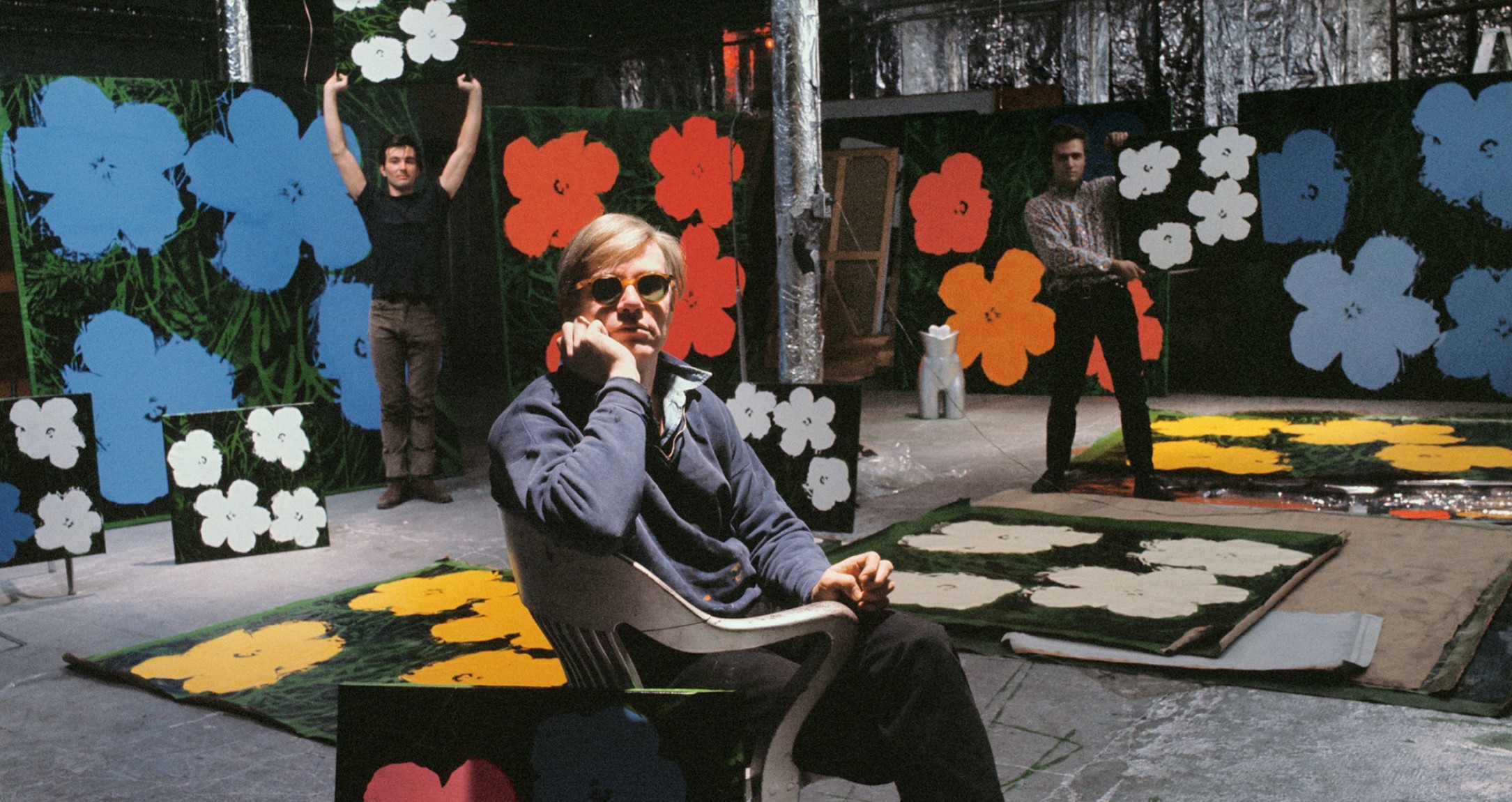
Andy Warhol, Philip Fagan and Gerard Malanga, New York, 1964. Photo Ugo Mulas © Ugo Mulas Heirs. All rights reserved.
Art © 2026 Andy Warhol Foundation for the Visual Arts / Licensed by DACS, London
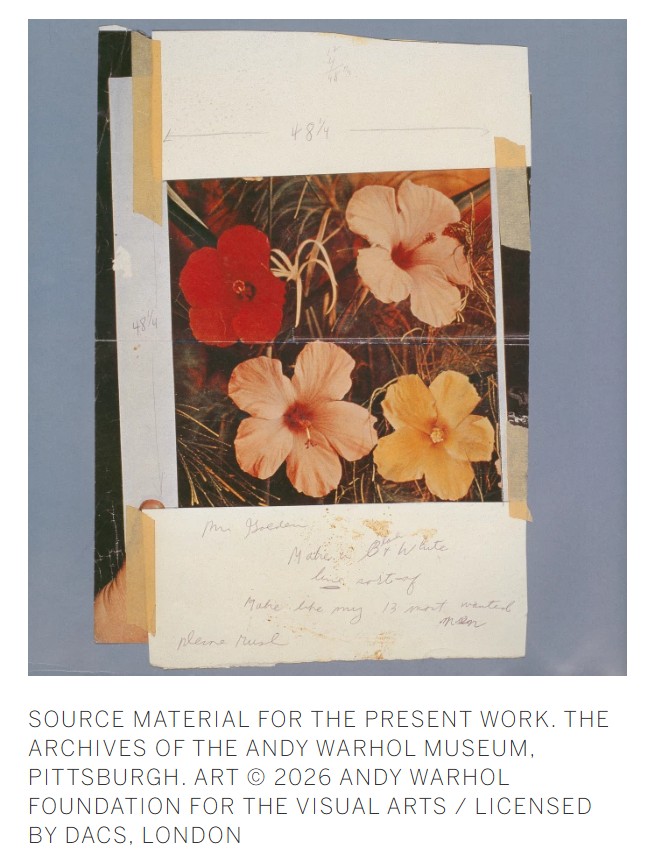
Four blossoms confront the viewer, compressed into a square formation and set against a densely silkscreened black ground animated by jagged white lines that evoke flattened foliage. The petals, rendered in saturated orange and electric fuchsia, are crisply bound and devoid of tonal modelling, hovering upon the surface without spatial recession. This deliberate suppression of depth, combined with abrupt chromatic contrasts, heightens the image’s artificiality, transforming a natural motif into a graphic, almost industrial emblem. Far from a decorative departure, the Flowers are derived from a photograph published in the June 1964 issue of Modern Photography, taken by Patricia Caulfield and reproduced multiple times to demonstrate variations in color-processing techniques. This utilitarian source – anonymous, mass-circulated, and mechanically reproduced – proved ideally suited to Warhol’s sensibility. By cropping the image into a square and isolating a cluster of blossoms, he excised narrative context and illusionistic space, translating photographic description into a flattened and iconographic form. The act of selection and repetition, rather than invention, becomes the primary creative gesture, reinforcing Warhol’s ongoing interrogation of authorship and originality. Produced in multiple scales and an array of colour combinations, the Flowers were executed in large numbers and frequently exhibited in rhythmic, grid-like arrangements. Their square format, without a fixed orientation, denies compositional hierarchy and permits endless reconfiguration. When installed in serial groupings, the canvases function less as discrete objects than as modular units within an expanded field, dissolving the traditional autonomy of the single painting.
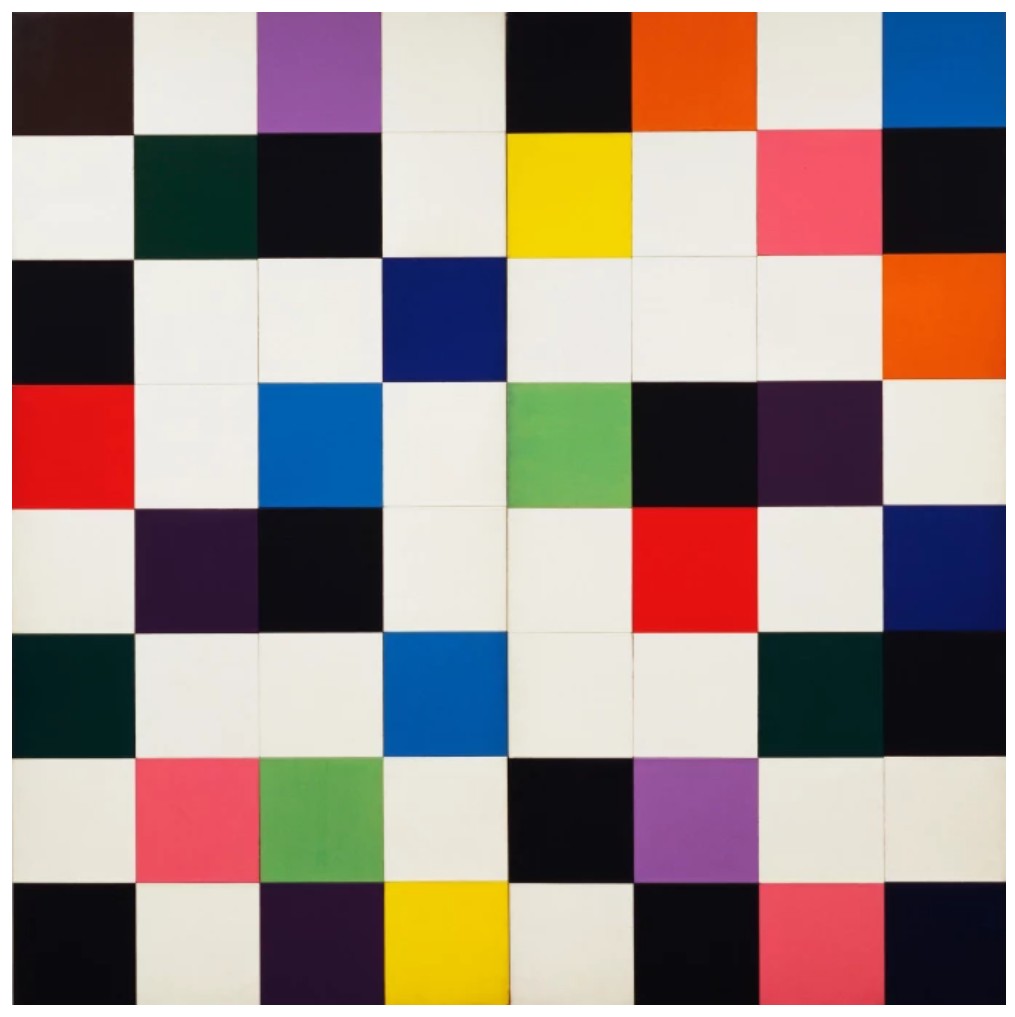
Ellsworth Kelly, Colors for a Large Wall, 1951. The Museum of Modern Art, NewYork.
Image © The Museum of Modern Art/Licensed by SCALA / Art Resource, NY. Art © Ellsworth Kelly Foundation
The series reached its most fully realized articulation in Warhol’s first exhibition at the Leo Castelli Gallery in November 1964, an event now widely regarded as a watershed in post-war American art. Installed across the gallery walls in vivid chromatic permutations, the Flowers enveloped the exhibition space, operating simultaneously as a summative statement and a point of conceptual closure. In the wake of this exhibition, Warhol effectively concluded his sustained engagement with the iconography of consumer culture and fame – Campbell’s Soup Cans, Coca-Cola bottles, and the silkscreened visages of Marilyn Monroe – and soon thereafter announced his withdrawal from painting in favor of filmmaking. As such, the Flowers may be understood as the final, distilled expression of his early Pop project.
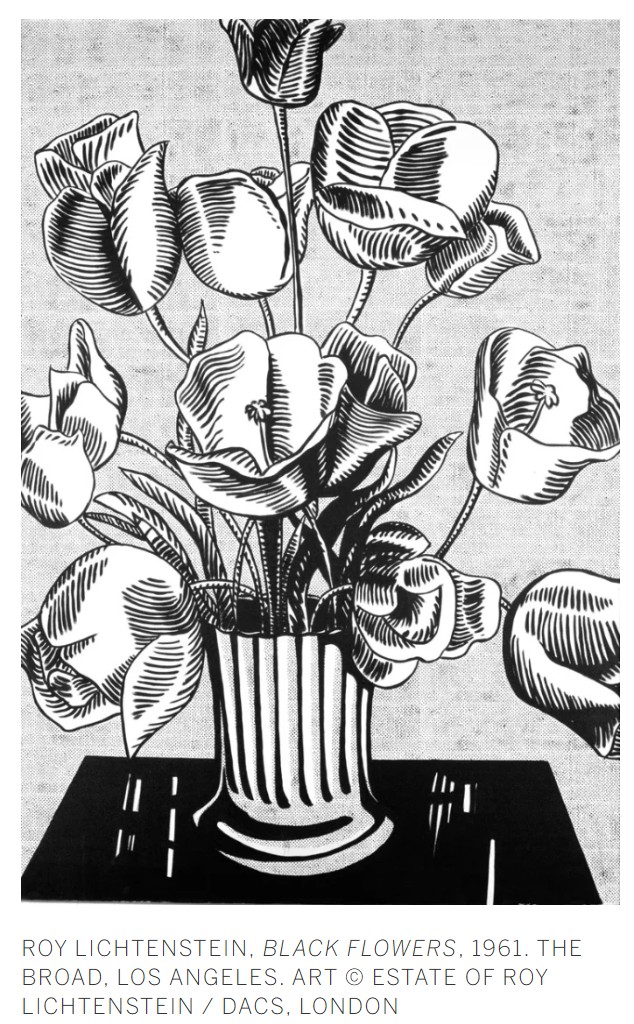
Executed in the immediate aftermath of the Death and Disaster series, the shift from images of fatality to florals coincided with the rise of countercultural idealism and the rhetoric of ‘flower power’. Yet Warhol’s flowers are curiously impersonal and emotionally restrained, retaining an undercurrent of morbidity that aligns them with his earlier confrontations with death and impermanence. Within an art-historical framework, the Flowers are situated in a long lineage of still-life imagery associated with transience and mortality, extending from Dutch vanitas painting to nineteenth-century Impressionism. While comparisons are frequently drawn to Monet’s water lilies, a closer parallel may be found in the vanitas tradition, in which blossoms depicted at the height of their bloom function as emblems of life’s brevity. Warhol’s treatment, however, is resolutely anti-expressive: the flowers are neither personalized nor sentimentalised, but reduced to impersonal signs, stripped of narrative specificity and suspended in a perpetual present.
In translating an image of natural beauty into an emblem of artificial permanence, Flowers articulates a central paradox at the heart of Warhol’s practice; the desire to arrest time while simultaneously exposing the inevitability of loss. Synthesizing themes of repetition, mortality, mass production, and visual seduction, the Flowers transform the still-life tradition into a Pop meditation on ephemerality and endurance, standing today as one of the most incisive and conceptually resolved statements of Warhol’s early maturity.
Flowers, 1965
Christie’s New-York: 10 November 2023
Estimated: USD 1,200,000 – 1,800,000
USD 1,320,500
ANDY WARHOL (1928-1987) (christies.com)
ANDY WARHOL (1928-1987)
Flowers, 1965
Silkscreen ink on canvas
22×22 inches (55.9 x 55.9 cm)
Set against a monochromatic background, the four blooms in Andy Warhol’s Flowers reverberate off the surface of the canvas with an exuberant energy. This combination of all red flowers set against a black-and-white ground is rare, with less than 10% of the series being devoted to this particular combination. In the present work, Andy Warhol employs vivid hues to emphasize his subject matter, resulting in flat planes of red that are punctuated only by the delicate black anthers and stamens of the hibiscus plant. Concentrating his palette on just one color emphasizes this effect, allowing the optical resonance of the cadmium red to reverberate off the surface. Furthermore, by setting the flowers against a dark, monochromatic ground, Warhol almost pushes his subject matter through the picture plane.
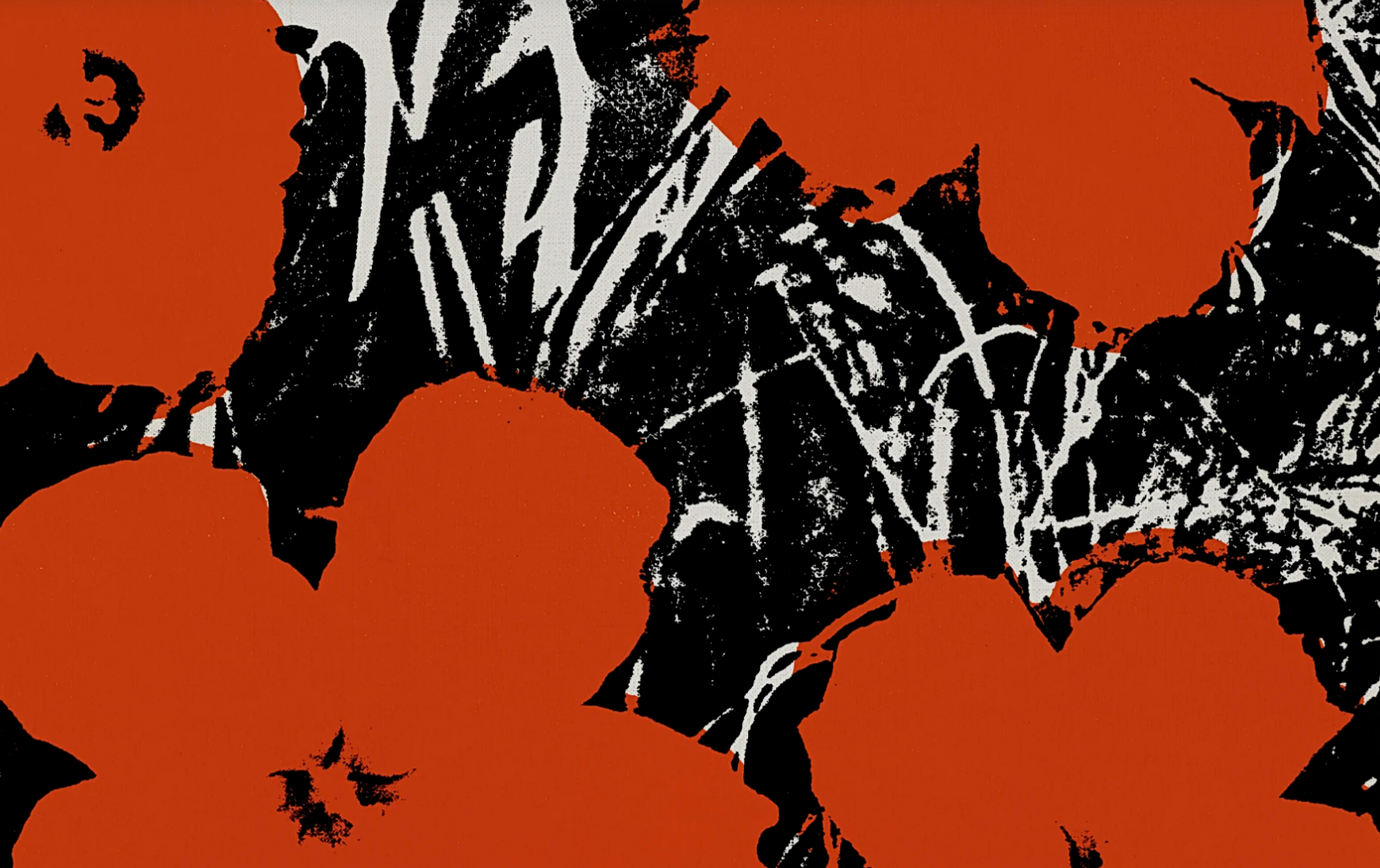
With such a meticulously structured composition, Warhol also emphasizes the sense of order and seriality that became a hallmark of his oeuvre. Just like his paintings of Campbell Soup Cans and Hollywood stars such as Marilyn Monroe, the repeated motifs in Flowers draw attention to the mechanical and mass-produced nature of the printed images. Yet, there is also something different in each work, as despite the artist’s adoption of the silkscreen technique, every work in the series is different in its own right, the technique allowing for the transfer of ink onto the canvas to be distinctive each time, resulting in a discretely unique image every time. Coming from Galerie Ileana Sonnabend in Paris and passing through Gian Enzo Sperone Gallery in Turin, Flowers then arrived to the collection of Marcello Rumma, a central figure in the Italian and international cultural debate between the 1960s and 1970s. A connoisseur and passionate collector, intellectual and friend of artists, organizing exhibitions and promoting publications dedicated to the most experimental artistic practices of his time, Marcello was a true pioneer during his brief lifetime in which he fostered a new generation of artists. With their intense colors and innovative compositions, Flowers exudes a sense of vibrancy and life that could only be captivated by Warhol himself. Through this series, Warhol has worked in the grand tradition of floral paintings in art history, but by adding his own interpretation on the flower motif, Warhol has created a staple composition to his oeuvre. Flowers serves as a symbol of Warhol’s ability to provoke thought and inspire conversation about the intersection of art, commerce, and culture, making Flowers an iconic and lasting symbol of the Pop Art movement, and one that will continue to bloom in the annals of art history.
Flowers, 1965
Christie’s New-York: 11 November 2021
Estimated: USD 1,000,000 – 1,500,000
USD 3,330,000
ANDY WARHOL (1928-1987) (christies.com)
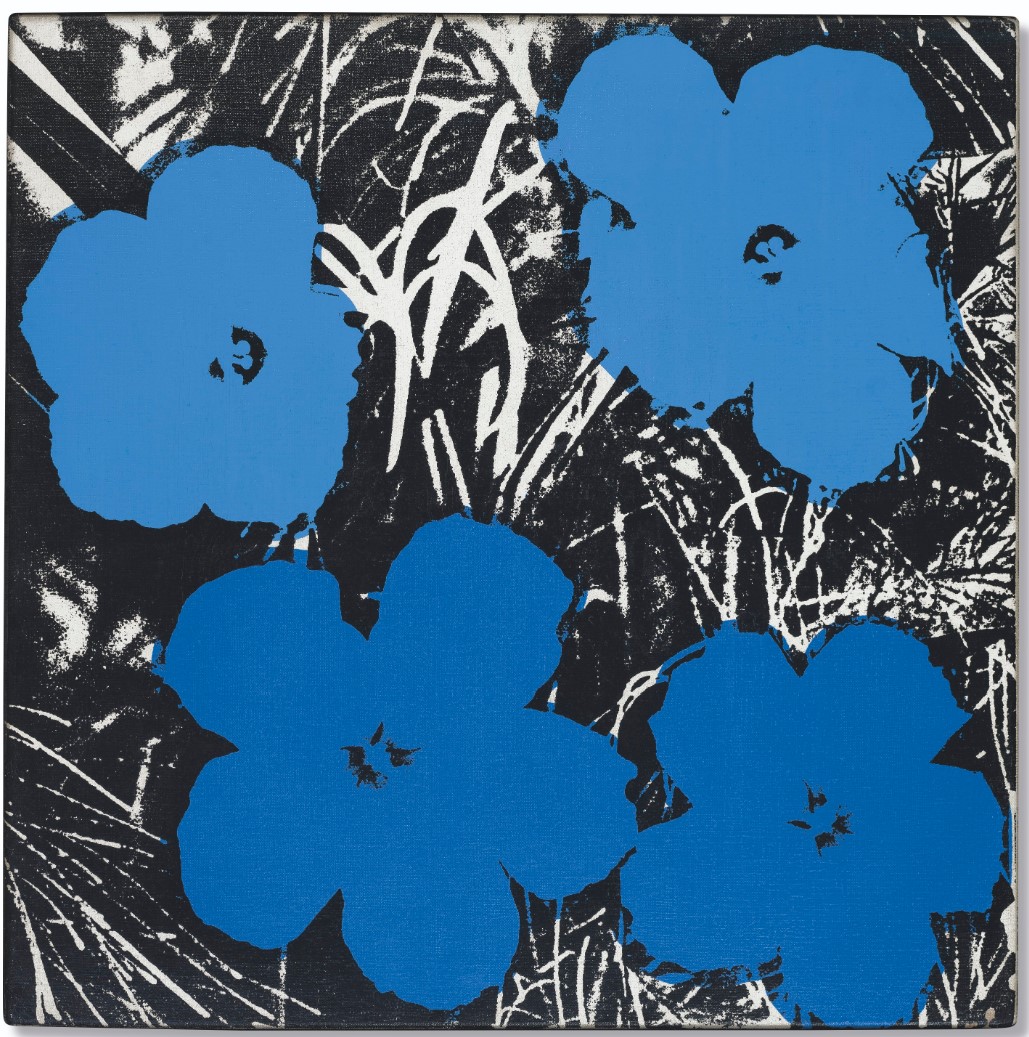
ANDY WARHOL
Flowers, 1965
Acrylic and silkscreen ink on canvas
22×22 inches (55.9 x 55.9 cm)
Signed ‘Andy Warhol’ (on the overlap)
Provenance
Ethel and Robert Scull, New York, 1965
Leo Castelli Gallery, New York
Private collection, Houston
James Corcoran Gallery, New York
Acquired from the above by the present owner, circa 1981
First commissioned by New York collecting royalty Ethel and Robert Scull in the early 1960s, the present Flowers painting tells a story of Warholian history in four friendly flowers perched atop a monochrome grassy background. Reveling in two different shades of the artist’s rare and iconic blues, the separate floral forms assume sacred status, emphasized against an elegant black and white ground that reads like a well-loved newspaper or vintage film reel. Black and white reminds of the long-lost days of yore, when entertainment lived in Saturday night specials on the cable television, and news traveled only as fast as the paperboy could pedal. Like the hand that selected it, Warhol’s lapis lazuli bursts onto the quaint scene in technicolor, opening up a world of kaleidoscopic possibilities and just in time for a new era in art, politics and pop culture. Equally a development in color as it is in production method, the present work is rendered in subsequent layers of silkscreen, the registration marks of each individual application of ink over acetate at one time visible on the tacking margins of the canvas.
Flowers, 1964
Tajan Paris: 1 July 2020
Estimated: EUR 1,400,000 – 1,800,000
EUR 1,445,600 / USD 1,619,070
Lot – ƒ ANDY WARHOL (1928-1987)
REPEAT SALE
Christie’s New-York: 13 November 2013
Estimated: USD 1,400,000 – 1,800,000
USD 1,685,000
Andy Warhol (1928-1987), Flowers | Christie’s
ANDY WARHOL (1928-1987)
Flowers, 1964
Synthetic polymer and silkscreen ink on canvas
22×22 inches (56×56 cm)
Signed and dated on the overlap
Provenance
Leo Castelli Gallery, New York
Joe Levine
Private Collection, Korea
Kukje Gallery, Seoul
Waddington Galleries, London
Christie’s New York, 13 November 2013, lot 124
Private Collection Europe
Andy Warhol’s Flowers embody a shift in his work from mining celebrity culture to cultivating a more abstract, filmic approach to subject matter. While it is well documented the source material was taken from the article on Kodak’s home coloring photographic process in the June 1964 issue of Modern Photography, less has been written about how Warhol took this source photograph as raw material and re-fashioned a whole new icon. Michael Lobel in Andy Warhol Flowers (Ibid, n.p.) describes the instructions to his printer scribbled on the newly adjusted photo collage, rotated clockwise once: “Mr. Golden Make in Black + White line sort of/Make like my 13 most wanted men,” which refers to his Thirteen Most Wanted Men, 1964 commissioned for the New York State Pavilion at the World’s Fair. The panels of starkly screened criminals stare out frontally or placed in profile, creating a patterned grid-like formation that repeats the face/head or seemingly arbitrarily deviates from the order. Once this image was made into a silkscreen, the reverse image is what one sees in the Flower paintings, whereby the blossoms are further transformed into a flattened image suitable for Warhol’s masterfully literal trans-figuration of the humble source photograph. They radiate not a sunny, cheerful disposition of which flowers seem to possess naturally but a dark, impersonal quality alluding to sex and death. As the mechanisms of sexual reproduction in plants, flowers acts as alluring agents in order perpetuate that species. Flowers also function a kind of memento mori in art, where in an Old Master painting, everyday objects and flora serve to remind the viewer the incessant marching of time, and how everything living is subject to decay and ultimately death. Warhol’s Flowers, despite their bright, unadulterated colors, that epitomizes the optimism and surface of Pop Art; it also shows its sinister, shadowy side, where such levity and promise comes at a steep cost one must bear. Four years later, on June 3, 1968, Valerie Solanas shot Any Warhol, inflicting him with gun wounds that could have been fatal.
Flowers, 1964
Christie’s New-York: 26 September 2019
Estimated: USD 1,500,000 – 2,000,000
USD 1,395,000
Andy Warhol (1928-1987) (christies.com)
ANDY WARHOL
Flowers, 1964
Acrylic and silkscreen ink on canvas
22×22 inches (55.9 x 55.9 cm)
Signed, stamped with the Andy Warhol Authentication Board, Inc. stamp
Numbered and dated ‘Andy Warhol 64 A110.979’ (on the overlap)
Provenance
Ileana Sonnabend, Paris
Gian Enzo Sperone, Italy
Collection M.E., Brussels
Galerie Burén, Stockholm
Peder Bonnier, New York
Susan Sheehan Gallery, New York
Art Consultancy Limited, Zürich
Acquired from the above by the present owner, 2007
In selecting the color for his Flowers, Warhol deliberately chose vibrant hues of brilliant synthetic and what was known as ‘cosmetic colors’ that would effectively attract and instantly engage the viewer, causing a sensory experience. The four pink and red blossoms juxtaposed against the dense foliage of black and white present a striking image of brilliant, chromatic color contrast. Warhol color-blocked each blossom, which transformed each flower into flat, discrete, graphic forms and elements that seem to hover above the background. “When Warhol made Flowers, it reflected the urban, dark, death side of that whole movement. There is a lot of depth in there…You have this shadowy dark grass, which is not pretty, and then you have these big, wonderful, brightly colored flowers” (J. O’Connor and B. Liu, Unseen Warhol, New York, 1996, p. 61). The bright and flat imagery of the flowers evokes a simplicity that is instantly accessible and easy to broadcast; this accessibility can also be understood as a Warhol’s attempt to create truly ‘popular’ art. Although some believe this ‘popular’ imagery in Flowers was a departure from Warhol’s obsession with death, his decision to fill Castelli’s gallery with flowers proved to be one of his most complex series of work. While flowers can represent new life and beauty, they only exist at their best for a short period of time, thus alluding to life’s fragility and symbolizing mourning. “In a funny way, he was kind of repeating the history of art. It was like, now we’re doing my flower period! Like Monet’s water lilies, Van Gogh’s flowers, the genre” (G. Malanga, A Year in the Life of Andy Warhol, New York, 2003, p. 74). Presciently, the colors and shapes are quintessentially sixties – an early harbinger of the notoriously anti-violence, anti-war, flower power generation.
Yellow Flowers, 1964
Christie’s New-York: 16 November 2016
Estimated: USD 800,000 – 1,200,000
USD 1,207,500
Andy Warhol (1928-1987) (christies.com)
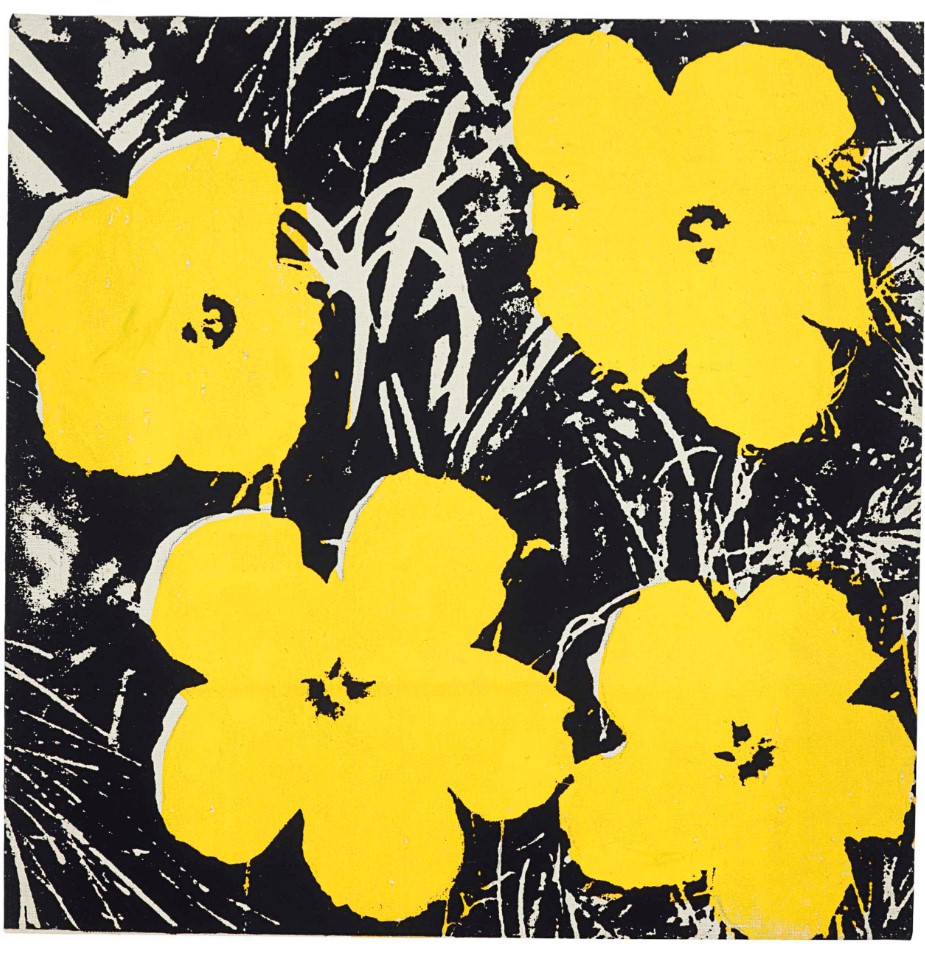
ANDY WARHOL
Yellow Flowers, 1964
Synthetic polymer and silkscreen ink on canvas
22 x 21.7 inches (55.9 x 55.2 cm)
Flowers, 1964
Christie’s New-York: 11 November 2015
Estimated: USD 1,500,000 – 2,000,000
USD 1,325,000
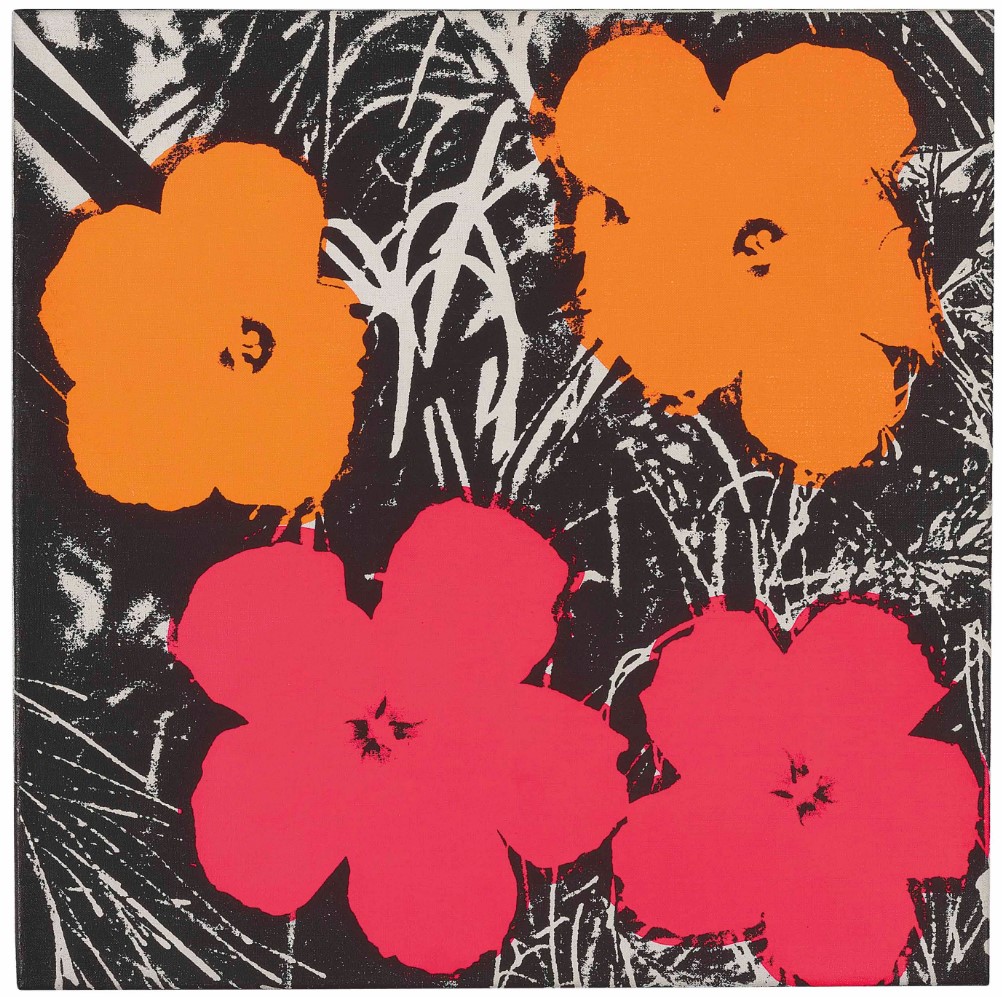
ANDY WARHOL
Flowers, 1964
Synthetic polymer and silkscreen ink on canvas
22×22 inches (55.8 x 55.8 cm)
Signed twice and inscribed ‘Andy Warhol To Carroll Andy’ (on the overlap)
Throughout the latter half of the twentieth century and into the twenty-first, the collector and philanthropist Carroll Petrie stood as a paragon of international style and taste. From the palmetto-shaded lanes of South Carolina to the couturiers of Paris and the drawing rooms of Fifth Avenue, Mrs. Petrie forever exuded the gentility and refinement of a bygone era. Educated, elegant, and exceedingly generous, her legacy rests on a lifelong dedication to beauty, connoisseurship, and helping others.
Flowers, 1964-65
Sotheby’s London: 15 October 2015
Estimated: GBP 1,000,000 – 1,500,000
GBP 1,055,000
(#4) Andy Warhol (sothebys.com)
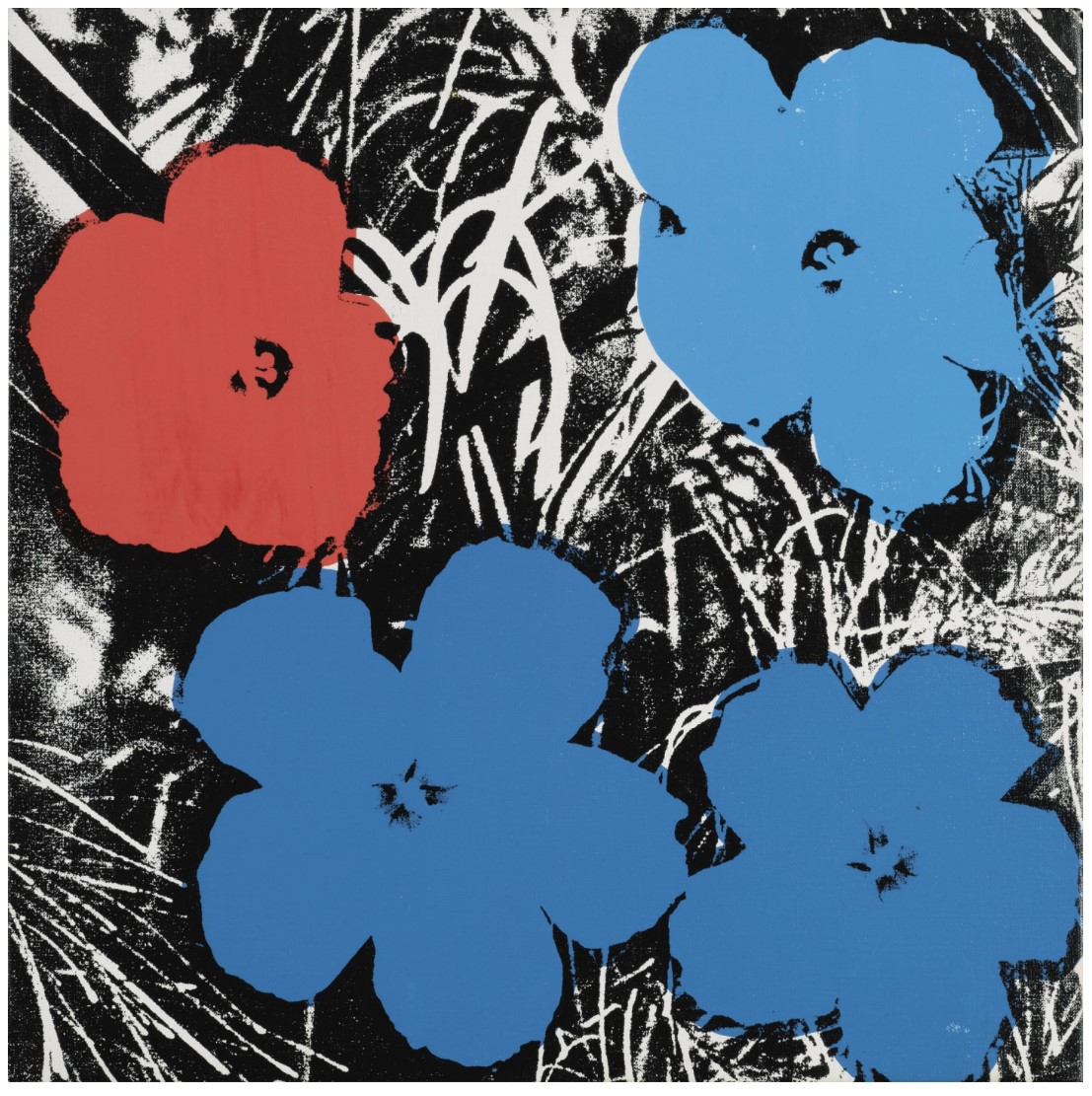
ANDY WARHOL
Flowers, 1964-65
Acrylic and silkscreen ink on linen
22×22 inches (55.9 x 55.9 cm)
Signed and dated 64 on the overlap
Furthermore, this specific example possesses an esteemed history having been part of the famous private collections of Robert and Ethel Scull – important early patrons of Warhol – and J. Irwin Miller – a patron of modern architecture and collector of modern art who exhibited this Flowers painting as part of his collection in 1977 at the Indianapolis Museum of Art. Executed in striking chromatic shades and boasting a fine pedigree of previous ownership, this painting is utterly synonymous with Warhol at the very height of his creative powers.
Flowers, 1965
Christie’s New-York: 13 May 2015
Estimated: USD 1,500,000 – 2,500,000
USD 4,197,000
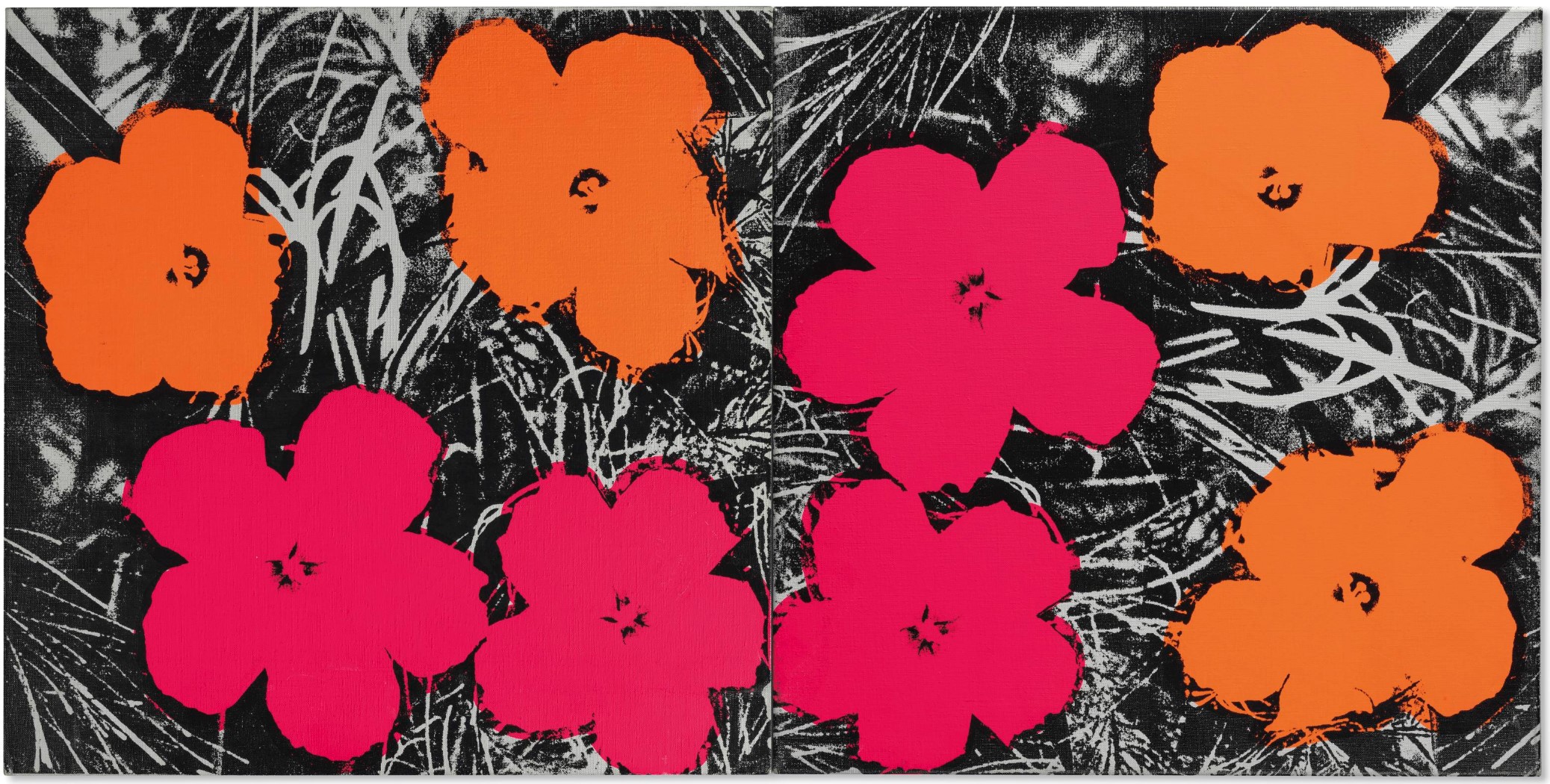
ANDY WARHOL
Flowers, 1965
Synthetic polymer and silkscreen inks on linen, in two parts
Each: 22×22 inches (55.9 x 55.9 cm)
Overall: 22×44 inches (55.9 x 111.7 cm)
Phillips London: 18 October 2008
GBP 735,650
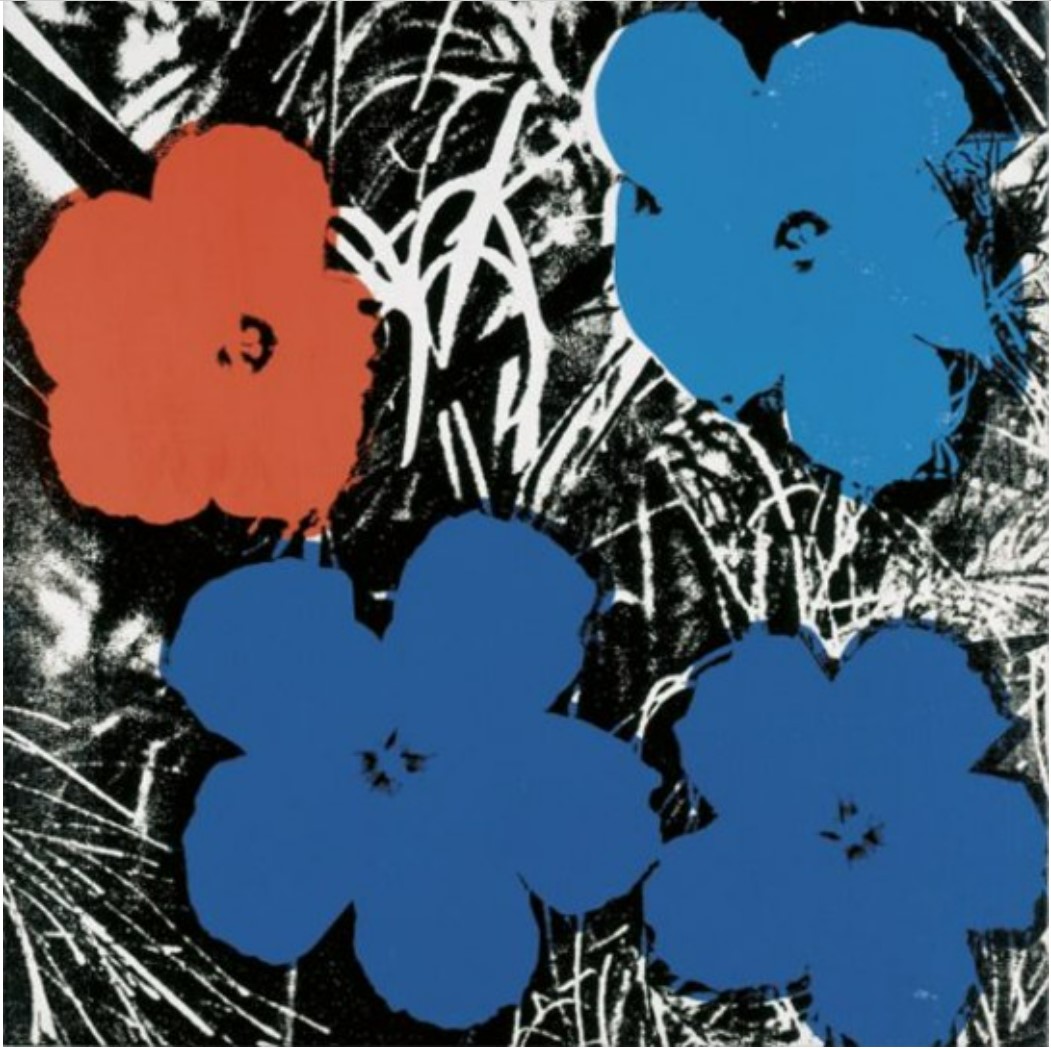
ANDY WARHOL
Flowers, 1964
Silkscreen inks on linen.
22×22 inches (55.9 x 55.9 cm)
Signed and dated ‘Andy Warhol 64’ on the overlap
Flowers (14×14)
Flowers, 1964
Christie’s New-York: 30 September 2025
Estimated: USD 150,000 – 200,000
USD 419,100
ANDY WARHOL (1928-1987), Flowers | Christie’s
REPEAT SALE
Christie’s New-York: 9 March 2021
Estimated: USD 200,000 – 300,000
USD 300,000
Andy Warhol (1928-1987) (christies.com)
ANDY WARHOL (1928-1987)
Flowers, 1964
Acrylic and silkscreen ink on canvas
14×14 inches (35.6 x 35.6 cm)
Signed indistinctly ‘Andy Warhol’ (on the overlap)
Provenance
Leon and Robyn Supraner, New York, circa 1964
Private collection, New York, by descent from the above
Anon. sale; Christie’s, New York, 8 March 2021, lot 49
Private collection, Switzerland
Acquired from the above by the present owner
With its colorful red flowers set against lush green foliage, Andy Warhol’s Flowers (1964) have become one of the most iconic and enigmatic images the artist ever painted. Following on from his highly acclaimed Death and Disaster paintings of 1962-1963, these bright and seemingly cheerful works were a welcomed departure from the dark, politically motivated and often disturbing canvases of the past. However, Warhol’s Flowers series also have a darker, more melancholic quality that beautifully synthesizes the themes that occupied his early oeuvre. This fourteen-inch version has been in the same family collection for nearly fifty years, acquired directly from the artist shortly after it was painted in 1964. Leon and Robyn Supraner knew Warhol through their connections with the entertainment industry (Leon insured Off Broadway shows and was an award winning photographer whose work is in the permanent collections of the Museum of the City of New York and the New York State Historical Society, and Robyn was a lyricist—writing songs for Chubby Checker amongst others—and an author of several books for children). During the 1960s, the couple became friendly with Warhol, visiting the Factory on several occasions, and acquiring a number of works by the artist.
Flowers, 1964
Sotheby’s Paris: 10 April 2025
Estimated: EUR 200,000 – 300,000
EUR 977,900 / USD 1,070,770
Flowers | Art Moderne et Contemporain Evening Auction | 2025 | Sotheby’s
ANDY WARHOL (1928 – 1987)
Flowers, 1964
Silkscreen ink on linen
14×14 inches (35.6 x 35.6 cm)
Signed, dedicated and dated twice 64 and 1964 (on the overlap)
Executed in 1964, Flowers is iconic for its poignant simplicity, luminous palette and intimate format. With four peacock-blue hibiscus flowers on the black-and-white surface, Andy Warhol revisits one of the most emblematic themes in the history of art – the floral still life. Almost abstract, the flowers emanate from the canvas with force and light, giving the image unrivalled sharpness and a striking immediacy.
Flowers, 1964-65
Sotheby’s London: 6 March 2024
Estimated: GBP 1,200,000 – 1,800,000
GBP 1,113,800 / USD 1,412,298
Flowers | Modern & Contemporary Evening Auction featuring The Now | 2024 | Sotheby’s (sothebys.com)
ANDY WARHOL (1928 – 1987)
Flowers, 1964-65
Acrylic and silkscreen ink on canvas
14×14 inches (35.6 x 35.6 cm)
Signed and dated 64 (on the overlap)
Executed between 1964-65, Flowers is elegant in its intimate scale, poignant simplicity, and its bright palette. Four fluorescent pink flowers float upon an encompassing and translucent backdrop of blackness; these bright almost abstract forms radiate a striking immediacy synonymous with one of the Pop era’s most enduring bodies of work: Andy Warhol’s Flowers. Flowers is distinguished from the group by its crisply rendered screen and rare fluorescent color, giving the image unparalleled sharpness and striking immediacy.
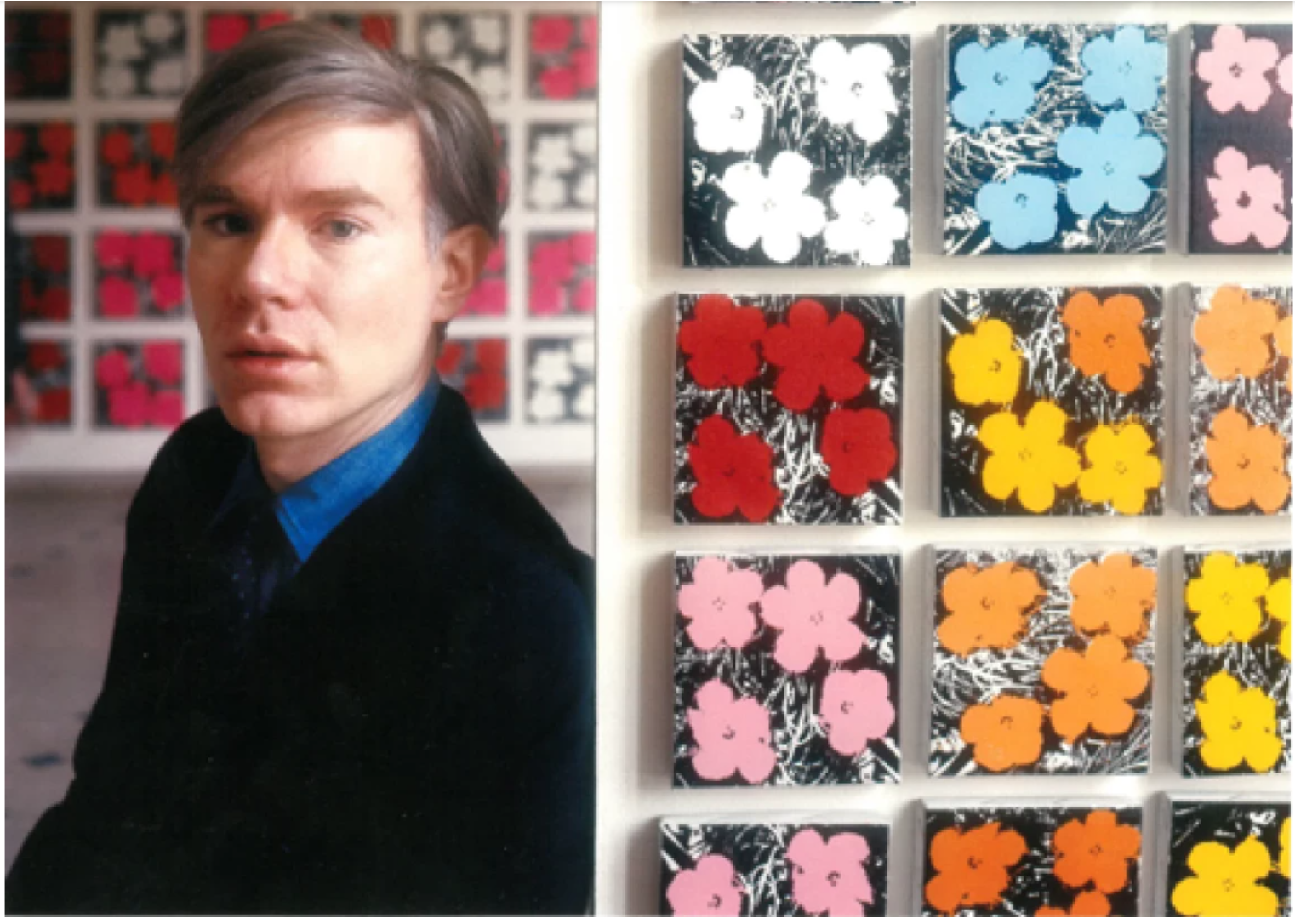
Whilst Warhol’s previous series—Death and Disaster—exploited photographs of car crashes, the electric chair and suicide, the Flowers seem to be distanced from this morbidity with their bright palette. Yet, the motif of the hibiscus is laden with tragedy that permeates Warhol’s entire oeuvre. Hibiscuses signify beauty, and especially the fleeting nature of beauty and fame, a symbolic meaning that wouldn’t have escaped Warhol. The Flowers became metaphors for a generation that changed artistically, socially and politically in a supremely important decade. Continuing Warhol’s typical use of mass imagery as source material, the Flowers series comes from a sequence of photographs on seven hibiscus blossoms, published in the June 1964 issue of Modern Photography to accompany an article on the new Kodak home color processing system. Modern Photography’s executive editor Patrick Caulfield took the original horizontal-format photographs and printed them with subtle color variances to illustrate the compelling visual effects of different exposure times and filter settings. Warhol further cropped, rotated, and printed versions of this extract into a square composition.
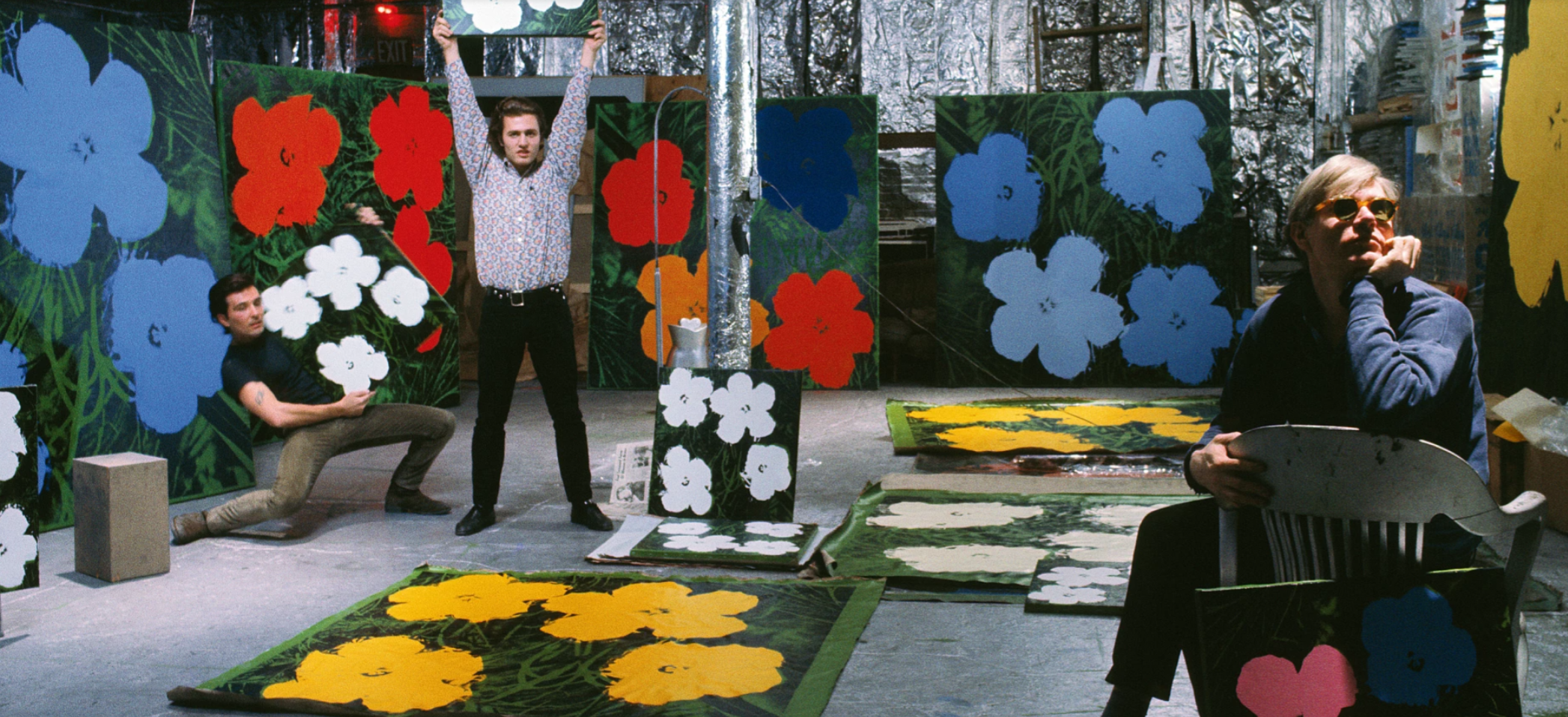 During the summer of 1964, Warhol executed canvases portraying this composition in formats measuring eighty-two, forty-eight- and twenty-four-inches square, intended for an exhibition with his new dealer Leo Castelli to open in New York in November. Castelli already represented the leading artists of the day, including Robert Rauschenberg, Jasper Johns, and Frank Stella; Warhol’s introduction into Castelli’s exclusive circle catapulted him into the highest echelons of artistic eminence and cemented his place in the canon of twentieth-century art history.
Flowers is among the smaller canvasses from the series, measuring twenty-four by twenty-four inches, that Warhol produced specifically for an exhibition at the Galerie Ileana Sonnabend in Paris in the spring of 1965. Unlike those in the Castelli exhibition, the Flowers made for the Sonnabend exhibition are painted on a white rather than green background; in the present work, this compositional choice means the fluorescent shapes contrast dramatically with the dark and hazy background. Ever since the Ethel Scull commission in 1963, Warhol found freedom in working in the square format—for it challenged the idea of a fixed upright—as Warhol could exhibit them in endless configurations to induce subtle variances in form and color and elicit rhythmic patterns. The gaps in between were narrower, creating this tiled structure of fluorescent flowers. Arranging the small canvases in a grid-like matrix, Warhol transformed the Galerie Ileana Sonnabend—the tesserae of Flowers reminiscent of those in Byzantine churches—into a spiritual mecca to Pop Art.
Flowers, 1964
Van Ham: 29 November 2023
Estimated: EUR 300,000
EUR 554,400 / USD 608,094
Andy Warhol – Buy & Sell | VAN HAM Art Auctions (van-ham.com)
ANDY WARHOL
Flowers, 1964
Synthetic polymer paints on canvas
14×14 inches (36×36 cm)
Signed and dated verso top on folded canvas: ANDY WARHOL 64
Stamped with the estate stamp and the stamp of the Andy Warhol Foundation for the Visual Arts
Numbered A1094.101 VF
The symbol of an entire artistic movement A beautiful example from Warhol’s iconic series »Flowers« is the canvas work on offer, which is a true cabinet piece with its size. The work was created in 1964 when Andy Warhol was on his way to becoming an iconic figure in the New York art world. Warhol took up not only the theme, but also the seriality of the layout in his works. In doing so, he did not simply appropriate the image, but rather cropped it and rotated one of the flowers until he had achieved the desired square format. He also increased the contrast of the image so much that the hibiscus flowers were no longer recognizable as such. In this way he achieved the simple, smooth forms and vivid outlines that characterize the “Flowers.” And he deliberately chose the square format, not only because he liked working on a square, but also because the regular shape allows the flower pictures to be hung up with each side facing up. Warhol also deliberately chose the unnatural-looking tones of brilliant synthetic colors for his flowers, which were clearly man-made. Its glaring luminosity is almost like an attack on nature, as if the natural wonder of the flower were artificially created. Warhol dealt intensively with the tradition of the still life. In doing so, he interpreted the motif in a rather banal way. Thus, he dispensed with a complicated and hierarchical composition and used the “overhead” perspective to discard horizon and spatiality and to depict the flowers in simplified and distorted forms. In addition, instead of complex color harmonies, he used the unnatural colors.
Flowers, 1964
Christie’s London: 24 June 2019
Estimated: GBP 400,000 – 600,000
GBP 671,250 / USD 851,865
Andy Warhol (1928-1987), Flowers | Christie’s
ANDY WARHOL
Flowers, 1964
Acrylic and silkscreen inks on canvas
14×14 inches (35.6 x 35.6 cm)
Signed and dated ‘Andy Warhol 64’ (on the overlap)
Provenance
Galerie Ileana Sonnabend, Paris
Frederick W. Hughes, New York
Thomas Ammann Fine Art, Zurich
Heiner Bastian, Berlin
Stellan Holm, New York
Acquired from the above by the present owner in 2004
Created for Andy Warhol’s seminal 1965 ‘Flowers’ exhibition at Sonnabend Gallery, Paris, Flowers (1965) is a striking monochrome example of one of the artist’s most visually bold and conceptually piercing series. In a powerful riposte to the romantic art-historical associations of flower painting, Warhol’s blossoms are flattened, condensed and mechanically repeated. Refined to four flat silhouettes, they appear in the present work as blank white voids hovering among shadowy blades of grass. The image was derived from a photograph of hibiscus blooms published in the June 1964 issue of Modern Photography magazine, which was repeated in four different colour variants to illustrate an article on a Kodak colour processor: a Pop-ready serialised format which, as Michael Lobel argues, ‘suggests the blossoms were ripe for Warholian plucking’ (M. Lobel, ‘In Transition: Warhol’s Flowers’, in Andy Warhol Flowers, exh. cat. Eykyn Maclean, New York 2012, n.p.). Creating his Flowers silkscreens on a variety of scales – all square, so that the canvases could be hung in grid-like formation on gallery walls – Warhol amplified the original photograph’s chill implication that nature had become another packaged product in the age of consumer technology. Distilled to stark black and white, Flowers represents one of Warhol’s most iconic motifs at its vacant and beguiling best.
Flowers, 1964
Property from the Miles and Shirley Fiterman Collection
Phillips Hong-Kong: 26 May 2019
Estimated: HKD 6,500,000 – 8,500,000
HKD 6,150,000 / USD 783,525
Andy Warhol 20th Century & Contemporary Art Evening Sale
ANDY WARHOL
Flowers, 1964
Silkscreen ink on linen
14×14 inches (35.6 x 35.6 cm)
Signed, dedicated and dated ‘Andy Warhol 64 To Mr. and Mrs. Fiterman ♡’ on the overlap
Provenance
Leo Castelli Gallery, New York
Locksley Shea Gallery, Minneapolis
Acquired from the above by the present owner
Against a verdant green ground, a grid of four exuberant red floral forms emerges, each delicately delineated by traces of a monochrome photographic image. As a preeminent example from one of Andy Warhol’s most iconic series of paintings, Flowers represents a formative moment in the history of Pop Art. Succinctly conjuring the artist’s most important themes of mortality and beauty, Warhol calls upon the historic genre of still life painting, adding the symbolic weight of the flower to his pantheon of mass produced products, celebrities and macabre images sourced from the daily news. Whilst the Flowers series would also signify Warhol’s adoption of mass-production techniques within his recently acquired ‘factory’, the present work is rare within the wider corpus. Of all 14 inch Flowers paintings listed in the artist’s catalogue raisonné, there are only five works (including the present) which utilise this uniquely vibrant combination of contrasting red and green paint. Furthermore, the present work is one of only two 14 inch Flowers that are signed with a dedication. Warhol assigned this work to prolific collectors Miles and Shirley Fiterman, in whose collection it has remained since they acquired it shortly after it was painted in 1964. Flowers thus represents the dawning of a long-standing relationship of patronage between the couple and Warhol, and attests to the unparalleled historic importance of their collection as well as their role as collectors.
Flowers, 1964
Christie’s New-York: 16 May 2019
Estimated: 600,000 – 800,000
USD 639,000
Andy Warhol (1928-1987), Flowers | Christie’s
ANDY WARHOL
Flowers, 1964
Acrylic and silkscreen ink on canvas
14×14 inches (35.6 x 35.6 cm)
Signed and dated ‘Andy Warhol 64’ (on the overlap)
Stamped with the Andy Warhol Art Authentication Board, Inc. stamp and numbered ‘A103.025’ (on the overlap)
Provenance
Ileana Sonnabend, Paris
Frederick W. Hughes, New York
Thomas Ammann Fine Art, Zürich
Heiner Bastian, Berlin
Stellan Holm Gallery, New York
Private collection, Korea, 2004
Acquired from the above by the present owner
Magnificently composed of four white petals and registered on a black ground, Andy Warhol’s Flowers of 1964, is an example of one of Pop Art’s most iconic series. During the fifty-five years since their creation, Warhol’s Flower paintings have become the stuff of legends and have pervaded the global consciousness as a classic emblem of American late 20th century art. In the early 1960s, Warhol established himself as leader of the Pop Art movement with his repeated images of celebrity icons, disaster scenes, and consumer goods such as Campbell’s soup cans. But like many of his fellow Pop artists, he eventually grew eager to move on to other artist endeavors. In the spring of 1965, at the second exhibition of Flowers at Ileana Sonnabend Gallery in Paris, he announced his retirement from painting altogether, turning his artistic intentions toward film. This announcement proved to be premature, however, as he continued his engagement with painting throughout his career. The Flowers series did not mark an endpoint, but rather signaled the changing profile of Warhol’s artistic output.
Flowers, 1964
Christie’s New-York: 10 November 2015
Estimated: USD 700,000 – 1,000,000
USD 869,000
Andy Warhol (1928-1987), Flowers | Christie’s
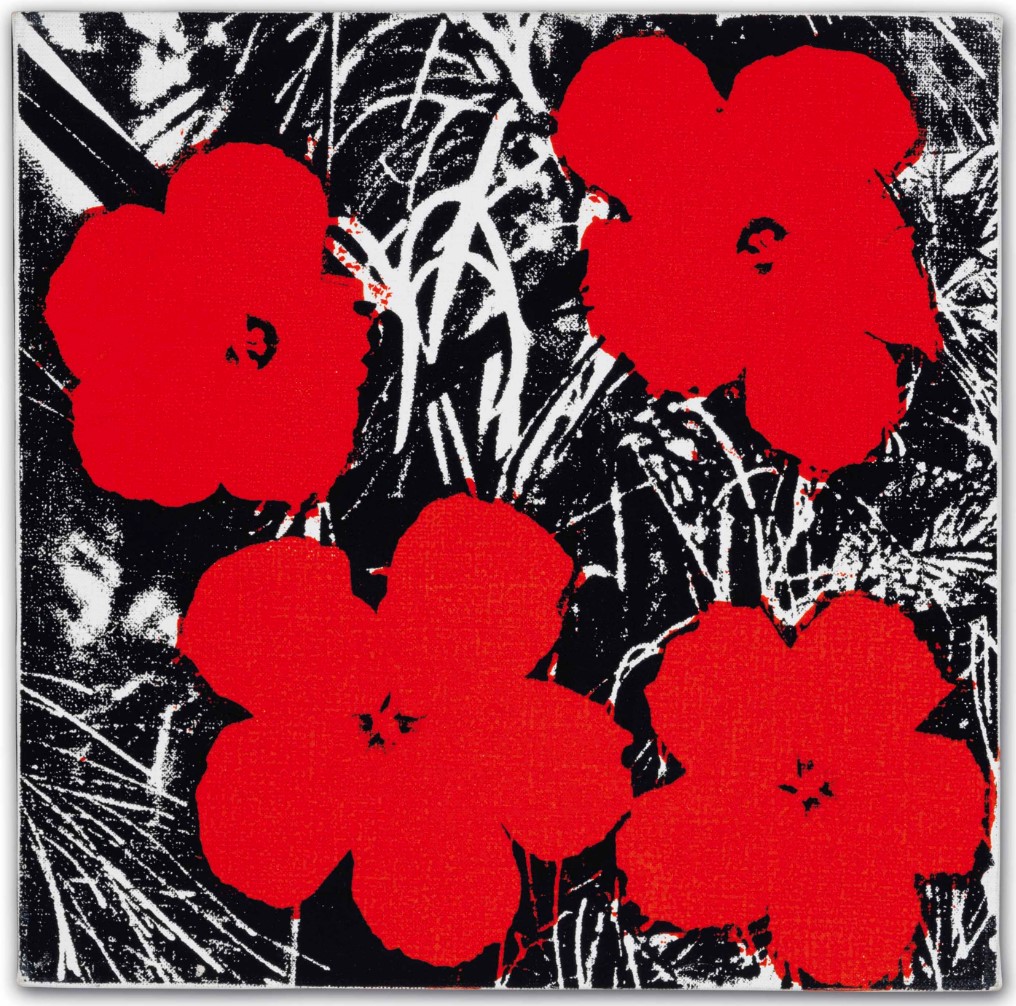
ANDY WARHOL
Flowers, 1964
Silkscreen ink on canvas
14×14 inches (35.5 x 35.5 cm)
Signed and dated ‘ANDY WARHOL 64’ (on the overlap)
Flowers, 1965
Christie’s New-York: 11 November 2015
Estimated: USD 600,000 – 800,000
USD 749,000
Andy Warhol (1928-1987), Flowers | Christie’s
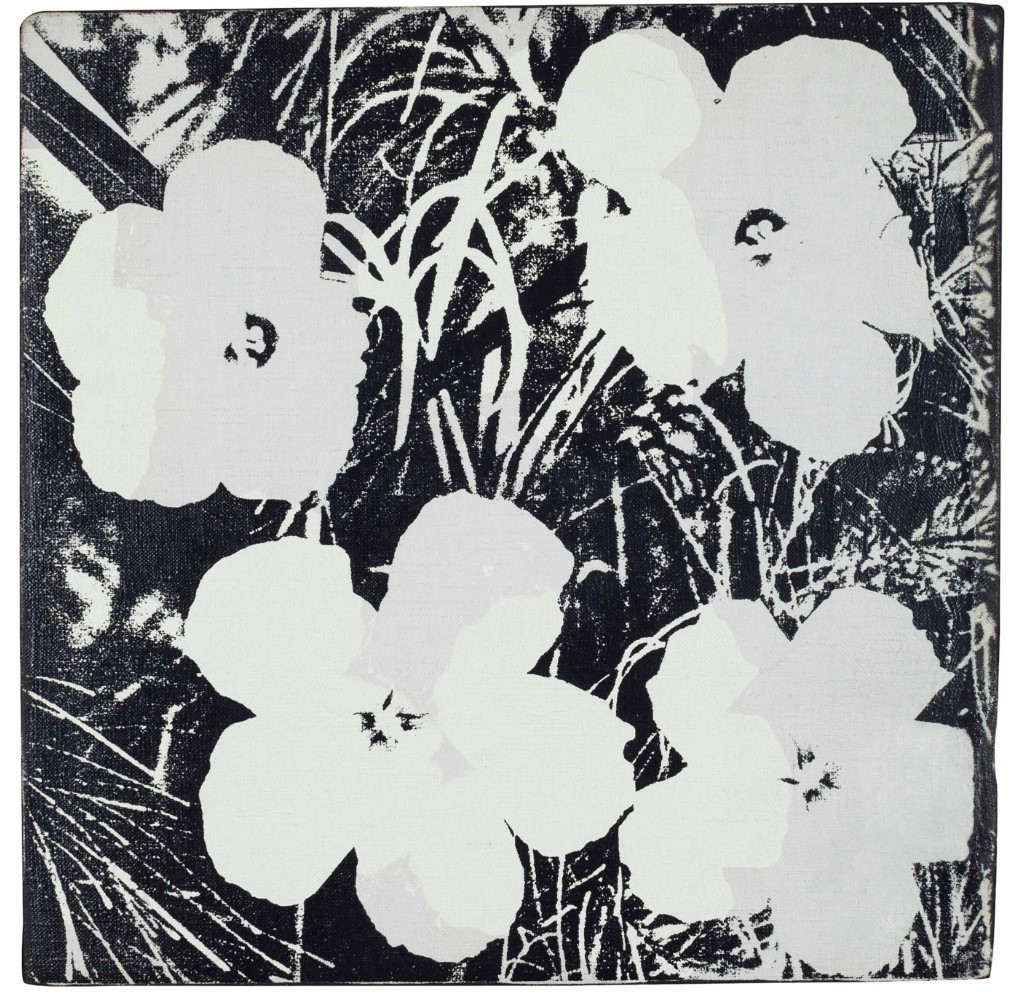
ANDY WARHOL
Flowers, 1965
Acrylic and silkscreen ink on canvas
14×14 inches (35.6 x 35.6 cm)
Signed and dated ‘Andy Warhol 1965’ (on the reverse)
Flowers, 1964
New-York: 13 November 2014
Estimated: USD 750,000 – 950,000
USD 965,000
Andy Warhol (1928-1987), Flowers | Christie’s
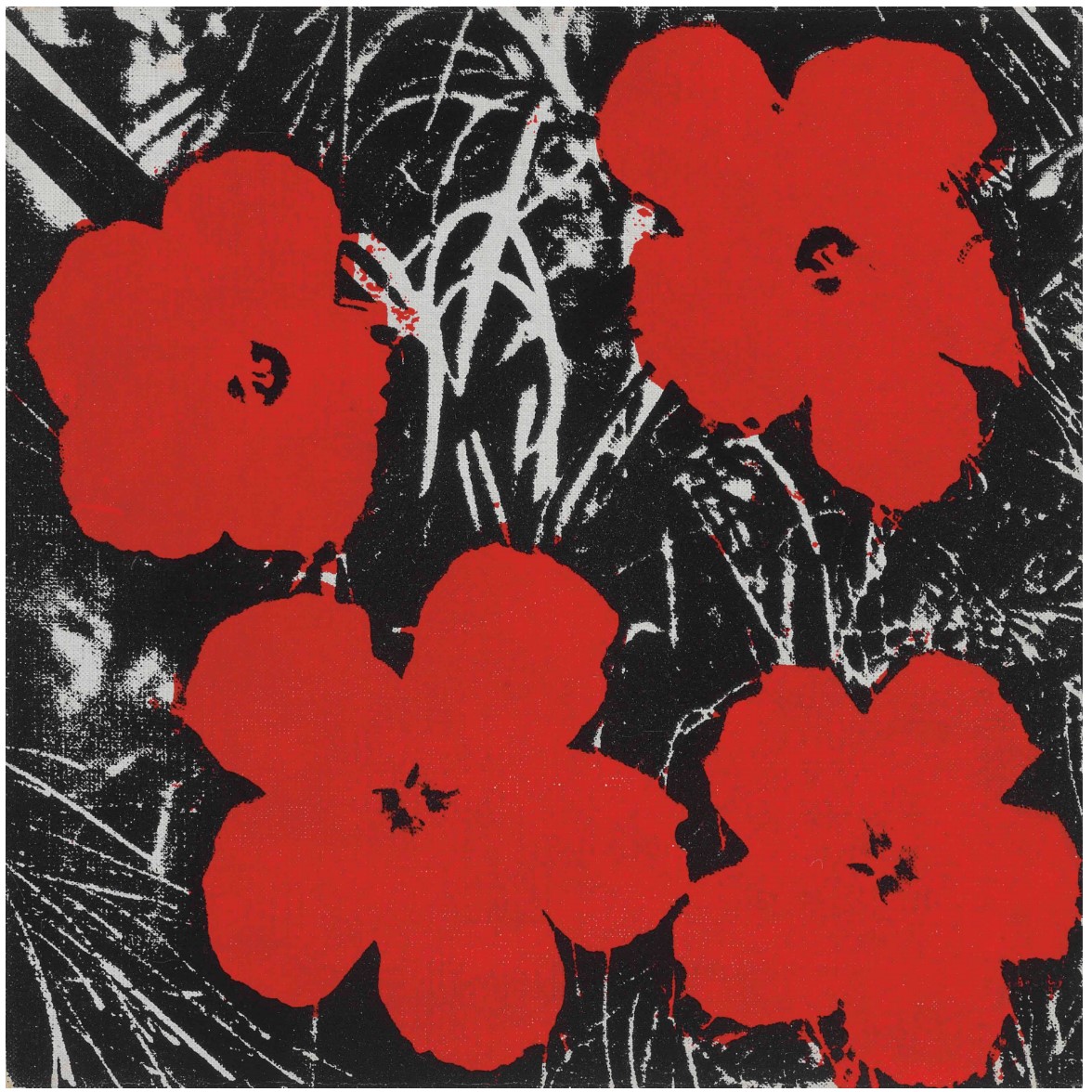
ANDY WARHOL
Flowers, 1964
Synthetic polymer and silkscreen inks on canvas
14×14 inches (35.5 x 35.5 cm)
Flowers, 1964
Christie’s New-York: 9 May 2012
Estimated: USD 800,000 – 1,200,000
USD 1,202,500
Andy Warhol (1928-1987) , Flowers | Christie’s
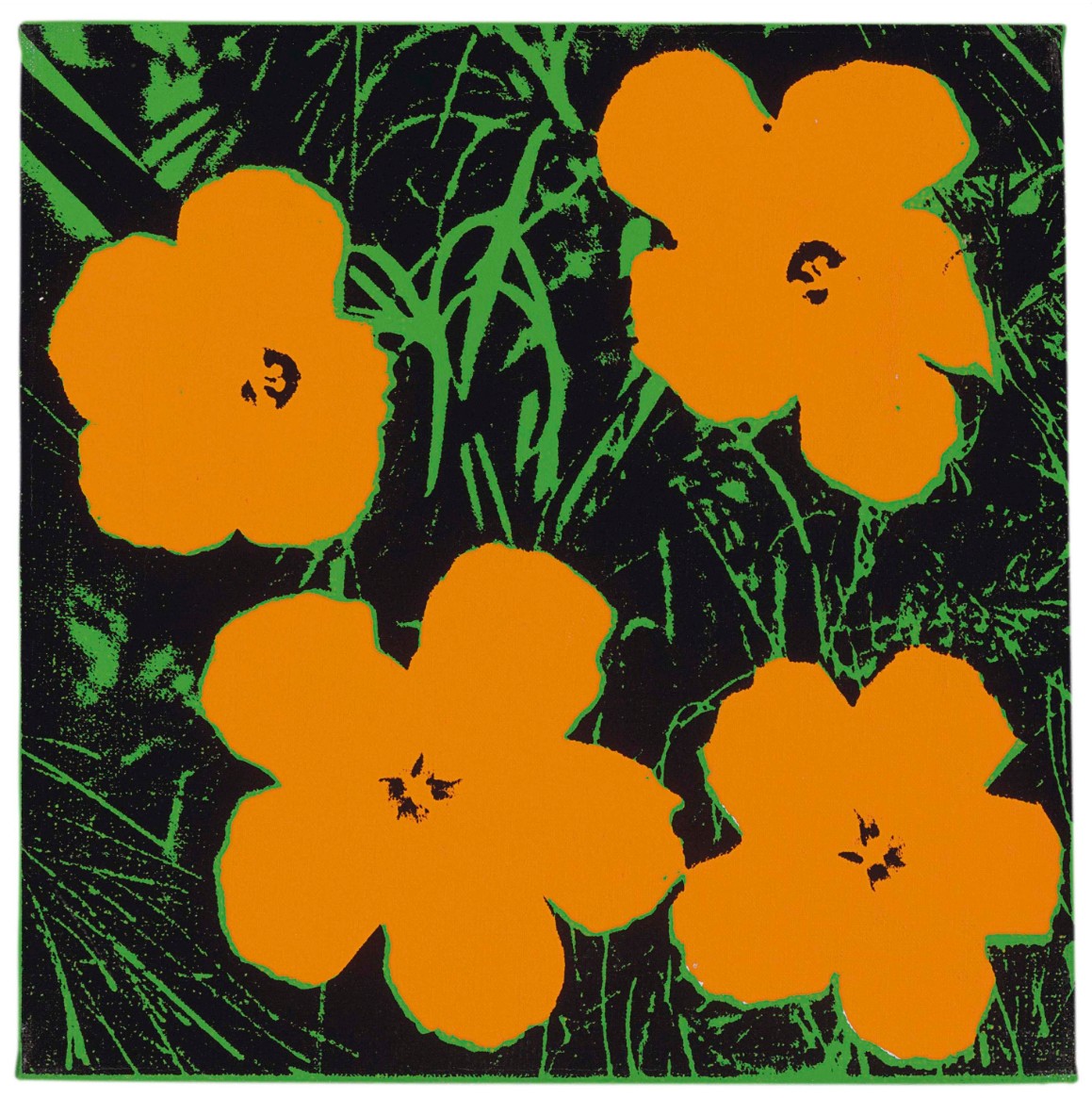
ANDY WARHOL
Flowers, 1964
Synthetic polymer and silkscreen inks on canvas
14×14 inches (35.5 x 35.5 cm)
Signed and dated ‘Andy Warhol 1964’
Stamped with the Andy Warhol Art Authentication Board, Inc. stamp
Numbered ‘A115.965’ (on the overlap)
Flowers, 1964
Sotheby’s New-York: 12 May 2009
Estimated: USD 400,000 – 600,000
USD 410,500
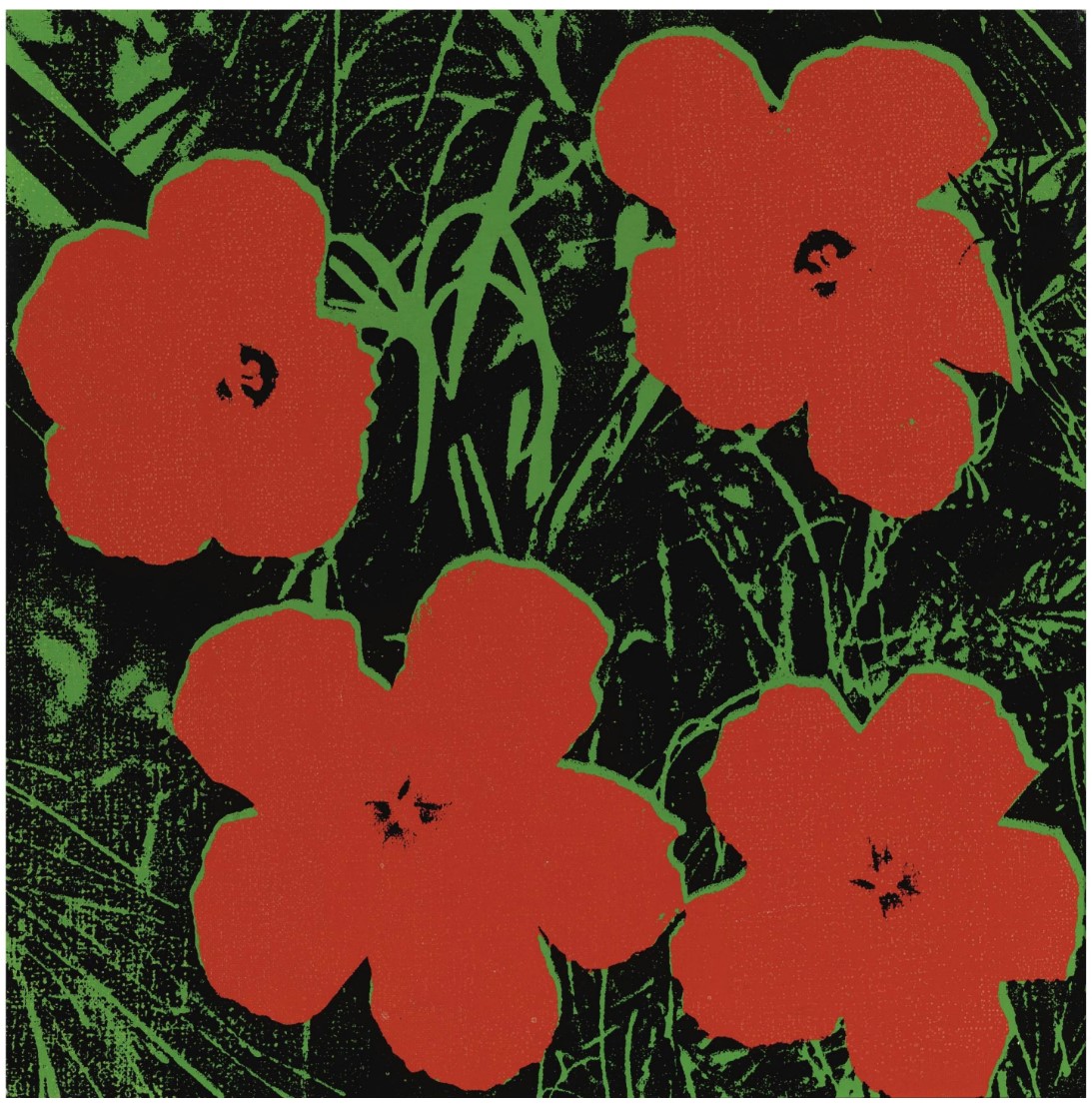 ANDY WARHOL
Flowers, 1964
Silkscreen ink on canvas
14×14 inches (35.6 x 35.6 cm)
Signed and dated 64 on the overlap
Flowers, 1964
Sotheby’s London: 27 February 2008
Estimated: GBP 300,000 – 400,000
GBP 580,500
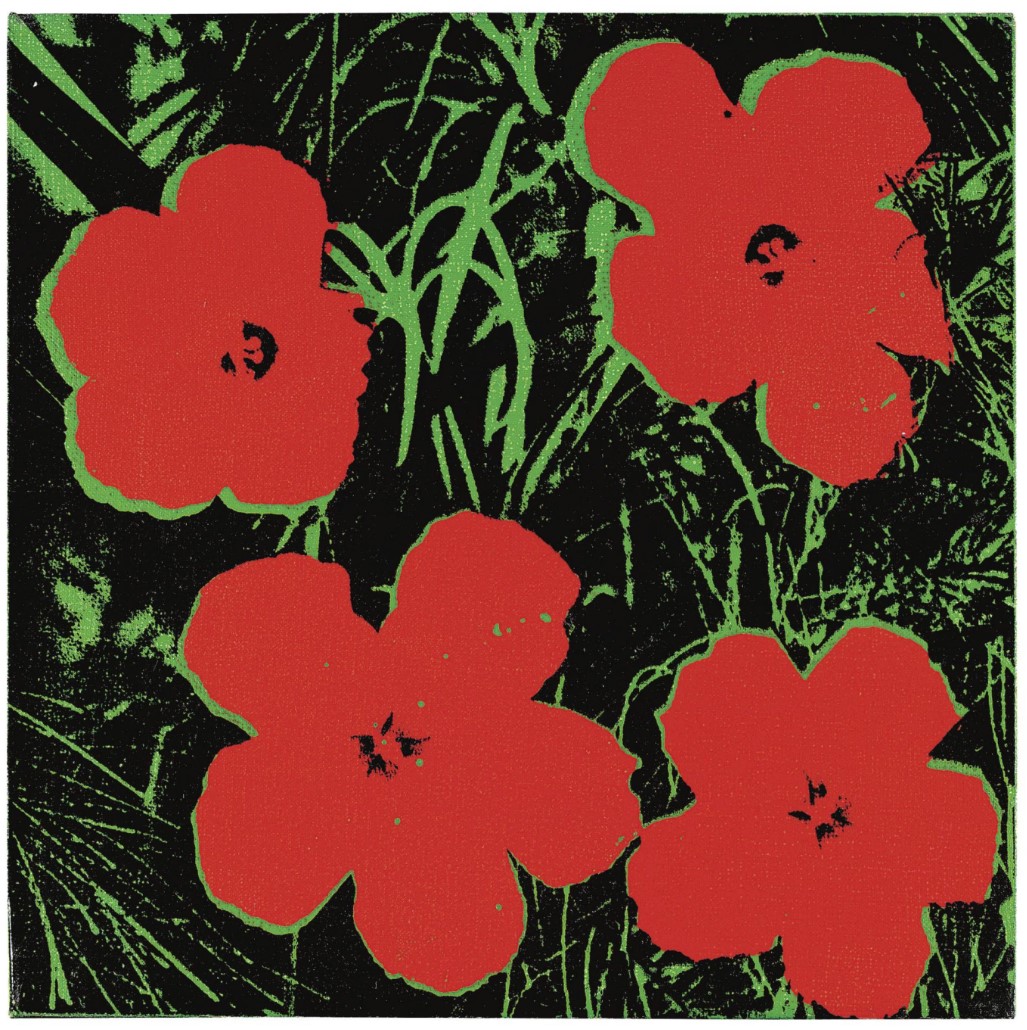 ANDY WARHOL
Flowers, 1964
Acrylic and silkscreen ink on canvas
14×14 inches (35.6 x 35.6 cm)
Signed and dated 64 on the overlap
Phillips London: 22 June 2007
Estimated: GBP 250,000 350,000
GBP 356,000 /
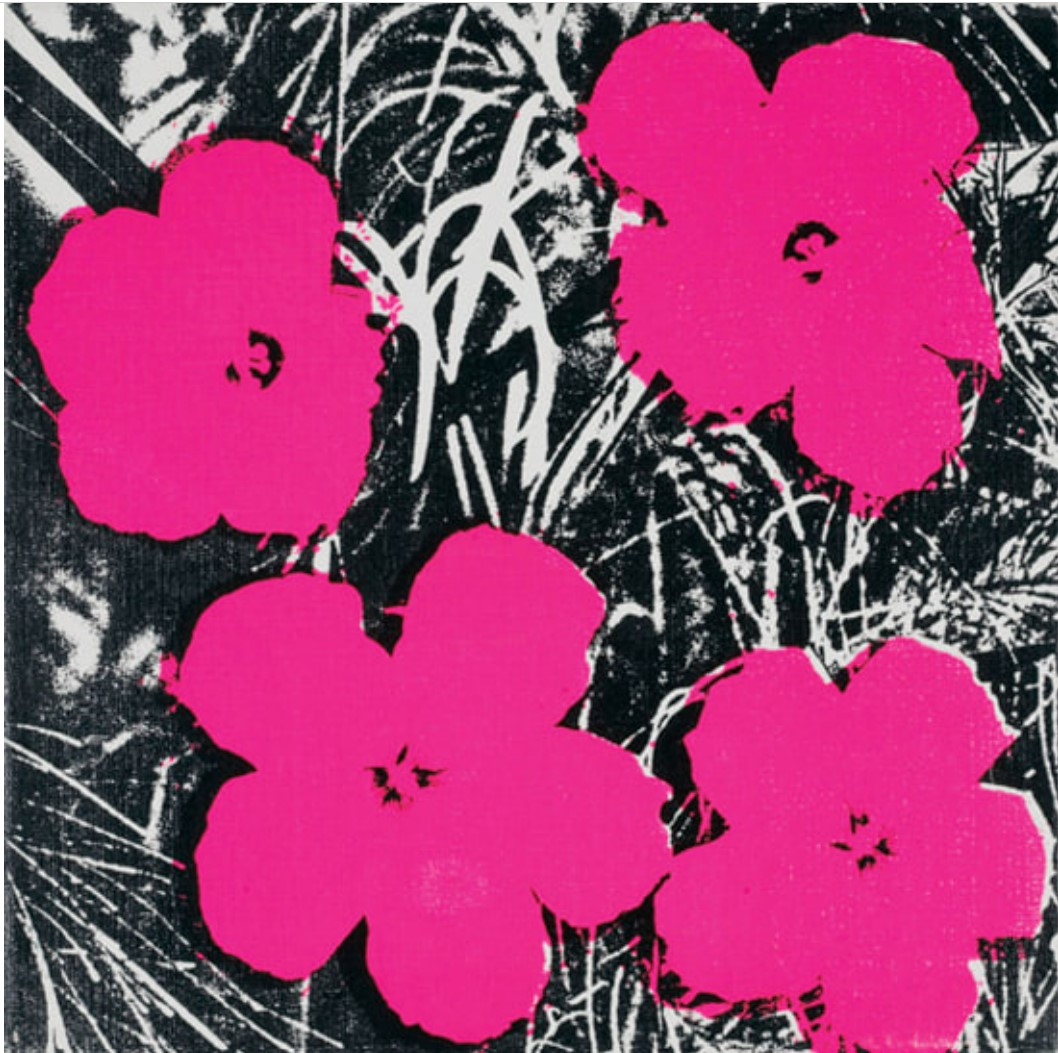
ANDY WARHOL
Flowers, 1964
Silkscreen ink on linen
14×14 inches (35.6 x 35.6 cm)
Signed and dated “Andy Warhol 64” on the overlap
Flowers, 1964
Sotheby’s London: 21 June 2007
Estimated: GBP 250,000 – 350,000
GBP 445,600
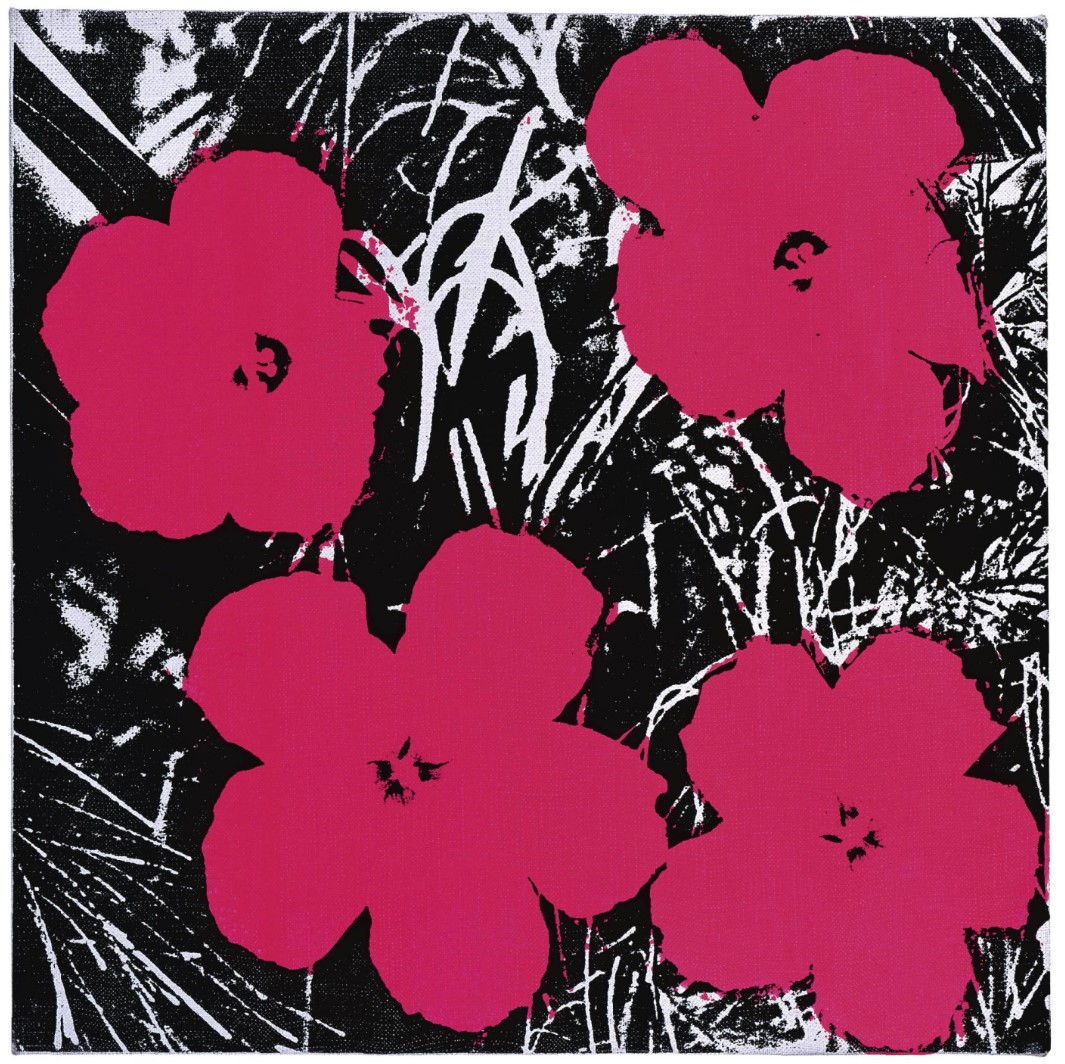 ANDY WARHOL
Flowers, 1964
Acrylic and silkscreen ink on canvas
14×14 inches (35.6 x 35.6 cm)
Signed and dated 64 on the overlap
Flowers (8×8)
Flowers, 1964
Ketterer: 8 December 2023
Estimated: EUR 180,000
EUR 190,500 / USD 200,025
Ketterer Kunst, Art auctions, Book auctions Munich, Hamburg & Berlin
ANDY WARHOL
Flowers, 1964
Silkscreen in colors on canvas
8×8 inches (20.5 x 20.5 cm)
Monogrammed, dated and inscribed “Top” on the folded canvas
Flowers, 1964
Christie’s London: 29 June 2023
Estimated: GBP 200,000 – 300,000
GBP 264,600 / USD 333,795
ANDY WARHOL (1928-1987) (christies.com)
ANDY WARHOL (1928-1987)
Flowers, 1964
Acrylic and silkscreen ink on canvas
8×8 inches (20.3 x 20.3 cm)
Signed and dated ‘Andy Warhol 64’ (on the overlap)
Ablaze in glorious chromium yellow, Flowers (1964) is a vivid example of one of Andy Warhol’s most iconic and conceptually potent series. In a riposte to the romantic art-historical associations of flower painting, Warhol’s blossoms are flattened, condensed and mechanically repeated. Refined to four flat silhouettes, they glow brightly as they hover among shadowy blades of grass. The image stems from a photograph of hibiscus blooms published in the June 1964 issue of Modern Photography magazine, which was printed in four different variants to illustrate an article on a Kodak color processor: a serial readymade which lent itself to the Warholian treatment. Creating his Flowers silkscreens on a variety of scales—all of them square, so that the canvases could be hung in grid formation on gallery walls—Warhol amplified the photograph’s implication that nature had become another packaged product in the age of consumer technology. The present Flowers, which Warhol consigned to Ileana Sonnabend in Paris in early 1965, are on an eight-by-eight-inch canvas, with the intimate presence of a devotional icon. They are artificial, luminous and beguiling.
Flowers, 1965
Christie’s New-York: 13 May 2022
Estimated: USD 250,000 – 300,000
USD 529,200
ANDY WARHOL (1928-1987) (christies.com)
ANDY WARHOL
Flowers, 1965
Acrylic, silkscreen ink and graphite on linen
8×8 inches (20.3 x 20.3 cm)
Flowers, 1965
SBI Art Auction: 12 March 2022
Estimated: JPY 15,000,000 – 25,000,000
JPY 33,350,000 / USD 284,241
ANDY WARHOL
Flowers, 1965
Acrylic and silkscreen ink on canvas
8×8 inches (20.3 x 20.3 cm)
Signed and dated (1964) on the reverse
Flowers, 1964
Christie’s New-York: 12 November 2021
Estimated: USD 250,000 – 350,000
USD 487,500
ANDY WARHOL (1928-1987) (christies.com)
ANDY WARHOL (1928-1987)
Flowers, 1964
Acrylic and silkscreen ink on canvas
8×8 inches (20.3 x 20.3 cm)
Signed, dedicated and dated ‘to PHILIP MY LOVE ANDY DEC. 64’ (on the overlap)
Offered from the collection of the Philip Norman Fagan Archive, these Flowers by Andy Warhol bear a touching inscription to his lover, muse, and studio assistant Phillip Fagan. Fagan and Warhol met in the fall of 1964, and Fagan quickly became Warhol’s first live-in boyfriend, central film subject, and studio assistant, working alongside Gerard Malanga in the Factory as part of Warhol’s official silkscreening team.
Flowers, 1964
Sotheby’s New-York: 19 November 2021
Estimated: USD 150,000 – 200,000
USD 441,000
Flowers | Contemporary Day Auction | 2021 | Sotheby’s (sothebys.com)
ANDY WARHOL
Flowers, 1964
Acrylic and silkscreen ink on canvas
8×8 inches (20.3 x 20.3 cm)
Flowers, 1964
Sotheby’s New-York: 19 November 2021
Estimated: USD 180,000 – 250,000
USD 403,200
Flowers | Contemporary Day Auction | 2021 | Sotheby’s (sothebys.com)
ANDY WARHOL
Flowers, 1964
Acrylic and silkscreen ink on canvas
8×8 inches (20.3 x 20.3 cm)
Flowers, 1964
Sotheby’s New-York: 19 November 2021
Estimated: USD 150,000 – 200,000
USD 277,200
Flowers | Contemporary Day Auction | 2021 | Sotheby’s (sothebys.com)
ANDY WARHOL (1928 – 1987)
Flowers, 1964
Acrylic and silkscreen ink on canvas
8×8 inches (20.3 x 20.3 cm)
Signed Andy Warhol and dated 64 (on the overlap)
Flowers, 1964
Christie’s New-York: 12 November 2021
Estimated: USD 250,000 – 350,000
USD 487,500
ANDY WARHOL (1928-1987), Flowers | Christie’s
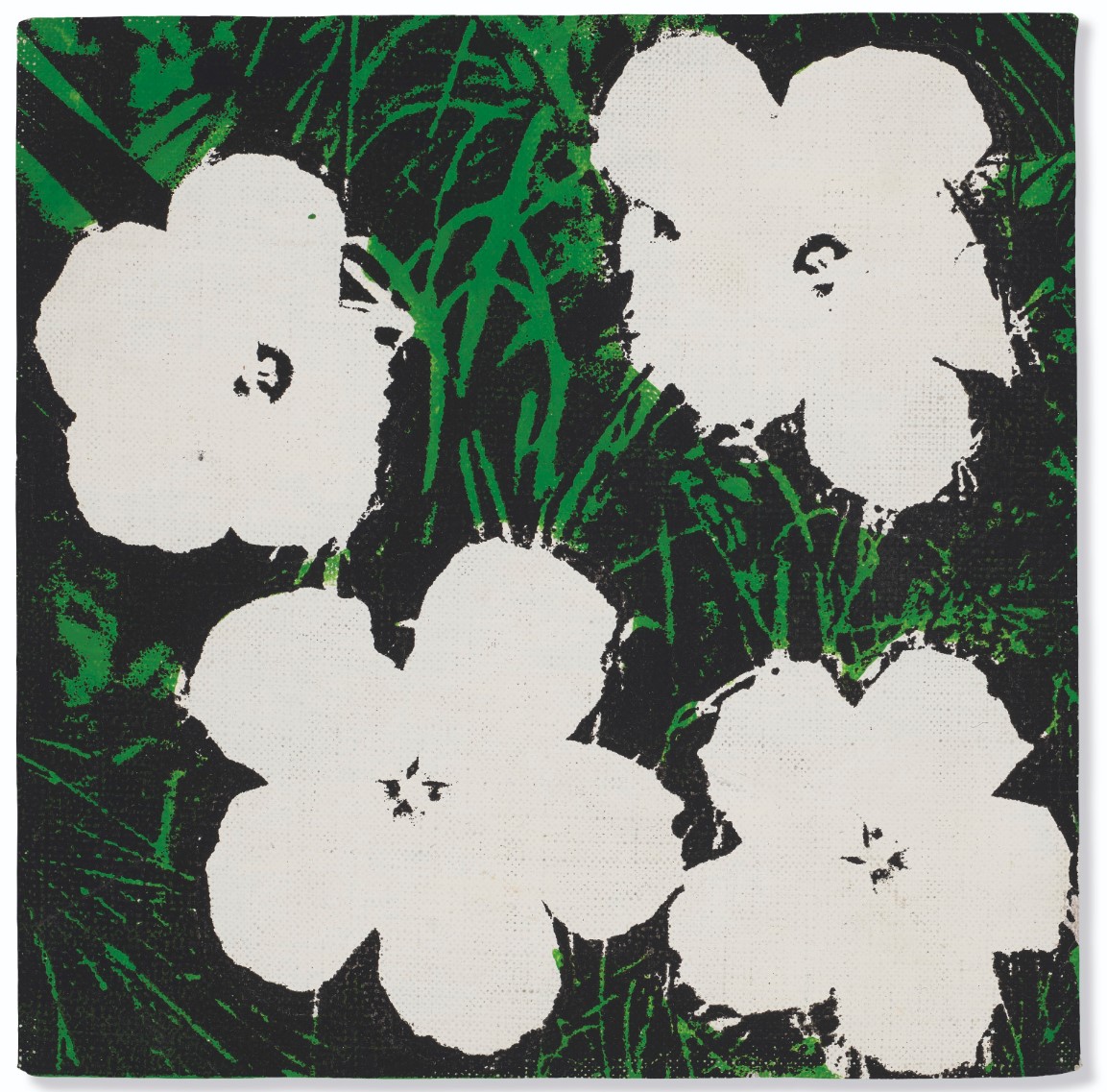
ANDY WARHOL
Flowers, 1964
Acrylic and silkscreen ink on canvas
8×8 inches (20.3 x 20.3 cm)
Flowers, 1964
Sotheby’s New-York: 6 March 2020
Estimated: USD 150,000 – 200,000
USD 231,250
ANDY WARHOL
Flowers, 1964
Acrylic and silkscreen ink on canvas
8×8 inches (20.3 x 20.3 cm)
Flowers, 1964
Sotheby’s New-York: 15 November 2019
Estimated: USD 150,000 – 200,000
USD 175,000
ANDY WARHOL
Flowers, 1964
Acrylic and silkscreen ink on canvas
8×8 inches (20.3 x 20.3 cm)
Flowers (Three Works), 1964
Sotheby’s Hong-Kong: 6 October 2019
Estimated: HKD 2,800,000 – 3,600,000
HKD 5,815,000 / USD 741,495
(#1152) ANDY WARHOL | Flowers (Three Works)
ANDY WARHOL
Flowers (Three Works), 1964
Acrylic and silkscreen ink on linen
Each 8×8 inches (20.3 x 20.3 cm)
Flowers, 1964
Christie’s New-York: 28 February 2019
Estimated: USD 200,000 – 300,000
USD 325,000
Andy Warhol (1928-1987), Flowers | Christie’s
ANDY WARHOL
Flowers, 1964
Acrylic and silkscreen ink on canvas
8×8 inches (20.3 x 20.3 cm)
Flowers, 1964
Christie’s New-York: 12 November 2013
USD 545,000
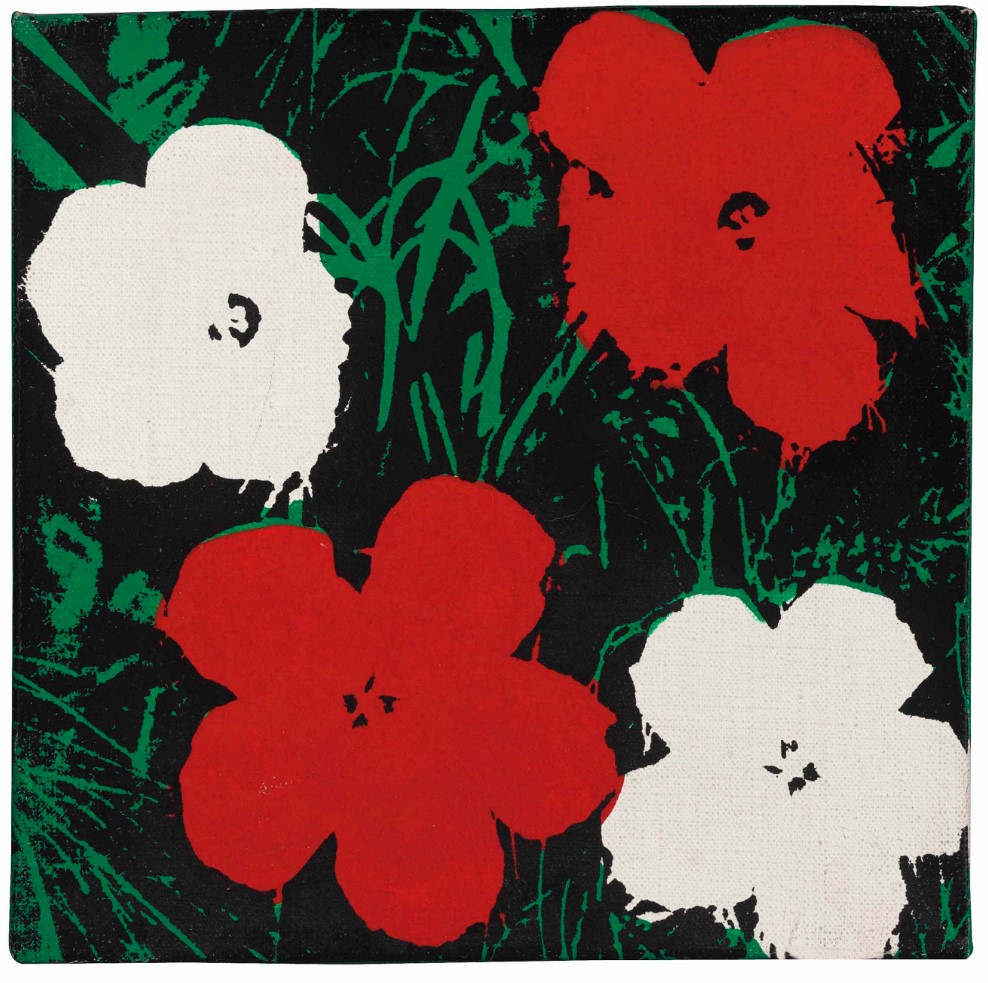
ANDY WARHOL
Flowers, 1964
Synthetic polymer and silkscreen inks on canvas
8×8 inches (20.3 x 20.3 cm)
Signed and dated, stamped with the Andy Warhol Foundation for the Visual Arts Inc., stamp Numbered ‘Andy Warhol 64 A116.946’ (on the overlap)
Flowers, 1964
Sotheby’s London: 18 October 2013
Estimated: GBP 120,000 – 180,000
GBP 308,500
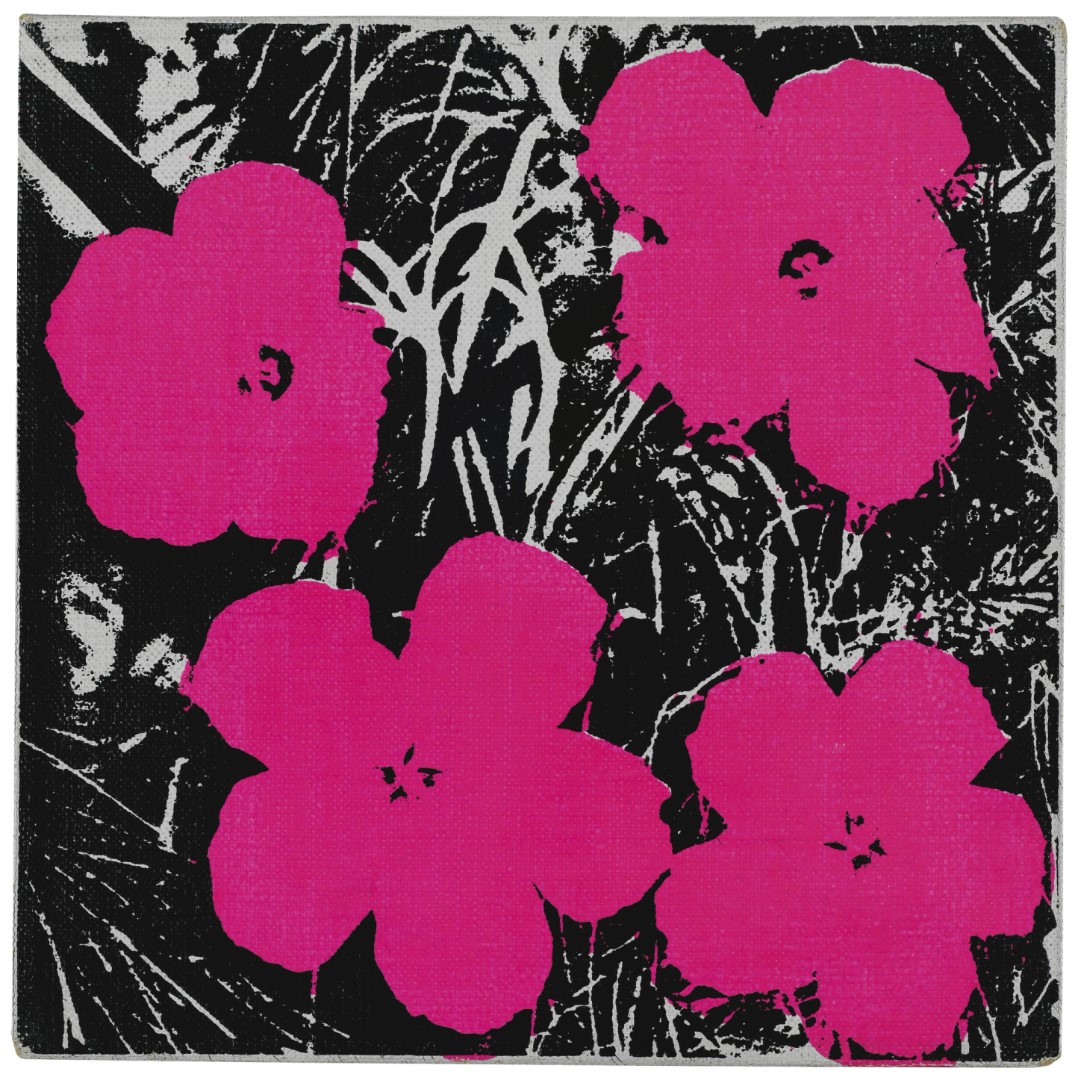 ANDY WARHOL
Flowers, 1964
Acrylic and silkscreen ink on canvas
8×8 inches (20.3 x 20.3 cm)
Signed with the artist’s initials and dated 64 on the overlap
Flowers, 1964
Christie’s New-York: 15 May 2013
Estimated: USD 120,000 – 180,000
USD 225,750
Andy Warhol (1928-1987) , Flowers | Christie’s
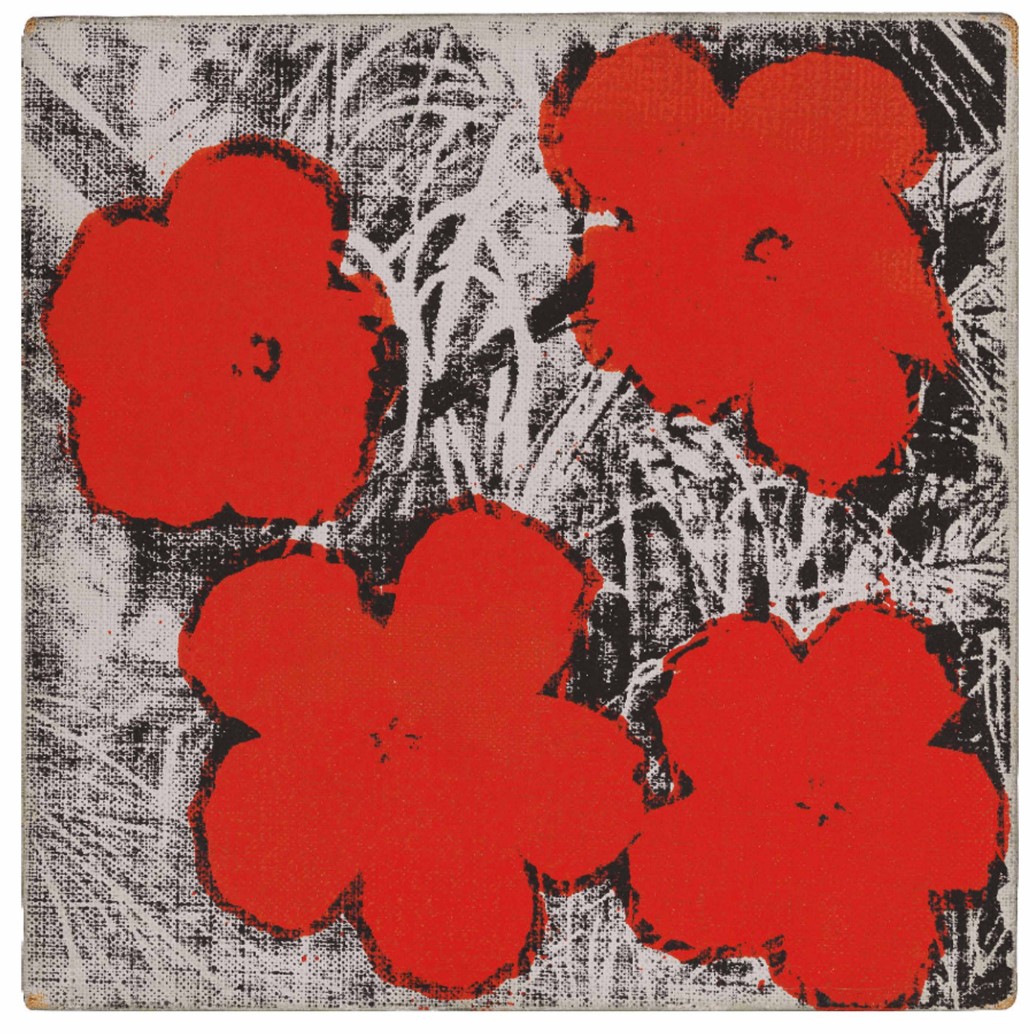
ANDY WARHOL
Flowers, 1964
Synthetic polymer and silkscreen inks on canvas
8 1/8 x 8 inches (20.6 x 20.3 cm)
Flowers, 1964
Christie’s New-York: 10 November 2010
USD 290,500
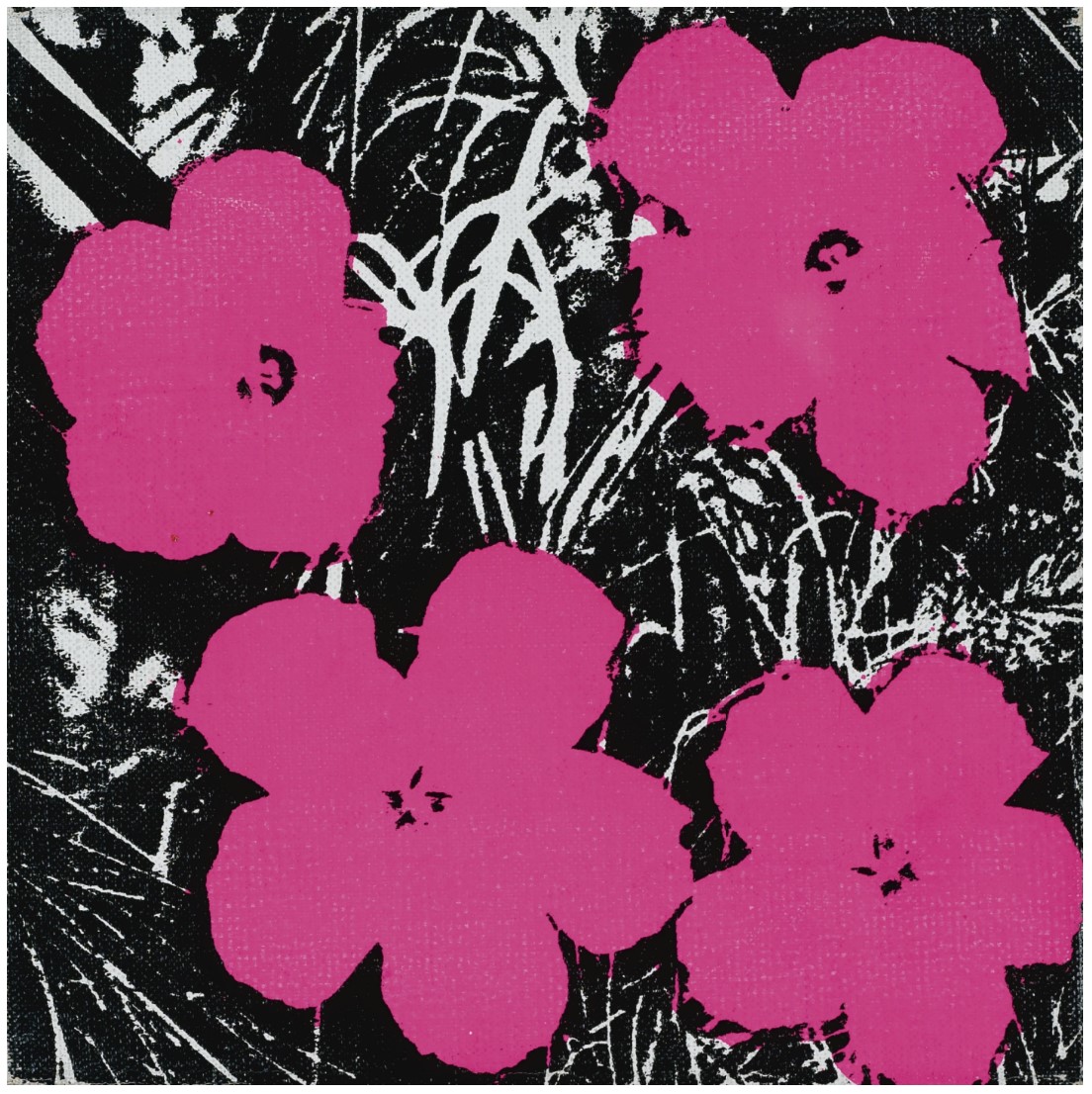 ANDY WARHOL
Flowers, 1964
Acrylic and silkscreen ink on canvas
8×8 inches (20.3 x 20.3 cm)
Signed with the artist’s initials and dated 64 on the overlap
Flowers (5×5)
The 5-inch Flowers left Warhol’s Factory in two bulk consignments, one for his exhibition at Sonnabend and the other for his show at Leo Castelli. Unlike the 14- and 18-inch Flowers, none of the 5-inch flowers have green backgrounds. The local color of the flowers is almost entirely silkscreened over the primed ground. Not only did this introduce a new color intensity, but Warhol found that leaving out the green background made the composition more abstract, emphasizing the stylization that had interested Warhol from the beginning of the project.
Flowers, 1964
AN EYE FOR COLOUR: WORKS FROM A PRIVATE COLLECTION
Christie’s London: 7 March 2026
Estimated: GBP 120,000 – 180,000
GBP 203,200 / USD 271,455
ANDY WARHOL (1928-1987), Flowers | Christie’s
REPEAT SALE
Sotheby’s New-York: 15 May 2013
Estimated: USD 120,000 – 180,000
USD 197,000
ANDY WARHOL (1928-1987)
Flowers, 1964
(Frei and Printz, The Andy Warhol Catalogue Raisonné: no. LC249)
Acrylic and silkscreen ink on canvas
5×5 inches (12.8 x 12.8 cm)
Signed with the artist’s initials and dated ‘A. W. 64’ (on the overlap)
Flowers, 1964
AN EYE FOR COLOUR: WORKS FROM A PRIVATE COLLECTION
Christie’s London: 7 March 2026
Estimated: GBP 120,000 – 180,000
GBP 342,900 / USD 458,080
ANDY WARHOL (1928-1987), Flowers | Christie’s
REPEAT SALE
Sotheby’s London: 9 March 2017
Estimated: GBP 120,000 – 180,000
GBP 246,350 / USD 299,650
ANDY WARHOL (1928-1987)
Flowers, 1964
Acrylic and silkscreen ink on canvas
5×5 inches (12.8 x 12.8 cm)
Signed and dated ‘Andy Warhol 64’, stamped with the Andy Warhol Art Authentication Board, Inc. stamp
Numbered ‘A100.089’ (on the overlap)
Flowers, 1964-1965
AN EYE FOR COLOUR: WORKS FROM A PRIVATE COLLECTION
Christie’s London: 7 March 2026
Estimated: GBP 180,000 – 250,000
GBP 355,600 / USD 475,045
ANDY WARHOL (1928-1987), Flowers | Christie’s
REPEAT SALE
Christie’s New-York: 13 November 2013
Estimated: USD 150,000 – 200,000
USD 341,000
Andy Warhol (1928-1987), Flowers | Christie’s
ANDY WARHOL (1928-1987)
Flowers, 1964-1965
(Frei and Printz, The Andy Warhol Catalogue Raisonné: no. 1655)
Acrylic and silkscreen ink on canvas
8-1/8 x 8-1/8 inches (20.5 x 20.5 cm)
Signed and dated ‘Andy Warhol 64’ (on the overlap)
Against a striking monochromatic ground, vibrant petals bloom across three of Andy Warhol’s celebrated Flowers (lots 603-605). Each with exceptional provenance that includes the collections of David C. Copley and David Pincus, among others, the works were created between 1964 and 1965, when Warhol was at the peak of his celebrity. This vivid series continued his desire to transform quotidian objects into seductive icons. Across the paintings Warhol employed a rich and varied palette, whose tonal opulence can be seen in the three present works. While the Day-Glo colours may suggest an optimistic outlook, the Flowers can in fact be understood as a continuation of the artist’s sharp-eyed vision of consumption and culture, here extended into the natural world. Although Warhol was captivated by the glamour of celebrity and consumer culture, a darkness underpinned his oeuvre, encapsulated here by bright blooms which seem to exist at the nexus of life and death.
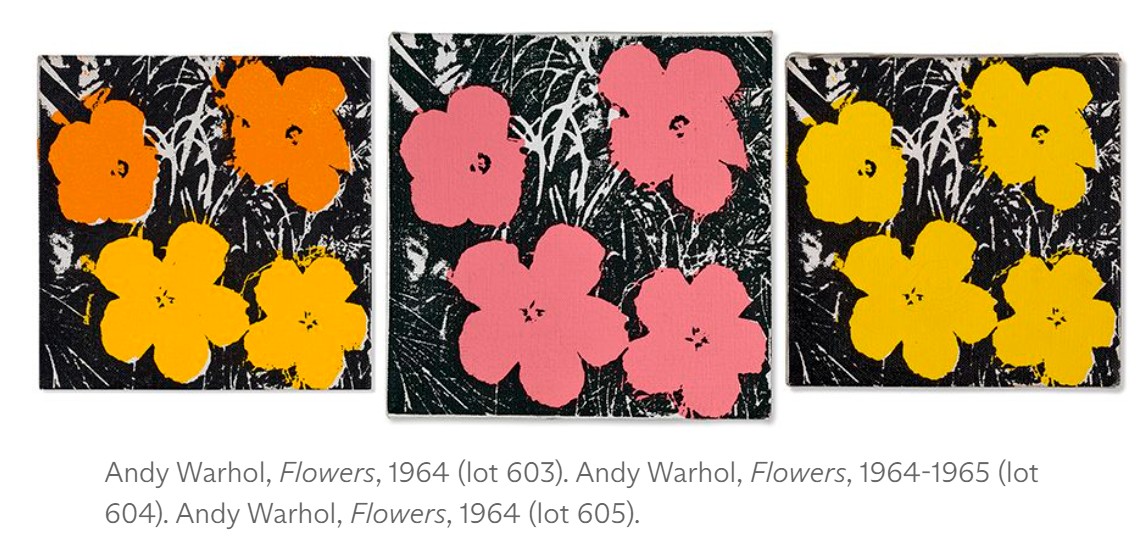
It was Henry Geldzahler, Warhol’s close friend and curator at The Metropolitan Museum of Art, who selected the source image for the Flowers from the June 1964 issue of Modern Photograph, encouraging the artist to leave behind the macabre sentiments of his electric chairs and Death and Disaster paintings. Warhol kept the original photograph’s essential composition but flattened and abstracted what had once been a detailed shot of hibiscus flowers. He then ran the image through a Photostat machine several times to further eliminate superfluous details. The artist’s assistant, Billy Linich, recalled how Warhol ‘just wanted the shape, the basic outline, of the flowers’ (B. Linich quoted in T. Scherman and D. Dalton, Pop: The Genius of Andy Warhol, New York 2009, p. 327). These flat shapes were stencilled in bright synthetic paint onto green or white grounds before the grass and stamens were applied in black ink through the silkscreen. The luminous blossoms stand in stark, slightly off-register contrast to the shadowy stems that surround them.
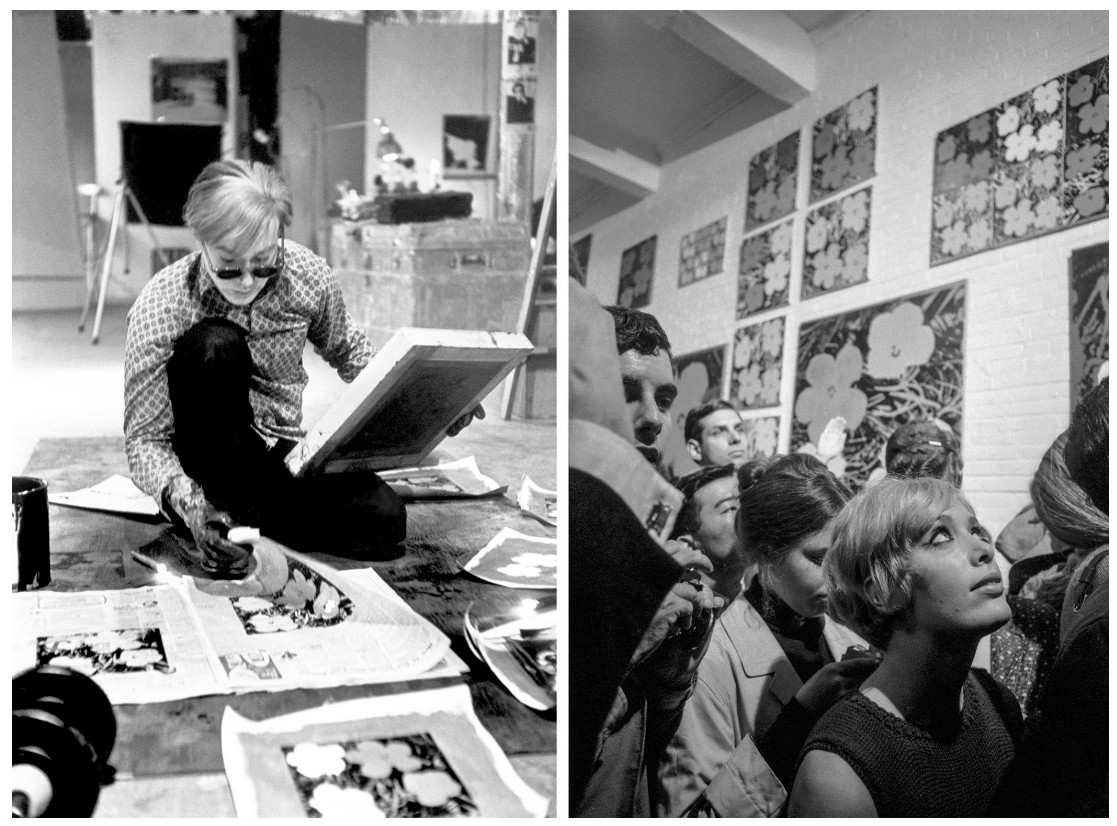
Left: Andy Warhol at The Factory, New York, 1964. Photo: Eve Arnold / Magnum. Artwork: © 2026 The Andy Warhol Foundation for the Visual Arts, Inc. / Licensed by DACS, London. Right: View of a crowd of patrons as they attend a retrospective exhibition of Andy Warhol’s artworks, including his Flowers silkscreens (seen in the background), at the Institute of Contemporary Art, Philadelphia, on October 8, 1965. The exhibition marked Warhol’s first solo show at a museum. Photo by Steve Schapiro/Corbis via Getty Images. Artwork: © 2026 The Andy Warhol Foundation for the Visual Arts, Inc. / Licensed by DACS, London.
Warhol initially developed this body of work in the run-up to his solo exhibition at Leo Castelli Gallery, then the centre of the post-war art world, and the first series comprised two sizes, 48- and 24-inch squares. Over the course of the following year, however, he continued to reduce their scale, to fifteen inches, then eight, and finally five. Lots 603 and 605 are part of the final, five-inch series, while lot 604 belongs to the eight-inch cycle. This painting was included in Warhol’s 1965 exhibition at the Institute of Contemporary Art, Philadelphia: his first museum show in the United States and one which saw celebrity and artwork became forever intertwined. The opening was so mobbed by fans who wanted to see Warhol that the art had to be removed from the walls for its protection.
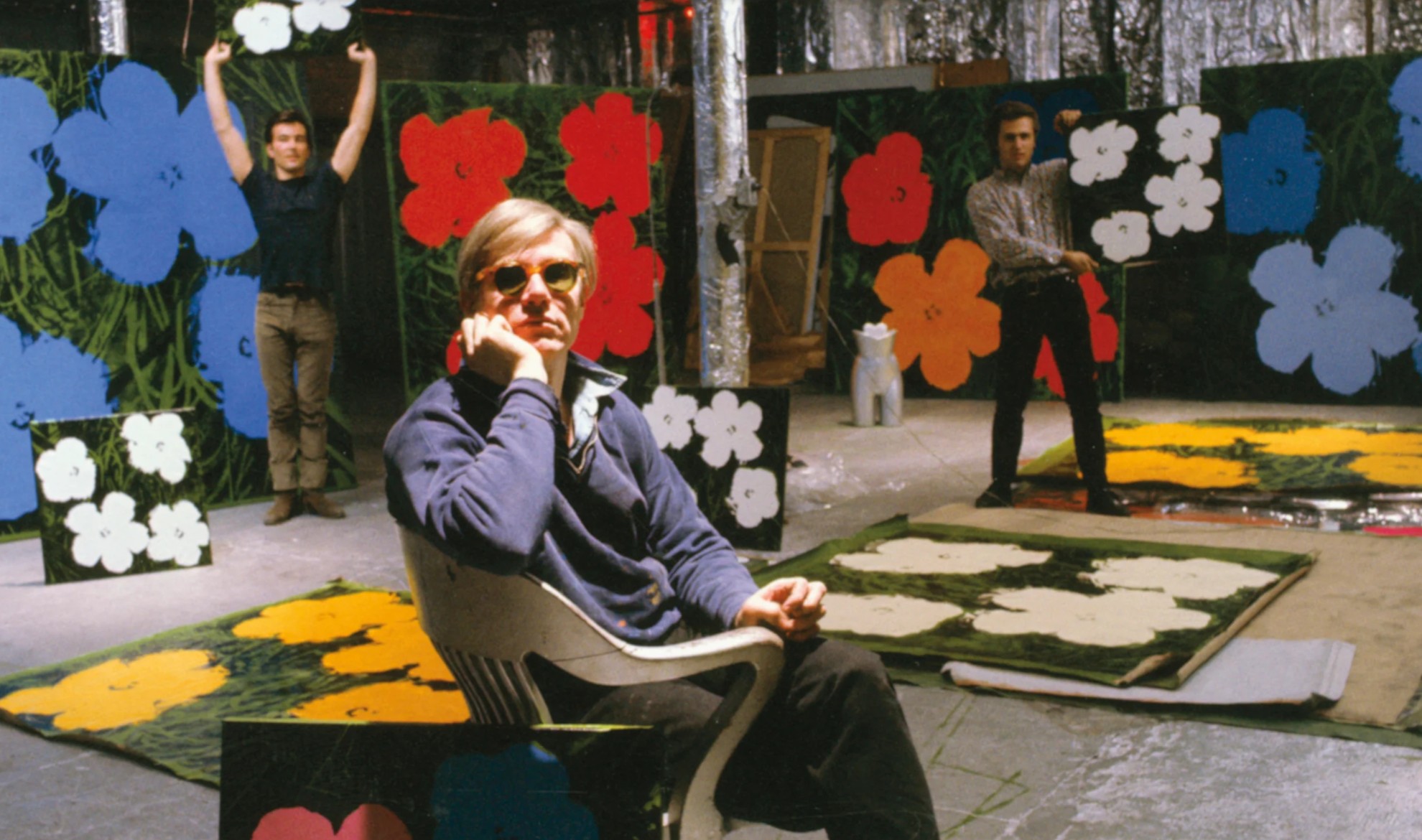
Andy Warhol with his assistants Philip Fagan (left), and poet Gerard Malanga (right). At the Factory, 231 East 47th Street, New York, 1964. Photo Ugo Mulas © Ugo Mulas Heirs. All rights reserved.
Artwork: © 2026 The Andy Warhol Foundation for the Visual Arts, Inc. / Licensed by DACS, London.
With their traditional subject matter, Warhol’s Flowers may appear to represent a departure from his previous work: bouquets have long been used by artists to explore ideas of decay, transience, and death. The blooms here loom almost menacingly large, threatening to overtake the frame and suggestive of a grandiose memento mori. As with his images of celebrities and socialites, the Flowers evince a similar fascination with surface glamour and the ways in which such images become commodified. Far from organic, the hibiscus blossoms have been manipulated and transformed into consumable images that stand in for rather than depict the natural world.
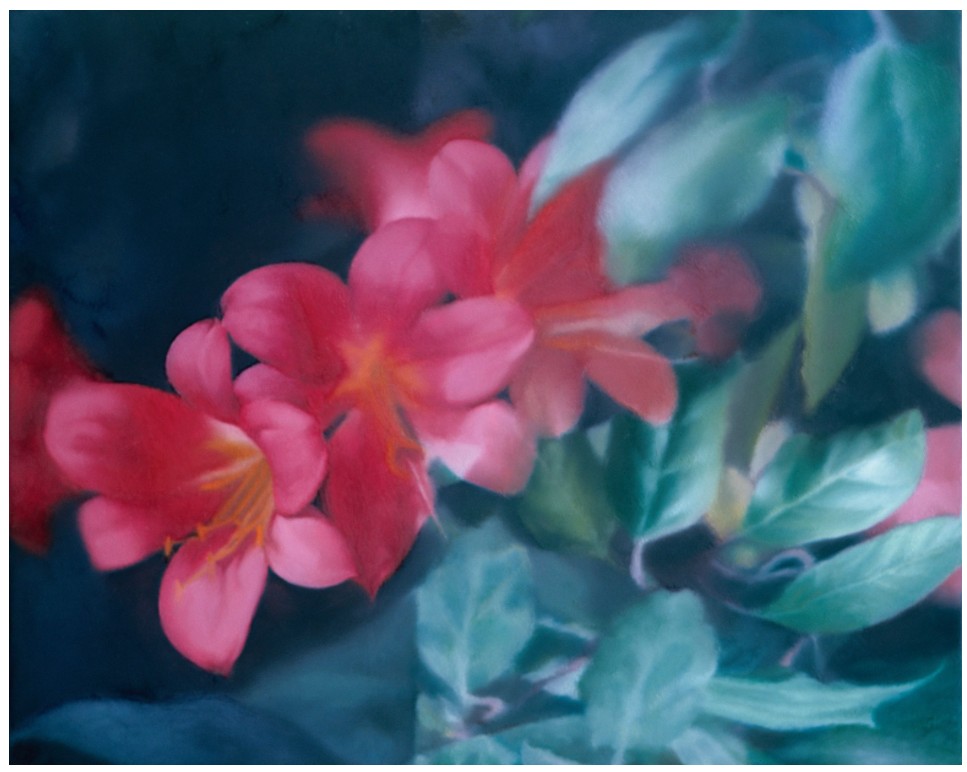
Gerhard Richter, Flowers (Blumen), 1977. Private collection. Artwork: © Gerhard Richter 2026 (0031).
Flowers were among the last paintings that Warhol created during the 1960s. Although formally reductive and thus associated with the artist’s eventual embrace of abstraction, the series also prompts comparison to the floral fabrics popular during the 1960s Flower Power movement. Yet these paintings are far from romantic or even optimistic, and, with their dark backgrounds and charge of commercialization, Flowers also seem to foreshadow the social unease that would dog the 1970s. At once stylized and mediated, real yet constructed, Flowers encapsulate the best of Warhol’s artistic interrogations by bridging the divide between fine art and mass consumption.
Flowers, 1964
Sotheby’s New-York: 16 May 2025
Estimated: USD 180,000 – 250,000
USD 355,600
Flowers | Contemporary Day Auction | 2025 | Sotheby’s
ANDY WARHOL (1928 – 1987)
Flowers, 1964
Acrylic and silkscreen ink on canvas
5×5 inches (12.7 x 12.7 cm)
Signed and dated 64 (on the overlap)
Stamped by the Estate of Andy Warhol and the Andy Warhol Foundation for the Visual Arts, Inc.
Numbered A102.015 on the overlap
Flowers, 1964
Digard Paris: 25 November 2024
Estimated: EUR 250,000 – 300,000
EUR 338,000 / USD 354,145
Andy WARHOL (1928 – 1987) – Lot 21
Andy WARHOL (1928 – 1987)
Flowers, 1964
Acrylic and silkscreen ink on canvas
5×5 inches (12.7 x 12.7 cm)
Monogrammed and dated on reverse
Flowers, 1964
Estimated: USD 180,000 – 250,000
USD 254,000
ANDY WARHOL (1928 – 1987)
Flowers, 1964
Acrylic and silkscreen ink on canvas
5×5 inches (12.7 x 12.7 cm)
Signed with the artist’s initials and dated ’64 (on the overlap)
Flowers, 1964
Sotheby’s London: 13 October 2023
Estimated: GBP 150,000 – 200,000
GBP 190,500 / USD 231,189
Flowers | Contemporary Day Auction | 2023 | Sotheby’s (sothebys.com)
ANDY WARHOL (1928 – 1987)
Flowers, 1964
Acrylic on canvas
5×5 inches (12.7 x 12.7 cm)
Signed and dated 64 (on the overlap)
With bright orange blossoms gleaming against the ink black foliage beneath, the present composition belongs to one of Andy Warhol’s most celebrated and beloved series, the Flower Paintings of 1964. Since their execution, Warhol’s Flower Paintings have pervaded a global consciousness as the totemic standard of classic American Pop; their imagery acting as talismanic metaphor for a generation that changed not only artistic but also social and political topographies in a supremely transformative decade. Unlike the artist’s legendary subjects of that period concerned principally with consumerism, celebrity, death and disasters, the Flowers corpus was a significant departure towards a more abstract and philosophically charged motif.
Flowers, 1964
Sotheby’s London: 28 June 2023
Estimated: GBP 150,000 – 200,000
GBP 368,300 / USD 465,319
Flowers | Modern & Contemporary Day Auction | 2023 | Sotheby’s (sothebys.com)

ANDY WARHOL (1928 – 1987)
Flowers, 1964
Acrylic and silkscreen ink on canvas
5×5 inches (12.7 x 12.7 cm)
Signed and dedicated Drue 75 LOVE on the overlap
With dream-like azure blossoms gleaming against the ink black foliage beneath, the present Flowers composition belongs to one of Andy Warhol’s most celebrated and beloved series, the Flower Paintings of 1964. Since their execution, Warhol’s Flower Paintings have pervaded a global consciousness as the totemic standard of classic American Pop; their imagery acting as talismanic metaphor for a generation that changed not only artistic but also social and political topographies in a supremely transformative decade. Unlike the artist’s legendary subjects of that period concerned principally with consumerism, celebrity, death and disasters, the Flowers corpus was a significant departure towards a more abstract and philosophically charged motif.
Flowers, 1963
Swann Galleries: 8 June 2023
Estimated: USD 100,000 – 150,000
USD 87,500
ANDY WARHOL (1928 – 1987)
Flowers, 1963
Acrylic and silkscreen ink on canvas
5×5 inches (12.7 x 12.7 cm)
Flowers, 1964
Christie’s New-York: 9 March 2022
Estimated: USD 180,000 – 220,000
USD 302,400
ANDY WARHOL (1928-1987) (christies.com)
ANDY WARHOL
Flowers, 1964
Silkscreen ink on linen
5×5 inches (12.7 x 12.7 cm)
Flowers, 1965
Christie’s New-York: 12 November 2021
Estimated: USD 150,000 – 250,000
USD 325,000
ANDY WARHOL (1928-1987) (christies.com)
ANDY WARHOL
Flowers, 1965
Acrylic and silkscreen ink on canvas
5×5 inches (12.7 x 12.7 cm)
Flowers, 1965
Christie’s New-York: 14 November 2019
Estimated: USD 150,000 – 200,000
USD 187,500
Andy Warhol (1928-1987), Flowers | Christie’s
ANDY WARHOL
Flowers, 1965
Acrylic and silkscreen ink on canvas
5×5 inches (12.7 x 12.7 cm)
Flowers, 1964
Christie’s New-York: 16 May 2019
Estimated: USD 100,000 – 150,000
USD 200,000
Andy Warhol (1928-1987), Flowers | Christie’s
ANDY WARHOL
Flowers, 1964
Acrylic and silkscreen ink on canvas
5×5 inches (12.7 x 12.7 cm)
Flowers, 1964
Christie’s New-York: 16 May 2019
Estimated: USD 150,000 – 200,000
USD 212,500
Andy Warhol (1928-1987), Flowers | Christie’s
ANDY WARHOL
Flowers, 1964
Acrylic and silkscreen ink on canvas
5×5 inches (12.7 x 12.7 cm)
Flowers, 1965
Christie’s New-York: 28 February 2019
Estimated: USD 150,000 – 200,000
USD 250,000
Andy Warhol (1928-1987), Flowers | Christie’s
ANDY WARHOL
Flowers, 1965
Acrylic and silkscreen ink on canvas
5×5 inches (12.7 x 12.7 cm)
Flowers, 1964
Christie’s New-York: 16 November 2018
Estimated: USD 150,000 – 200,000
USD 262,500
Andy Warhol (1928-1987), Flowers | Christie’s
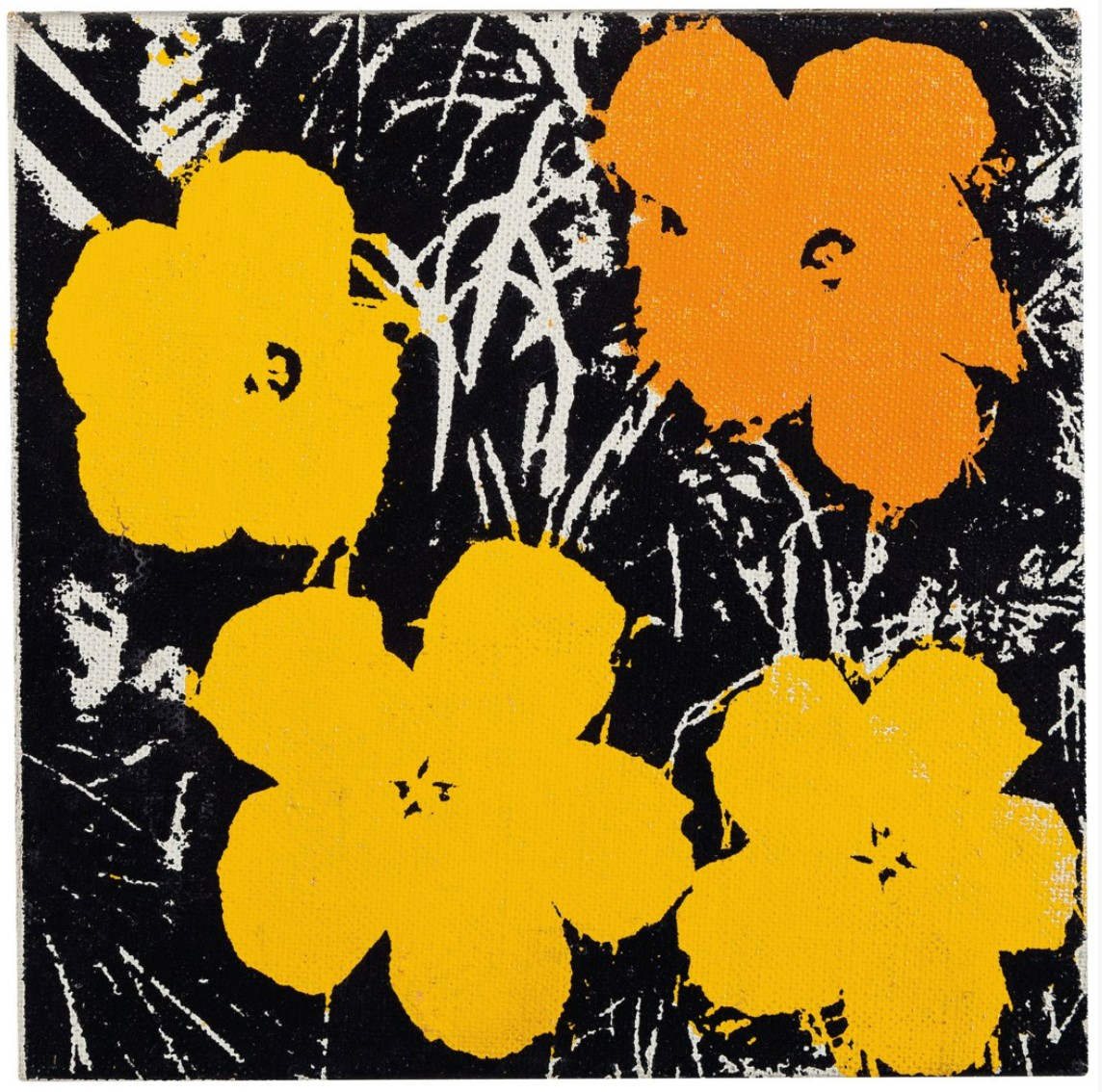
ANDY WARHOL
Flowers, 1964
Synthetic polymer and silkscreen ink on canvas
5×5 inches (12.7 x 12.7 cm)
Flowers, 1964
Sotheby’s New-York: 25 September 2018
Estimated: USD 120,000 – 180,000
USD 200,000
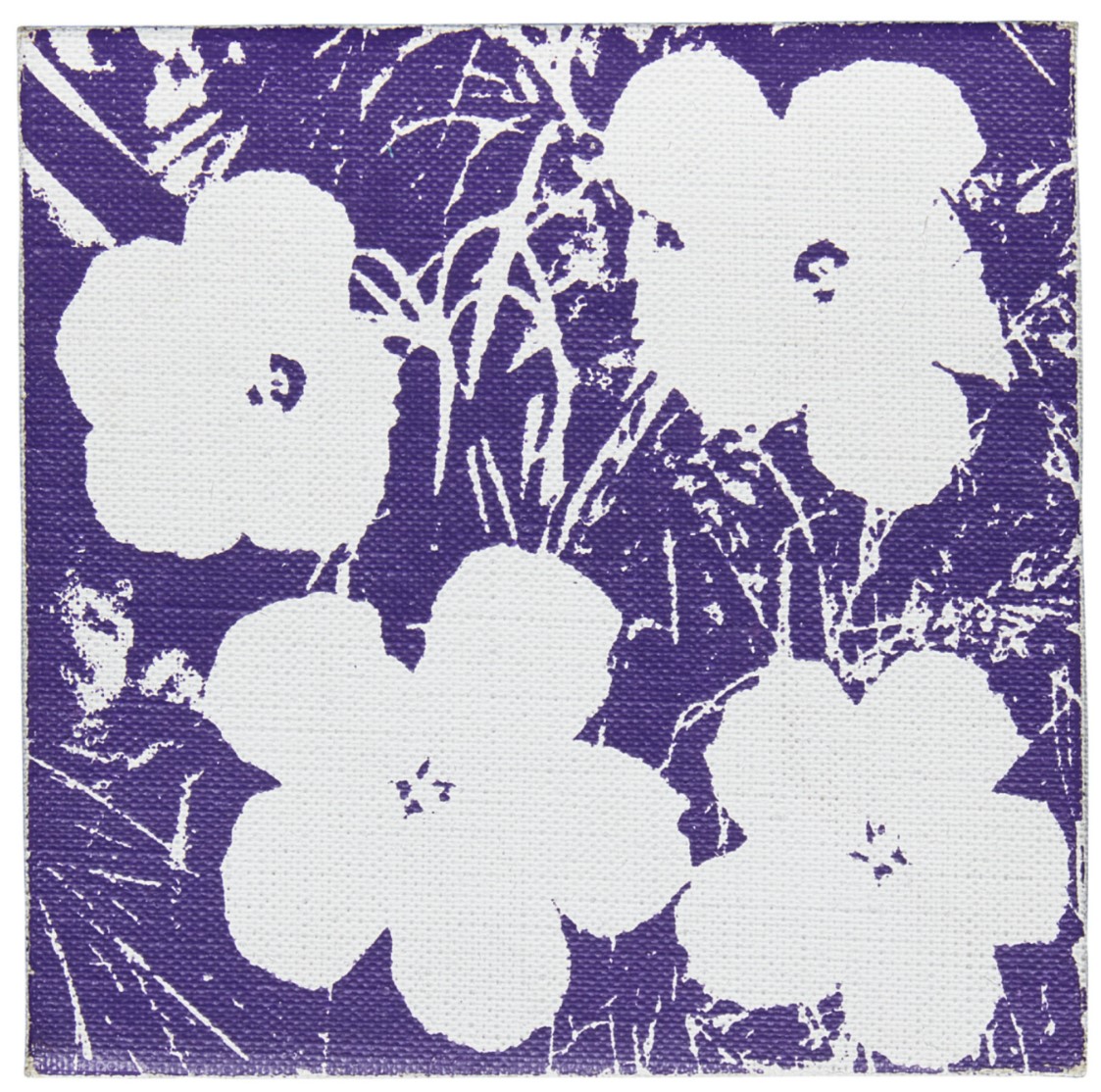
ANDY WARHOL
Flowers, 1964
Acrylic and silkscreen ink on canvas
5×5 inches (12.7 x 12.7 cm)
Flowers, 1964
Sotheby’s New-York: 25 September 2018
Estimated: USD 120,000 – 180,000
USD 200,000
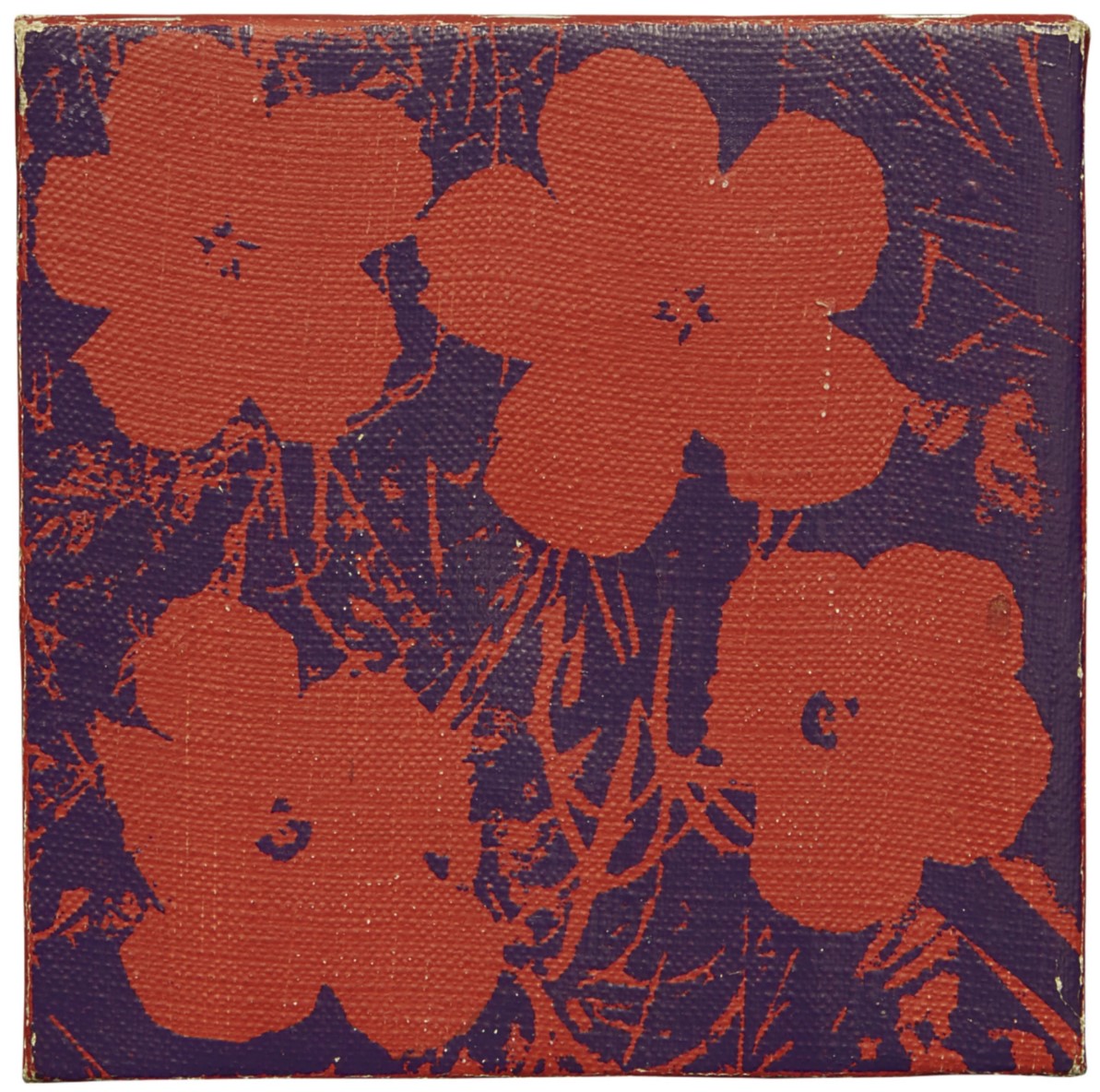
ANDY WARHOL
Flowers, 1964
Acrylic and silkscreen ink on canvas
5×5 inches (12.7 x 12.7 cm)
Flowers, 1964
Christie’s New-York: 11 May 2016
Estimated: USD 120,000 – 180,000
USD 233,000
Andy Warhol (1928-1987), Flowers | Christie’s
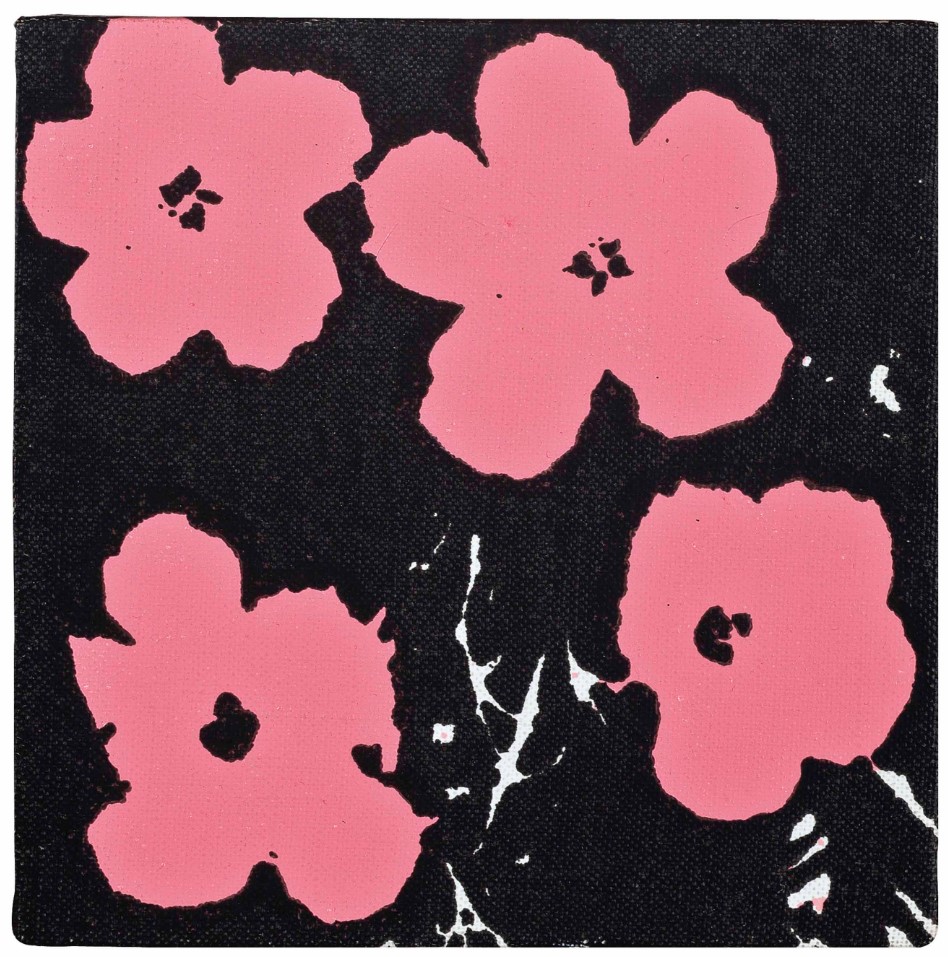
ANDY WARHOL
Flowers, 1964
Synthetic polymer and silkscreen ink on canvas
5×5 inches (12.5 x 12.5 cm)
Signed with the artist’s initials and dated ‘a.w. ’64’ (on the overlap)
Stamped with the Andy Warhol Art Authentication Board, Inc. stamp
Numbered ‘A107.032’ (on the overlap)
Flowers, 1964
Christie’s New-York: 11 November 2015
Estimated: USD 200,000 – 300,000
USD 293,000
Andy Warhol (1928-1987), Flowers | Christie’s
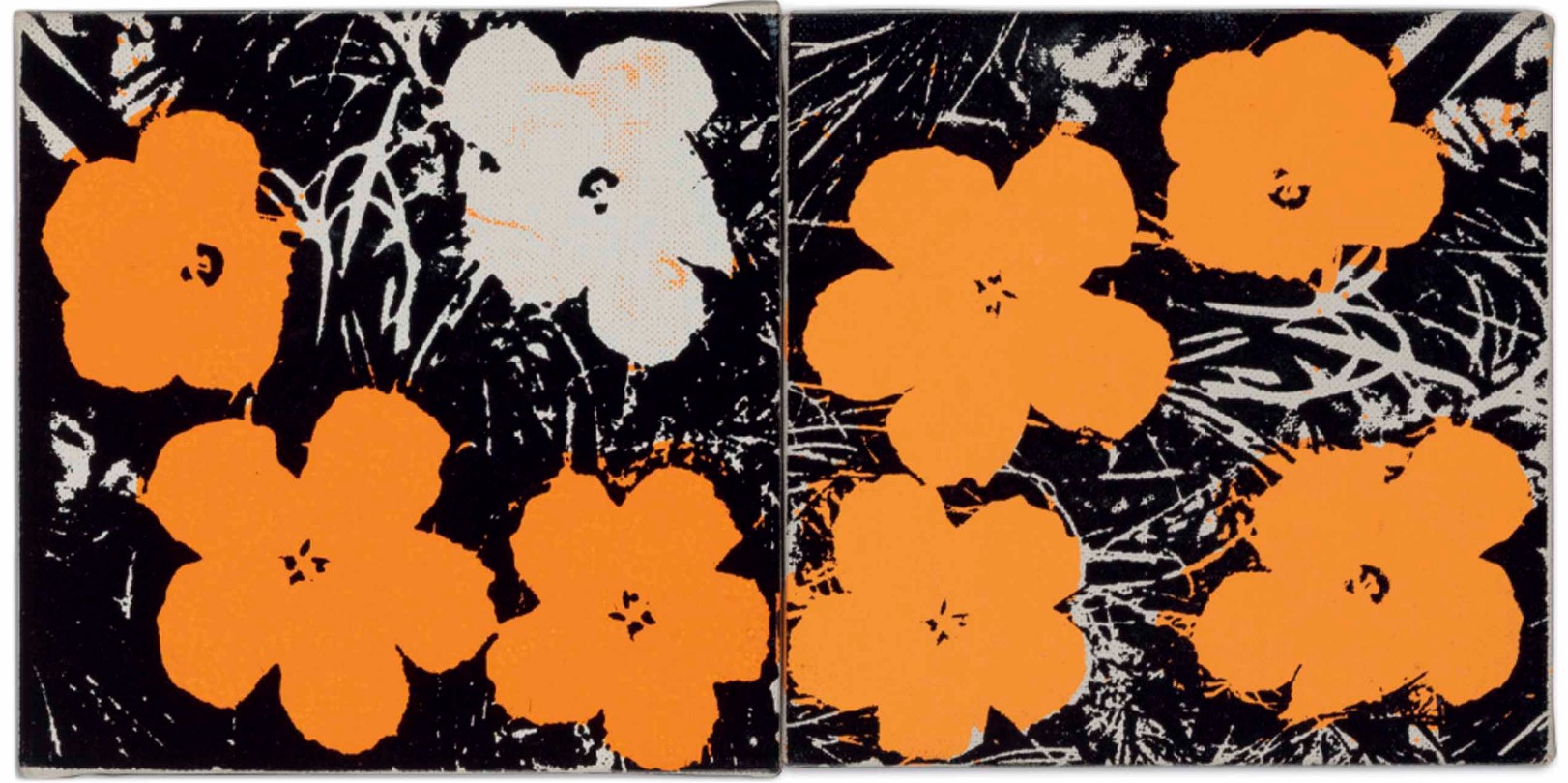
ANDY WARHOL
Flowers, 1964
Silkscreen ink on canvas in two parts
Each: 5×5 inches (12.7 x 12.7 cm)
Flowers, 1965
Christie’s New-York: 11 November 2015
Estimated: USD 200,000 – 300,000
USD 245,000
Andy Warhol (1928-1987), Flowers | Christie’s
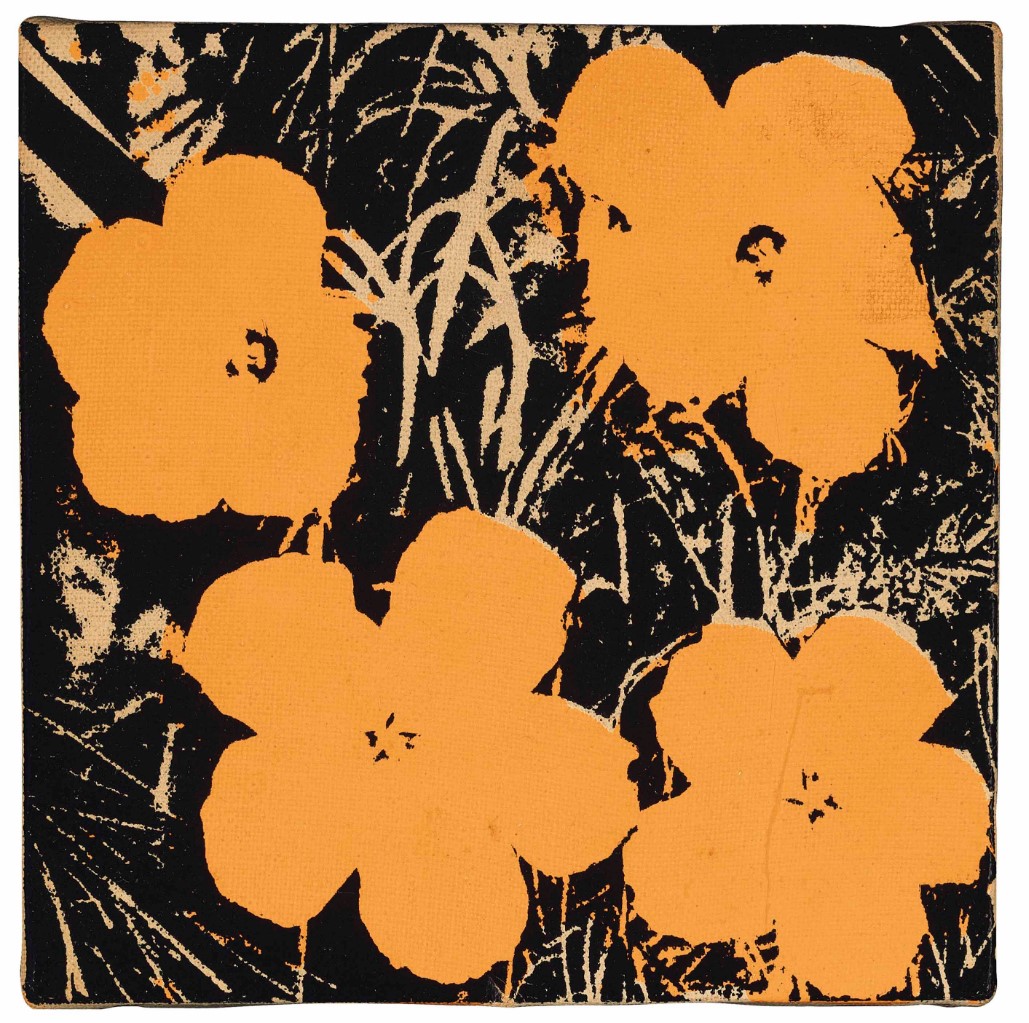
ANDY WARHOL
Flowers, 1965
Silkscreen ink on canvas
5×5 inches (12.7 x 12.7 cm)
Stamped with the Andy Warhol Art Authentication Board, Inc. stamp
Numbered ‘A109.971’ (on the overlap)
Flowers, 1964
Sotheby’s New-York: 15 May 2013
Estimated: USD 120,000 – 180,000
USD 197,000
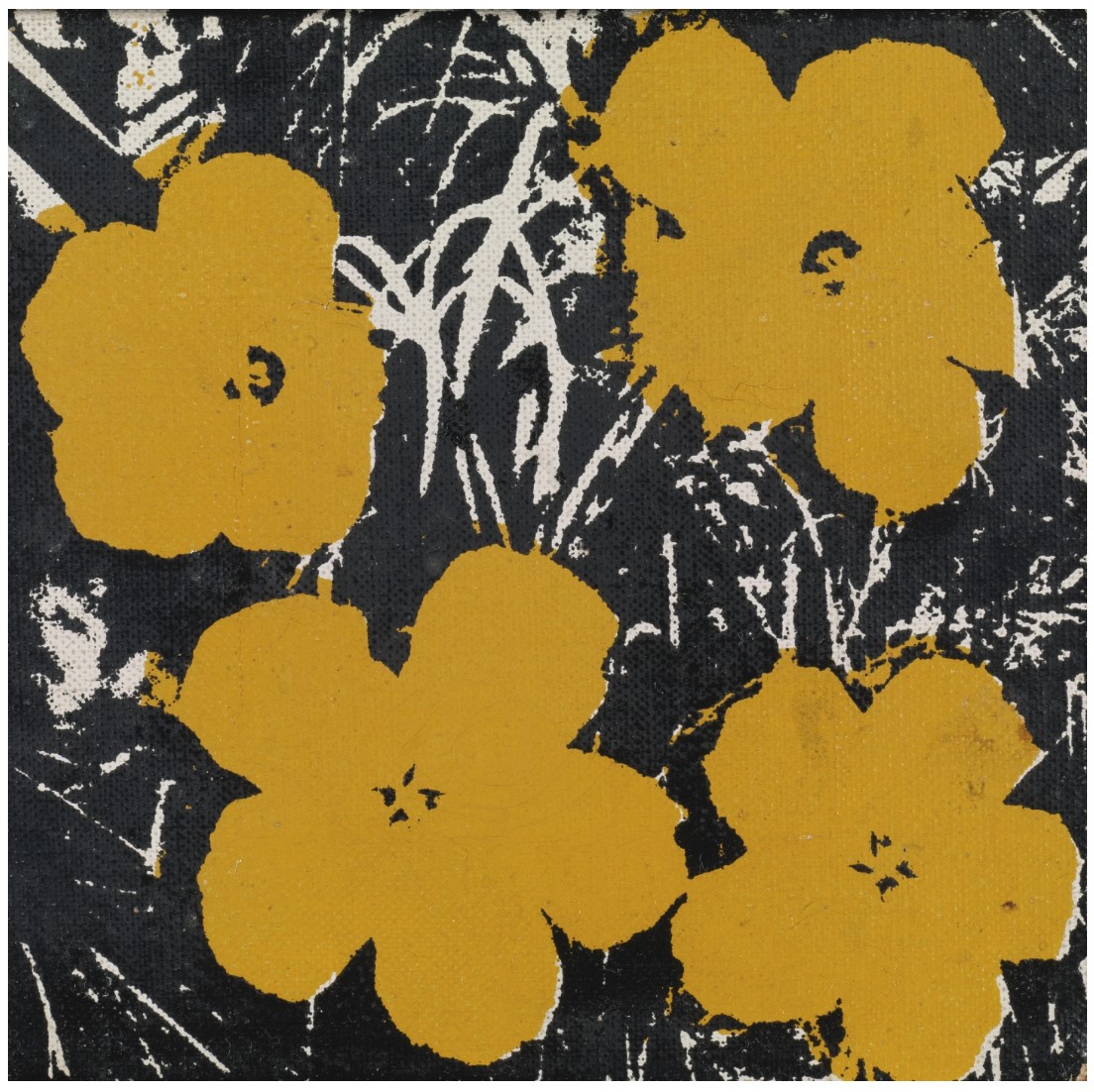 ANDY WARHOL
Flowers, 1964
Acrylic and silkscreen ink on canvas
5×5 inches (12.7 x 12.7 cm)
Signed with the artist’s initials and dated 64 on the overlap
Christie’s Paris: 31 May 2012
EUR 241,000
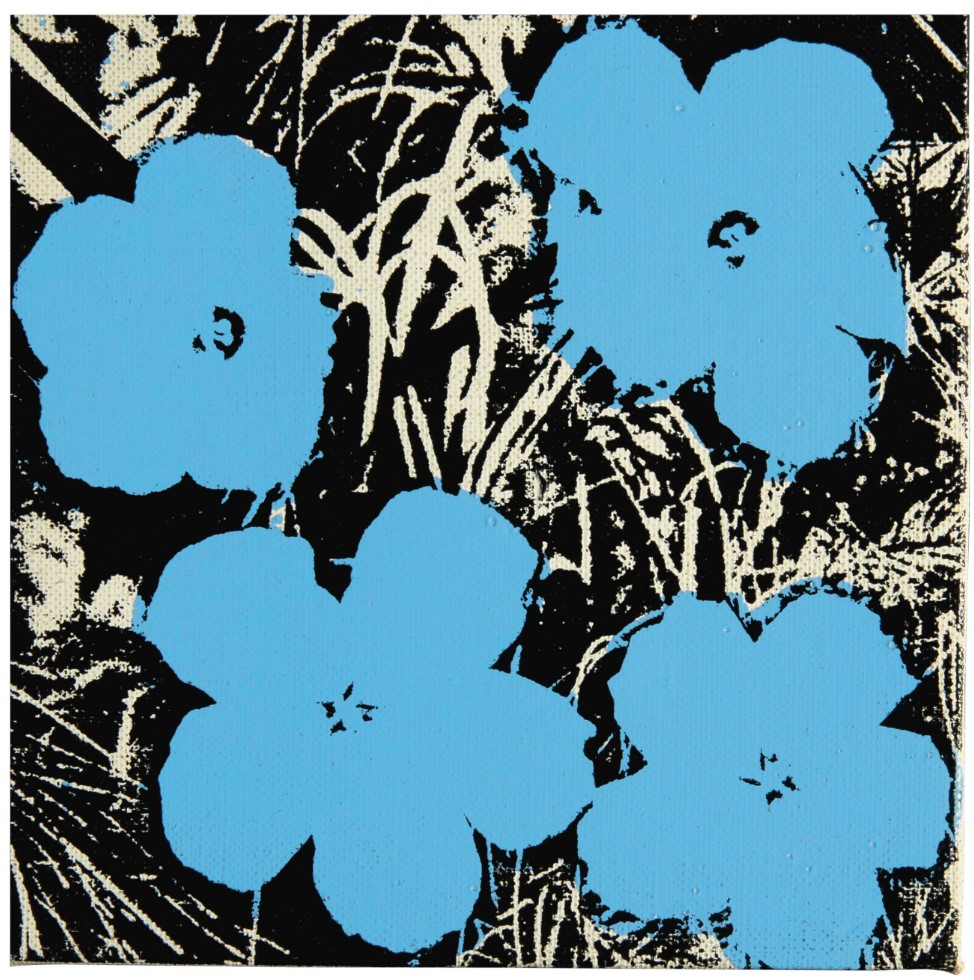
ANDY WARHOL
Flowers, 1964
Silkscreen ink on canvas
5×5 inches (12.7 x 12.7 cm)
Signed and dated ‘Andy Warhol 64’ (on reverse)
Flowers, 1965
Christie’s New-York: 9 May 2012
Estimated: USD 70,000 – 100,000
USD 266,500
Andy Warhol (1928-1987) , Flowers | Christie’s
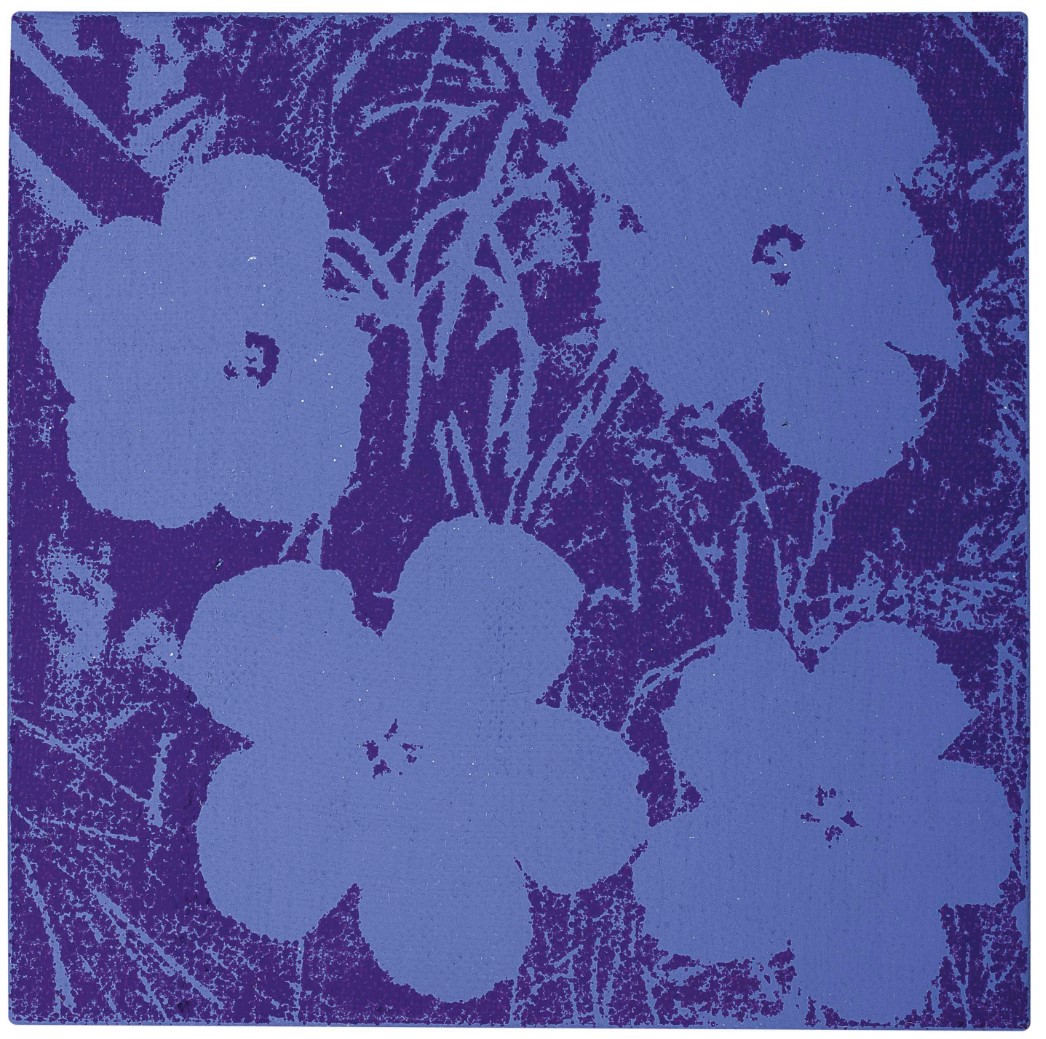
ANDY WARHOL
Flowers, 1965
Synthetic polymer and silkscreen ink on canvas
5×5 inches (12.7 x 12.7 cm)
Flowers, 1965
Sotheby’s New-York: 11 May 2011
Estimated: USD 80,000 – 120,000
USD 158,500
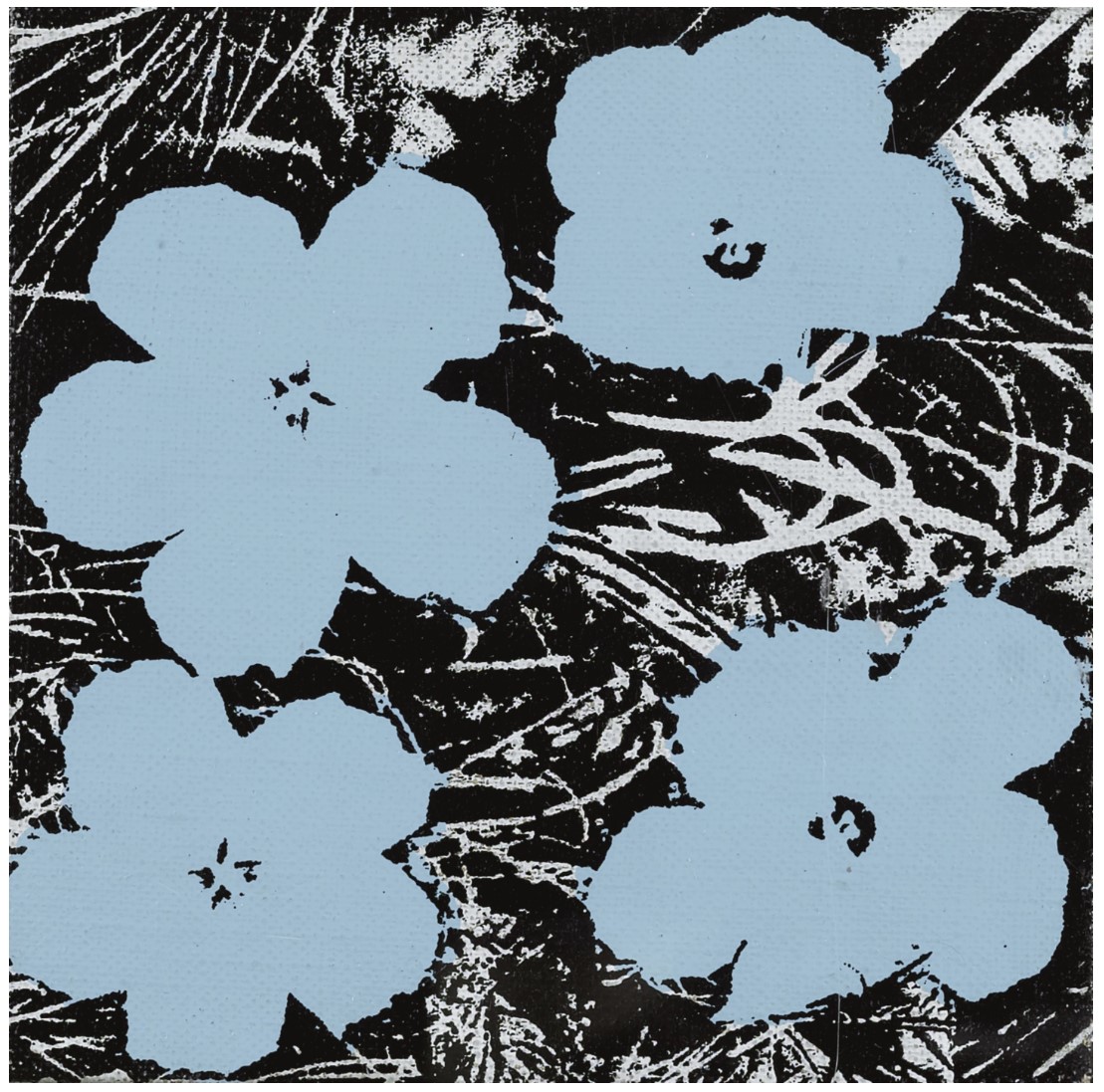 ANDY WARHOL
Flowers, 1965
Acrylic and silkscreen ink on canvas
5×5 inches (12.7 x 12.7 cm)
Signed, dated 65 and dedicated to Leonard Lyons on the overlap
Flowers, 1965
Sotheby’s New-York: 13 May 2009
Estimated: USD 60,000 – 80,000
USD 122,500
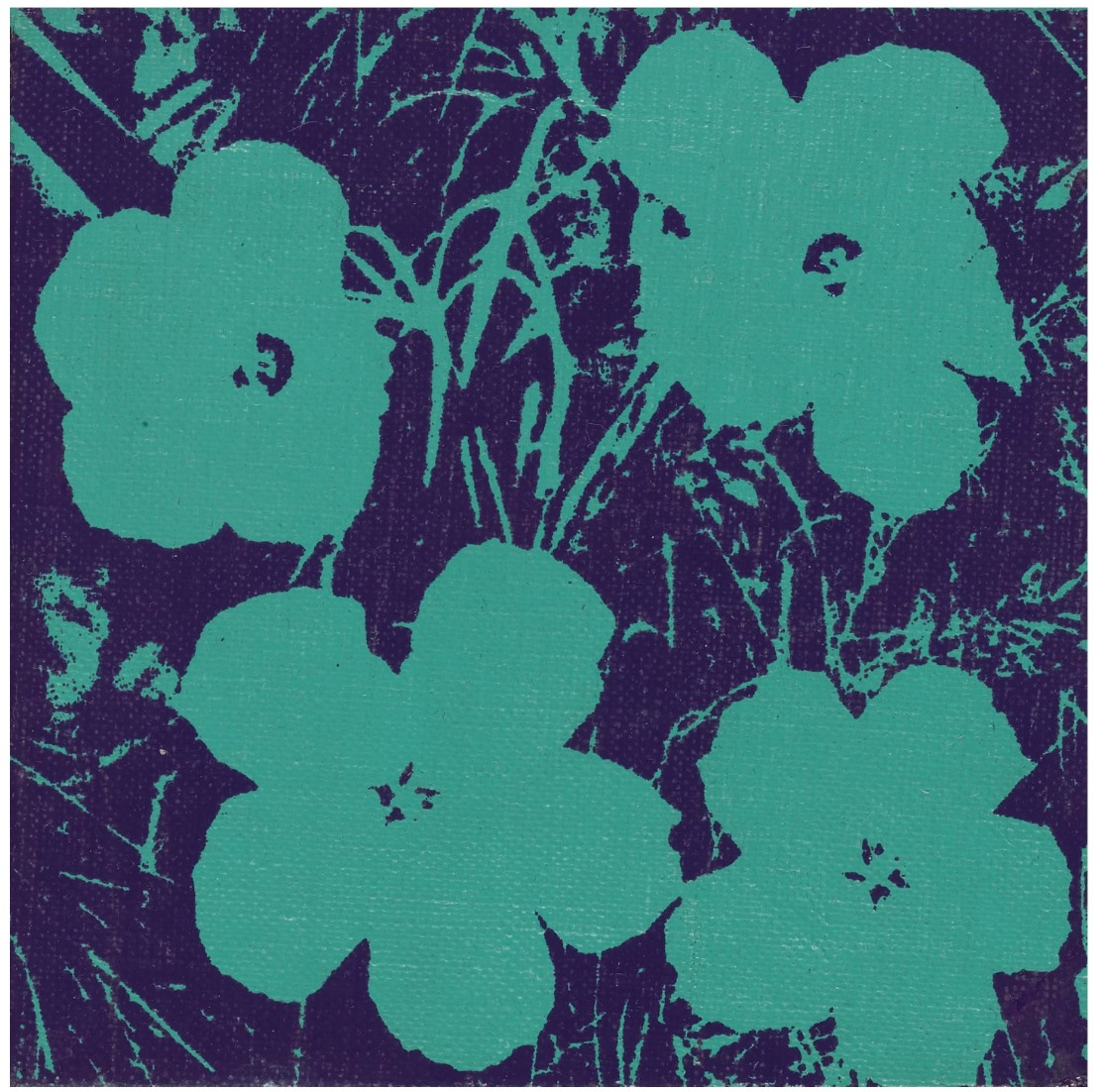 ANDY WARHOL
Flowers, 1965
Acrylic and silkscreen ink on canvas
5×5 inches (12.7 x 12.7 cm)
Stamped by The Andy Warhol Art Authentication Board, Inc.
Numbered A110.969 on the overlap
Signed twice, dated 64 and dedicated To Todd Brassner on the overlap
Flowers, 1964
Sotheby’s New-York: 15 May 2008
Estimated: USD 1,000,000 – 1,500,000
USD 1,105,000
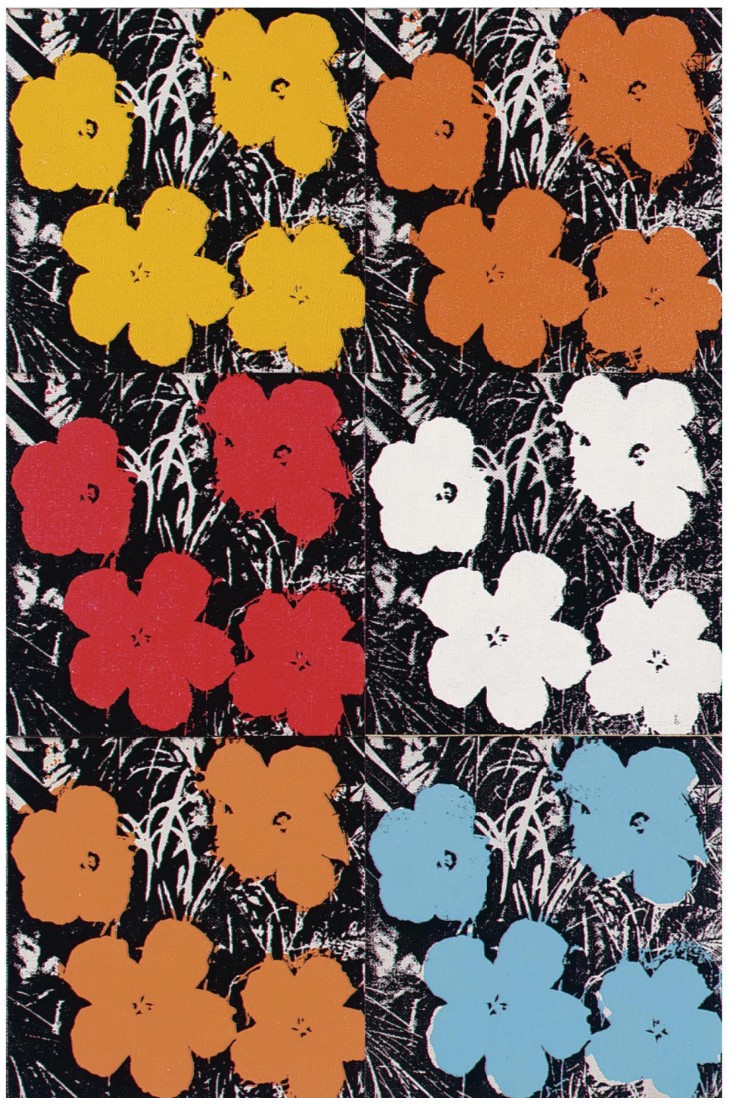 ANDY WARHOL
Flowers, 1964
Acrylic and silkscreen ink on canvas, in 6 parts
Each: 5×5 inches (12.7 x 12.7 cm)
Each stamped by the Andy Warhol Foundation for Visual Arts, Inc.
Each signed and dated 64 on the overlap
Jewel-like in scale and dynamic in color, Andy Warhol’s Six Flowers is a beaming example from this iconic series. Each petite 5×5 inch canvas is meticulously executed, using the same composition of the four hibiscus flowers against a black and white background, yet each uniquely colored. Employing a rainbow of colors, their petals exhibit vibrant hues of cadmium red, white, yellow, orange and pthalo blue. Individually, these works are precious models of Warhol’s celebrated Flowers series in their own right, however, when grouped together as they are in the present work, they make a bold statement about seriality and repetition in art. Furthermore, this grouping of six small canvases together recalls the original presentation and exhibition of Warhol’s Flowers series when they were first unveiled in 1964-65 at the Galerie Ileana Sonnabend in Paris and Leo Castelli Gallery in New York.