DAVID HOCKNEY (B. 1937)
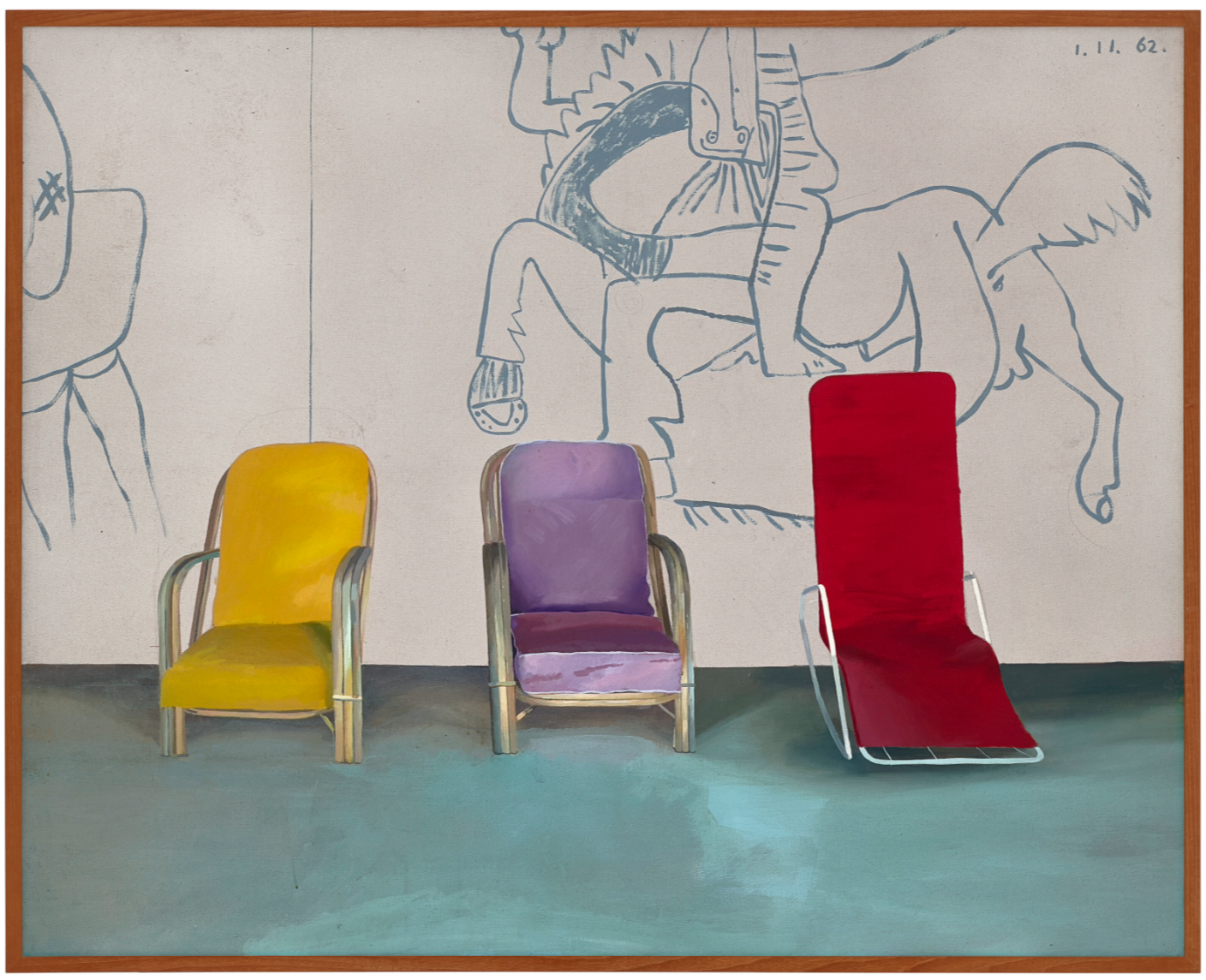
Three Chairs with a Section of a Picasso Mural, 1970
Acrylic on canvas
48×60 inches (121.9 x 152.4 cm)
Signed, dated and titled ‘Three chairs with a section of a Picasso mural David Hockney 1970’ (on the reverse)
Provenance
Lewis M. Kaplan, London
Waddington Galleries, London (acquired from the above, 1975)
Acquired from the above by the late owner, 1975
Auction History
The Collection of Mica Ertegun
Christie’s New-York: 19 November 2024
Estimated: USD 4,000,000 – 6,000,000
USD 9,035,000
DAVID HOCKNEY (B. 1937), Three Chairs with a Section of a Picasso Mural | Christie’s
A poignant act of homage, and a luminous portrait of friendship, Three Chairs with a Section of a Picasso Mural is a landmark painting dating from an important moment in David Hockney’s practice. Executed in 1970, it is the first work in his oeuvre to make direct reference to Pablo Picasso: his great inspiration and idol. It depicts part of the latter’s mural at the Château de Castille in Provence, home of the eminent collector and art historian Douglas Cooper. Cooper was close to Picasso, and later became friends with Hockney, who stayed at the property on a number of occasions. These visits brought the artist within striking distance of his hero, though he and Picasso never met in person. Here, his mural looms large above three exquisitely painted chairs: defining motifs within Hockney’s own practice. Their forms glow with anthropomorphic intensity, as if awaiting the arrival of their unseen sitters. Upon Cooper’s sunlit stage, Hockney and Picasso pass through art history’s sliding doors: two masters half a century apart.
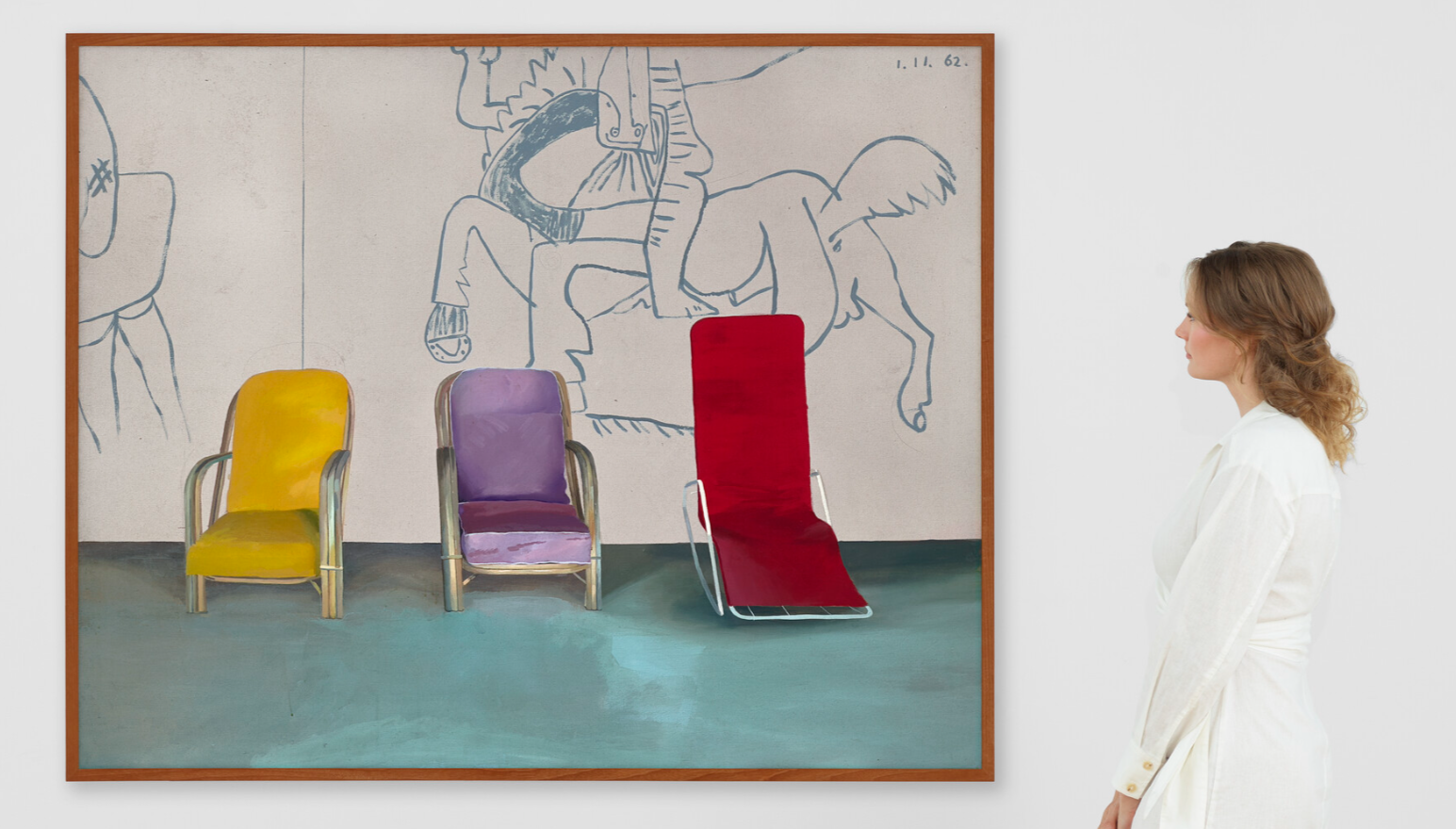
Included in Hockney’s major touring retrospective at the Los Angeles County Museum of Art in 1988, the work occupies pivotal territory in his practice. As Picasso’s career came to an end—he died three years after the present work—Hockney’s was in its ascendancy. 1970 saw his first retrospective at the Whitechapel Art Gallery in London, which toured Europe to critical acclaim. This period of early professional triumph spawned some of his finest works, including his seminal “double portraits.” These extraordinary large-scale canvases marked the culmination of Hockney’s celebrated “naturalistic” phase, defined by the same crisp perspective, hyperreal clarity and sharp theatrical lighting that characterize the present work. Chairs featured prominently in these paintings—from the iconic pink sofa in Henry Geldzahler and Christopher Scott (1969), to the sleek Marcel Breuer “Cesca” in Mr and Mrs Clark and Percy (1970-1971, Tate Gallery, London). Le Parc des Sources, Vichy (1970, Chatsworth House Trust), meanwhile, echoes the present work’s trilogy of chairs. Two are occupied by Hockney’s then lover Peter Schlesinger and his friend Ossie Clark; the other is left tantalizingly vacant, as if for the artist himself.
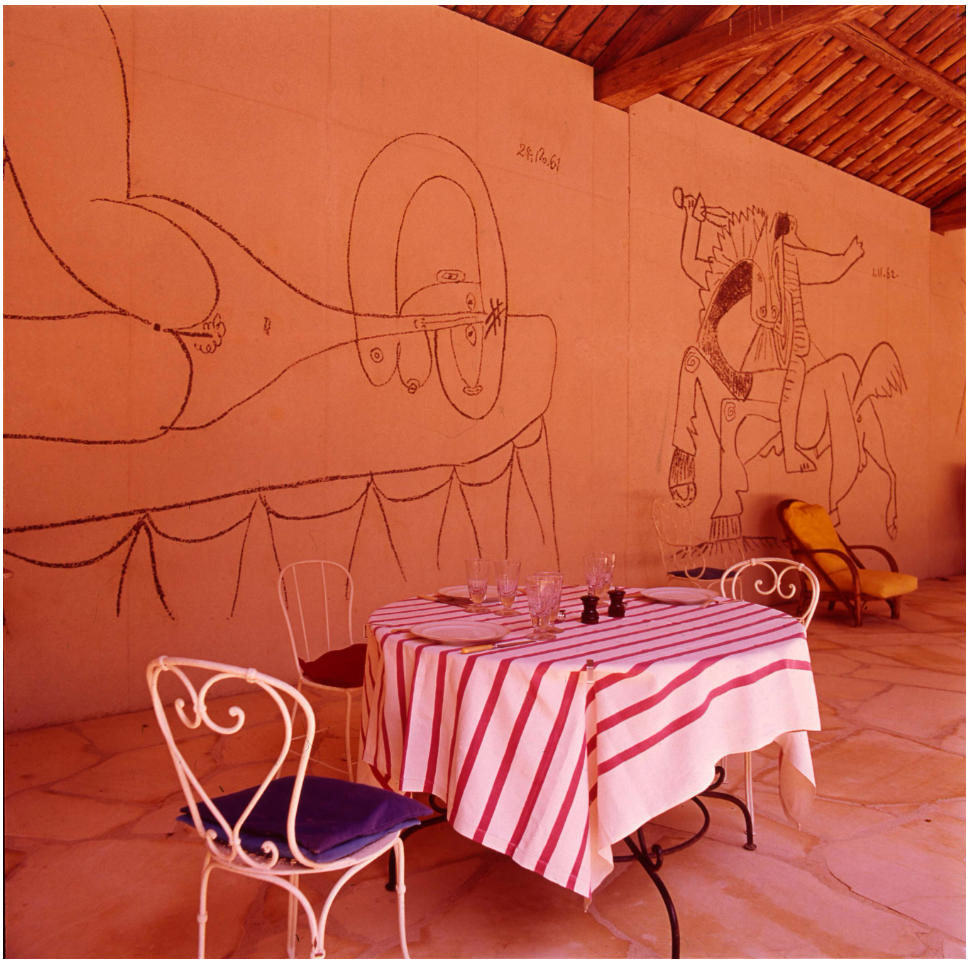
Wall murals by Pablo Picasso at Douglas Cooper’s Château de Castille, Uzès.
Photo: Horst P. Horst / Condé Nast via Getty Images. Artwork: © 2024 Estate of Pablo Picasso / Artists Rights Society (ARS), New York.
Three Chairs with a Section of a Picasso Mural confronts the viewer in a similar manner. Conceptually, it might be read as a double portrait of Cooper and Picasso, with Hockney triangulated between them. Alternatively, it might be seen as a virtual meeting between two artists, brokered by their mutual friendship with Cooper. As in Vincent van Gogh’s chair portraits, which Hockney deeply admired, presence is made all the more palpable by absence. The painting became the first in a long line of works in which Hockney paid explicit tribute to Picasso. Following the latter’s death in 1973, he produced the etchings The Student: Homage to Picasso and Artist and Model, depicting himself in imaginary conversation with the Spaniard. In 1977 he made a further suite of etchings based on Wallace Stevens’ Picasso-inspired poem “The Man with the Blue Guitar.” That year, he also painted the extraordinary Self-Portrait with Blue Guitar (Museum Moderner Kunst Stiftung Ludwig Wien, Vienna), featuring a bust of Dora Maar in the background, and another expectant empty chair opposite Hockney.
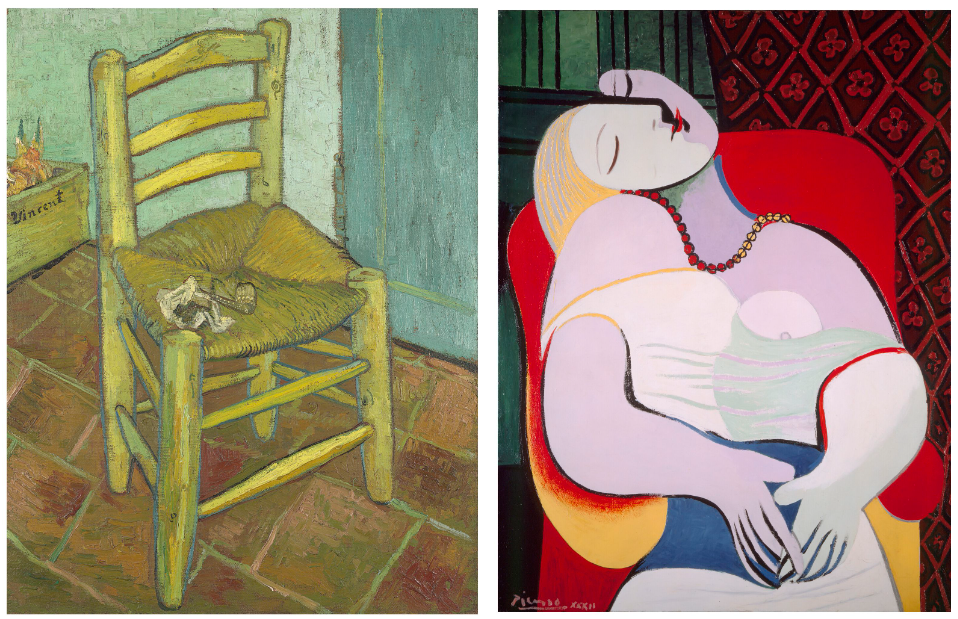
Left: Vincent van Gogh, La chaise de Van Gogh, 1888. National Gallery, London. Photo: © National Gallery, London / Art Resource, NY.
Right: Pablo Picasso, Le Rêve, 1932. Private Collection. © 2024 Estate of Pablo Picasso / Artists Rights Society (ARS), New York. Photo: Art Resource, NY.
Hockney’s fascination with Picasso dates back to his student days at the Royal College of Art, when he had famously returned eight times to the artist’s 1960 retrospective at the Tate Gallery. The dazzling stylistic range of Picasso’s art had fueled his early practice, instilling in him a lifelong desire to avoid allegiance to any particular genre or medium. In 1980, another retrospective—this time at The Museum of Modern Art, New York—would spark a new wave of engagement with his work: “it’s like the National Gallery all painted by one man,” he enthused at the time. “Totally incredible” (letter to R.B. Kitaj, 20 May-19 August 1980). That year, he began working on the Metropolitan Opera’s production of Eric Satie’s Parade (1917), drawing heavily upon Picasso’s original set and costume designs. His portraits, landscapes and photocollages of this period, meanwhile, grappled with the teachings of Cubism, prompting critics to posit him as Picasso’s heir. Studying the artist’s cubist works showed Hockney that sight is not a linear experience, but rather a composite of multiple simultaneous viewpoints. This revelation would come to form the touchstone of his art, writing and research over the following decades.