Liz Taylor epitomized Andy Warhol’s idea of a Hollywood icon: she was beautiful, rich and famous, yet her personal life was touched by tragedy. At the time Warhol created his first Liz paintings, she was 31 years old, already an Oscar-winner, about to divorce her fourth husband, and recently recovered from a life-threatening infection. The peculiar blend of glamour, scandal and illness that plagued Elizabeth Taylor throughout her life made her the ultimate muse for Warhol, who’s Liz epitomizes the star at the height of her glamorous career.
Since childhood, Warhol had been enraptured by the films of Hollywood. Growing up in Pittsburgh during the 1930s, he spent nearly every Saturday morning at the movies, though multiple childhood illnesses frequently confined him to his bed, where he would listen to the radio and collect pictures of movie stars. His home at 1342 Lexington Avenue in New York was a veritable shrine to the golden age of Hollywood cinema, with fan magazines scattered about the floor.
Introduction
For Warhol, Elizabeth Taylor was the penultimate example of Hollywood fame. When asked about his belief in the afterlife, he famously said that he would like to be reincarnated as a big ring on Elizabeth Taylor’s finger.
“It would be very glamorous to be reincarnated as a great big ring on Liz Taylor’s finger.”
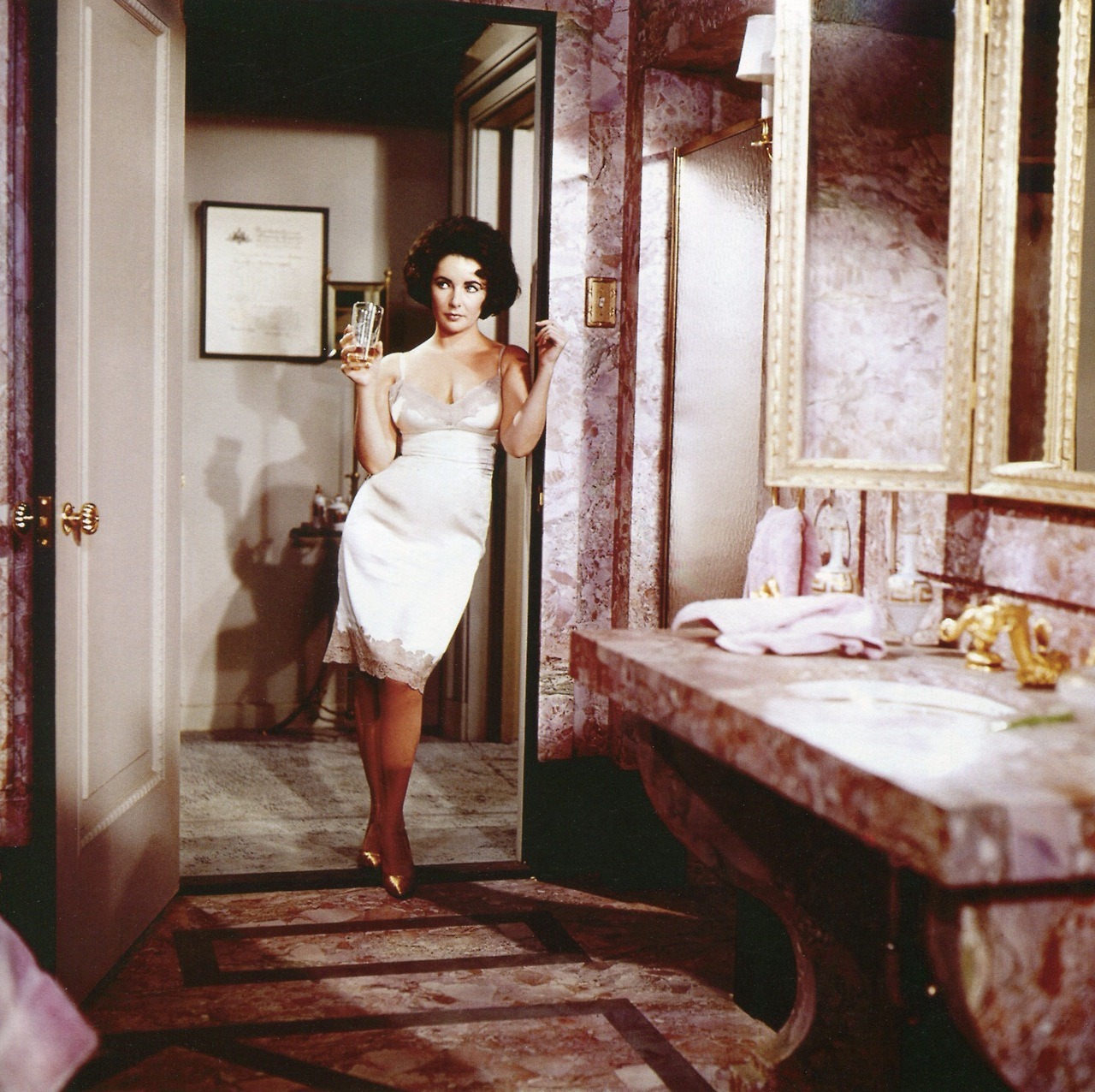
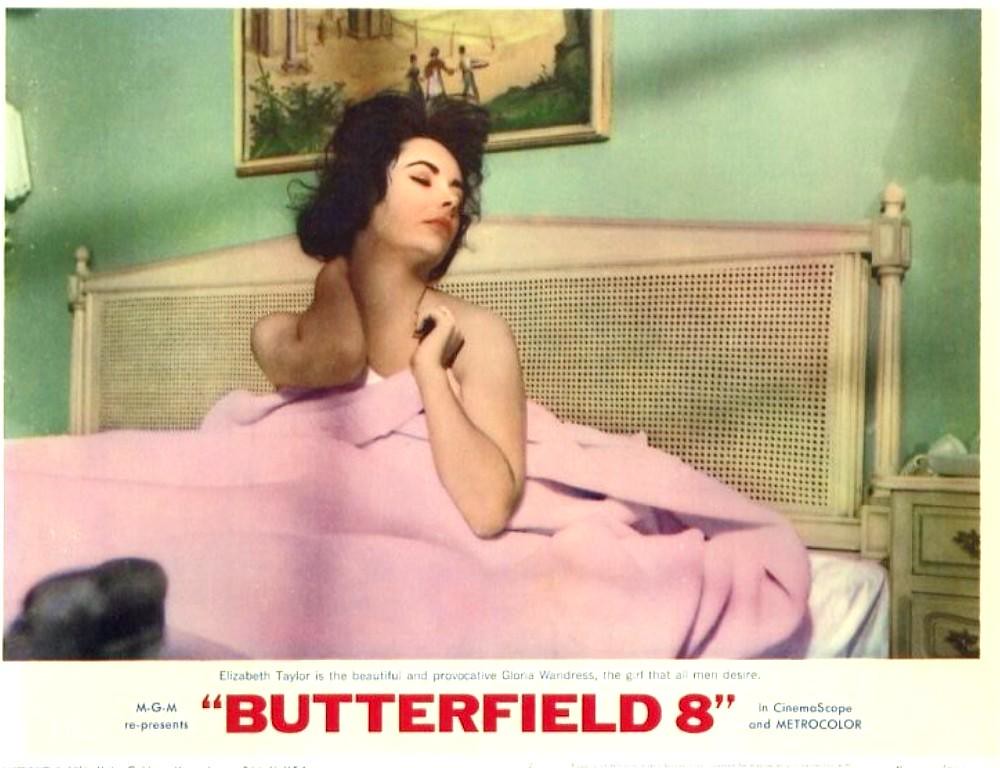
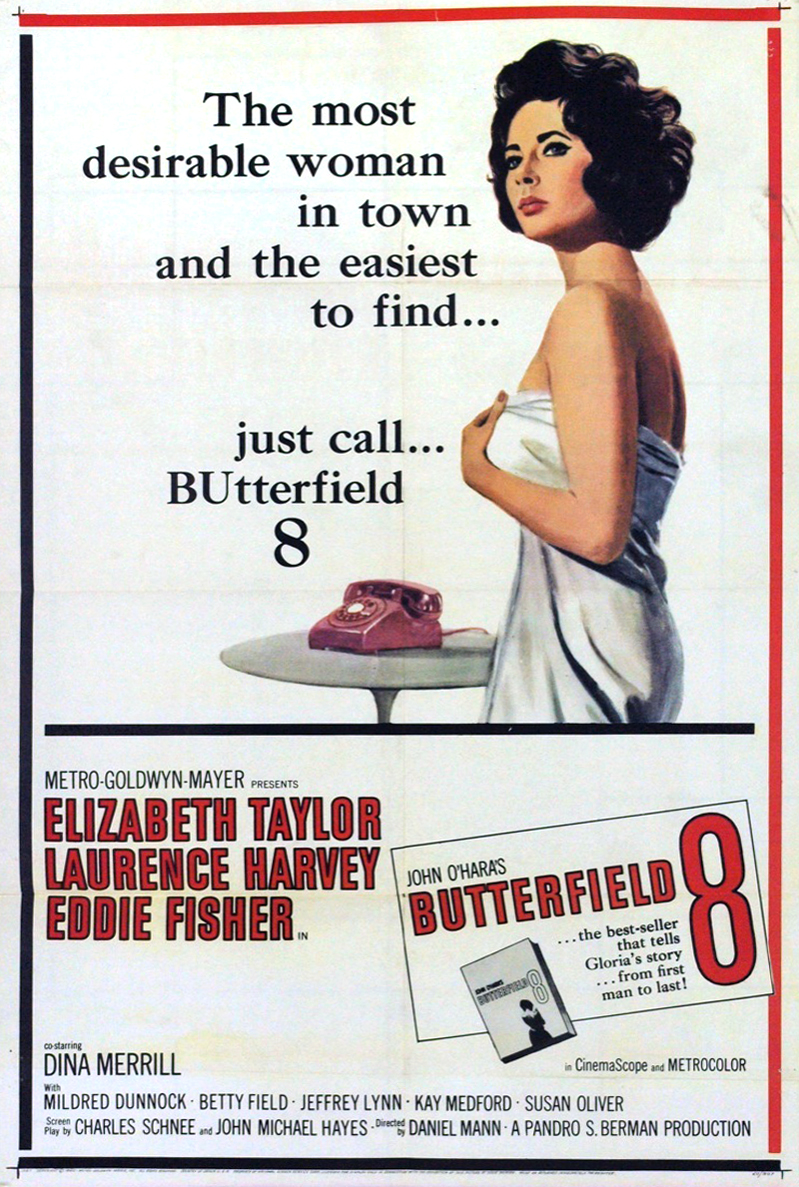
By the time Warhol began the Silver Liz series in the summer of 1963, Liz Taylor had become the highest-paid actor in Hollywood, having signed a $1 million dollar contract for her title role in Cleopatra. During filming, she became embroiled in a tempestuous love affair with her co-star Richard Burton, though she was married to Eddie Fisher at the time. Their rumored tryst was widely broadcast in newspapers and tabloids, even condemned by the Vatican, who described it as “erotic vagrancy.” Taylor was by then a definitive screen icon, known around the globe as the personification of style and glamour. Her beautiful “violet” eyes beguiled a nation, having captivated audiences from the age of twelve in the MGM production of National Velvet. A string of successful films garnered the actress four Academy Award nominations in four years between 1957 and 1960, and she finally won the Oscar for best actress for her role in Butterfield 8.
Despite her on-screen success and tumultuous love affairs, it was Taylor’s brush with death that propelled Warhol to paint her likeness. In 1960, Taylor traveled to London to begin filming Cleopatra, where she was struck by a particularly virulent respiratory illness, and she was briefly pronounced dead. An emergency tracheotomy rescued Taylor, who by her own account, died on nearly four separate occasions in her life. Warhol painted the Silver Liz series at his Firehouse studio between the months of June and July of 1963, an extremely prolific period in which he produced a series of silver paintings including the Silver Liz and Elvis paintings. This crucial period of Warhol’s early career resulted in several fundamental developments. With the assistance of Gerard Malanga, who Warhol hired on June 11, 1963, Warhol radically altered the format of his paintings, moving from several images repeated across the canvas surface, to a single, solitary image centered upon a 40×40 inch square format. The extraordinary time, care and attention to detail that Warhol took in these early works belies the spontaneity and experimentation that pervades them. Despite his reputation of a vacuous Pop star, Warhol was a shrewd innovator with a keen eye and a strong work ethic.
Indeed, Warhol himself once spoke of America, democracy, consumerism, Coca-Cola and Elizabeth Taylor in the same breath.
“What’s great about this country is that America started the tradition where the richest consumers buy essentially the same things as the poorest. You can be watching TV and see Coca-Cola, and you can know that the President drinks Coke, Liz Taylor drinks Coke, and just think, you can drink Coke, too. A Coke is a Coke and no amount of money can get you a better Coke than the one the bum on the corner is drinking. All the Cokes are the same and all the Cokes are good. Liz Taylor knows it, the President knows it, the bum knows it, and you know it.”
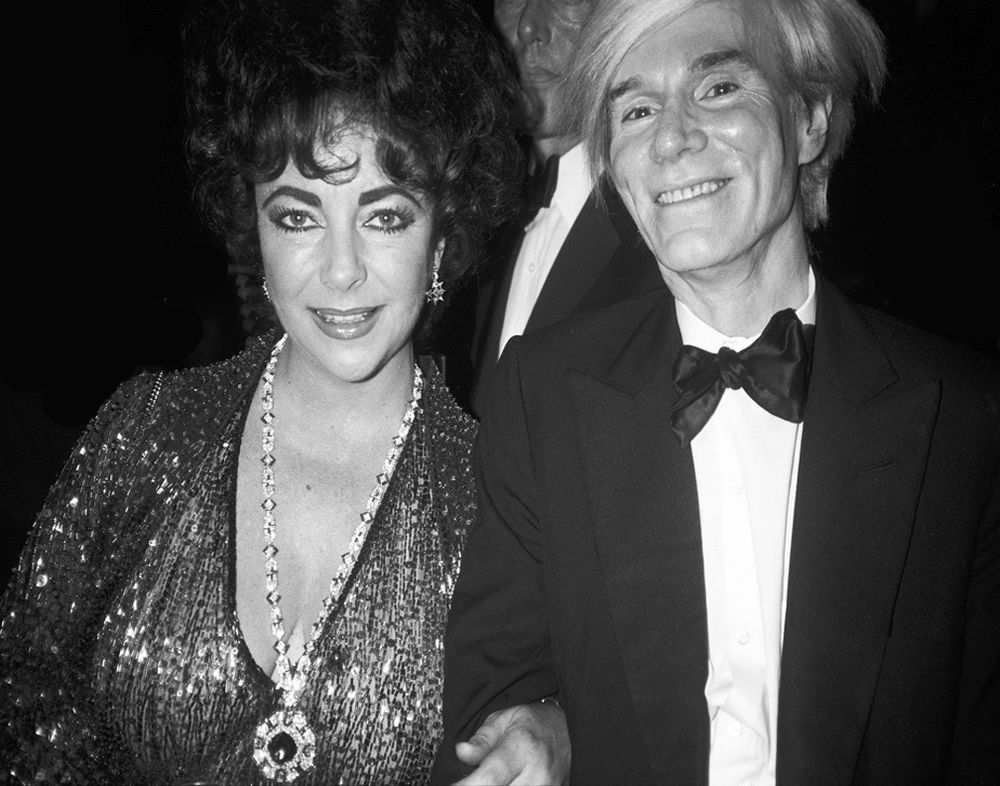
As perhaps the greatest cinematic icon of the silver screen in the latter half of the twentieth century, Elizabeth Taylor was clearly a fitting subject for Warhol’s celebrity-oriented art. Indeed, of all the many famous stars that Andy Warhol knew and painted, he seems to have held Elizabeth Taylor in especially high regard, seeing her throughout his life as the absolute epitome of glamour. When later in life Warhol met Taylor, growing to become friends with her in the late 1970s and 80s, he was famously heard to quip how as a choice of afterlife, he would like to be reincarnated as a “big ring” on Taylor’s finger. Not only was Elizabeth Taylor one of the great screen goddesses of her age and an enduring icon of glamour, it was her history as a child star, her many marriages and, in the early 1960s, the relatively recent tragedy of the death of her husband Mike Todd and rumored scandal of her romance with Richard Burton, that led to her status as a superstar who was seldom out of the gossip columns and her image rarely out of the papers.
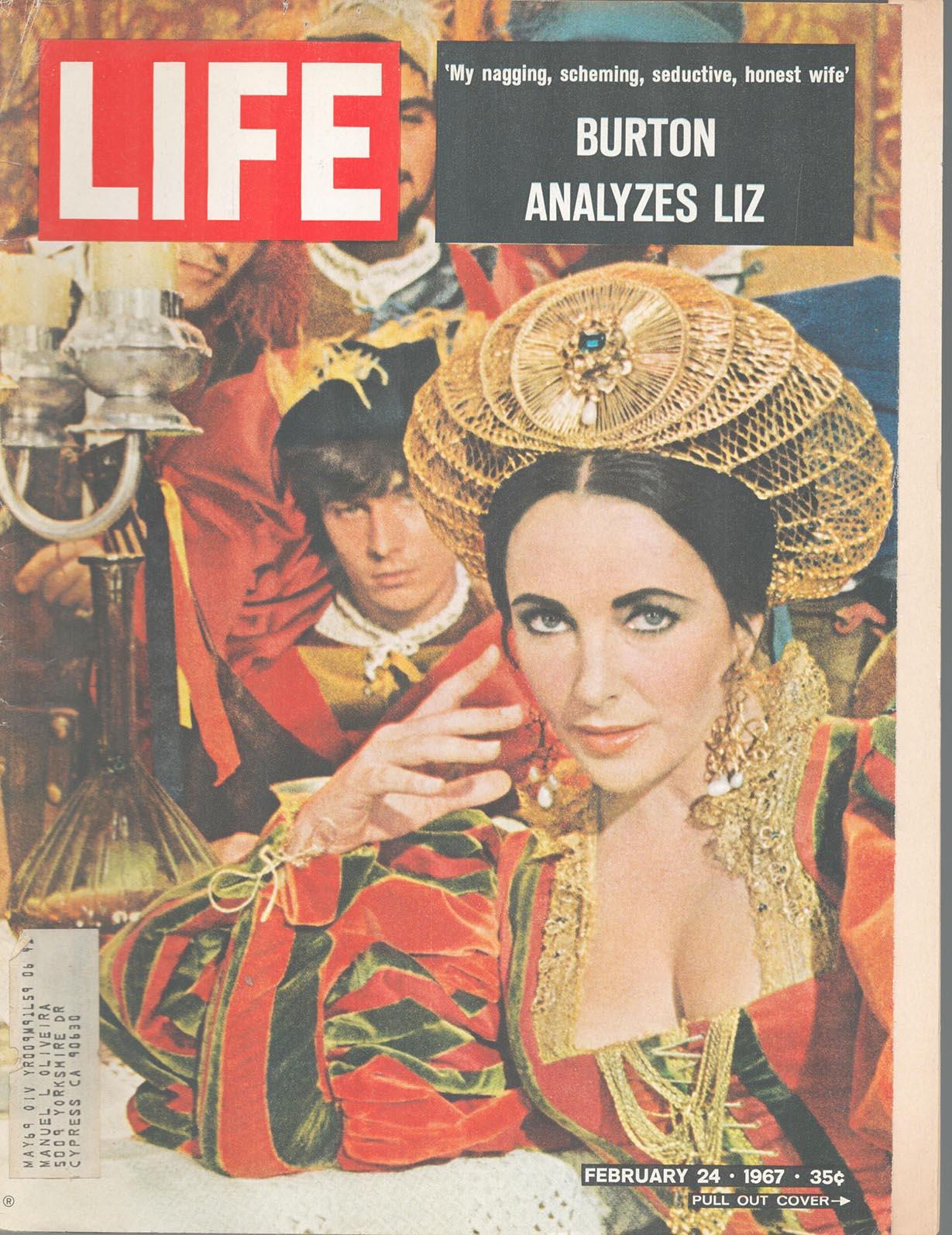
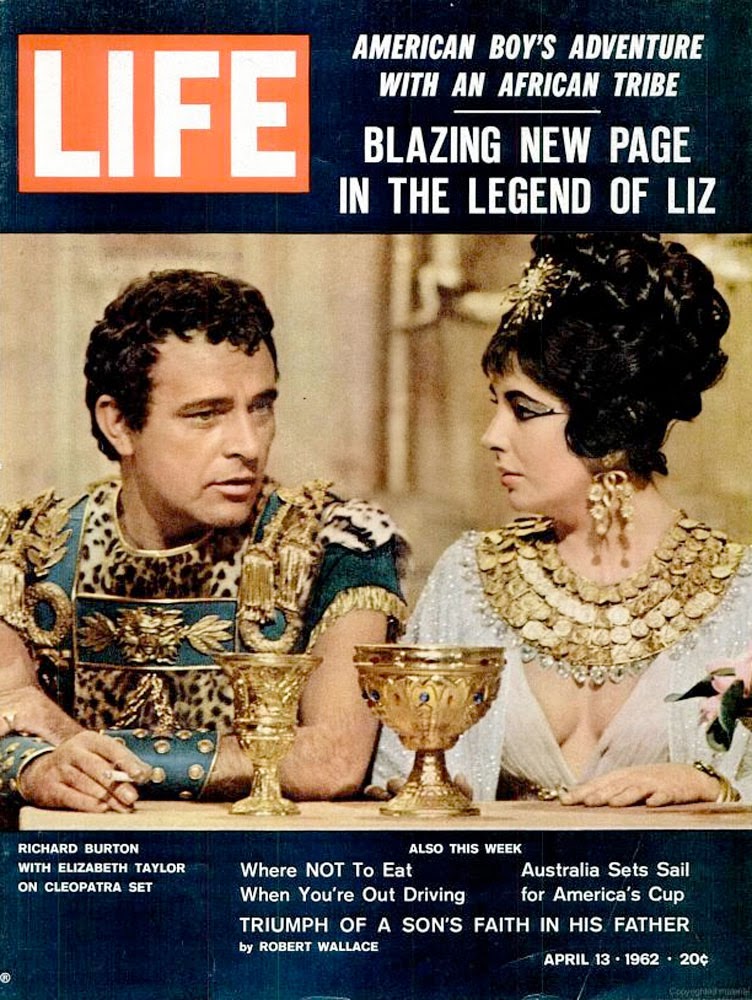
This combination of glamour and tragedy appealed to Warhol’s fascination with fame and his own deep sense of morbidity, and in 1962 the personae of Marilyn Monroe and Elizabeth Taylor would become Warhol’s ultimate muses in establishing iconic symbols of popular culture. While his series of colored Marilyn paintings were inspired by the shocking news of Monroe’s suicide in August 1962, Warhol’s focus on Elizabeth Taylor was generated from a ten-page feature on her marital history and career in the April 13, 1962 issue of Life, portraying Taylor on the cover with her new passion, Richard Burton, under the banner headline “Blazing New Page in the Legend of Liz.” Warhol chose images from this article to create several works of the actress in a retrospective vein from an early photograph of her role in National Velvet to a still from the upcoming movie Cleopatra, for which the actress was receiving the unprecedented salary of one million dollars. The most arresting image Warhol used was a group photograph of Liz, her third husband Mike Todd, Eddie Fisher and Debbie Reynolds at the Epsom Downs horse race prior to the scandalous intrigue of her romance with Eddie. In October-November 1962, Warhol used this image in four paintings all titled The Men in Her Life, memorializing this period as a preamble to the red-hot intensity of the publicity machine that was thriving on her tempestuous – and extremely public – affair with Burton. While Cleopatra would become notorious for its lavish budget and protracted production over years, its reception on its release in 1963 was cool and unforgiving as opposed to the career-enhancing publicity of the Burton-Taylor scandal.
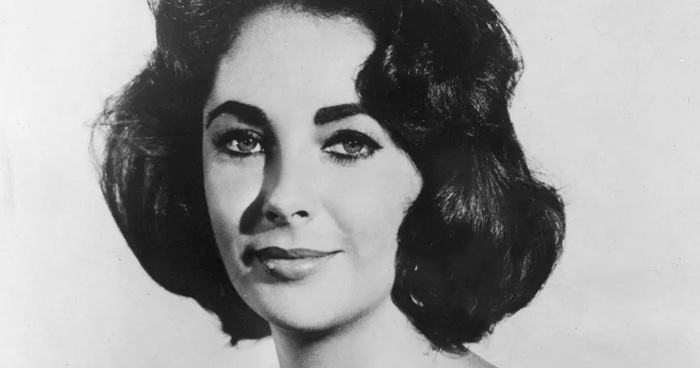
In the summer of 1963, Taylor’s role as an icon of luxury, decadence, sexuality and celebrity was at its height, when Warhol chose a publicity shot of the actress in the late 1950s to match the iconic pose he was using in his silkscreen paintings of Marilyn Monroe’s studio publicity shot. As in the case of Monroe, Warhol sought to capture her physical attributes – her public mask of hair and makeup – rather than a biographical or career moment. At first, Warhol screened this image over silver backgrounds in the summer of 1963, at the same time he was screening his Silver Elvis paintings, and both series were shown at the Ferus Gallery in October 1963.
However in October-November 1963, Warhol soon moved to the multi-colored backgrounds that he was using for his 20×16 inch Marilyn paintings of late 1962. With his Liz portraits, Warhol inaugurated the most classic format for his modern muses – the 40×40 inch canvases in which his goddess is centrally placed and evenly balanced. Set against bold colors, the thirteen Colored Liz paintings command our attention and seduce our senses. The Marilyn and Jackie paintings in this format followed in the summer of 1964. Like modern-day Madonnas, the images of these three women were refined down to their basic attributes contrasted dramatically against brilliant-colored backgrounds; in the case of Liz Taylor, her abundant dark hair, her brilliantly hued eyes, her perfectly arched brow and her voluptuous red lips were the signs of her immortality as a public image.
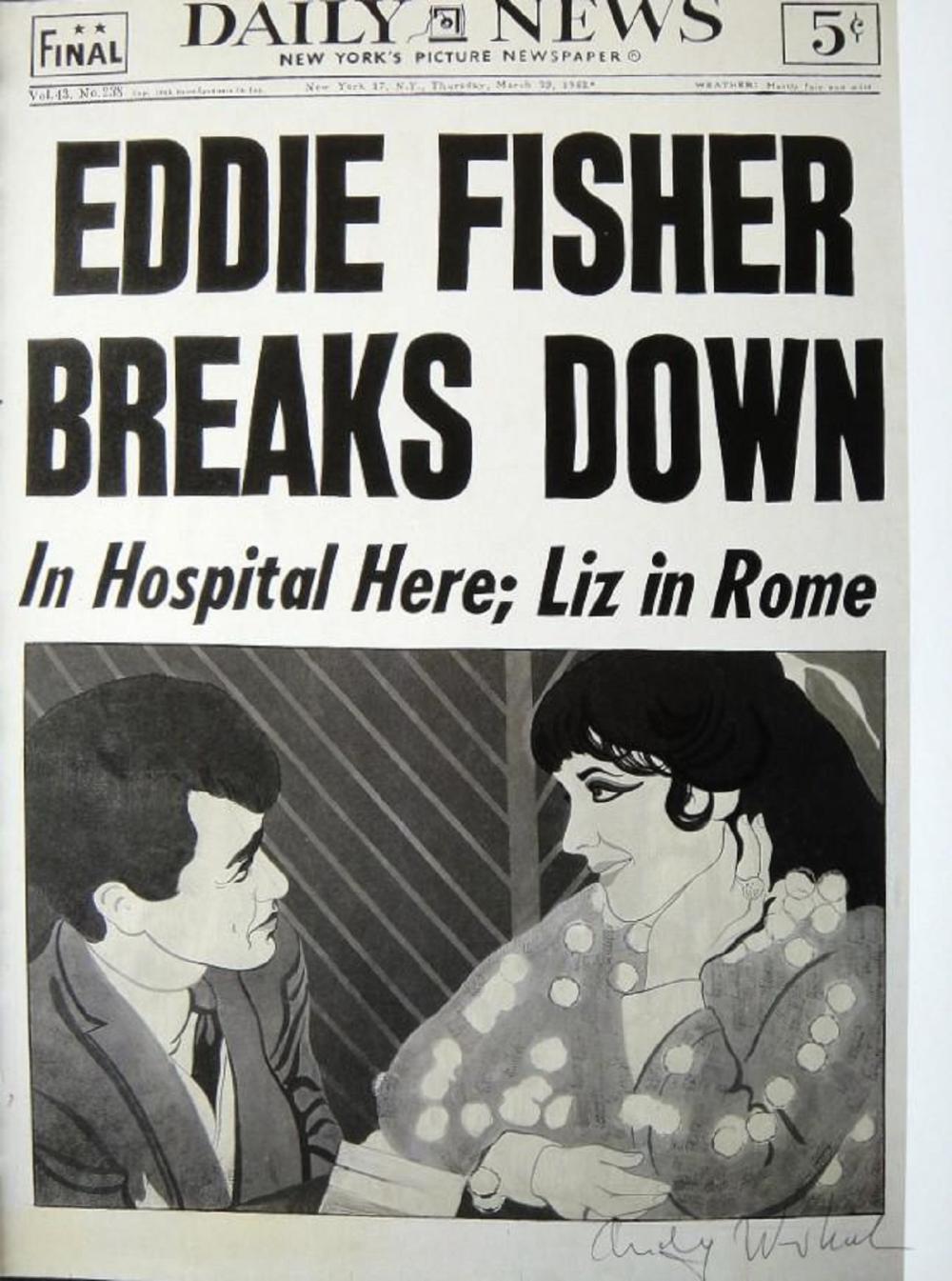
Most often, however, Warhol was intrigued with Liz as Hollywood starlet: he multiplied images of her characters in National Velvet and Cleopatra, or more simply portrayed her celebrated beauty in numerous full-face portraits. For Warhol, Elizabeth Taylor was much more than just a celebrated actress. She was the survivor of a near fatal illness, a goddess of the silver screen and the grand embodiment of the trinity of mortality, celebrity and fame which so fascinated the artist. Warhol’s deep involvement with the image of Elizabeth Taylor appeared very early in his career, beginning with his Death and Disaster paintings. When Warhol was still largely painting his canvases by hand, he borrowed subject matter from the front pages of tabloids and newspapers, beginning in 1961. Warhol’s second and largest “headline’’ painting, Daily News (1962), was based on the front and back pages of a March 29, 1962 newspaper with the front page headline “Eddie Fisher Breaks Down: In Hospital Here, Liz in Rome.” For Warhol, tabloid papers were either vehicles for mass disaster, rendering tragic circumstances almost mundane by their commonplace repetition, or the purveyors of celebrity and fame to an avid audience.
“I started those a long time ago, when she was so sick and everybody said she was going to die. Now I’m doing them all over, putting bright colors on her lips and eyes.”
As a canonization of the actress and as a comment on the manufactured nature of fame, Warhol achieved his desired aesthetic effect in the iconic Liz by employing silkscreen. As a process that he had begun on an experimental basis in 1962, Warhol recognized both the instant electricity and underlying artificiality it generated; indeed, the inky superimpositions of photo-derived screens on the bright, hand-painted hues epitomized Pop in their brand-like distinctness. Using the Duchampian methodology that he brought to his previous celebrity portraits such as the Marilyns, he created Liz using a publicity image of the actress, later cropping the bust-length image just below the chin, and sizing the screen to an enlargement of this detail.
Basing his process in the “readymade” and in he mechanical nature of the silkscreen, Warhol nonetheless brought a personal involvement to his portraits from the mid-sixties compared to some of his later more removed adaptations. With works like Liz, he started with a preliminary application of the screen on black canvas. Then, he brushed on background colors and each area of local color, such as the skin tone, eye shadow and lips, by hand in a rough appliqué of patterns. Finally, he added the black frame of the face to the colored map of the under painting. The effect, which is visible in the present work, was one of forced flatness, at once seductively alluring and shallowly artificial—keenly in keeping with the glamorous facade of Hollywood. In the present portrait, Liz’s luminous soft pink skin, green-shadowed eyes, and arresting scarlet lips are of unrivaled beauty.
Silver Liz
Warhol painted the Silver Liz series at his Firehouse studio between the months of June and July of 1963, an extremely prolific period in which he produced a series of silver paintings including the Silver Liz and Elvis paintings. This crucial period of Warhol’s early career resulted in several fundamental developments. With the assistance of Gerard Malanga, who Warhol hired on June 11, 1963, Warhol radically altered the format of his paintings, moving from several images repeated across the canvas surface, to a single, solitary image centered upon a 40 x 40 inch square format. The extraordinary time, care and attention to detail that Warhol took in these early works belies the spontaneity and experimentation that pervades them. Despite his reputation of a vacuous Pop star, Warhol was a shrewd innovator with a keen eye and a strong work ethic.
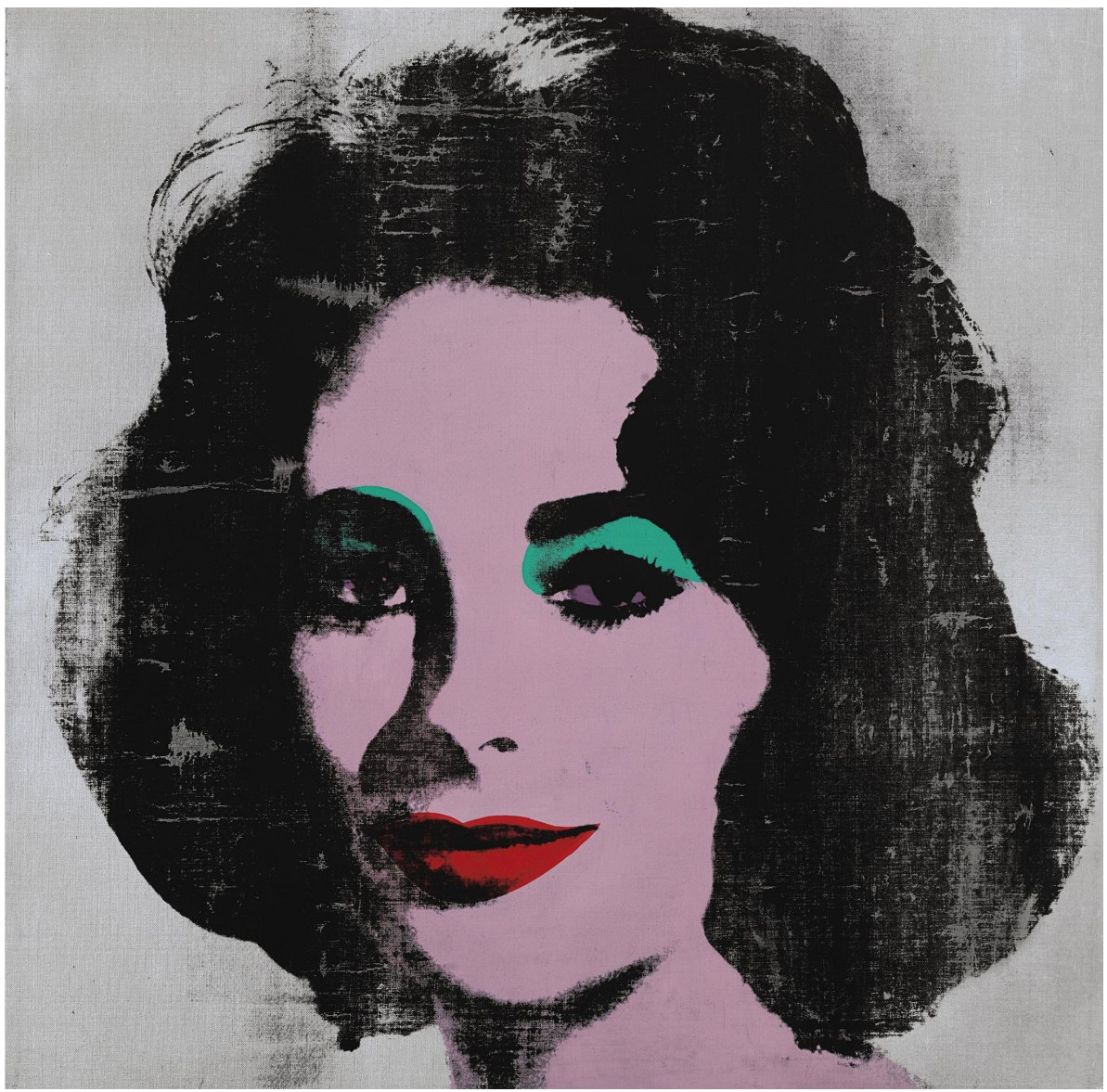
Warhol’s Silver Liz is based upon a black-and-white headshot of Elizabeth Taylor that was distributed by MGM as a publicity photograph. Rather than simply copying from the original, Warhol made subtle enhancements. By cropping the photograph and zeroing in on the original, he brings her features closer to the picture plane so that the canvas is nearly saturated with her appearance. Warhol captures the alluring sensuality of Taylor’s most celebrated attributes, from the cadmium red of Taylor’s sultry lips to the phthalo green eye shadow surrounding her seductive, come-hither eyes. Her gorgeous raven hair is perfectly coiffed, the essence of a glamorous film star. The acra violet that Warhol hand-painted for her skin imparts an otherworldly, ephemeral quality that seems to hint at the immortality she has achieved as an icon of the silver screen.
Warhol envelops his penultimate portrayal of the Hollywood legend in a rich and evocative field of silver, which ushers the image into a new realm. “For the rest of Warhol’s life and beyond, silver would be the color most associated with him, the only color to warrant its very own passage in [his memoir] Popism. “Silver was the future, it was spacey—the astronauts wore silver suits—Shepard, Grissom and Glenn had already been up in them, and their equipment was silver too. And silver was also the past—the Silver Screen—Hollywood actresses photographed in silver sets” (A. Warhol and P. Hackett (eds.), Popism: The Warhol Sixties, New York, 2006, p. 156). Warhol most likely intended the silver painted background of Silver Liz as a surrogate for the silver screen, which he also used in the concurrent Elvis series that summer, though its use must have had other expressive connotations. In Silver Liz, Warhol’s use of silver creates a mystical quality that seems to situate the screen goddess in a kind of pictorial ether, which immortalizes her image as the personification of style and glamour.
The Silver Liz paintings of 1963 were some of the last silver canvases he ever created. The series had its debut in September of 1963 at the Ferus Gallery in Los Angeles, where they were exhibited along with Warhol’s silver Elvis paintings. Of the ten Silver Liz paintings that were included in the Ferus show, only nine have been definitively identified. The present painting was included in this seminal show, where it was exhibited as a single panel. Two years later, Warhol added the silver “blank” when he included the work as a diptych in the comprehensive exhibition at the Institute of Contemporary Art in Philadelphia in 1965. This same year, the work was consigned to the Castelli Gallery and was acquired by Holly Solomon. With its impeccable provenance of the Ferus Gallery, Leo Castelli Gallery and the distinguished collection of Mr. and Mrs. Horace H. Solomon, this painting is one of the most iconic pieces of Warhol’s work, and one of only five Silver Liz diptychs of this type.
Silver Liz (diptych), 1963-1965
Christie’s New-York: 11 May 2015
Estimated: USD 25,000,000 – 35,000,000
USD 28,165,000
Andy Warhol (1928-1987), Silver Liz (diptych) | Christie’s
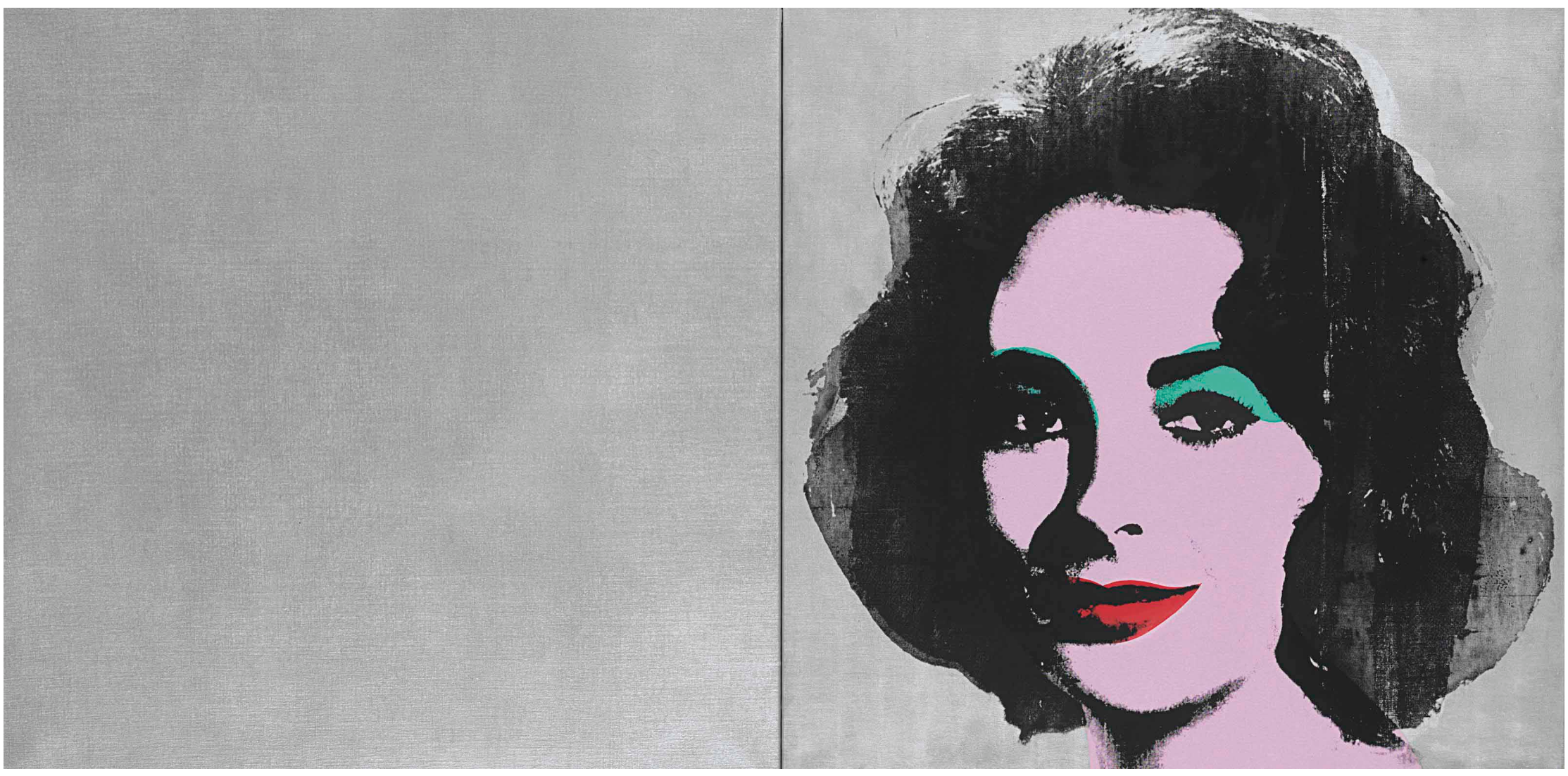
ANDY WARHOL
Silver Liz (diptych), 1963-1965
Spray enamel, synthetic polymer and silkscreen inks on canvas
40×80 inches (101.6 x 203.2 cm)
Signed and dated ‘Andy Warhol 65’ (on the overlap of the left panel)
The brilliant, shimmering double-paneled Silver Liz is one of the most celebrated and acclaimed paintings of Andy Warhol’s entire career. Painted during the summer of 1963, Silver Liz is an early Pop Art masterpiece that illustrates Warhol’s newly developed silkscreen technique with a power and gravitas unrivaled by other works. Warhol’s Silver Liz is based upon a black-and-white headshot of Elizabeth Taylor that was distributed by MGM as a publicity photograph. Rather than simply copying from the original, Warhol made subtle enhancements. By cropping the photograph and zeroing in on the original, he brings her features closer to the picture plane so that the canvas is nearly saturated with her appearance. Warhol captures the alluring sensuality of Taylor’s most celebrated attributes, from the cadmium red of Taylor’s sultry lips to the phthalo green eye shadow surrounding her seductive, come-hither eyes. Her gorgeous raven hair is perfectly coiffed, the essence of a glamorous film star. The acra violet that Warhol hand-painted for her skin imparts an otherworldly, ephemeral quality that seems to hint at the immortality she has achieved as an icon of the silver screen.
Warhol envelops his penultimate portrayal of the Hollywood legend in a rich and evocative field of silver, which ushers the image into a new realm. “For the rest of Warhol’s life and beyond, silver would be the color most associated with him, the only color to warrant its very own passage in [his memoir] Popism. “Silver was the future, it was spacey—the astronauts wore silver suits—Shepard, Grissom and Glenn had already been up in them, and their equipment was silver too. And silver was also the past—the Silver Screen—Hollywood actresses photographed in silver sets” (A. Warhol and P. Hackett (eds.), Popism: The Warhol Sixties, New York, 2006, p. 156). Warhol most likely intended the silver painted background of Silver Liz as a surrogate for the silver screen, which he also used in the concurrent Elvis series that summer, though its use must have had other expressive connotations. In Silver Liz, Warhol’s use of silver creates a mystical quality that seems to situate the screen goddess in a kind of pictorial ether, which immortalizes her image as the personification of style and glamour.
Silver Liz, 1963
Christie’s New-York: 8 November 2011
Estimated: USD 16,000,000 – 19,000,000
USD 16,322,500
Andy Warhol (1928-1987) , Silver Liz | Christie’s
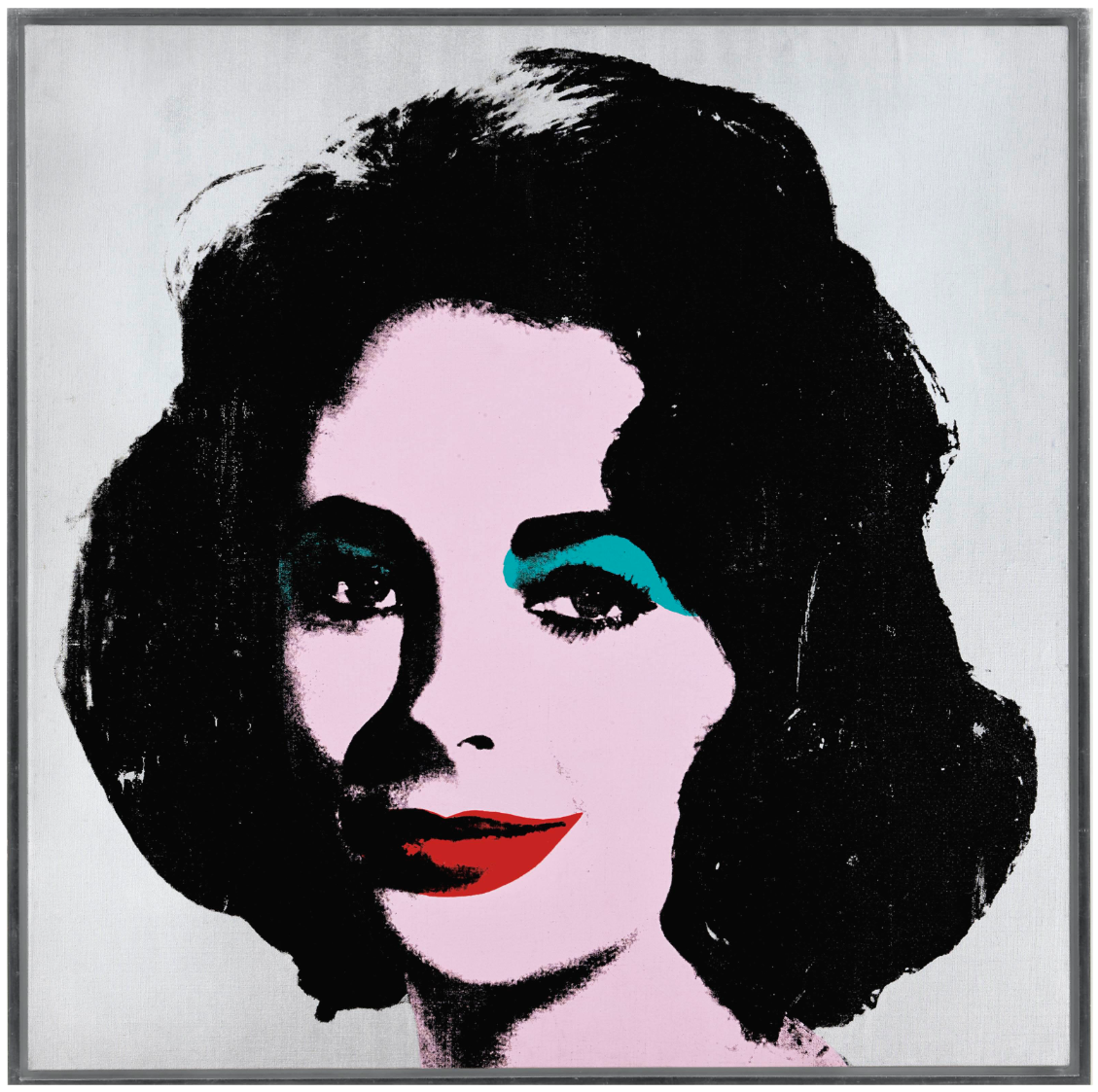
ANDY WARHOL (1928-1987)
Silver Liz, 1963
Acrylic, silkscreen ink and spray enamel on canvas
40×40 inches (101.6 x 101.6 cm)
Stamped with the Andy Warhol Art Authentication Board, Inc. stamp and numbered ‘A108.992’ (on the overlap)
Apart from a brief series of monochrome silver images of Taylor drawn from an alternate publicity shot, the first fully colored versions of these new silver images of Liz came to be known as the ‘Ferus-type’ Silver Liz paintings because they were made for Warhol’s second one-man show held at the Ferus Gallery in Los Angeles in October 1963. Warhol’s first exhibition at the Ferus Gallery had been his famous 1962 exhibition of soup cans. As a follow-up to this radical and groundbreaking show with its serial imagery of inanimate consumerist celebrity, and because the gallery was situated in the home of Hollywood, both Warhol and the gallery’s director Irving Blum believed that images of Hollywood-related celebrity would prove an appropriate choice for Warhol’s second West Coast show. As a consequence Warhol subsequently produced a long series of silver images of Elvis Presley taken from the Hollywood movie Flaming Star and ten large square-format Silver Liz paintings of which this work is one.
Executed on a series of square 40 x 40 inch canvases that would subsequently become a standard format for many Warhol paintings, Warhol chose his image of Taylor from a black and white publicity shot of her which he cropped around her chin in a manner not unlike that with which he had formerly cut down his equally famous image of Marilyn Monroe. Like that of his Marilyns Warhol’s choice of image in this instance ultimately helped to define the public image of the star herself becoming, as Liz Taylor was years later to point out to Warhol in a letter she wrote to him, at least as famous, if not more so, than she was. Warhol’s selection of a generic image of Taylor in this case, was crucial. He did not choose one of her playing a role nor one with a specific setting or any image drawn from any identifiable moment in her life (unlike the previous 1962 images he had used), but rather a simple and powerful portrait image that, allows and indeed encourages her face to be seen and recognized as a kind of archetype or icon.
Choosing a flat full-face and commanding image of the star looking directly out of the picture, Warhol presents Taylor’s famously striking features and distinctive jet black hair in a rich purple-pink adorned with a lurid emerald green eye make-up and blood red lips in a way that is both sensitive to and actively heightening of the almost demonic nature of her beauty. Indeed, in Warhol’s hands, Taylor’s arresting face is here made even more so to the point where it becomes almost Medusa-like in its power to transfix the viewer’s gaze and convey a powerful sense of an enduring and resonant image now forever fixed and frozen in a moment in time.
Silver Liz, 1963
Christie’s London: 30 June 2010
Estimated: GBP 6,000,000 – 8,000,000
GBP 6,761,250
Andy Warhol (1928-1987) , Silver Liz | Christie’s
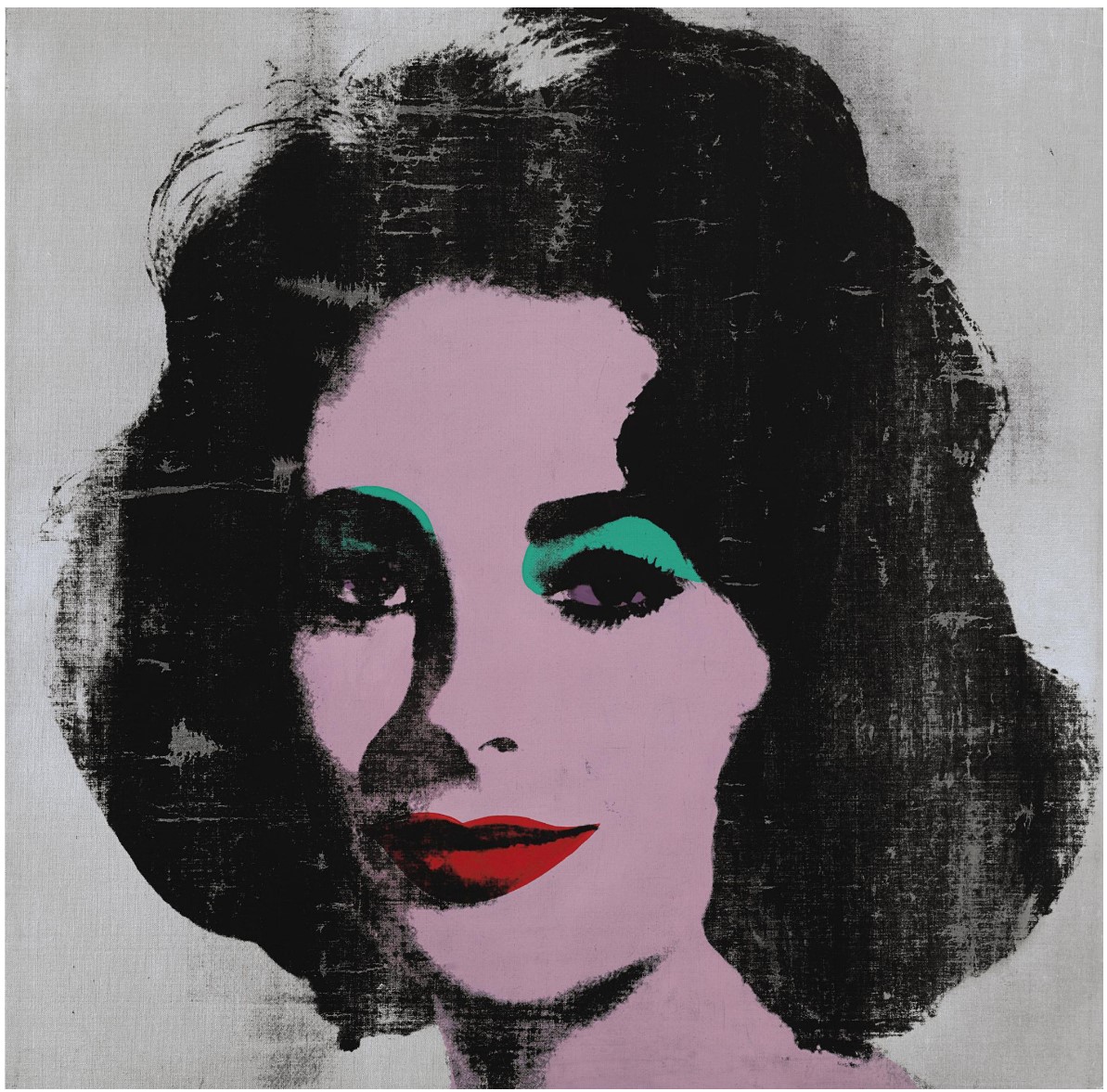
ANDY WARHOL
Silver Liz, 1963
Synthetic polymer paint, silkscreen inks and spray enamel on linen
39.9 x 39.4 inches (101.5 x 99.7 cm)
Stamped twice with the artist’s signature (on the overlap)
As an icon of Pop Art and one of Andy Warhol’s original ‘Ferus-type’ Silver Liz works of 1963 this shimmering example is one of only two paintings in which the artist highlights her legendary violet eyes. Executed at a time when she had just become the world’s first million-dollar actress, and Warhol’s star itself was arriving, this was a true meeting of the cultural giants of their time. Taylor’s unusual eye color has captured the imagination of her legions of fans and helped to establish her reputation as one of the most beautiful screen goddesses of all time. Interestingly, the unique color of her eyes, which originated in an unusual genetic condition, would have been hidden from the audiences of her early black and white films. But with the introduction of color cinematography the true nature of her appearance was revealed, and it added to her almost mythical status in the glamorous world of Hollywood. As a window onto the soul, the eyes have long been an important way of trying to decipher someone’s true personality. Warhol’s decision to pay special attention to her eyes in this way makes this canvas stand out as one of his most personal works in which he was trying to establish a direct relationship with the actress and a true connection to her soul. With this particular Silver Liz, Warhol produces a glamorous and very individual portrait that has become one of most iconic images he ever produced.
Painted for Warhol’s now famous show at the Ferus Gallery in Los Angeles in October 1963, his Silver Liz series was exhibited in the same exhibition as his silver canvases of Elvis Presley. The combination of a legendary rock and roll star and a goddess of the silver-screen proved to be intoxicating. Both stars were at the height of their fame; Elvis had returned after his stint in the US Army and Liz Taylor had just become the first $1million actress for her role alongside Richard Burton in Cleopatra. Painted before he embarked on his Liz paintings, Warhol’s Elvis pictures were screened onto a canvas that hand been painted silver. However, by the time he produced Silver Liz Warhol had refined the process and started to spray paint the canvases silver as he preferred the smoother finish the spray paint gave him.
Searching for a way of exploring his ideas about art, celebrity and popular culture Warhol had developed his silkscreen process in 1962. He appreciated the instant electricity and underlying artificiality it generated; the inky superimpositions of the photo derived screens and the vivid colors epitomized Pop with their brand-like distinctness. Onto the silver surface of the canvas Warhol made an impression in black ink to establish the areas where the secondary colors would go. These colours: acra violet for the face and neck, phthalo green for the eye shadow, purple for the eyes and cadmium red for the lips were then painted on by hand. Once the purple eyes had been added, a second impression would have been made to match the first as closely as possible.
As with much of Warhol’s work, color was one of his most important considerations and his choice of silver as the dominant color for his portraits of Liz Taylor was partly inspired by the aesthetic possibilities it offered him and in part by its references to contemporary culture. He first began using silver in 1963, the year Silver Liz was painted and most of his silver canvases were produced during a brief burst of activity between April and July of that year. Silver was the color of Hollywood glamour and the silver screen, an association that would have meant a lot to Warhol who spent the happiest moments of his childhood in Depression-era Pittsburgh at his local cinema watching his favorite film stars on the big screen. Warhol was also captivated by the associations the color had with pop culture. In contrast to gold and its links with the ancient world and old fashioned luxury he thought silver had far more potential for his work. The fleeting nature of fame and the ethereal quality of cinema made a portrait of Liz Taylor an ideal subject for Warhol to use for his silkscreening process. The physical qualities inherent in the process also represent some of Warhol’s ideas about celebrity. Some intended effects, especially the thin, striated areas of paint insinuate a physical dissolution that evokes a fleeting presence, indicating the transience of fame: ‘The silkscreened image, reproduced whole, has the character of an involuntary imprint. It is a memorial in the sense that it resembles memory – sometimes vividly present, sometimes elusive, always open to embellishment as well as loss’ (T. Crow, ‘Saturday Disasters: Trace and Reference in Early Warhol’, After the Party: Andy Warhol Works 1956- 1986, exh. cat., Irish Museum of Modern Art, Dublin, 1997, p. 22). Warhol’s link between fame and nostalgia is the very basis of these works, which are often generated from old photographs: the one used to create present work, for example, is a publicity photograph from 1950, which predates the painting by some thirteen years. When Warhol painted Silver Liz the actress was at the pinnacle of her career. Her career started at the age of nine when she starred in her first film There’s One Born Every Minute but her breakthrough moment came in 1944 with release of MGM’s National Velvet, which grossed over $4million dollars at the box office. This was not first of Warhol’s work to include Liz Taylor. She first appeared in one of his tabloid paintings, Daily News, a painting documenting her catastrophic illness of 1961. She resurfaced in allusion only, in The Men in Her Life, a work based on a 1957 photograph, which included both her current husband, Mike Todd, and her future one, Eddie Fisher. Most often, however, Warhol was obsessed with Liz as Hollywood starlet: he multiplied images of her characters in National Velvet and Cleopatra. Decades after his obsessive repetition of her image, he eventually befriended Taylor. While in Rome in 1973, Warhol even made a cameo appearance in The Driver’s Seat, a film in which Taylor was starring.
Early Colored Liz
Andy Warhol’s Liz is an iconic tribute to one of the major silver screen goddesses in the artist’s Pop pantheon. Painted at the height of Elizabeth Taylor’s fame, Andy Warhol realized thirteen colorful portraits of the actress in the fall of 1963. Warhol immortalizes the actress as an embodiment of the cult of celebrity. Closely related to the candy-colored Marilyn paintings that he executed in the previous year, Liz shows Warhol’s genius for color in full force. Although Warhol employed the mass media technique of screen printing, he brought a high level of personal involvement to the Liz series, carefully embellishing her skin, eyes and make-up with hand-applied paint.
Liz [Early Colored Liz], 1963
Christie’s New-York: 15 May 2019
Estimated: USD 20,000,000 – 30,000,000
USD 19,343,000
Andy Warhol (1928-1987), Liz [Early Colored Liz] | Christie’s
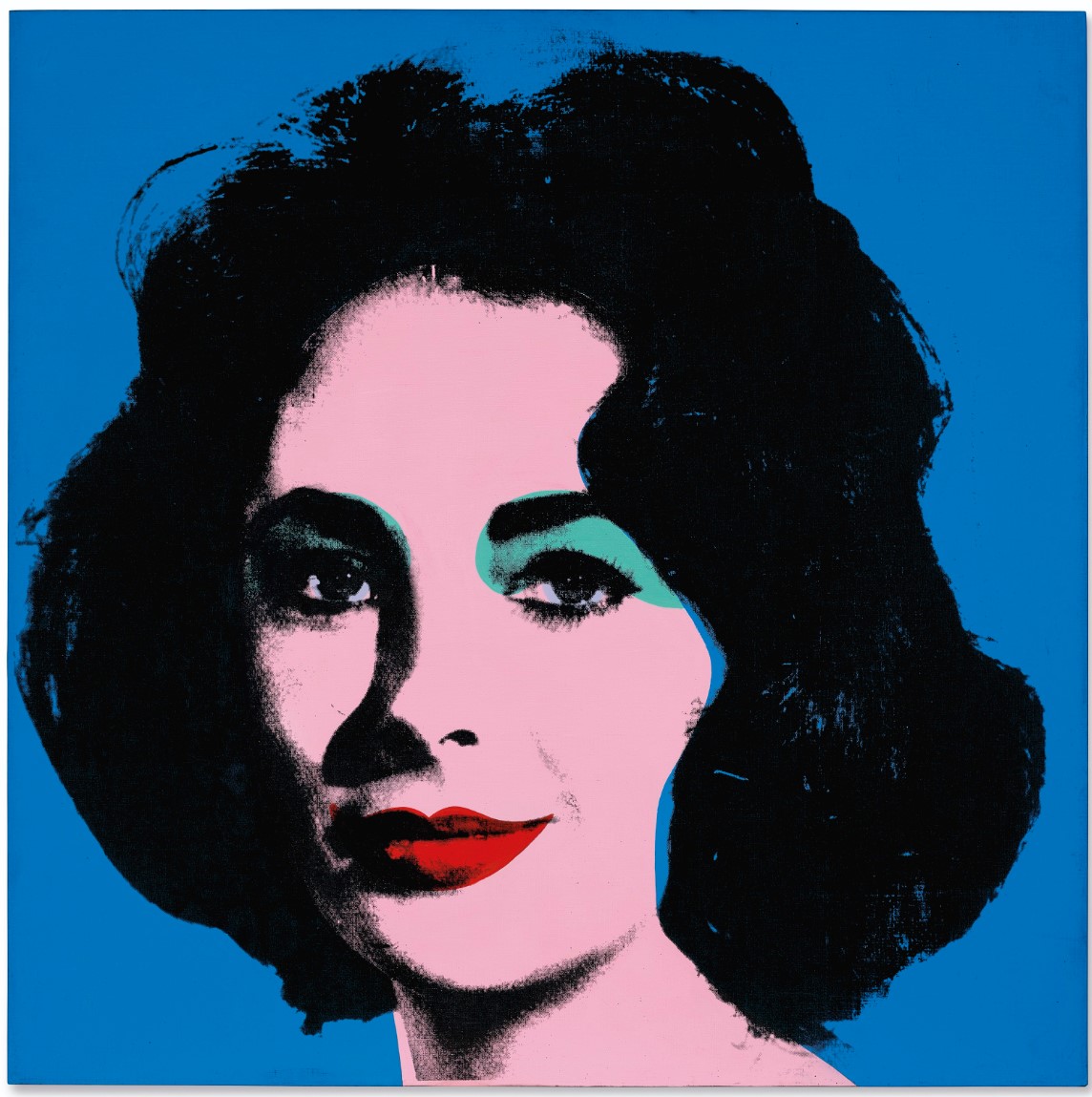
ANDY WARHOL
Liz [Early Colored Liz], 1963
Synthetic polymer and silkscreen ink on canvas
40×40 inches (101.3 x 101.3 cm)
Signed and misdated ‘Andy Warhol 62’ (on the overlap)
Painted at the height of Elizabeth Taylor’s fame, Liz is a unique painting from a group of thirteen colorful portraits of the actress that Warhol executed in the fall of 1963. In this cerulean blue portrait, Warhol immortalizes the actress as an embodiment of the cult of celebrity. Closely related to the candy-colored Marilyn paintings that he executed in the previous year, Liz shows Warhol’s genius for color in full force. The brilliant blue background offsets Taylor’s luminous skin, as well as her trademark scarlet lips and violet eyes, magnifying the most characteristic features of her celebrated beauty. Although Warhol employed the mass media technique of screen printing, he brought a high level of personal involvement to the Liz series, carefully embellishing her skin, eyes and make-up with hand-applied paint. In this respect, the present painting is outstanding, and indeed recuperative in many respects. This example not only incorporates a blue background, which reprises the dominant color of Warhol’s earlier Cleopatra image, but it also includes a deep violet hue in Liz’s irises, reproducing Taylor’s actual eye color, a most characteristic feature of her celebrated beauty.
Liz #3 (Early Colored Liz), 1963
Sotheby’s New-York: 11 November 2014
Estimate on Request
USD 31,525,000
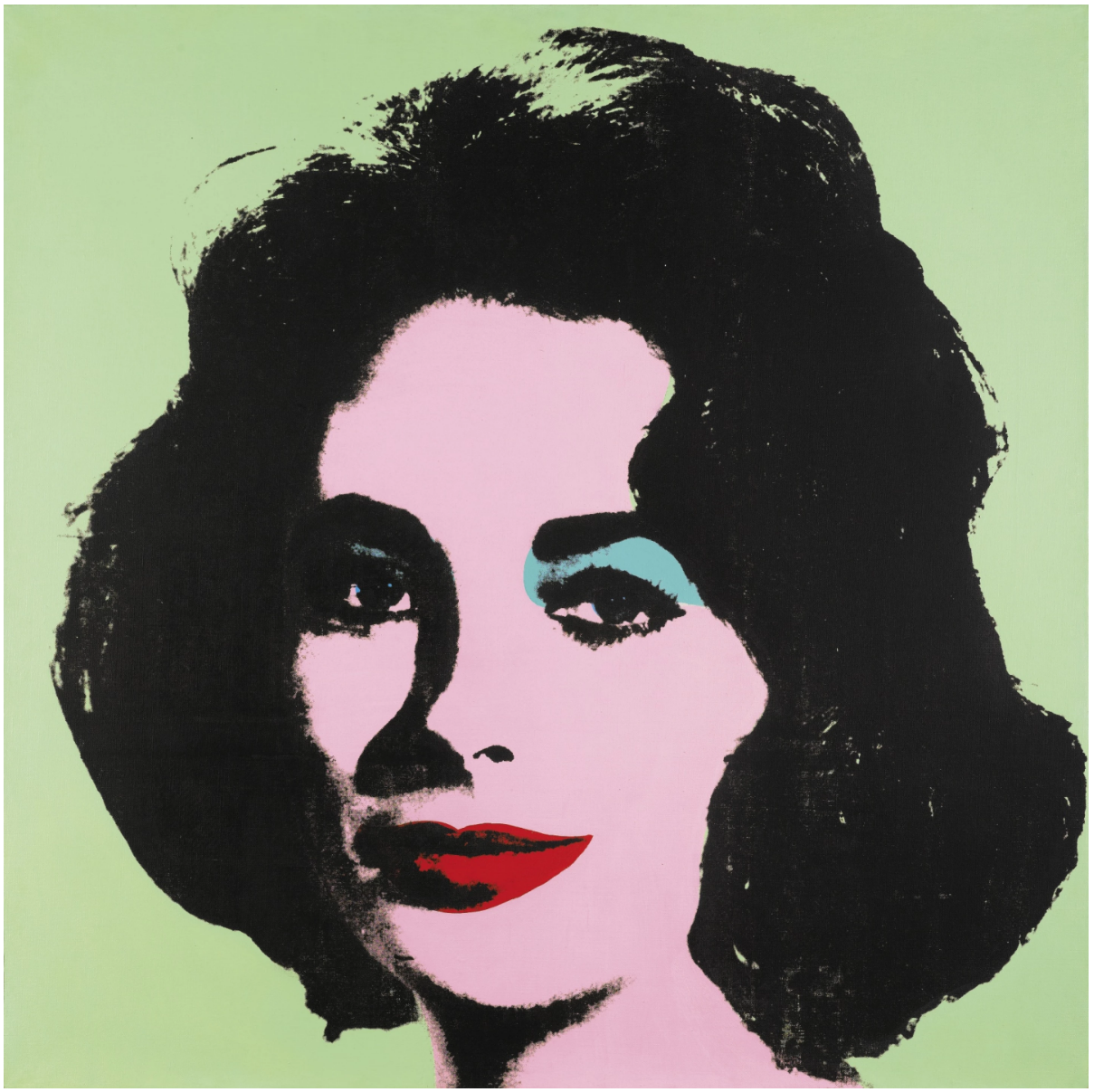
ANDY WARHOL
Liz #3 (Early Colored Liz), 1963
Acrylic and silkscreen ink on canvas
40×40 inches (101.6 x 101.6 cm)
Thus in the summer of 1963 there could not have been a more perfect alignment of artist and subject than Warhol and Liz. Perhaps the most famous depiction of the biggest superstar by the original superstar artist, Liz#3 is a historic paradigm of Pop Art from a breath-taking moment in Art History. With devastating immediacy and efficiency, Warhol’s canvas seduces our view with a stunning aesthetic and is an indisputable icon for our age.
Warhol’s magnificent Liz #3, executed between October and November 1963, is one of a rare series of Elizabeth Taylor produced by the master of Pop Art on colored backgrounds. This series of jewel-toned portrait paintings represents the apotheosis of Warhol’s ground-breaking creative vision, both as the technician of the (still then) revolutionary silkscreen process and the architect of iconic visual treatises on the modern vagaries of celebrity. This luminous portrait not only captures the ironically dark essence of Twentieth Century glamour and fame, it also speaks of a time of growing fame for Warhol himself. The numerical title of Liz #3 originates from the first exhibition of this series at the Contemporary Art Center in Cincinnati, where six of the colored Liz paintings appeared in a December 1963 show fittingly titled An American Viewpoint.
Liz #3 is another example of Andy Warhol’s exceptional colorist abilities, by the stunning mint green hue that bursts from the surface. It seeps into the sitter’s hair, displaying pyrotechnics of color and screen. Punctuating these bold passages are the shocking turquoise of her eyeshadow as well as the famous blue tones of her eyes. This strong chromatic field sets the stage upon which the star herself is realized. Warhol’s silkscreen technique, still a relatively new phenomenon to him in 1963, is beautifully executed here. There is a wonderful balance between the crisp record of the overall form, together with softer, more subtle areas of screen that shape the shadows around her nose, cheek and neck. One finds in this series of Colored Liz paintings a more confident Warhol with the silkscreen. The early experiments had been made, and now he wished to explore the various nuances this new technique presented to him.
Liz #1 (Early Colored Liz), 1963
Sotheby’s New-York: 10 November 2013
Estimated: USD 20,000,000 – 30,000,000
USD 20,325,000
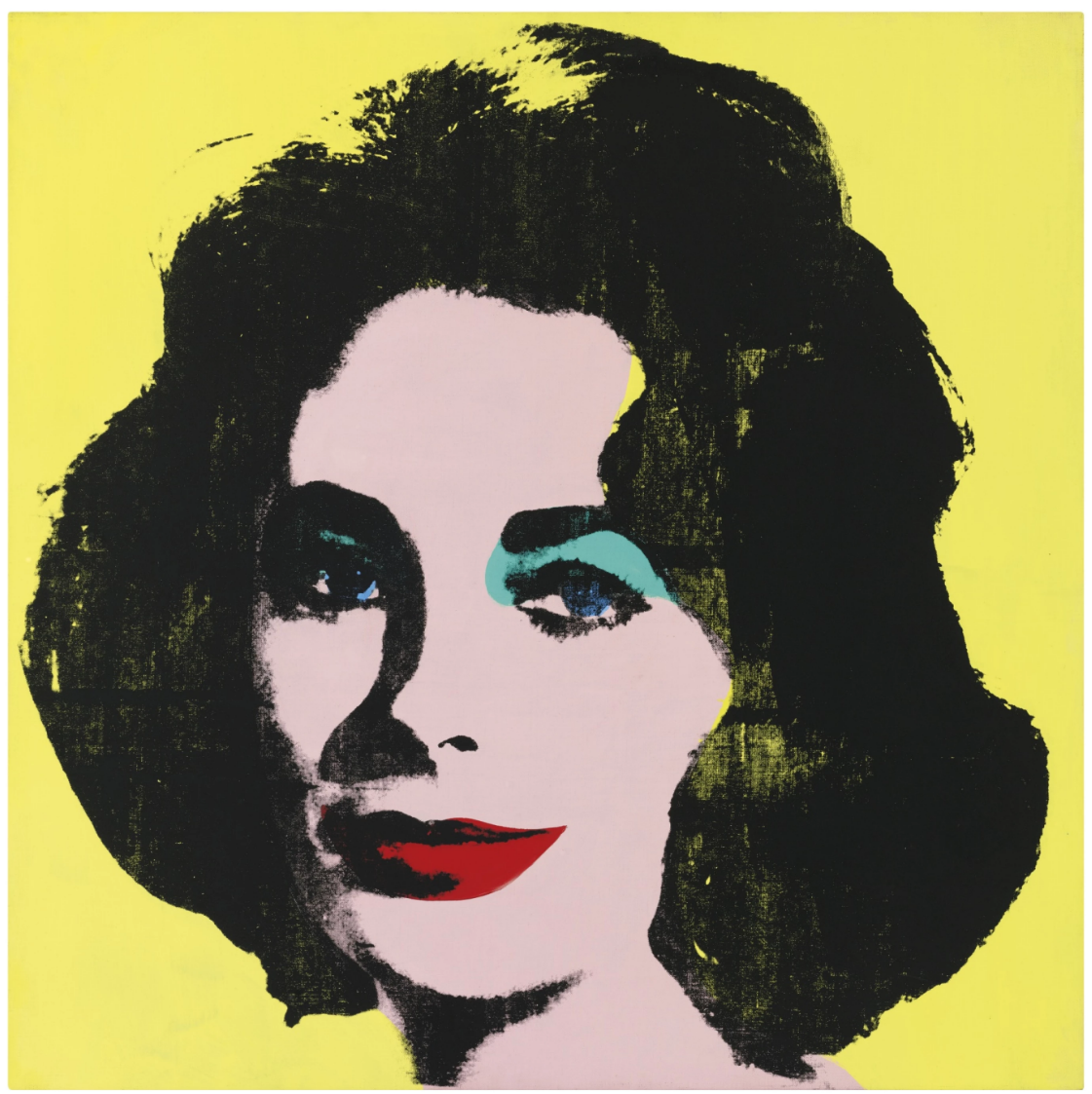
ANDY WARHOL
Liz #1 (Early Colored Liz), 1963
Acrylic and silkscreen ink on canvas
40×40 inches (101.6 x 101.6 cm)
From the very first moment one encounters Andy Warhol’s magnificent Liz #1, one is seduced by the bright, electrified yellow hue that bursts from the surface. It seeps into the sitter’s hair, displaying pyrotechnics of color and screen. Punctuating these bold passages are the shocking turquoise of her eyeshadow as well as the famous blue tones of her eyes. This strong chromatic field sets the stage upon which the star herself is realized. Warhol’s silkscreen technique, still a relatively new phenomenon to him in 1963, is beautifully executed here. There is a wonderful balance between the crisp record of the overall form, together with softer, more subtle areas of screen that shape the shadows around her nose, cheek and neck. One finds in this series of Colored Liz paintings a more confident Warhol with the silkscreen. The early experiments had been made, and now he wished to explore the various nuances this new technique presented to him.
The numerical title of Liz #1 originates from the first exhibition of this series at the Contemporary Art Center in Cincinnati, where six of the colored Liz paintings appeared in a December 1963 show fittingly titled An American Viewpoint. Most importantly, it resided for several decades in the illustrious Sonnabend Collection, along with Liz #5 (Early Colored Liz) and Four Marilyns of 1962, both on turquoise grounds, among many other masterpieces of Pop Art. Ileana Sonnabend and her former husband Leo Castelli each held important exhibitions for Warhol in the months following the creation of Liz #1 – the Death and Disaster paintings at Galerie Sonnabend in Paris in January and the Flower paintings in New York at the Castelli Gallery in November – December 1964.
Liz, 1963
Christie’s New-York: 13 November 2007
Estimated: USD 25,000,000 – 35,000,000
USD 23,561,000
Andy Warhol (1928-1987) , Liz | Christie’s
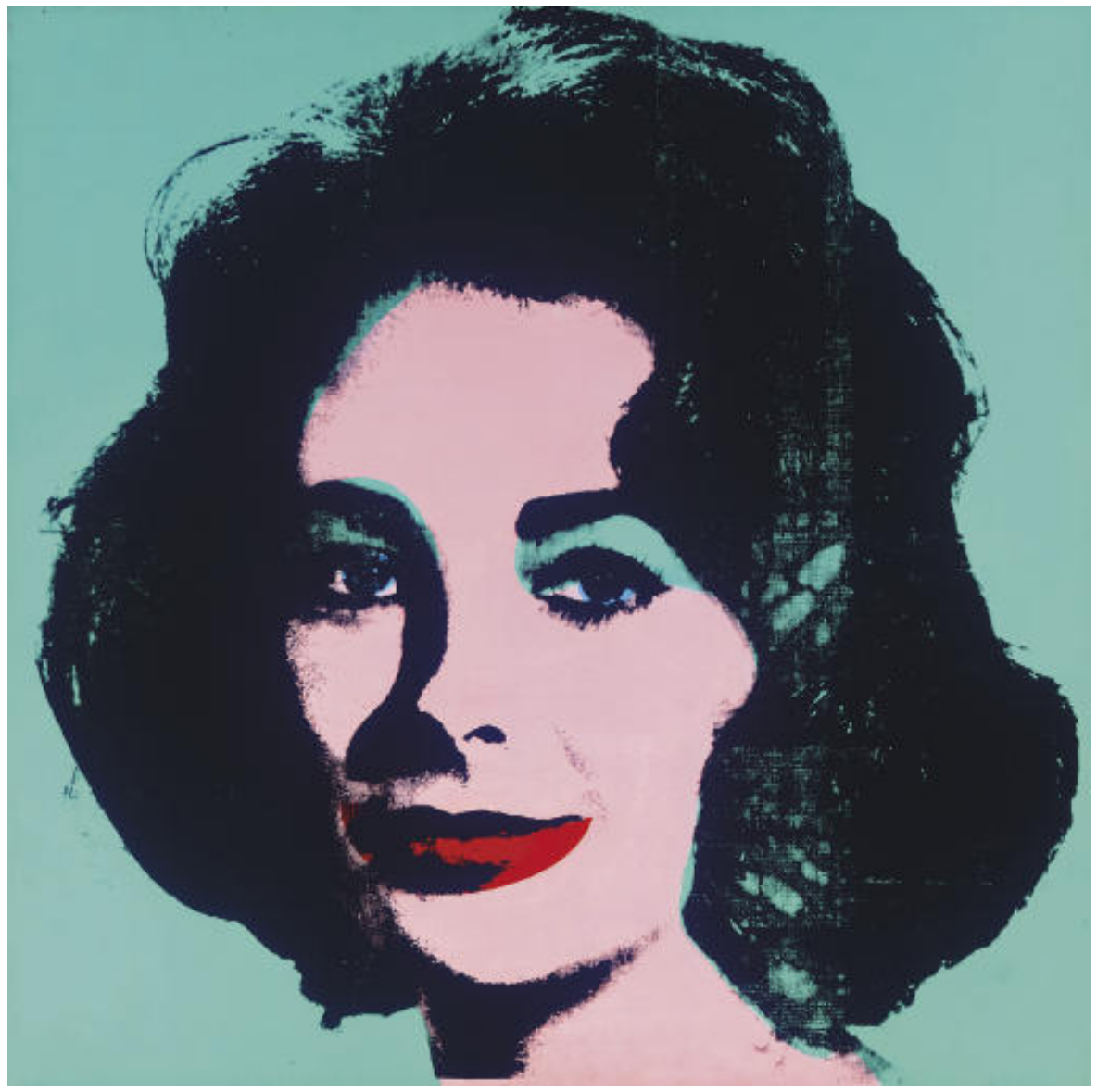
ANDY WARHOL
Liz, 1963
Synthetic polymer, silkscreen inks and acrylic on linen
40×40 inches (101.6 x 101.6 cm)
Andy Warhol’s Liz is a dazzling tribute to one of the major silver-screen goddesses in the artist’s Pop pantheon. Painted at the height of Elizabeth Taylor’s fame, Liz is a unique painting from a group of thirteen colorful portraits of the actress that Warhol executed in the fall of 1963. In this jewel-toned portrait, Warhol immortalizes the actress as an embodiment of the cult of celebrity. Closely related to the candy-colored Marilyn paintings that he executed in the previous year, Liz shows Warhol’s genius for color in full force. The turquoise background offsets Taylor’s luminous skin, as well as her trademark scarlet lips and violet eyes, magnifying the most characteristic features of her celebrated beauty. Although Warhol employed the mass-media technique of screenprinting, he brought a high level of personal involvement to the Liz series, carefully embellishing her skin, eyes and make-up with hand-applied paint.
Liz, 1963
Sotheby’s New-York: 9 May 2005
USD 12,608,000
REPEAT SALE
Christie’s New-York: 18 November 1998
Estimated: USD 800,000 – 1,200,000
USD 1,707,500
Andy Warhol (1928-1987) , Red Liz | Christie’s
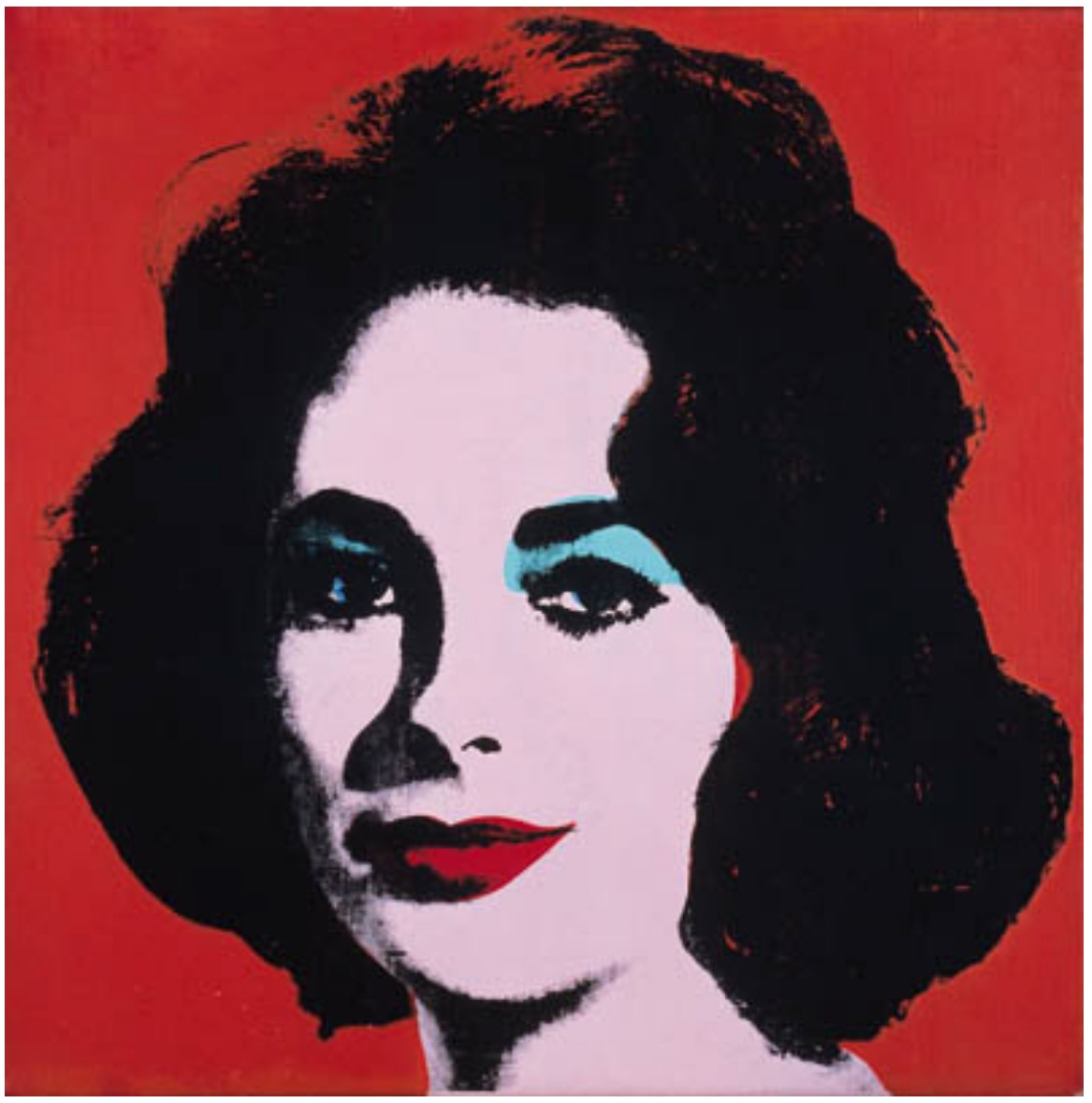
ANDY WARHOL
Liz, 1963
Acrylic and silkscreen ink on canvas
40×40 inches (101.6 x 101.6 cm)
In this version, a bright, electrified hue of scarlet bursts forth from the surface. It seeps into the sitter’s hair, displaying pyrotechnics of color and screen that animate what would otherwise be a relatively nondescript passage of description. This red color forms a line that follows the outline of the left-hand side of the sitter’s face, hair and neck, channeling its way down her visage, affording a separation between the clean black of the hair and the light pink of her flesh tones. It is only in this example of the thirteen Colored Liz paintings that we find such a strong color line, so clearly defined, separating these physiognomic fields. The color is employed, once more, to suggest the lusciousness of the film star’s lips. Punctuating these bold passages are the shocking turquoise of her eyeshadow as well as the famous violet blue tones of her eyes. The surface of the present work is impeccable: a perfect marriage of the crisp registration one finds in the clean silkscreen with the saturated naphthol red light background that pushes the silhouette out of the pictorial space. Only in the most important of Warhol’s works do we see the artist so lovingly devoted to the actual mechanics of his craft, and thus to the overall physical properties of the painting itself.
This strong chromatic field sets the stage upon which the star herself is realized. Warhol’s silkscreen technique, still a relatively new phenomenon to him in 1963, is beautifully executed here. There is a wonderful balance between the crisp record of the overall form, together with softer, more subtle areas of screen that shape the shadows around her nose, cheek and neck. One finds in this series of Colored Liz paintings a more confident Warhol with the silkscreen. The early experiments had been made, and now he wished to explore the various nuances this new technique presented to him.
Men in Her Life
Phillips New-York: 8 November 2010
USD 63,362,500
ANDY WARHOL
Men in Her Life, 1962
Silkscreen and pencil on primed canvas
84.5 x 83.2 inches (214.6 x 211.5 cm)
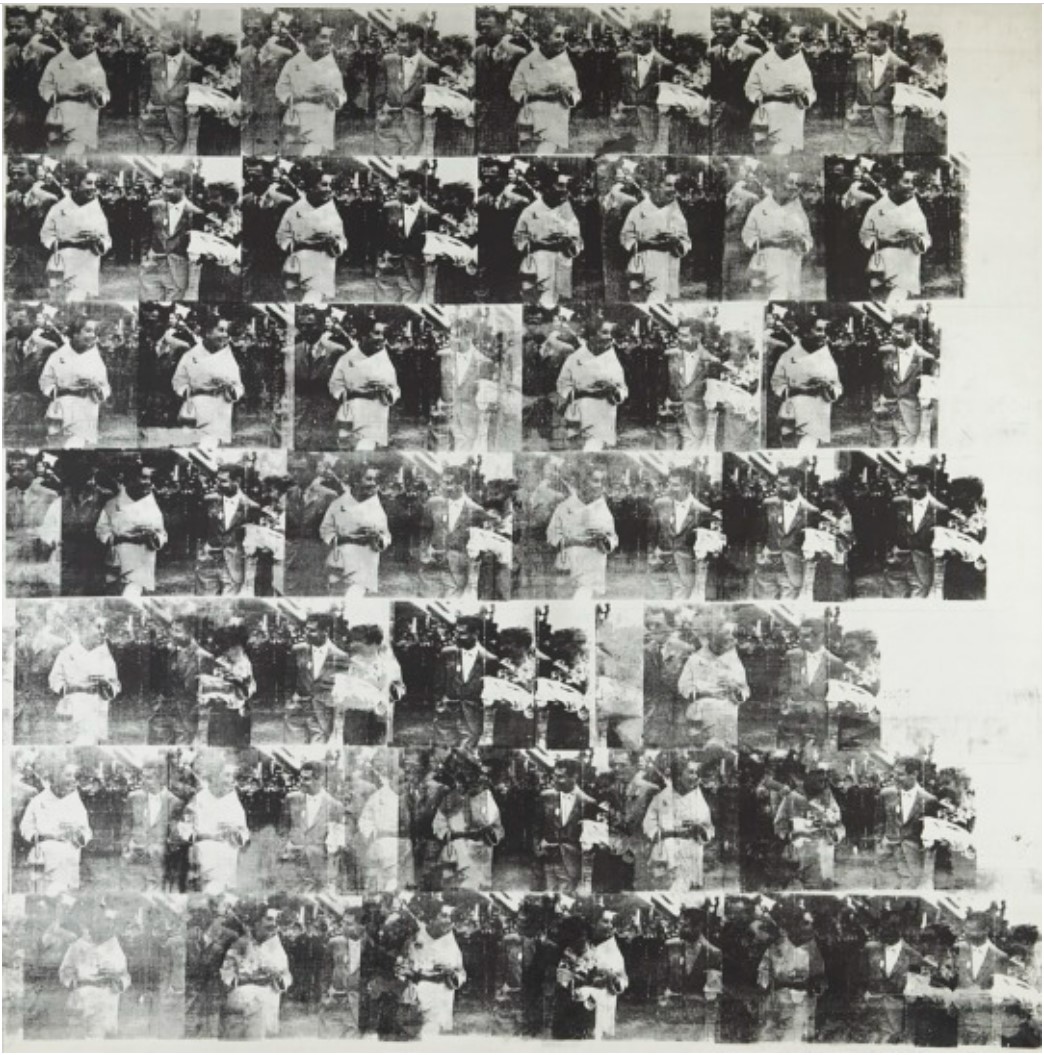
Men in Her Life is an outstandingly important work from one of the most significant and creative moments in Andy Warhol’s career. Made in the fall of 1962, arguably the artist’s breakthrough year, the picture is among his earliest silkscreen paintings, and it combines in one image many of the central themes of his oeuvre: celebrity, wealth, scandal, sex, death, Hollywood, icons of American life. The present painting, moreover, is one of only four works in the Men in Her Life series; it is one of only two of these works on a large-scale, multi-image format; and it is the largest of all the four pictures in the series. It is a work of great significance, fascination and beauty.
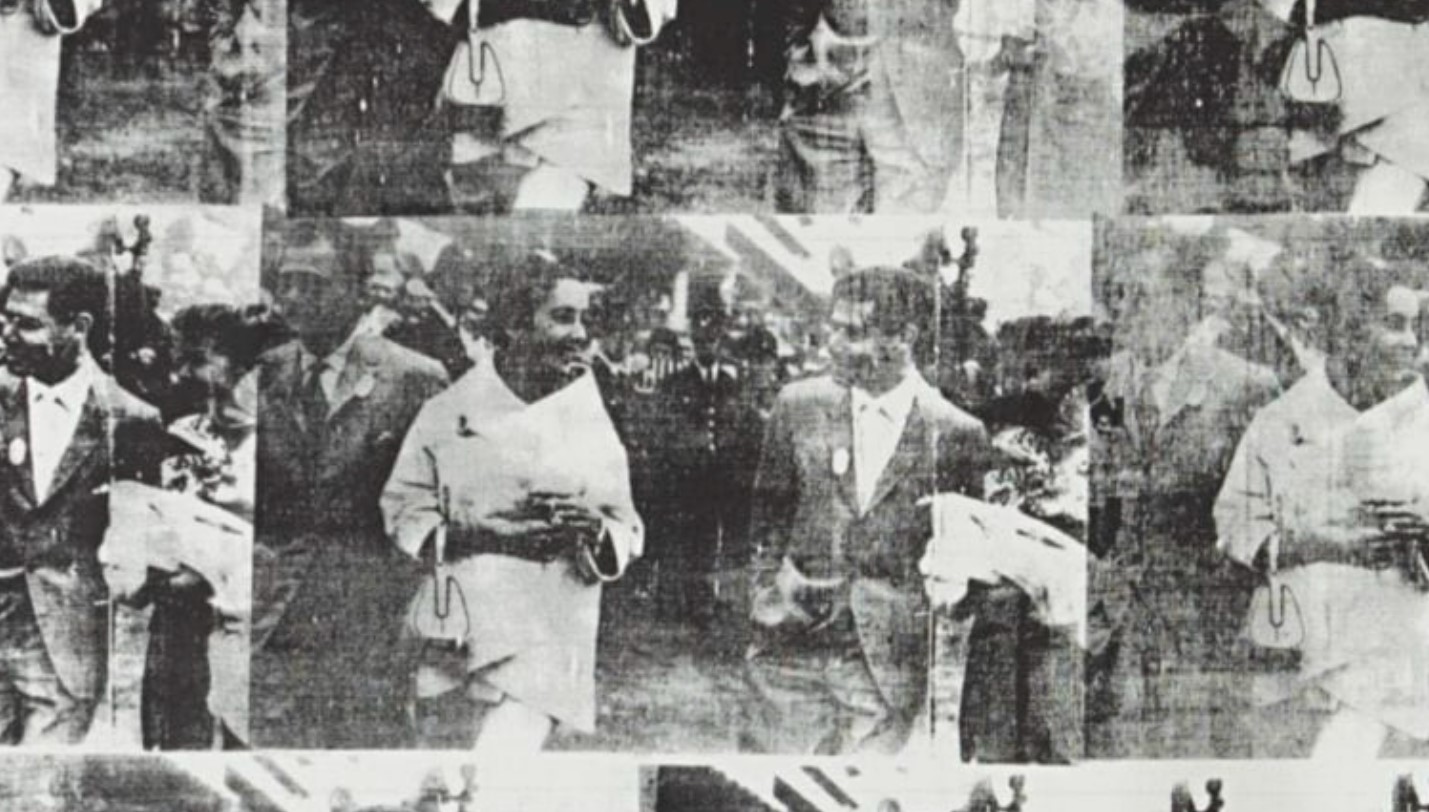
The painting is based on a news photograph of Elizabeth Taylor walking with both her third husband Mike Todd, seen to the left, and her fourth husband Eddie Fisher, who is seen at the right with his then current wife Debbie Reynolds. Warhol took the photograph from an issue of Life magazine dated 13 April 1962 which featured an article on Taylor. Describing her as a “storybook princess,” the article presented pictures of her from throughout her life, but with special emphasis on her husbands and lovers —the “princes” in the fairy tale. Warhol used a total of three images from the article as the basis for different paintings; the other two photographs were pictures of her in National Velvet and in (and as) Cleopatra. The Men in Her Life pictures from 1962 were his first paintings of Taylor, one of his most iconic subjects, which he treated obsessively, for example in the Silver Liz series.
The photograph he used for Men in Her Life had been shot on 5 June 1957 at the English Derby at Epsom Downs in the United Kingdom. Taylor, Todd, Fisher and Reynolds were then best friends and at the height of international celebrity. Fisher had served as Todd’s best man at the wedding; Reynolds had served as Taylor’s matron of honor. At the time of the photograph, Taylor and Todd were on a trip to Europe, a combination honeymoon and publicity tour to promote the best-selling film he had produced, Around the World in Eighty Days. When the photograph was made, the two couples appeared to have every success: wealth, fame, privilege. Taylor was the highest paid actress in the world, and internationally famous for her stunning beauty. Todd was in the course of making $29,000,000 in one year on his film. Fisher was a topselling pop singer, with a million-dollar-a-year endorsement contract from Coca-Cola. Reynolds was a leading actress and America’s sweetheart. They even seemed to enjoy the blessings of happy domestic life: at the time of the photograph, both Taylor and Reynolds were pregnant.
But tragedy and scandal were just around the corner. Less than a year after the photograph was shot, Todd died in a crash in his private plane, The Liz. Always flashy, he had spent ten times more money on installing a lavish lilac-colored boudoir in the plane than on updating its safety systems. It went down in a thunderstorm near Grants, New Mexico on March 22, 1958. He had just received the Showman of the Year award and was on his way to New York for a banquet. Taylor was supposed to have been on the plane but had stayed home in Los Angeles with a bad cold. At his funeral, thousands of gawkers showed up to see Taylor grieving. They snacked on Coke and potato-chips and sat on the headstones in the cemetery during the burial, then attacked Taylor to snatch souvenirs, tearing away her veil, hat, and coat. She had to be rushed into a limousine for protection, which sped off as the mob started to pound on its windows. The sordid nightmare of the event was a national news story.

One biography has summarized her life up to this point in the following terms. “Elizabeth Taylor, one of the most famous women in the world, had appeared in twenty-seven movies, had been married three times, was twice divorced, had three children by two husbands and was now a widow. She had just marked her twenty-sixth birthday” (Donald Spoto, A Passion for Life, The Biography of Elizabeth Taylor, New York 1995, p. 142).
Following Todd’s death, his widow and his best friend looked to each other for solace. Romance soon blossomed, and in August of 1958 they became lovers. Their affair instantly turned into scandal, made all the more notorious in September when gossip columnist Hedda Hopper quoted Taylor in an interview as saying, “What do you expect me to do? Sleep alone?” Taylor was pegged as a hussy and home-wrecker, while Fisher was portrayed as dishonoring his friend’s memory and abandoning his own wife. The notoriety of the affair severely damaged Fisher’s public reputation, and Coca-Cola fired him, his career never recovered; but it boosted Taylor’s, who was able to double the fees for her work. Fisher and Reynolds divorced in Las Vegas on May 12, 1959; moments later Fisher and Taylor married. But the scandal did not go away. Fisher was addicted to amphetamines and Taylor to pills and liquor, and they led very messy lives, trashing hotel rooms and Taylor sometimes even passing out in public. Taylor almost died twice from illnesses caused or made worse by her addiction. Yet recovery from near-death experiences helped her garner still more fame: it was sympathy for her struggle for life that helped her win the Oscar for Best Actress for her performance as a call girl in Butterfield 8 (1960). Everyone voted for her, even Debbie Reynolds, Fisher’s angry ex-wife.
At the time of Warhol’s painting, Taylor’s love with Fisher was ending, although they did not divorce until 1964, and she had recently taken up with Richard Burton. Indeed, Taylor and Burton are featured together on the cover of the April 13, 1962 issue of Life, shown during a break on the set of the film-extravaganza, Cleopatra. They are seen in costume as the Roman general Anthony, and his royal Egyptian lover Cleopatra. Yet the photograph has a large touch of unintended irony: Burton is smoking a cigarette; and overweight and wearing absurdly thick eye shadow, Taylor looks dumpy, and unglamorous. The fictionality of their roles in the film is clear, but the impression that a private life behind the fiction is being shared with the public is a fiction too.
In Men in Her Life Warhol ingeniously examines the drama of the Taylor-Todd-Fisher affair. Warhol repeats the photograph from Life thirty-eight times, arranged in seven rows. By varying the cut of the image and the inking of the silkscreen, he was able to articulate and narrate the story. In the top tier, one sees the photograph four times, and the image appears relatively clear and stable in each iteration. There it is a seemingly unambiguous image of the two happy couples. But in the lower tiers on the canvas the images begin to stutter across the canvas, like frames of a filmstrip slipping in a projector, and to fracture and blur as they do so. In some of these images, Taylor stands forth as if in isolation. In others, either Todd or Reynolds is cut out of the image or obliterated with paint. In many the emphasis is on the gaze on Taylor’s face, as she looks at Fisher. In actuality, it was a moment in passing, one friend smiling at another. (We know from other photographs taken immediately before the scene in the painting that Eddie and Debbie were hurrying to catch up with Mike and Liz as they walked in front of the grandstand at the track.) But in light of their subsequent history, it is easy to imagine a leer in Taylor’s eyes, and to see smug arrogance in Fisher’s suave stride. Paul Newman, her costar in Cat on a Hot Tin Roof, made in 1958, said of Taylor that she was not only a “beauty [but also] a combination of child and bitch who wants to love and be loved” (quoted in Spoto, p. 141). The look on her face seems to suggest this combination of passions: both the unbridled cupidity and the anxious desire to please that have characterized her celebrity and her career.
In its manipulation of photographic imagery, the picture marks an important step in Warhol’s exploration and development of the possibilities of silkscreen painting. The fracturing and blurring of the image is more successful in structuring the canvas than it is in Baseball, the first of the silkscreen paintings, from August 1962, or in the Let Us Now Praise Famous Men paintings, made shortly before Men in Her Life. Moreover, the stuttering effect created by repeating the photograph here more obviously has a cinematic result; it looks like a strip of stop-action photographs by Muybridge. The cinematic quality of Men in Her Life is also evoked by being in black-and-white, rather than color. Warhol was to explore this result even more directly in the Merce series of 1963.