DAVID HOCKNEY (B. 1937)
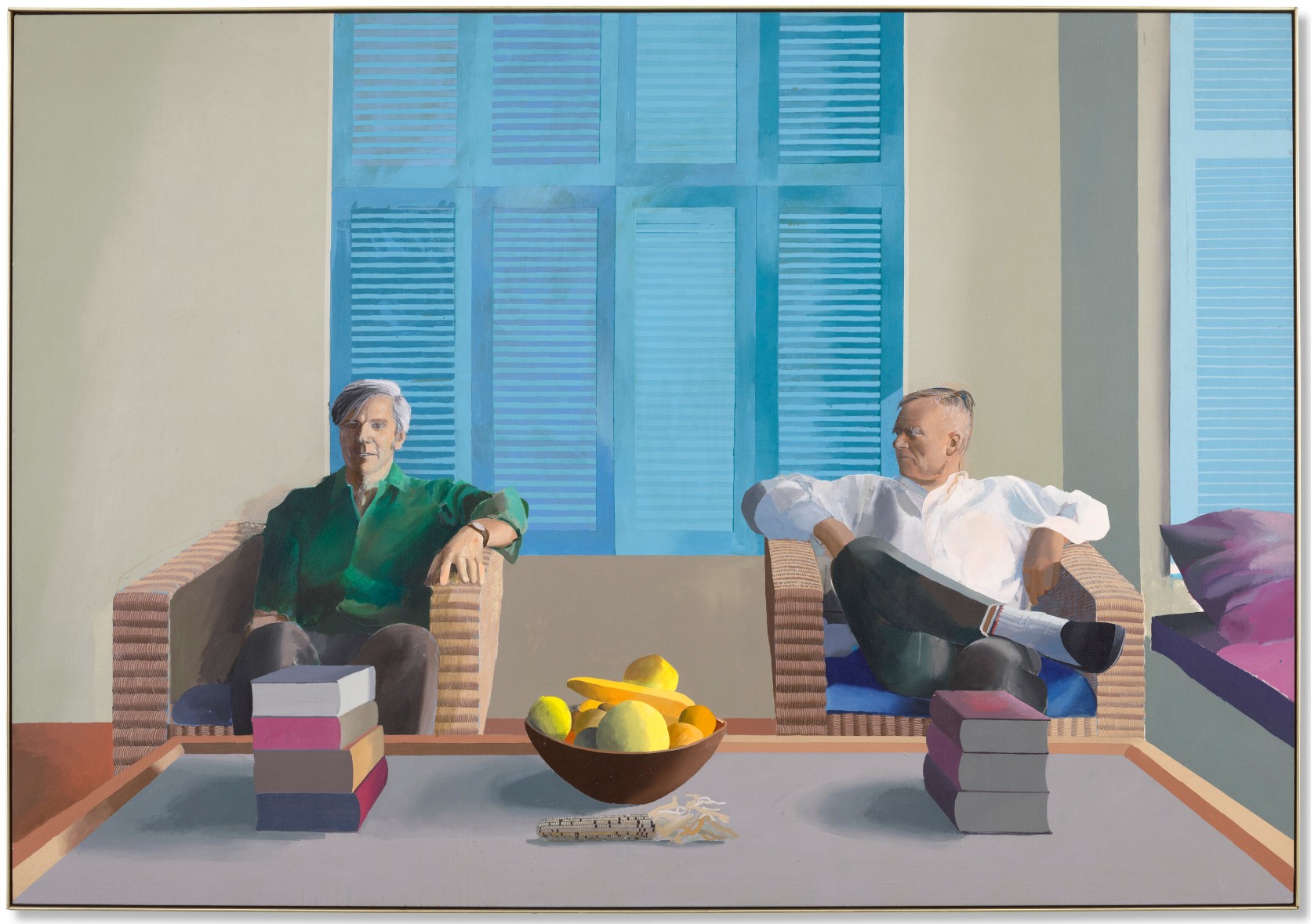
Christopher Isherwood and Don Bachardy, 1968
Acrylic on canvas
83 1/2 x 119 1/2 inches (212 x 303.5 cm)
Provenance
Kasmin Ltd., London
Sir John Foster, London, 1969
Marguerite Littman, London, circa 1970, gift of the above (returned 1982)
William Beadleston, Inc., New York
Private collection, New York
Acquired from the above by the present owner, 1985
Auction History
Property from a Distinguished Private European Collection
Christie’s New-York: 17 November 2025
Estimate on Request
USD 44,335,000
DAVID HOCKNEY (B. 1937), Christopher Isherwood and Don Bachardy | Christie’s
A masterpiece in psychological depth and virtuoso composition, Christopher Isherwood and Don Bachardy (1968) is the first of David Hockney’s double portraits: a series which stands among the supreme triumphs of his career. In a sunlit Santa Monica living room, two men sit upon woven armchairs.
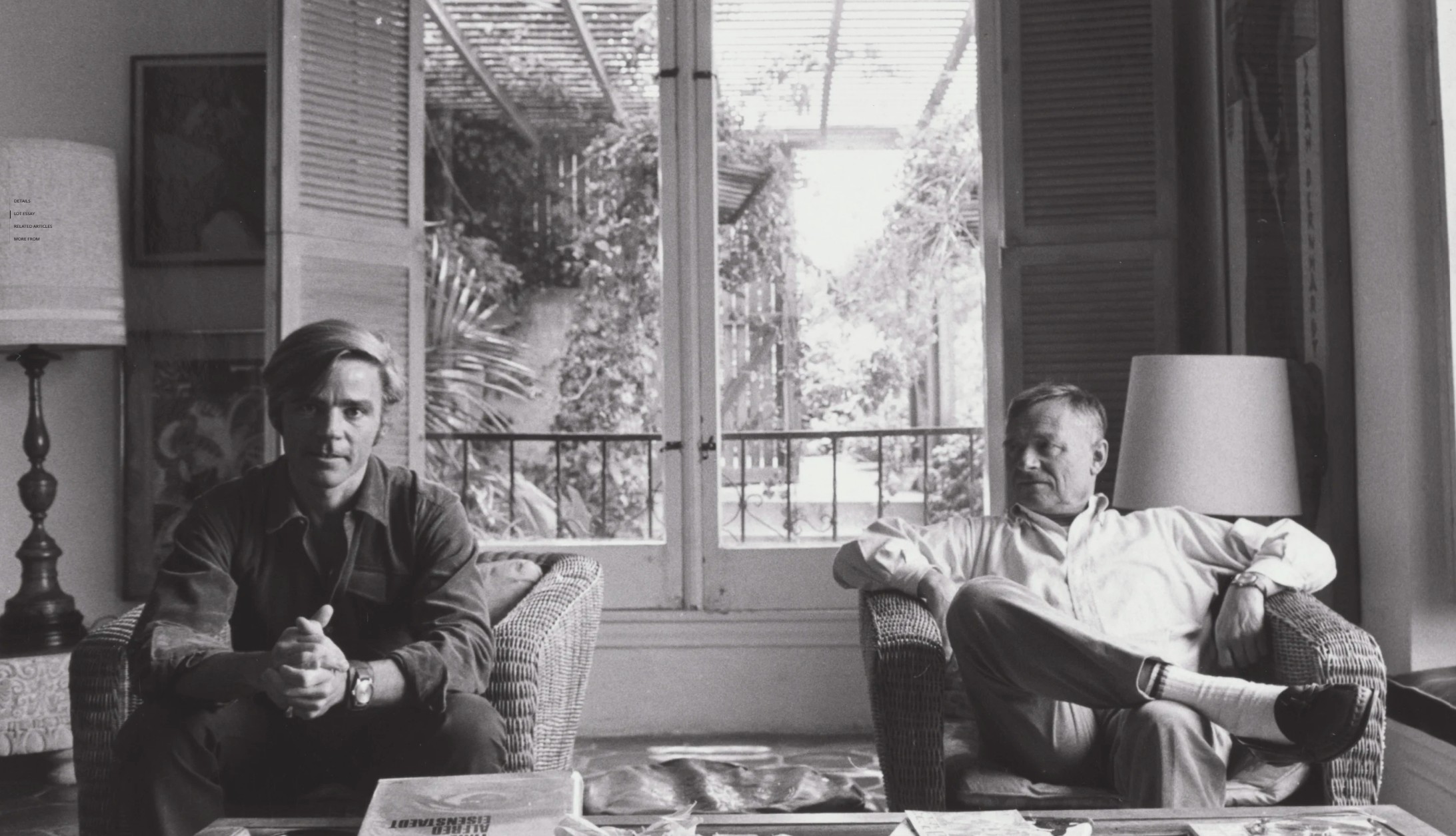
Christopher Isherwood and Don Bachardy, March 30, 1968 (source material for the present lot). Christopher Isherwood Papers, Huntington Library, San Marino. Photo: © David Hockney. Image courtesy of the Huntington Library.
In front of them is a table bearing two stacks of books, with a fruit bowl and an ear of corn at its center. Behind them is a screen of shutters, their slats and panels gleaming in pearlescent blue. The man to the right is the English novelist Christopher Isherwood, one of the great literary figures of the twentieth century. Dressed in crisp white shirt and socks, with a razor-sharp pleat in his trousers, he looks towards his companion. Don Bachardy, an artist and native Californian thirty years his junior, stares confidently out at the viewer. His deep green shirt makes him a jewel in the painting’s radiant setting. The dynamic of gazes is enhanced by the sunlight that streams in from the bedroom at the right, casting directional shadows upon the table. Hockney’s social intelligence is paired flawlessly with his pictorial ingenuity. He implicates himself and the viewer in the tension between the two men, conveying the subtleties of his friends’ relationship through his own exploration of space, sightlines and surface.
“If a picture has a person or two people in it, there is a human drama that’s meant to be talked about. It’s not just about lines.”
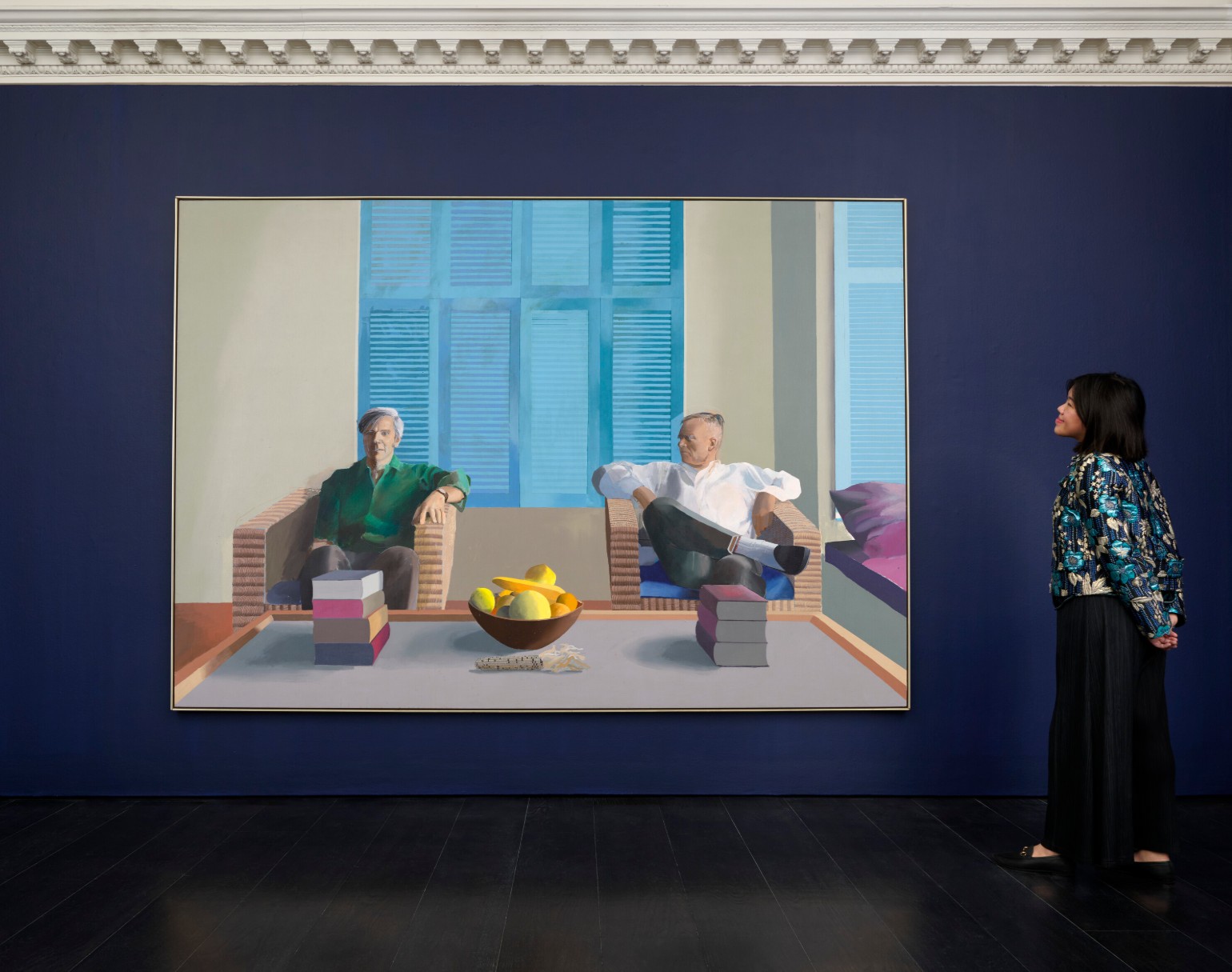
Most recently seen in the landmark 2025 survey show David Hockney 25 at the Fondation Louis Vuitton, Paris, Christopher Isherwood and Don Bachardy has been prominently exhibited throughout its lifetime. It was included in Hockney’s career-defining international retrospectives of 1970, 1988 and 1992-1993; in 2017-2018 it was a highlight of the survey David Hockney—touring London, Paris and New York—where it was shown in a room dedicated to the double portraits. Created between 1968 and 1975, these large, ambitious works mark the emergence of a carefully observed realism in light and perspective in Hockney’s painting, as well as a new focus on formal construction. Christopher Isherwood and Don Bachardy’s considered geometry, particularly the right-angled forms of the shutters and armchairs, takes cues from the staged iconography of early Renaissance artists such as Piero della Francesca. It also reflects the more immediate artistic context of 1960s American Minimalism. An equilateral triangle is formed between the sitters’ heads and the bowl of fruit, and they are locked in rectangular rhythm with the chairs, books and shuttered window. While the foreground’s stylized still-life lends the scene an almost timeless stillness, recalling the symbolism of medieval Annunciation scenes, the limpid sunlight and clean colors create a distinctively West Coast vision.
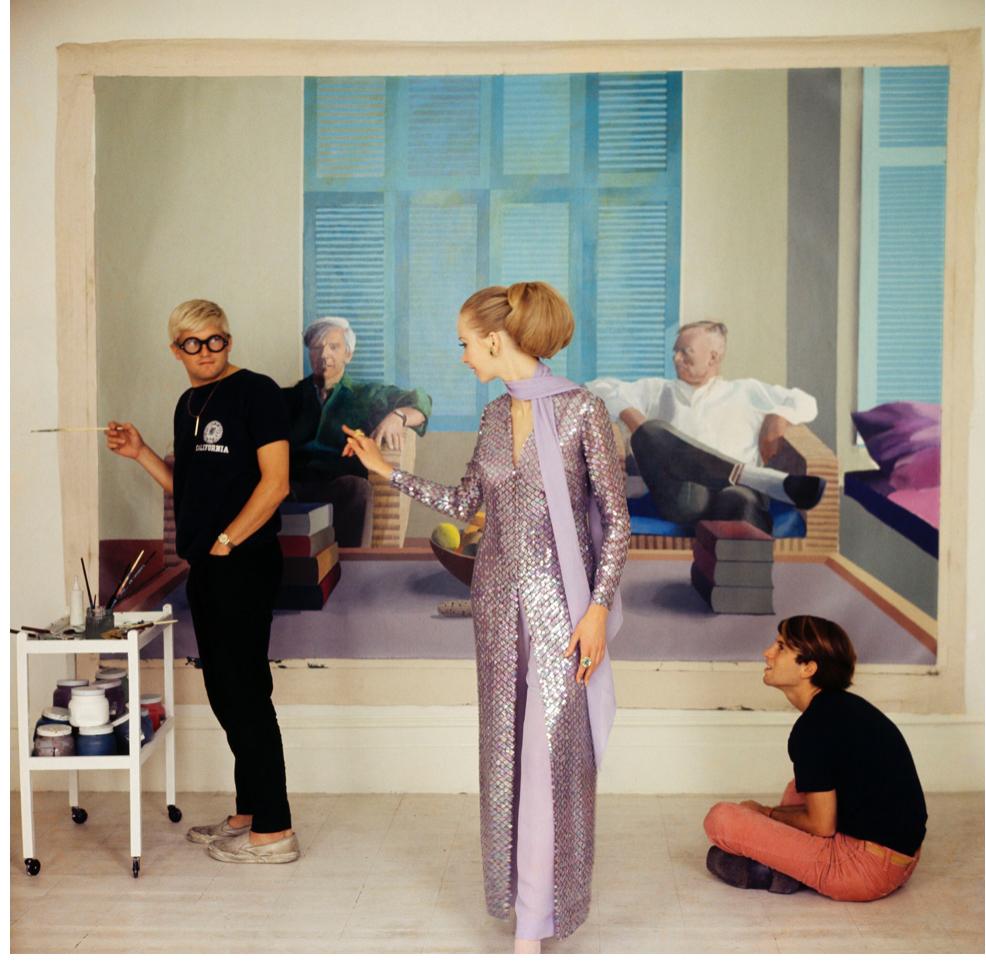
David Hockney, Maudie James, and Peter Schlesinger, December 1968 (present lot illustrated).
Photograph by Cecil Beaton for Vogue Magazine. © Condé Nast.
Christopher Isherwood met Don Bachardy on Valentine’s Day in 1953. Isherwood, a friend of W. H. Auden, Aldous Huxley and Truman Capote, had already found fame as an author with novels such as Goodbye to Berlin (1939), a semi-autobiographical account of his experiences of Weimar Germany. He and Auden had left Europe for New York on the outbreak of the Second World War, before Isherwood went west to Los Angeles, where he joined a distinguished milieu of European exiles. In Hollywood, he would later write A Single Man (1964), one of the founding texts for contemporary gay culture. When the couple met, Bachardy was eighteen years old and Isherwood forty-eight. “Don was young and full of life and he was a perfect darling,” Isherwood recalled. “It was just as simple as that” (C. Isherwood quoted in A. Maupin, “The First Couple: Don Bachardy and Christopher Isherwood,” The Village Voice, vol. 30, no. 16, July 2, 1985). Hockney’s friend Stephen Spender, another prominent author, had introduced Hockney to Isherwood—a fellow Yorkshireman—upon his arrival in Los Angeles in 1964, and they soon became close friends. Indeed, the present work is emblematic of the vibrant community of artists, writers, musicians and intellectuals at whose heart Hockney, a working-class Englishman born in Bradford, found himself in the 1960s and 1970s.
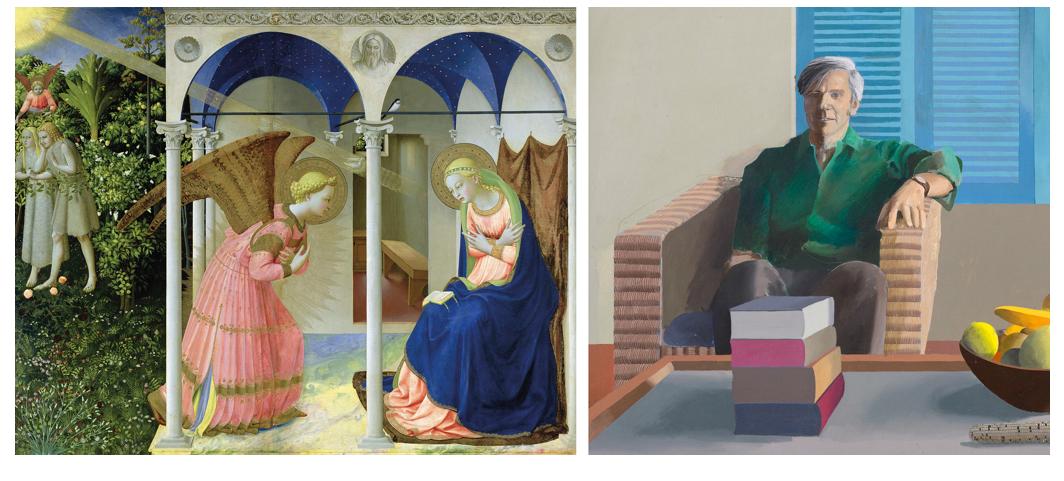
Left: Fra Angelico, The Annunciation, 1426. Museo del Prado, Madrid.
Right: Present lot illustrated (detail).
Throughout its long history, portraiture has been a way of signifying power, cultivation and character. Piero della Francesca’s famed double portrait of the Duke and Duchess of Urbino (circa 1473-1475) captures the sitters in profile before a landscape that represents their worldly dominion. It also reflects the relationship between Piero and his subjects: he was a frequent guest at their court, which became a major artistic and cultural center of the Italian Renaissance. The painter Hans Holbein was a similarly important figure in the English Tudor court. The affiliation between the two men in his The Ambassadors (1533)—which Hockney later analyzed in his 2001 book Secret Knowledge: Rediscovering the Lost Techniques of the Old Masters—is hotly debated. So too is the significance of the enigmatic, symbolic objects arrayed between them, which allude to various forms of scientific and religious knowledge. In the twentieth century, artists and writers in the Modernist avant-garde became ever more closely intertwined. Pablo Picasso’s statuesque portrait Gertrude Stein (1905-1906) is an iconic image of the writer and patron who held weekly salons in her Paris apartment, and whose support was critical to his early success.
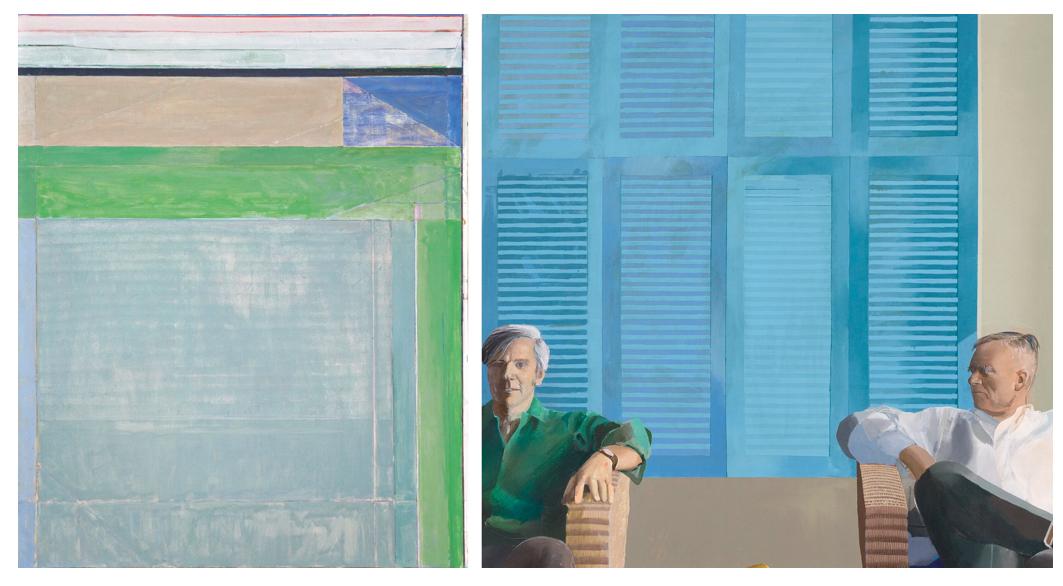
Left: Richard Diebenkorn, Ocean Park 115, 1979. Museum of Modern Art, New York. © 2025 Richard Diebenkorn Foundation / Artists Rights Society (ARS), New York.
Right: Present lot illustrated (detail).
While it was born of friendship rather than commission or patronage, Christopher Isherwood and Don Bachardy echoes aspects of these courtly masterpieces. Hockney pictures the duo presiding over their own salon, in the living room of the Adelaide Drive home they had shared since 1959. It was Bachardy—himself an accomplished artist—who had painted the shutters sky blue, creating what would be the background for Hockney’s painting. There is a tangible sense of exchange between the artist and his sitters. He interpreted their relationship in paint, while their image represents the cultural world in which he was making his way. The couple would also portray Hockney in their own work. In 1982, they published their collaborative book October, which reproduced elegant portraits by Bachardy—depicting Hockney, Joan Didion, Malcolm McDowell, Gore Vidal and other luminaries—alongside Isherwood’s journal entries for the month of October 1979.
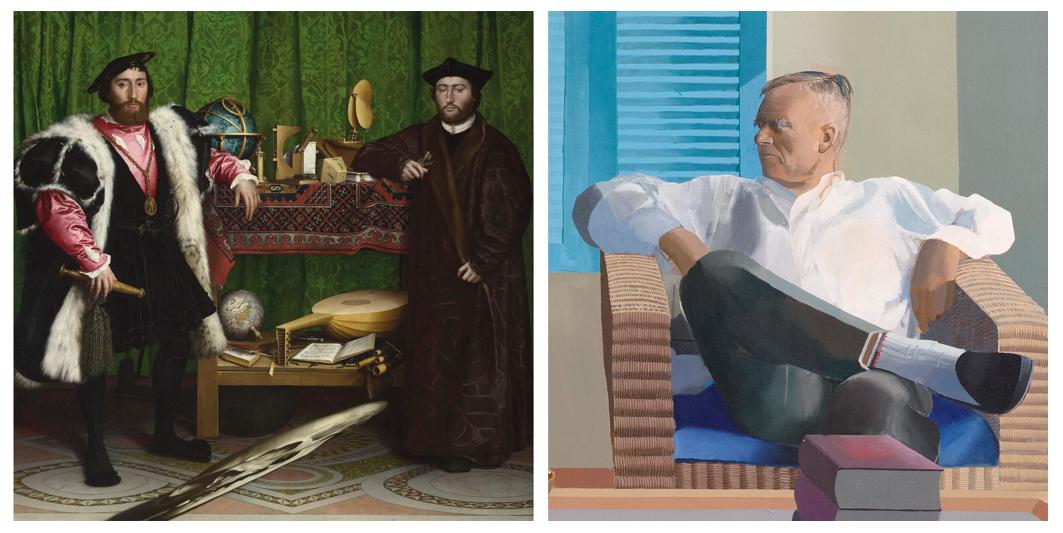
Left: Hans Holbein the Younger, Jean de Dinteville and Georges de Selve (‘The Ambassadors’), 1533. National Gallery, London.
Right: Present lot illustrated (detail).
Isherwood and Bachardy’s relationship would endure until the author’s death in 1986. In their double portrait, his solicitude towards his younger partner is physically palpable, and taken from life, as Hockney relates. “… I took a lot of photographs of them in a room, trying to find compositions, how to do it, and whenever I said Relax, Christopher always sat with his foot across his knee, and he always looked at Don. Don never looked that way; he was always looking at me. So I thought, that’s the pose it should be. And I began the picture” (D. Hockney, David Hockney by David Hockney, London 1976, p. 152). The face of Bachardy—who went away to England for two months—was eventually based largely on these photographs. Left alone, Isherwood visited Hockney’s studio almost daily, where the artist continued to study him from life. The duo’s differences are thus captured even in Hockney’s brushwork, with Isherwood’s face figured with fresh immediacy, and Bachardy’s built up through more slow, studied strokes.
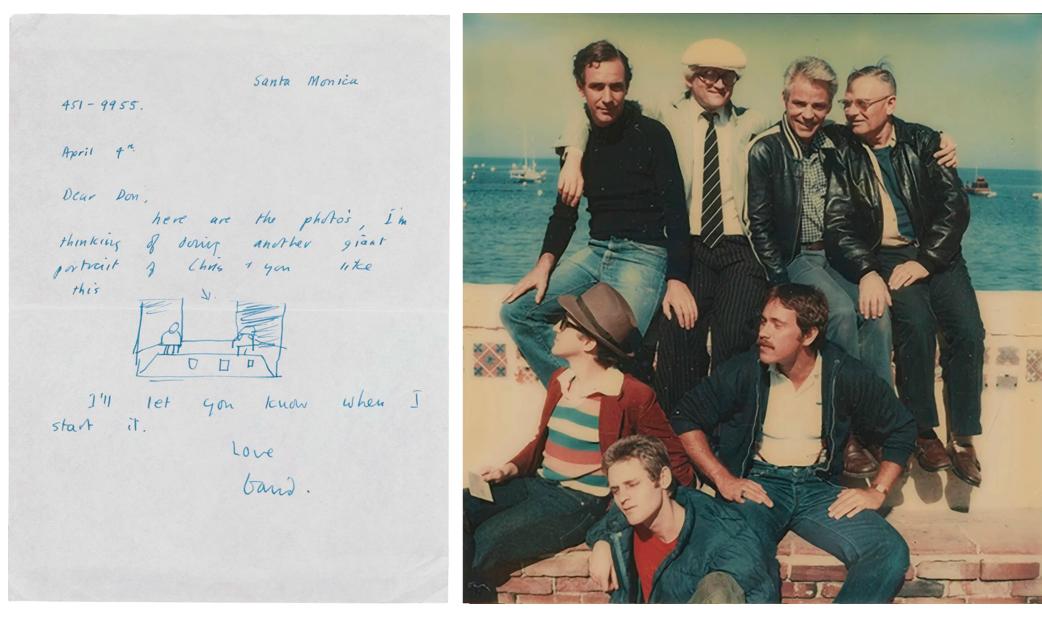
Left: Letter from David Hockney to Don Bachardy, April 4, 1968. Christopher Isherwood Papers, Huntington Library, San Marino. Photograph courtesy of the Huntington Library.
Right: David Hockney, Christopher Isherwood, and Don Bachardy in Catalina, 1976. Christopher Isherwood Papers, Huntington Library, San Marino. Photograph courtesy of the Huntington Library.
The present work’s masterful composition is echoed in Hockney’s later double portrait Mr and Mrs Clark and Percy (1970-1971), one of the best-loved paintings in the Tate, London. Here, too, Hockney worked both from photographs and life, astutely shading and flattening to create beguiling, crisp surfaces, and embracing the challenge of a difficult contre-jour light source. Again, he portrayed a couple in their home, staging a scene suggestive of tension. Ossie Clark’s extramarital affairs were well known, and his straying is hinted at his luxuriant pose, as well as the pure white lilies set before his wife Celia, and the wistful outdoor gaze of the couple’s cat, Percy.
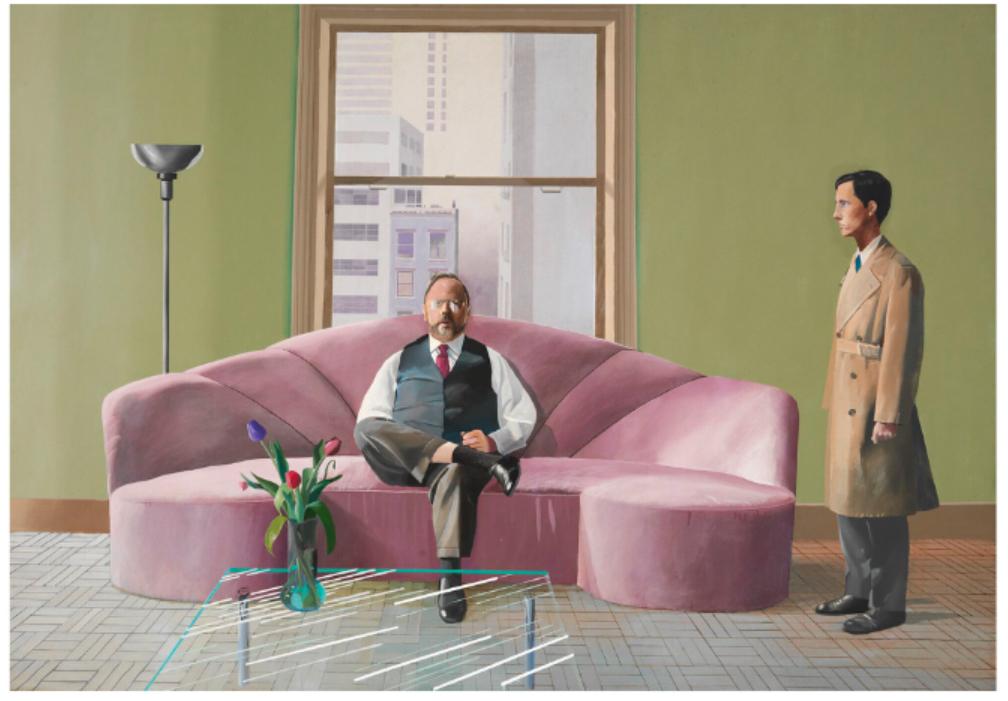
Henry Geldzahler & Christopher Scott, 1969. Private Collection. © David Hockney. Photo: Richard Schmidt.
Similarly, Henry Geldzahler and Christopher Scott (1969) seats the art dealer Geldzahler comfortably at the picture’s midpoint, while his younger partner stands buttoned up in a trenchcoat, stiff and ready to leave. The genius of Hockney’s double portraits lies in this transposition of complex interpersonal relationships into pictorial dramas of shape and form. Hockney cautions, however, against any overly symbolic approach to his work. The objects in Christopher Isherwood and Don Bachardy were arranged to heighten the picture’s poise and rhythm, not in a cryptic game of allusion.
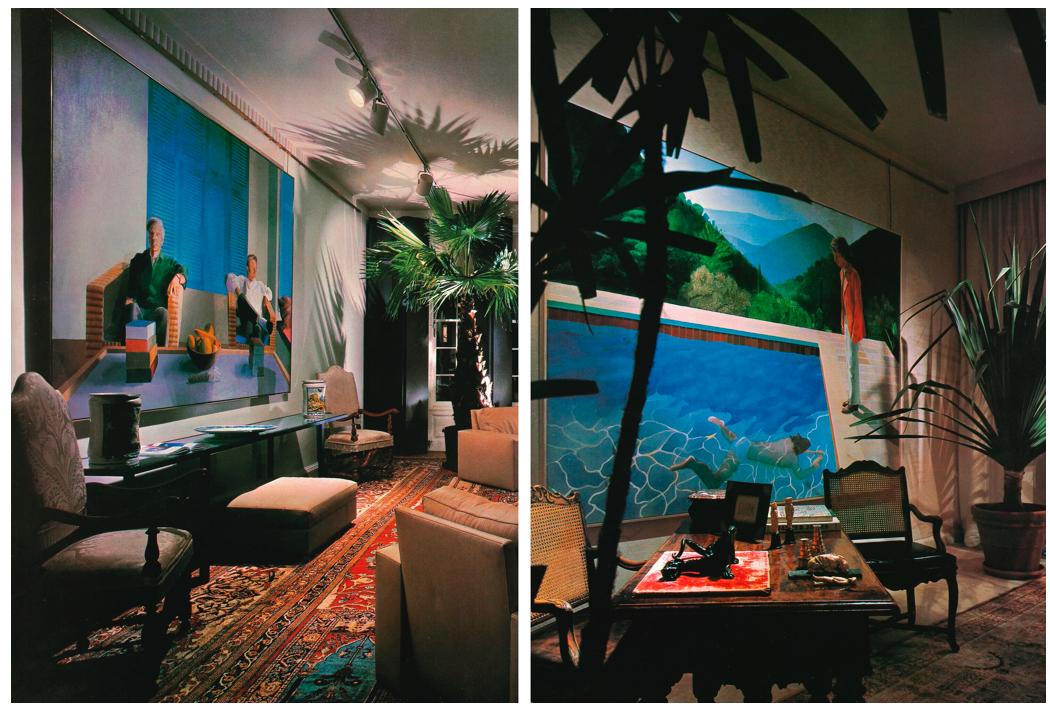
Left: The present work installed in the home of Mr. and Mrs. William L. Beadleston, Manhattan, 1982. Photo: Architectural Digest, © Conde Nast.
Right: David Hockney’s Portrait of an Artist (Pool with Two Figures) (1972) installed in the home of Mr. and Mrs. William L. Beadleston, Manhattan, 1982. Photo: Architectural Digest, © Conde Nast. Artwork: © David Hockney.
“I remember somebody asked why there were four books in front of Don and only three books in front of Christopher. Was this because Don wasn’t as well-read and needed more? Amazing what people read into pictures. There are four books because I needed four to balance it out” (D. Hockney, ibid., p. 152). Indeed, while the table’s still-life and shadows help to direct the work’s triangulation of gazes, this central area of the painting—with its crisp, Cezannesque volumes and smooth nuances of shade—can stand alone beautifully as an independent composition, as evidenced by its use as the striking cover of Nikos Stangos’ 1979 monograph Pictures by David Hockney.
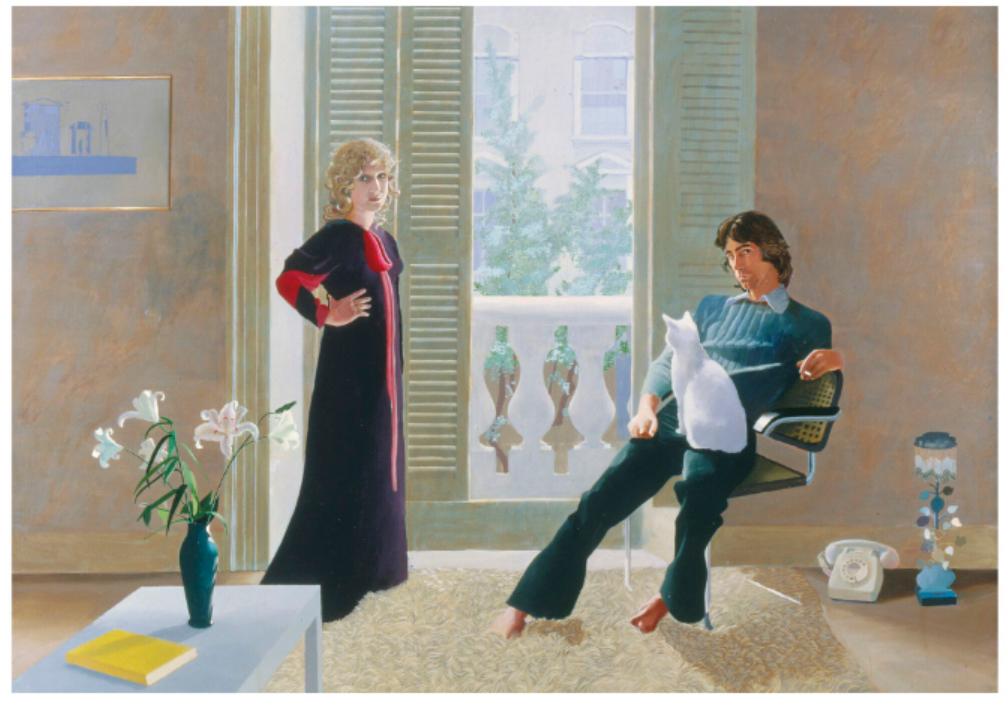
Mr. and Mrs. Clark and Percy, 1970-1971. Tate, London. © David Hockney.
Profound concerns with illusionistic space, surface and depth on the picture plane have long lain at the heart of Hockney’s work, leading him beyond the medium of paint to his iconic photo-collages and forays into theatrical set design. Relentlessly curious, in recent years he has even begun to draw work using an iPad. Paint, however, was his first love, and his joy in the creation of Christopher Isherwood and Don Bachardy is everywhere evident. We can feel his devotion to the light dancing upon the shutters’ iridescent planes, the sharply graphic fruit and books, and the engaging, tactile intimacy in his friends’ faces and clothing. The picture is at once an honest portrait of a lifelong relationship and a theatre of compelling visual architecture. It exemplifies the unique talent of Hockney, an artist at the height of his powers, in bringing the two together.
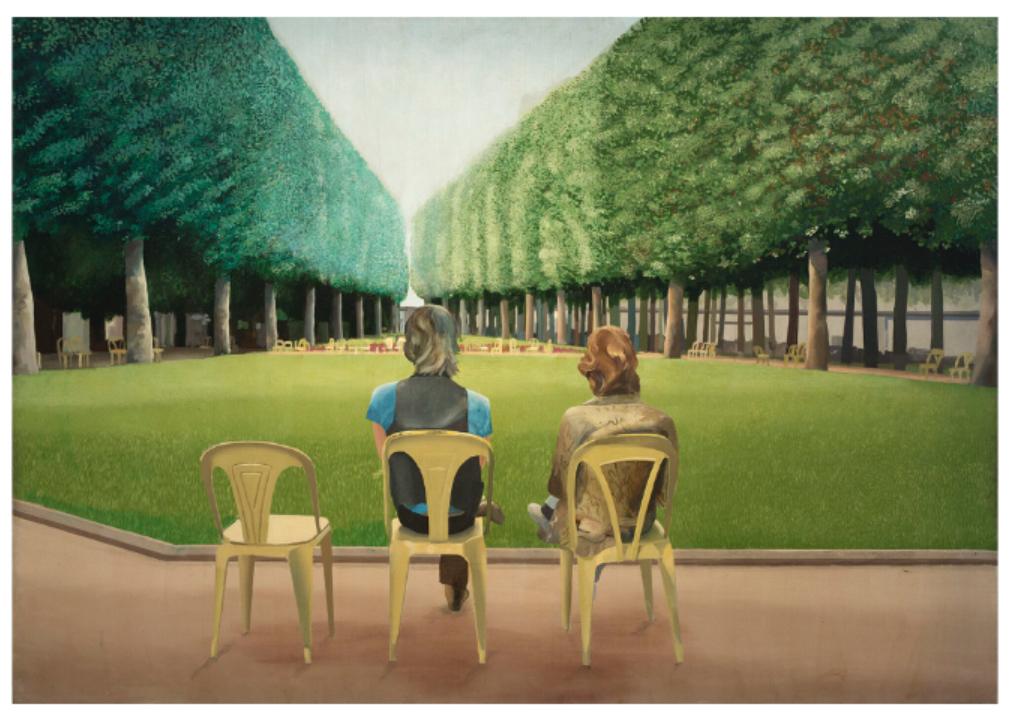
Le Parc des Sources, Vichy, 1970. Trustees of the Chatsworth Settlement, Bakewell. © David Hockney. Photo: Fabrice Gibert.
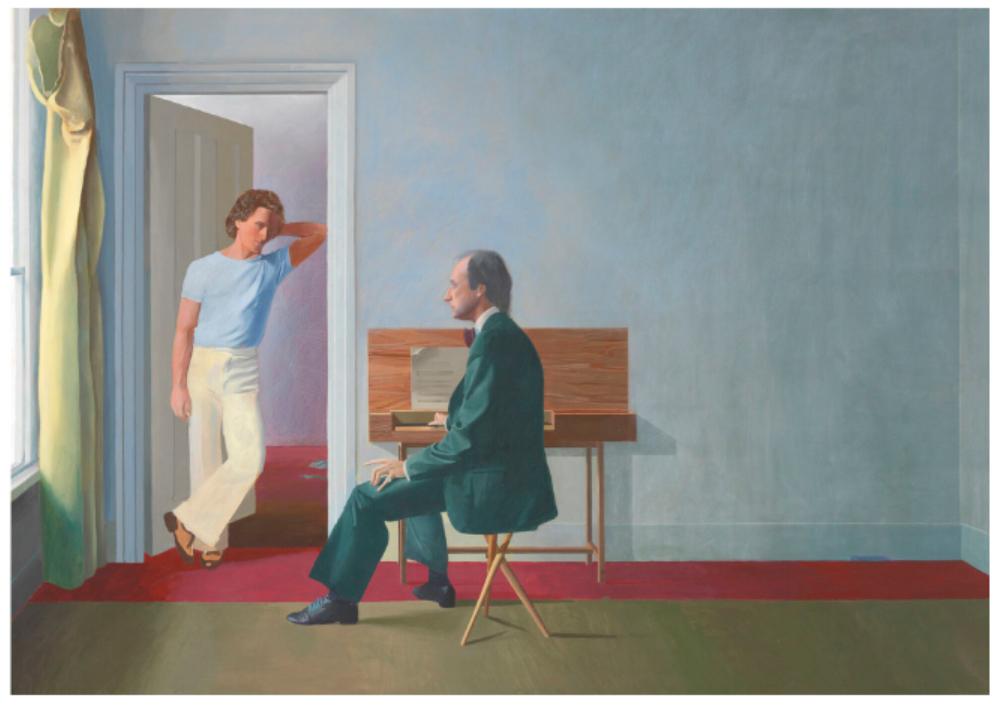
George Lawson and Wayne Sleep, 1975. Tate, London. © David Hockney. Photo: © Tate.
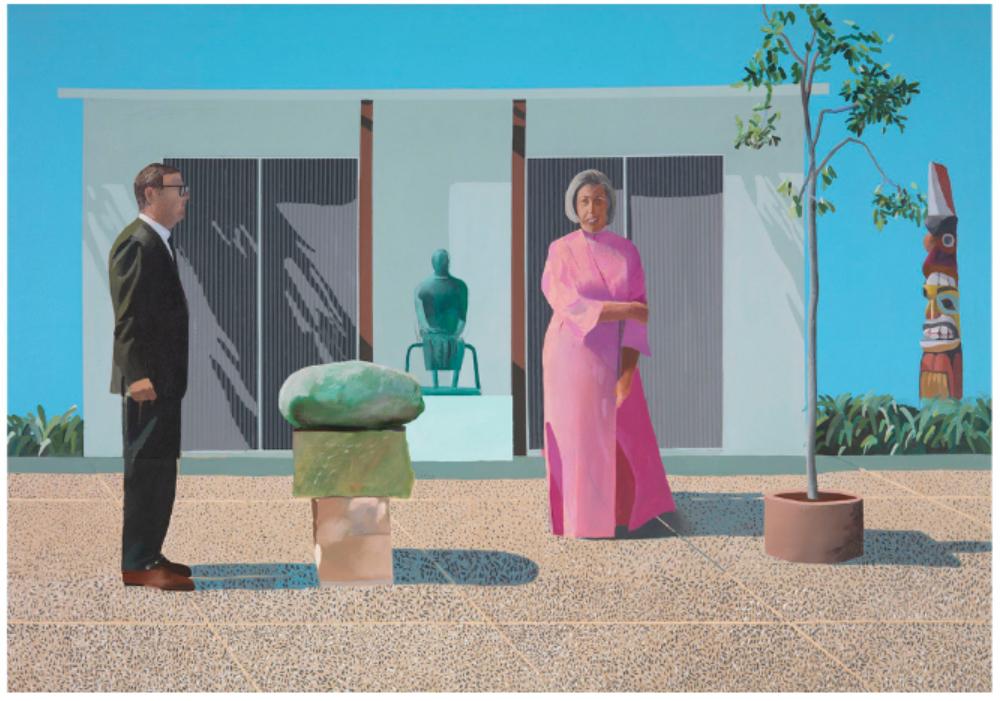
American Collectors (Fred and Marcia Weisman), 1968. Art Institute of Chicago © David Hockney. Photo: Richard Schmidt.
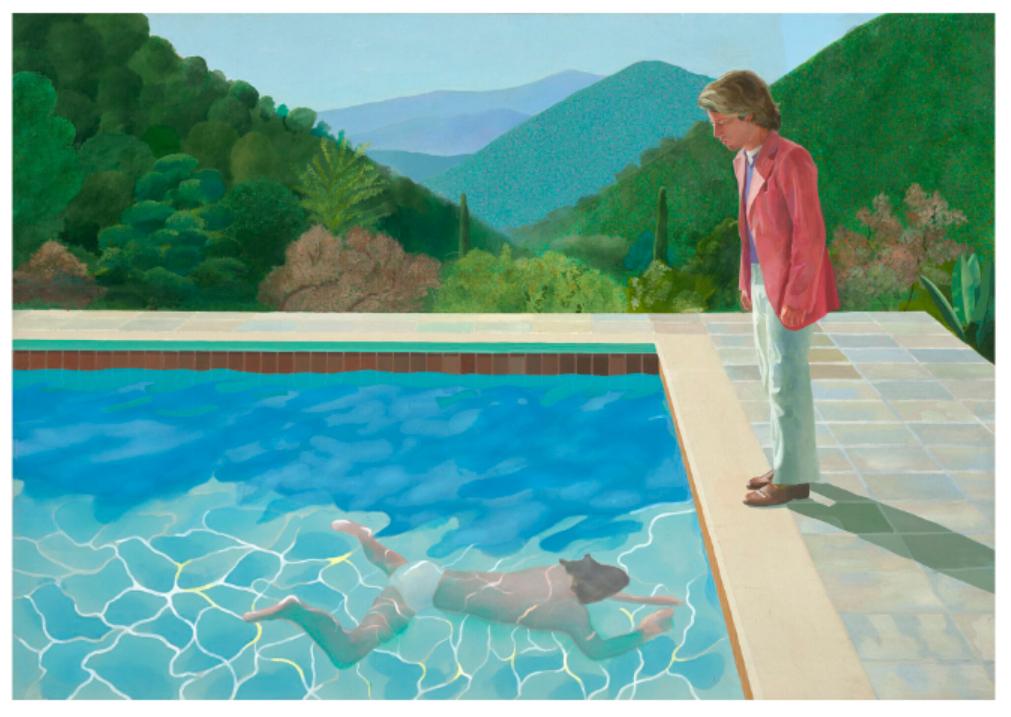
Portrait of an Artist (Pool with Two Figures), 1972. Private Collection. © David Hockney. Photo: Jonathan Wilkinson.