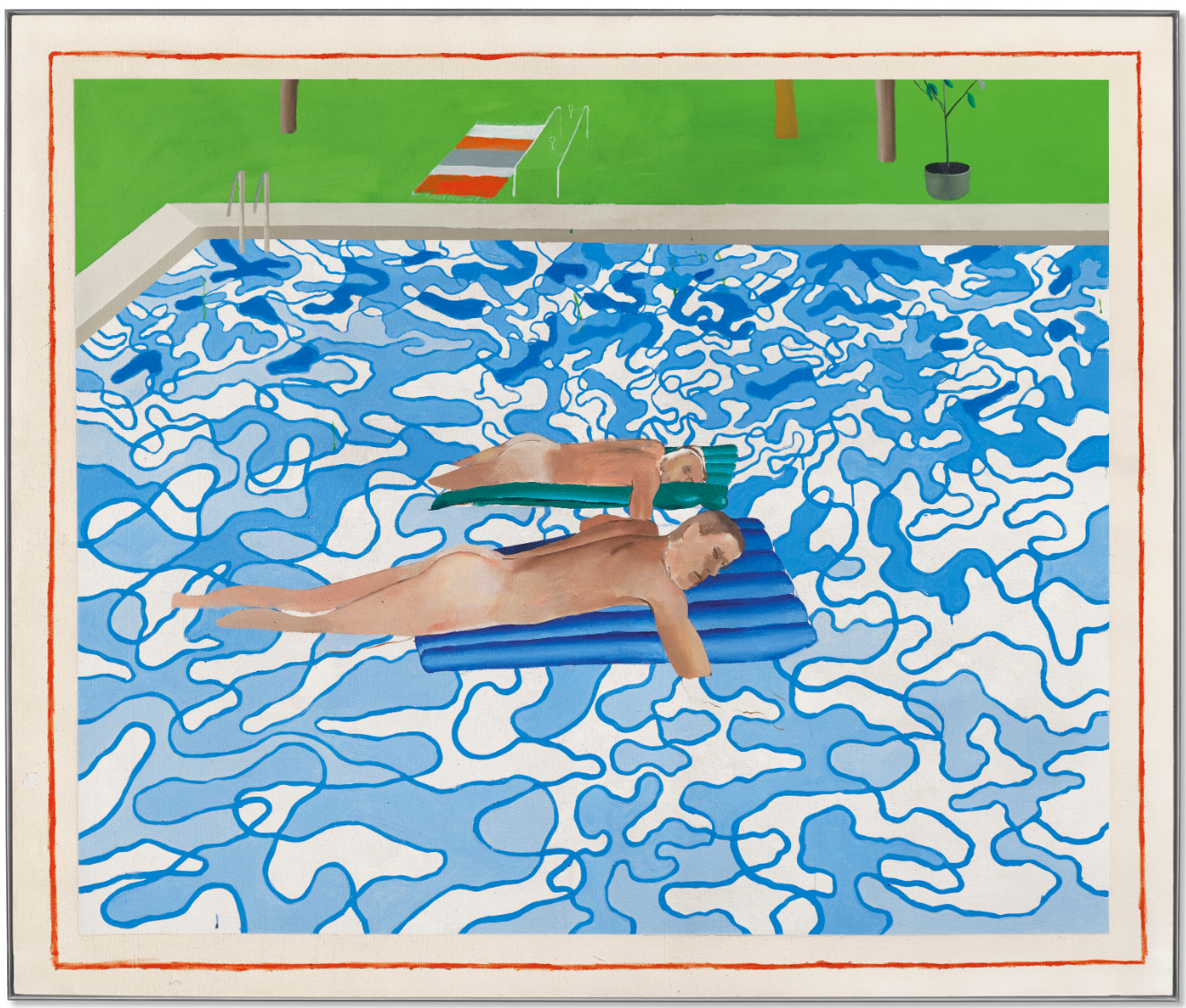
DAVID HOCKNEY (B. 1937)
California, 1965
Acrylic on canvas
66 1/8 x 78 1/4 inches (168 x 198.8 cm)
Provenance
Kasmin Ltd., London.
Acquired from the above by the present owner in 1968.
Auction History
Christie’s London: 7 March 2024
Estimate on Request
GBP 18,710,000 / USD 23,724,280
DAVID HOCKNEY (B. 1937), California | Christie’s (christies.com)
A rare, seminal masterpiece, California (1965) stands among David Hockney’s first great swimming pool paintings. Inaugurating one of the twentieth century’s most celebrated bodies of art, it is the largest and finest in the extraordinary group of early pool paintings created in London after Hockney’s first visit to Los Angeles in 1964. There, the artist had been fascinated by the play of sparkling West Coast light upon crystal clear waters. The paintings that followed have come to be synonymous with his oeuvre, combining dazzling technical virtuosity with strains of fantasy, desire and longing. A halcyon vista of carefree summer bliss, the present work stands among Hockney’s earliest iterations of the motif. It was also among the first of these works to feature figures, anticipating the landmark series of double portraits that Hockney would commence just three years later. Acquired by the present owner in 1968, the work has been unseen in public for over four decades.
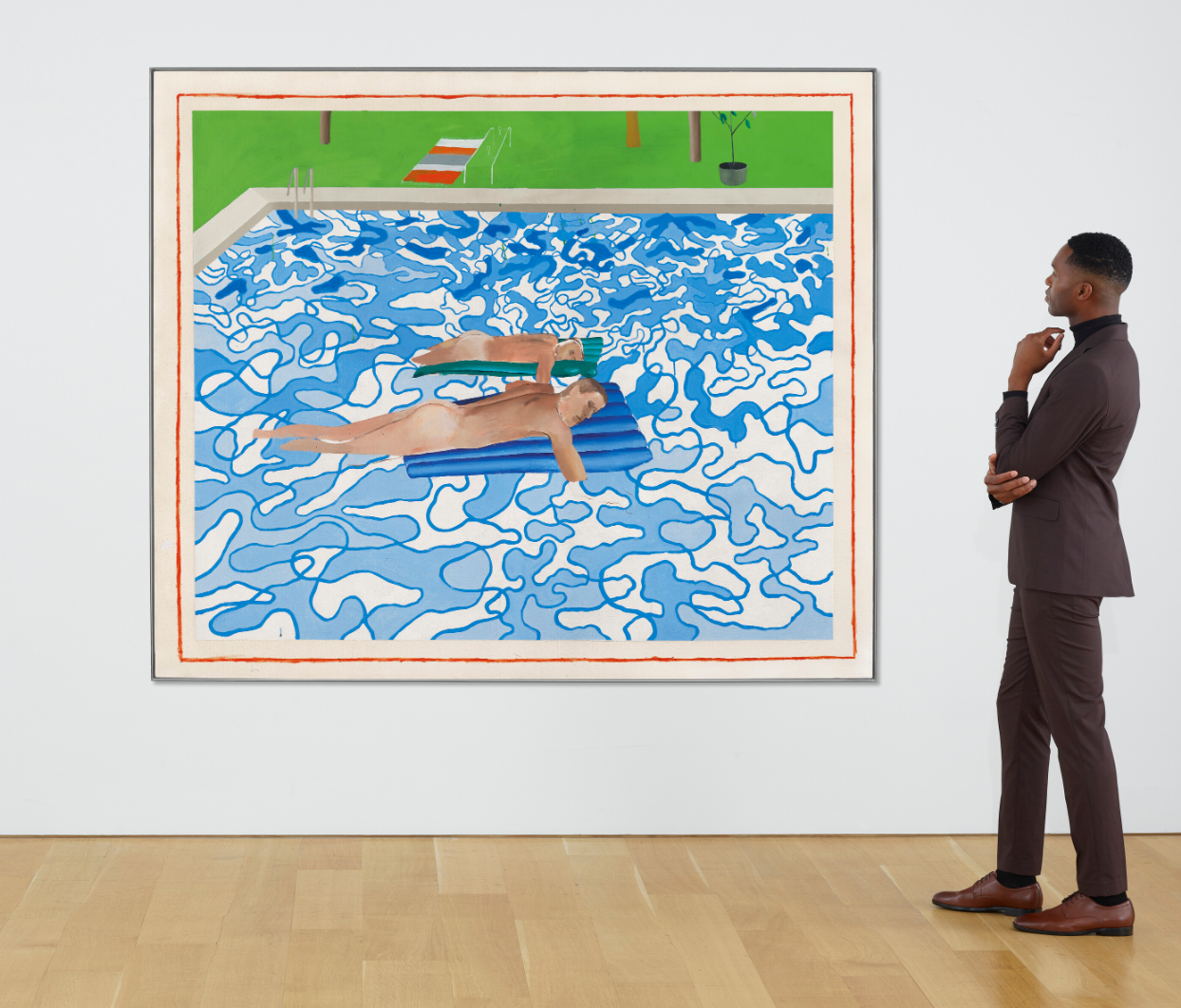
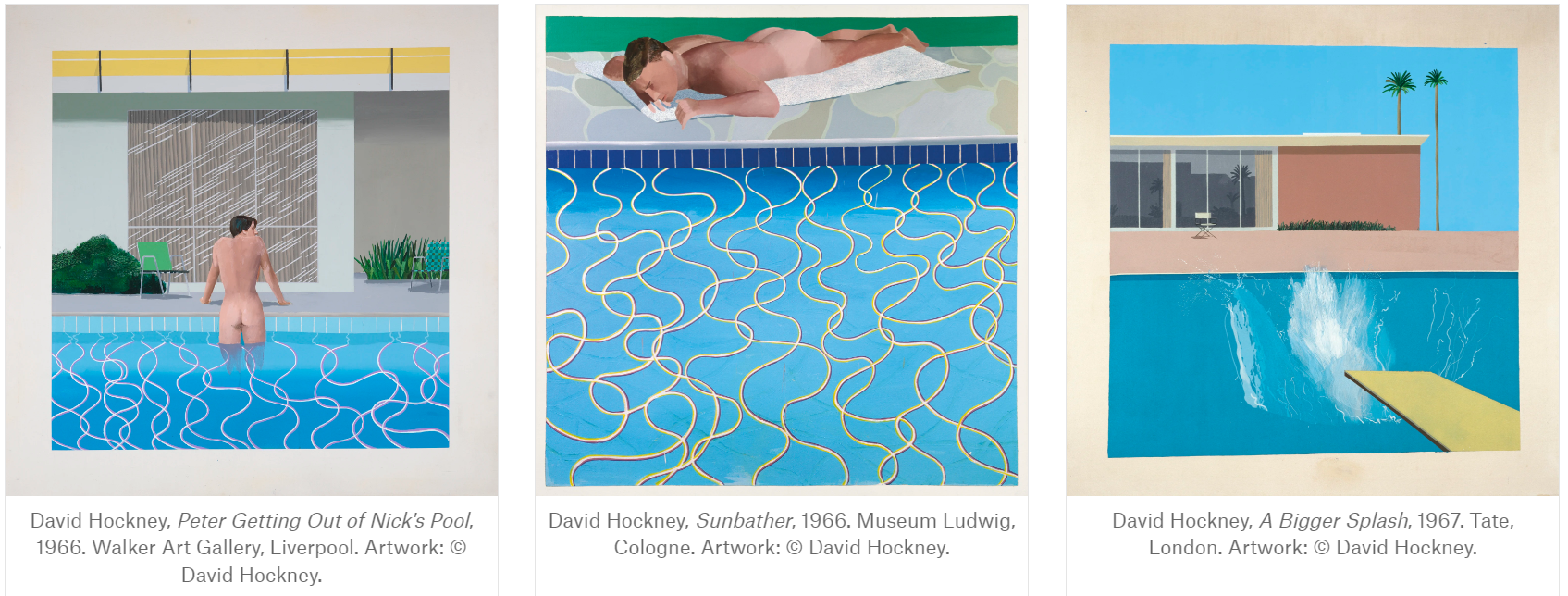
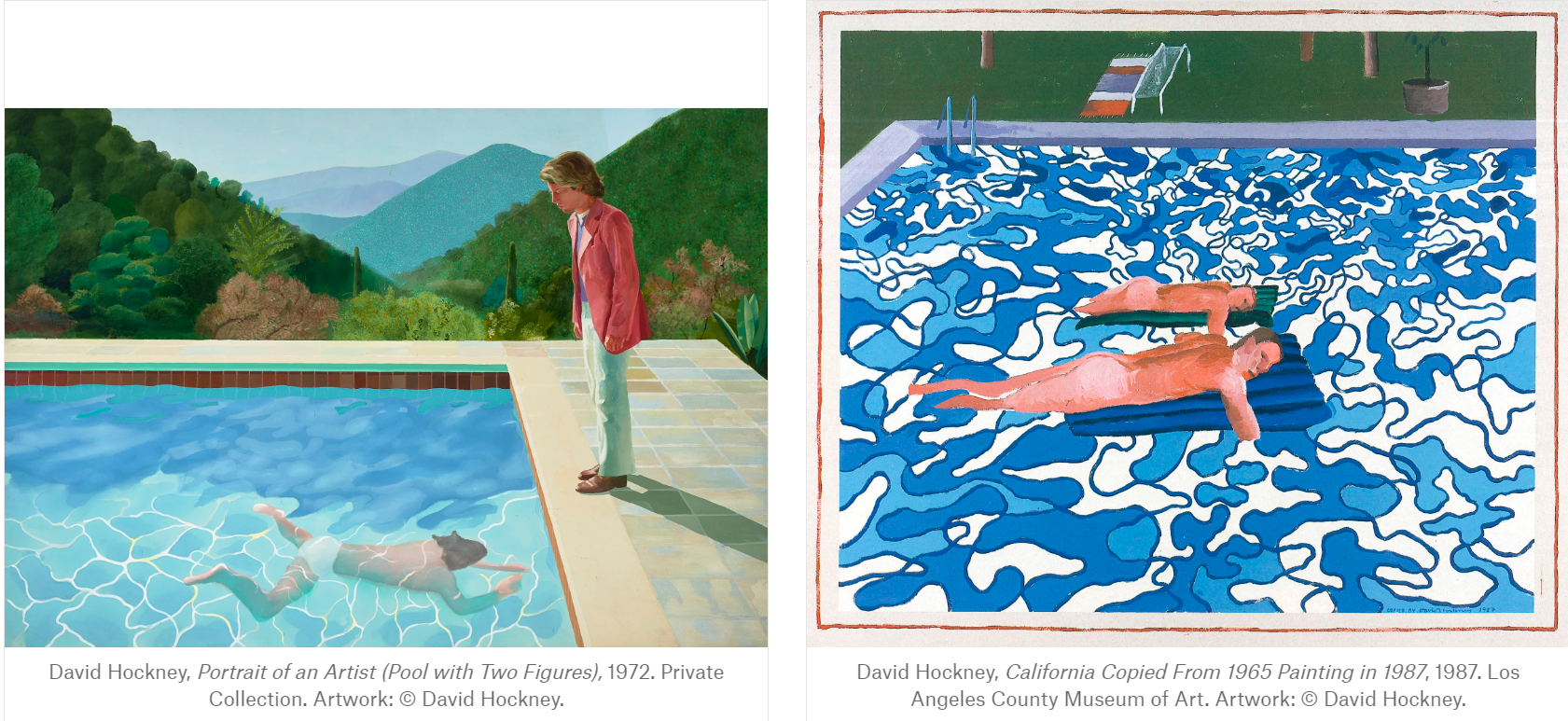
While Hockney had included a swimming pool in the 1964 painting California Art Collector, it was not until he returned to London for Christmas that year that he made his first full pool painting: a figureless composition entitled Picture of a Hollywood Swimming Pool. California followed shortly afterwards, along with the closely-related painting Two Boys in a Pool, Hollywood, both featuring a pair of nude men. The present work—the more ambitious of the two—anticipates many of the achievements that followed. Its naked figures foreshadow the sensuous male nudes of Sunbather (1966, Museum Ludwig, Cologne) and Peter Getting Out of Nick’s Pool (1966, Walker Art Gallery, Liverpool). Its kaleidoscopic depiction of moving water lays the foundations for the techniques explored in A Bigger Splash (1967, Tate, London) and Portrait of an Artist (Pool with Two Figures) (1972). So essential did Hockney consider the painting to his oeuvre that—when unable to include it in his 1988 retrospective at the Los Angeles County Museum of Art—he made his own copy, now held in the museum’s permanent collection.
The swimming pool had been at the forefront of Hockney’s mind since landing in California in early 1964. As a young man growing up in the north of England, America had loomed large in his imagination: a place of sunshine, promise and possibility. With the grey landscapes of post-war England far behind him, he recalls looking down from the plane to see ‘blue swimming pools all over.’ It occurred to Hockney that this idyllic, utopian place had never been truly represented in art.
‘There were no paintings of Los Angeles. People then didn’t even know what it looked like … I suddenly thought: “My God, this place needs its Piranesi; Los Angeles could have a Piranesi, so here I am!”’
In his early swimming pool paintings, Hockney threw himself into this role. Faced with depicting the elusive, ever-changing properties of water and light, he made his first great forays into the themes of vision and perception that would come to define his practice. California’s stylized vocabulary of tangled lines and cells is particularly distinctive of this early period, predating the artist’s turn towards naturalism during the late 1960s and early 1970s. Hockney has spoken of his early interest in Jean Dubuffet’s Hourloupe paintings, produced around the same time, whose influence is palpable in the present work’s meandering jigsaw-like surface.
“The idea of painting moving water in a very slow and careful manner was (and still is) very appealing to me… it is a formal problem to represent water, to describe water, because it can be anything—it can be any color, it’s movable, it has no set visual description.”
Coinciding with Hockney’s embrace of fast-drying acrylic, the present work’s looping scrawl is alive with newfound euphoria, swirling with rapid, intuitive linear strokes. In places, paint drips in liquid strands, spiked with flashes of green; elsewhere, Hockney has inscribed fleeting traces of his subjects’ underwater limbs.
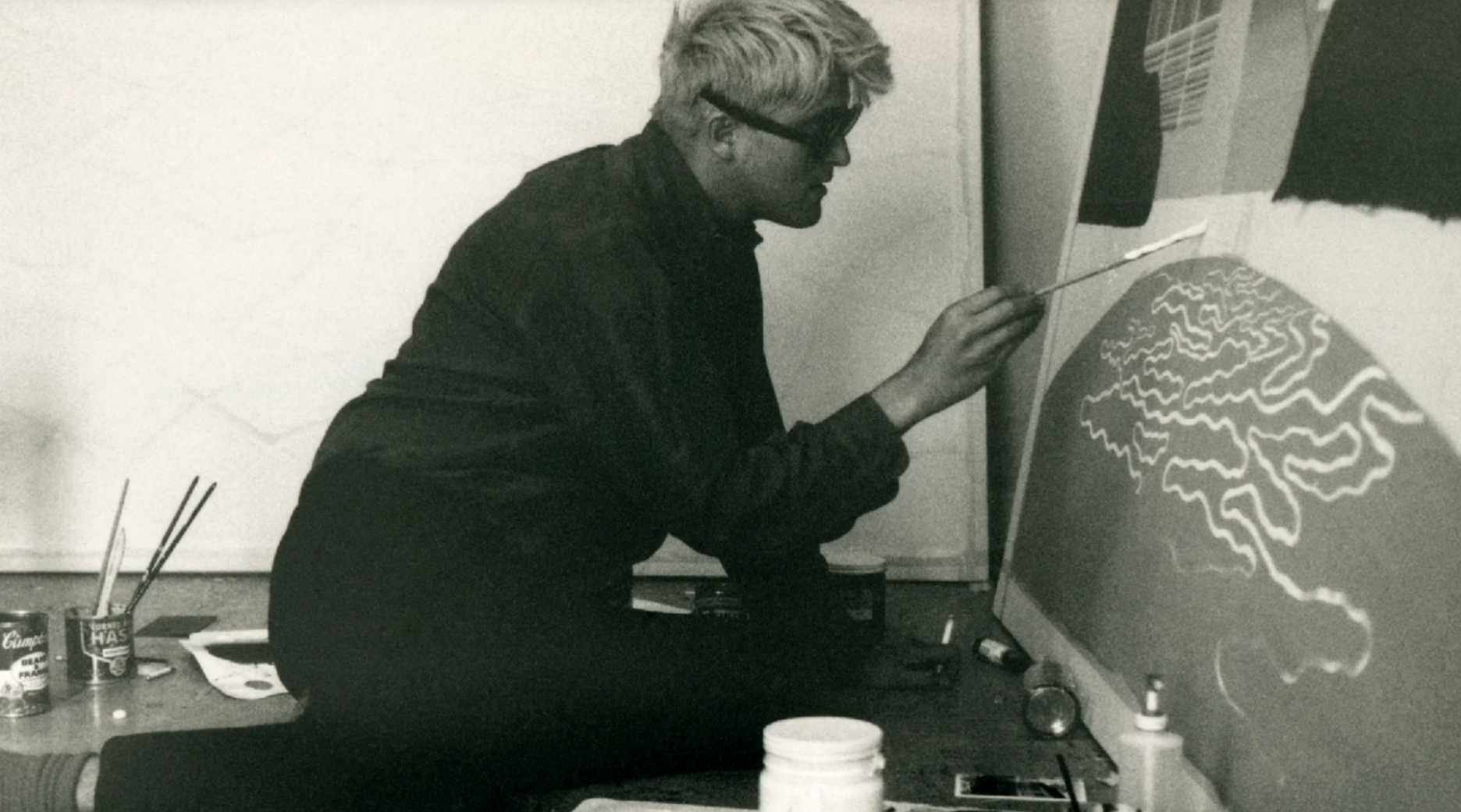
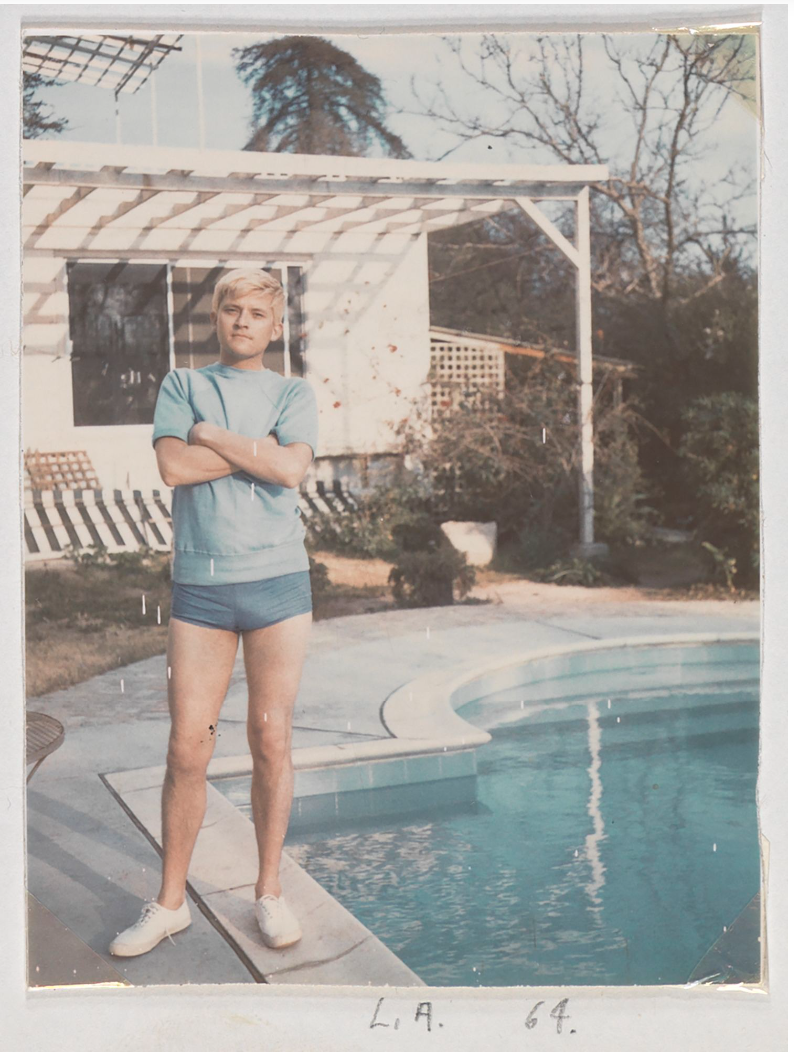
Hockney’s first introduction to California had been through the pages of Physique Pictorial: an American fitness magazine known for its homoerotic imagery. Through its photographs, he had dreamt of an Arcadian land full of sexual freedom and desire, giving rise to early portraits of naked male couplings such as Two Men in a Shower (1963, Astrup Fearnley Museet, Oslo) and Domestic Scene, Los Angeles (1963). California, similarly based on an image from the magazine, extends the language of these works. Yet it also sets the stage for Hockney’s double portraits, begun in 1968, many of which would reflect his immersion in the city’s gay literary and artistic scene. He became close friends with the writer Christopher Isherwood and his partner, the artist Don Bachardy, who featured in a majestic double portrait of 1968. Later, back in London, he painted the curator Henry Geldzahler and his boyfriend Christopher Scott. Both works have their roots in California, extending its complex perspectival play and carefully staged figural pairing. Henry Geldzahler and Christopher Scott would even echo the present work’s glass table, here topped with a delicate pair of wine glasses.
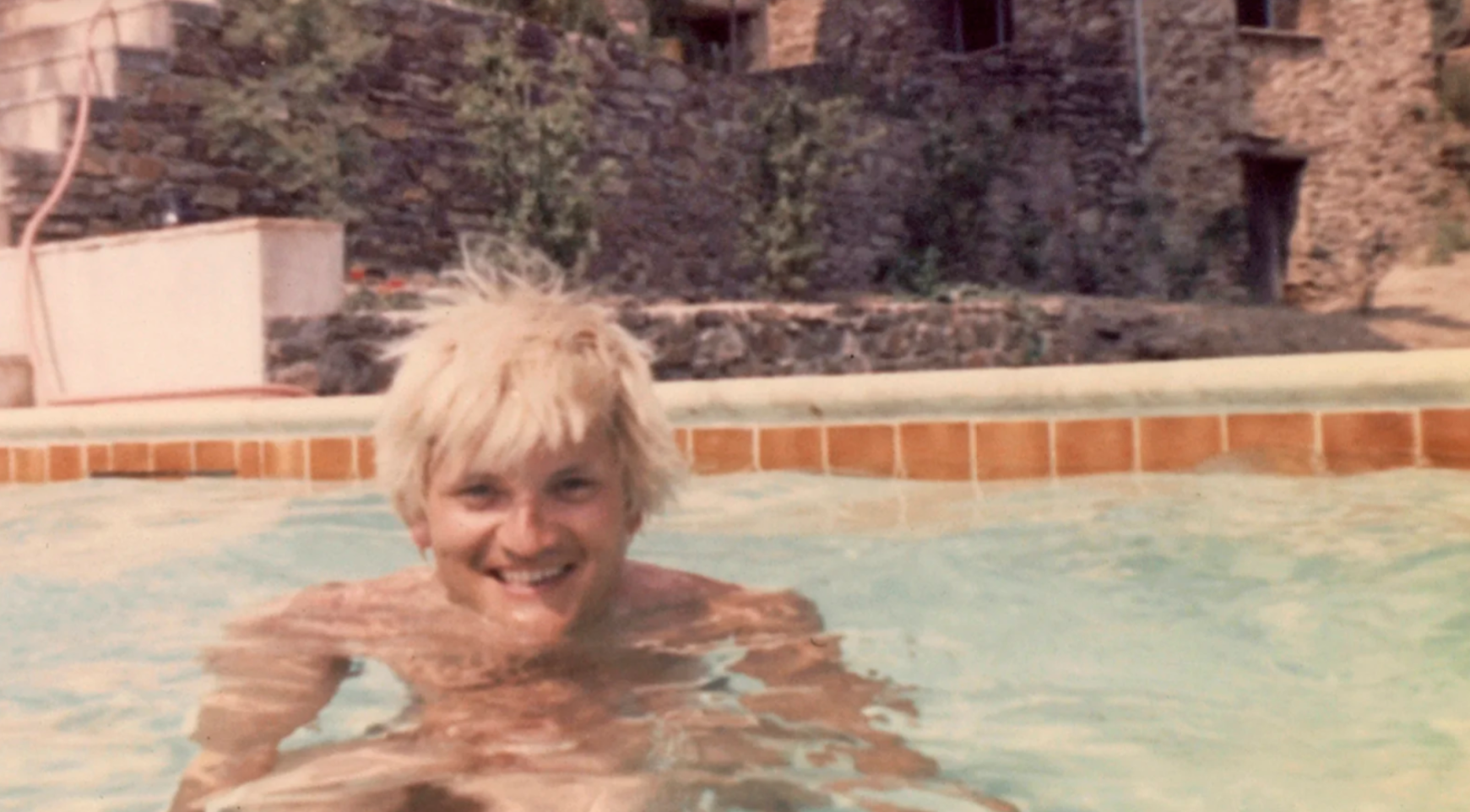
California had surpassed Hockney’s wildest dreams, and for the first time he felt truly at home. Within a week of arriving, he had set up a studio in Santa Monica and passed his driving test, cruising the wide boulevards and road-tripping to Las Vegas. The novels of John Rechy and the warm, sun-drenched paintings of Henri Matisse seemed to come to life before his eyes. He met Ed Ruscha, who would also depict the city’s swimming pools during the 1960s, and made a pilgrimage to the offices of Physique Pictorial. To Hockney, California was a fantasy come true. Melia and Luckhardt note that the present work offers ‘the representation of the region’, depicting an escapist, near-cinematic idyll (P. Melia and U. Luckhardt, ibid., p. 59). The men themselves are lithe, muscular archetypes: their sumptuously painted bodies anticipate the arrival of Hockney’s own Californian lover Peter Schlesinger in 1966, who would later feature in Portrait of an Artist (Pool with Two Figures). Over the next few years, Hockney would begin to ascend the international stage, with California and several other paintings of this period featuring in his entry for the prestigious Marzotto Prize in 1966.
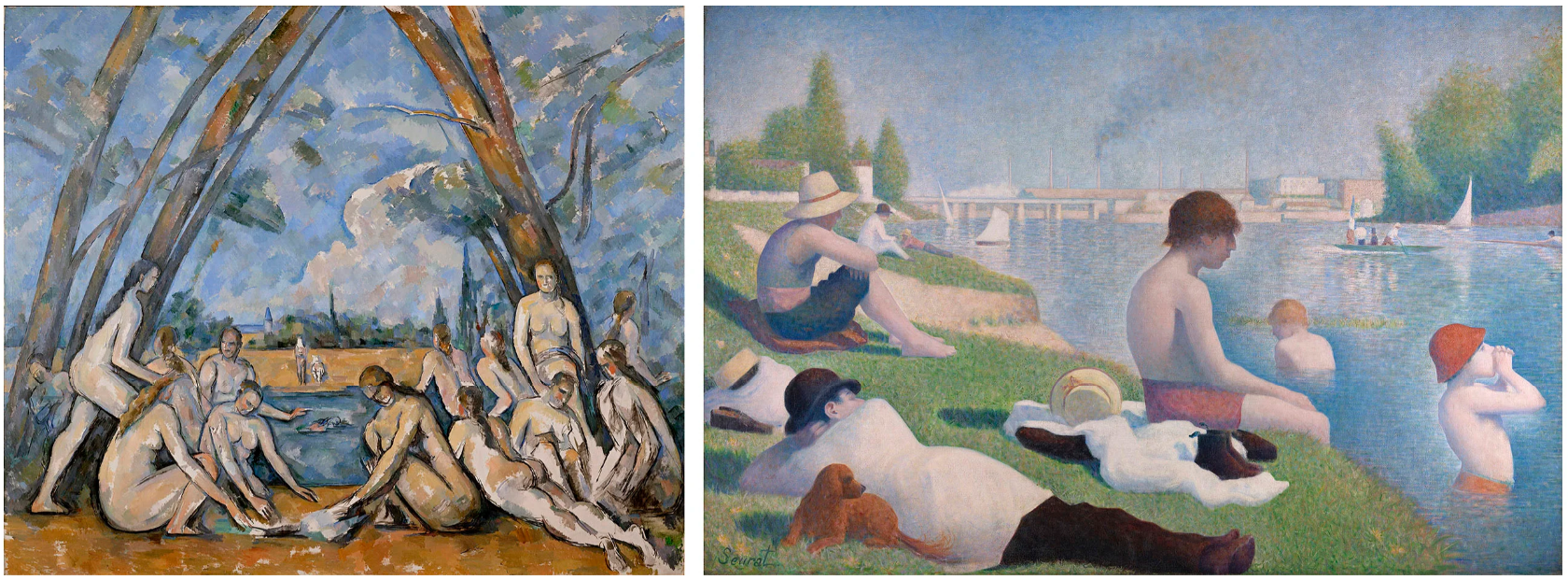
Left: Paul Cezanne, The Large Bathers, 1906. Philadelphia Museum of Art, Philadelphia. Photo: © The Philadelphia Museum of Art/Art Resource/Scala, Florence. Right: Georges Seurat, Bathers at Asnières, 1884. National Gallery, London. Photo: © The National Gallery, London/Scala, Florence.
California demonstrates the wide-ranging breadth of Hockney’s art-historical imagination during these fertile years. His depiction of reclining swimmers, notably, invokes a long and distinguished history of waterside nudes, inviting particular comparison with Matisse’s Bather (Cavalière, summer 1909) as well as conjuring the works of Ingres, Picasso, Cezanne, Seurat and others. The critic Christopher Knight has written that ‘Hockney’s pictures of swimming pools … are contemporary adaptations of the conventional literary and artistic theme of the Golden Age. The voluptuous and sybaritic bather is a primary symbol of that classical myth of origin, a myth that speaks of a lost, pastoral Arcadia of peace and harmony’ (C. Knight, ‘Composite Views: These and Motifs in Hockney’s Art’, David Hockney: A Retrospective, exh. cat. Los Angeles County Museum, 1988. p. 38). At the same time, write Melia and Luckhardt, the work’s elevated vantage point emphasizes the two boys’ status as distant, passive objects of desire, implying ‘a spectator whose gaze asserts control … in the manner familiar from the age-old tradition of the female nude in art’ (P. Melia and U. Luckhardt, ibid., p. 76).
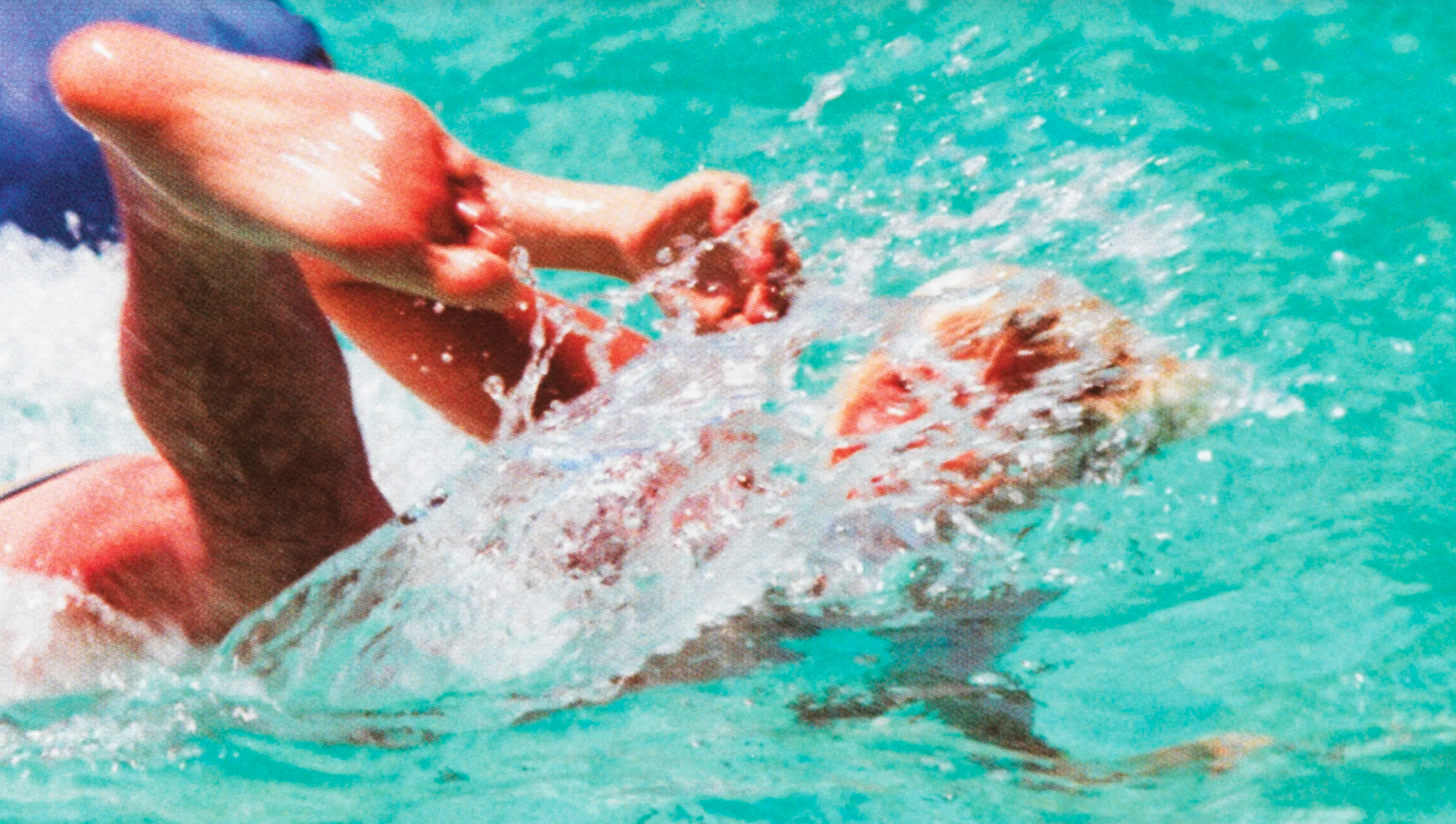
The work’s abstract elements, too, are revealing. As well as invoking Dubuffet, Hockney’s depiction of water makes reference to the so-called ‘spaghetti paintings’ of Bernard Cohen, which he greatly admired. It also invites comparison with the later works of Brice Marden, its seamless, calligraphic line collapsing all sense of perspective. Equally important in this vein were Matisse’s ‘cut-outs’: Nikos Stangos would later draw comparison between Hockney’s pool paintings and the French artist’s monumental La Piscine (1952) (N. Stangos (ed.), David Hockney: Paper Pools, New York 1980, pp. 5-6). The work’s flat colour fields conjure the works of California-based painter Richard Diebenkorn. Its complex gestural textures, meanwhile, evoke the paintings of Willem de Kooning and other Abstract Expressionists, whose works were still deeply influential during the 1960s. Hockney’s photographic source imagery and crisp graphic language chime with the currents of Pop Art, which were quickly gaining traction in America. In the upper half of the composition, cool planar divisions and angular geometries call to mind the works of Frank Stella, or indeed the burgeoning aesthetics of East and West Coast Minimalism.
The work also demonstrates Hockney’s rigorous engagement with the formal mechanics of representation. The empty canvas border surrounding the work—here inscribed with a red band—was employed repeatedly throughout this early period. Hockney used this frame-like device, he explained, to ‘[make] the picture look more like a painting.’ This self-proclaimed ‘modernist’ aspiration manifested itself in a number of other ways. Many works, including the 1965 painting Different Kinds of Water Pouring into a Swimming Pool, Santa Monica, explicitly articulated their engagement with the idea of art as a constructed illusion. Melia and Luckhardt, meanwhile, link California to the 1965 painting Portrait Surrounded by Artistic Devices (Arts Council Collection, London), citing both works’ structural use of art-historical quotation (P. Melia and U. Luckhardt, ibid., pp. 74, 76). Hockney, who later immersed himself in the world of theatre, remained fascinated by questions of artifice and staging throughout his career. California is not just a painting of a swimming pool, but a painting of painting itself: a dazzling showcase of its possibilities, brimming with youthful confidence.
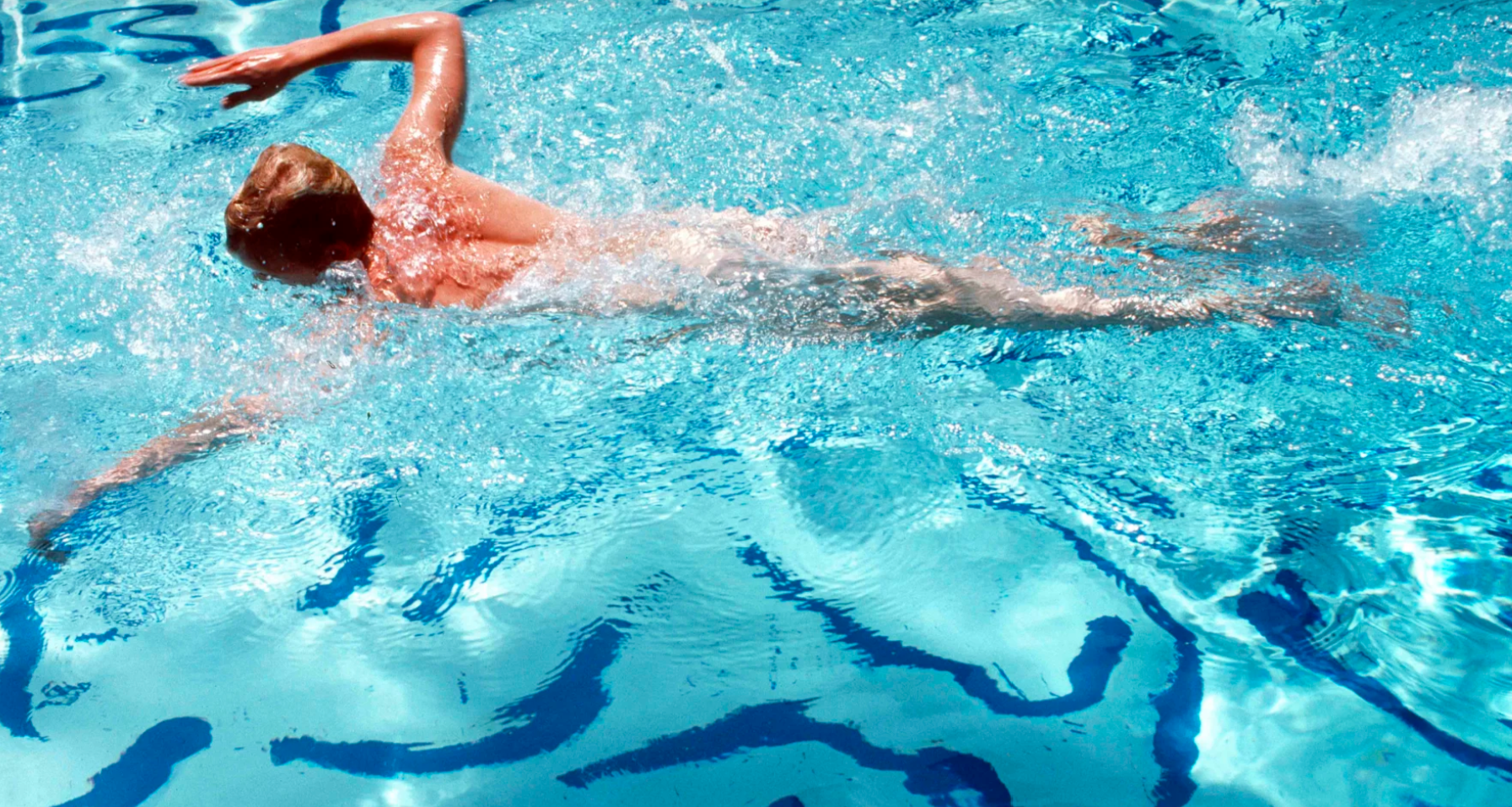
Hockney himself would eventually go one step further. Not content with simply depicting swimming pools, he painted directly onto the bottom of his own. Significantly, the undulating curved blue lines that he daubed across its concrete base shared much in common with the stylized loops of his earliest swimming pool paintings, the water activating them as it rippled and flowed.
“When the water’s still, you see just clear through it and the lines are clean and steady. When somebody’s been swimming, the lines are set to moving. But where are they moving? If you go underneath the surface, no matter how turbulent the water, the lines again are steady. They are only wriggling on the surface, this thinnest film. Well, it’s that surface that fascinates me; and that’s what those paintings are about really.”
California, ultimately, came to life in three dimensions, its revelations tested on a grand operatic scale. Its spirited language, so rich in new promises, would live on.