YAYOI KUSAMA (b. 1929)
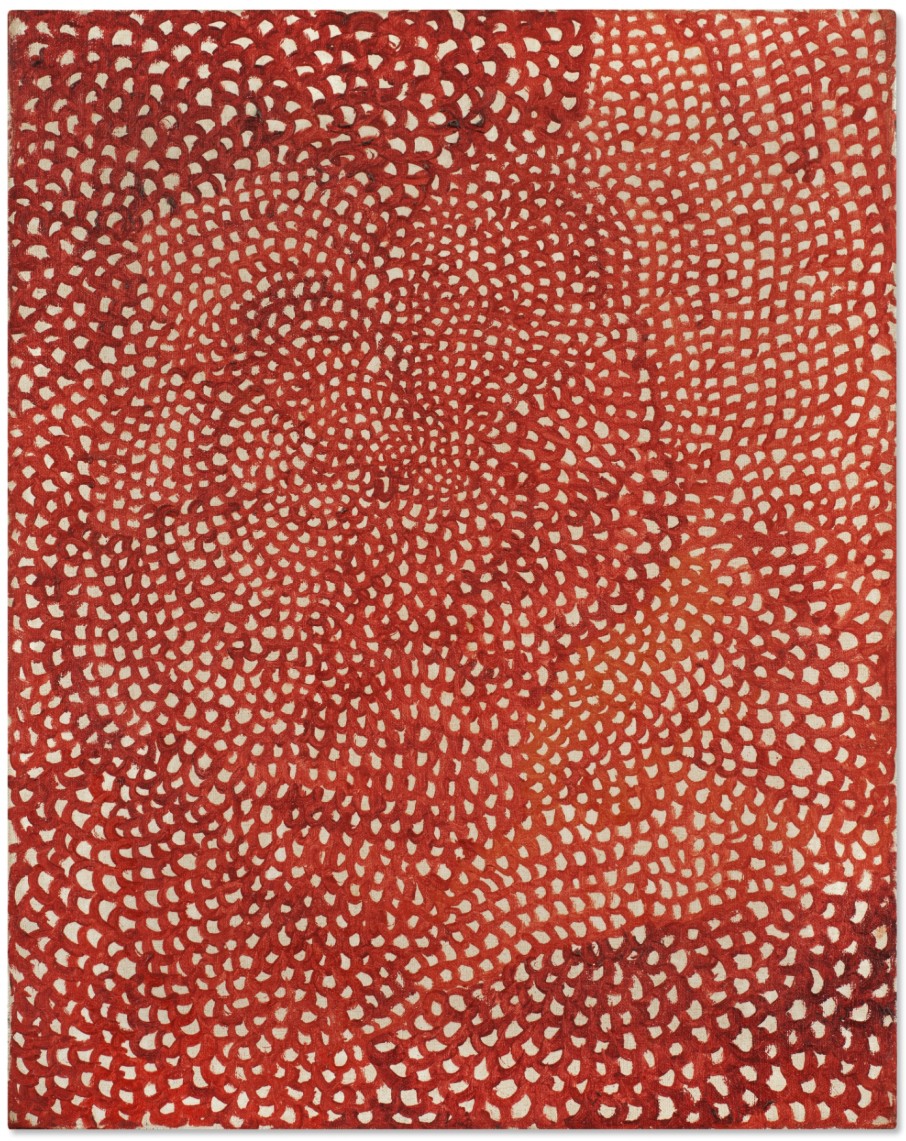
Net-Obsession, 1964
Oil on canvas
50.8 x 40.6 cm (20×16 inches)
Signed, titled and dated 1964 twice (on the reverse)
Titled (on the stretcher)
Provenance
Private Collection, New York (acquired directly from the artist circa 1966)
Sotheby’s New York, 15 May 2013, lot 180 (consigned by the above)
Acquired at the above sale by the present owner
Auction History
Sotheby’s New-York: 19 November 2025
Estimated: USD 700,000 – 1,000,000
USD 1,079,500
Net-Obsession | Contemporary Day Auction | 2025 | Sotheby’s
REPEAT SALE
Sotheby’s New-York: 15 May 2013
Estimated: USD 350,000 – 450,000
USD 557,000
Painted in 1964, Net-Obsession is a superb example of Yayoi Kusama’s early and defining Infinity Net period, a body of work that positioned her among the most original voices of postwar abstraction. Executed in densely modulated tones of crimson and oranges, the painting reveals the rhythmic accumulation of brushstrokes that came to symbolize Kusama’s unique vision of the infinite. Each mark, small and cellular, repeats across the canvas in an undulating field that appears at once methodical and ecstatic. In its hypnotic depth and vibrating texture, Net-Obsession embodies the psychological intensity and transcendental ambition that characterize Kusama’s art of the 1960s.
“You might say that I came under the spell of repetition and aggregation.
My nets grew beyond myself and beyond the canvases I was covering with them. They began to cover the walls, the ceiling, and finally the whole universe.
I was always standing at the center of the obsession,
over the passionate accretion and repetition inside of me.”
By the time Kusama painted Net-Obsession, she had been living in New York for nearly six years, immersed in the downtown avant-garde milieu that included Donald Judd, Frank Stella, Eva Hesse, and Claes Oldenburg. While Minimalism and Color Field painting sought purity through reduction, Kusama arrived at infinity through repetition. Her Infinity Nets, begun in 1958, were radical for their combination of obsessive gesture and near-total abstraction. Unlike her contemporaries, whose work often aspired to objectivity or detachment, Kusama’s process was deeply personal: each painted cell became both a manifestation of her psychic state and a meditation on the dissolution of the self.
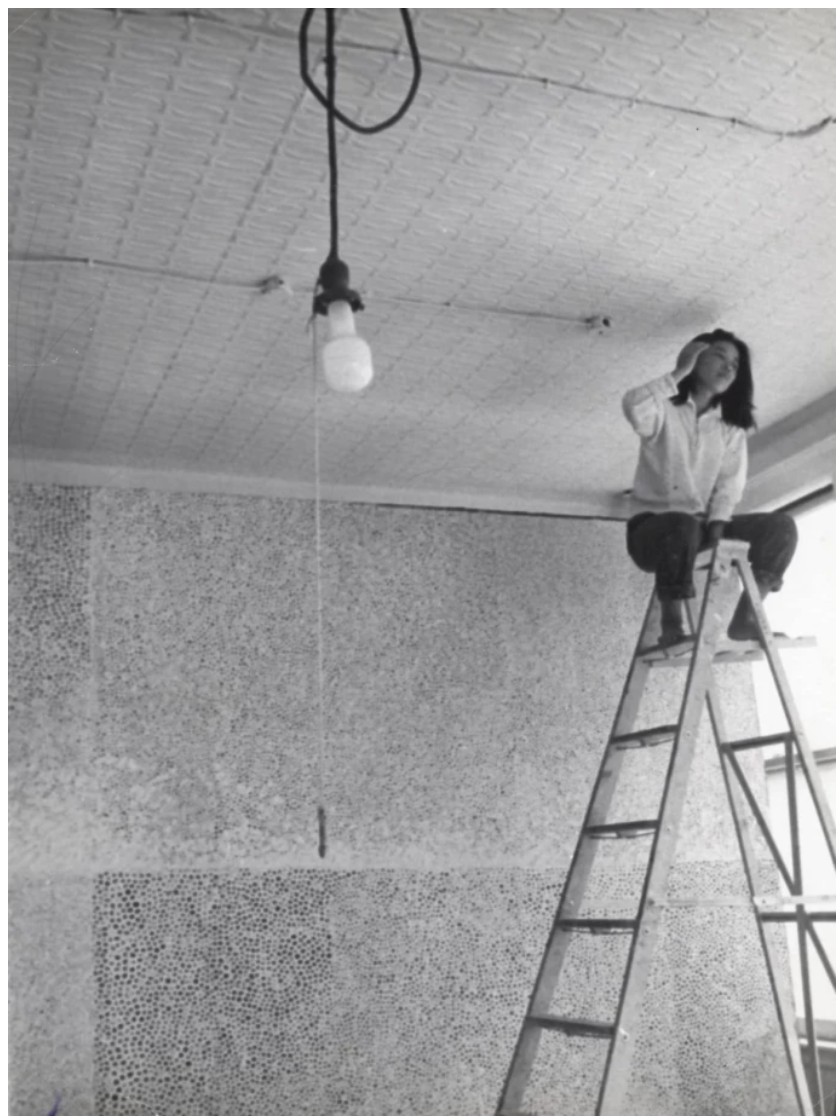
Yayoi Kusama next to her Infinity Net Paintings in her studio in New York, 1961. Image © Yayoi Kusama
In Net-Obsession, the red palette introduces a visceral energy absent from her earlier monochrome white nets. The oscillating hues of carmine and vermilion, interwoven with pale flecks of negative space, create a pulsating rhythm reminiscent of biological growth or cosmic expansion. The composition’s centripetal movement draws the viewer inward, suggesting an infinite spiral rather than a flat surface. The accumulation of thousands of small, repeated gestures produces a field that is both microscopic and cosmic – a visual corollary to Kusama’s lifelong fascination with the boundlessness of the universe.
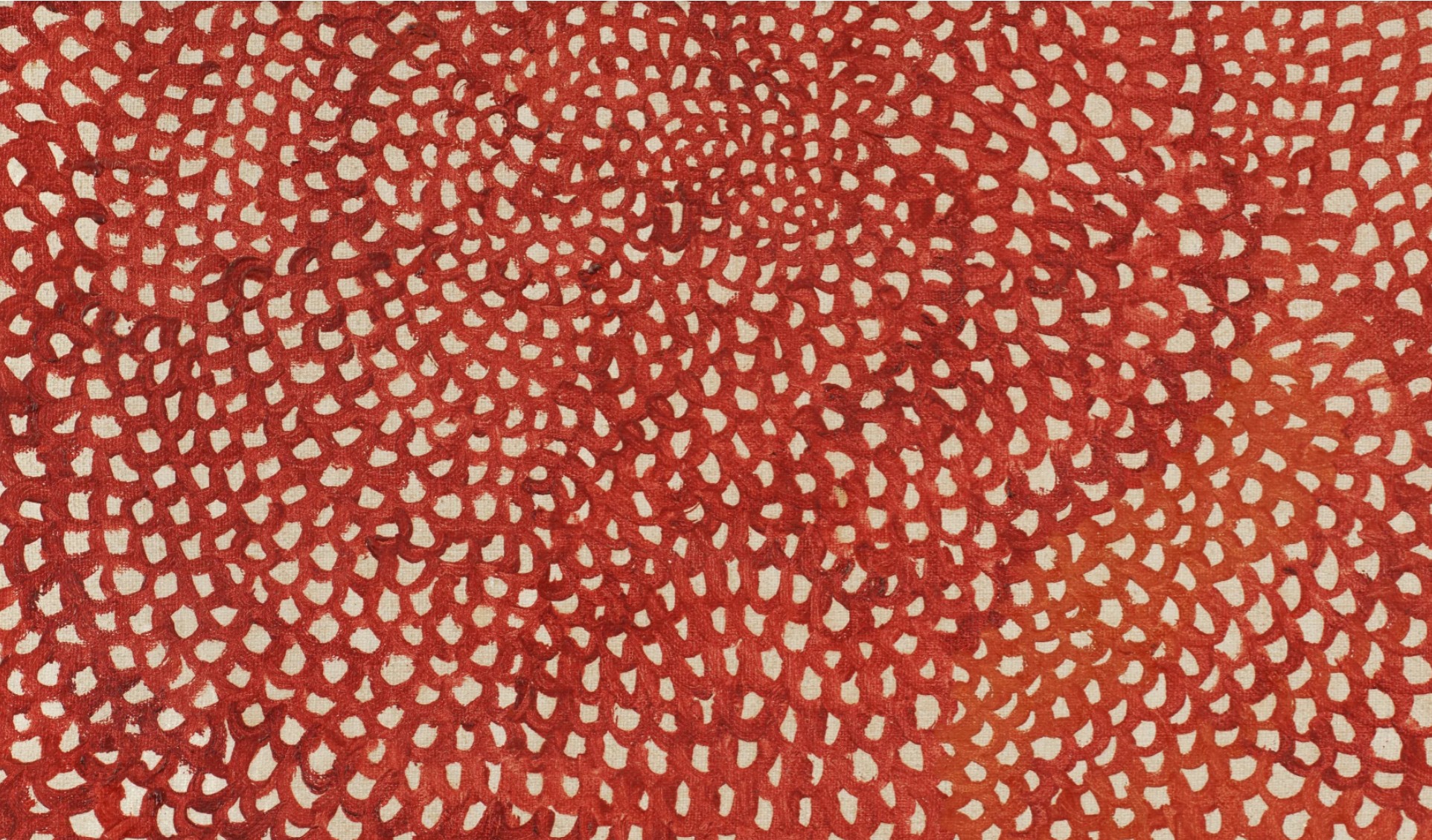
The year 1964 marked a pivotal moment in Kusama’s career. Having gained critical attention from influential dealers such as Richard Castellane and Donald Judd, she presented her first large-scale Infinity Net exhibitions in New York and Tokyo. The Net-Obsession works from this period, smaller in scale yet monumental in conception, bear witness to the transition between her early abstract practice and her later sculptural and performative experiments. In these paintings, the disciplined hand of the abstractionist coexists with the inner compulsion of the visionary. The repetitive act of painting each cell functions as both aesthetic construction and psychological catharsis, blurring the boundary between art-making and survival. Beyond its aesthetic refinement, Net-Obsession holds a deeply autobiographical resonance. Created during a period of intense self-imposed isolation, the work reflects the artist’s attempt to externalize the repetitive hallucinations that had haunted her since childhood. The act of painting thus becomes therapeutic, a disciplined ritual that transforms anxiety into pattern, and pattern into transcendence. Each brushstroke signifies both control and surrender, the conscious and the subconscious held in perfect equilibrium.
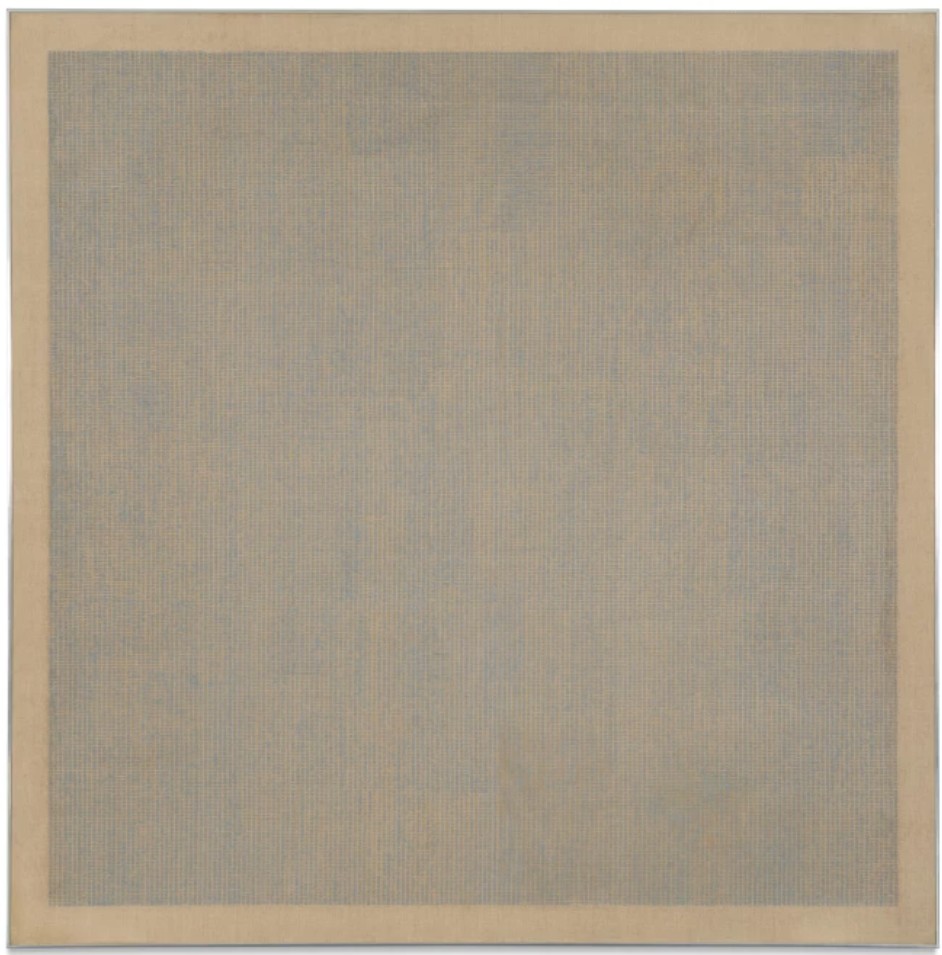
Agnes Martin, Grey Stone II, 1961. Sold at Sotheby’s, New York for $18.7 million in November 2023.
Private Collection. Art © 2025 Estate of Agnes Martin / Artists Rights Society (ARS), New York
Net-Obsession exemplifies the qualities that have made Kusama one of the most influential artists of the postwar era: the capacity to transform personal experience into universal metaphor, and to merge the physical act of painting with the metaphysical pursuit of infinity. In its modest scale and monumental sensibility, the work distills the essence of the Infinity Nets: a vision where repetition becomes revelation, and where the boundaries of the self dissolve into the endless rhythm of the cosmos.