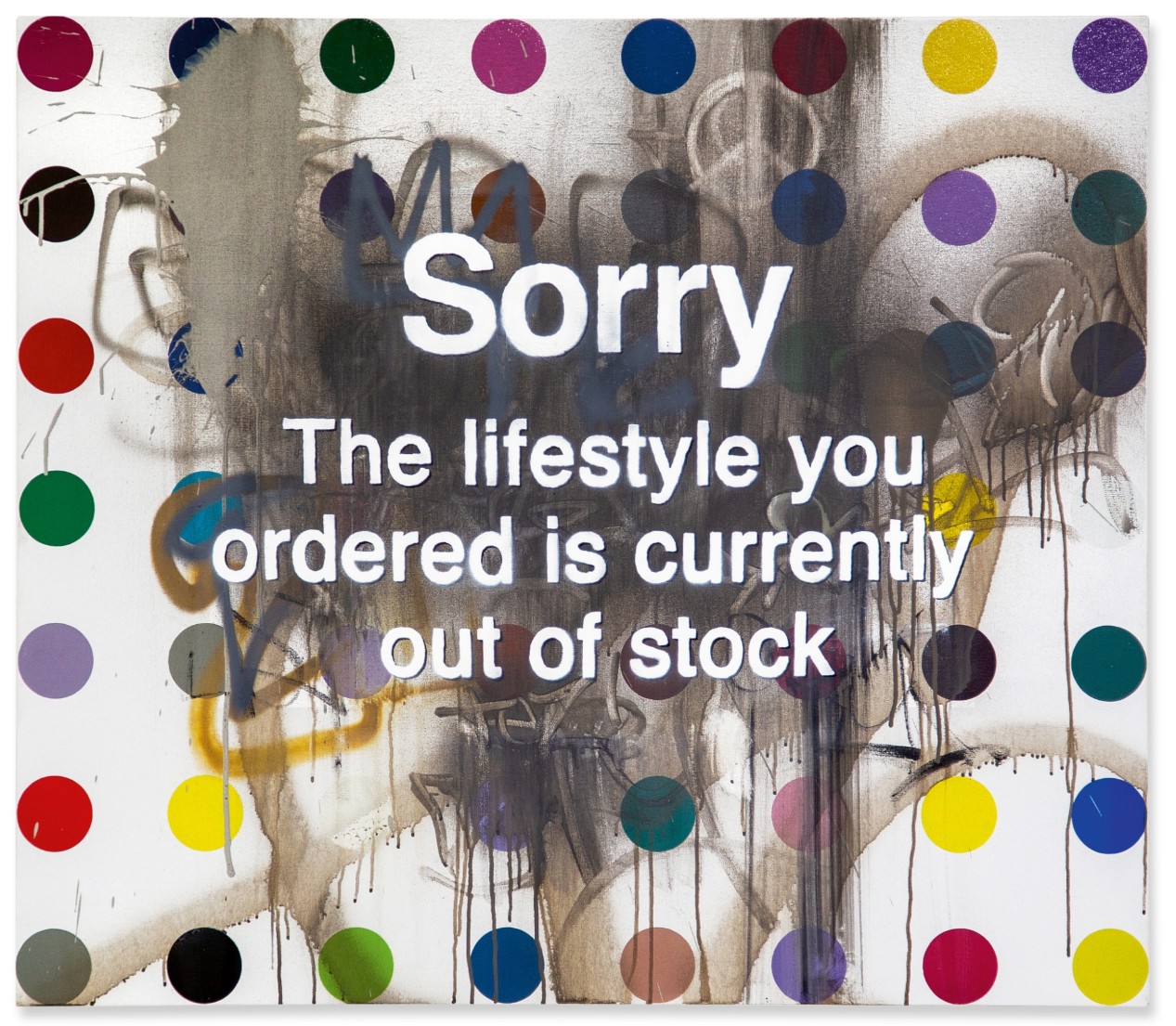
BANKSY (DEFACED HIRST)
SORRY THE LIFESTYLE YOU ORDERED IS CURRENTLY OUT OF STOCK, 2013-2014
Spray paint, emulsion and household gloss on canvas
39×45 inches (99.1 x 114.3 cm)
Signed by both artists on the reverse and variously inscribed
Provenance
Private Collection (acquired directly from the artist)
10 Hanover Gallery, London
Black Rat Projects, London
Private Collection, Miami (acquired from the above)
Sotheby’s New York, 28 October 2020, lot 46 (consigned by the above)
Private Collection, Dallas (acquired from the above)
Acquired from the above by the present owner
Auction History
Sotheby’s New-York: 19 November 2025
Estimated: USD 800,000 – 1,200,000
USD 2,856,000
Sotheby’s New-York: 28 October 2020
Estimated: USD 2,000,000 – 3,000,000
USD 2,319,000
Executed in 2013, Sorry the Lifestyle You Ordered is Currently Out of Stock encapsulates Banksy’s unparalleled ability to fuse conceptual wit, social critique, and art-historical dialogue into a single image. A unique collaboration, or perhaps more precisely, a defacement, of one of Damien Hirst’s iconic Spot Paintings, the present work stands as a pointed meditation on consumer desire, authorship, and the commodification of contemporary art itself. Executed in 2013 and signed by both artists, this Defaced Hirst is among the most incisive statements in Banksy’s career-long exploration of the contradictions between rebellion and luxury, subversion and spectacle.
“If you want to survive as a graffiti writer when you go indoors your only option is to carry on painting over things that don’t belong to you there either”
In this composition, Banksy intervenes directly upon Hirst’s work, extending a tradition begun years prior in his Vandalised Oils series that saw the artist deface found paintings with his iconic text and symbols, in this case overlaying Hirst’s pristine rationalism with the slogan “Sorry the lifestyle you ordered is currently out of stock.” The juxtaposition is devastating in its simplicity, the witty text confronting the hollowness of consumer aspiration within the polished logic of Hirst’s aesthetic system. The result is both collaboration and critique, a wry dialogue between two of Britain’s most recognizable artists, each of whom has defined the intersection of art and commerce in the early twenty-first century.
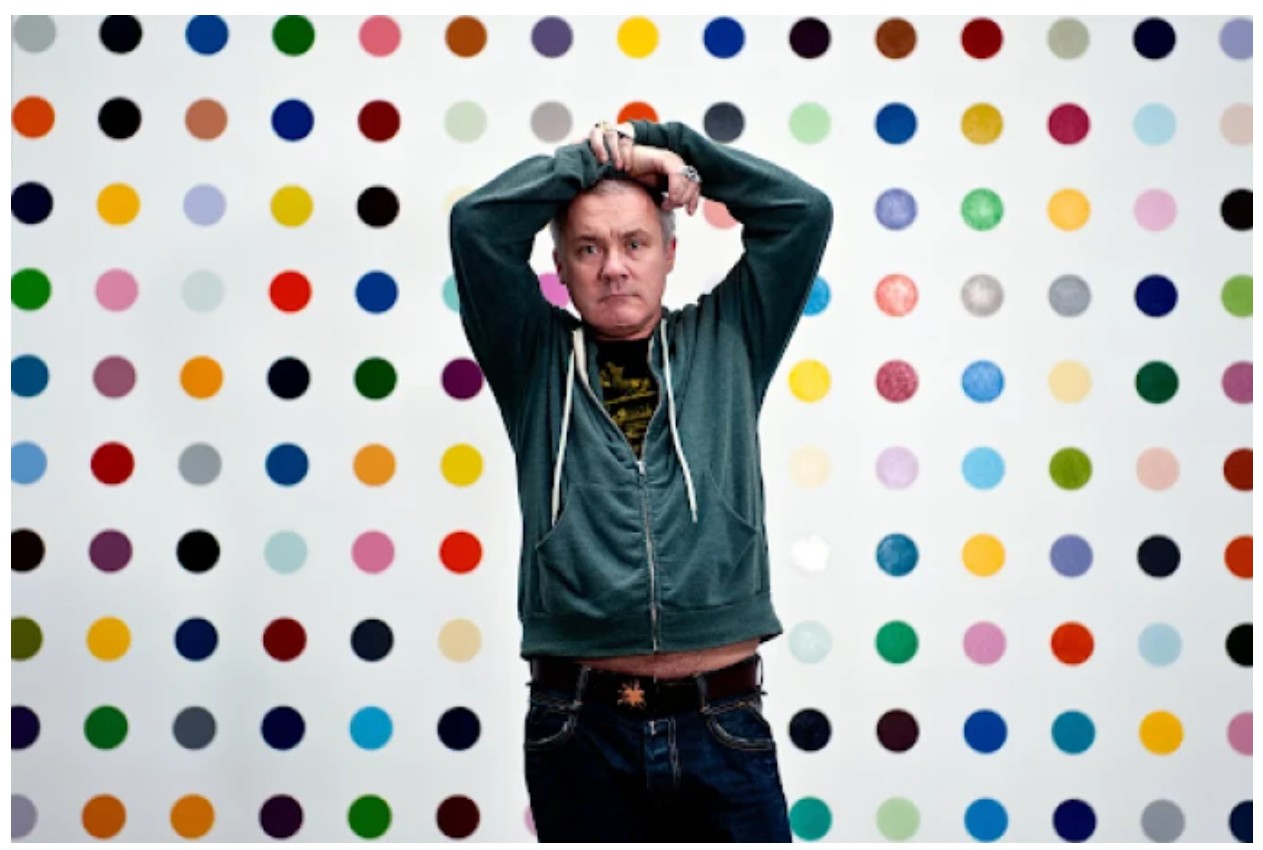
Damien Hirst in front of one of his Spot Paintings, 2011.
Hirst’s ordered grid of colored dots, emblematic of an art market that celebrates perfection and repetition, becomes the backdrop for Banksy’s disillusioned aphorism. The phrase, drawn from the language of online retail, transforms the consumer apology into a cultural verdict: a society that equates fulfillment with consumption is bound to encounter emptiness. This gesture extends Banksy’s long-standing interrogation of late capitalism, echoing works such as Shop Until You Drop (2011) and Choose Your Weapon (2010), in which slogans and symbols expose the violence of branding and conformity. The present work represents a turning point in Banksy’s oeuvre, marking his evolution from street provocateur to institutional interlocutor. By subverting the work of an icon of the YBAs, Banksy both critiques and joins their lineage, positioning himself as the conscience of the art world he simultaneously inhabits and undermines. The mutual acknowledgment between Banksy and Hirst transforms this painting into a commentary on authorship and value. In the act of “defacement,” Banksy paradoxically increases the work’s cultural and economic worth, exposing the art market’s hunger for rebellion packaged as collectible rarity.
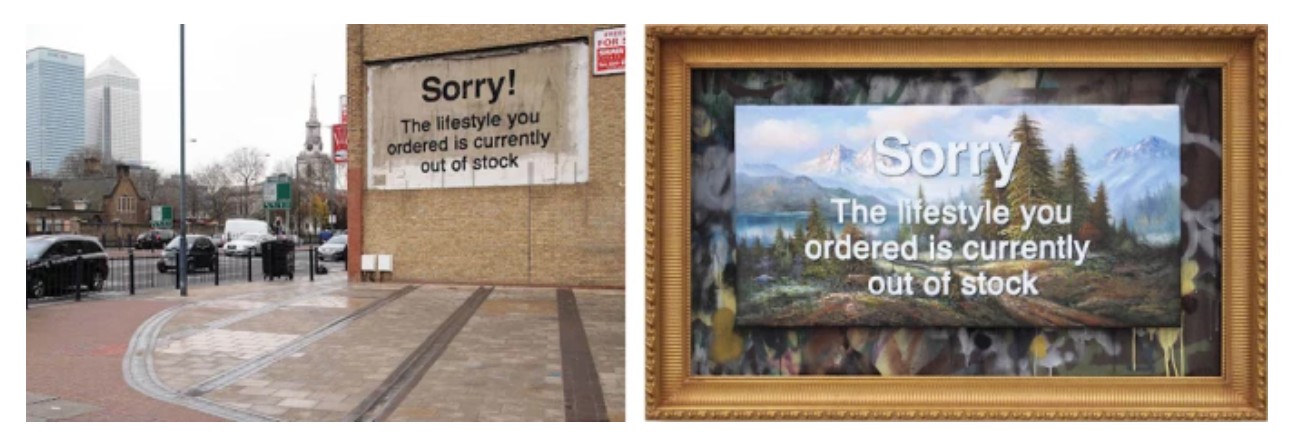
Left: Banksy mural, East India Rock Road, London, 2011.
Right: Sorry The Lifestyle You Ordered is Currently Out of Stock, 2012. Private Collection.
The phrase “Sorry The Lifestyle You Ordered is Currently Out of Stock” has recurred throughout Banksy’s oeuvre, including in a work of the same name painted in 2012 and, exemplifying Banksy’s dual status as a street and fine artist, on the side of an abandoned building in London’s East End in 2011. The 2011 work, the first instance of Banksy’s usage of the phrase, was a searing commentary on the British government’s aggressive financial policies that led to buildings like the one he painted on, believed to be a failed housing project, to sit idly during the recession. This tension between destruction and creation found its most spectacular expression in Love is in the Bin (2018), Banksy’s infamous self-destructing painting that sold at Sotheby’s London for £18.6 million in 2021, setting a record for the artist. That event, when Girl with Balloon shredded itself moments after the hammer fell, reframed notions of authenticity, spectacle, and artistic control. The Defaced Hirst works anticipate that gesture: they literalize the act of intervention, turning an existing artwork into a new, conceptually charged object. Both moments reveal Banksy’s mastery of theatrical critique, where subversion itself becomes the medium and the market’s reaction the performance.
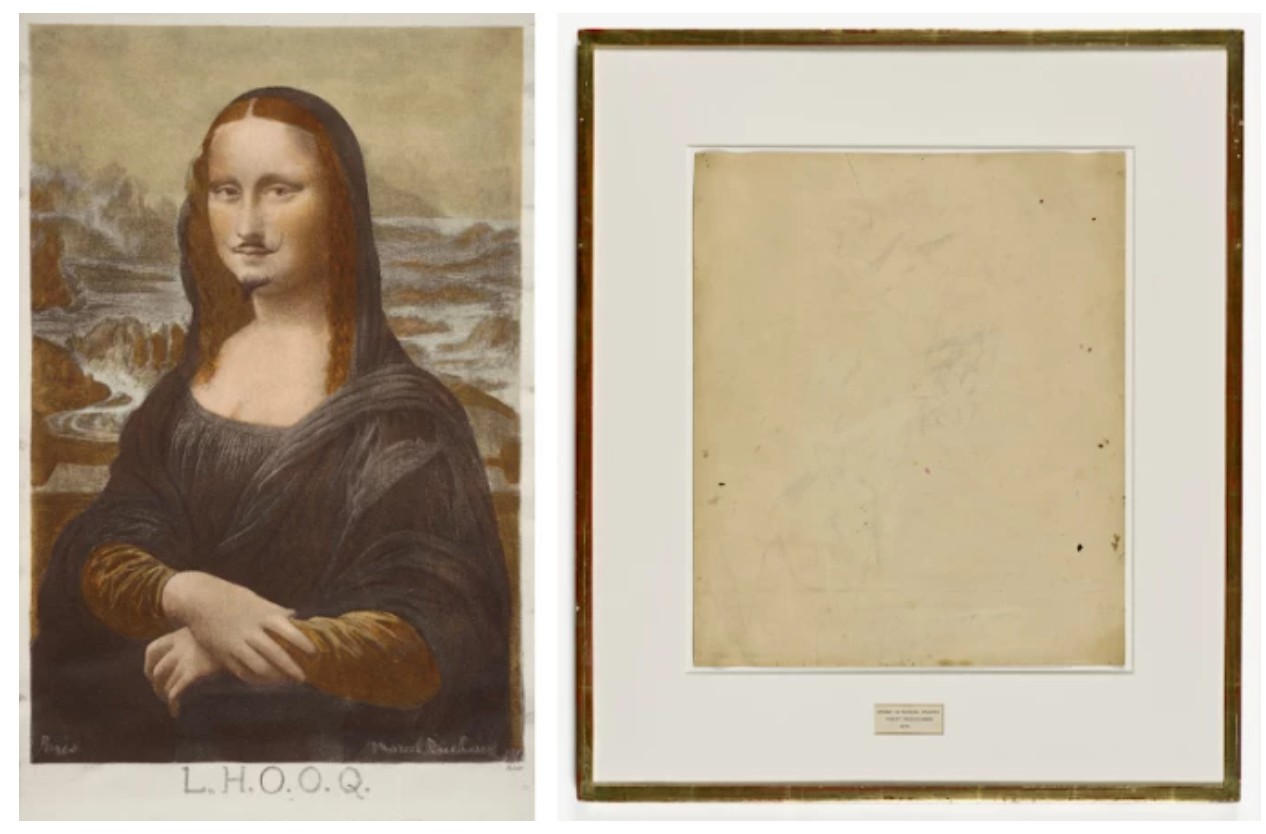
Left: Marcel Duchamp, Mona Lisa (L.H.O.O.Q.), 1919. Philadelphia Museum of Art, Philadelphia.
Right: Robert Rauschenberg, Erased de Kooning, 1953. San Francisco Museum of Modern Art. Art © 2025 Robert Rauschenberg Foundation
The text-based subversion of corporate language recalls Ed Ruscha’s deadpan signage and Barbara Kruger’s declarative slogans, while the collaborative defacement aligns with Marcel Duchamp and Rauschenberg’s radical gesture of altering existing works, as in Duchamp’s L.H.O.O.Q. (1919) and Rauschenberg’s Erased de Kooning (1953), the latter of which serving as a key predecessor to the present work in its collaborative, sanctioned defacement. Like Duchamp’s readymade interventions, Banksy’s appropriation of Hirst’s minimalist order transforms an emblem of modern perfection into a critique of its own sanctity. Sorry the Lifestyle You Ordered is Currently Out of Stock epitomizes Banksy’s deft command of irony and precision. It is at once a visual joke and a profound statement, a mirror held up to the systems of art, commerce, and consumption that sustain its own existence. Like Love is in the Bin, it captures the paradox at the heart of Banksy’s genius: that the act of critique, performed with wit and elegance, becomes itself an object of desire.