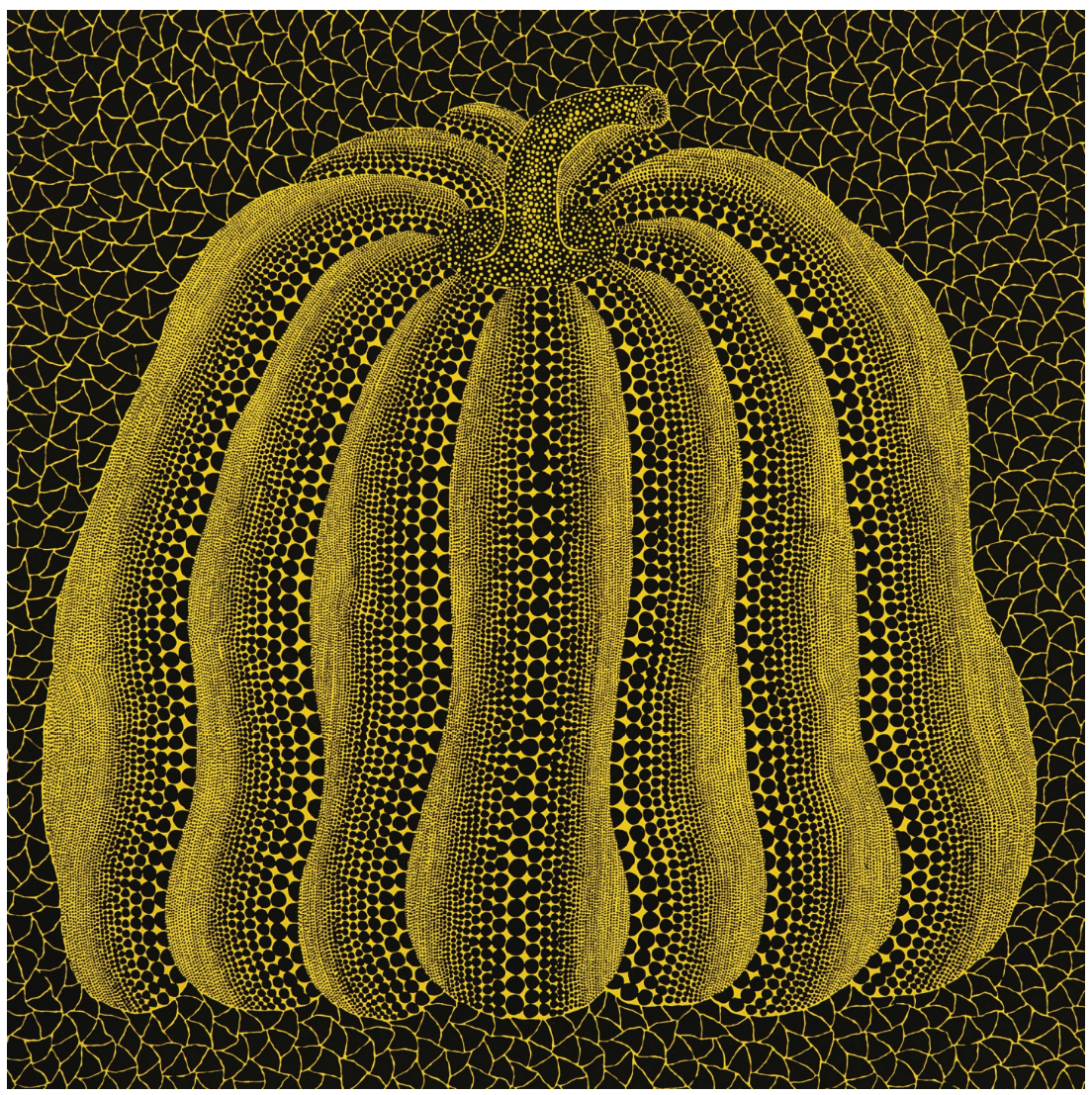
YAYOI KUSAMA
Pumpkin AA, 2012
Acrylic on canvas
145.5 x 145.5 cm (57.1 x 57.1 inches)
Signed in English, titled in Japanese and English and dated 2012 on the reverse
Provenance
Hong Kong, Sotheby’s S|2 Gallery
Private Asian Collection
Sotheby’s Hong-Kong: 4 April 2015
HKD 11,120,000
Source: Sotheby’s
(#1067) Kusama Yayoi (sothebys.com)
Kusama Yayoi’s name has assumed omnipresence in the contemporary art world, and to say that she is the most important living Japanese female artist today is hardly an exaggeration. Armed with a paintbrush and her mind, Kusama has breathed new life into many aspects of art history, in part revolutionising Pop Art, Abstraction, Expressionism, Minimalism and Emotionalism. She is moreover a representative figure of contemporary Asian abstract work, exploring the theme since the fifties and continually reinventing it into present day. Once standing alongside key figures such as Andy Warhol, George Segal, Donald Judd and Claes Oldenburg, Kusama’s renown has simply grown, and has become a permanent fixture in contemporary artistic discourse. Showing immense energy, the octogenarian continues to work tirelessly on her works, producing beautiful and mesmerizing pieces. Pumpkin AA is the culmination of a lifetime of dedication to art, and a brilliant tribute to one of the key symbols from Kusama’s oeuvre.
The Pumpkin is of course a ubiquitous symbol in Kusama’s works. Covered in polka dots in a rich yellow color, the iconic pumpkin is presented against a background of nets. When coupled, all such elements form a visual language that is unmistakable to the artist’s style and has been evolved and perfected through decades of painstaking production and reproduction. Each component of Pumpkin AA reflects a different element of Kusama’s philosophy and when combined, one can read compelling narrative that full expounds the artist’s lifelong dedication to her art.
Kusama first began depicting the iconic vegetable in her Nihonga (traditional Japanese art) practice at the Kyoto Municipal School of Arts and Crafts in the late forties, though the pumpkin would only resurface in her oeuvre much later in the eighties and nineties. Along with the matured polka-dot motif that the artist had been working on for a few decades, the pumpkin re-emerged much later, such as in the three-dimensional mirrored room, Mirror Room (Pumpkin). The Mirror Room (Pumpkin) created the effect of a vast field of the gourd, as their reflections bounced against myriad mirrors infinitely. This installation became an important part of her exhibition at the 1993 Venice Biennale, and the pumpkin saw itself recreated in many colossal outdoor sculptures, among which included commissions for the Fukuoka Prefectural Museum of Art in 1994. It is self-evident, then, that the pumpkin is a crucial emblem of Kusama’s works.
But the source for Pumpkin AA can be traced back further than simply the early nineties and is an early example of the severe hallucinations the artist suffered as a child. “The first time I ever saw a pumpkin was when I was in elementary school and went with my grandfather to visit a big seed-harvesting ground…and there it was: a pumpkin the size of a man’s head…It immediately began speaking to me in a most animated manner.”1 For Kusama, the pumpkin is an integral part of her childhood, but more importantly, the pumpkin can be seen as a link to her encounters with various other plants, objects, and animals, such as her childhood memories of speaking to a talking flower and dog as a young girl. In contrast to traumatic feelings that the artist felt towards other objects, however, the anthropomorphised vegetable carried with him a “generous unpretentiousness”2, and emitted a “solid spiritual balance”3.
For an artist such as Kusama, who places heavy emphasis on purging her fears through meticulous and repetitive movements, the fact that the pumpkin is an inherently “positive” memory is important. As opposed to works such as Accumulation, Sex Obsession, and Compulsion Furniture, which were created in response to a childhood fear of phalluses, the pumpkin embodies no such barrier which she has to “overcome” in order to conquer trepidation and stress. Rather, as Pumpkin AA shows, there is something undoubtedly serene about the pumpkin, and it is the very epitome of life itself. Traditionally a symbol of fertility, the pumpkin also gives one a feeling of abundance and joy, not unlike the feelings one would experience when reaping one’s harvest after an arduous season of work. The present pumpkin also seems to emanate some form of energy, as all the arrows around it point outwards, acting as a magnet of sorts. Thus one can most certainly read the pumpkin as a symbol of strength, a vegetable that cannot simply be governed by external forces.
Aside from being a way through which she fights her fears, repetition is also an important feature of Pop art, with the likes of Roy Lichtenstein and Andy Warhol using this method in their respective oeuvres as a means to investigate popular culture. While Lichtenstein repeatedly explored select aspects of society through comic-strip format, Warhol reproduced items as a nod to consumerism. Similarly, Pumpkin AA, along with its repetitive background and bold black outline, is a nod to Pop Art; and, considering Kusama’s contemporaneity to figures like Warhol himself, it would not be an exaggeration to note her eminence in influencing Pop Art itself. Aside from here adherence to Pop, Kusama’s process of repetition is also a method through which she attains perfection. The more she reproduces an image, the closer to achieving perfection she arrives. Thus, the newly rendered Pumpkin AA is a true representation of Kusama’s endeavours to capture beauty and flawlessness.