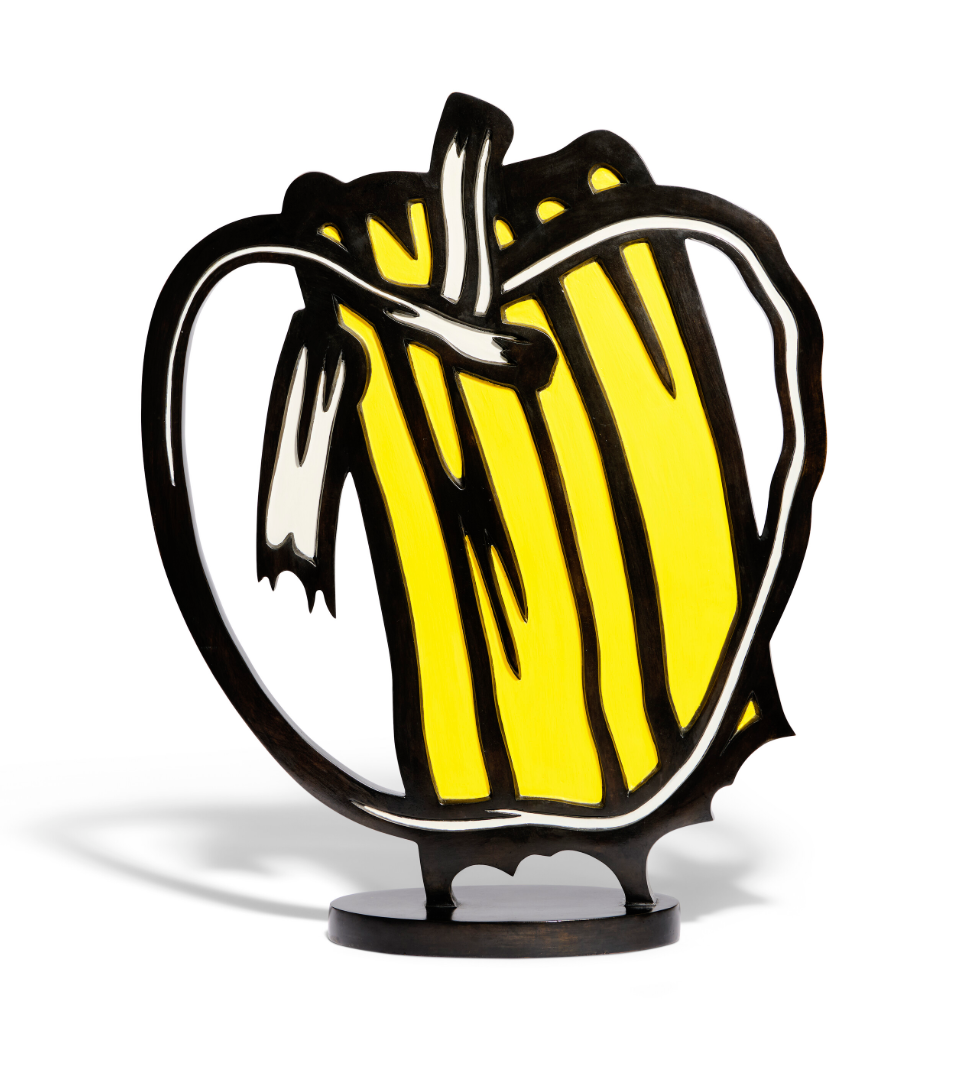
ROY LICHTENSTEIN (1923-1997)
Yellow Apple, 1981
Painted bronze
21 x 16-3/4 x 4-3/4 inches (53.3 x 42.5 x 12 cm)
Edition: 6
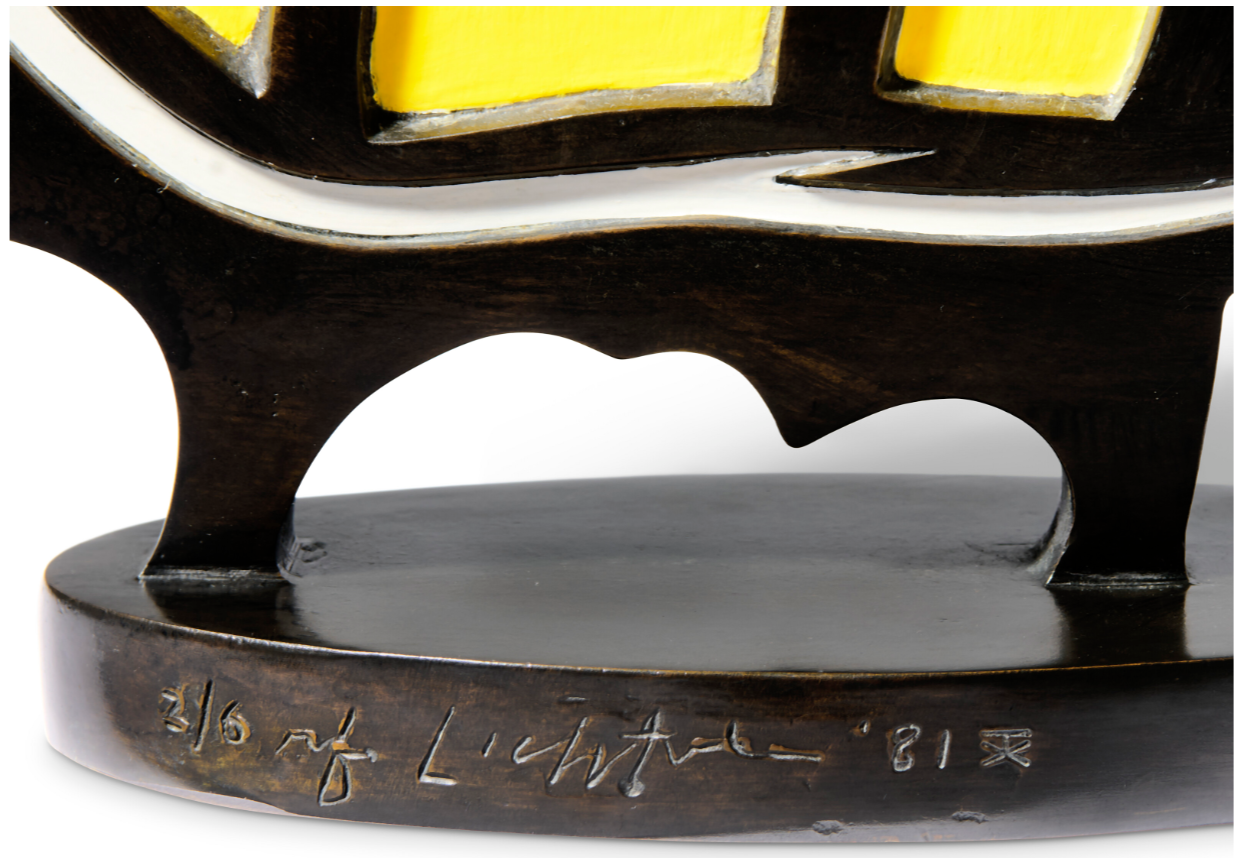
Inscribed with the artist’s signature
Numbered and dated (on the base)
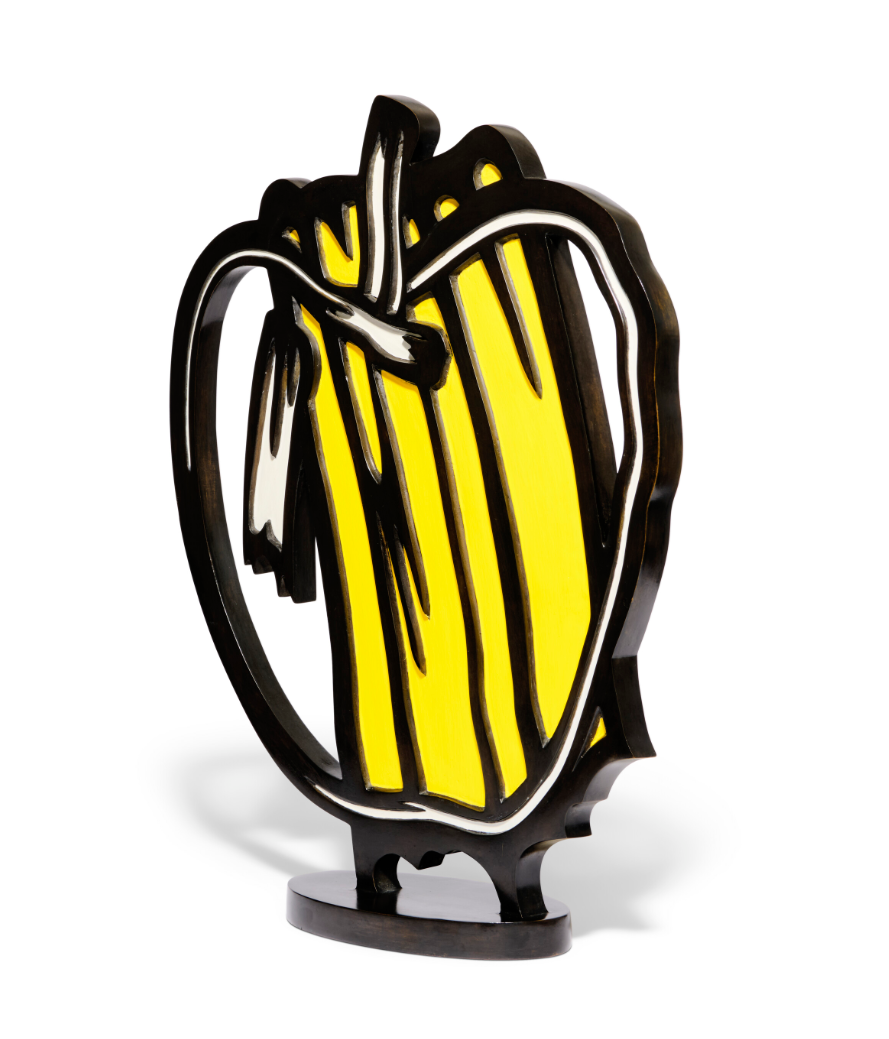
A playful commentary on the transformative power of art, Yellow Apple (1981) belongs to Roy Lichtenstein’s acclaimed series of bronze still-life sculptures. It comprises the outline of an archetypal apple encircling a cartoonish rendering of a yellow brushstroke, both floating above a smooth circular base. The bronze is painted white, yellow and black, disguising the metal in opaque, comic-book colour. Lichtenstein captures the mutability of a brushstroke and the organic shape of an apple in solid form with characteristic wit. The choice of the apple—a mundane object, but also a classic subject in painting, from Paul Cezanne’s still-lives to René Magritte’s dreamlike visions—hovers between everyday life and art history. Other works from the edition of Yellow Apple have been widely exhibited, including in Lichtenstein’s 2012 retrospective at the Art Institute of Chicago, which travelled to the National Gallery of Art, Washington, D.C., Tate Modern, London and Centre Pompidou, Paris. One can be seen alongside masterpieces of twentieth-century art in photographs of legendary New York dealer Leo Castelli’s living room.
Alongside Andy Warhol, Lichtenstein was the most significant figure in Pop Art. He emerged in the 1960s with works that adopted the bold outlines and block colours of comic strips, shattering hierarchies of high and low culture. He became particularly well-known for manually replicating the mechanical Ben Day dots used by printers to create darker areas of colour and shadow. In 1965 he began a series of paintings taking brushstrokes as their subject, parodying the obsession with spontaneity and painterly expressiveness in Abstract Expressionist art. ‘Lichtenstein’, writes Frederic Tuten, ‘seizes the most apparent aspect of Abstract Expressionism, its bravura strokes and rhetorical painterliness, and encapsulates it in a single image created with precision and much forethought’ (Roy Lichtenstein: Bronze Sculpture 1976-1989, exh. cat., 65 Thompson Street, New York, 1989, p. 12).
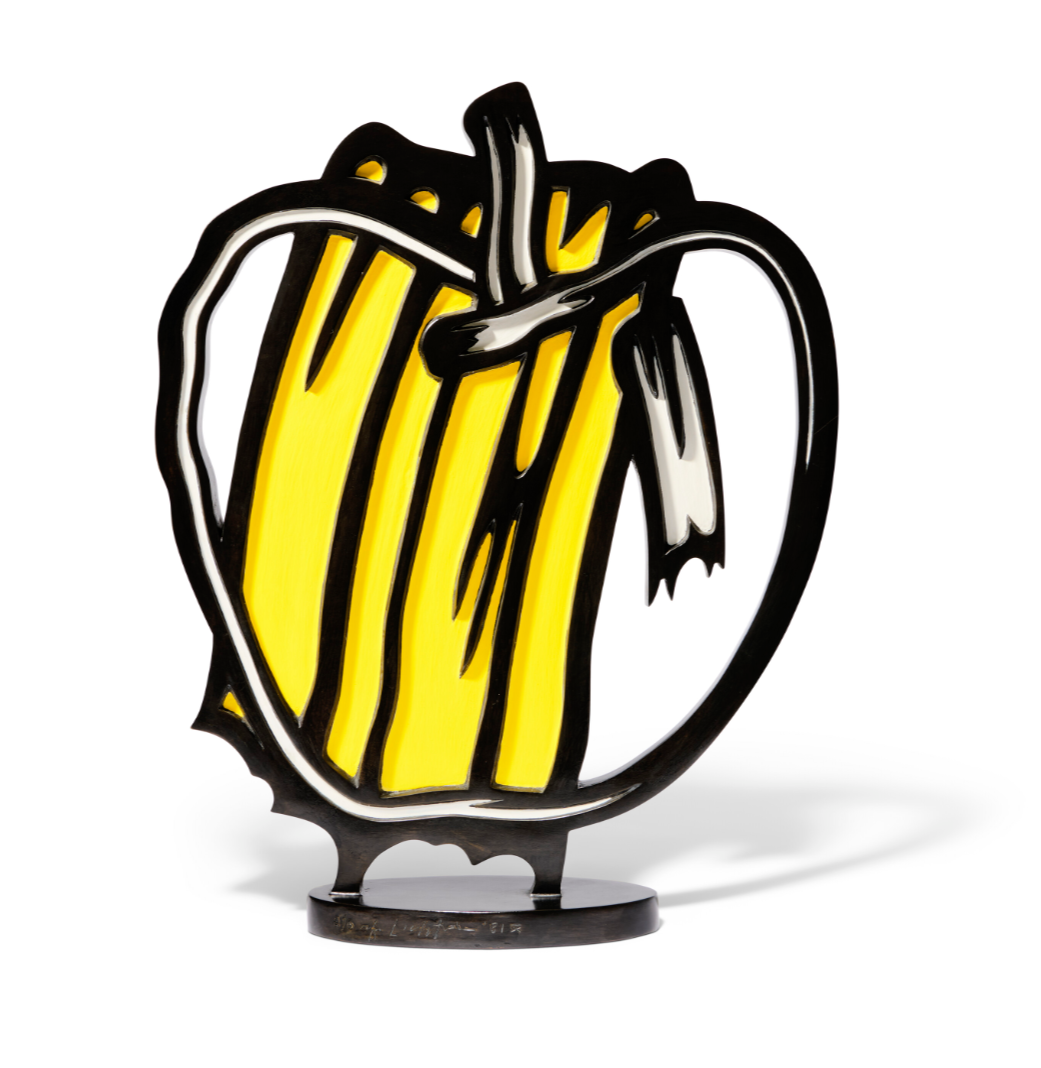
In the early 1980s Lichtenstein began translating his subjects to sculpture, while also expanding his interest in the traditional form of the still life. Lichtenstein created these works through a technique of lost wax casting. He began with drawn studies before creating a wooden maquette. This would then be used to create a lost wax mould, from which he would steam out the wax before molten metal was poured inside, playing with the artistic potential of semi-industrial processes. In the resulting sculptures, depicted objects are flattened into two dimensions and reborn in a different three-dimensional form. Yellow Apple is a virtuosic example of this subversive practice, caught between movement and stasis, flatness and materiality, and high art and popular culture.
Auction Results
#7. Yellow Apple, 1981
Christie’s London: 14 October 2026
Estimated: GBP 280,000 – 350,000
GBP 294,400 / USD 387,150
ROY LICHTENSTEIN (1923-1997), Yellow Apple | Christie’s
ROY LICHTENSTEIN (1923-1997)
Yellow Apple, 1981
Painted bronze
21 x 16-3/4 x 4-3/4 inches (53.3 x 42.5 x 12 cm)
Inscribed with the artist’s signature
Number and date ‘2⁄6 rf Lichtenstein ’81’ (on the base)
Executed in 1981, this work is number two from an edition of six