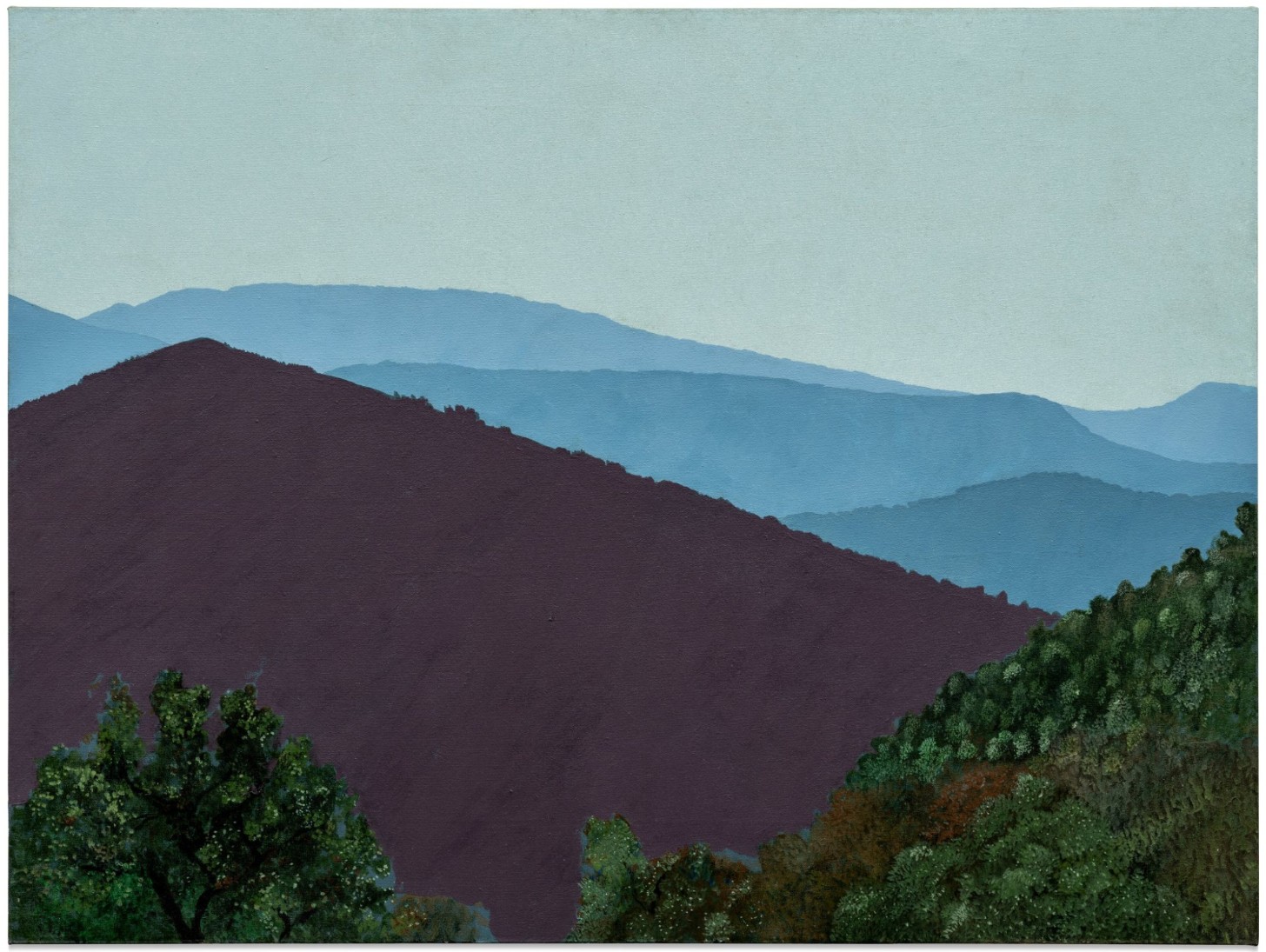
DAVID HOCKNEY (b. 1937)
The Valley, Mountains in Var (Near La Garde Freinet), 1970
Acrylic on canvas
36×48 inches (91.4 x 121.9 cm)
Signed, titled and dated 1970 (on the reverse)
Provenance
Kasmin Ltd., London
Ian Dunlop, New York (acquired from the above circa 1970)
André Emmerich Gallery, New York (consigned by the above in 1979)
Private Collection, Los Angeles (acquired from the above in 1979)
André Emmerich Gallery, New York (consigned by the above in 1988)
Mr. and Mrs. Crosby Kemper, Missouri (acquired from the above in 1988)
M. Knoedler & Co., New York
Acquired from the above in November 2005 by the present owner
Auction History
Property from The Sheryl and Harvey White Trust Collection
Sotheby’s New-York: 14 May 2026
Estimated: USD 6,000,000 – 8,000,000
USD 6,586,000
David Hockney | The Valley, Mountains in Var (Near La Garde Freinet)
Dating to a pivotal early period in David Hockney’s legendary practice, The Valley (Mountains in Var, Near La Garde Freinet) offers a resplendent vista of the French Riviera’s verdant terrain. Distinguished for its exceptional provenance, the present work comes from the collection of Sheryl and Harvey White, where it has been cherished in their esteemed collection for over two decades.
“Anything that interests me I take photographs of… I usually carry a little camera in my pocket and then I have a bigger camera, so I’m always clicking away at things.”
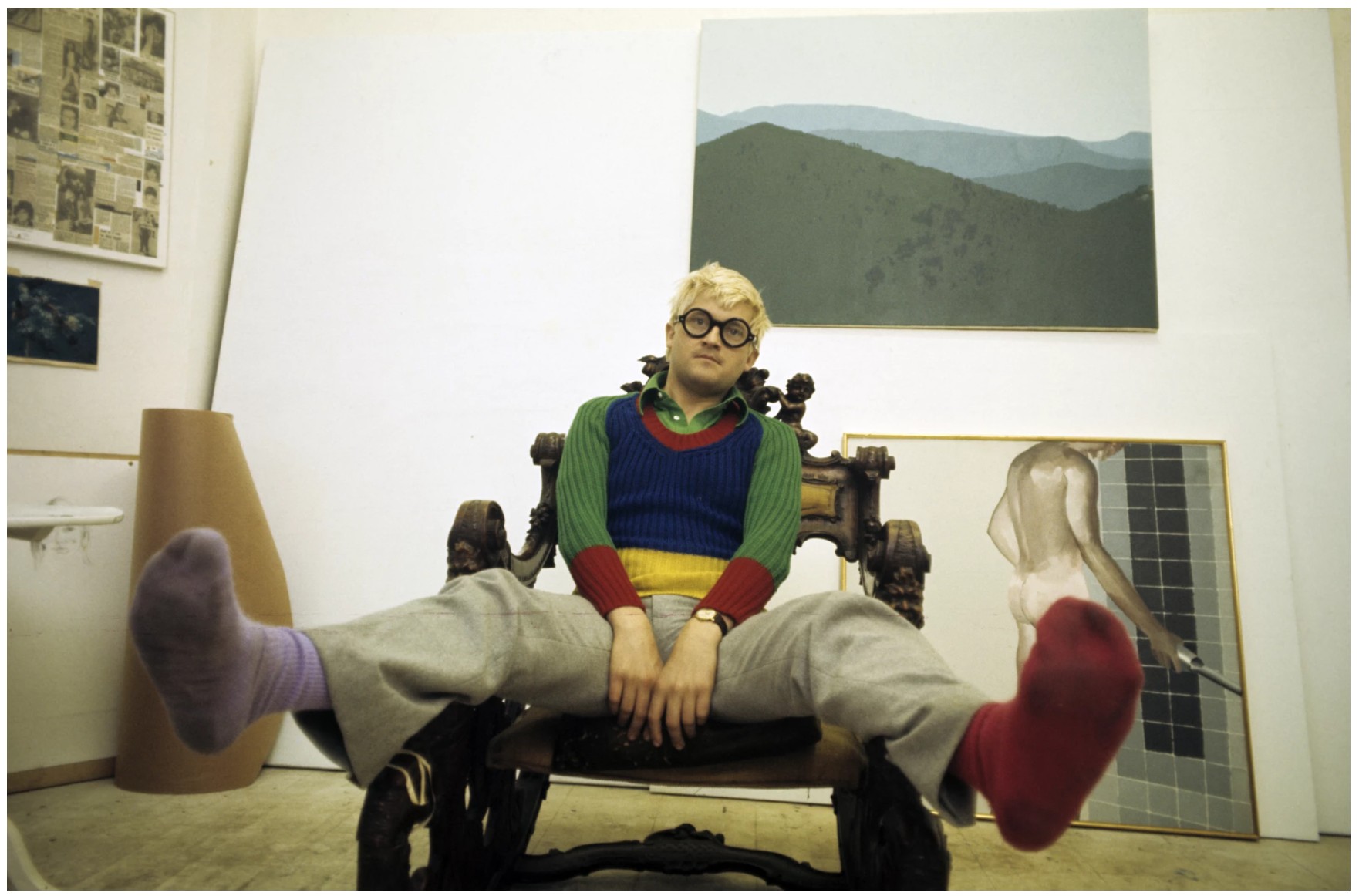
David Hockney in his studio with the present work in progress, May 1970.
Photo by Jack Garofalo/Paris Match via Getty Images. Art © 2026 David Hockney
Painted after the success of Hockney’s ten-year retrospective exhibition at the Whitechapel Gallery in London in 1970, the present work captures a moment of deep personal and professional fulfillment for the young artist. The crystalline light and utter chromatic clarity of this minutely observed painting would prefigure one of the most significant works of Hockney’s entire career, Portrait of An Artist (Two Figures by a Pool), serving as a reference for the landscape depicted in the background. Distinguished by its crisp, meticulous detail and unique relation to the world record painting for the artist, The Valley (Mountains in Var, Near La Garde Freinet) is a rare and paradigmatic example of the artist’s celebrated naturalistic style of the late 1960s and early 1970s.
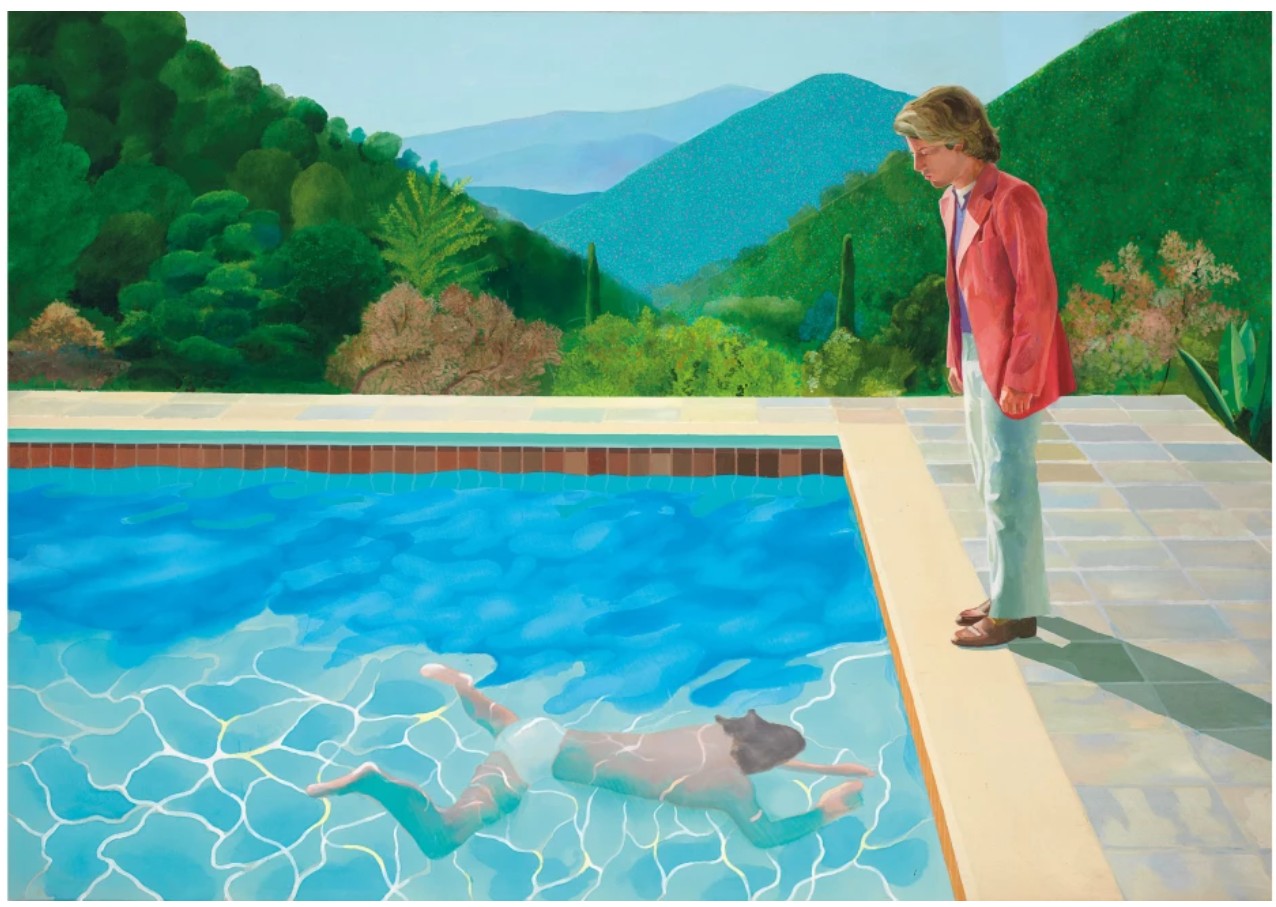
David Hockney, Portrait of an Artist (Pool with Two Figures), 1972. Private Collection. Art © 2026 David Hockney
The present work captures the view from the pool of film director Tony Richardson’s villa, Le Nid du Duc, in the south of France, where Hockney was staying with Peter Schlesinger. Here, the artist carefully composes the stippled, lush foliage of the foreground against the rolling, atmospheric hills of the Côte d’Azur. In 1970, Hockney’s output was limited while he prepared for the Whitechapel exhibition and traveled around Europe; in this year, he would paint only: Le Parc des Sources, Vichy, Mr. and Mrs. Clark and Percy, Three Chairs with a Section of a Picasso Mural and A Chair with a Horse Drawn by Picasso, as well as the present work.
“I began working on [Le Parc des Sources, Vichy], in January and it took me much longer than expected… I think the difficulties stemmed from the acrylic paint and the naturalism, the fight to achieve naturalistic effect, the difficulty of blending colors, things like that.”
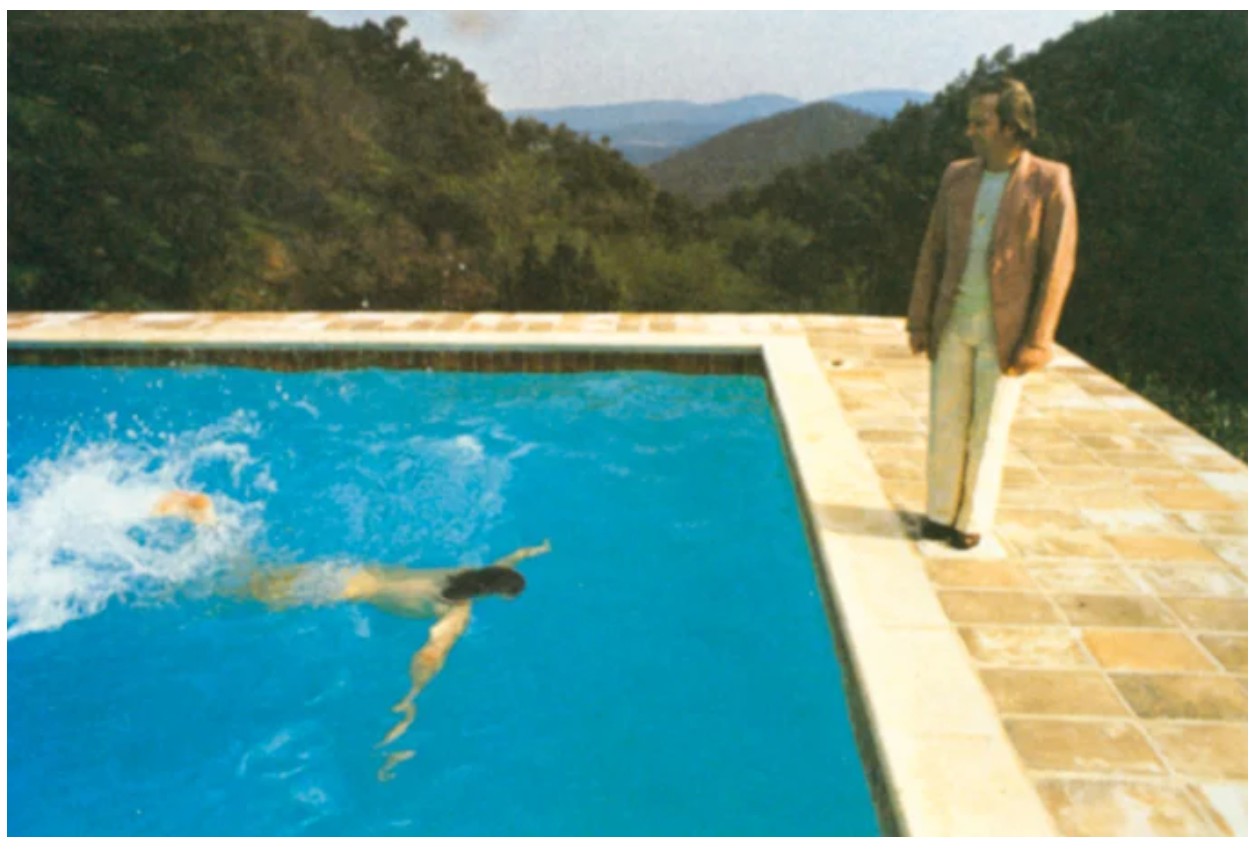
Reference photo taken by the artist in Le Nid Du Duc. Photo by David Hockney
During this time, the artist’s romance with Schlesinger was growing increasingly strained, eventually dissolving in an infamous row the following year. The figure is absent from many of the works the artist started later in 1970, with the key motif of the empty chair populating Le Parc de Sources, Vichy and again in Three Chairs with a Section of a Picasso Mural—a theme that culminates in the vacant quietude of the present work.
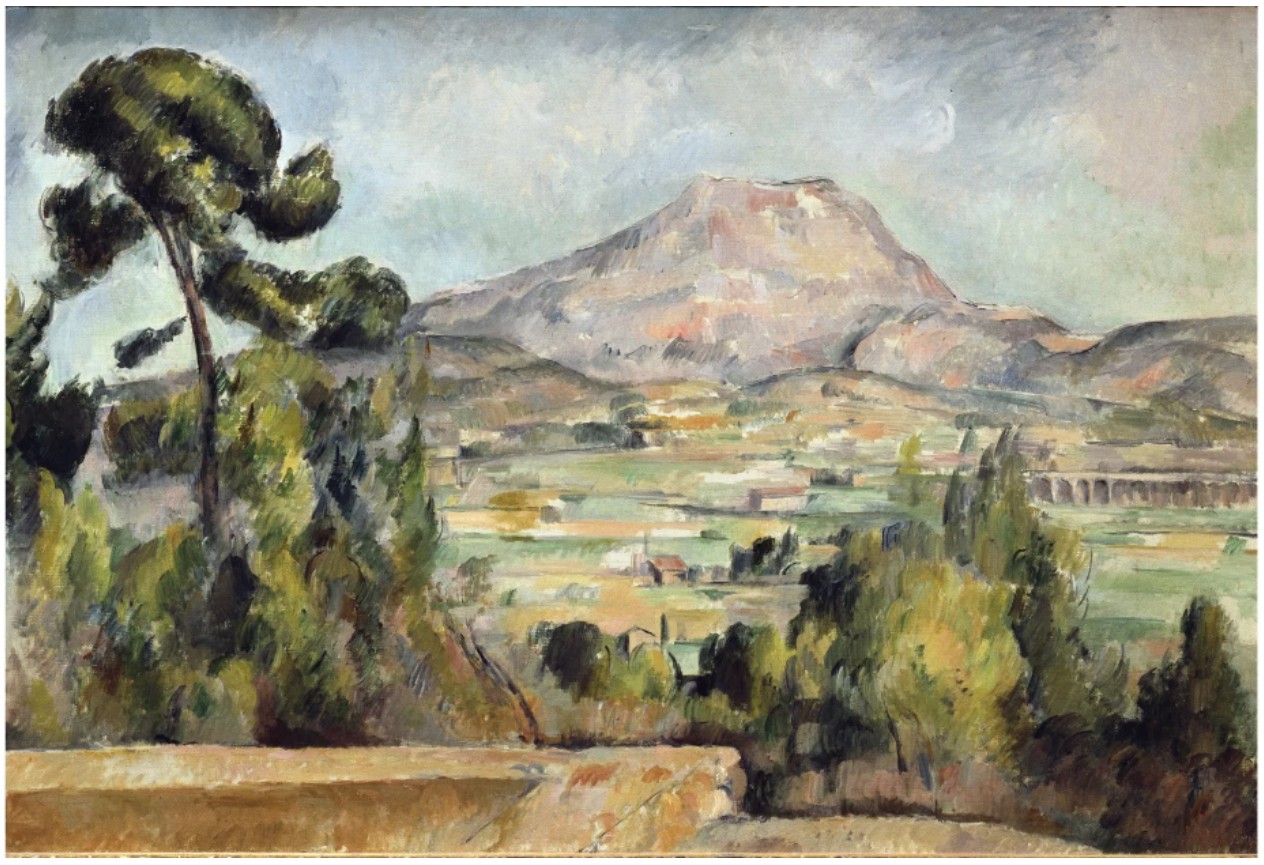
Paul Cézanne, Montagne Sainte-Victoire, 1890. Musee d’Orsay, Paris. Image © Luisa Ricciarini / Bridgeman Images
The South of France, with its languid mountains, brilliant light, and endless summers, became an instant draw for David Hockney and Peter Schlesinger and would play a pivotal role in their relationship. As Peter Webb describes, the couple “quickly bonded: … the couple were traveling again, this time to the film director Tony Richardson’s home in the south of France … [Hockney] discovered that they shared not only common roots and a northern sense of humor but also a love of sunshine and the clear light of the south.” (Peter Webb, Portrait of David Hockney, New York 1988, p. 100) Hockney and Schlesinger often attended Richardson’s extravagant parties at Le Nid du Duc, the director’s spectacular house in the mountains near La Garde-Freinet.
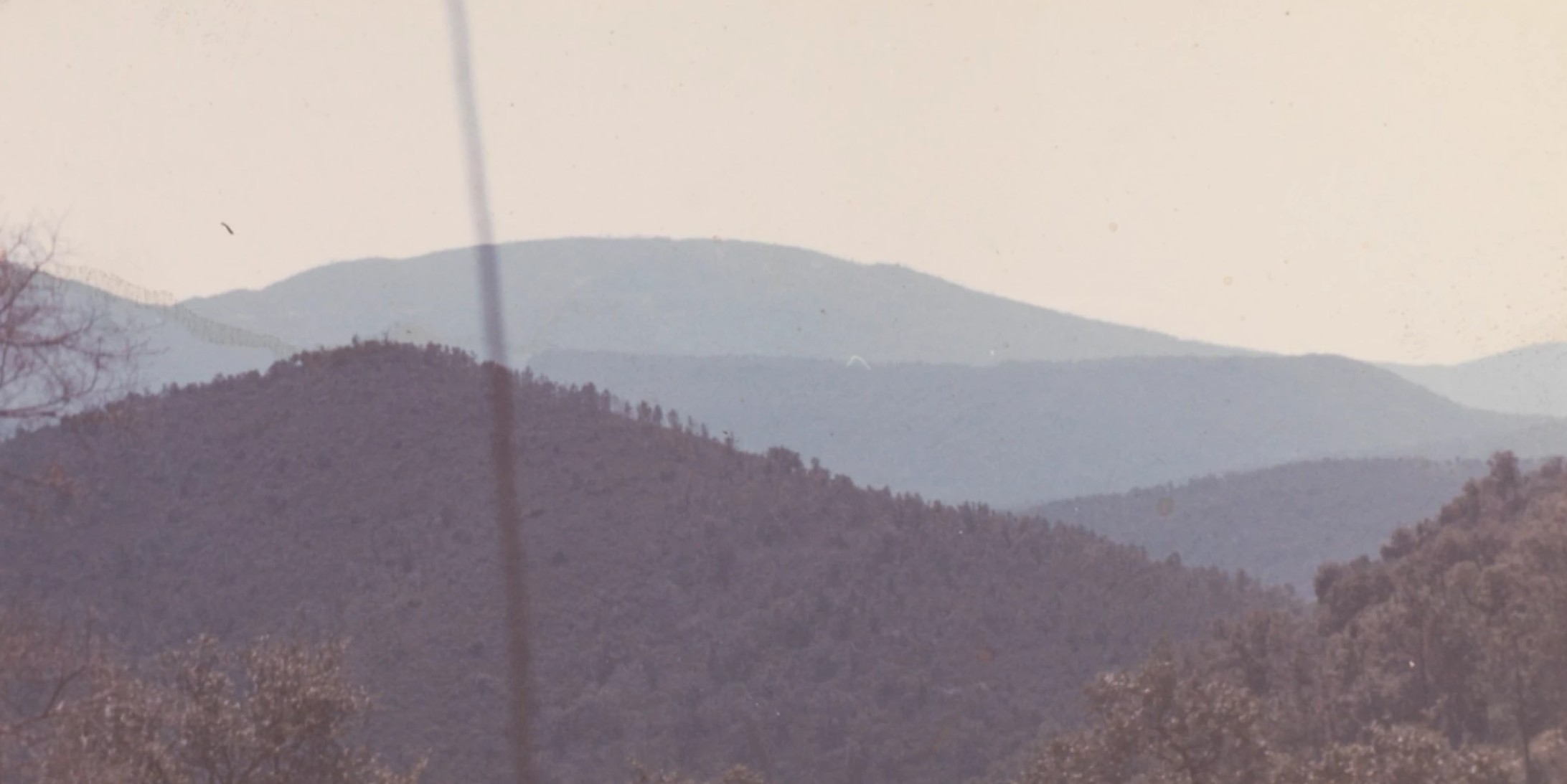
Reference photo taken by the artist in Le Nid Du Duc. Photo by David Hockney
Hockney traveled throughout the area around Richardson’s home and began to use photography in earnest, not merely for snapshots but for visual information that would help him with his compositions. He voraciously photographed the rolling hills and sparkling sea, the inspiration for the present work. The Côte d’Azur, long an artistic haven, had attracted painters like Pablo Picasso, Claude Monet, Paul Signac, and Henri Matisse, who were drawn by its luminous light. In the 1960s, it became a glamorous center for filmmakers, as the romantic backdrop for Alfred Hitchcock’s To Catch a Thief (1955) with Grace Kelly and Cary Grant, and was popularized by stars like Brigitte Bardot. In this birthplace of modern art and cinema, Hockney would also leave his mark. Following Hockney and Schlesinger’s tumultuous break-up in 1971, the present work’s setting became the setting for some of Hockney’s most profound and cathartic paintings, including Portrait of an Artist (Pool with Two Figures). Although, when The Valley (Mountains in Var, Near La Garde Freinet) was painted, the couple were very much in love.
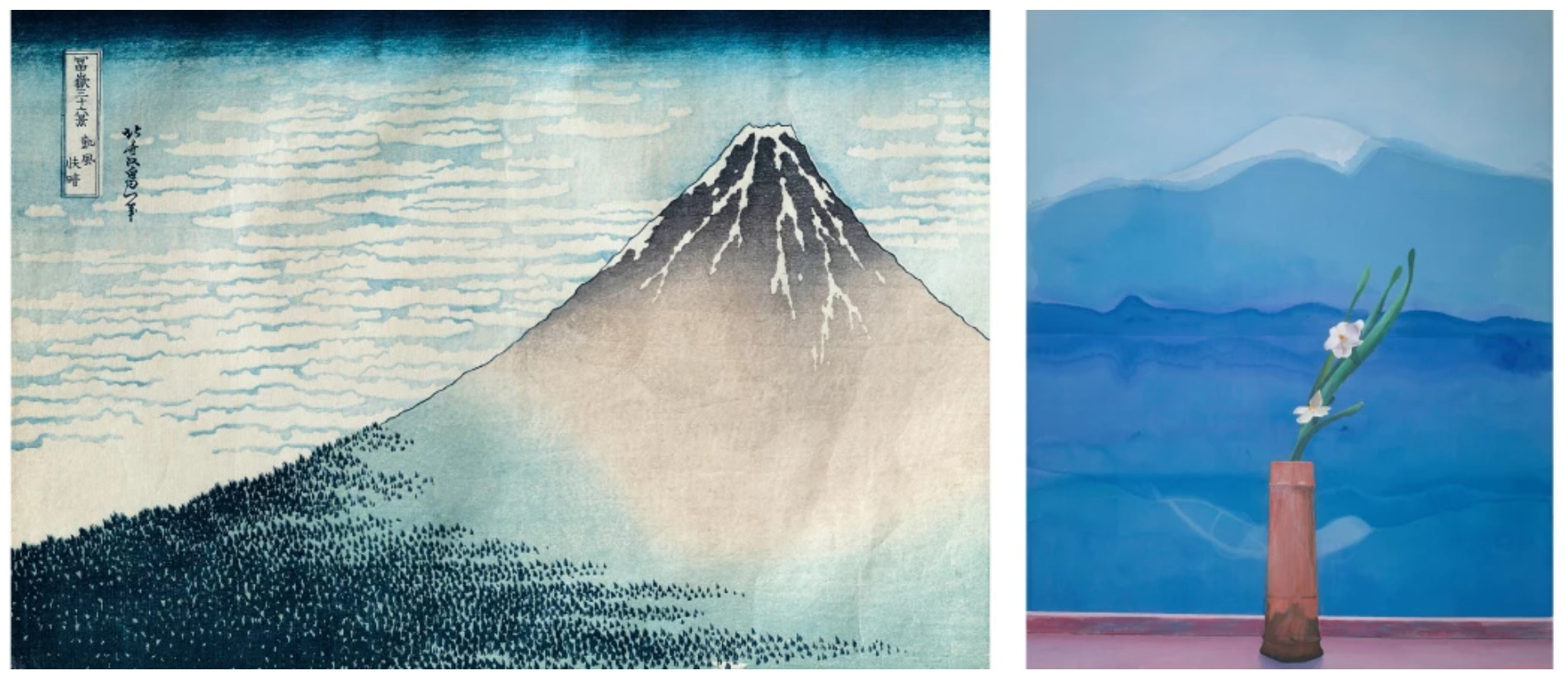
Left: Hokusai, Katsushika, Fuji in Clear Weather, 19th century. Musée Guimet, Paris. Image © Bridgeman Images.
Right: David Hockney, Mount Fuji and Flowers, 1972. The Metropolitan Museum of Art, New York. Image © The Metropolitan Museum of Art. Image source: Art Resource, NY
In The Valley (Mountains in Var, Near La Garde Freinet), the rolling mountains, rendered in subtle gradients of cobalt, are set against a vivid plum, contoured by lush, verdant foliage that captures the glistening light and shimmering perspectives of a sun-kissed day in the French landscape. Suffused with the optimism and tenderness of a summer’s day and an enchanting romance in a glorious setting, the present work captures that moment of intimacy and exhilaration with remarkable poignancy. Confronted with deeply pigmented forms of luscious foliage set against the elegant geometry of the almost abstracted landscape, we are transported to a space that is at once an aesthetically seductive and finely composed mise-en-scène: informed by photographic, cinematic, and art historical precedent, The Valley (Mountains in Var, Near La Garde Freinet) is a perfect expression of Hockney’s unique Pop dialect.