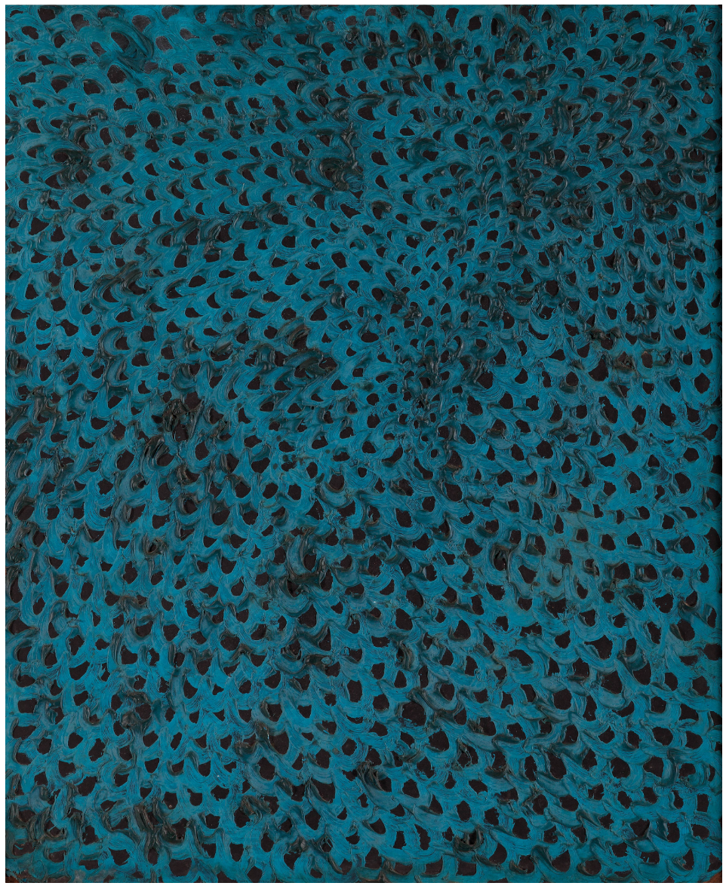
YAYOI KUSAMA
Nets Blue, 1960
Oil on board
51.8×41.9 cm (20.4×16.5 inches)
Signed, titled, inscribed and dated ‘KUSAMA 1960 NETS BLUE’ (on the reverse)
Provenance
Private Collection, Pennsylvania
Robert Miller Gallery, New York
Private Collection (acquired from the above in 2008)
Christie’s, Hong Kong, May 27, 2017, lot 1
Acquired at the above sale by the present owner
Auction History
Phillips New-York: 15 November 2022
Estimated: USD 2,500,000 – 3,500,000
USD 2,450,000
Yayoi Kusama – 20th Century & Conte… Lot 26 November 2022 | Phillips
REPEAT SALE
Christie’s Hong-Kong: 27 May 2017
Estimated: HKD 5,500,000 – 8,000,000
HKD 16,860,000 / USD 2,163,507
YAYOI KUSAMA (JAPAN, B. 1929) (christies.com)
Yayoi Kusama’s Nets Blue, 1960, is a striking, aquatic work from the artist’s signature Infinity Nets series. The artist paints a spiraling mesh of u-shaped, cerulean brushstrokes that completely envelop the black ground. The mesh is not uniform in direction or texture; it seems to whorl, clockwise, like a hurricane, with ridges of excess oil paint like rough waves on the surface. Nets Blue stands as brightly colorful net among Kusama’s early monochrome works, and her use of blue is also outstanding; the artist rarely painted any nets in blue until the 1980s-1990s. Grounded in the direct theory and influences of her initial Nets period from 1958-1962, Nets Blue’s blue-on-black vibrancy presages the colorful world of art that Kusama would build over the next six decades.
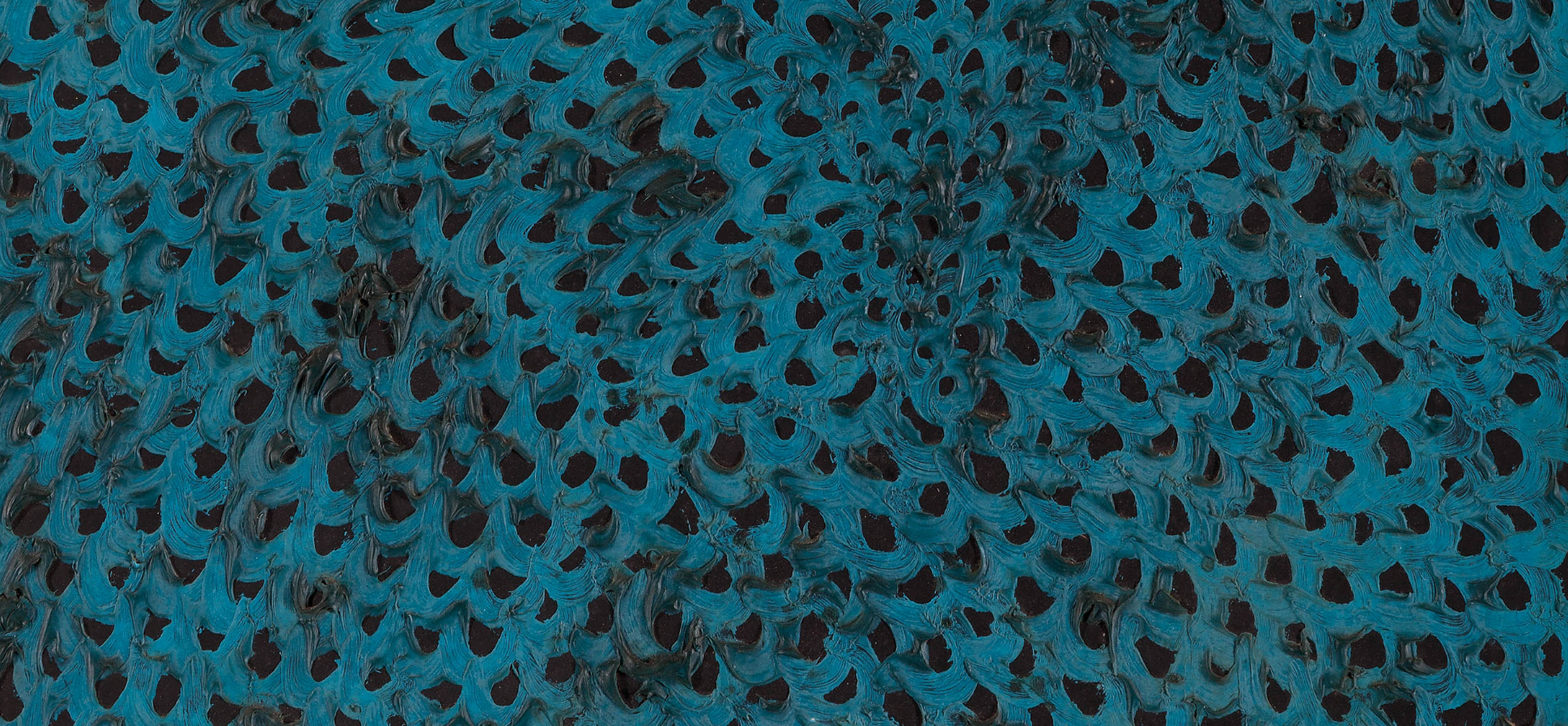
The work immerses the viewer in meditative repetitions of form, producing the sense of an infinite pattern that extends far beyond the confines of the frame. Rendered in an evocative aquatic cerulean blue, Kusama’s painstaking application of the tiny curved brushstrokes that structure the work generates a subtle spatial complexity. Variations in its patterning, here smaller black dots are clumped together, there they are larger and spread out, give the net of paint a natural texture and tactile contours, like a boundless bed of coral or an exotic marine plant. The longer we spend in front of these psychedelic, rippling lines of color, the more profound our sense of the work’s expansive endlessness becomes.
The infinity net is one of the essential visual and theoretical concepts in Kusama’s art practice. Constructed from repeated u-shaped brushstrokes, the net pattern expands from portions of canvases, such as A Flower with Nets, 1952-c. 1963, collection of the artist, to fill entire rooms, as at her 1961 exhibition at the Stephen Radich Gallery, where her Infinity Nets, thirty feet in length, covered the gallery’s walls, edge-to-edge and floor-to-ceiling, in a wallpaper of Kusama’s aesthetic fingerprints. In early nets, such as Nets Blue, the artist leans into the hand-drawn quality of her brushstrokes; the mesh of the net varies in size and texture, from thin loops to tactile areas of impasto. There is variation within the repetition, an artist’s hand at the center of the net.
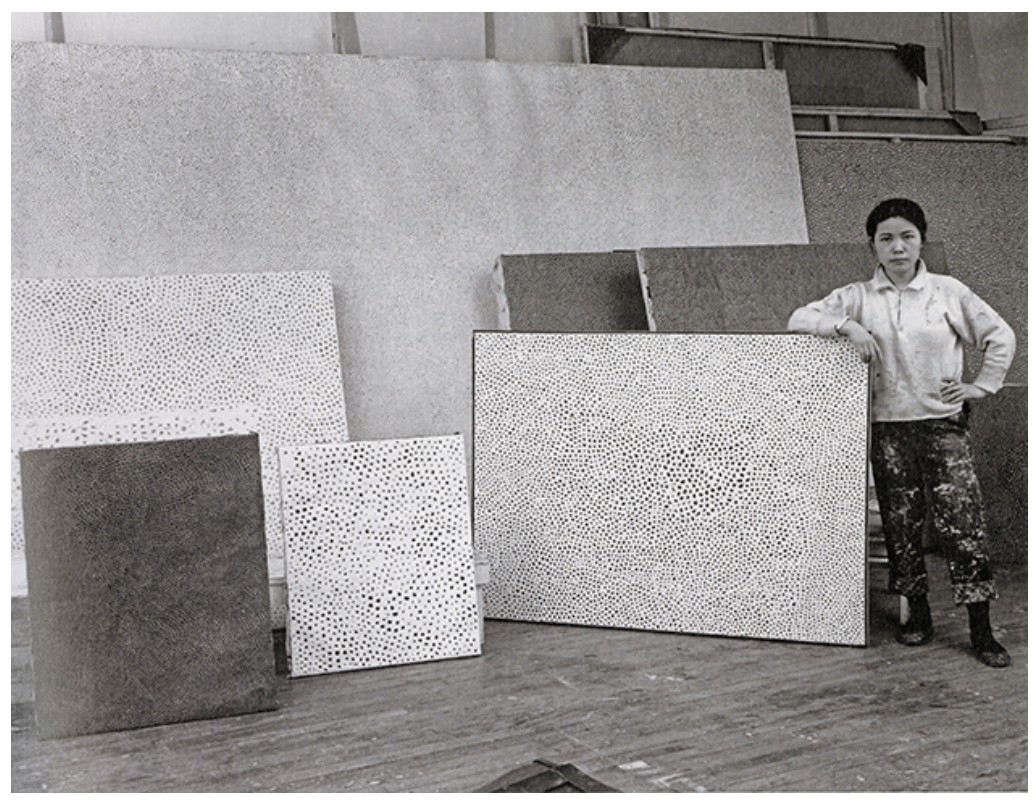
Yayoi Kusama with her Infinity Nets in her New York studio, c. 1960. Artwork: © YAYOI KUSAMA
Conceptually, the infinite net embodies an inherent contradiction: how can one put a net around infinity? Or, inversely, how can a net span infinitely? To encircle or extend infinitely is, by definition, an infinite task, and it is one that Kusama takes up, voraciously, initially from 1958-1962, and revisits again later in her career, in the form of the infinity net motif. Reflecting back on these early Nets paintings, Kusama recalls working on her canvases for forty or fifty hours at a time.
“I feel as if I were driving on the highways or carried on an (endless) conveyor belt… to my death… like continuing to drink thousands of cups of coffee or eating thousands of feet of macaroni.”
In other words, weaving an infinity net felt like moving, making, being, consuming, infinitely, both with and against her own will. The infinity net was life itself. Kusama’s source of inspiration for the infinity nets came from a major of change in her life: in 1957, she flew from Japan to the United States for the first time. She cites the view of ocean waves from the airplane as the visual origin of her nets. With Nets Blue, the blue-on-black color combination deepens the connection to Kusama’s inspiration. One can imagine looking out the window of an airplane, perhaps at night, and seeing an infinite abyss of blue-tinged-black below.
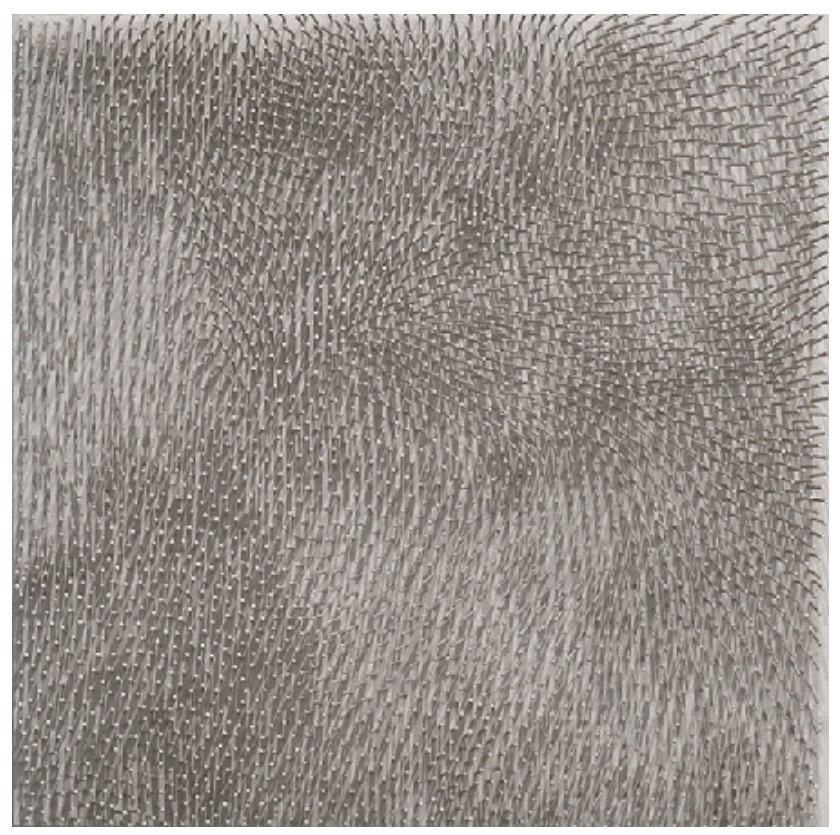
Günther Uecker, White Field, 1964. Tate Modern, London. Image: © Tate, London / Art Resource, NY
Artwork: © 2022 Artists Rights Society (ARS), New York / VG Bild-Kunst, Bonn
Another source of inspiration may have come across the ocean, in the form of the European avant-garde. Kusama’s works were more readily accepted in Europe than the United States in the 1960s, and the year 1960 marked the beginning of her relationship with artists in the German Group Zero, among others. Like Kusama, these artists were interested in repetitive visual motifs, and their pursuit of abstraction was motivated by theoretical conceptions of infinity, and infinity as a means of self-obliteration. With these guidelines Group Zero sought to create work that was “anti-metaphoric, non-relational, and empty of any reference except to itself.” For them, infinite self-obliteration meant removing the artist’s hand entirely. Kusama preferred to lose the hand in the waves.