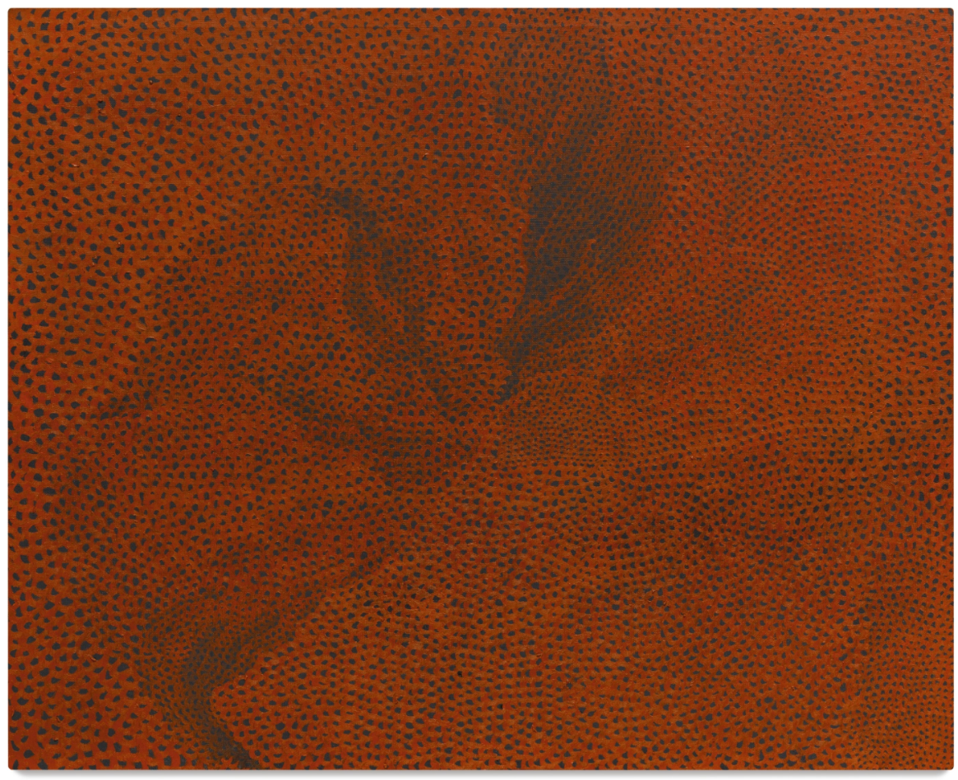
Lake Michigan, 1960
Oil on canvas
64.8×80 cm (25.5×31.5 inches)
Signed, titled and dated 1960 on the reverse
Provenance
Private Collection (acquired in 1960)
Private Collection (thence by descent)
Acquired by the present owner from the above
Sotheby’s New-York: 18 May 2017
USD 5,300,000
Source: Sotheby’s
(#2) Yayoi Kusama (sothebys.com)
Painted in 1960, Yayoi Kusama’s third year in New York City and the first in which she rendered her iconic Infinity Nets in red, Lake Michigan eloquently articulates the blazing passion and acute conceptual turmoil which fuels the artist’s extraordinary practice. Intricately complex and exquisitely beautiful, the present work is a superb early example of Kusama’s Infinity Net paintings, the artist’s largest and most celebrated body of work. Characterized by a remarkably rippling composition comprised of elegantly swirling undulations of Kusama’s trademark dots, unlike other all-over Infinity Nets the present work is unique in its direct visual allusion to crashing waves. Against the impenetrable depths of the black underpainting, Kusama’s labyrinthine web of tightly woven scarlet loops pulsates with a frenzied, obsessive energy, mimicking the expanding fields of color and pattern that inspire Kusama’s practice; as such, Lake Michigan is a highly personalized expression of Kusama’s desire to “lend specificity to infinity of space.” Examples from the esteemed handful of early Infinity Nets executed in 1959 and 1960 are held in renowned museum collections such as the Solomon R. Guggenheim Museum in New York, the Los Angeles County Museum of Art, and the Art Institute of Chicago, among other pre-eminent institutions.
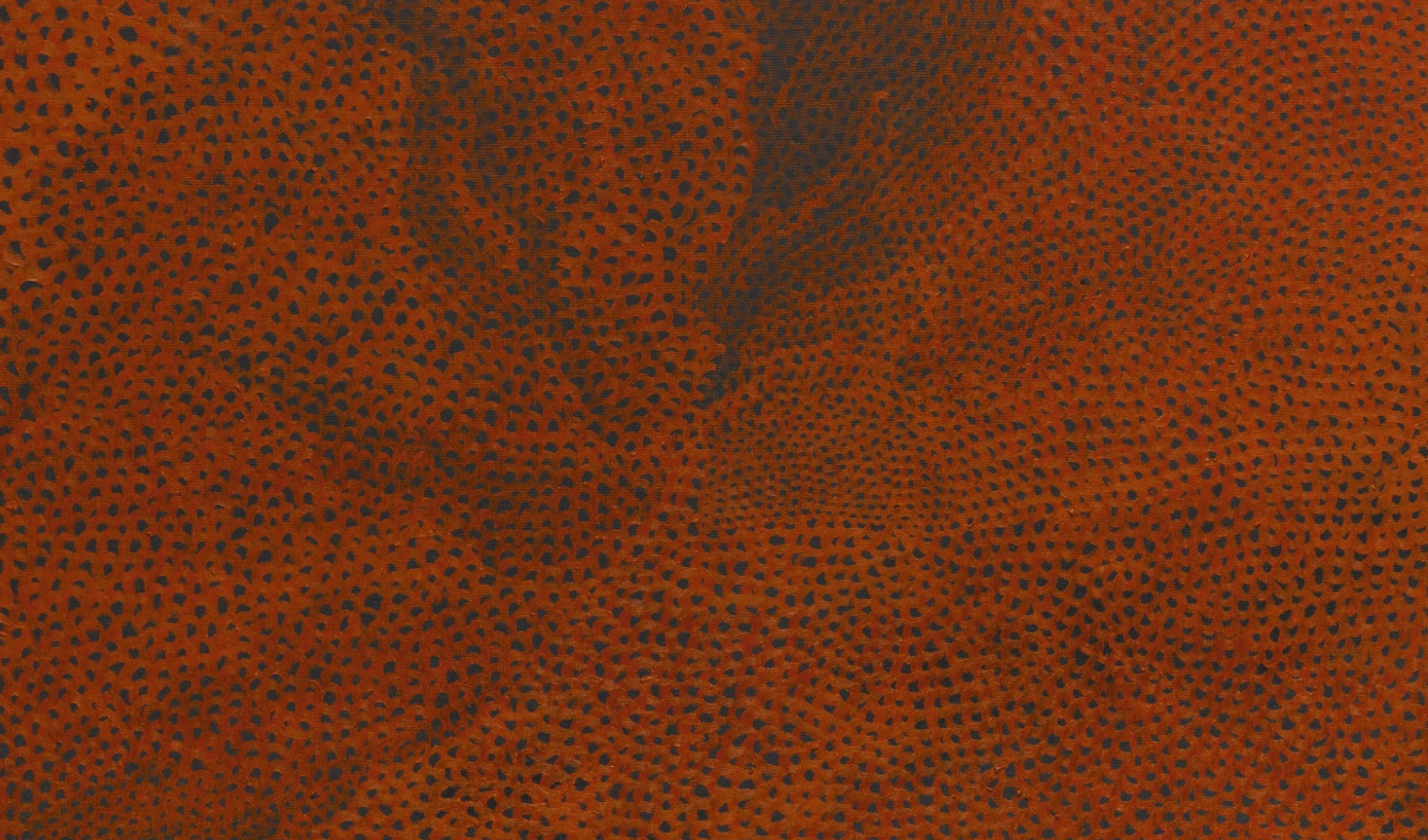
One of a small group of red Infinity Nets from 1960, the vibrant color of Lake Michigan constitutes a particularly intimate expression of the psychotropic visions which inspire and fuel Kusama’s unique abstraction. Diagnosed with obsessional neurosis, the artist has been haunted by hallucinatory visions of oscillating, kaleidoscopic patterns since her early childhood in Matsumoto City, Japan. Painted in the third year after Kusama’s arrival in New York, Lake Michigan is a stirring evocation of the intense passion, tremendous hardship, and remarkable creative vision which marked the first years of the artist’s practice in the United States. In late 1959, Kusama began to channel her psychosomatic visions and tendencies into the paintings that would form the beginning of the iconic Infinity Nets series. With a focus both obsessive and meditative, she moved across her canvas with precise, minute flicks of the wrist, carefully weaving the complex skein of overlapping loops which ripples and pulses across the surface of Lake Michigan. Her intensive artistic practice became her most effective form of self-therapy, a way of escaping her own mind by transcribing and enacting the infinite repetition which haunts her.
Within the small group of early Infinity Net paintings, Lake Michigan is distinguished as a particularly personalized and explicit reference to the origins of the iconic series. While the scarlet color of the present work intimately alludes to the hallucinations of Kusama’s childhood, the title of Lake Michigan is an unusual revelation of the conceptual antecedents to the Infinity Nets of 1959 and 1960. Remarking upon the basis for her acclaimed oeuvre, Kusama has revealed that the origin of the Infinity Nets lies in an earlier series of watercolors titled Pacific Ocean. Painted in 1958, the suite of smaller works was inspired by the infinite expanse of “shallow space” contained within the tiny wavelets of the Pacific Ocean, which Kusama glimpsed through her airplane window as she arrived in the United States. That sentiment is again referenced in the title of Lake Michigan, as Kusama’s undulating, mesmerizing pattern calls to mind the terrifying glimpse of infinity one experiences before a seemingly endless expanse of water. Indeed, standing before Lake Michigan, surrounded and absorbed by the interminable expanse of minute marks, the viewer experiences a momentary and intimate glimpse of the brilliant, complex, and tortuously infinite mind of Yayoi Kusama.