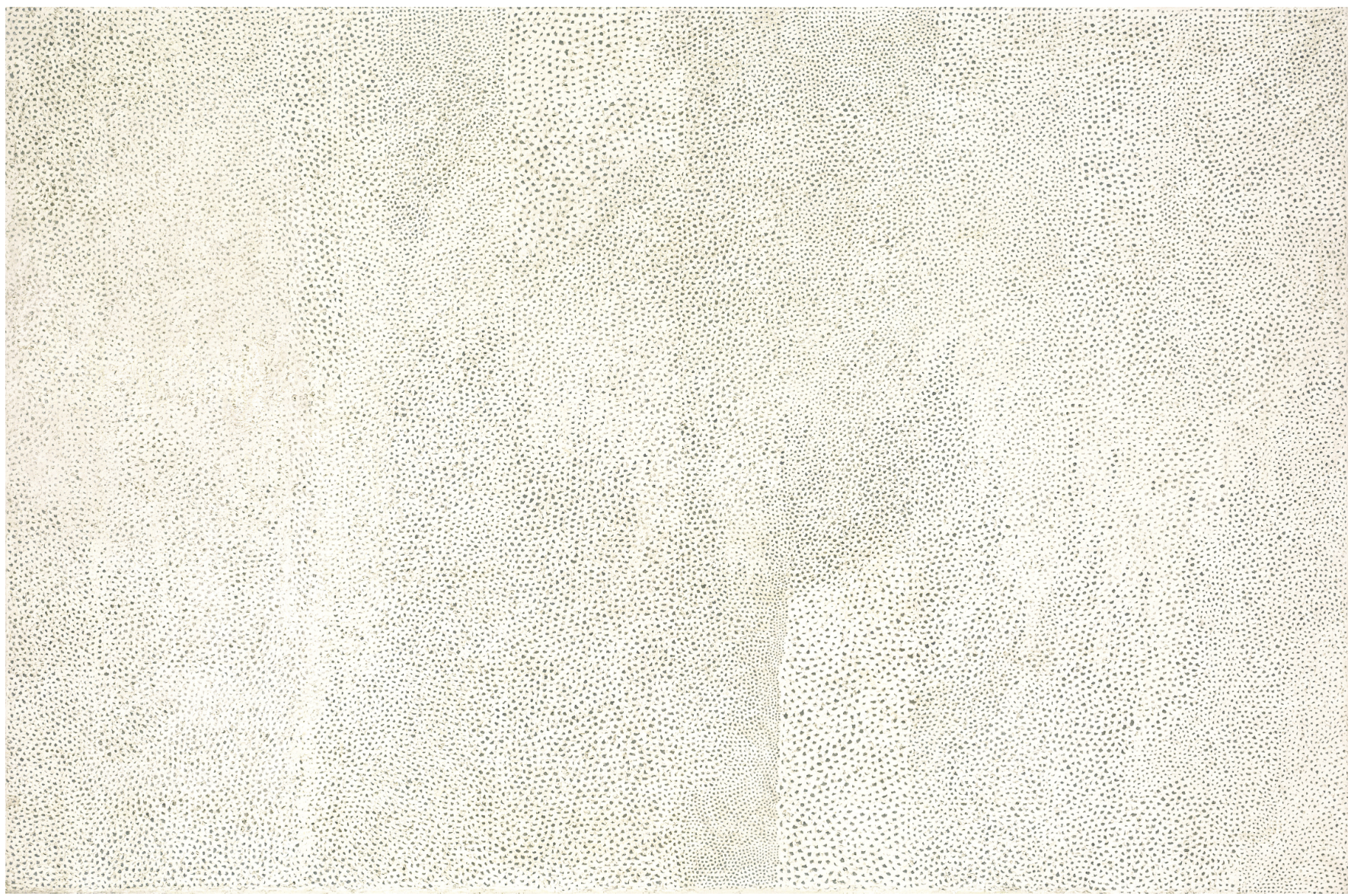
No. 2, 1959
Oil on canvas
182.9×274.3 cm (71.7×108 inches)
Signed, titled and dated ‘YAYOI KUSAMA 1959 No. 2’ (on the reverse)
Provenance
Donald Judd, New York
Paula Cooper Gallery, New York
Acquired from the above by the present owner
Christie’s New-York: 11 November 2008
USD 5,792,000
Source: Christie’s
Yayoi Kusama (b. 1929) (christies.com)
The Infinity Nets of 1959 are hypnotic monochrome paintings that Yayoi Kusama created soon after her arrival in New York, the first step in a highly original artistic career that has made her the most highly renowned post-war artist from Japan. This series of paintings proved to be extremely prescient, as it not only encapsulated the seed of Kusama’s signature style for the next five decades but also presaged crucial elements of the influential Minimalist movement. No. 2 of 1959, with its undulating lattice of pure white paint, is one of the very first examples of Kusama’s Infinity Net series. Through the repetitive technique that she characterizes as “obsessional,” Kusama’s No. 2 envelops the viewer in a shimmering web that paradoxically radiates both a meditative calm and a dizzying restlessness.

The seemingly infinite field of dots that fills No. 2 would remain an important motif in Kusama’s work for many decades. She applied the dot motif to many sculptures, as well as the objects in her pioneering installations, and even to the bodies of the nude performers who took part in her infamous happenings in the 1960s although this repetitive accumulation of pattern always reflected her own interior state above all. As Kusama described in 1964, “My nets grew beyond myself and beyond the canvases I was covering with them. They began to cover the walls, the ceiling, and finally the whole universe. I was always standing at the center of the obsession, over the passionate accretion and repetition inside of me” (Y. Kusama, quoted in Yayoi Kusama, p. 103). Although she subsequently produced Infinity Net paintings in a variety of different colors, the white Infinity Nets of 1959 arguably remain the most subtle in their visual effects, while also evoking the optimistic and futuristic aspirations of Kusama at the dawn of the 1960s.