DAVID HOCKNEY
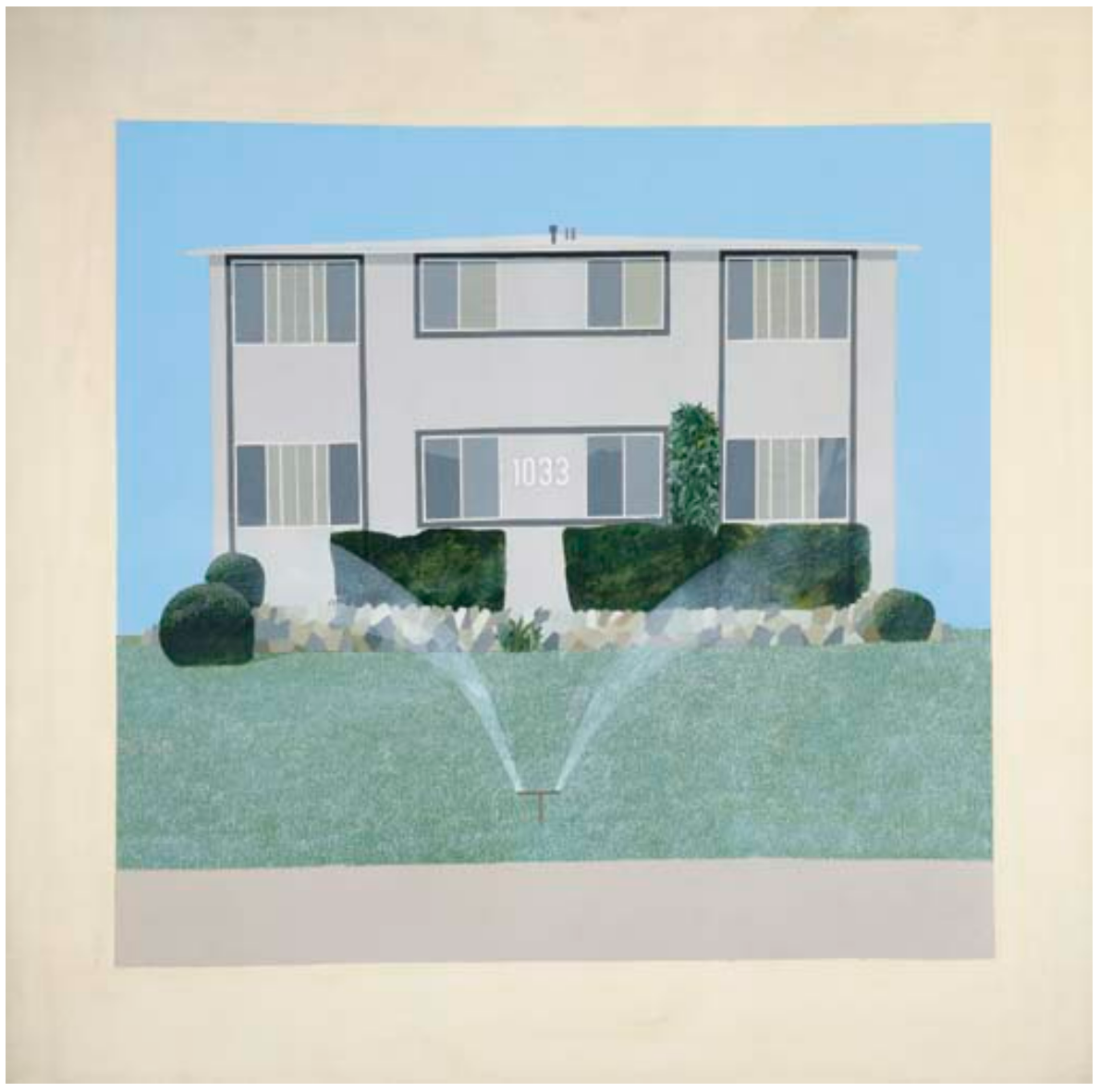
A Neat Lawn, 1967
Oil and acrylic on canvas
96×96 inches (243.9 x 243.9 cm)
Provenance
Kasmin Limited, London
Galerie Rudolph Springer, Berlin
Mr. and Mrs. G. Webb, London
Sotheby & Co., London, December 4, 1974, lot 66
Galerie Meyer-Ellinger, Frankfurt
Private Collection
Sotheby’s, London, December 1, 1988, lot 680
Private Collection (acquired at the above sale)
Christie’s, New York, May 9, 2006, lot 42
Acquired at the above sale by the present owner
Phillips New-York: 23 June 2021
USD 11,000,000
Source: Phillips
David Hockney – 20th Century & Contempo… Lot 13 June 2021 | Phillips
Belonging to a series of monumental canvases painted in 1967, David Hockney’s A Neat Lawn is a seminal example of the artist’s California Dreaming paintings. Here, Hockney presents a Los Angelesian house set against bright blue sky with a perfectly tended lawn nurtured by a sprinkler, the spewing spindrifts offering the only indication of movement in this otherwise static scene. A Neat Lawn demonstrates one of Hockney’s first sustained experimentations on the dynamics of light and water, as exemplified in the strong shadows cast by the eave and across the hedges as well as the glistening blades of grass. Hockney recalled, “for the first time it became an interesting thing for me, light.”i A Neat Lawn was first shown alongside A Bigger Splash and A Lawn Sprinkler in 1968 at the artist’s sensational solo exhibition at Kasmin Gallery, London, a pivotal show that brought him to international acclaim.
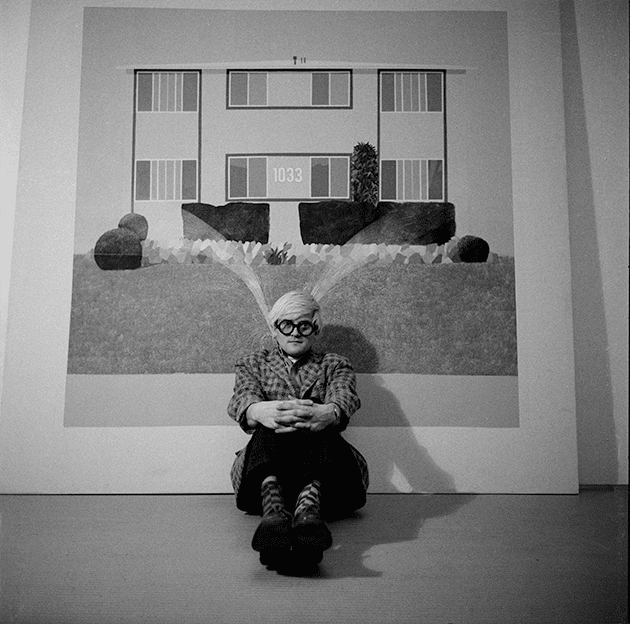
Hockney took his first trip to Los Angeles in 1964 and was immediately enthralled with the sunlight, pools, and glitz and glamor of the city he had only thus far experienced through magazines and film. However, it was not until 1967 when teaching a graduate course at the University of California in Berkeley that Hockney was afforded the opportunity to celebrate his muse-city on an epic scale. Weekending in Los Angeles, where he was living on Pico Boulevard with his partner Peter Schlesinger, Hockney stayed in Berkeley during the week, where he was offered a studio on the university grounds. “In Berkeley they gave me a very large proper studio…It was the first time I’d ever had a proper studio with a north light.”ii It was here that Hockney embarked on his most ambitious California pictures to date, as the space and light allowed Hockney to endeavor on the largest canvases he had so far attempted, including the present work, A Bigger Splash, and The Room, Tarzana. Indeed Hockney recalled, “[In 1967] I painted more pictures than I’d ever done before….it was certainly the happiest year I spent in California.
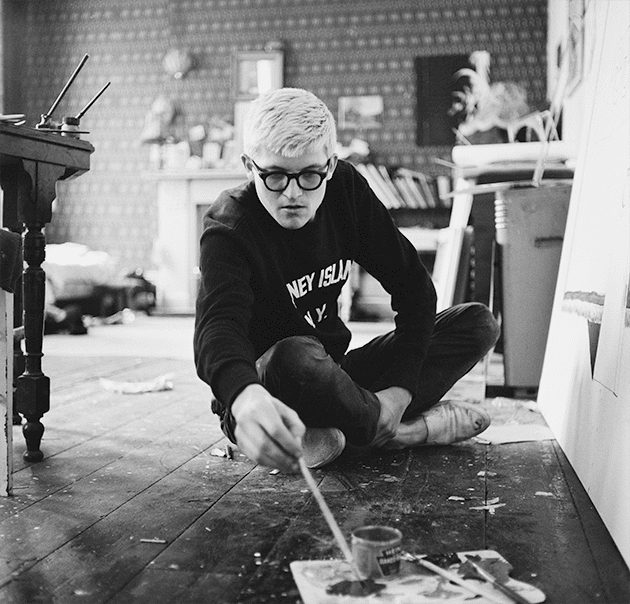
In A Neat Lawn, the ostensible subject of Hockney’s gaze is a modest structure typical of the suburban middle-class neighborhoods located on 1033 South Bedford Street—just blocks away from Hockney’s home at the time. “As the climate and the openness of the houses reminded me of Italy,” Hockney expressed, “I borrowed a few notions from Fra Angelico and Piero Della Francesca.”iv Exemplifying the artist’s earliest investigations into coalescing his enchantment with the suburban landscape and lifestyle, A Neat Lawn elevates the mundane to the monumental, transforming the shallow front yard of the property into a grand lawn and supersizing the innocuous structure to the majestic proportions of his sensibility.
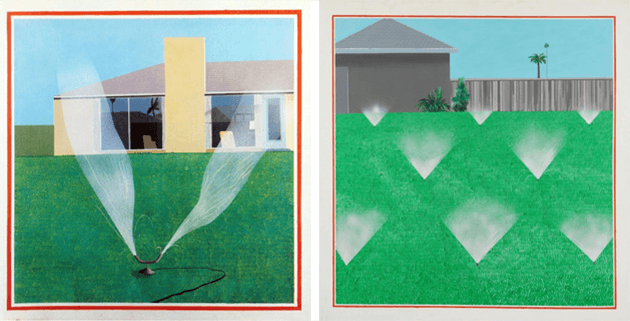
left] David Hockney, A Lawn Sprinkler, 1967. Artwork: © David Hockney
[right] David Hockney, A Lawn Being Sprinkled, 1967. Museum of Contemporary Art, Tokyo, Artwork: © David Hockney
At the time Hockney created A Neat Lawn, he was preoccupied with capturing the fleeting movement of water, a recurring feature of his work from this period. He expressed, “I loved the idea, first of all, of painting like Leonardo, all his studies of water…And I loved the idea of painting this thing that lasts for two seconds.”In an interview reflecting on Hockney’s 1968 show at his gallery, John Kasmin recalled how this fascination manifested in A Neat Lawn, “[It was] painted in and the result of David’s living in Los Angeles, and being impressed by the treatment of the lawns in that dry area and sprinklers being everywhere. I think it probably was the first time he’d noticed lawn sprinklers.”vi In the present work, Hockney channeled his newfound captivation for lawn sprinklers as Kasmin described through his engrossment with depicting water as a formal endeavor. In the artist’s words, “I had become interested in the more general problem of painting the water, finding a way to do it. It is an interesting formal problem, really, apart from its subject matter; it is a formal problem to represent water, to describe water, because it can be anything…