 DAVID HOCKNEY
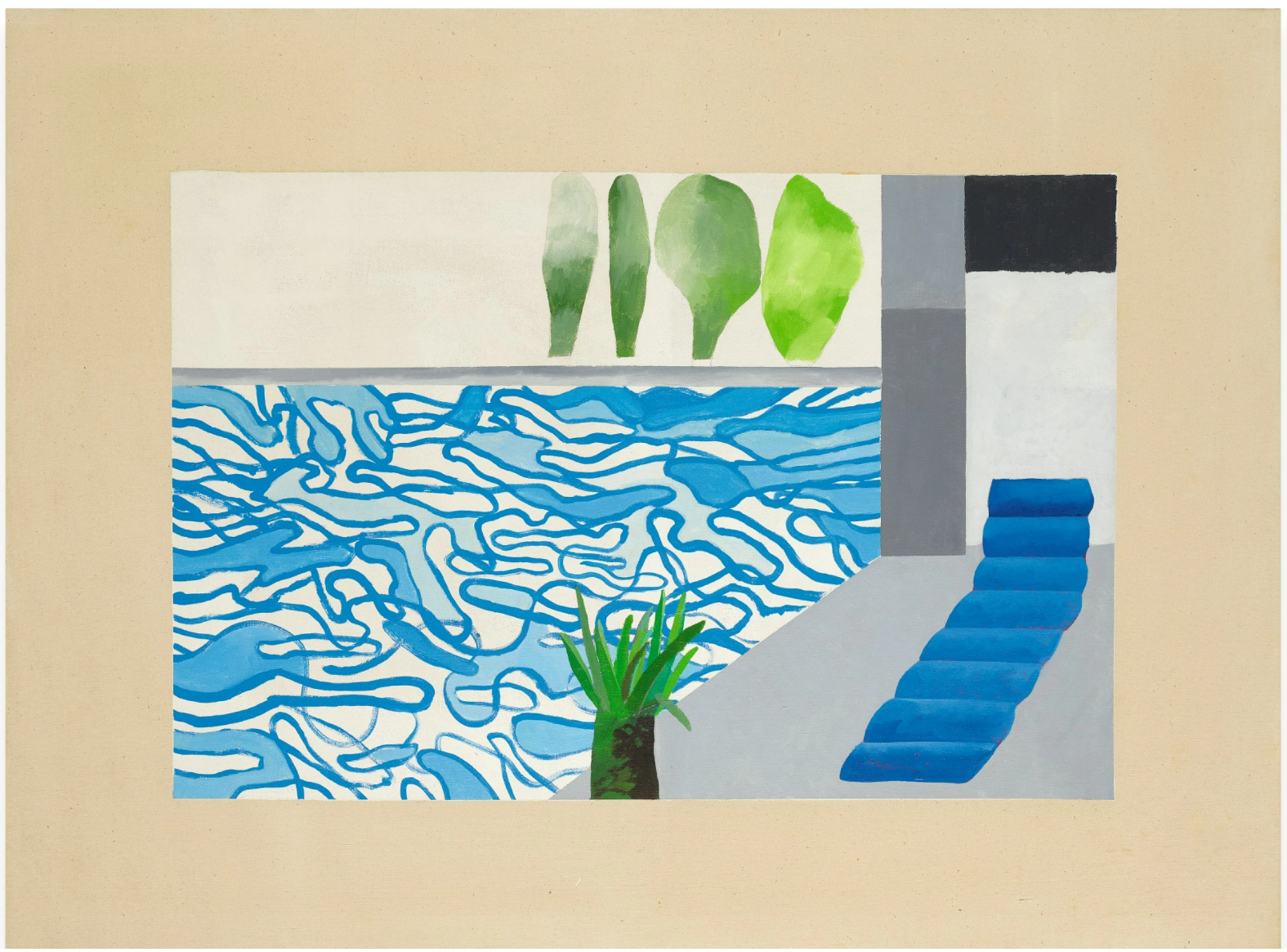
Picture of a Hollywood Swimming Pool, 1964
Acrylic on canvas
36.1 x 48.1 inches (91.8 x 122.2 cm)
Kasmin Gallery, Ltd., London
Sir Robert Adeane, O.B.E., London (acquired by 1970)
The Mayor Gallery, London
Knoedler & Co., London
Stanley J. Seeger, Great Britain (acquired from the above in May 1980)
Sotheby’s New York, The Eye of a Collector: Works from the Collection of Stanley J. Seeger, May 8, 2001, Lot 30 (consigned by the above)
Acquired by the present owner from the above
Sotheby’s New-York: 14 November 2019
Estimated: USD 6,000,000 – 8,000,000
USD 7,211,900
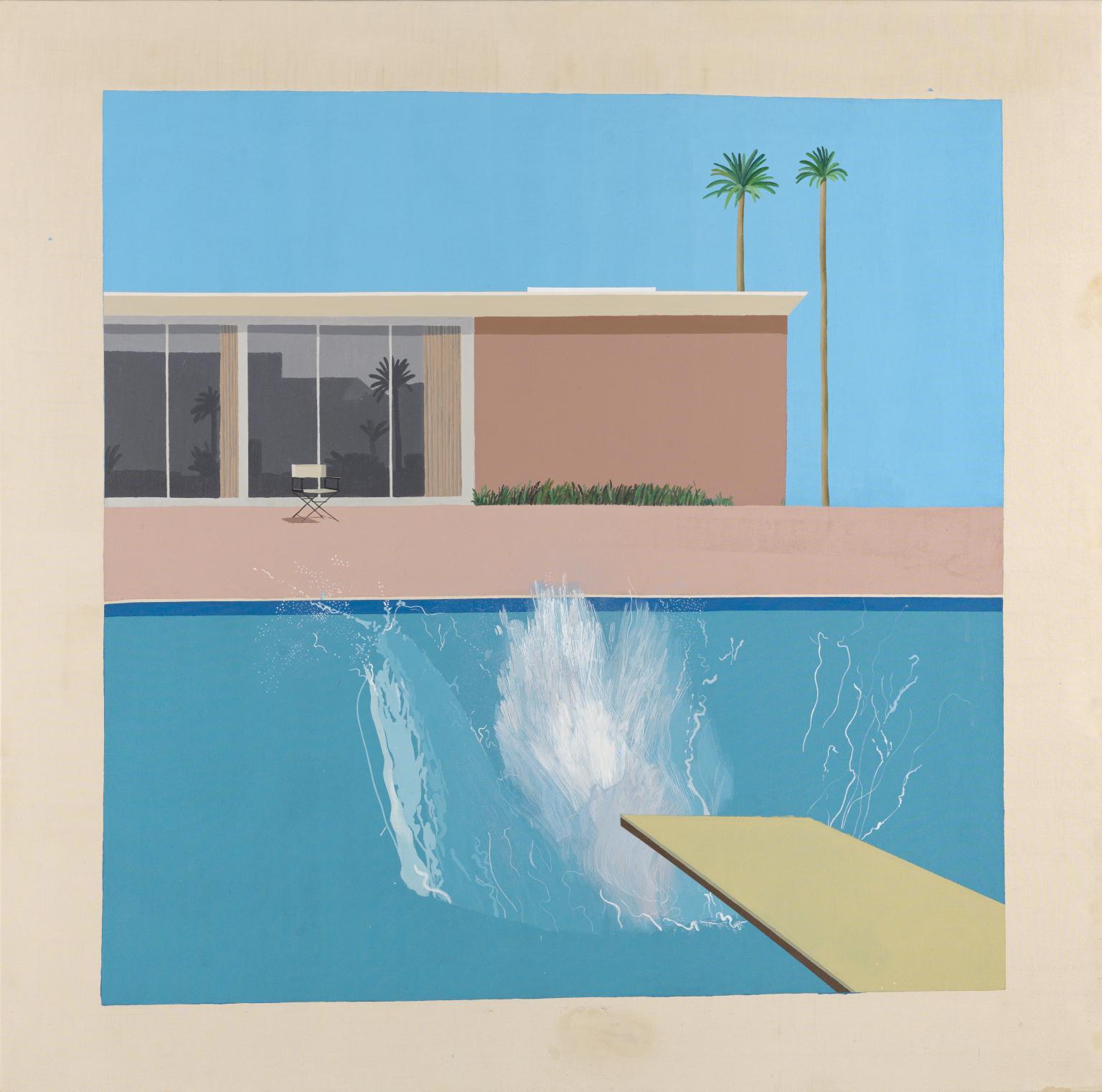
“And then I came back to England near Christmas in 1964 and the first thing I did was Picture of a Hollywood Swimming Pool, from a drawing. I painted it in England. The method of depicting water was influenced by the later abstract paintings of Dubuffet and Bernard Cohen’s spaghetti pictures. I thought, here is a way to do water. The idea of leaving a border of virgin canvas round the image was, in retrospect, a timid one. It makes the picture look more like a painting (you’re even less likely to trip up and fall into the pool), which was an essential premise in advanced painting at that time.”
Hockney’s characteristic flattening and tilting of space in the present work plunges the viewer into his remembered experience, enveloping us in the calm pool-side atmosphere. Hockney’s brilliant use of line and perspective creates a vertiginous drop, such that the viewer does feel as if he or she has walked out onto the warm pool deck and can peer over the edge into the rippling water. A leafy green plant – a signature Hockney motif – bursts from its brown pot, which has been strategically cropped at the edge of the image, refusing the viewer any shallow pictorial space. Throughout his career, Hockney has returned to the insertion of plants and flowers in his paintings – a nod to the most significant and beloved subject matter for artists as disparate as Dutch master Ambrosius Bosschaert and Impressionist master Vincent van Gogh. Aside from anchoring Picture of a Hollywood Swimming Pool in an art historical context, the planter here acts as stand-in for the viewer, gaining an autonomy and independence as an object all its own. The dark blue lounge chair, comprising stylized rhomboid forms and thrusting outward, also acts as a proxy for a person; in the artist’s own words: “I’ve always loved chairs; they have arms and legs, like people…They’re not just empty chairs.” (The artist quoted in Martin Bailey, “What Hockney Thinks of van Gogh,” The Art Newspaper, October 9, 2015, n.p.) Hockney’s use of plant and chair within this flattened space speaks to the artist’s early work as a set designer, and illustrates a profound engagement with the grander tradition of still life painting.
Loops and puddles of blue and white paint undulate over the canvas in a tangled weave that, while remaining stylized, immediately evokes the shimmering surface of a pool whilst nodding to contemporary styles. Of the present work, Marco Livingstone writes: “There are two important features which save Hockney’s work from becoming too drily pedagogic in its demonstration of twentieth-century pictorial devices. One is the wit with which Hockney charges his stylistic references through a change of context. The curvilinear surface pattern of Picture of a Hollywood Swimming Pool, for instance, refers to Dubuffet’s new hourloupe paintings, to abstracts by Bernard Cohen in which a looped line establishes a continuous movement across the picture, and to the arabesques of Art Nouveau (one of Cohen’s own sources), but it succeeds despite the weight of reference because of the convincing way in which it evokes water in movement.” (Marco Livingstone, David Hockney, New York, 1996, p. 72) These sinuous curls and twisting lines also prefigure the calligraphic and rhythmic compositions of Brice Marden’s Cold Mountain paintings, and the thunderous crimson crests and roaring riptides of Cy Twombly’s legendary Bacchus series.
Picture of a Hollywood Swimming Pool marks a critical juncture in Hockney’s technique, in which he began exploring the possibilities afforded by different media, most notably acrylic paint and cameras. In contrast to the pliability and wetness of oil paint, plastic-based acrylic paint dried quicker and produced a more flattened finish – much like a photograph. Up to this point, Hockney’s choice to use oil paint was as much stylistic as intellectual; it was in 1964 that he took stock of his early 1960s paintings and realized that his use of oil paint built thickly onto his canvases reflected the works of his Abstract Expressionist forebears, such as Willem de Kooning. By making a conscious effort to flatten his surfaces through the use of thinly applied and quick-drying acrylic paint, Hockney shifted the focus of his paintings from the paint itself to the image – an emphatic rejection of the previous generation’s insistence on materiality. The second stylistic change that spurred the present work was color film, which Hockney began using in his Polaroid camera in 1964. The framing device of the Polaroid prints, with the border surrounding the colored image, inspired Hockney’s later compositional choices, first employed in the present work; Hockney notes: “I used borders around an image a lot, from about 1964 to 1967. This wasn’t just a framing device. It started off as a formal device. I think the first one where the real painted picture is within the border was Picture of a Hollywood Swimming Pool in 1964. By 1967 I’d realized that the reason I was using the border was that the pictures had become more fully pictorial; it was a kind of concession to current art.” (The artist in Nikos Stangos, David Hockney by David Hockney, New York, 1977, p. 125)
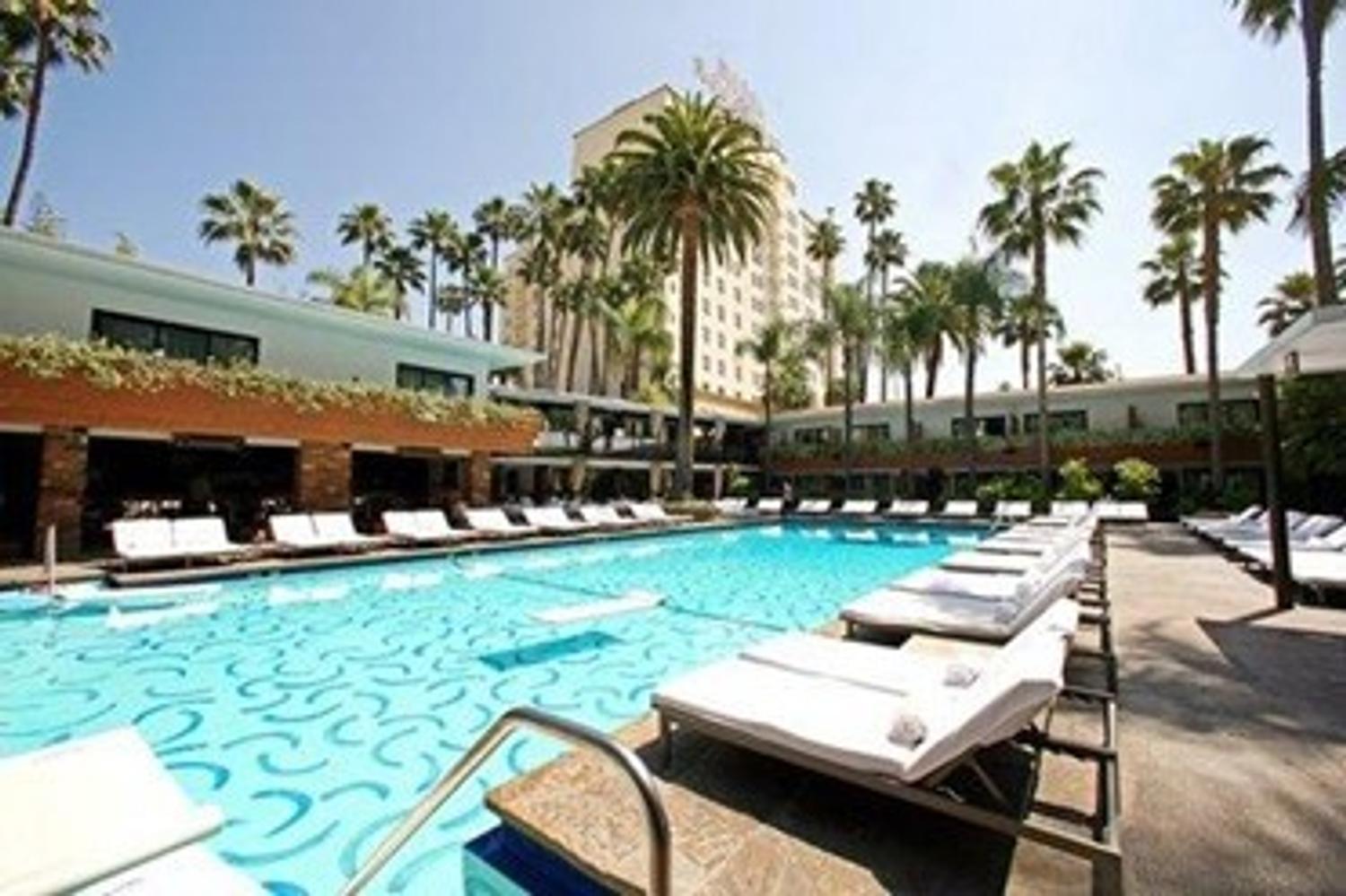 The Pool at Hollywood Roosevelt Hotel
Although the first pool painting of many to come, Picture of a Hollywood Swimming Pool bears all the hallmarks of later masterpieces; flattening space and perspective, Hockney creates a stage across which he choreographs this vivid remembered experience – an experience that would transform his entire body of work. Even today, after decades of producing continually inventive paintings, Picture of a Hollywood Swimming Pool remains a stunning testament to Hockney’s artistic prowess.