Auction Results
# 1. Untitled, 1982
Sotheby’s New-York: 18 May 2017
Estimated: USD 4,000,000 – 6,000,000
USD 6,537,500
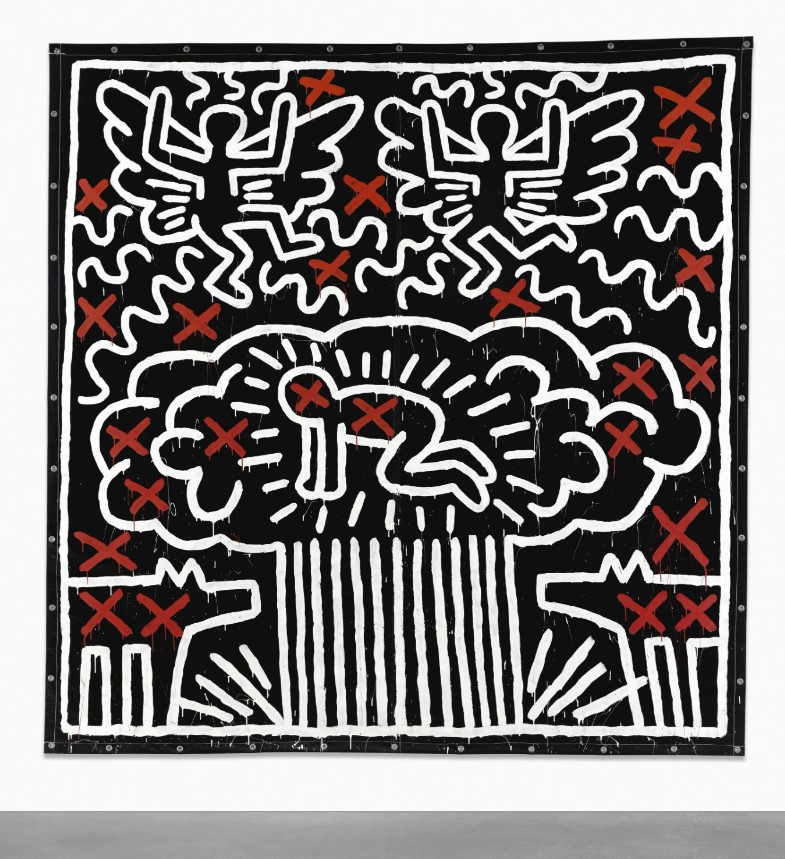
KEITH HARING
Untitled, 1982
Acrylic on vinyl tarpaulin with metal grommets
121 1/2 x 118 3/4 inches (308.6 x 301.6 cm)
#2. Untitled, 1984
Christie’s London: 29 June 2021
Estimated: GBP 3,900,000 – 4,500,000
GBP 4,301,250 / USD 5,938,492
KEITH HARING (1958-1990) (christies.com)
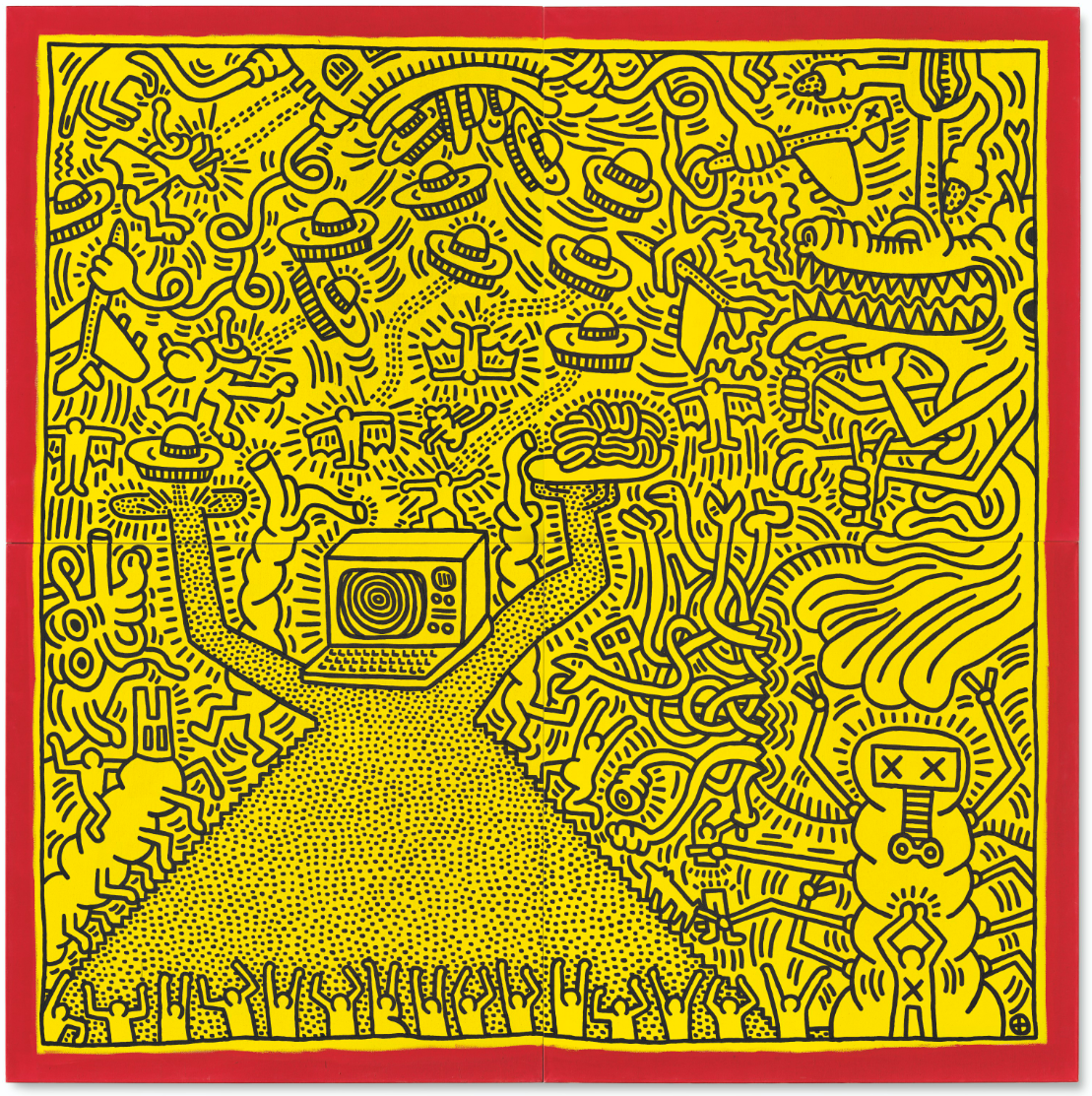
KEITH HARING
Untitled, 1984
Acrylic on canvas, in four parts
Each: 60×60 inches (152.4 x 152.4cm)
Overall: 120×120 inches (304.8 x 304.8cm)
#3. Untitled, 1982
Christie’s New-York: 17 November 2022
Estimated: USD 4,000,000 – 6,000,000
USD 5,820,000
KEITH HARING (1958-1990) (christies.com)
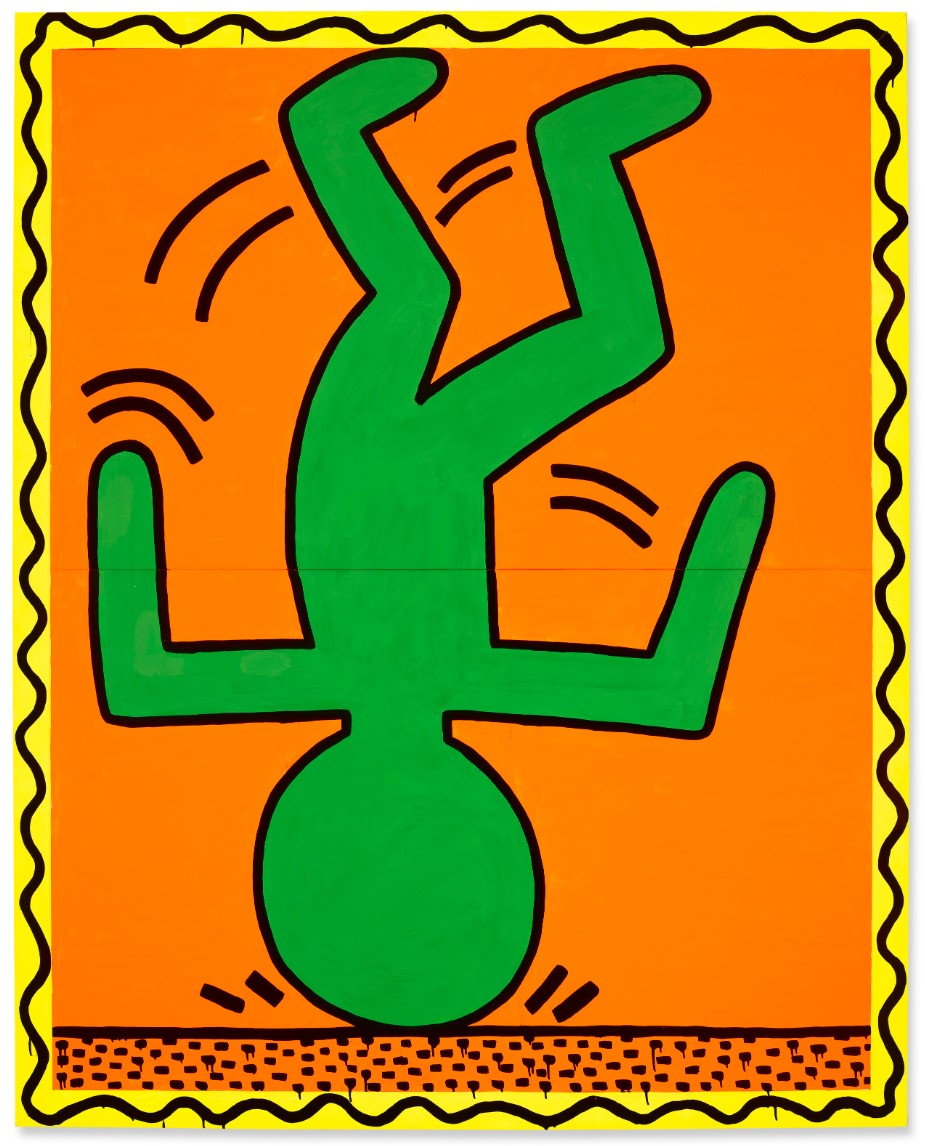
KEITH HARING (1958-1990)
Untitled, 1982
Enamel and DayGlo on metal, in artist’s painted frame
90 1/4 x 72 inches (229.2 x 182.9 cm)
#4. Untitled, 1986
Sotheby’s New-York: 12 May 2021
Estimated: USD 4,000,000 – 6,000,000
USD 5,779,200
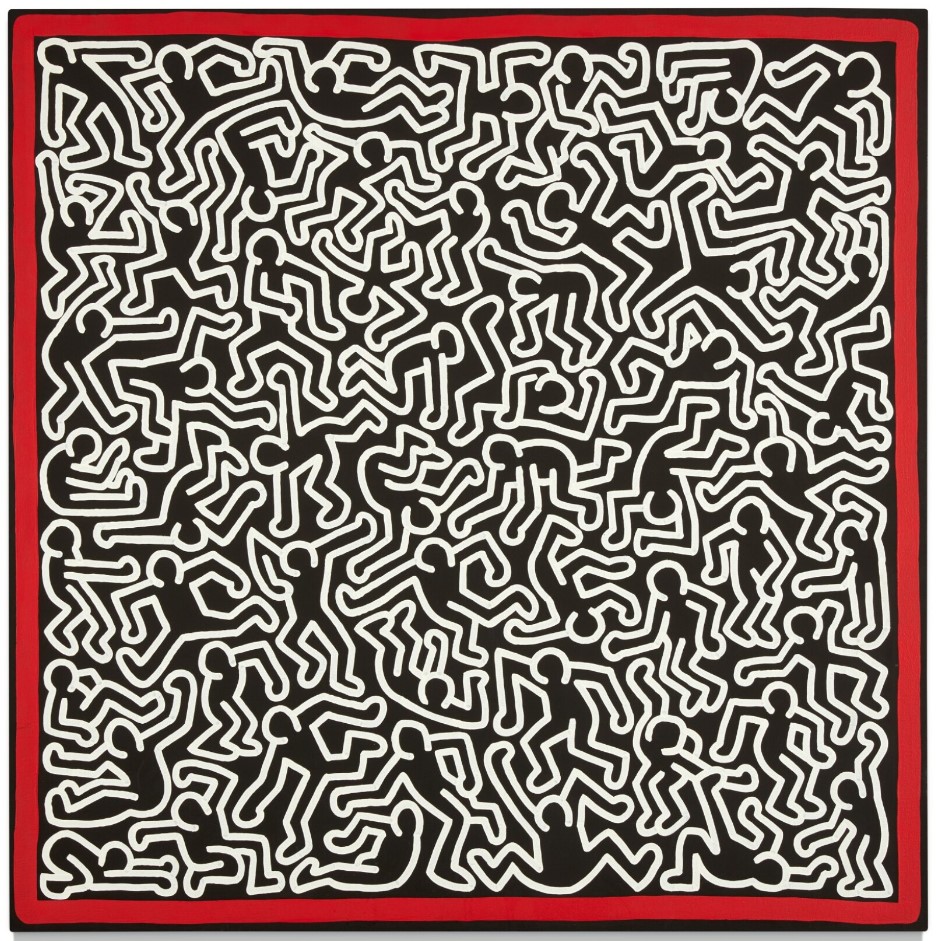
KEITH HARING (1958 – 1990)
Untitled, 1986
Acrylic on canvas
60×60 inches (152.4 x 152.4 cm)
Signed and dated JAN. 22 1986 on the overlap
#5. Silence = Death, 1988
Christie’s New-York: 15 May 2019
Estimated: USD 4,500,000 – 5,500,000
USD 5,609,500
Keith Haring (1958-1990), Silence = Death | Christie’s
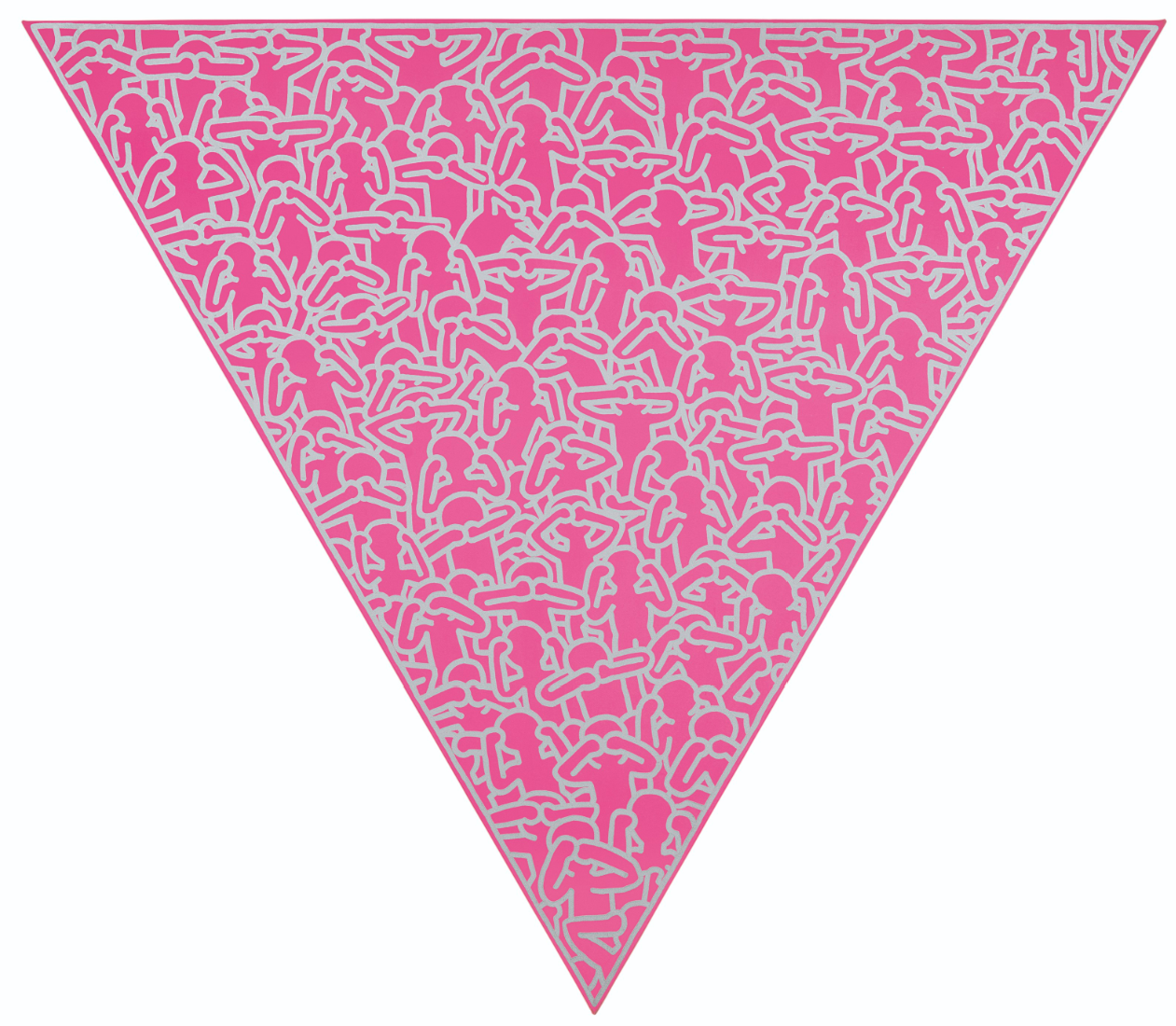
KEITH HARING (1958-1990)
Silence = Death, 1988
Acrylic on canvas
108×120 inches (274.3 x 304.8 cm)
Signed, titled and dated ‘SILENCE = DEATH ©K. Haring SEPT. 11 – 88’ (on the overlap)
#6. The Last Rainforest, 1989
Sotheby’s London: 28 June 2016
Estimated: GBP 2,000,000 – 3,000,000
GBP 4,181,000 / USD 5,513,503
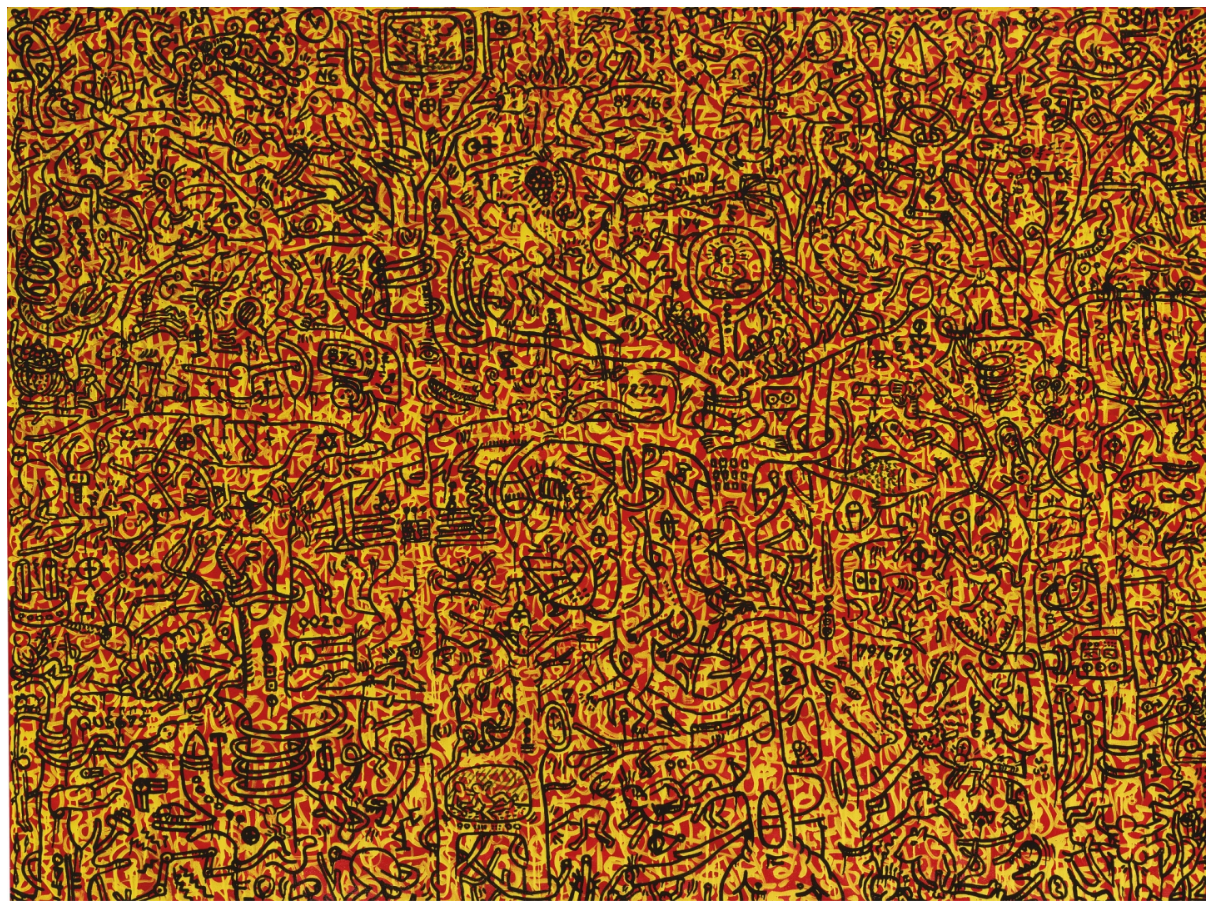
KEITH HARING
The Last Rainforest, 1989
Acrylic and enamel on canvas
71 3/4 x 95 1/3 inches (182.2 x 242.6 cm)
#7. Untitled (Acrobats), 1982
Sotheby’s New-York: 8 December 2021
Estimated: USD 1,800,000 – 2,500,000
USD 5,491,950
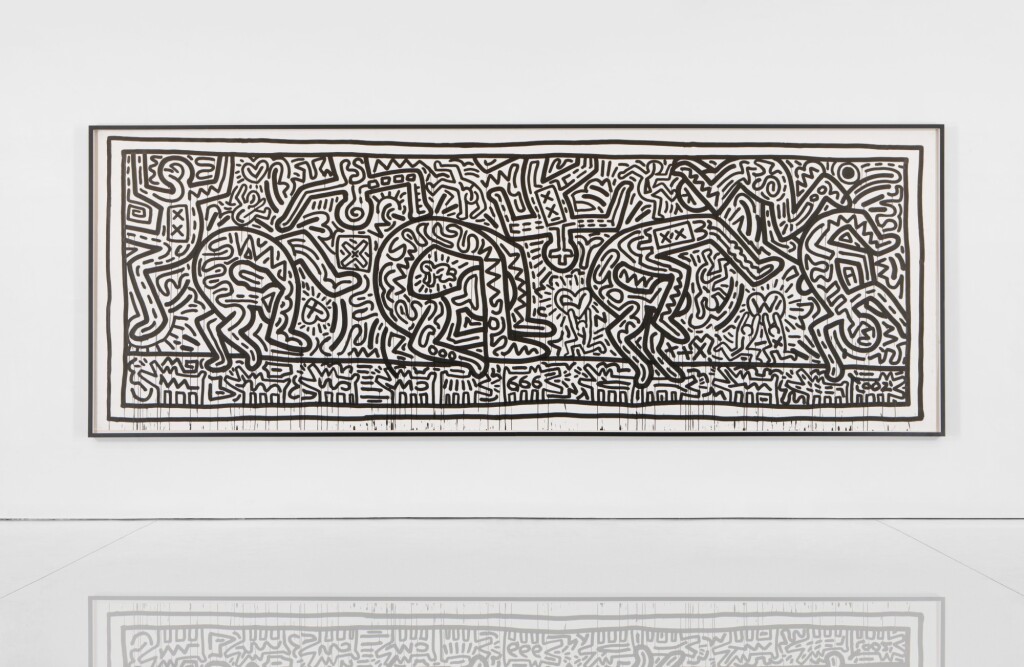
KEITH HARING
Untitled (Acrobats), 1982
Sumi ink on paper mounted to canvas
72×192 inches (182.9 x 487.7 cm)
USD 5 million
#8. Untitled (September 14, 1986)
Sotheby’s New-York: 13 May 2014
Estimated: USD 2,000,000 – 3,000,000
USD 4,869,000
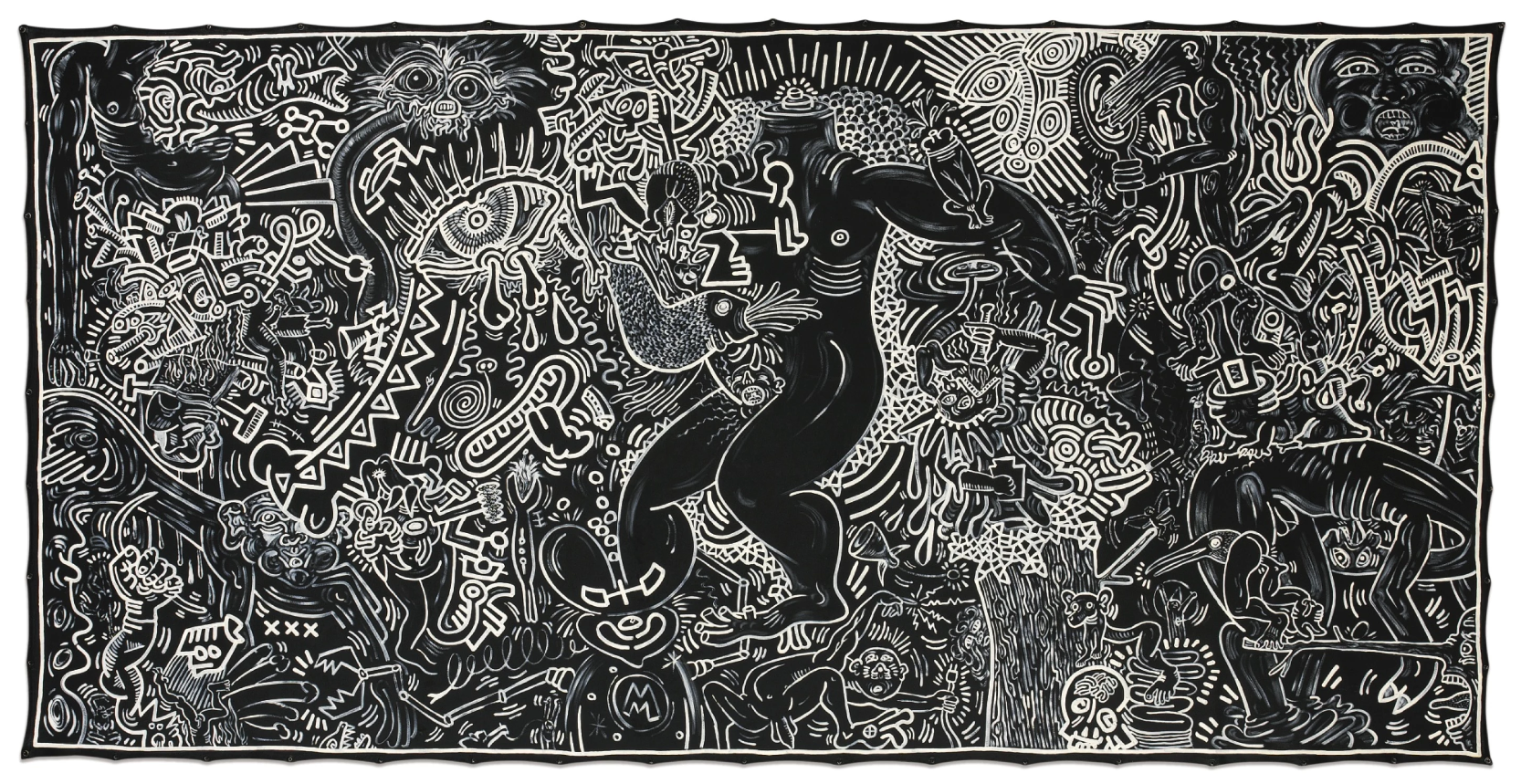
KEITH HARING
Untitled (September 14, 1986)
Acrylic and enamel paint on canvas with metal grommets
95×192 inches (241.3 x 487.7 cm)
Signed, titled and dated Sept. 14 1986 on the reverse
#9. Untitled (Dancing Dogs), 1981
Sotheby’s New-York: 13 May 2014
Estimated: USD 2,000,000 – 3,000,000
USD 4,589,000
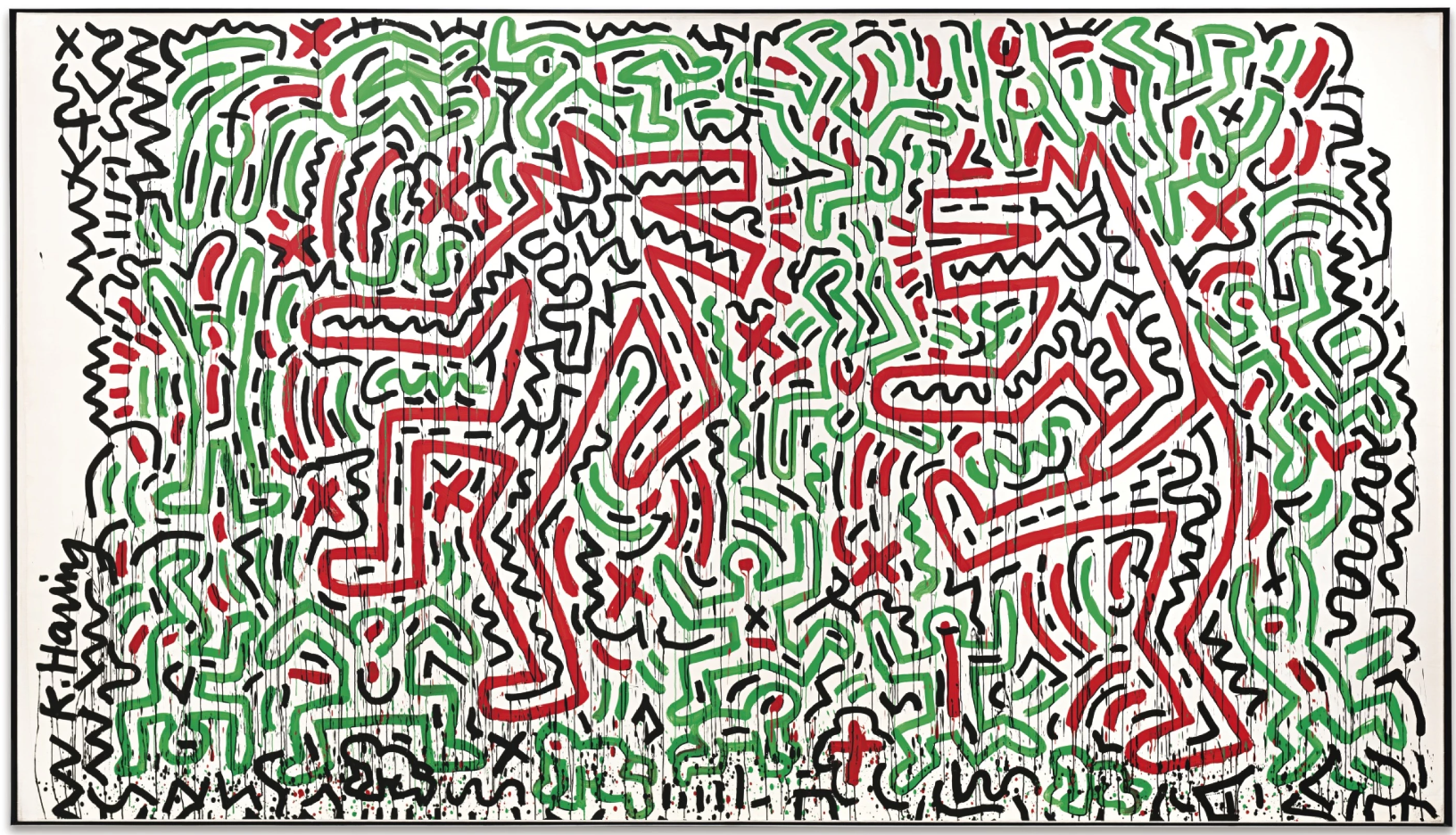
KEITH HARING
Untitled (Dancing Dogs), 1981
Sumi ink and acrylic on paper mounted on canvas
108 x 191 1/2 in. 274.3 x 486.4 cm.
#10. Self-Portrait for Tony, 1985
Sotheby’s New-York: 17 November 2016
Estimated: USD 2,500,000 – 3,500,000
USD 4,512,500
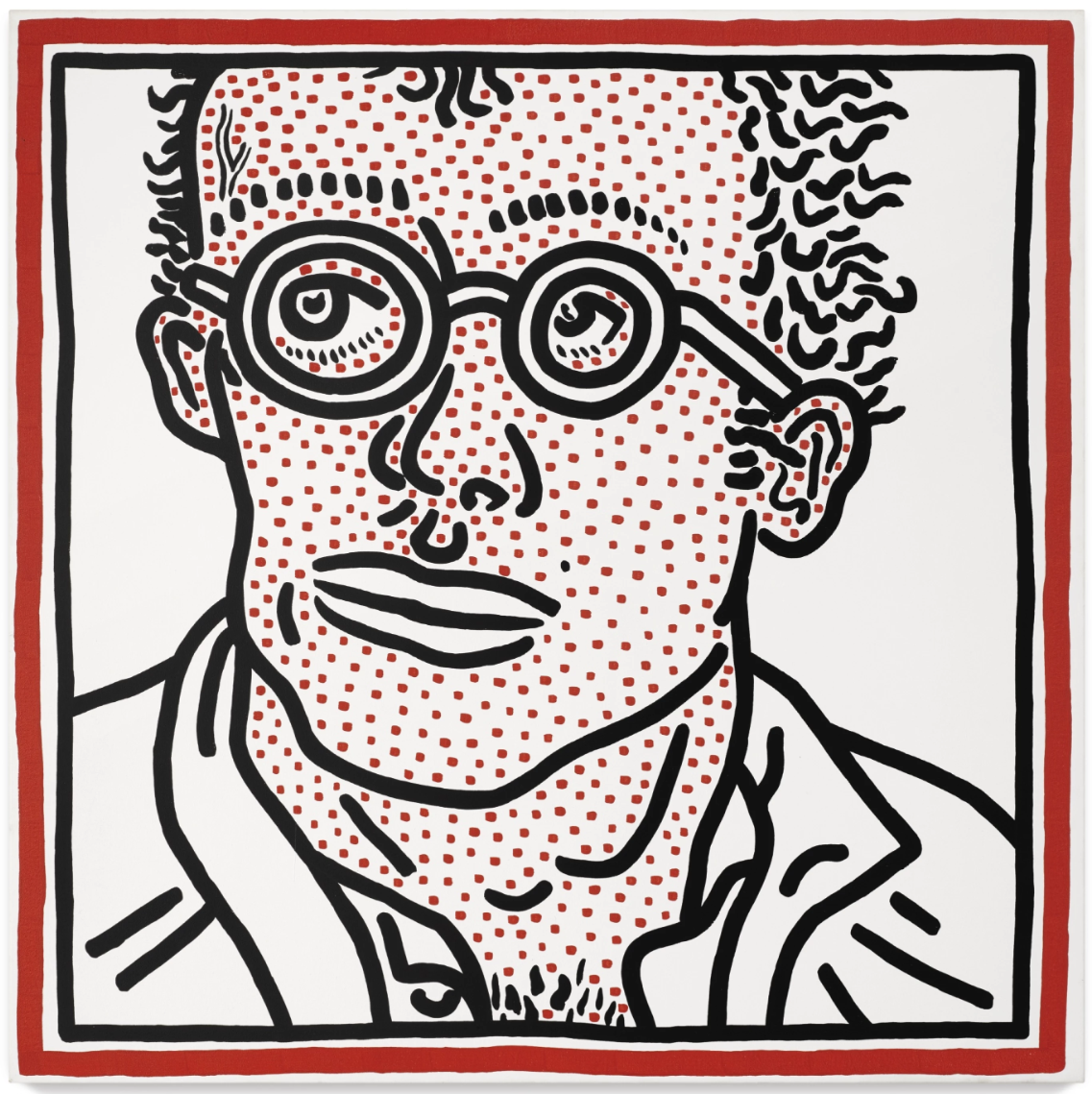
KEITH HARING
Self-Portrait for Tony, 1985
Acrylic on canvas
48×48 inches (121.9 x 121.9 cm)
Signed, titled and dated Feb 2 85 on the overlap
#11. Sister Cities – For Tokyo, 1985
Sotheby’s New-York: 14 November 2018
Estimated: USD 4,000,000 – 6,000,000
USD 4,455,000
(#23) KEITH HARING | Sister Cities – For Tokyo
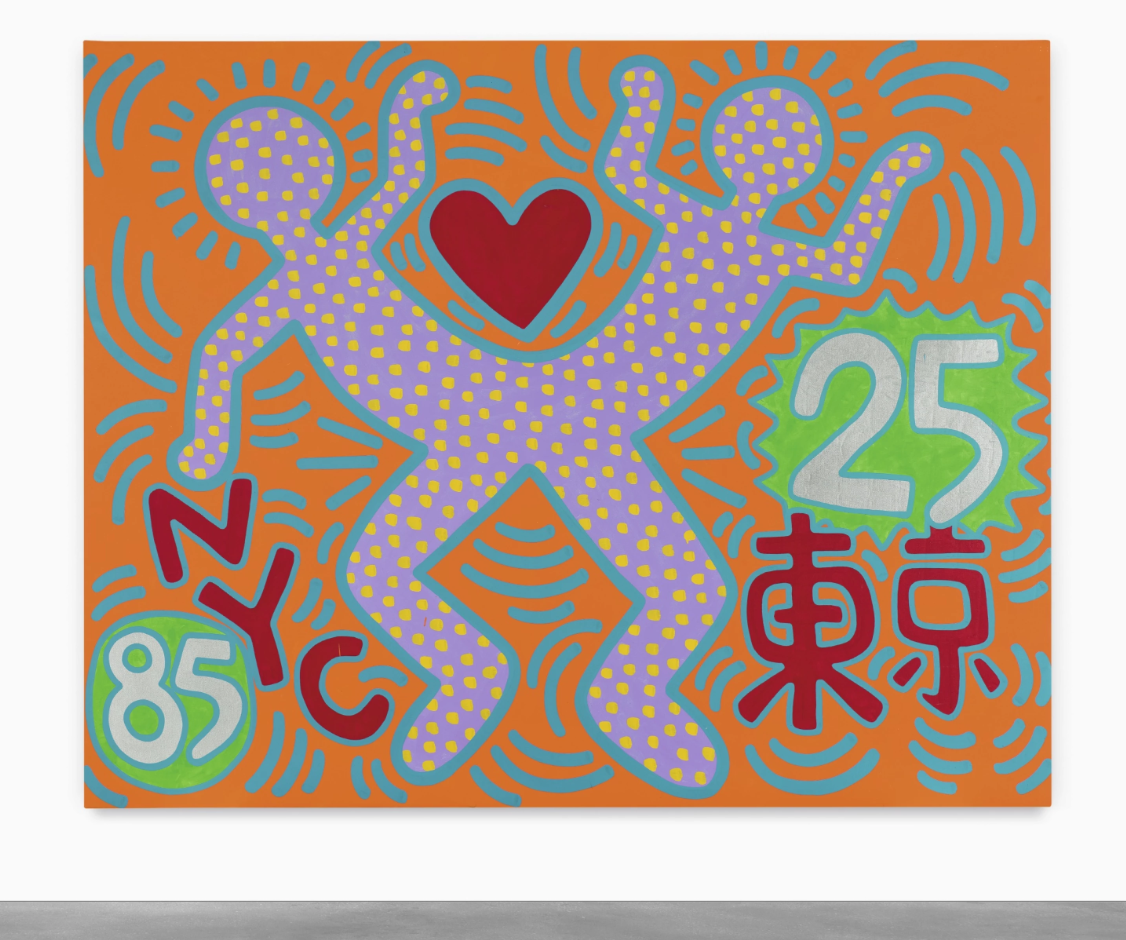
KEITH HARING
Sister Cities – For Tokyo, 1985
Acrylic on canvas
93 1/4 x 117 1/4 inches (236.9 x 297.8 cm)
Signed twice, titled, dated Nov. 5, 1985, and variously inscribed in English and Japanese on the reverse
#12. Untitled, 1983
Bonhams New-York: 15 May 2019
Estimated: USD 1,000,000 – 1,500,000
USD 4,220,075
Bonhams : Keith Haring (American, 1958-1990) Untitled, 1983
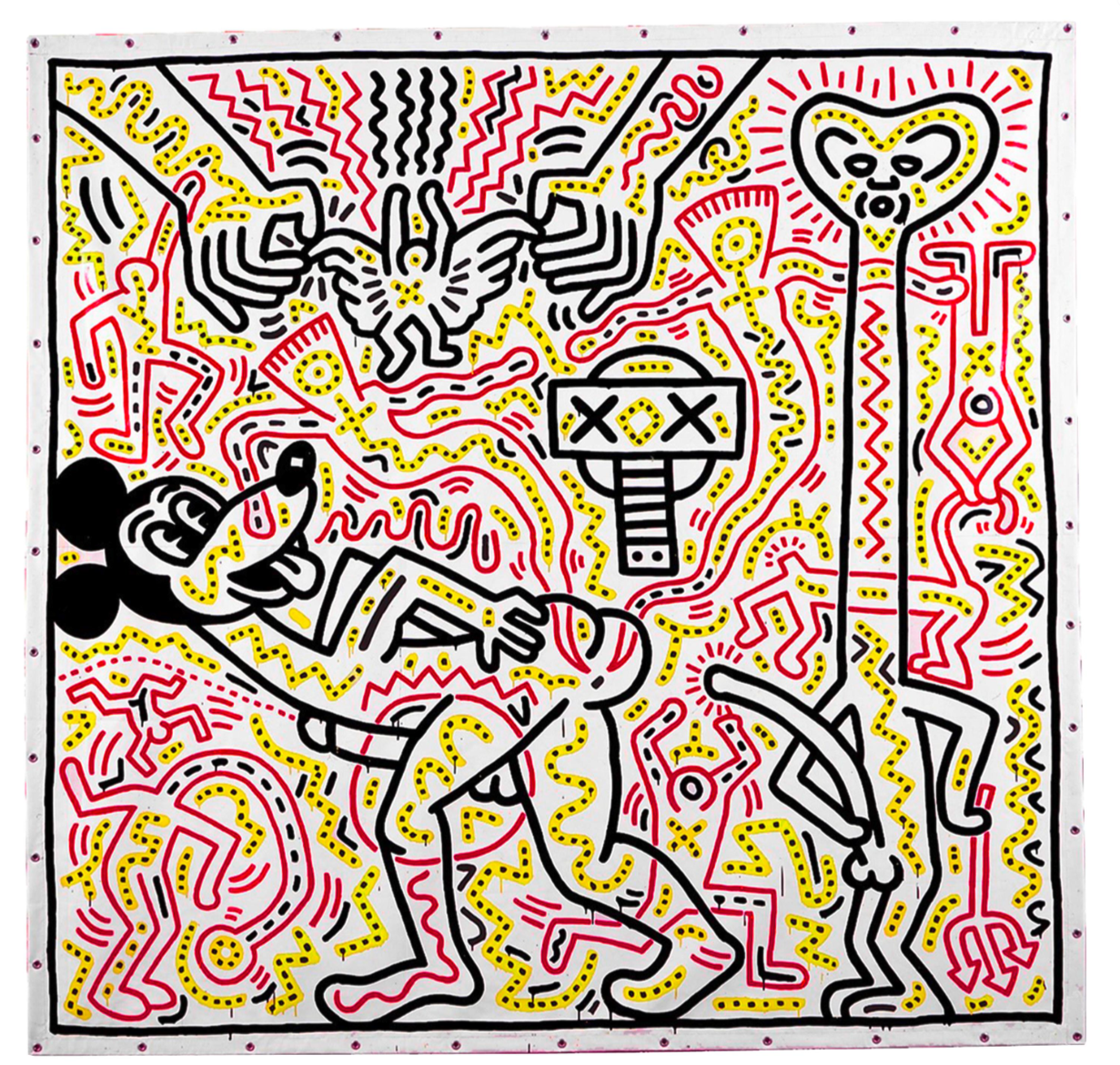
Acrylic on vinyl tarpaulin
119 x 120 1/2 inches (302.3 x 306 cm)
#13. Untitled, 1981
Phillips London: 13 February 2020
Estimated: GBP 3,000,000 – 4,000,000
GBP 3,206,000 / USD 4,178,662
Keith Haring – 20th Century & Conte… Lot 10 February 2020 | Phillips
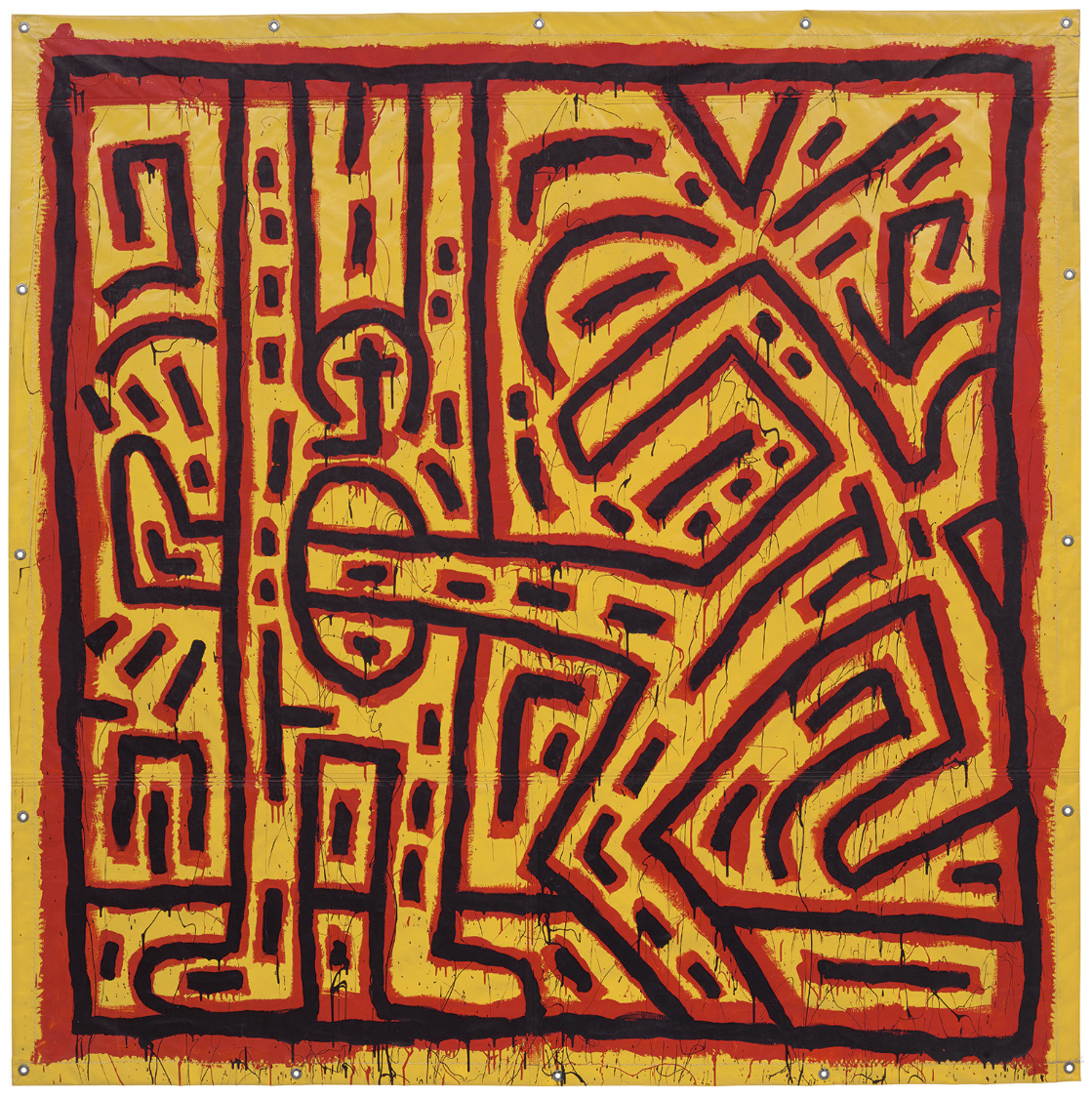
KEITH HARING
Untitled, 1981
Vinyl paint on vinyl tarpaulin with metal grommets
96 1/2 x 96 3/8 inches (245 x 244.8 cm)
Signed and dated ‘NOV. 1981 K. Haring ⨁’ on the reverse
Painted in November 1981.
#14. Untitled, 1983
Phillips New-York: 14 November 2023
Estimated: USD 2,800,000 – 3,500,000
USD 3,206,000
Keith Haring – 20th Century & Conte… Lot 50 November 2023 | Phillips
REPEAT SALE
Christie’s New-York: 15 November 2017
Estimated: USD 3,500,000 – 4,500,000
USD 4,212,500
Keith Haring (1958-1990), Untitled | Christie’s
KEITH HARING
Untitled, 1983
Vinyl paint on vinyl tarpaulin with metal grommets
120×120 inches (304.8 x 304.8 cm)
Signed and dated ‘”JANUARY 1983 K. Haring ⨁” on the reverse
USD 4 million
#15. Untitled, 1987
Sotheby’s New-York: 16 November 2022
Estimated: USD 3,000,000 – 4,000,000
USD 3,922,000
Untitled | Contemporary Evening Auction | 2022 | Sotheby’s (sothebys.com)
KEITH HARING (1958-1990)
Untitled, 1987
Acrylic on canvas tarp
95 x 95 ¼ inches (241.3 x 241.9 cm)
Works on Canvas
Untitled, 1984
Christie’s London: 29 June 2021
Estimated: GBP 3,900,000 – 4,500,000
GBP 4,301,250 / USD 5,938,492
KEITH HARING (1958-1990) (christies.com)
KEITH HARING
Untitled, 1984
Acrylic on canvas, in four parts
Each: 60×60 inches (152.4 x 152.4cm)
Overall: 120×120 inches (304.8 x 304.8cm)
Originally owned by the celebrated German gallerist Paul Maenz—who unveiled the work in Cologne shortly after its creation—Keith Haring’s Untitled is an extraordinary masterpiece that prophesies the dawn of a new era. Dating from 1984, the year that the first Apple Macintosh was released, it stands among the earliest painterly depictions of a computer, heralding the birth of the digital age. Across four conjoined panels measuring nine square metres, a sci-fi bacchanal unfolds: flying saucers collide mid-air, while angels soar, monsters writhe and disembodied limbs pluck aeroplanes from their flight paths. At the center, the computer reigns, mounted on a pyramid like an ancient deity. The structure assumes an anthropomorphic form, with the machine serving as the head; its outstretched arms, like scales, hold a spaceship and a human brain, as if triumphantly having superseded both as the world’s determining force. Tiny figures bow down before it, their arms raised in ecstatic worship. Loaned to the Neues Museum, Weimar, between 1993 and 2005, the work captures the clairvoyant power of Haring’s art: he could not have known that, nearly forty years later, it would be possible to buy the painting in cryptocurrency.
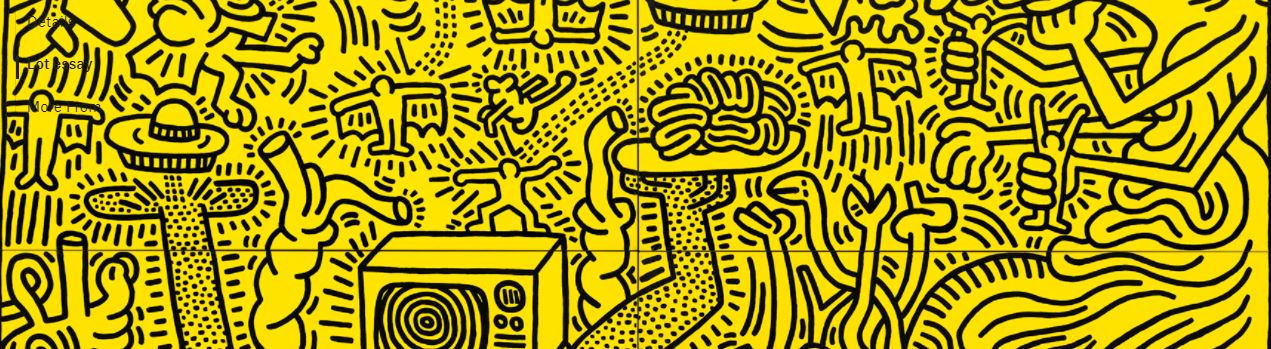
Haring’s various mythic allusions coincided with the birth of a new, contemporary legend: the rise of the home computer. Following the release of the IBM PC in 1981, Apple unveiled their iconic Macintosh model on 24 January 1984. The television advert, directed by Ridley Scott, was broadcast two days prior, during the third quarter of the Super Bowl. It riffed on George Orwell’s novel Nineteen Eighty-Four, which—written in 1949—predicted a dystopian society set twenty-five years in the future. ‘On January 24th, Apple Computer will introduce Macintosh’, concluded the advert. ‘And you’ll see why 1984 won’t be like “1984”.’ Ironically, Haring’s response to the Zeitgeist seemed to suggest quite the opposite, foretelling a veritable apocalypse in which technology would bend human, natural and supernatural forces to its will. Speaking of the painting twenty years later, Maenz hailed the artist’s foresight: ‘when you think when it was painted, we didn’t even have cell phones, we didn’t have computers on everybody’s desks, laptops and iPads’, he explained. ‘… Keith had a very good idea about the world we live in now. I think this painting is really packed with vision and that’s why I think it’s an important work of art’ (P. Maenz in conversation with Christie’s, September 2018).
Untitled, 1986
Sotheby’s New-York: 12 May 2021
Estimated: USD 4,000,000 – 6,000,000
USD 5,779,200
KEITH HARING (1958 – 1990)
Untitled, 1986
Acrylic on canvas
60×60 inches (152.4 x 152.4 cm)
Signed and dated JAN. 22 1986 on the overlap
Dazzlingly vibrant and brimming with graphic force, Keith Haring’s Untitled from 1986 is a brilliant celebration of Haring’s distinct painterly style. The artist’s instantly recognizable pop iconography of the dancing figures is here rendered in a graphic monochrome palette of black and white acrylic paint, with a thick band of rich red paint encircling the composition. Created in the final years of Haring’s tragically short life, Untitled is a seminal example of the artist’s celebration of music and movement despite the overwhelming challenges of the decade. Across the present work, Haring’s dancing figures are carefully placed such that none overlaps with another, the precise organization yet chaotic contortion of their bodies lending the composition a kinetic clarity that bursts with the effusive spirit so resolutely associated with Haring’s work.
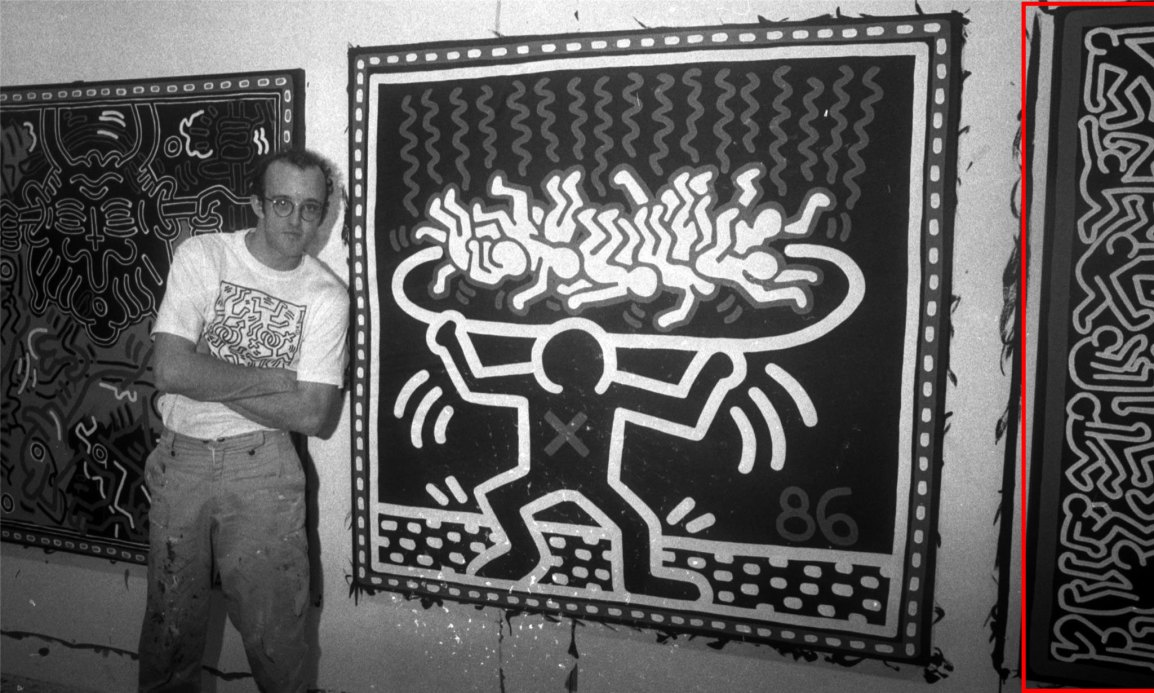
In its astonishingly assured compositional structure and astounding candor, Untitled stands as s a work of immense significance within Haring’s oeuvre, embodying the dizzying energy and sense of possibility that existed within the New York cultural scene for a brief but heady period in the 1980s. Ultimately, the present work superbly encapsulates the sensation that Haring declared he was striving for within his art when he stated, “When I paint, it is an experience that, at its best, is transcending reality.” (Keith Haring, quoted in: David Sheff, “Keith Haring: Just Say Know,” Rolling Stone, August 1989) In its creation of a powerfully distinctive dreamscape, Untitled not only transcends reality, but exceeds it.
Silence = Death, 1988
Christie’s New-York: 15 May 2019
Estimated: USD 4,500,000 – 5,500,000
USD 5,609,500
Keith Haring (1958-1990), Silence = Death | Christie’s
KEITH HARING (1958-1990)
Silence = Death, 1988
Acrylic on canvas
108×120 inches (274.3 x 304.8 cm)
Signed, titled and dated ‘SILENCE = DEATH ©K. Haring SEPT. 11 – 88’ (on the overlap)
Depicted on a shocking pink canvas in the shape of an inverted triangle, Silence = Death is packed with a writhing mass of Haring’s signature figures. Their fingerless hands cover the areas on their faces where eyes or ears would exist in a manner similar to the three wise monkeys who ‘see no evil, hear no evil, speak no evil.’ Rendered in even silver strokes, the rowdy mass tumbles down the canvas but is hemmed in by a silver border that keeps them from approaching the edge of the stretcher. The sheer chaos of the scene is in line with the feeling of the time, and is only tamed and controlled by Haring’s precision and attention to color and detail. Jeffrey Deitch, speaking about the artist’s work, noted, “[Keith Haring’s] images are insightfully chosen and carefully worked out with a sensitivity toward layers of meaning and sexual connotation. They are not just drawings but ‘signs.’ But these rings of meaning around the individual figures are only part of the Haring process. The work’s full impact results from a mélange of all these elements: context, medium, imagery; and their infiltration into the urban consciousnesses. […] They diagram the collective unconscious of a city—a city that moves along happily enough, but just barely enough to keep from degenerating into the dog-eat-dog, topsy turvy world of Haring’s images” (J. Deitch, Keith Haring, New York, 2008, p. 220-221). The triangle and its silver denizens are attractive visually, but this attraction serves to further hold the viewer’s attention and make them come to grips with the solemnity of the subject matter. Silence = Death is one of two triangular canvases that Haring completed in the fall of 1988. The other is a work titled Pile of Crowns (1988) which the artist created in memoriam of his friend and colleague, the painter Jean-Michel Basquiat. Basquiat had risen to fame as a street artist turned gallery sensation in much the same way as Haring, and the two had worked together during the 1970s and 80s in the electrified art scene of New York City. Both had strong ties to Andy Warhol and his milieu, and each embraced the crossover between their graffiti roots and Warhol’s Pop sensationalism. Silence = Death and Pile of Crowns were finished roughly one month after Basquiat’s untimely death, and both show Haring’s innate ability to use his signature cartoony style to tackle serious topics. The latter addresses a prodigious talent and close friend lost to drugs, while Silence = Death deals with the AIDS epidemic and its devastating effects on the arts community.
Sister Cities – For Tokyo, 1985
Sotheby’s New-York: 14 November 2018
Estimated: USD 4,000,000 – 6,000,000
USD 4,455,000
(#23) KEITH HARING | Sister Cities – For Tokyo
KEITH HARING
Sister Cities – For Tokyo, 1985
Acrylic on canvas
93 1/4 x 117 1/4 inches (236.9 x 297.8 cm)
Signed twice, titled, dated Nov. 5, 1985, and variously inscribed in English and Japanese on the reverse
Executed in 1985 in commemoration of the 25th anniversary of a sister-city friendship between New York City and Tokyo, Keith Haring’s Sister Cities – For Tokyo is a dynamic, celebratory affirmation of Haring’s adoration for his two most beloved cities. Employing his instantly recognizable Pop iconography and painting with bold, highly saturated hues and glimmering metallic silver on a monumental canvas, Haring here imagines the relationship between Tokyo and New York City through his iconic dancing figures motif. The bold chromatic spectrum of blues, purples, greens, reds, and oranges exhibited here enlivens the picture with a strong emotive power that radiates through the dancing figures joined in the center by a radiant heart. A common motif in Haring’s work, dancing figures serve as a broader symbol of joyful life and coexistence; art historian Robert Farris Thompson has described Haring’s employment of dancers coming together, as exhibited in the present composition, as “not merely dancing. They are living a principle: work with your brother, share space in relation to time. Haring expands on that. It turns into an emblem.” (Robert Farris Thompson, Haring and the Dance, Keith Haring, New York, 1997, p. 218) At once vibrantly expressive and lyrically balanced, the present work reverberates with a potent energy. Two dancing figures, arms gleefully thrown into the air and bodies inextricably conjoined at the hips, emanate a pulsating movement that reverberates in waves over the monumental canvas. In the space between their gyrating bodies, a bursting red heart boldly signifies their jovial coexistence, and on either side of the figures in the same vibrant cherry red color, New York City and Tokyo are written in English and Japanese, respectively. The numbers “25” and “85,” rendered in luminous metallic silver and highlighted in electrifying green paint, refer to the occasion which inspired the present work: the 25th anniversary of the 1960 alliance of friendship between Tokyo and New York City, and the weeklong festivities that took place in 1985 to commemorate the occasion. Haring first visited Tokyo in 1983, and his initial trip left such a positive impression that he returned to Japan numerous times over the course of the next decade. Japan deeply inspired Haring, and elements of Japanese culture and history became immediately discernible in his work; in turn, Haring left a profound mark on the physical landscape of the Japanese cities he visited, creating numerous public murals and collaborative art projects that engaged with their communities and left an artistic legacy still visible today. Japan’s influence on the artist can be seen through the mediums and materials that he adopted – in his visits to Japan, Haring made drawings on Japanese folding screens, scrolls, kites, and fans with Sumi ink – and in the deep influence that Eastern philosophy, Tsumi painting, and Zen Buddhist principles had on Haring and his artistic practice. Haring looked not only to Japan’s rich cultural and historical past, but also to Japan’s present: in the mid-1980s, Haring found himself immersed in an electrifying outburst of cultural activity and innovation that followed Tokyo’s economic boom in the early 1980s, and indeed contributed to this modernization and growth. Referring to Haring’s lasting influence on the cultural ethos of Tokyo today, artist Peter Halley states: “You know, when I think about Keith Haring nowadays, I think about Japan – especially Murakami – and all the people in Japan who are interested in the idea that an artist can function between fine art and commercial art. Keith Haring made T-shirts, buttons for your coat, and stuff like that. He was interested in mass-produced objects, as well as in public art. I think Tokyo is where you really see his influence.” (Peter Halley, “Between Politics and Mythology,” Exh. Cat., Milan Fondazione, Triennale di Milano, The Keith Haring Show, 2005, pp. 87-90)
In May of 1960, on the centennial of the first treaty of amity and commerce between the cities of Tokyo and New York in 1860, representatives of the two cities gathered to declare one another “sister cities.” This proclamation carried political and social consequences, reinforcing a relationship of mutual respect and celebrating opportunities for commercial and cultural growth and exchange between the two metropolises. In 1985, on the 25th anniversary of this union/compact, the mayor of New York City invited the governor of Tokyo to New York to sign a Memorandum of Understanding – a document reaffirming the bonds of friendship between the two cities – and to inaugurate “Tokyo Week in New York,” a thenceforth annual week-long festival in New York City honoring and celebrating Japanese culture. Haring was inspired by this momentous occasion and the week of festivities that followed, and Sister Cities – For Tokyo serves as both an expression of Haring’s excitement and a record of this historical moment in Japanese-American history. Keith Haring sought through his art to create a connection and community, and Sister Cities – For Tokyo is a pure affirmation of the joy the artist found in building communities and forging relationships that transcend borders.
Self-Portrait for Tony, 1985
Sotheby’s New-York: 17 November 2016
Estimated: USD 2,500,000 – 3,500,000
USD 4,512,500
(#37) Keith Haring (sothebys.com)
KEITH HARING
Self-Portrait for Tony, 1985
Acrylic on canvas
48×48 inches (121.9 x 121.9 cm)
Signed, titled and dated Feb 2 85 on the overlap
Crafting an iconic visual idiom that became synonymous with his cultural milieu, Keith Haring gifted an entirely new language of contemporary symbolism to the history of painting. Articulated through unabashed linear confidence, Haring’s compelling yet tragically limited oeuvre wove an interconnected tapestry that held a stark mirror to the present state of humanity. Wide reaching themes of money, religion, morality, race, sexuality, prejudice and oppression often took center stage within Haring’s allegorical dramas of modernity. Yet, despite the artist’s deeply personal connection to these profound issues, it was only on a few rare occasions that he explicitly turned to himself as a subject. Painted in the pivotal year of 1985, the present work is undoubtedly the most daringly honest and intimate self-portrait that Haring created. As a personal gift for friend and gallerist Tony Shafrazi, in the specifically titled Self-Portrait for Tony we see Haring stepping out of his contemporary myth-making to craft a sensitive likeness of himself. Across a vibrantly impactful stark white canvas, we witness a rare sense of naturalistic mimesis that still maintains the economy of line characteristic of the artist’s idiosyncratic visual lexicon. As such, Self-Portrait for Tony offers a unique invitation to a rare moment of self-reflection which is intrinsically bound to an enshrinement of the vitality of life.
The Last Rainforest, 1989
Sotheby’s London: 28 June 2016
Estimated: GBP 2,000,000 – 3,000,000
GBP 4,181,000 / USD 5,513,503
(#15) Keith Haring (sothebys.com)
KEITH HARING
The Last Rainforest, 1989
Acrylic and enamel on canvas
71 3/4 x 95 1/3 inches (182.2 x 242.6 cm)
The Last Rainforest is Keith Haring’s last great masterpiece. It is more detailed, more complete, more studied, and more virtuosic than any other work by this artist. It is a tempest; a melting pot where personal stories blend with societal issues and eroticism entwines with violence; where cruelty coincides with frivolity, and fantasy melds with inescapable truth. It should be viewed as Haring’s artistic last will and testament; a socio-political warning shot to those who would outlive him and a formal summation of his cruelly curtailed career. It is closely linked to his views on the AIDS crisis and on nuclear technology, and certainly connected to his environmental activism; it is densely packed with art-historical reference, and executed in a manner that demands the viewer’s attention. Although it has appeared in numerous prestigious international museum exhibitions, this painting has remained in the same collection of renowned photographer David LaChapelle since it was first acquired from the Tony Shafrazi Gallery.
Untitled (September 14, 1986)
Sotheby’s New-York: 13 May 2014
Estimated: USD 2,000,000 – 3,000,000
USD 4,869,000
(#19) Keith Haring (sothebys.com)
KEITH HARING
Untitled (September 14, 1986)
Acrylic and enamel paint on canvas with metal grommets
95×192 inches (241.3 x 487.7 cm)
Signed, titled and dated Sept. 14 1986 on the reverse
Epic in scope and impressive in scale, Untitled (September 14, 1986) was created at the peak of Keith Haring’s tragically short but intensely dynamic career. Depicting a fantastical scene of apocalyptic magnitude, the frenzied composition of Untitled (September 14, 1986) is dominated by a central headless figure that writhes amidst a chaotic background of mythical creatures and humanoid forms that are seemingly engaged in conflict with each other. Recalling the paintings of the sixteenth-century Dutch artist Hieronymus Bosch in its amalgamation of the monstrous with the bizarre, Untitled (September 14, 1986) presents an immensely powerful dystopian vision in which normality has been totally suspended in favor of an utterly surreal tableau. Half-human beasts appear to devour each other with abandon, whilst two snake-like creatures rear their heads towards the central figure, rendered like figments of a nightmare by the substitution of a weeping eye and a staring face in place of the head of each snake. Executed in a strikingly pared-down palette, the graphic iconicity and intricate tessellation of Untitled (September 14, 1986) reinforces the power of the scene, with the chaotic melee appearing close to bursting beyond the composition. The struggle depicted seems almost biblical in scale, with the central figure attempting to blindly forge his way through the commotion around him to invoke the oft-painted biblical tale of the temptation of St. Anthony.
Untitled (Dancing Dogs), 1981
Sotheby’s New-York: 13 May 2014
Estimated: USD 2,000,000 – 3,000,000
USD 4,589,000
(#22) Keith Haring (sothebys.com)
KEITH HARING
Untitled (Dancing Dogs), 1981
Sumi ink and acrylic on paper mounted on canvas
108 x 191 1/2 in. 274.3 x 486.4 cm.
Incorporating on a colossal scale Haring’s most iconic, culturally recognizable, and desirable iconographic figures—the dancing dog, the radiant baby, and the X-branded stick figures—within the same composition, Untitled (Dancing Dogs) from 1981 represents an early, definitive summary of Haring’s pictorial lexicon. Included in the most important Keith Haring retrospective exhibition at the Whitney Museum of American Art in New York in 1997, the present work is a spectacular example of Haring’s optically ravishing yet critically laudatory paintings. Keith Haring is a complex and compelling icon of 1980s Pop art, profoundly colliding the spheres of art and life through an economy of aesthetic means previously untrodden. Haring’s larger than life dancing dog figures bark at each other and proceed across the canvas from right to left, resembling contemporary re-imaginations of the half-human half-jackal Egyptian deity Anubis, and formally emulating the ancient iconography that depicted figures within narratives as two-dimensionally flattened and walking linearly in side profile. The vibrant painting is notable for its exceptionally sumptuous drips, as cascades of fluid ink and acrylic pour down and across the surface. While Haring here deploys similar forms as in his formative subway chalk drawings, the expressive joie de vivre of the drips juxtaposed with the hard-edged lines of his archetypal bold shapes exemplify Haring’s mastery over the painterly medium, bridging his Pop language with the critical gravitas of Abstract Expressionism. Just as we can visualize Pollock vigorously taking paint to canvas, exuding his heroic genius with every gestural drip and pour, Untitled (Dancing Dogs) analogously conjures Haring’s performance of painting—the ineluctable motion of the image parallels Haring’s own instinctive, primal dance with brush and canvas.
Vinyl Tarpaulin
Untitled, 1983
Phillips New-York: 14 November 2023
Estimated: USD 2,800,000 – 3,500,000
USD 3,206,000
Keith Haring – 20th Century & Conte… Lot 50 November 2023 | Phillips
REPEAT SALE
Christie’s New-York: 15 November 2017
Estimated: USD 3,500,000 – 4,500,000
USD 4,212,500
Keith Haring (1958-1990), Untitled | Christie’s
KEITH HARING
Untitled, 1983
Vinyl paint on vinyl tarpaulin with metal grommets
120×120 inches (304.8 x 304.8 cm)
Signed and dated ‘”JANUARY 1983 K. Haring ⨁” on the reverse
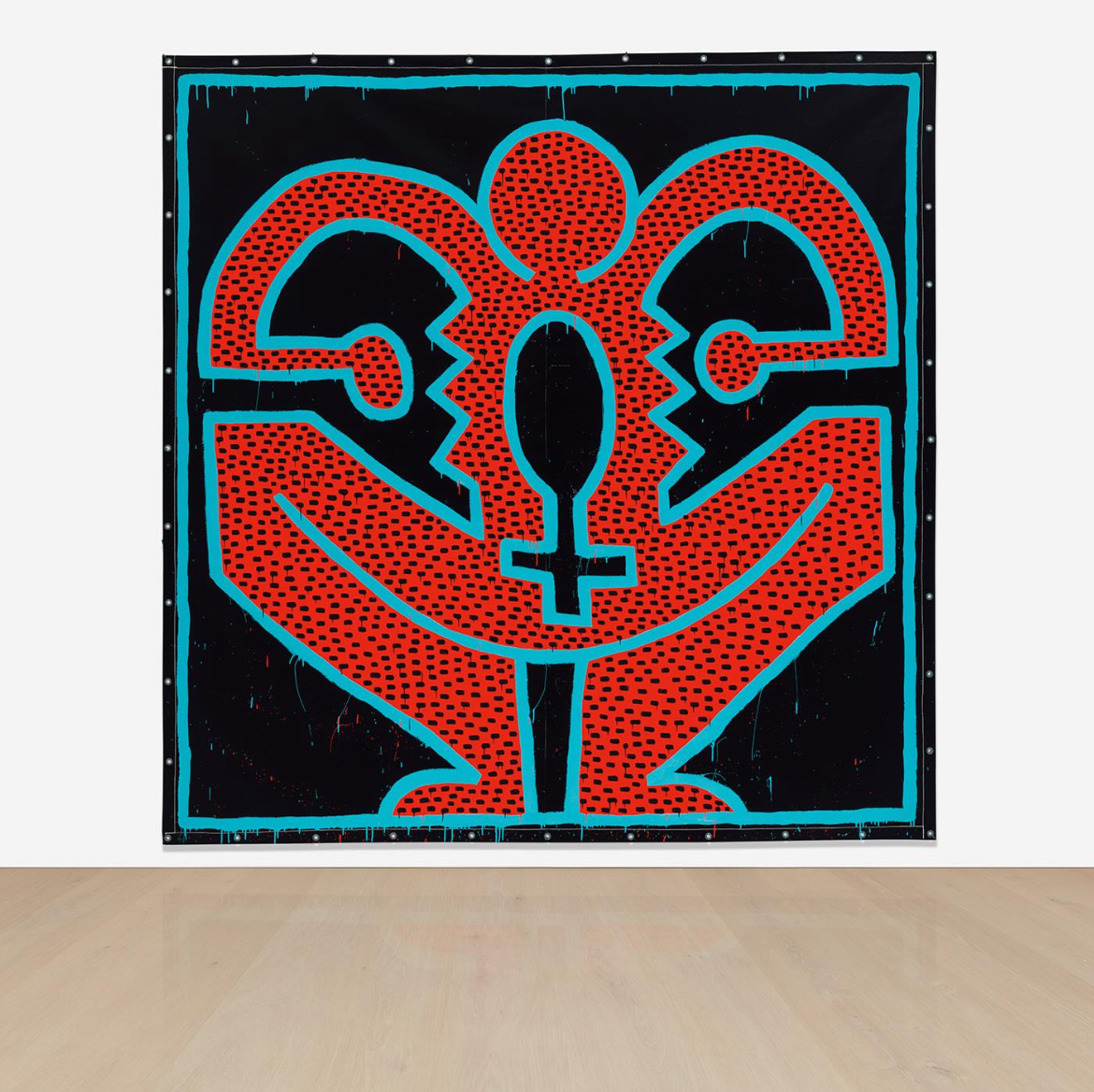
Keith Haring’s unique visual language and symbolic sensibility unfurl across the surface of Untitled, 1983. His totemic central figure—nearly the full height of the ten-foot square tarp—crouches in a dynamic squat that bristles with energy, like a freeze-frame of a dancer, with the gravitas and timelessness of prehistoric sculpture. A monumental example of Haring’s witty style, Untitled synthesizes the artist’s enduring ability to imbue his 1980s downtown New York social milieu with an archetypical simplicity of form, in a universal language of freedom of expression. Coming out of the downtown New York scene, Haring’s visual work takes on the vibrancy of the music and dance cultures that surrounded him. The rhythmic pose of the figure in Untitled recalls the boisterous physical movements of both break-dancing and voguing, in a dual reference to the underground hip-hop and queer communities that Haring circled within. Both dance styles are explosive, and take pleasure in physical distortion and the angles of the human body, and Haring captures this energy in the central figure of Untitled.
“1982 to 1984 was the peak of rap music and breakdancing, and graffiti was the visual tie-in. A lot of my inspiration was coming out of watching break-dancers, so my drawings started spinning on their heads and twisting and turning all around.”
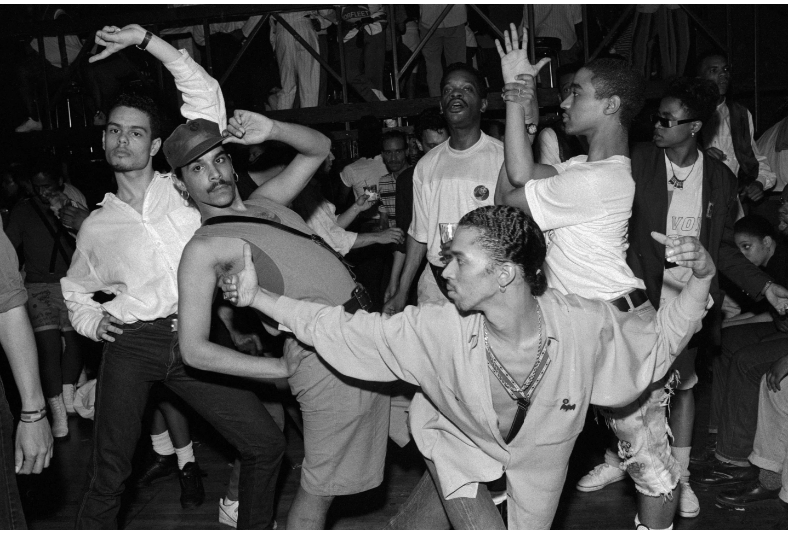
House of Xtravaganza Legendary Voguers, Luis, Danny, Jose, and David Ian Xtravaganza, at Tracks, New York, 1989. Image: © Chantal Regnault
After signing with dealer Tony Shafrazi in 1982, Haring sought a new format for his large-scale paintings, that registered the gravitas of gallery representation without sacrificing the grit and edge of his street art origins. While walking the streets of New York, he noticed a Con Edison construction crew who covered their equipment with a large sheet of industrial tarpaulin. The large-scale and machine-made quality of the tarp appealed to Haring, who sought out a tarp manufacturer in Brooklyn and purchased a selection of “canvases” for his inaugural solo show with Tony Shafrazi Gallery later that year. Untitled represented this seminal body of work early the following calendar year, in the group exhibition at Tony Shafrazi, Champions, January 15 – February 19, 1983. Untitled is an aggrandizement of Haring’s astute linear sensibilities, as perfected in his practice of graffiti. Through street art, Haring honed an economy of line and energetic expression, which give work like Untitled its striking visual quality. Haring‘s unique ability to create work that popped off city walls is translated into the bright color palette and dynamism of Untitled. The central figure is composed of arching sky-blue lines, confidently brushed against the black vinyl tarp, and filled in with a matrix of scarlet red gridded with rectangular black dots. In purposefully limiting his palette to blue, red, and black, Haring allows the cleverness of his composition to shine through.
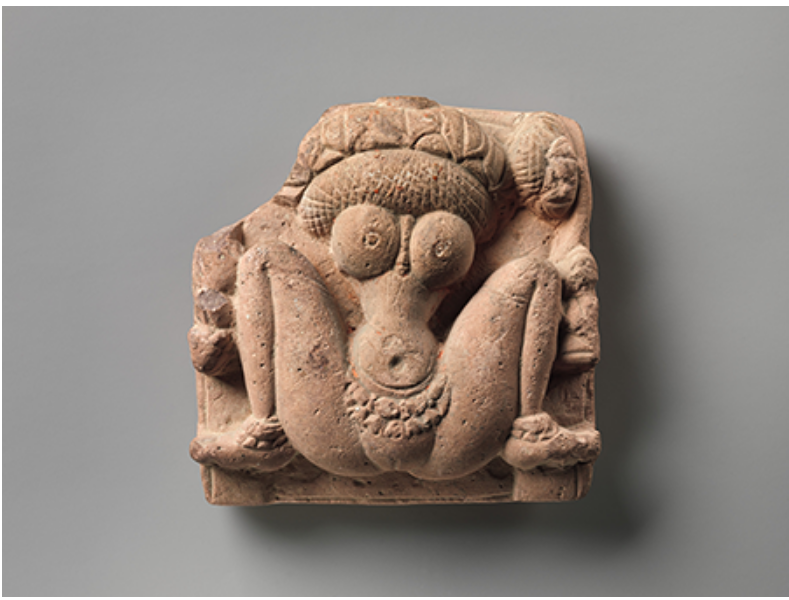
Lotus-Headed Fertility Goddess Lajja Gauri, Madhya Pradesh, India, c. 6th century CE. The Metropolitan Museum of Art, New York. Image: © The Metropolitan Museum of Art, New York, Samuel Eilenberg Collection, Bequest of Samuel Eilenberg, 1998, 2000.284.13
Untitled is not just one figure, but multiple images in one. Haring codes a smiley face into the dancer’s pose: their hands form the eyes, and the blue line of their legs turns into a smile. The negative space of Untitled holds symbolic value as well, most obviously in the feminine symbol, keyholded into the center of the figure. Further, the space under the arms of the figure cleaves into two halves of a broken heart locket, which wait to be reconnected by the feminine symbol “key.” The feminine symbol at the center of the work confirms a connection between the squatting pose of the figure and the forms of historic fertility and mother goddess sculptures, such as the Indian fertility goddess Lajja Gauri; the zig-zagged sides of the figure, too, recall the stylized body of the Ancient Roman she-wolf. These multivalent readings of Untitled, steeped in human history and Haring’s contemporary moment, speak to the universality of his visual idiom.
Untitled, 1987
Sotheby’s New-York: 16 November 2022
Estimated: USD 3,000,000 – 4,000,000
USD 3,922,000
Untitled | Contemporary Evening Auction | 2022 | Sotheby’s (sothebys.com)
KEITH HARING (1958-1990)
Untitled, 1987
Acrylic on canvas tarp
95 x 95 ¼ inches (241.3 x 241.9 cm)
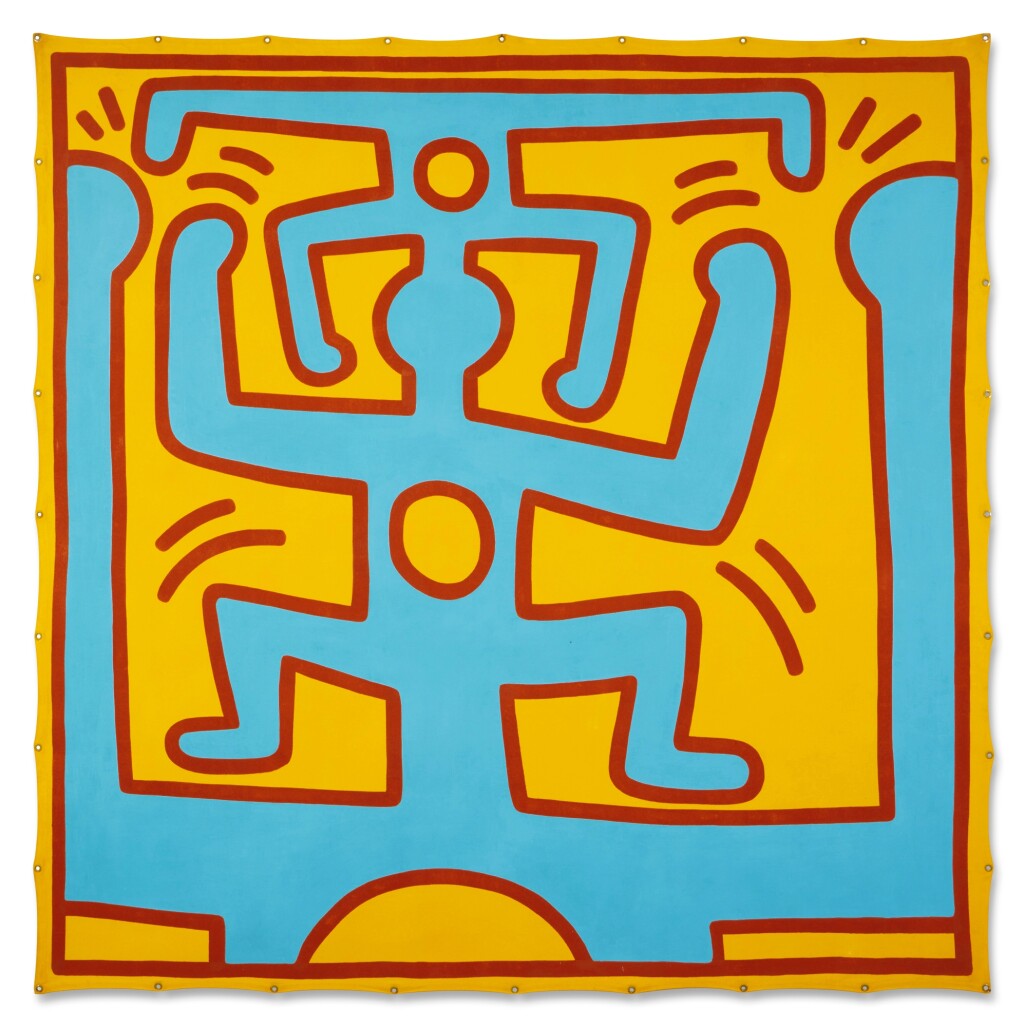
Dazzlingly vibrant and brimming with graphic positivity, Keith Haring’s Untitled of 1987 is emblematic of the compositional dynamism and iconic figuration from one of the most upbeat and confident artistic voices of our time. Created in the final years of Haring’s life, Untitled is a seminal example of the artist’s distinct visual language, and his determination to celebrate music, movement and an interconnected human spirit through his art– despite the overwhelming challenges of the decade. Across the monumental tarp, Haring depicts three tiers of interlocking figures in a moment of spectacular activity, rendered in the bold, simplistic chromatic pallet for which he is best known. Commissioned by renowned gallerist Martin S. Blinder for the Martin Lawrence Gallery 1987 annual calendar, the present work has remained in the private collection of famed Tony Shafrazi since it was acquired in 1995. Since its completion, the present work has been exhibited among Haring’s most prominent exhibitions, including his solo show at the Whitney Museum of American Art, New York in 1997, The Keith Haring Show at Fondazione Triennale di Milano in 2005, and was exhibited extensively at Shafrazi’s own Chelsea gallery, including the 20-year memorial show commemorating Haring’s tragic passing in 2010. Exemplary of the vibrant urban environment by which Haring’s oeuvre was so heavily inspired, Untitled endures as a record of the artist’s prolific career.
Untitled, 1981
Phillips London: 13 February 2020
Estimated: GBP 3,000,000 – 4,000,000
GBP 3,206,000 / USD 4,178,662
Keith Haring – 20th Century & Conte… Lot 10 February 2020 | Phillips
KEITH HARING
Untitled, 1981
Vinyl paint on vinyl tarpaulin with metal grommets
96 1/2 x 96 3/8 inches (245 x 244.8 cm)
Signed and dated ‘NOV. 1981 K. Haring ⨁’ on the reverse
Painted in November 1981.
‘See, when I paint, it is an experience that, at its best, is transcending reality. When it is working, you completely go into another place, you’re tapping into things that are totally universal, of the total consciousness, completely beyond your ego and your own self. That’s what it’s all about.”
A visceral, larger-than-life masterpiece executed at the dawn of Keith Haring’s oeuvre, residing in the same collection since 1982, Untitled, 1981, portrays two human figures mid-movement, outlined in black and red on a yellow background. To the left, a cross-faced man raises his arms far enough to reach the extremity of the vinyl support, as if hanging from the real world and into the painting. Next to him, an anonymous counterpart vindictively shoots into the hole that punctures his body, betraying a possibly violent gesture. These characters perfectly embody the ambivalence that Haring sought to capture in his art, coalescing two apparently contradicting atmospheres within a single image: one replete with gloom and danger, the other brimming with buoyant energy. The work’s grandiloquent dynamism is only emphasised by its all-consuming format, reminiscent of the subway setting from which Haring’s art originated when he began painting in the late 1970s. Executed at the outset of his fame in the city of New York – which would soon take over the entire world – Untitled was included in the artist’s seminal Tony Shafrazi show in the fall of 1982, as well as highlighted in both the artist’s watershed retrospective at the Whitney Museum of American Art, New York, in 1997, and his first-ever retrospective to focus on the political aspect of his work: Keith Haring: The Political Line at the Musée d’Art moderne de la Ville de Paris, in 2013. As such, it is a paradigmatic example of the artist’s practice, which was tragically shortened by AIDS-related complications less than a decade later.
Recently the subject of a number of major institutional exhibitions, Keith Haring’s work is at the forefront of the public’s attention and has been celebrated to an unprecedented calibre, at a time when the subjects he addressed in his art – the necessity for love, inclusion and protection – seem more relevant than ever. His oeuvre was shown at Tate Liverpool in 2019 – marking his first major exhibition in the United Kingdom – and is currently at the heart of two simultaneous shows: one at the BOZAR, Brussels, the other at the National Gallery of Victoria, Melbourne. Signifying the ever-intensifying interest vested in his work, growing with time and bleeding beyond borders, Haring will once again be the subject of a solo exhibition at Museum Folkwang, Essen, from May to September 2020.
Like many artists of his generation – including his friend Jean-Michel Basquiat – Haring eluded traditional gallery representation in the early years of his career, taking instead the streets of Manhattan as his exhibition space, and the social context of 1980s New York as his subject matter. With inimitable tonal vigour, the early Untitled boasts visual elements that would later be deemed inextricable from Haring’s oeuvre: the figure with a hole in its stomach, the black-ochre-red colour combination and the interaction between two visibly animated parties on an otherwise abstract, monochromatic background. It is a pristine example of his vision and intention, which remained intact throughout his career.
In a method akin to that of Pablo Picasso, Haring worked on his drawings and paintings in single, uninterrupted lines. In this way, the figures designed across his surfaces became themselves lively, spontaneous, unobstructed by the constraints of painterly pause. As a result, the two protagonists in the present work are as essential as they are evocative; despite being rendered with thick black lines devoid of angular subtleties, they demonstrate visible actions, recognisable to all. The scene’s ambivalent urgency is made evident by their movement, but also by the heated colours in which they are drenched. The drips of paint tumbling down their outlines impart the image with further urgency – it is as if the fiery colours within and around the two figures had caused them to melt before our eyes.
Yet it is not just the visual novelty brought by Haring’s paintings and graffiti that distinguished his output from that of others. It is the purpose that animates it, the meaning located within the continuous lines, and the subtle formal interaction that takes place between that meaning and the painted matter itself. Untitled exemplifies the political line that Haring imparts in his work with an imperious subject matter – a figure hitting another figure right inside the circular hole that punctures his body – but also in its choice of rendition, which here only emphasises the composition’s urgent tone, akin to Picasso’s Guernica scene. At once vindictive and playful, Untitled demonstrates Haring’s ability to straddle the seriousness of subjects including violence and death, and the humour deriving from absurd aggressions – spurred by politics, history, and at times people themselves. It also testifies to his talent in fusing form and content, not only showing violence but embodying it in precise, strongly vivified lines.
Reflecting the political intentions Haring discreetly weaves into his compositions, the form of a man with a gaping hole in his torso is particularly striking. It forms part of the artist’s cosmos of political signs, first appearing in his work in the early 1980s, following a vision that had occurred to him after the murder of John Lennon. At the time, Haring had recorded the event in his diary and began using it as a pattern within his painterly scenes. Not only does the hole here refer to the murder of a musical legend that marked his whole generation, it furthermore signifies the sense of emptiness that dawns on the whole of humanity, right at its core.
Paired with historical context, the image in Untitled assumes increased symbolic meaning. Indeed, the painting was executed in 1981, at the dawn of the AIDS crisis in New York. At this time, rumours regarding a ‘gay-related immunodeficiency disease’ began to consume the thoughts of many Americans, who feared that the emerging sickness would spread like the plague. An unpredictable assault on the body, both absurd and fatal, Untitled shows two viscerally active protagonists visibly consumed by an uncontrollable, intangible energy – allegorical perhaps, of the tragic fatefulness of AIDS, which intruded bodies, unannounced, and ravaged thousands of lives.
Haring’s idiosyncratic dripping aesthetic, in this sense, brings to mind a variety of symbolisms – movement, the melt entailed by fire, and the general collapse of the human body. Yet, on a formal level, it equally recalls the stylistic tendencies that pervaded the art historical canon throughout the 20th century. Notably, a particularity of Untitled is its unequivocal iconographic similitude to Abstract Expressionist canvases – in its sheer size, but also in its attention to colour and space. Embodying the painted matter’s irrepressible autonomy, the drips within Untitled more specifically evoke the eponymous method carried out by Jackson Pollock. His Blue Poles, 1952, equally displaying sizzling colours scattered across a strong chromatic ground in a riotous splash, conjures a new lens through which to envision the present work. At the same time, the study of colour in Mark Rothko’s No. 5/No. 22, 1950, seems an interesting source for comparison. Ceaselessly shifting focus from form and subject matter in his creative process, Haring ultimately marries the two, imparting energetic content with similarly energetic hues.
It is furthermore evident that the performative aspect entailed by Untitled’s creation process was replicated in the dance shared by the two portrayed figures. One can imagine Haring moving from place to place, waltzing from one quadrant of the vinyl to the other to design his characters in a single, free-flowing motion. The result is what the viewer sees before his eyes; a dancing scene between two anonymous figures who, despite displaying alarming signs and consequences of violence – a kick, a hole – remain whimsical on the surface, somehow playful with one another. Regarding Haring’s tendency to pair aggression with love, violence with dance, Robert Farris Thompson once noted, ‘Parallel to Haring’s sadness, and his social conscience, ran something else: an allegiance to the dance in all its powers of transcendence’ (Robert Farris Thompson, ‘Notes on the Art and Life of Keith Haring’, Keith Haring: The Political Line, exh. cat., Fine Arts Museum of San Francisco, 2014, p. 47). It is perhaps in this sense that Untitled is a chef-d’oeuvre beyond compare; it infiltrates all the masterful elements that have hailed Keith Haring as one of the foremost artists of his time.
Untitled, 1983
Bonhams New-York: 15 May 2019
Estimated: USD 1,000,000 – 1,500,000
USD 4,220,075
Bonhams : Keith Haring (American, 1958-1990) Untitled, 1983
Acrylic on vinyl tarpaulin
119 x 120 1/2 inches (302.3 x 306 cm)
Impressive in scale and radiating with unabashed vibrance, Keith Haring’s Untitled (1983) is one of the artist’s masterworks. Coming to auction for the first time, having its inaugural viewing alongside the 1984 Venice Biennale, this is the work’s first public exhibition in over a decade.
Born to a suburban middle-class family in Reading, Pennsylvania, Keith Haring showed an interest in art and popular culture at an early age. Raised on Disney cartoons, Mickey Mouse was an early favorite of Haring’s, one who he liked to draw, a skill he picked up from his cartoonist father. His artistic ambitions and sensibilities were fine tuned in New York City in 1978, where Haring was a student at the School of Visual Arts.
Haring arrived in the city on the cusp of the 1980s, a period considered a turning point in the city’s rich history. Emerging on its knees from near bankruptcy in the 1970s, 1980s New York was fast, furious, loud, creative, dangerous and decadent. Everything and everyone was converging: high art and low brow culture merged, the lines that separated uptown and downtown began to blur, everything seemed possible. Fellow artists including Jean-Michel Basquiat and Kenny Scharf were also joining the scene and bringing their own unique voice to the milieu.
In this melting pot, Haring began creating his famous, and now mostly lost, ‘Subway Drawings’. Immediately making a name for himself in New York’s underground (literally and figuratively) and using these often-fleeting creations to try new ideas and develop imagery. From there, his first solo exhibition came quickly and was held at the Westbeth Painters’ Space in 1981. That same year Haring organized Beyond Words at the Mudd Club. Afrika Bambaataa was the D.J. at the opening party, heralding in a new era in collaboration and creativity. In 1982, Haring made his Soho gallery debut with a one-man exhibition at the Tony Shafrazi Gallery, signaling the beginning of the fame and recognition that would make him one of the defining artists of not just the decade but the second half of the Twentieth Century.
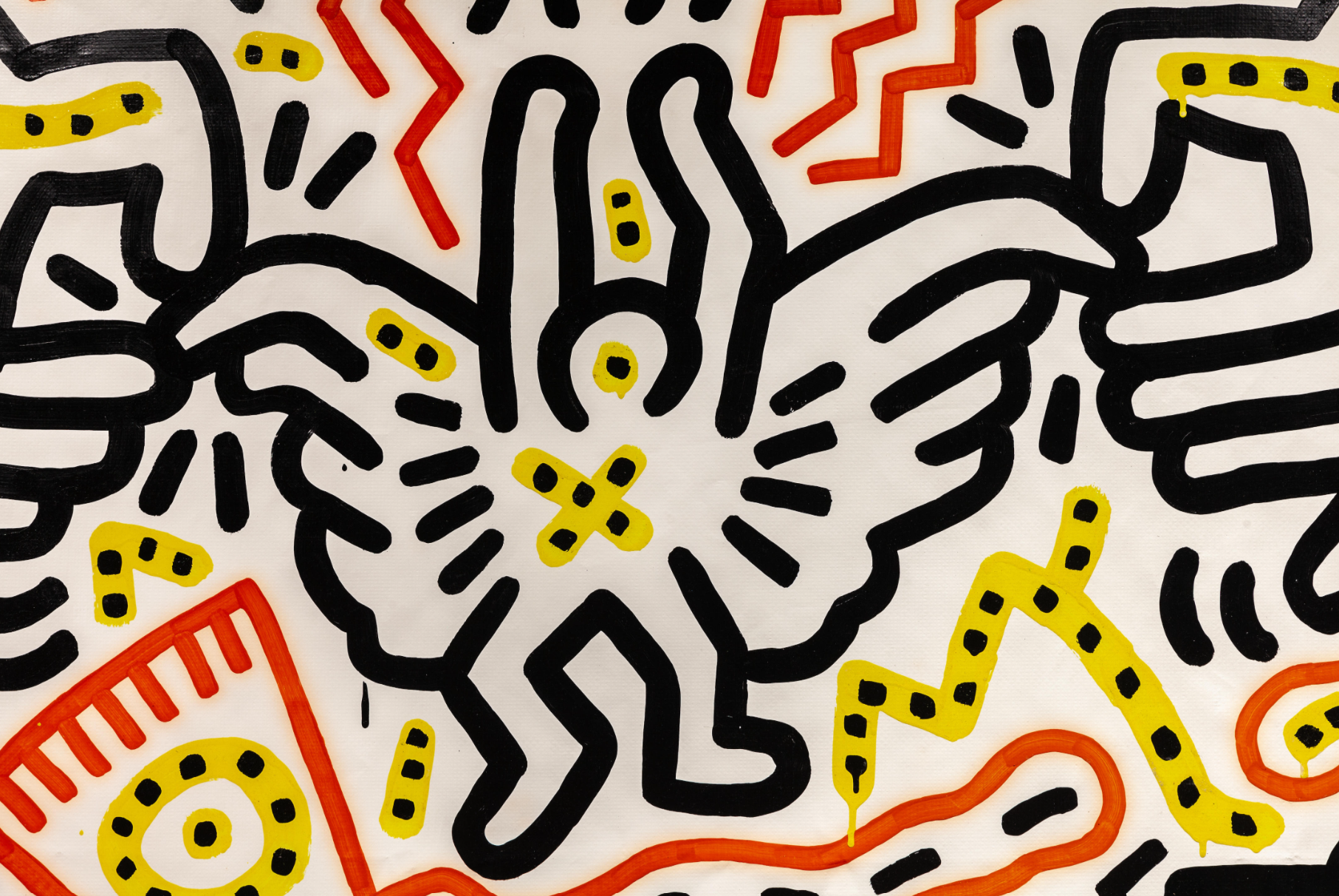
The present work was executed soon after, on 29 October 1983 and its exhibition history draws close parallels with Haring’s international rise to fame during this period. In the summer of 1984 the work would be displayed alongside that year’s Venice Biennale part of Aperto 84 (‘Open 84’), a new initiative conceived for the 1980 iteration. Aperto 84 was curated that year by John Roberts, the British critic and writer, and Haring’s works were displayed alongside Richard Hambleton amongst others.
Within days of being in Venice, it would be displayed at the Palazzo della Espozioni in Rome. Much of Haring’s exhibitions and connections with Italy were thanks to Salvatore Ala, who would own the present work for much of its early history. Ala was a famed Italian gallerist who championed many cutting-edge movements and artists including Arte Povera, Antony Gormley and Anselm Kiefer, who are now considered the protagonists of the period. Ala introduced Haring to Italy, a country which Haring quickly embraced, and hosted the first exhibition of the artist’s work in 1984. Haring’s own journals fondly reminisce of his weeks in Italy during this period, even remarking on Ala’s delivery of Coca-Cola and pizza for a late lunch every day.
Untitled is quintessentially Haring, whilst also being a work from a singular time in New York. Arguably one of Haring’s most complex works compositionally, it also carries a strong message. The work explodes with color, buzzing with fluorescent pink and pops of yellow. Theoretically simple in execution and only employing three colors, the work remains deeply dynamic – pulling the eye across its highly worked surface. Haring’s signature figures, characters with whom we have all become deeply familiar with in the cultural zeitgeist, can be found throughout the work: an angel, a dog and dancing figures all move, dance and jump throughout it. It also seems however to be a warning about the complications of unprotected sex. Mickey Mouse, a subject of fascination for Haring who appears throughout his oeuvre, is seen contemplating sex with a second figure, perhaps the devil. A figure wearing a gas mask, which can also be interpreted as a screw – an example of Haring’s strong ability to create double entendre – is placed between the figures of a devil and angel. The angel signaling not just an alternative to the devil – seen at the lower right-hand side of the composition with the trident, symbolically used throughout art history when depicting a demon – but also even alluding to death that might befall him from this choice.
Mickey Mouse is a staple character in Haring’s practice, one of the few not conceived from within his own imagination. The son of an illustrator, Haring grew up tracing and drawing the mouse as he developed his own hand as a draftsman. Disney seems to have been a topic of fascination for Haring even as a young adult, writing on 23 May 1977 about a trip to Disneyland “What a trip! It was like another world” (Keith Haring Journals, London 2010, p. 5).
Mickey remains inescapable from immediate recognition but his force as a cultural figure in the post-war period cannot be understated. So much so that Roy Lichtenstein, the grand master of Pop Art, would use Mickey in one of his earliest paintings Look Mickey (1961) which is now in the collection of the National Gallery of Art, Washington. Andy Warhol, a friend of Haring’s, also depicted the iconic mouse as part of his Myths series alongside other immediately recognizable figures such as Superman and Santa Claus. Haring certainly took inspiration from the Pop movement, but he also used Mickey as a naïve, child-like figure in his works, using him to instill joy and innocence in paintings which simultaneously capture the grit and darkness of the 1980s.
In addition to the Pop artists, many of whom he knew personally, Haring’s works also grow out of the legacy of Jean Dubuffet whom he looked to throughout his career. In his journal on 7 November 1978 Haring wrote, “I hope I am not vain in thinking that I may be exploring possibilities that artists like Stuart Davis, Jackson Pollock, Jean Dubuffet and Pierre Alechinsky have initiated but did not resolve. Their ideas are living ideas.” On 7 July 1986 Haring continues to espouse his admiration for Dubuffet when he writes that Dubuffet’s speech at the Art Institute of Chicago on the misconception of beauty in Western culture is “one of my favorite things written by another artist” (Keith Haring Journals, New York 2010, p. 129). Dubuffet’s works perfectly synthesize post-war Paris in new ways whilst employing revolutionary mediums. Works such as Houel de Virtuel (1963) use discrete sections of color and line to imply the dizzying frenzy of Paris in the midst of post-war recovery. In that vein, Haring’s works such as Untitled use modern materials, such as the tarp and fluorescent paint in a hip-hop mash-up of graffiti, animation, and cartooning to truly capture the energy of 1980s New York.
A particular admirer of the artist Christo, Haring viewed himself from the beginning as a public artist. Some of Haring’s most celebrated works are murals bedecking locations around the world from the Berlin Wall, to the Princess Grace Maternity Hospital, Monaco to public pools and billboards around New York City. His interest in this kind of public art, painted on a grand, almost historical scale, is also seen in the present work where the artist paints on a monumental tarpaulin measuring almost ten feet square (three meters). The tarp connects the work to the street art culture that was taking place around him yet also allows for the work to travel and be displayed internationally, furthering his message arguably more than a mural could.
Beyond murals, Haring had become the artist behind many of the social activism campaigns of the decade. Devoid of unnecessary details, his works displayed the power evident in simple imagery which saw them quickly used for causes associated with UNICEF, AIDS, literacy and even the fight against apartheid in South Africa. He was highly sought-after to participate in collaborative projects with children and corporations, bringing his work to a large international audience from the outset.
The rest of the decade was prolific and busy for Haring with his international recognition continuing to rise through exhibitions at major institutions globally including at the Stedelijk Museum, Amsterdam, The Whitney Museum of American Art, New York, the Musée d’Art Moderne de la Ville de Paris, the Hirshhorn Museum, Washington, The Louisiana Museum of Art, Humlebæk and the Institute of Contemporary Art, London.
Haring was diagnosed with AIDS in 1988. In 1989, he established the Keith Haring Foundation, its mandate being to provide funding and imagery to AIDS organizations and children’s programs, and to expand the audience for Haring’s work through exhibitions, publications and the licensing of his images. Haring enlisted his imagery during the last years of his life to speak about his own illness and generate activism and awareness about AIDS. Keith Haring died in New York City at the age of 31 on February 16, 1990. Thousands of mourners attended his memorial a few months later.
Despite his premature death, Haring’s legacy was immediate and long lasting. Career retrospectives began in 1993 in Japan and continued in Miami, San Francisco, Montreal, New York, Toronto, Madrid, Vienna, Sydney and Wellington. Later this year the Tate Liverpool will stage the artist’s first UK retrospective. Haring’s virtuostic ability to render joy, life, sadness and strong messages using simple lines and recurring figures has made him arguably one of the most internationally recognized artists around the world. With some of his murals still intact, and much of his other imagery experiencing an even further reach in the Internet world, his legacy and importance intensifies to this day.
Glowing with effervescent colors and humming with movement, works of this scale, medium and year, are extremely rare on the market. Indicative of the social and artistic scene of the 1980s, as well as Haring’s singular gift for monumental public art, Untitled remains a superlative example of Keith Haring’s practice that would influence not just artists but humanity the world over for the decades since his death.