Kaws
Top Lots at Auction
#1. The Kaws Album
Sotheby’s Hong-Kong, 1 April 2019
USD 14,773,492
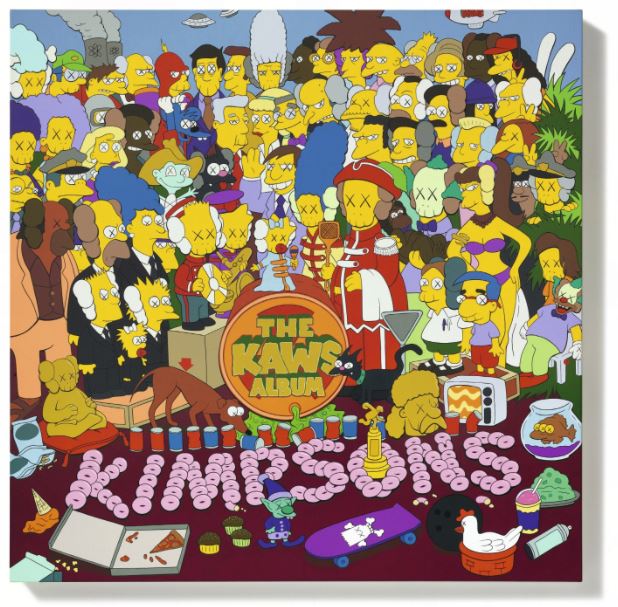
Released in 1967, The Beatles’ era-defining Sgt. Pepper album was lauded by critics for its bridging of popular music, high art and contemporary counterculture. THE KAWS ALBUM follows in its legendary footsteps in its bold straddling and uniting of genres, cultures and subcultures. Exemplifying KAWS’s formal agility as an artist, the piece is the most accomplished work on canvas the KAWS ever created.
Commissioned by NIGO® in 2005, THE KAWS ALBUM is an appropriation of an appropriation – KAWS’s take on The Simpson’s The Yellow Album, which was itself a parody of The Beatles’ 1967 album Sgt. Pepper’s Lonely Hearts Club Band. In this historical ‘family portrait’, KAWS includes the whole host of his Kimpsons characters with their trademark sprouting puffy crossbones and X’ed eyes.
#2. Untitled (Kimpsons #1)
Sotheby’s Hong-Kong, 6 October 2019
USD 7,382,553
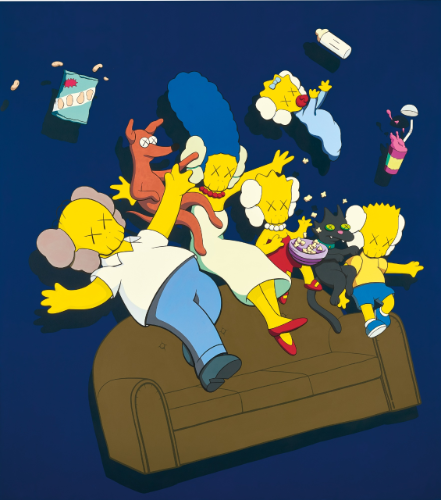
UNTITLED (KIMPSONS #1), 2004
Acrylic on canvas
274.5 x 244 cm (108×96 inches)
Captured in mid-air, suspended at the apex of their projectile trajectory, the KIMPSON family flails with a comic helplessness amplified by their X-ed out eyes, a signature of the artist. The impact is unknown. No context is given. What is at stake is simply the instantly recognizable cartoon silhouettes and the iconic flash of yellow.
UNTITLED (KIMPSONS #1) is the largest work amongst KAWS’s (a.k.a. Brian Donnelly’s) iconic KIMPSONS paintings. Commissioned by NIGO® in 2004 and created at a critical juncture of the artist’s career, the KIMPSONS works were the first formal paintings on canvas created by KAWS. Painted by hand with Chromacolour paint, a unique acrylic pigment primarily used by animators, these KIMPSONS paintings manifest as the quintessence of the artist’s anarchic painterly enterprise.
#7. Untitled (KIMPSONS)
Sotheby’s Hong-Kong, 1 April 2019
USD 2,697,589
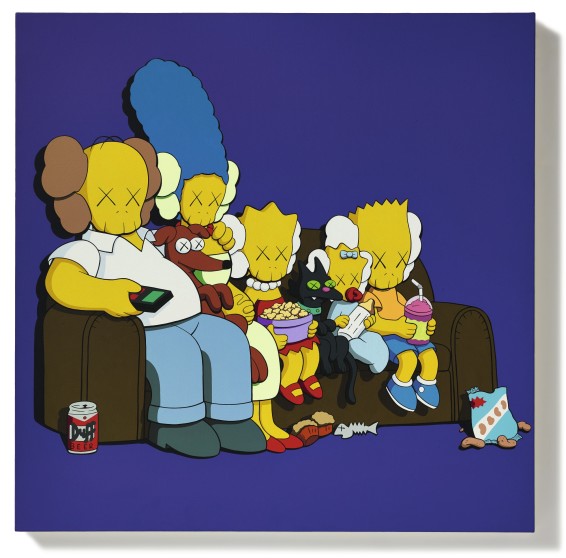
UNTITLED (KIMPSONS), 2003
Acrylic on canvas
40×40 inches (101.6 x 101.6 cm)
KAWS shows his wit, vision and irreverence, which crisscrosses an ever-expanding network of humanity – from the artist to NIGO®, from cartoon characters to the American public, and from the hitherto enclosed sphere of fine art to street art to television and to the entire world. It is a gargantuan apotheosis of the brilliant insurgence of one of the most influential artists of our time.
#3. The Walk Home
Phillips New-York, 16 May 2019
USD 5,955,000
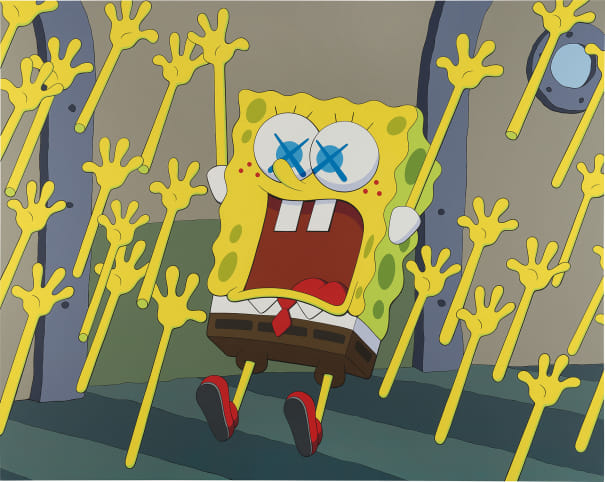
The Walk Home, 2012
Acrylic on canvas
173 x 219.1 cm (68 1/8 x 86 1/4 inches)
THE WALK HOME is a quintessential example of the artist’s ability to communicate complex human emotion through reclaimed cartoon imagery. In the present work, KAWS depicts the ever‐popular animated character, SpongeBob SquarePants, using line and flat, evenly saturated colors in “an almost rubber-like matte finish”, similar to that of cartoons or toys (KAWS, quoted in KAWS: WHERE THE END STARTS, exh. cat., Modern Art Museum of Fort Worth, Fort Worth, 2016, p. 72). KAWS makes SpongeBob his own by obliterating the character’s eyes with his signature X-motifs. Presented on a scale akin to the grand tradition of history painting, KAWS captures the moment when SpongeBob, teetering on the heels of his bright red shoes, appears to be scared off his feet, his mouth agape in a shriek. Surrounding SpongeBob are over a dozen pairs of disembodied arms, echoing the protagonist’s own raised limbs. In their disembodiment, these fragmented forms serve as a precursor to KAWS’s more recent work where he strips cartoon visages of the salient features that convey emotion and reconstitutes those elements into an abstracted amalgamation.
In THE WALK HOME, the catalyst of SpongeBob’s overwhelming anxiety is placed beyond the confines of the picture plane. The audible manifestation of the scene is conveyed in the repeated arms contained within the compositional frame, that ostensibly function like the physical action exclamations of cartoons like “POW!” or “BAM!”. This technique more aptly recalls a scene on infinite loop, one that never comes to narrative fruition, rather than a cartoon strip. In so doing, KAWS succeeds in emphasizing the magnitude of emotion captured in a single moment. By starting with the cartoon as his reference point, a genre characterized by short narratives, KAWS utilizes the televised series’ simplification for his greater goal. Combined with his deconstructive approach of isolating parts of the whole to comprise his seemingly familiar vignettes, KAWS complicates the viewer’s narrative reading of the scene and compels us to imbue the work with our own suppositions. As curator Mónica Ramírez-Montagut explains, “…we recognize the cartoon characters yet, with KAWS’s intervention, the meaning becomes somewhat subverted…Since we are familiar with these characters…we in fact feel empowered to ponder the meaning and have an opinion. Thus it is up to us to decide whether these are homages or criticisms” (Mónica Ramírez-Montagut, KAWS, exh. brochure, The Aldrich Contemporary Art Museum, Ridgefield, 2010, online).
#4. In the Woods
Christie’s New-York, 16 May 2019
USD 3,855,000
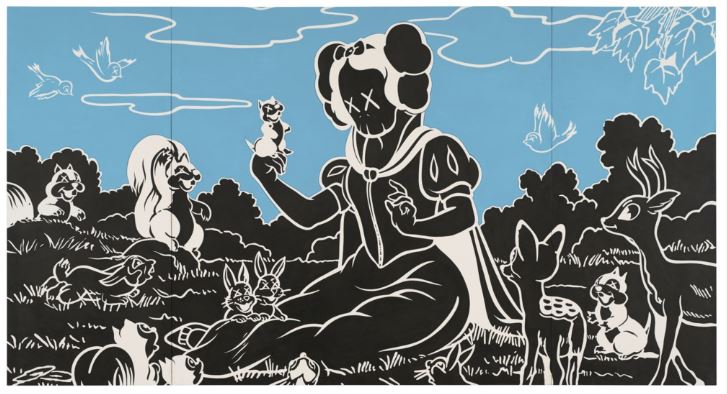
In The Woods, 2002
triptych—acrylic on canvas over panel
overall: 147.6 x 275.3 cm (58 1/8 x 108 3/8 inches)
The iconic character of Snow White has captivated the hearts of generations, renowned for the beauty, purity, and innocence that her name suggests. In 1937, Disney chose the original, nineteenth-century fairytale written by the Grimm Brothers as the first that it would transform into a feature-length animated film. Reclaimed in the twenty-first century by the Brooklyn-based artist KAWS, Snow White’s innocence is transformed into an acerbic critique within IN THE WOODS (2002). An approximation of a scene from the Disney classic Snow White and the Seven Dwarfs has been reduced to a dense black palette with crisp white outlines, offset by a whimsical sky-blue background. In the original scene, Snow White is comforted by a league of woodland animals that transform her tears into “A Smile and a Song.” In KAWS’s version, the title character instead holds up a chipmunk to her face, and not a bluebird, while an array of bunnies, deer, and others gather around her, entranced by her beauty. However, stripped of color, with her eyes crossed out in the artist’s signature X-marks style and her hair modified to the famed cross-bone design, KAWS’ interpretation takes on the sinister undertones that are at the core of his practice of appropriation, in which classic cartoon and comic book icons are repurposed to explore the visual language within popular culture, and the role it plays in society.
#5. Armed Away
Christie’s Hong-Kong, 25 May 2019
USD 3,073,000
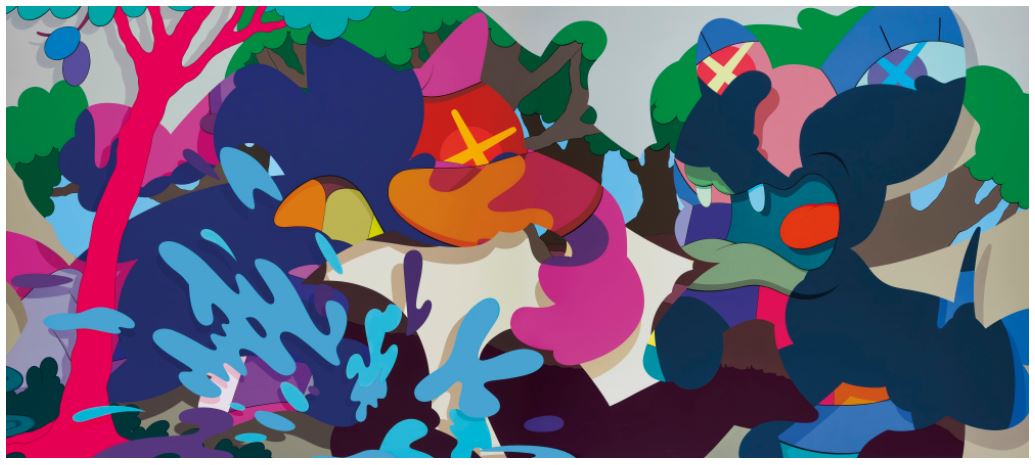
ARMED AWAY, 2014
Acrylic on canvas
87 7/8 x 198 inches (223.2 x 503 cm)
Signed and dated ‘KAWS..14’ (on the reverse)
KAWS, an amalgamation of his city-driven and graffiti-inspired upbringing, has vehemently established his position in the lexicon of Contemporary Art. ARMED AWAY is not only prodigious in scale, but boundless in its complexity. Standing in front of ARMED AWAY you are immediately drawn in by the artist’s explosive and instantly recognizable vibrant palette. The scale allows KAWS to exercise his proficiency as a colorist in a method seldom captured to this extent. Like no other artist has done since Jean-Michel Basquiat and Keith Haring, he has transformed his street art and graffiti sensibility into the upper echelons of fine art galleries and institutions. ARMED AWAY epitomizes all that is loved within the new iteration of Pop sensibility which KAWS has continuously transformed. The cartoon and comic imagery instantly conveys the feeling of Roy Lichtenstein’s pop heroes and heroines, while the lively swathes of color and repetition of imagery inspire visions of Warhol’s effortless refinement of pop culture.
The sharpness of the figures outlines and associated shadows create a vision, which is striking in its trompe l’oeil complexity. The artist creates a flat surface that is more alive with movement than most three-dimensional objects. The energy and motion created in the present artwork painted in conjunction with the most recognizable images of our contemporary ecosystem exemplify what is loved by KAWS viewers. Presented in KAWS 2014 solo exhibition as an integral artwork, “…a landscape that pictures Tom chasing Jerry offers an immersive dystopian scene of environmental disaster.” The momentous cartoonish figures with classic XX eyes are emblazoned onto a surreal landscape. Neon and emerald colored trees are simultaneously interspersed within a dreamy mountain range. The shapes from which the figures are set convey feelings of abstraction, from gestural to hard edge abstract masters of the 1960s and 1970s. The calculated yet chaotic nature of the composition recalls the controlled spontaneity of a Jackson Pollock drip painting. Rarely does KAWS include a fully rendered landscape – such as the present painting – this exceptional opportunity allows his signature characters to live within an entirely different universe, encouraging the viewer to explore KAWS’s environment in greater depth.
#6. Fatal Group
Phillips New-York, 15 November 2018
USD 2,716,500
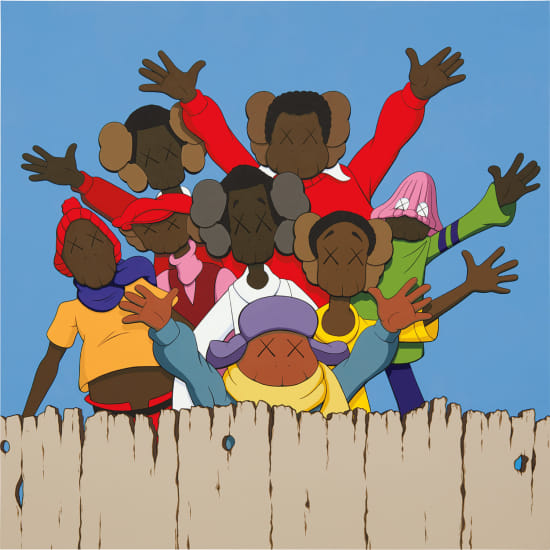
UNTITLED (FATAL GROUP), 2004
Acrylic on canvas
68 1/8 x 68 1/8 inches (173 x 173 cm)
Painted in 2004, KAWS’s playfully irreverent UNTITLED (FATAL GROUP) is exemplary of the artist’s unique visual lexicon that deconstructs the division between popular culture and fine art. Composed on an immersive scale akin to the grand tradition of history or myth painting, this enigmatic work evinces KAWS at his most technically accomplished and conceptually resolute. Painted with such perfected clarity that there is no trace of the artist’s hand, the careful balance of block colors and monotone shadows harnesses an emotive nostalgia that supports KAWS’s longstanding project of appropriating children’s cartoon characters. The present work refigures the cast of the animated series The Fat Albert Show with their heads composed in the artist’s trademark cross-eyed skulls. Reading like a movie poster without text, this image provides an entrancing scene that challenges the artifice of familiar mass media images and a saturated contemporary visual culture.
With UNTITLED (FATAL GROUP), KAWS alludes to the historic genre of the group portrait that was popularized in 16th and 17th century Europe, but, rather than depicting nobility, he selects a familiar image from children’s entertainment. Running from 1972 to 1985, The Fat Albert Show was a popular animated television show for children. Inspired by cartoon imagery, KAWS essentially inserts himself into a long tradition of appropriation within a fine art context: from Marcel Duchamp’s infamous “R. Mutt” signature on his 1917 rendition of Fountain, through to Andy Warhol’s Campbell’s Soup cans and the photographic appropriation of The Pictures Generation. Yet, rather than re-contextualizing faithful copies of an original, KAWS interprets the Fat Albert cast in his own, highly distinct visual language that echoes Michael Auping’s observation that “KAWS is not just referring to pop culture, he is making it” (Michael Auping, “America’s Cartoon Mind”, KAWS: WHERE THE END STARTS, exh. cat., Modern Art Museum of Fort Worth, Fort Worth, 2016, p. 63).
#8. KURF (HOT DOG)
Sotheby’s New-York, 16 May 2019
USD 2,660,000
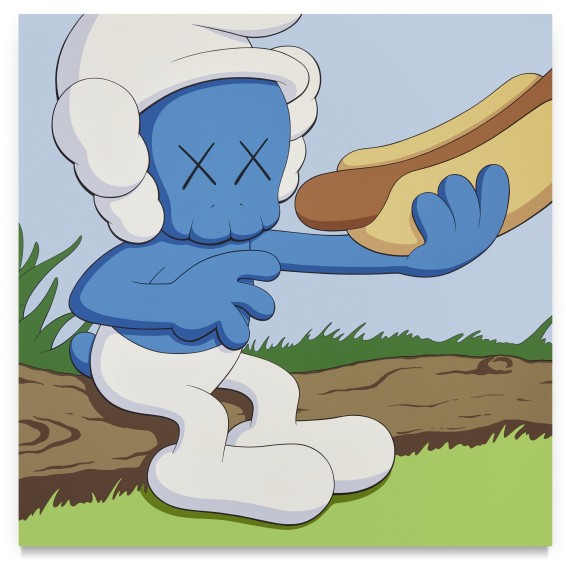
KURF (HOT DOG), 2008
Acrylic on canvas
68×68 inches (172.7 x 172.7 cm)
Another work epitomizing the playful dynamism and sophisticated manipulation of familiar imagery that distinguishes the acclaimed output of KAWS, Kurf (Hot Dog) is composed of vibrantly saturated colors and boldly defined forms. The figure is outfitted in the guise of a Smurf, the humorous woodland character familiar from innumerable comics and toys of childhood. However, it is marked by the artist’s signature ‘X’ eyes, a sinister and fascinating hallmark of his practice. Like many of his works, it examines the psychology of contemporary society through an intriguing cast of cartoon characters.
#9. KURF (TANGLE)
Christie’s New-York, 15 May 2019
USD 2,655,000
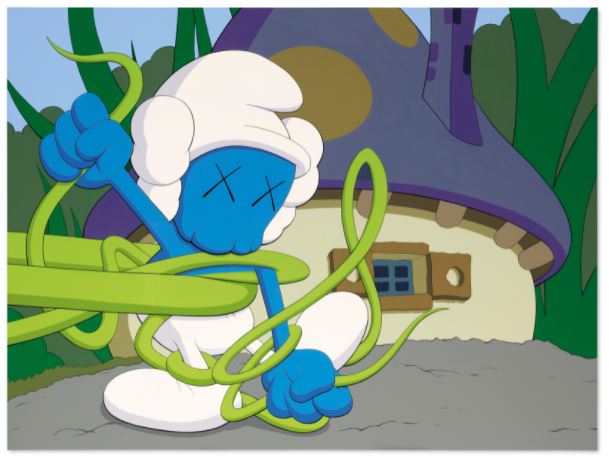
KURF (TANGLE), 2008
Acrylic on canvas
72×96 inches (182.8 x 243.8 cm)
Tangled up in a lime green vine, the titular Kurf grapples with its entrapment using fist and foot. Rendered with KAWS’s exacting attention to the original animation style, the figure is nonetheless seen sporting the artist’s signature skull and crossbones head with ‘x’s for eyes. This negation of personality makes for an oddly confrontational reading of the otherwise ubiquitous children’s character. The rest of the scene takes on the look of an animation cell as the background is less bold than the action at the front. A small house built into the cap of a mushroom sits squatly in the towering greenery as the battle between Kurf and vine continues in the foreground. This strangely violent scene, coupled with the artist’s alterations, casts the Saturday morning cartoon in a darker light. “By giving the comics a new face,” writes Germano Celant, “the artist seems to aspire to update their past, which is not simply playful and lyrical, but can also be frightening and deathly. Hence the masks with ‘sewn’ eyes that do not look ahead but inside at their own stories…” (G. Celant, “BD and K,” in KAWS: 1993-2010, exh. cat., Aldrich Contemporary Art Museum, 2010, p. 55). Never one to take things at face value, KAWS’s investigations into the absurdity of animation and its crossover into the real world continue unabated.