Auction Results
#1. Portrait of an Artist (Pool with Two Figures), 1972
Christie’s New-York: 15 November 2018
Estimate on Request
USD 90,312,500
David Hockney (b. 1937) (christies.com)
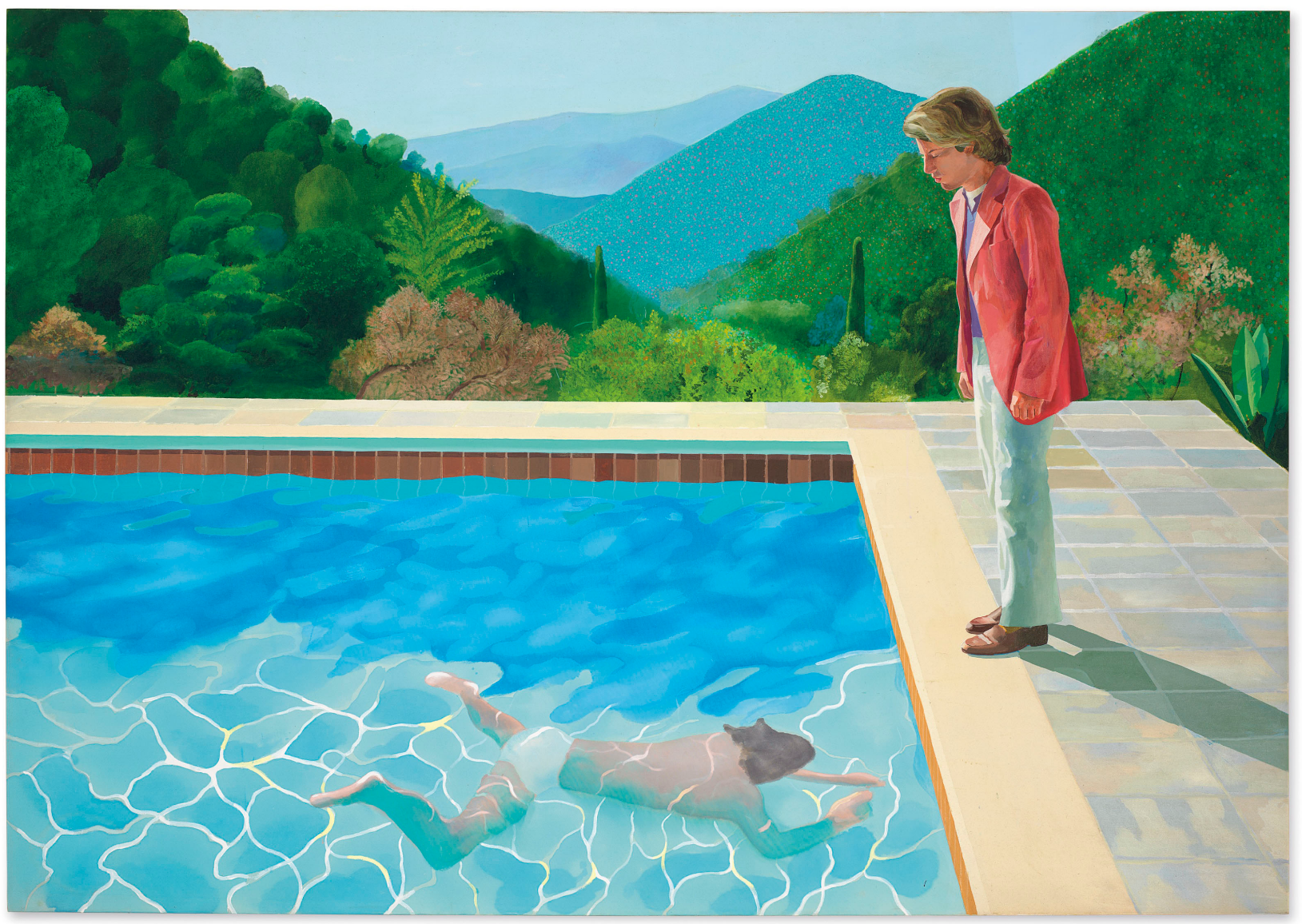
DAVID HOCKNEY
Portrait of An Artist (Pool with Two Figures), 1972
Acrylic on canvas
213.5 x 305 cm (84.1 x 120.1 inches)
#2. Henry Geldzahler and Christopher Scott, 1969
Christie’s London: 5 March 2019
Estimate on Request
GBP 37,661,250 / USD 49,300,648
David Hockney (b. 1937), Henry Geldzahler and Christopher Scott | Christie’s
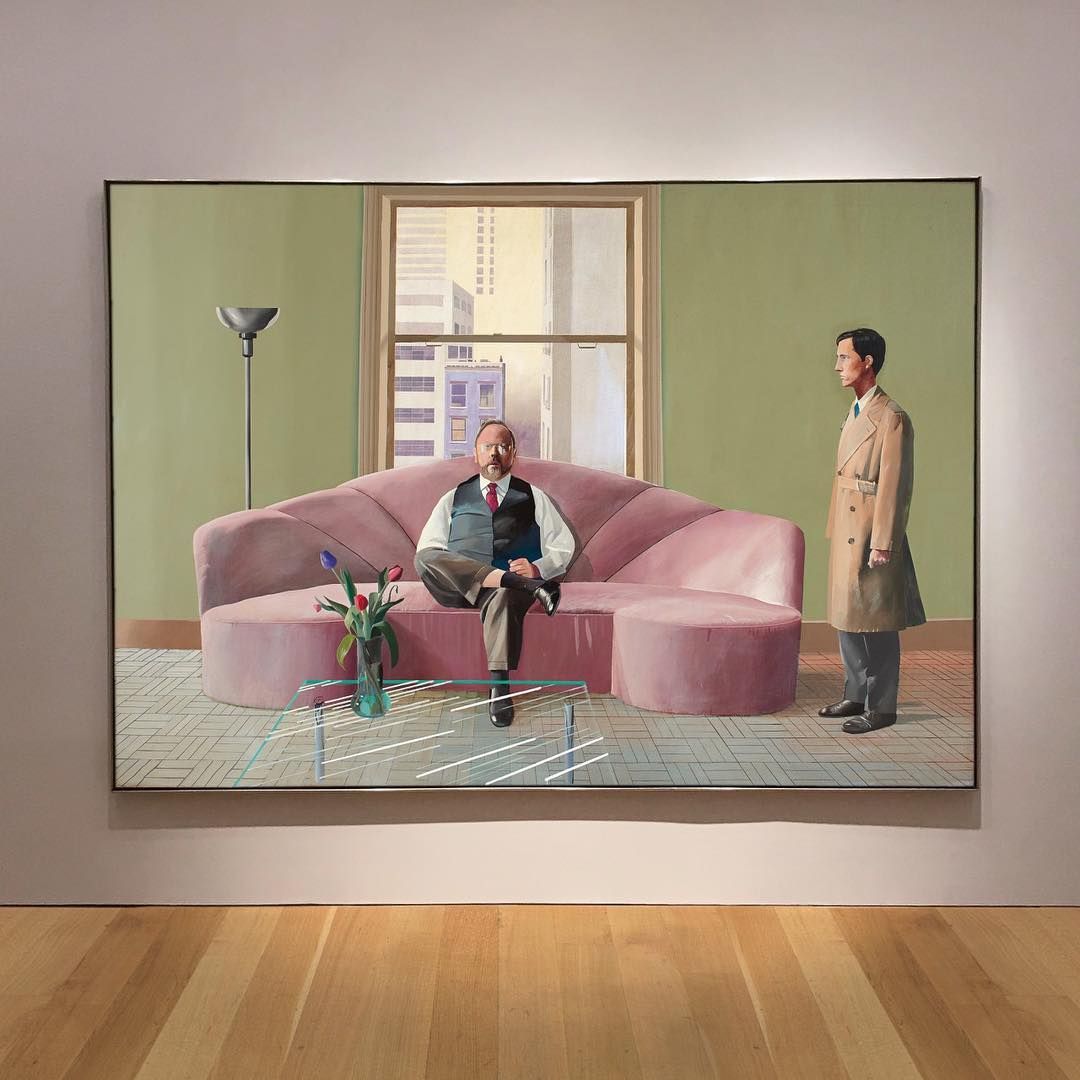
Henry Geldzahler and Christopher Scott, 1969
Acrylic on canvas
84×120 inches (214 x 305 cm)
Painted in 1969
#3. Nichols Canyon, 1980
Phillips New-York: 7 December 2020
Estimate on Request
USD 41,067,500
David Hockney – 20th c. & Contempor… Lot 10 December 2020 | Phillips
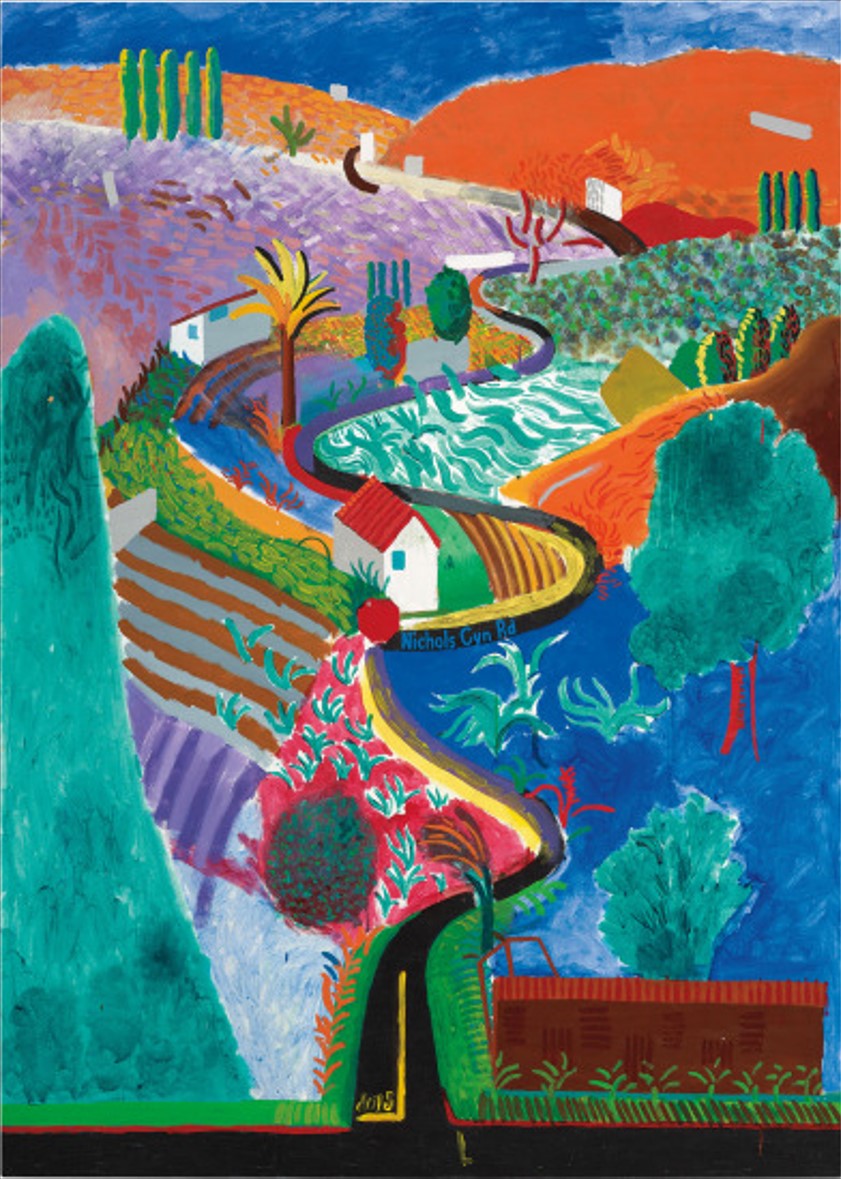
DAVID HOCKNEY
Nichols Canyon, 1980
Acrylic on canvas
84×60 inches (213.4 x 152.4 cm)
#4. The Splash, 1966
Sotheby’s London: 11 February 2020
Estimated: GBP 20,000,000 – 30,000,000
GBP 23,117,000 / USD 29,884,183
(#16) DAVID HOCKNEY | The Splash
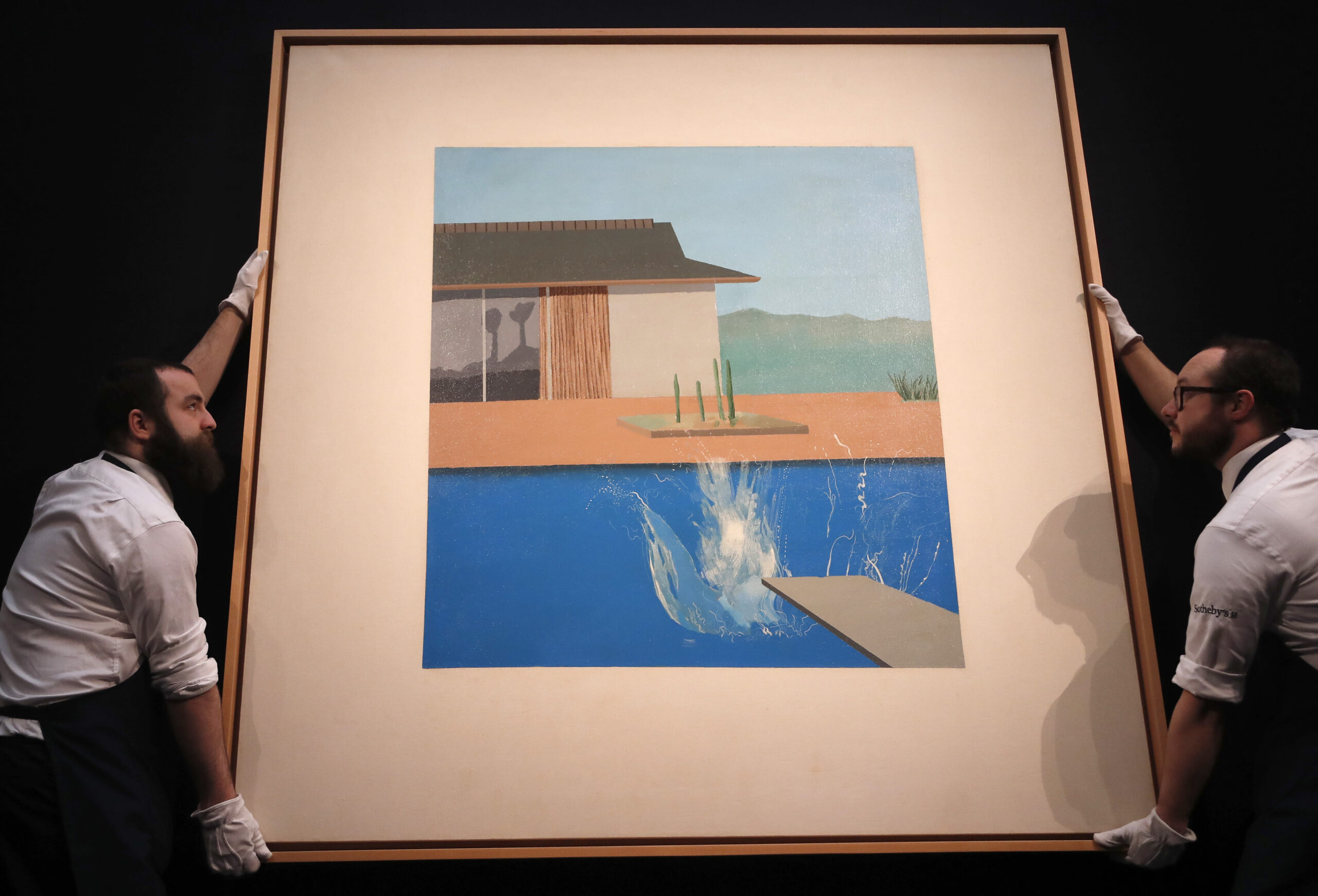
DAVID HOCKNEY
The Splash, 1966
Acrylic on canvas
72×72 inches (183×183 cm)
Signed, titled and dated 1966 on the reverse
#5. Sur la Terrasse, 1971
Christie’s New-York: 12 November 2019
Estimated: USD 25,000,000 – 45,000,000
USD 29,501,250
David Hockney (b. 1937), Sur la Terrasse | Christie’s
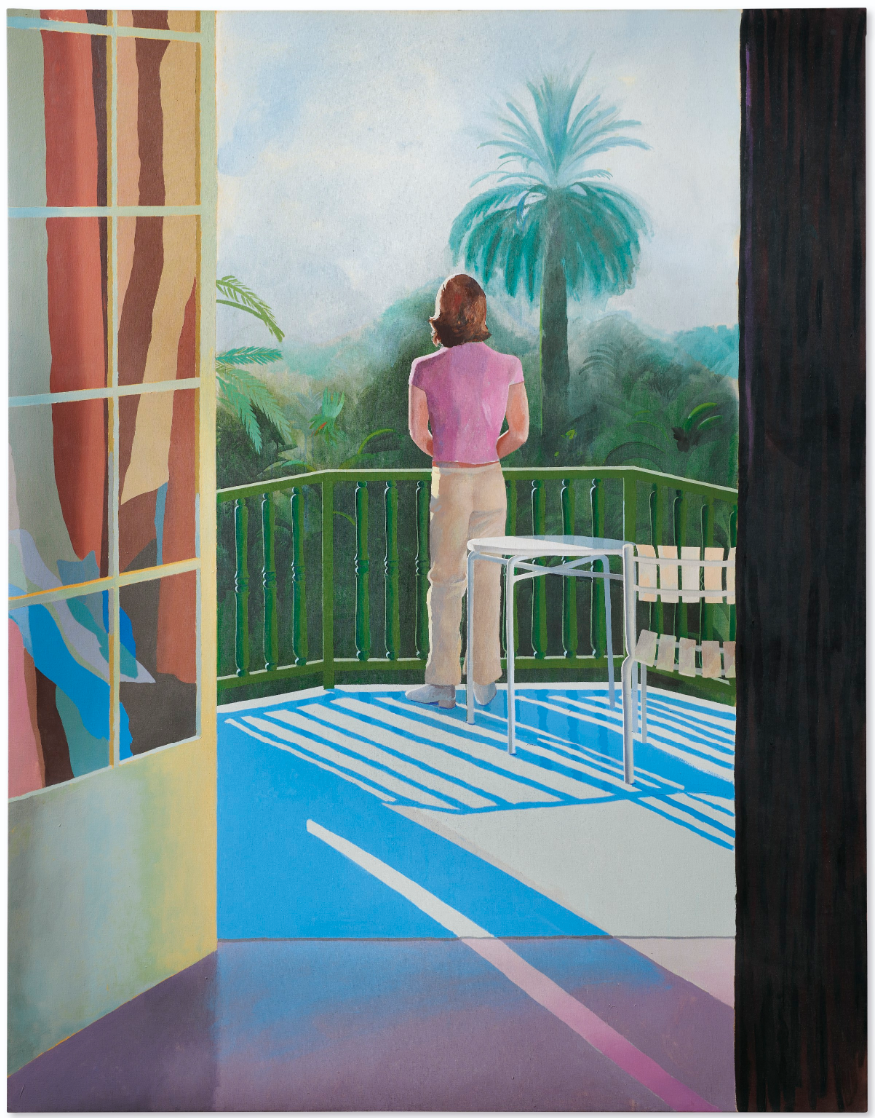
DAVID HOCKNEY
Sur la Terrasse, 1971
Acrylic on canvas
108×84 inches (274.5 x 213.5 cm)
#6. A Lawn Being Sprinkled, 1967
Christie’s New-York: 14 May 2024
Estimated: USD 25,000,000 – 35,000,000
USD 28,585,000
DAVID HOCKNEY (B. 1937), A Lawn Being Sprinkled | Christie’s (christies.com)

DAVID HOCKNEY (B. 1937)
A Lawn Being Sprinkled, 1967
Acrylic on canvas
60×60 inches (152.4 x 152.4 cm)
Signed, inscribed, titled and dated ‘”Lawn being sprinkled” David Hockney Los Angeles 1967’ (on the reverse)
#7. Pacific Coast Highway and Santa Monica, 1990
Sotheby’s New-York: 16 May 2018
Estimated: USD 20,000,000 – 30,000,000
USD 28,453,000
DAVID HOCKNEY
Pacific Coast Highway and Santa Monica, 1990
Oil on canvas
78×120 inches (198.1 x 304.8 cm)
Signed, titled and dated 1990 on the reverse
#8. California, 1965
Christie’s London: 7 March 2024
Estimate on Request
GBP 18,710,000 / USD 23,724,280
DAVID HOCKNEY (B. 1937), California | Christie’s (christies.com)
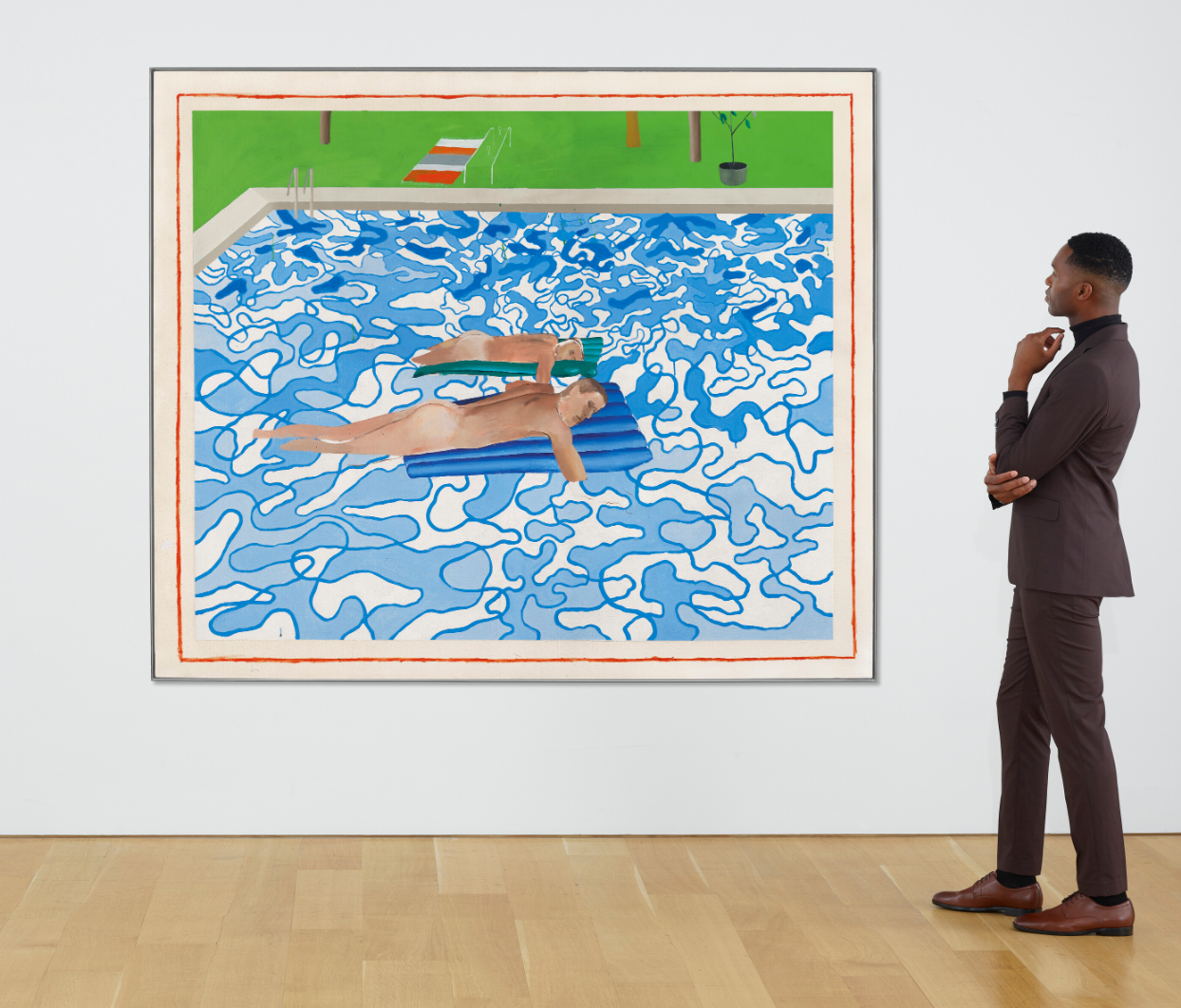
DAVID HOCKNEY (B. 1937)
California, 1965
Acrylic on canvas
66 1/8 x 78 1/4 inches (168 x 198.8 cm)
#9. Winter Timber, 2009
Christie’s New-York: 9 November 2022
Visionary: The Paul G. Allen Collection
Estimated: USD 10,000,000 – 15,000,000
USD 23,290,000
DAVID HOCKNEY (b. 1937), Winter Timber | Christie’s
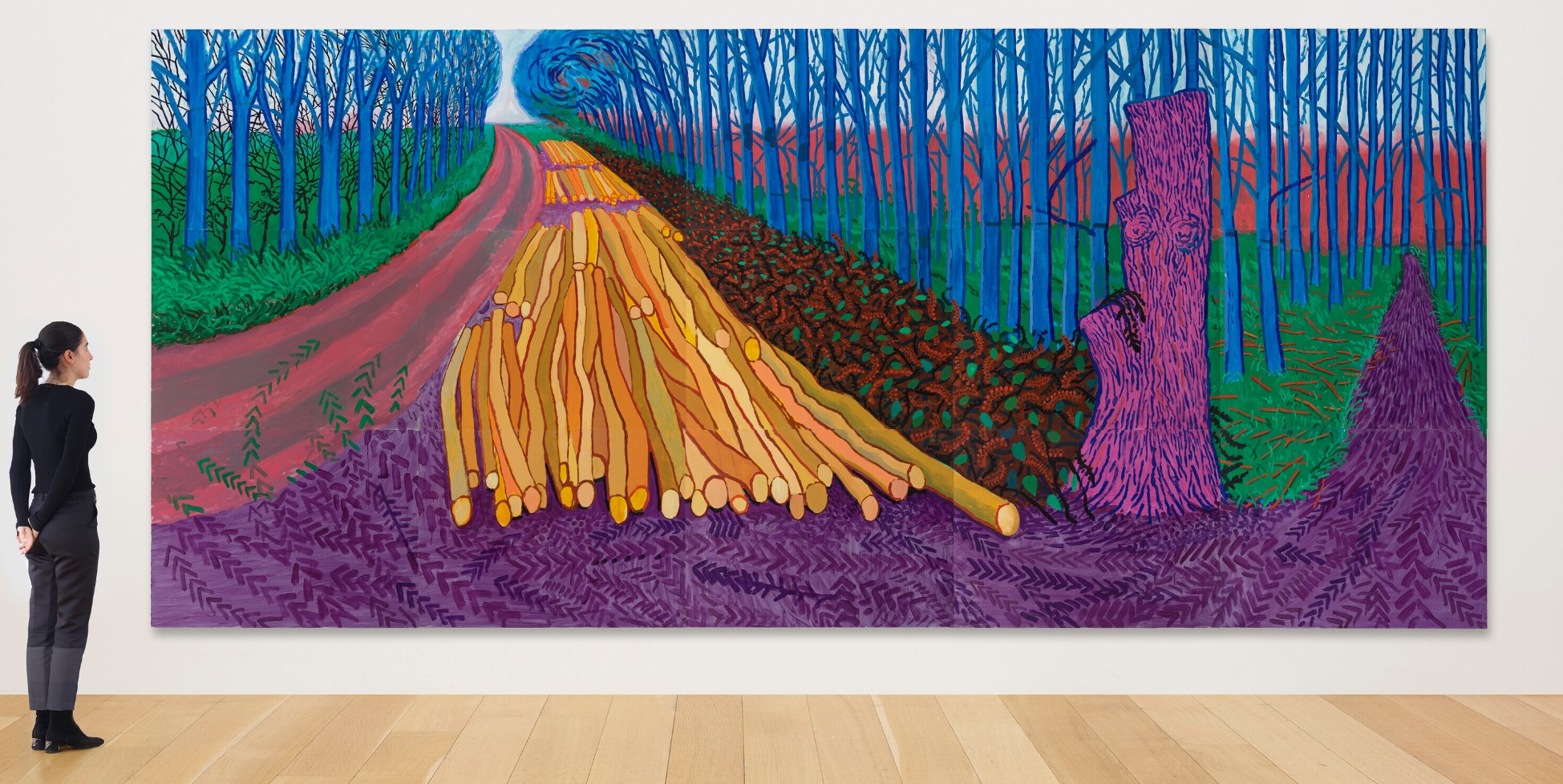
Winter Timber, 2009
Oil on canvas, in 15 parts
Overall: 108 x 240 inches (274.3 x 609.6 cm)
#10. Early Morning, Sainte-Maxime, 1968-1969
Christie’s London: 13 October 2022
Estimated GBP 7,000,000 – 10,000,000
GBP 20,899,500 / USD 23,706,330
DAVID HOCKNEY (B. 1937), Early Morning, Sainte-Maxime | Christie’s
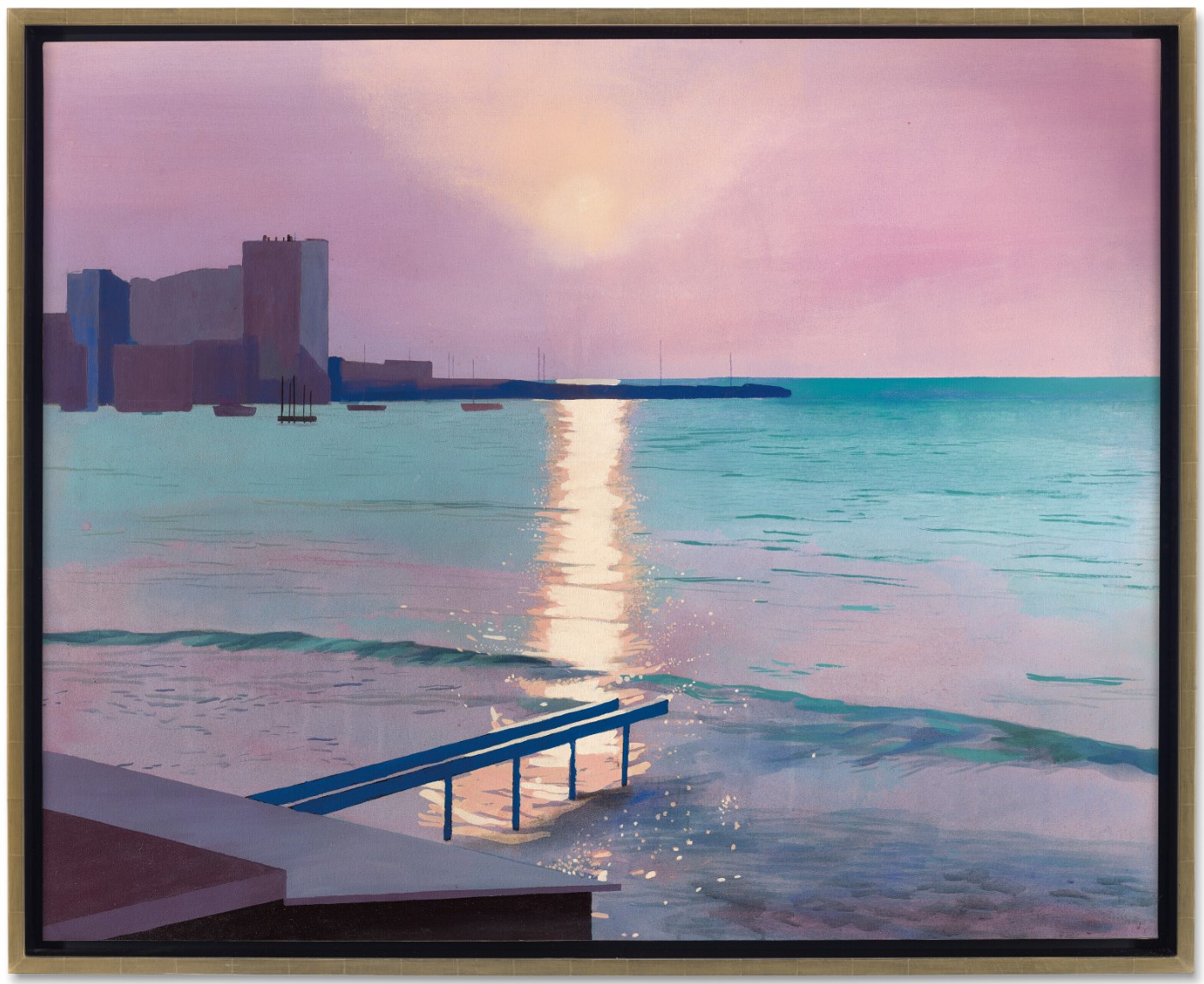
DAVID HOCKNEY
Early Morning, Sainte-Maxime, 1968-1969
Acrylic on canvas
48 1/8 x 60 1/8 inches (122.1 x 152.6 cm)
USD 20 million
#11. Early Blossom, Woldgate, 2009
Christie’s New-York: 11 May 2023
Visionary: The Paul G. Allen Collection
Estimated: USD 5,000,000 – 7,000,000
USD 19,385,000
DAVID HOCKNEY (B. 1937), Early Blossom, Woldgate | Christie’s
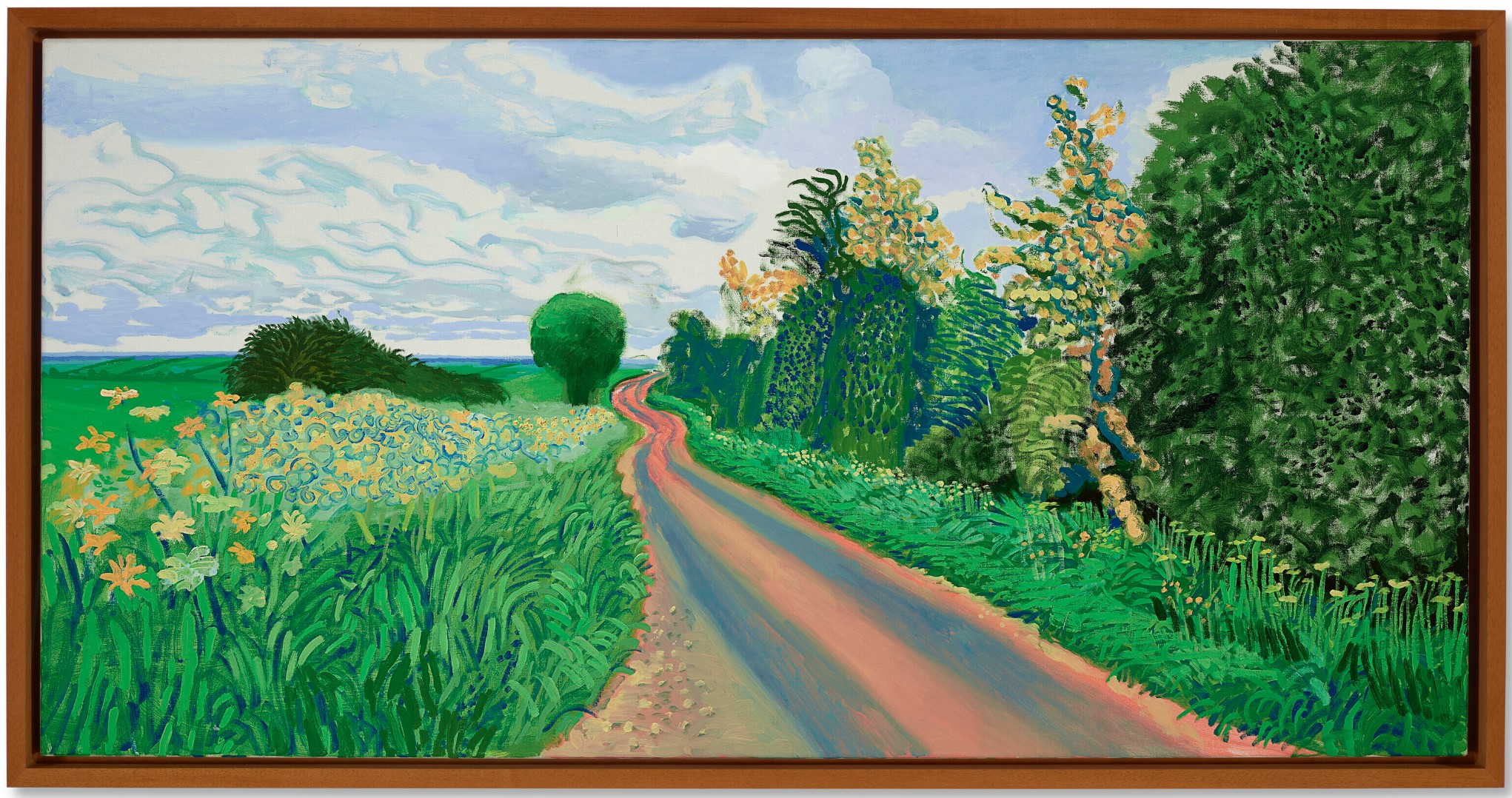
DAVID HOCKNEY (B. 1937)
Early Blossom, Woldgate, 2009
Oil on canvas
36×72 inches (91.4 x 182.9 cm)
Signed, titled and dated ‘Early Blossom Woldgate 2009 David Hockney’ (on the reverse)
#12. Still Life on a Glass Table, 1971
The Collection of Mica Ertegun
Christie’s New-York: 19 November 2024
Estimated: USD 15,000,000 – 20,000,000
USD 19,040,000
DAVID HOCKNEY (B. 1937), Still Life on a Glass Table | Christie’s
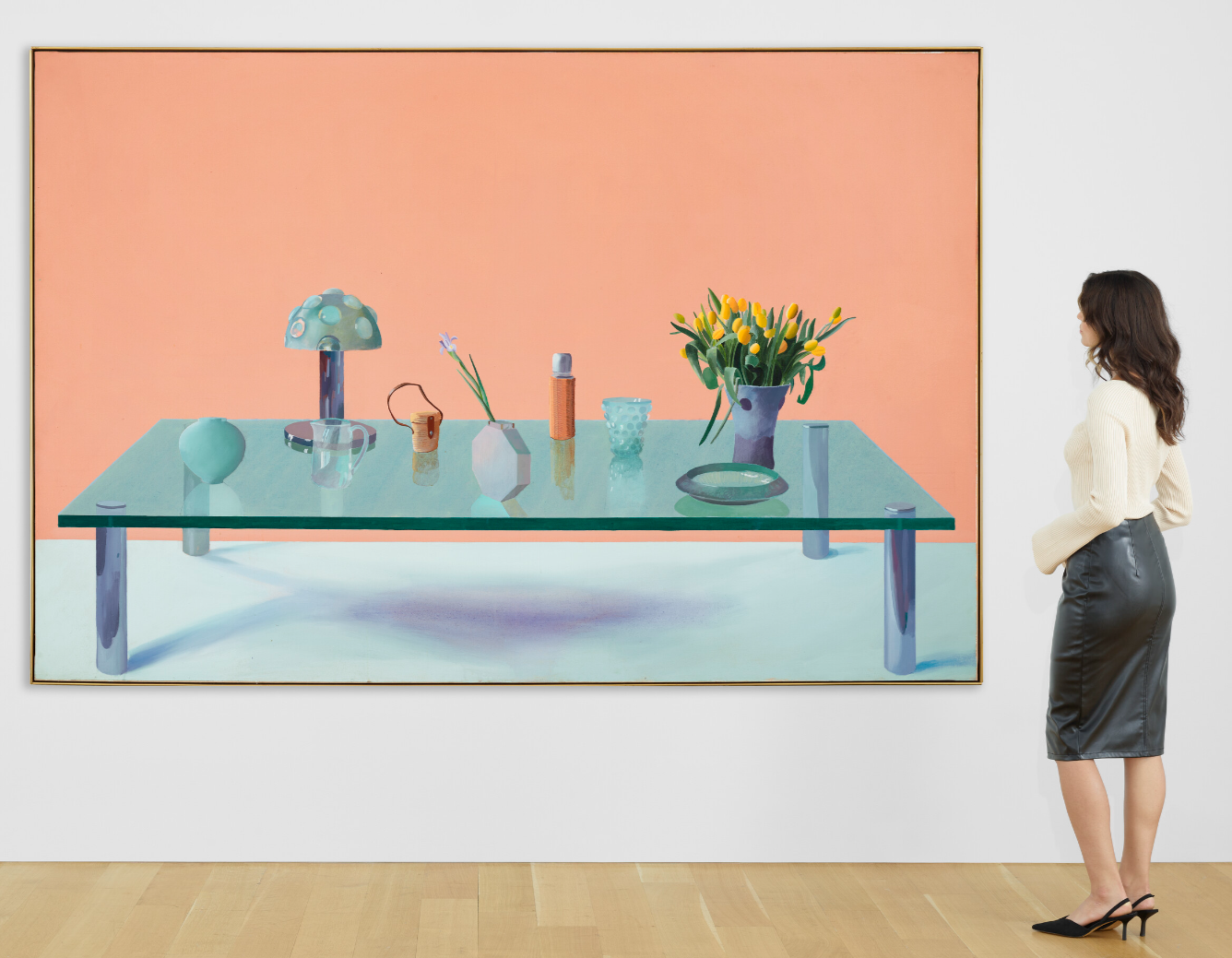
DAVID HOCKNEY (B. 1937)
Still Life on a Glass Table, 1971
Acrylic on canvas
72×108 inches (182.9 x 274.3 cm)
#13. Garrowby Hill, 2017
Sotheby’s London: 2 March 2022
Estimated: GBP 7,500,000 – 10,500,000
GBP 14,093,950 / USD 18,839,660
Garrowby Hill | Modern & Contemporary Evening Auction | 2022 | Sotheby’s
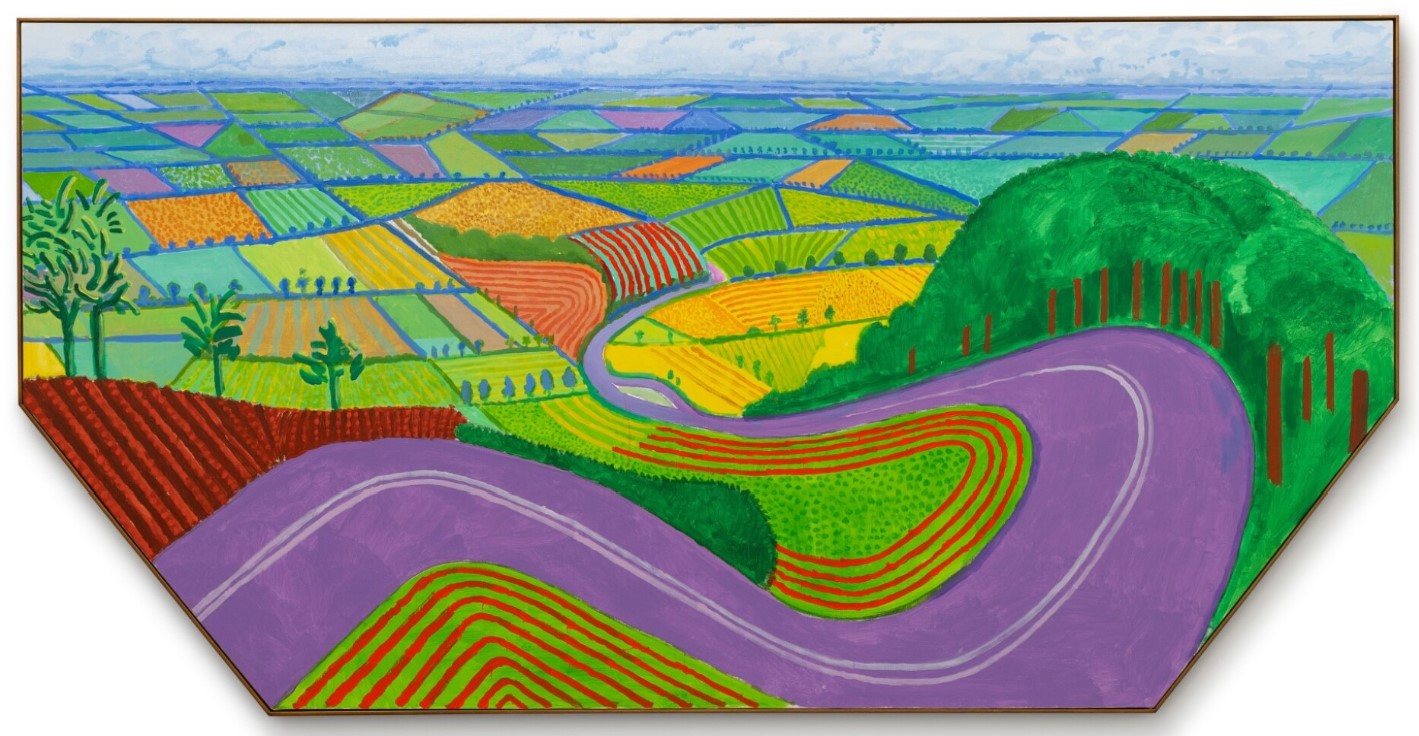
DAVID HOCKNEY
Garrowby Hill, 2017
Acrylic on canvas
48×96 inches (121,9 x 243.8 cm)
#14. Queen Anne’s Lace Near Kilham, 2010-2011
Visionary: The Paul G. Allen Collection
Estimated: USD 8,000,000 – 12,000,000
USD 18,710,000
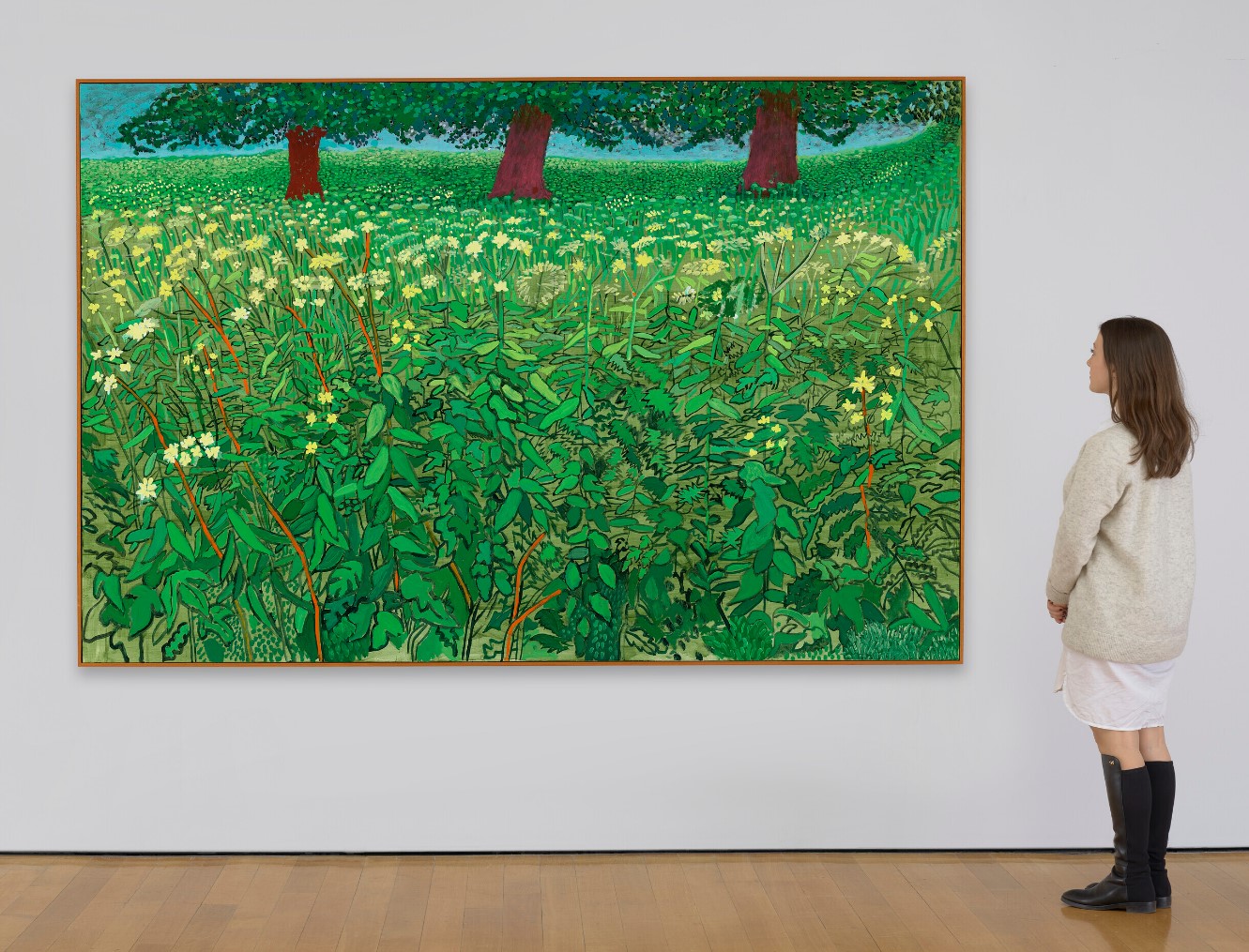
Queen Anne’s Lace Near Kilham, 2010-2011
Oil on canvas
67 x 102 1/4 inches (170.2 x 259.7 cm)
#15. L’Arbois, Sainte-Maxime, 1968
Sotheby’s London: 9 October 2024
Estimated: GBP 7,000,000 – 10,000,000
GBP 13,150,000 / USD 17,226,500
L’Arbois, Sainte-Maxime | Contemporary Evening Auction | 2024 | Sotheby’s (sothebys.com)
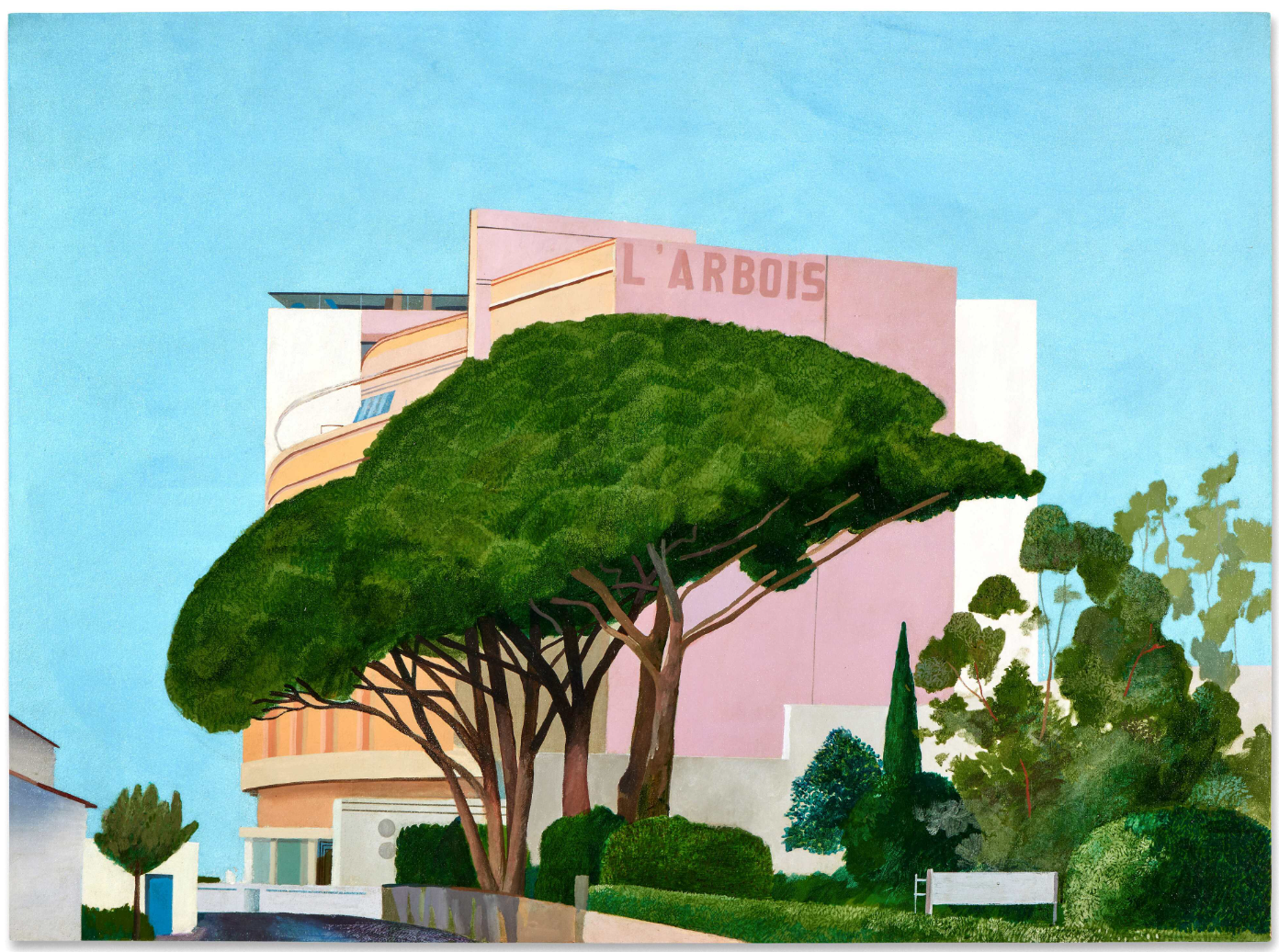
DAVID HOCKNEY (b. 1937)
L’Arbois, Sainte-Maxime, 1968
Acrylic on canvas
113×153 cm (44×60 inches)
Signed and dated 1968 (on the reverse)
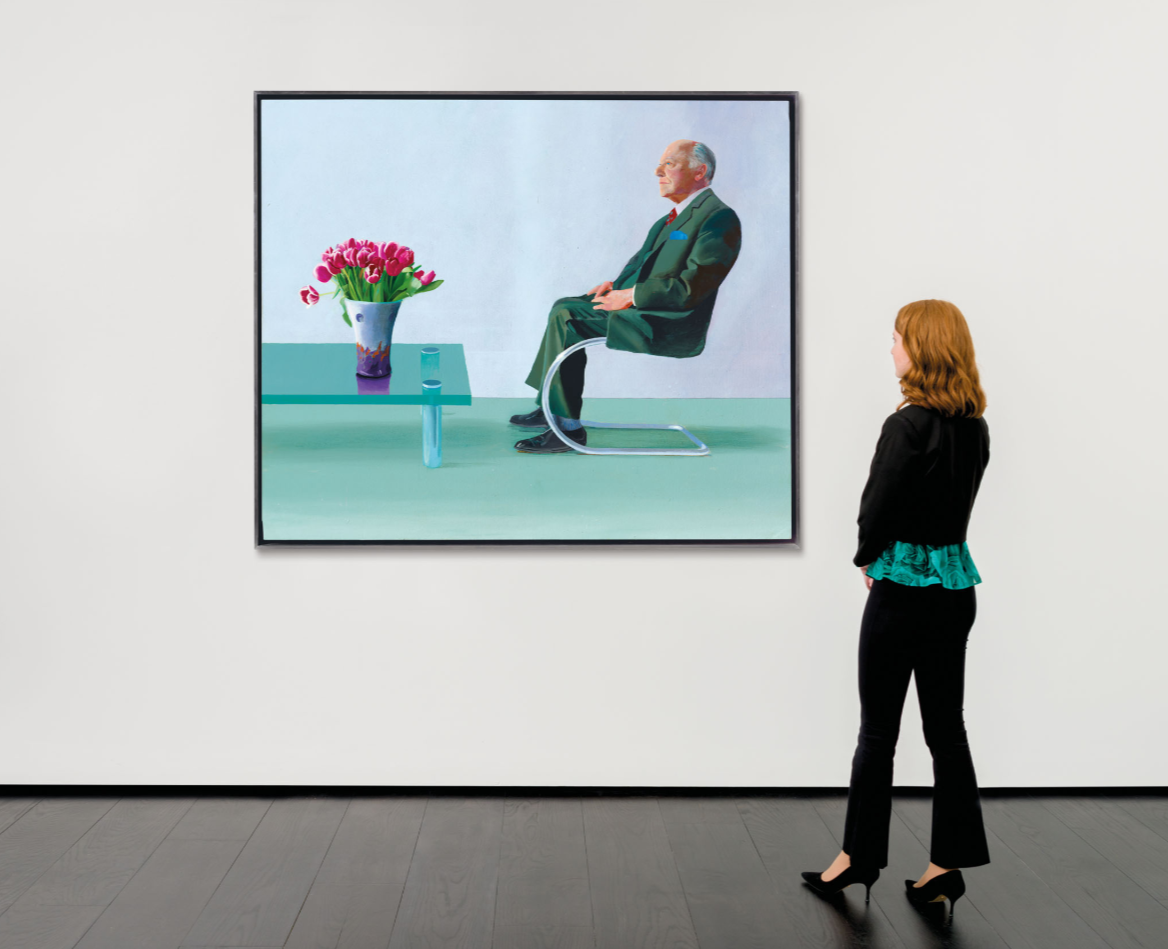
DAVID HOCKNEY (B. 1937)
Portrait of Sir David Webster, 1971
Acrylic on canvas
60 1/8 x 72 5/8 inches (152.8 x 184.5 cm)
Signed, inscribed and dated ‘Sir David Webster with tulips Jan 1971 David Hockney’ (on the reverse)
#17. Double East Yorkshire, 1998
Sotheby’s London: 26 June 2018
Estimated: GBP 10,000,000 – 15,000,000
GBP 11,287,200 / USD 14,943,760
(#26) DAVID HOCKNEY | Double East Yorkshire
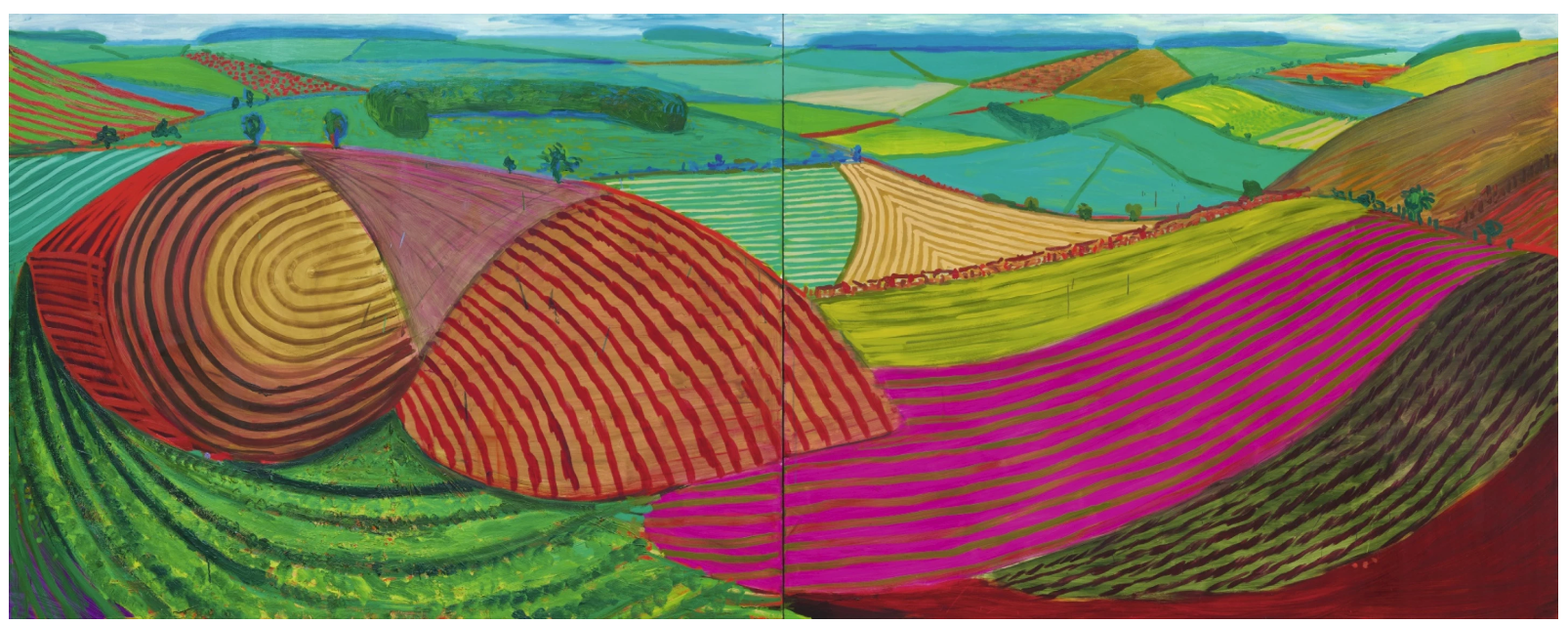
DAVID HOCKNEY
Double East Yorkshire, 1998
Oil on canvas, in two parts
Each: 60×76 cm (152.4 x 193 cm)
Overall: 60×152 inches (152.4 by 386 cm)
#18. 30 Sunflowers, 1996
Sotheby’s Hong-Kong: 10 July 2020
Estimated: HKD 80,000,000 – 100,000,000
HKD 114,827,000 / USD 14,816,120
(#1118) DAVID HOCKNEY | 30 Sunflowers
DAVID HOCKNEY
30 Sunflowers, 1996
Oil on canvas
72×72 inches (182.9 x 182.9 cm)
Signed, titled and dated 1996 on the reverse
Swimming Pools
Portrait of an Artist (Pool with Two Figures), 1972
Christie’s New-York: 15 November 2018
Estimate on Request
USD 90,312,500
David Hockney (b. 1937) (christies.com)
DAVID HOCKNEY
Portrait of An Artist (Pool with Two Figures), 1972
Acrylic on canvas
213.5 x 305 cm (84.1 x 120.1 inches)
One of the most iconic images in the artist’s oeuvre, Portrait of an Artist (Pool with Two Figures) is a story of two compositions. The first, started in 1971, was inspired by the serendipitous juxtaposition of two photographs on the artist’s studio floor.
“One was of a figure swimming underwater and therefore quite distorted… the other was a boy gazing at something on the ground. The idea of painting two figures in different styles appealed so much that I began the painting immediately.”
Hockney worked on the painting for four months in late 1971, but dissatisfied with the composition, in particular with the angle of the pool, abandoned the work and started afresh. He then travelled for several months with Mark Lancaster and returned to the work in early 1972. The year 1972 was a very productive year for Hockney, as he threw himself into his work to escape from his unhappiness, often working 14 or 15 hours a day. Around the same time, he was working on his (unfinished) double portrait of George Lawson and Wayne Sleep (1972-5, Tate).
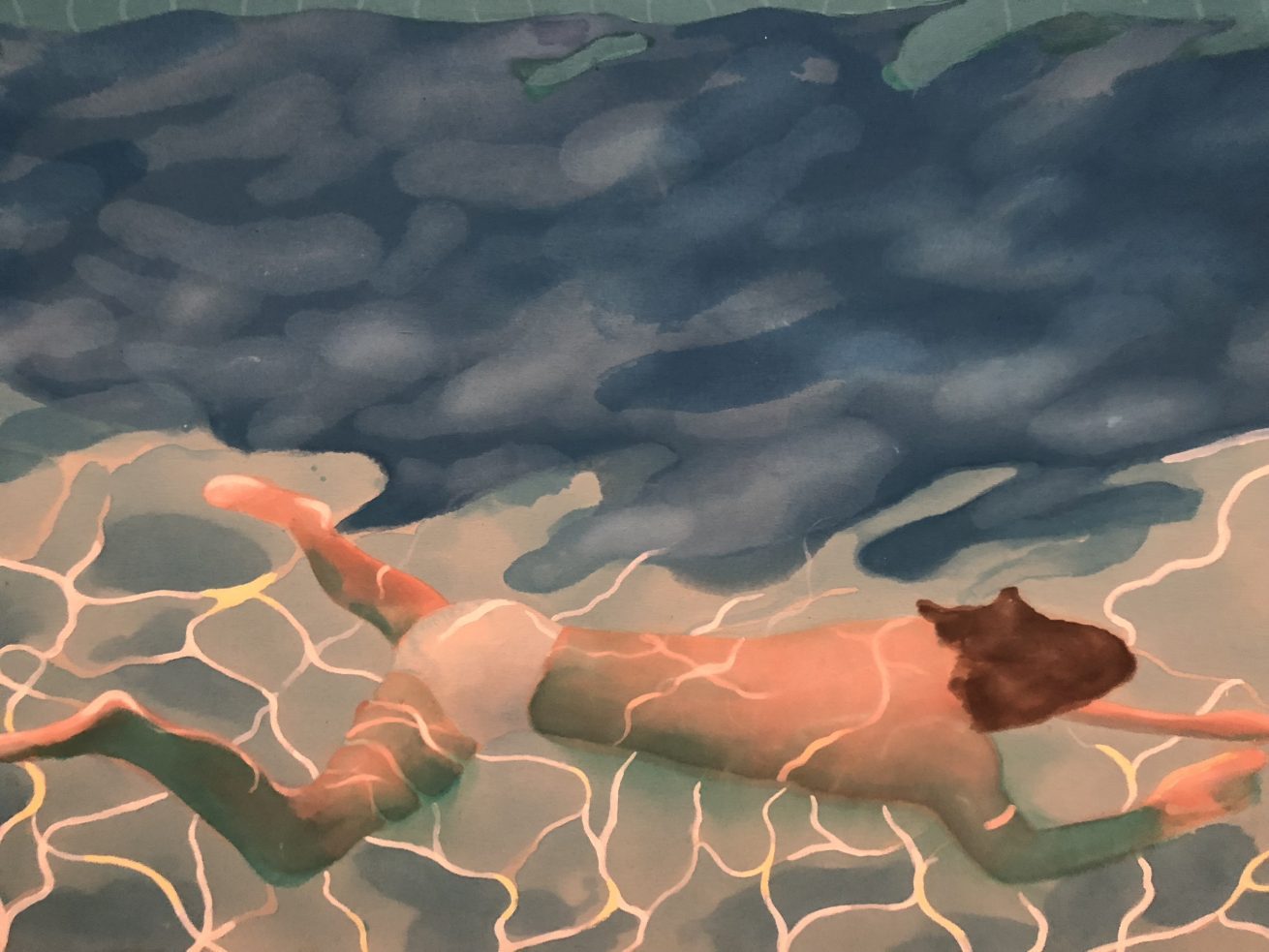
In April 1972, Hockney flew to the south of France to better visualize the figure swimming underwater, using the pool at film director Tony Richardson’s villa at Le Nid du Duc near Saint-Tropez to do so. Hockney’s studio assistant, Mo McDermott, recreated the pose of the downcast man, while a young photographer, John St Clair, was the swimmer. Hockney took hundreds of photographs based on his original composition. Back at his London studio, Hockney assembled the photos along with photographs of Peter Schlesinger taken in Kensington Gardens wearing the same pink jacket. Hockney worked on the painting for two weeks, working 18-hour days, completing and varnishing it only the night before it was due to be shipped to New York for the exhibition at Andre Emmerich Gallery. It was first shown in the exhibition Paintings and Drawings, which ran from 13 to 31 May 1972. The creation of the painting and the breakdown of Hockney’s relationship with Schlesinger were featured in the semi-fictional 1974 documentary A Bigger Splash, named after the 1967 Hockney painting.
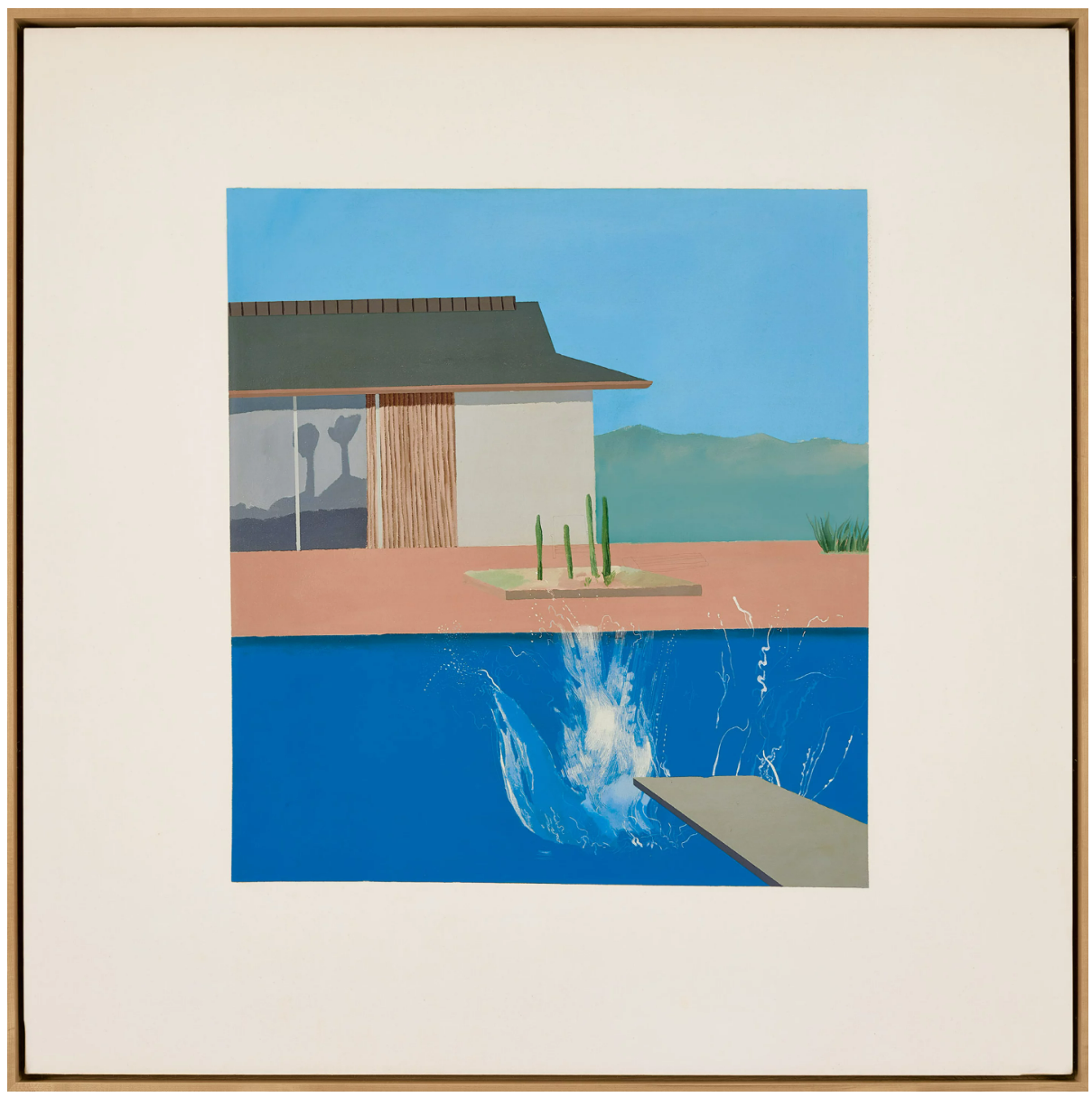
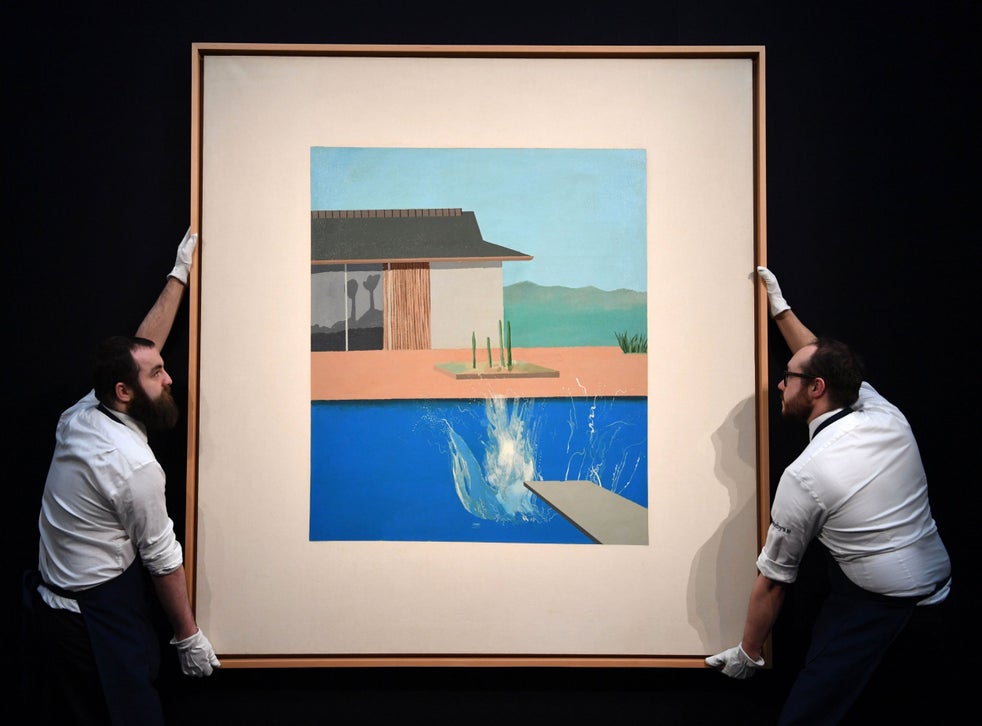
#2. The Splash, 1966
Sotheby’s London: 11 February 2020
Estimated: GBP 20,000,000 – 30,000,000
GBP 23,117,000 / USD 29,884,183
(#16) DAVID HOCKNEY | The Splash (sothebys.com)
DAVID HOCKNEY
The Splash, 1966
Acrylic on canvas
72×72 inches (183×183 cm)
Signed, titled and dated 1966 on the reverse
(Double) Portraits
Henry Geldzahler and Christopher Scott, 1969
Christie’s London: 5 March 2019
Estimate on Request
GBP 37,661,250 / USD 49,300,648
David Hockney (b. 1937) (christies.com)
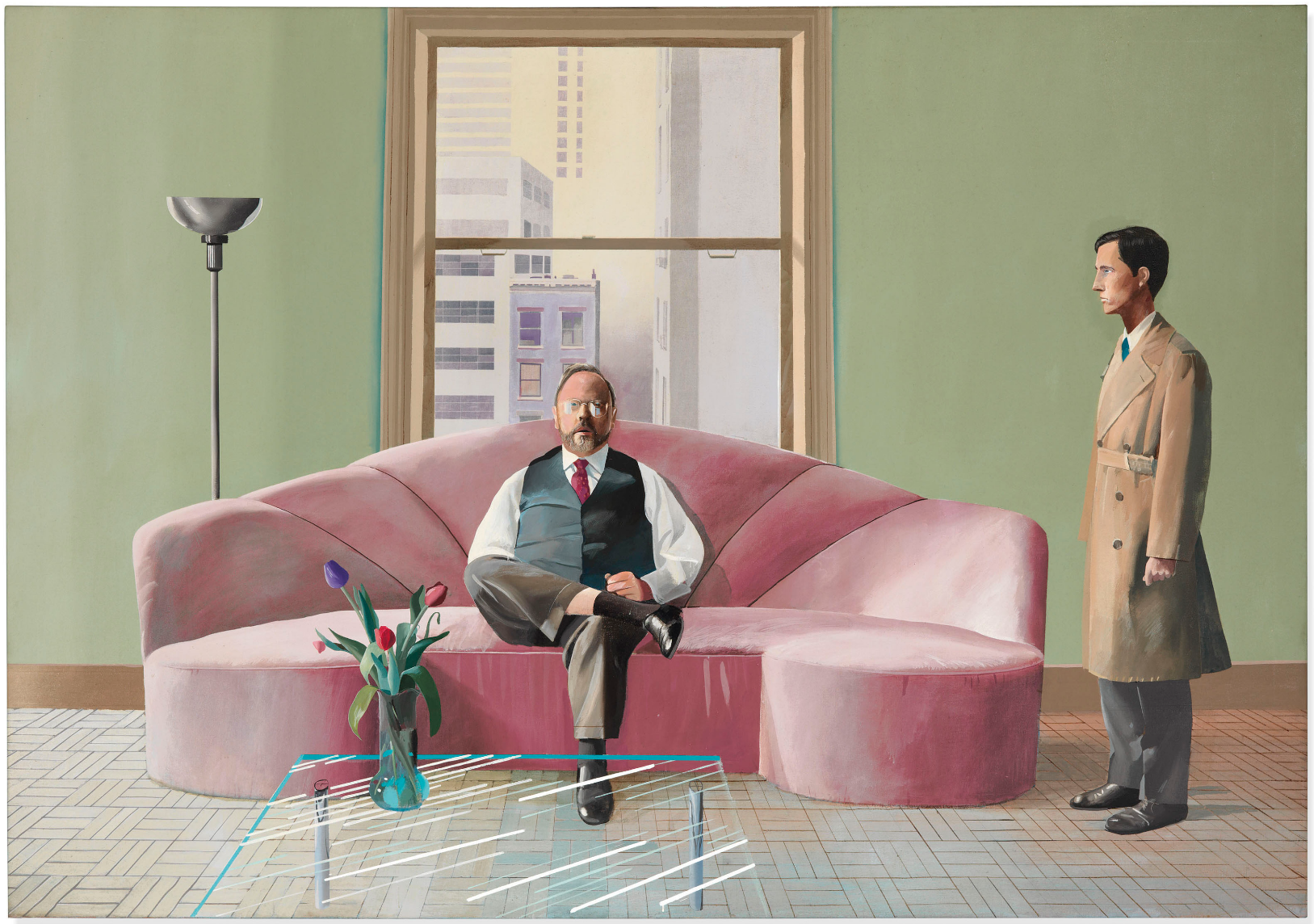
Henry Geldzahler and Christopher Scott, 1969
Acrylic on canvas
84×120 inches (214 x 305 cm)
Painted in 1969
A masterpiece of pictorial drama from the collection of Barney A. Ebsworth, Henry Geldzahler and Christopher Scott stands among the great icons of David Hockney’s oeuvre. Monumentally scaled and intimately observed, it is a glowing meditation on human and visual relationships, set within a panoramic theatre of color and form. Hockney’s closest friend Henry Geldzahler – the legendary curator, critic and king of the New York art world – dominates the center of the composition, framed by the city’s skyscrapers. Christopher Scott, his then-boyfriend, hovers to the right like a fleeting apparition. Completed in 1969, it is the third work in the career-defining series of seven double portraits that Hockney created between 1968 and 1975. With four held in museum collections, these extraordinary seven-by-ten-foot canvases represent the culmination of the artist’s naturalistic style, initiated in his Californian swimming pool paintings of the mid-1960s. Structured like a devotional triptych or an Annunciation scene, the painting stages an enigmatic dialogue between subjects and artist. Through crystalline use of one-point perspective, Hockney places himself in crisp communion with Geldzahler, casting Scott as a temporary imposter. Spatial and psychological tensions flood the scene, amplified by the scintillating play of light, shadow and texture across multiple glass surfaces.
The work’s provenance, along with its extensive exhibition history, is exceptional. In 1969, it was unveiled in Hockney’s solo show at André Emmerich Gallery, where it was described as ‘truly amazing’ and ‘totally hypnotizing’ by New York magazine(J. Gruen, ‘Open Window’, New York, 12 May 1969, p. 57). It was acquired from the gallery that year by Harry N. Abrams, the renowned American art book publisher and distinguished collector. Abrams would go on to publish the first reprint of Hockney’s seminal autobiography David Hockney by David Hockney in 1977, and the work remained in his family collection until 1992. Under this stewardship, it featured in a number of significant exhibitions, including Pop Art Redefined – one of the earliest shows at London’s newly-founded Hayward Gallery in 1969 – as well as major touring retrospectives organized by the Musée des Arts Décoratifs, Paris (1974), the Walker Art Center, Minneapolis (1984-85) and the Los Angeles County Museum of Art (1988-89). In 1997, it became one of the final pieces to enter the prestigious Ebsworth collection, offering a rare British addition to one of the world’s greatest assemblages of twentieth-century American art. Long admired by the collector, it took its place alongside Edward Hopper’s 1929 masterpiece Chop Suey, as well as important works by artists such as Willem de Kooning, Jackson Pollock and Georgia O’Keeffe. For twenty-one years, the painting hung in Ebsworth’s home, starring in notable exhibitions during this period. Most recently it featured as a highlight of Hockney’s eightieth birthday touring retrospective originating at Tate Britain, London (2017-18).
Portrait of Sir David Webster, 1971
Christie’s London: 22 October 2020
Estimated: GBP 11,000,000 – 18,000,000
GBP 12,865,000 / USD 16,821,325
DAVID HOCKNEY (B. 1937), Portrait of Sir David Webster | Christie’s
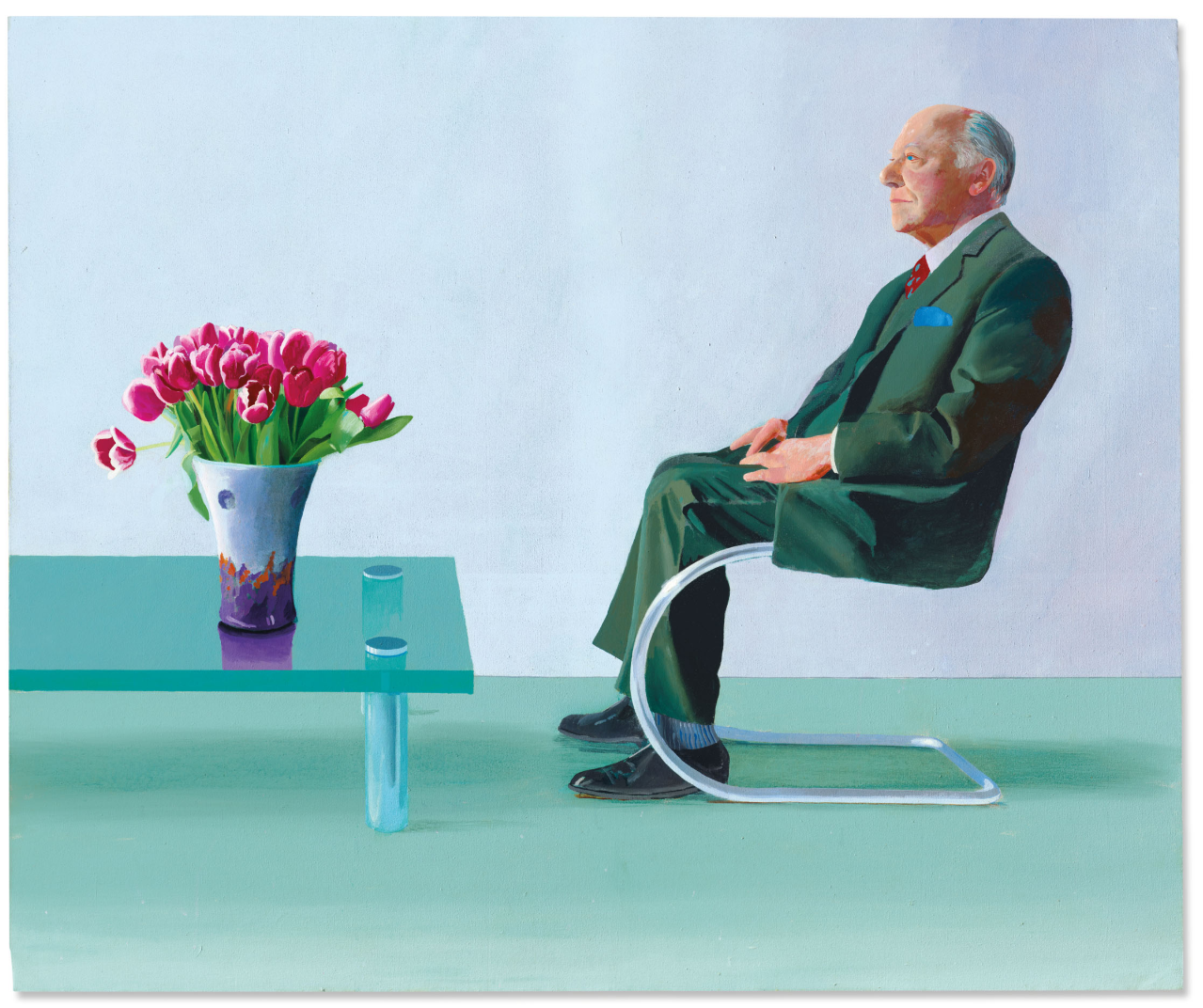
DAVID HOCKNEY (B. 1937)
Portrait of Sir David Webster, 1971
Acrylic on canvas
60 1/8 x 72 5/8 inches (152.8 x 184.5 cm)
Signed, inscribed and dated ‘Sir David Webster with tulips Jan 1971 David Hockney’ (on the reverse)
Executed in 1971, during one of David Hockney’s greatest periods, the present work is an exquisite tribute to Sir David Webster: the former General Administrator of the Royal Opera House, Covent Garden. Painted on the occasion of his retirement after an outstanding twenty-five-year tenure, it depicts Webster in the artist’s studio, seated before a glass table upon a Mies van der Rohe ‘MR’ chair. Rendered on a grand scale, the work unites Hockney’s flair for human observation with his lifelong passion for opera. Inviting stylistic comparison with the artist’s landmark double portraits produced between 1968 and 1975, it demonstrates the meticulous exploration of space, perspective, lighting and compositional drama that would eventually come to inform his own stage designs – for venues including Glyndebourne, the Metropolitan Opera in New York and the Royal Opera House itself. The vase of tulips – frequently interpreted as a symbol for Hockney – implicates the artist’s own presence within the painting, hinting at what was to become a rich dialogue with Webster’s creative legacy.
The present work shares many of these properties, notably featuring the same glass table and vase of tulips as the 1969 painting Henry Geldzahler and Christopher Scott. In both, the tulips seem to float artificially upon the table’s translucent surface: a phenomenon that recalls the weightless illusionism of Hockney’s swimming pool paintings. This surreal quality is mirrored in his depiction of Webster, who appears to hover miraculously above the partially-invisible chair – interestingly, the artist used a similar Marcel Breuer design in Mr and Mrs Clark and Percy (Tate, London), which he completed alongside the present work. Though Webster sits alone, the painting captures the sense of hyper-real interaction that lay at the heart of the double portraits: the tulips are startlingly anthropomorphic, as vivid, alive and conversational as another person in the room.
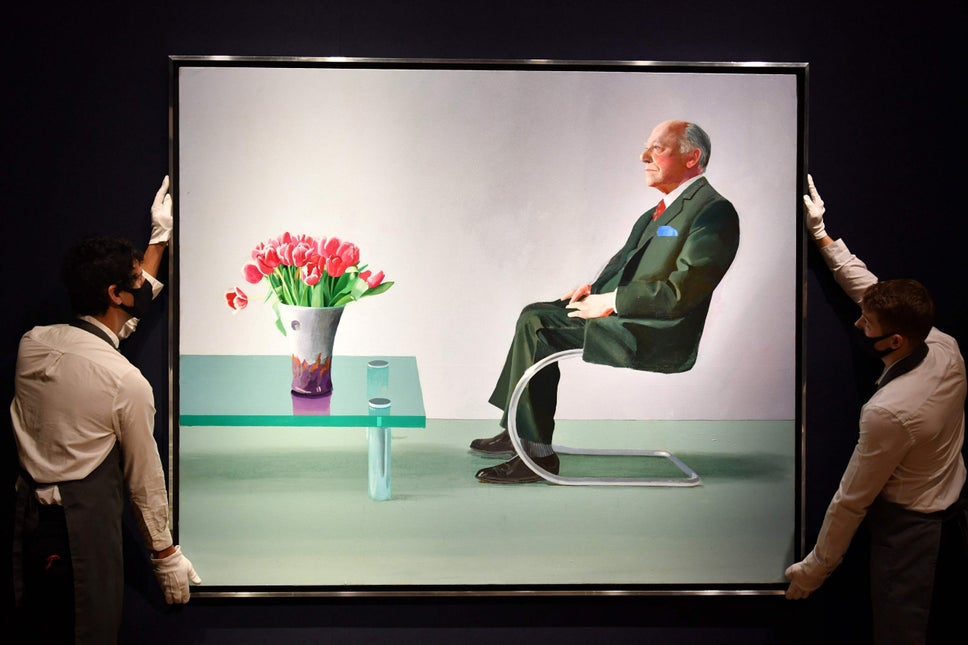
Portrait of Sir David Webster was the first of a rare handful of commissions completed by Hockney: he would not accept another until three decades later, when he painted Sir George and Lady Mary Christie of Glyndebourne for the National Portrait Gallery. As an avid opera fan, Hockney would certainly have connected with Webster’s story. Indeed, the two shared much in common: Webster, like Hockney, had been entranced by theatre and music in his youth, and had eventually left his home in the North of England for the excitement of London. After beginning his career in retail, he had served as Chairman of the Liverpool Philharmonic Society during the Second World War. His visionary leadership of the orchestra prompted an invitation to Covent Garden in the mid-1940s, where he persuaded Sadler’s Wells Ballet to take up residence, and set about establishing what was to become the Royal Opera company. Under his administration, the Royal Opera House was restored from a wartime dance hall into a world-class institution that hosted the finest international singers, dancers and conductors of its time. Webster was also President of the Wagner Society: a fact that would surely have appealed to Hockney, who made the pilgrimage to Bayreuth and religiously listened to the composer’s music.
Landscapes
Nichols Canyon, 1980
Phillips New-York: 7 December 2020
Estimate on Request
USD 41,067,500
David Hockney – 20th c. & Contempor… Lot 10 December 2020 | Phillips
DAVID HOCKNEY
Nichols Canyon, 1980
Acrylic on canvas
84×60 inches (213.4 x 152.4 cm)
Depicting the winding titular road in Los Angeles, Nichols Canyon is one of David Hockney’s greatest masterpieces—and unequivocally the most important landscape by the artist in private hands. Executed in a pivotal year in the artist’s career, 1980, the tour de force is considered by contemporary scholarship to be Hockney’s first mature landscape, and has been exhibited as such in both of his major travelling retrospectives.
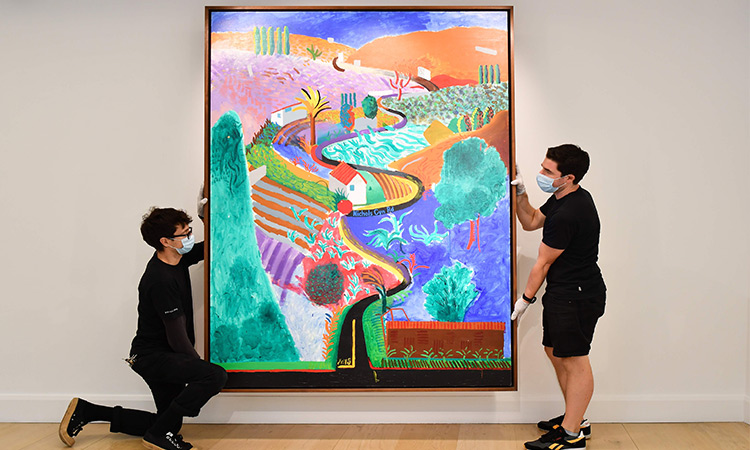
Nichols Canyon is one of his most recognizable paintings, having graced the cover of the 1994 monograph David Hockney and was reproduced on the poster for the Metropolitan Museum leg of his retrospective in 1988.
What makes the image so iconic is its fusion of two of Hockney’s themes that have appeared and reappeared time and again throughout his entire career: the natural world and the theater. One of the most refined paintings from a very small body of work depicting the Los Angeles terrain—other examples of which are in the Los Angeles County Museum of Art, Walker Art Center in Minneapolis, and Museum Ludwig, Cologne—Nichols Canyon marks the beginning of his decades-long panoramic landscapes series spanning California, the Grand Canyon, and the United Kingdom.
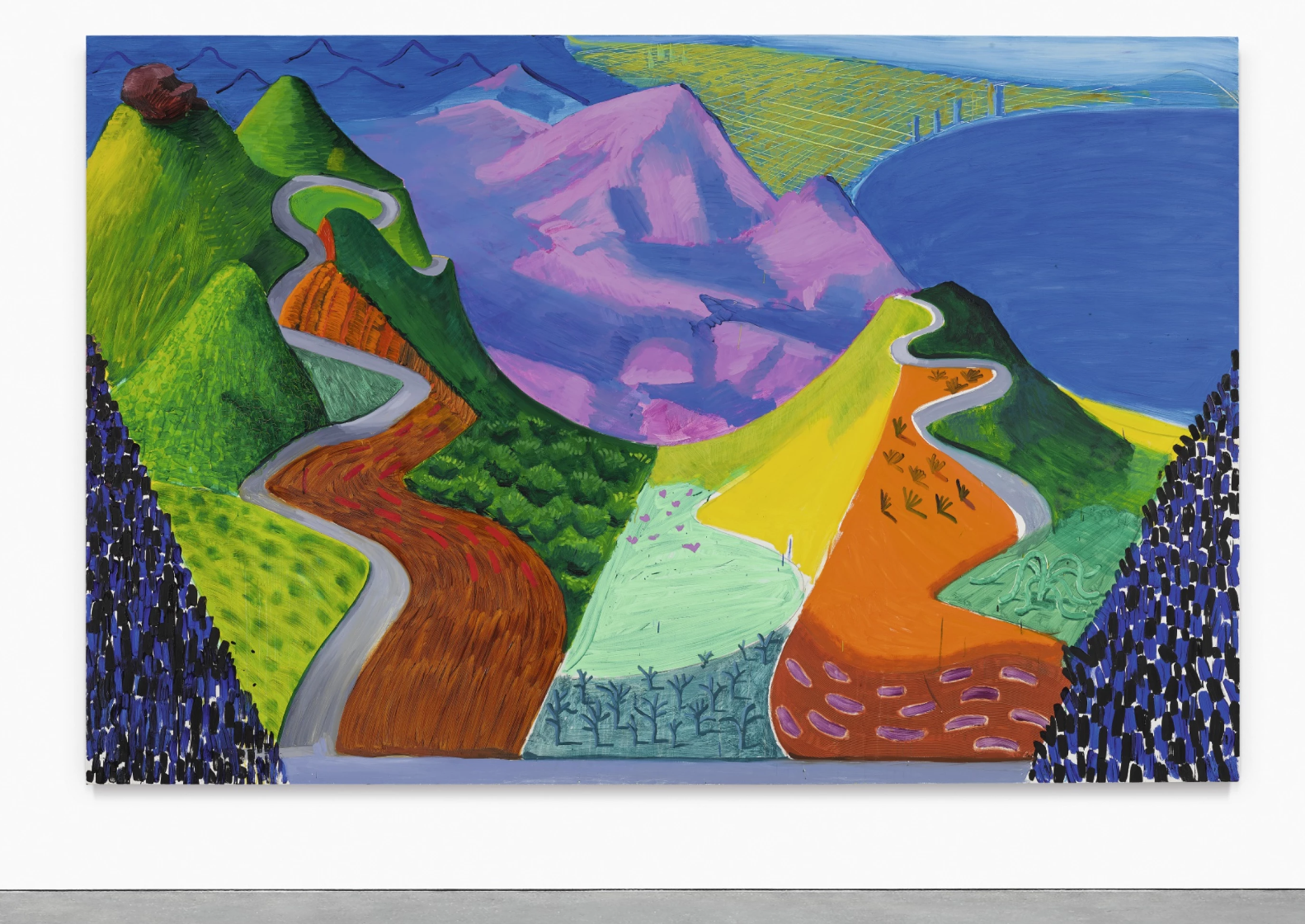
Pacific Coast Highway and Santa Monica, 1990
Sotheby’s New-York: 16 May 2018
Estimated: USD 20,000,000 – 30,000,000
USD 28,453,000
DAVID HOCKNEY
Pacific Coast Highway and Santa Monica, 1990
Oil on canvas
78×120 inches (198.1 x 304.8 cm)
Signed, titled and dated 1990 on the reverse
One of a limited group of monumental California landscape paintings, Pacific Coast Highway and Santa Monica is a significant marker of David Hockney’s sixty-year career. The ambitious painting, dazzling with hues of chartreuse, tangerine, rose, lavender and cerulean across its 10-foot wide canvas, epitomizes the artist’s bold use of color – a characteristic that has come to define his oeuvre. Comparable works hold court in renowned institutions such as the Los Angeles Museum of Contemporary Art, Museum Ludwig, Cologne, and the Walker Art Center, Minneapolis. This 1990 oil on canvas is also an acknowledgement of the importance and significance of traditional painting. At a time when artists across the board were turning away from painting and towards photography and conceptual art, Pacific Coast Highway and Santa Monica addresses the history and impact of artistic styles such as Post-Impressionism and Fauvism, all executed in Hockney’s signature vernacular.
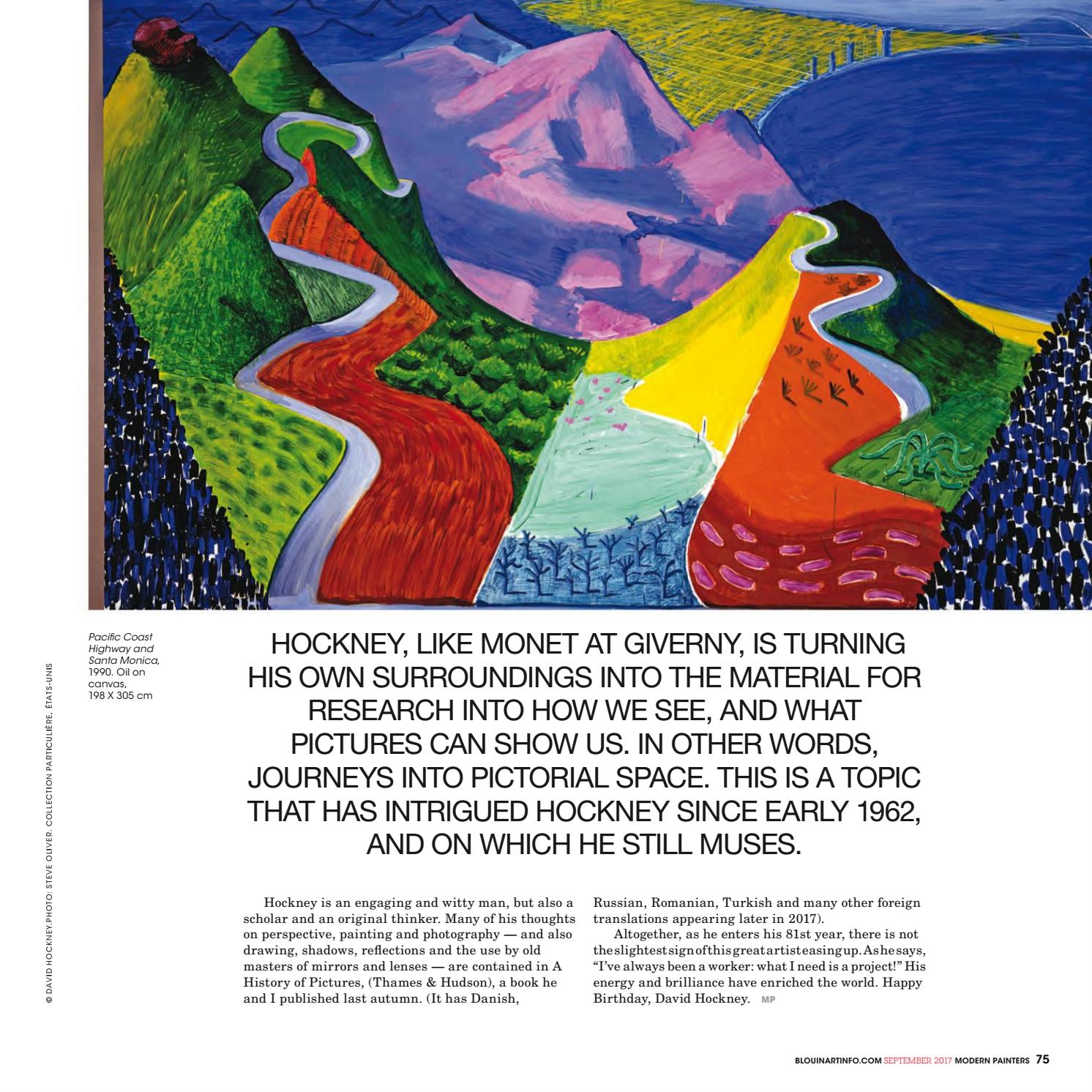
Pacific Coast Highway and Santa Monica may also be interpreted as David Hockney’s heartfelt ode to Los Angeles. In his autobiography That’s the Way I See It, which features the present work on the back cover, he writes, “anyone who had been on my Wagner drive would immediately recognize Pacific Coast Highway [and Santa Monica] – a multiple view of Santa Monica Bay and the mountains.” Wagner Road, the artist’s multifaceted and variegated daily route from his home in the Hollywood Hills to his studio on Santa Monica Boulevard, encapsulates Los Angeles’s bright sunlight and bold colors, the very characteristics that drew Hockney away from the grey skies of London. Remembered and recalled in his studio, the result is a masterpiece in which mountain peaks, rolling hills, serpentine roads, calm bays and orderly cityscapes harmoniously vie for attention, guiding the viewer from the top of the road to the horizon.
Winter Timber, 2009
Christie’s New-York: 9 November 2022
Visionary: The Paul G. Allen Collection
Estimated: USD 10,000,000 – 15,000,000
USD 23,290,000
DAVID HOCKNEY (b. 1937) (christies.com)
Winter Timber, 2009
Oil on canvas, in 15 parts
Overall: 108 x 240 inches (274.3 x 609.6 cm)
Early Morning, Sainte-Maxime, 1968-1969
Christie’s London: 13 October 2022
Estimated GBP 7,000,000 – 10,000,000
GBP 20,899,500 / USD 23,706,330
DAVID HOCKNEY (B. 1937) (christies.com)
DAVID HOCKNEY
Early Morning, Sainte-Maxime, 1968-1969
Acrylic on canvas
48 1/8 x 60 1/8 inches (122.1 x 152.6 cm)
A sublime, radiant tribute to the South of France, Early Morning, Sainte-Maxime is a virtuosic tour de force dating from a unique moment in David Hockney’s early practice. Rendered in exquisite detail, it captures a majestic sunrise over the French Riviera, its glass-like waters bathed in the sparkling light of a new day. A fiery orb hangs low against a deliquescent pink and violet sky, casting a dazzling reflection that glistens like liquid gold. The sea, dotted with tiny luminous flecks, is awash with tones of purple, azure and aquamarine; in the distance, boats and buildings are dramatically silhouetted against the sky, while a midnight blue jetty slices through the foreground, the entire surface shimmering as it catches the light. Painted at the height of Hockney’s romance with Peter Schlesinger, the work’s poetic vista speaks to a time of both personal contentment and professional triumph. Situated between his seminal Californian swimming pool paintings and the ground-breaking ‘naturalism’ of his double portraits, its spectacular sweeping reflection seems not only to echo the gestural drama of his 1967 masterpiece A Bigger Splash (Tate, London), but also to foreshadow the glimmering waters of his poignant tribute to Schlesinger Portrait of an Artist (Pool with Two Figures) (1972). Included in Hockney’s first retrospective at the Whitechapel Art Gallery, London in 1970, and unseen in public for over three decades, it is a work of rare, near-cinematic beauty that—in both subject and style—ushers in a thrilling new dawn.
#. Early Blossom, Woldgate, 2009
Christie’s New-York: 11 May 2023
Visionary: The Paul G. Allen Collection
Estimated: USD 5,000,000 – 7,000,000
USD 19,385,000
DAVID HOCKNEY (B. 1937) (christies.com)
DAVID HOCKNEY (B. 1937)
Early Blossom, Woldgate, 2009
Oil on canvas
36×72 inches (91.4 x 182.9 cm)
Signed, titled and dated ‘Early Blossom Woldgate 2009 David Hockney’ (on the reverse)
David Hockney is one of the world’ most respected living painters, and generations of artists and patrons have been compelled by his singular depiction of the world around him. Characters and friends, detached vistas, and sublime swimming pools, all become vibrant with rippling energy under his steady hand. A particularly exhilarating example of his late-career shift into landscape, Early Blossom, Woldgate melds expressive brushwork with a nuanced observation on landscape painting and ideas of place. Part of a substantial series that materialized as the artist returned to his native Britain at the turn of the twenty-first century, it is celebrated not only for its compositional strength but also its virtuosic command of oil.
Flowers
30 Sunflowers, 1996
Sotheby’s Hong-Kong: 10 July 2020
Estimated: HKD 80,000,000 – 100,000,000
HKD 114,827,000 / USD 14,816,120
(#1118) DAVID HOCKNEY | 30 Sunflowers
DAVID HOCKNEY
30 Sunflowers, 1996
Oil on canvas
72×72 inches (182.9 x 182.9 cm)
Signed, titled and dated 1996 on the reverse
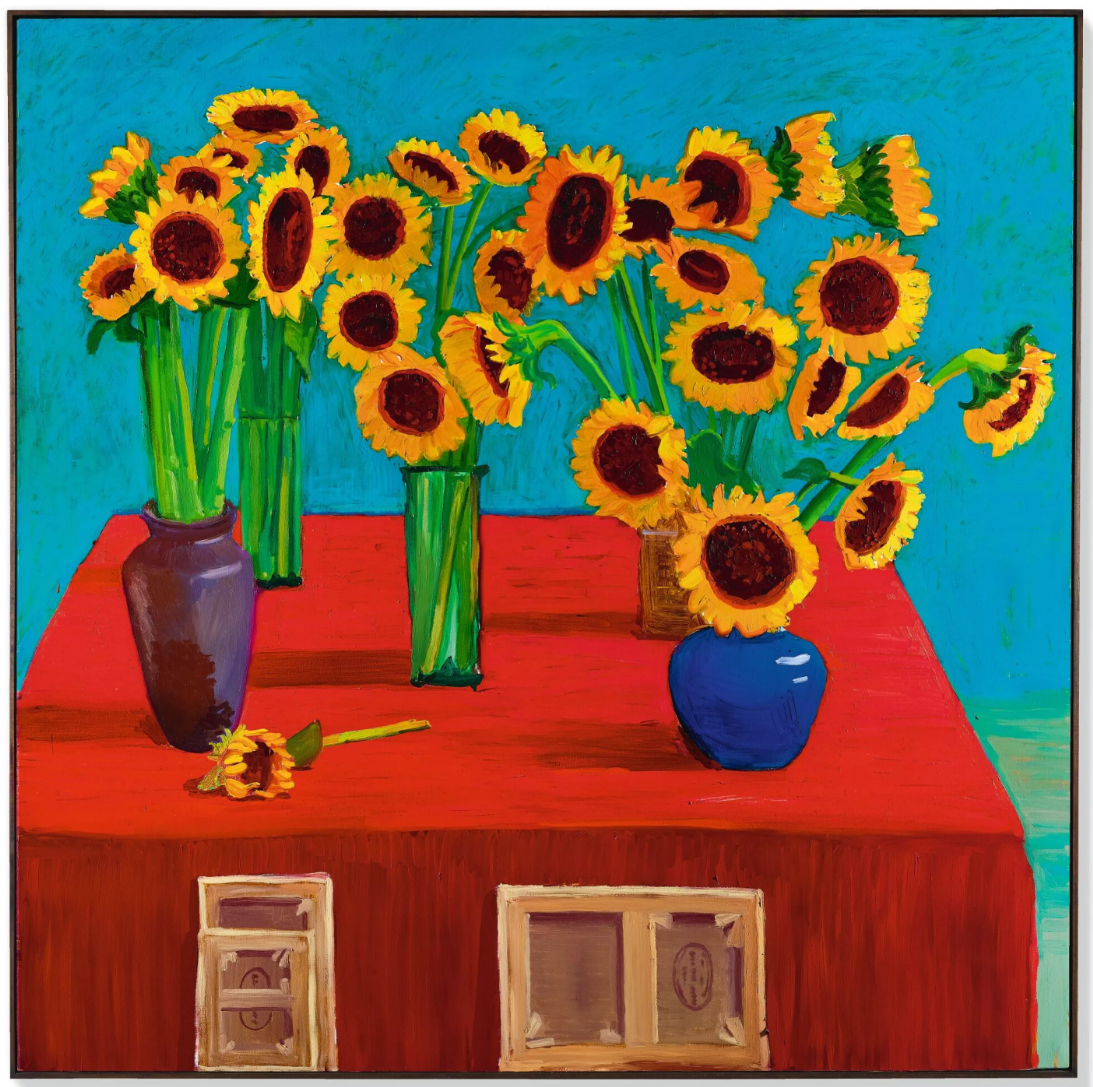
Created in 1996, at the brink of the artist’s sixtieth year, 30 Sunflowers is a singularly extraordinary masterpiece of crucial significance within Hockney’s inimitable oeuvre, revealing peerless formal execution and profound emotive depth. Marking Hockney’s return to painting after a decade primarily immersed in photography, the magnificent, exhilaratingly radiant painting represents the artist’s momentous undertaking of traditional subject matter – the venerated genre of the still life – at the height of his artistic powers, when he must have finally deemed himself ready and worthy to encounter his heroes and predecessors, including Vincent van Gogh, Paul Cézanne, Claude Monet and Johannes Vermeer. Prior to painting 30 Sunflowers, Hockney had attended two exhibitions that proved to be tectonic: Claude Monet, 1840-1926 at the Art Institute of Chicago and the Johannes Vermeer retrospective at the Mauritshuis in the Hague. Emerging thrilled and revitalized, he picked up his brush again with renewed vigor and urgency, applying unprecedented attention to painterly texture and modulated tonalities. 30 Sunflowers is one of the two largest paintings of Hockney’s pivotal Flower series from 1996, and without doubt the most superlatively exceptional in terms of its richly resplendent color palette, complex, charged compositional structure, and intimately significant subject matter that characterize the artist’s most iconic masterpieces. A definitive picture situated at a remarkably cogent juncture within Hockney’s legendary painterly journey, 30 Sunflowers was featured on the cover of the catalogue for Hockney’s “Flowers, Faces and Spaces” exhibition in 1997, which was his largest exhibition in London since his 1988 Tate retrospective.
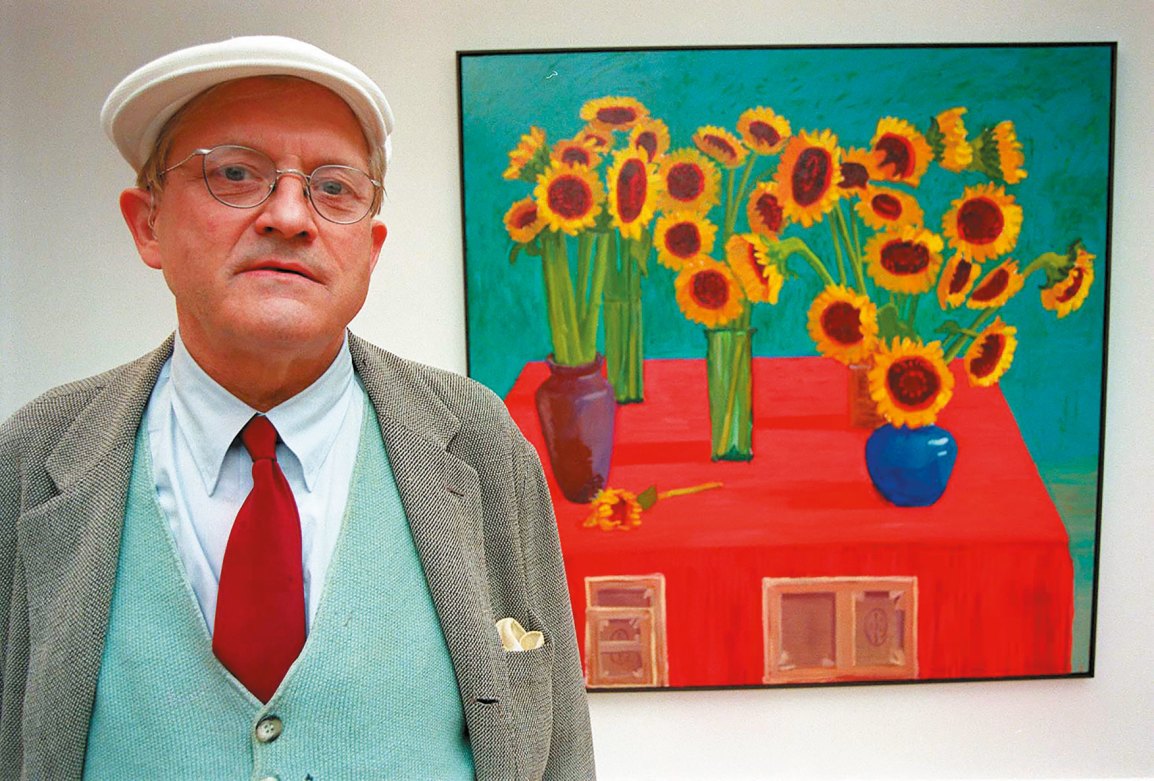
Amongst the twenty-five still life paintings, 30 Sunflowers stands out as the most impressive and accomplished masterpiece of imposing scale, arresting yet elegant composition, and sheer exuberance of color and texture – a definitive painting ranking among the very best of Hockney’s mature work. Orchestrating a thrilling event of evolving sensual delight, the majestic chorale of sunflowers rises regally, their Tuscan yellow and golden ochre heads surging resplendent and insurgent from stems of vivid green. The classic still life format, revolutionized by the choreography of five strategically placed vases, is fashioned against a rich electric turquoise backdrop woven from staccato pointillist strokes. The plush tablecloth of deep crimson, evoking stage curtains, evokes Hockney’s enduring preoccupation with theatre; the scene thus set, the eye is compelled to rove the canvas in a clockwise course, from the rigid taut stalks on the upper left to the dipping, searching blooms on the right, and finally to the single fallen stem lying prostrate on the lower left. Deeply charged with both ebullience and grace, 30 Sunflowers dazzles with the sublime bravura that only comes with artistic maturity, as well as with the quiet yet palpable elation of a master once again intoxicated by the very craft of painting. As Hockney once said: “It is a marvelous thing to dip a brush into paint and make marks on anything. Even now, I could spend the whole day painting a door just one flat color”. Evincing the timeless vision of the archetypal still life, 30 Sunflowers urges a new, heightened mode of seeing via the vehicle of an age-old genre.
“Painting still lifes can be as exciting as anything can be in painting. I remember once saying to Francis Bacon in Paris, that I knew a painting in California of tulips in a vase that was as profound as any painting he’d made. I think at first he almost thought I was referring to my own, but I was referring to the Cézanne in the Norton Simon Museum. It’s the most beautiful painting, and it is as profound as anything he did. Just some tulips in a vase. The profundity is not in the subject, it is the way it’s dealt with”
In keeping with the tradition of the greatest still lifes in history, 30 Sunflowers prompts contemplations on mortality and transience. The painting’s tender poignancy is accented by symbolic cues: the fallen sunflower, the grand drapery and the enigmatic canvas stretchers. At the time 30 Sunflowers was created, Hockney was emerging from a period of prolonged mourning over several significant losses, including the passing of his closest confidant and champion, the critic and curator Henry Geldzahler, as well as that of painter Sandra Fisher, close friend and wife of R.B. Kitaj. Hockney had previously taken to painting intimate flower still lifes for his friends as get-well cards; here in 30 Sunflowers, such fervent blessings are ablaze in solemn tribute. Elegiac in tone yet imbued with hope, optimism, and the pure and simple exuberance of life, 30 Sunflowers encapsulates a cherished worldview that is weathered yet untainted by sorrow and loss; in Hockney’s words: “The world is colorful. It is beautiful, I think. Nature is great. Van Gogh worshipped nature. He might have been miserable, but that doesn’t show in his work. There are always things that will try to pull you down. But we should be joyful in looking at the world” (the artist cited in Exh. Cat. Hockney – Van Gogh. The Joy of Nature, 2019). Encapsulating both splendor and brutality, celebrating ravishing beauty as well as delicate ephemerality, 30 Sunflowers is a glowing exaltation of light, space, and color refracted through the lens of art history while suffused with personal meaning and transformation – manifesting the supreme quintessence of Hockney’s artistic output that powerfully establishes him as one of the greatest painters of the twentieth century.