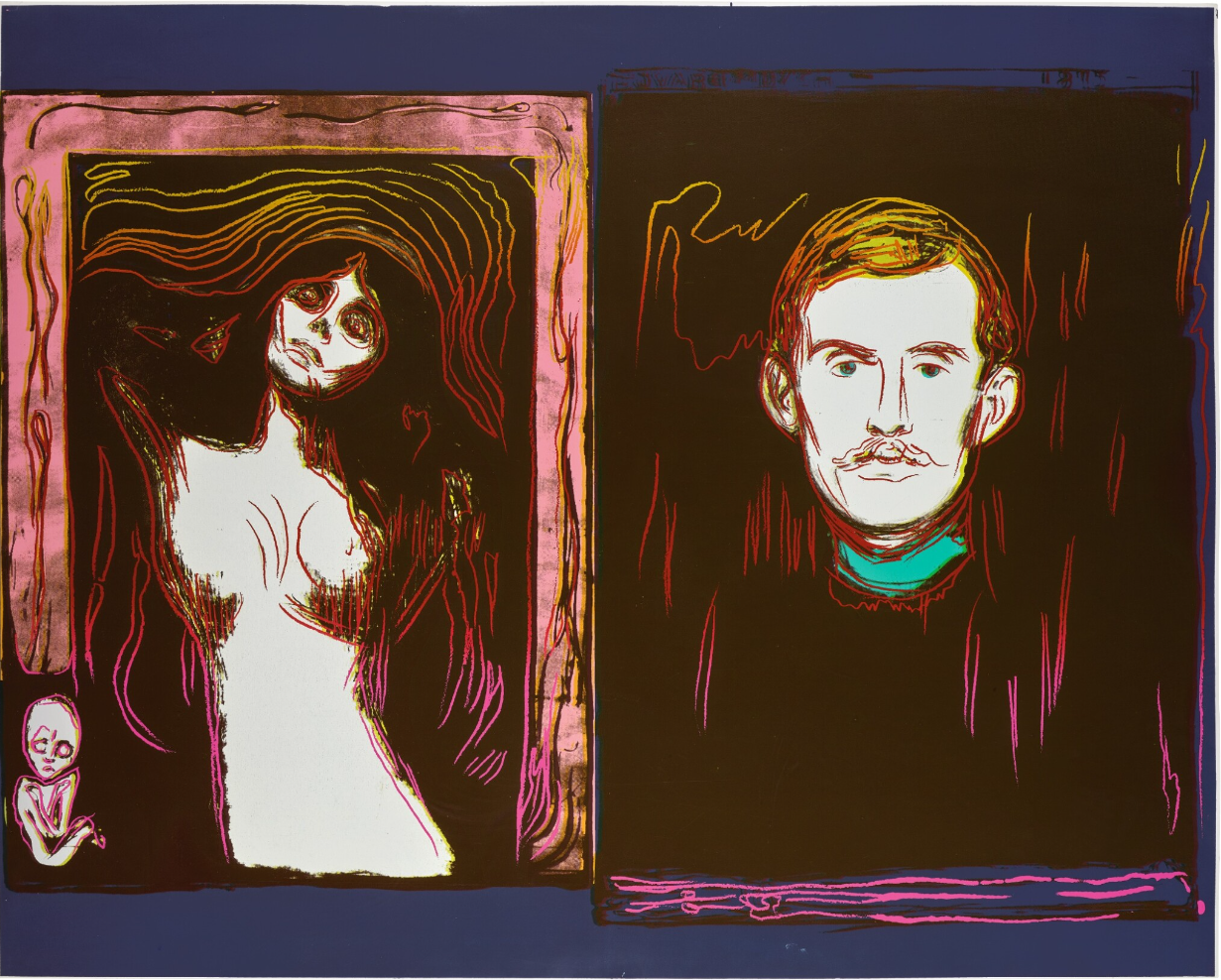
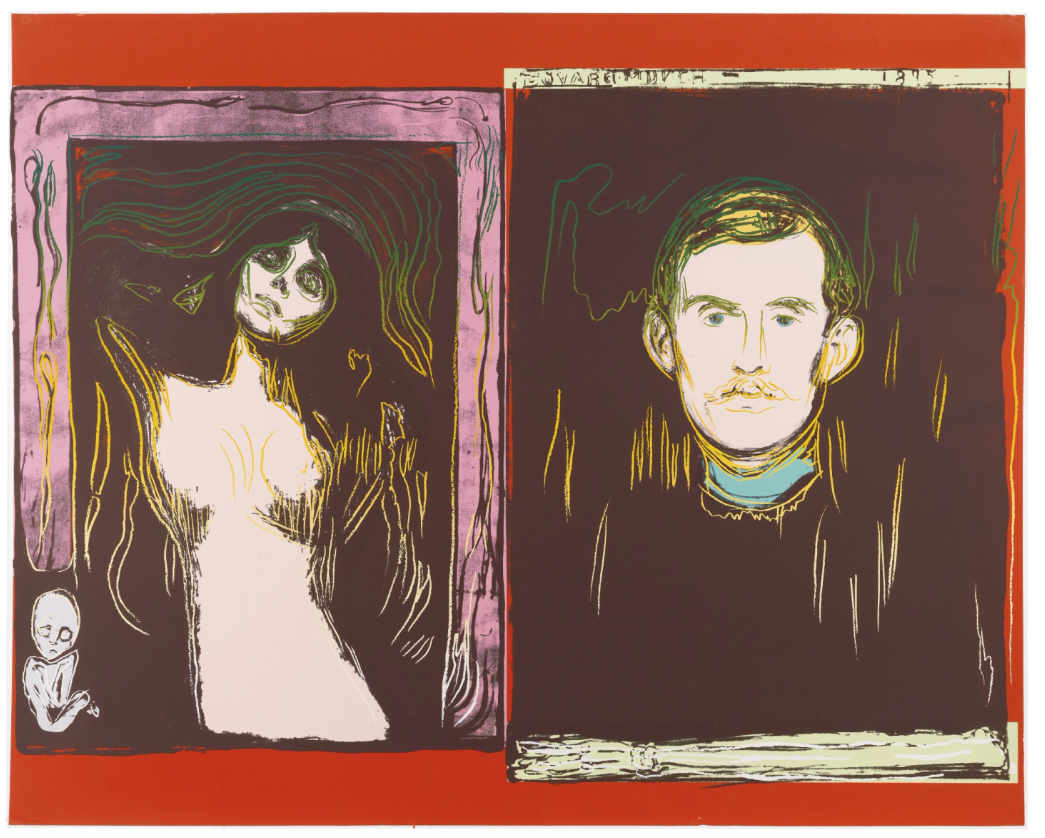
Madonna and Self-Portrait with Skeleton’s Arm (After Munch)
Medium: Screen-print in colors on Lenox Museum Board
Year: 1984
Sheet: 32×40 inches (81.3 x 101.6 cm)
Edition: Small number of unique impressions
Based on Edvard Munch’s 1895 lithographs Madonna and Self-Portrait with Skeleton’s Arm
Commissioned as an edition print was never published
Printer: Rupert Jasen Smith, New-York
Literature: Feldman & Schellmann IIIA.62
Among Warhol’s most powerful and enigmatic works, Madonna and Self-Portrait with Skeleton’s Arm (After Munch) embodies and transcends Warhol’s archetypal appropriation of popular culture icons. The left half of the work is occupied by a nude female figure with cascading hair swirling around her thrown-back head, her sinuous body half-immersed in a spiralling nimbus. Mirroring this ecstatic apparition is Edvard Munch’s haunting self-portrait, an illuminated head set against a velvety black background, staring out of the darkness. Warhol’s choice and pairing of the two motifs, far from being random, make this work one of the most complex within his canonical oeuvre.
In 1971, Warhol took a tour of Oslo’s museums and art galleries with Per Hovdenakk, then director of the Henie-Onstad Art Centre. Hovdenakk recalls Warhol’s great interest and enthusiasm for Munch’s printing technique at the Munch Museum, and as a parting gift gave Warhol a copy of Rolf Stenersen’s biography Edvard Munch: Close-up of a Genius. To a narcissist like Warhol, Stenersen’s highly romanticized version of the Norwegian artist’s childhood illness, losses and suffering then ascension to the status of the greatest printmaker of the Nineteenth Century fin-de-siècle must have seemed like a mythologized retelling of his own life – and, as for everything else he deemed iconic, needed to own it.
An avid image collector, Warhol would come to own five of Munch’s prints, including a signed impression of Self-Portrait. Executed in 1895, Self-Portrait was one of Munch’s first lithographic prints and one of his most compelling. Immersed in dense obscurity, the face’s delicate features contrast sharply with the much bolder lines of the artist’s hair. The white collar, reminiscent of clerical attire, further heightens the eerily mystical atmosphere of the work whilst the thin skeletal arm, cautiously placed at the bottom of the composition, is a reminder of the artist’s own mortality but also resembles a vanitas, the customary skull in Sixteenth and Seventeenth Century Northern European still lifes. Translated from Latin as ’emptiness’, the vanitas symbolizes the meaninglessness and transient nature of all earthly goods and pursuits.
Around the same time as Self-Portrait, Munch started working on what would arguably become one his most widely reproduced and reworked motifs, the Madonna. Originally called Woman Making Love, Madonna was among Munch’s very first intaglio prints. The perspective, as if the beholder was seeing the nude figure lying down from above, and use of symbols such as spermatozoa and the foetus, suggest intimacy: “The woman, on the verge of the most sacred consummation, illuminated by a ray of light, attains a moment of celestial beauty. The male lover who is allowed to experience such a sight might easily have a vision of a Madonna” (Frank Servaes in: Stanislaw Przybyszwski, Ed., Das Werk des Edvard Munch: Vier Beiträge, Berlin, 1894, p. 48).
Reproduced many times in many different mediums and formats – at first by Munch himself, but then relayed by popular culture in the form of posters, gift shop mugs, calendars and so forth, Munch’s Madonna and Self-Portrait had already became mass-repeated icons by Warhol’s time. An image about images, the present work epitomizes Warhol’s remarkable feat of using available pictures from consumer culture as readymades, to ultimately instate – or, in this case, re-instate – them within the realm of high art. Superimposed with Warhol’s maximalist aesthetic, jagged lines and garish colours, Munch’s ominous and riveting works, thus appropriated as Warholian celebrity portraits, become Pop icons. “It is really a remarkably complex work” (Roland Augustine cited in: Exhibition Catalogue, New York, Scandinavia House, Munch/Warhol and the Multiple Image, 2013, p. 33).
Auction Results
Sotheby’s New-York: 22 October 2024
Estimated: USD 80,000 – 120,000
USD 78,000
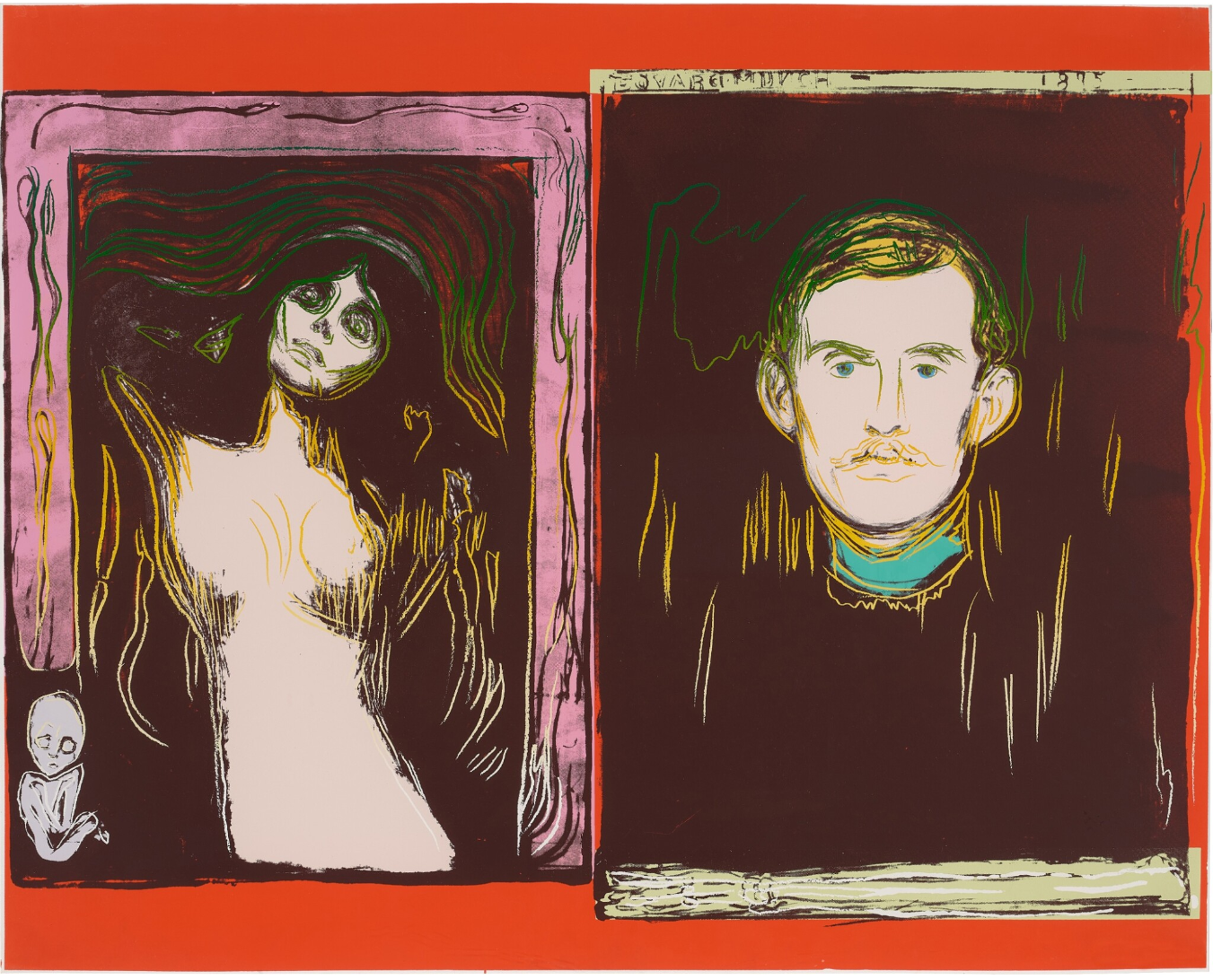
ANDY WARHOL (1928 – 1987)
Madonna and Self-Portrait with Skeleton’s Arm (After Munch) (see Feldman & Schellmann IIIA.62), 1984
Screenprint in a unique color combination on Lenox Museum Board
Sheet: 32×40 inches (81.3 x 101.6 cm)
With the Estate of Andy Warhol and the Andy Warhol Foundation for the Visual Arts inkstamps on the verso
Inscribed in pencil U.P 35.40
This impression is one of a small number of unique color variants
Sotheby’s London: 26 September 2018
Estimated: GBP 100,000 – 150,000
GBP 125,000
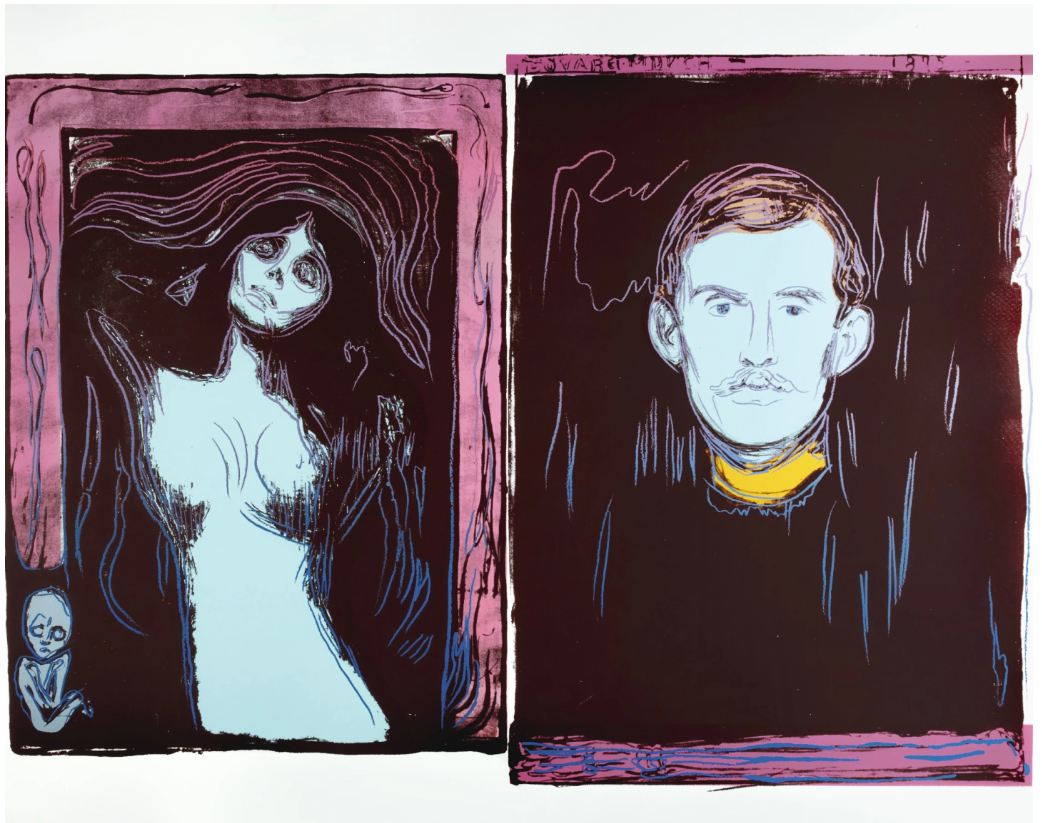
ANDY WARHOL
Madonna and Self-Portrait with Skeleton’s Arm (After Munch) (F. & S. IIIA.62), 1984
Screenprint in a unique combination of colors on Lenox Museum Board
With the Estate of Andy Warhol and the Andy Warhol Foundation for the Visual Arts ink stamps verso
Annotated ‘UP35.17’ and ‘VF’ in pencil verso
From a small unpublished edition of unique color variants
Sotheby’s London: 18 March 2014
Estimated: GBP 120,000 – 180,000
GBP 134,500
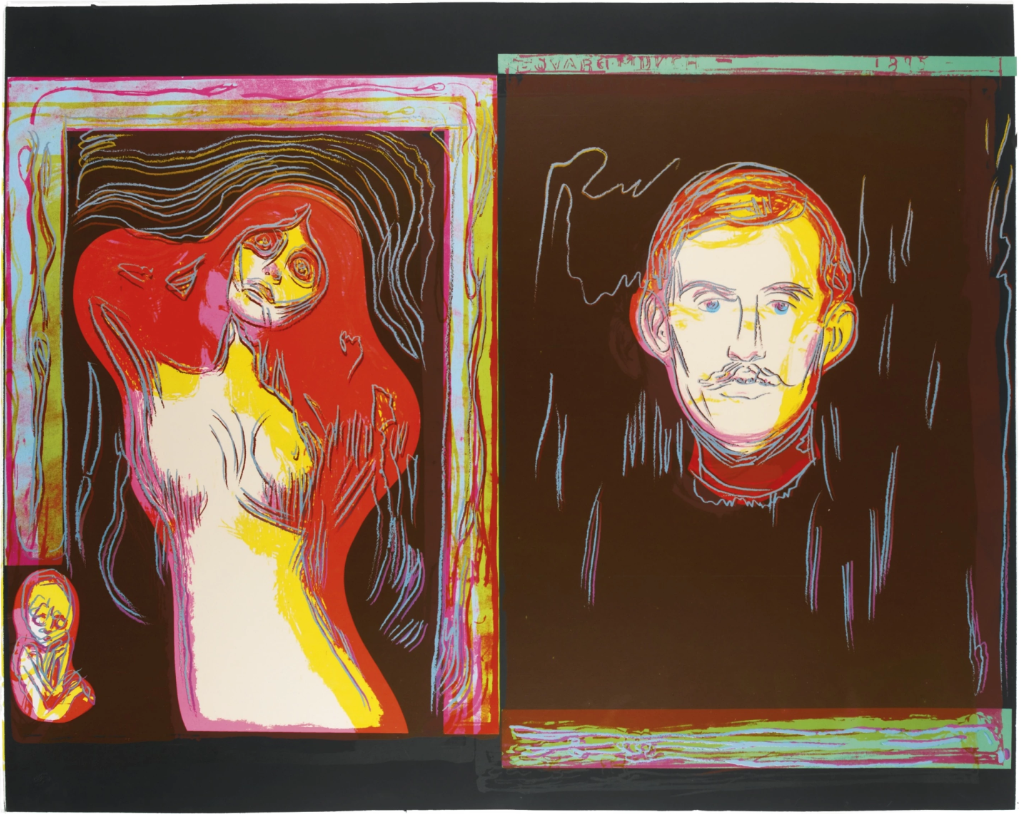
ANDY WARHOL
Madonna and Self-Portrait With Skeleton’s Arm (After Munch) (F. & S. IIIA.62), 1984
Screenprint in a unique combination of colors on Lenox Museum Board
With the Andy Warhol Art Authentication Board stamp verso, annotated ‘A158.992‘ in pencil
Sotheby’s London: 18 October 2013
Estimated: GBP 150,000 – 200,000
GBP 182,500
ANDY WARHOL
Madonna and Self-Portrait with Skeleton’s Arm (After Munch), 1984
Silkscreen ink on paper
Stamped by The Estate of Andy Warhol and The Andy Warhol Foundation for Visual Arts, New York
Numbered U.P 35.40 on the reverse