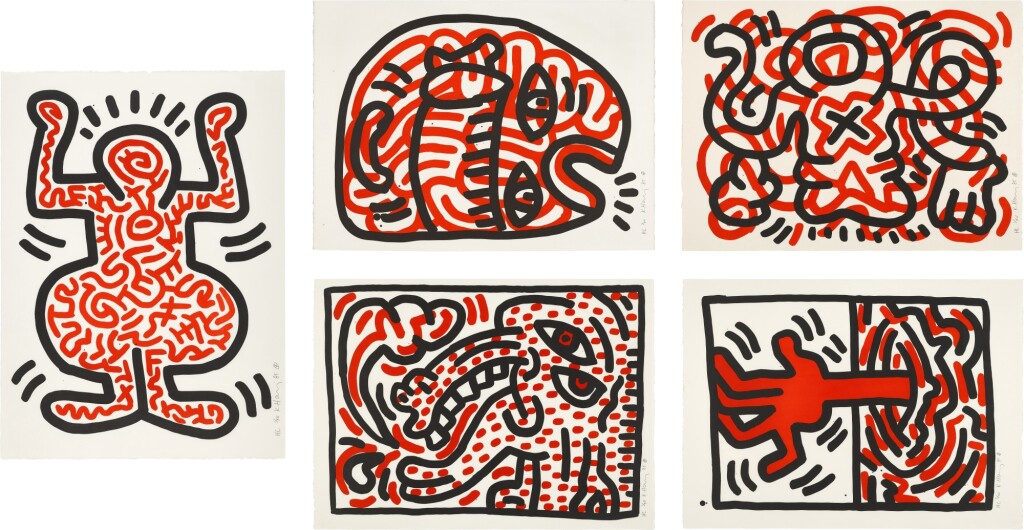
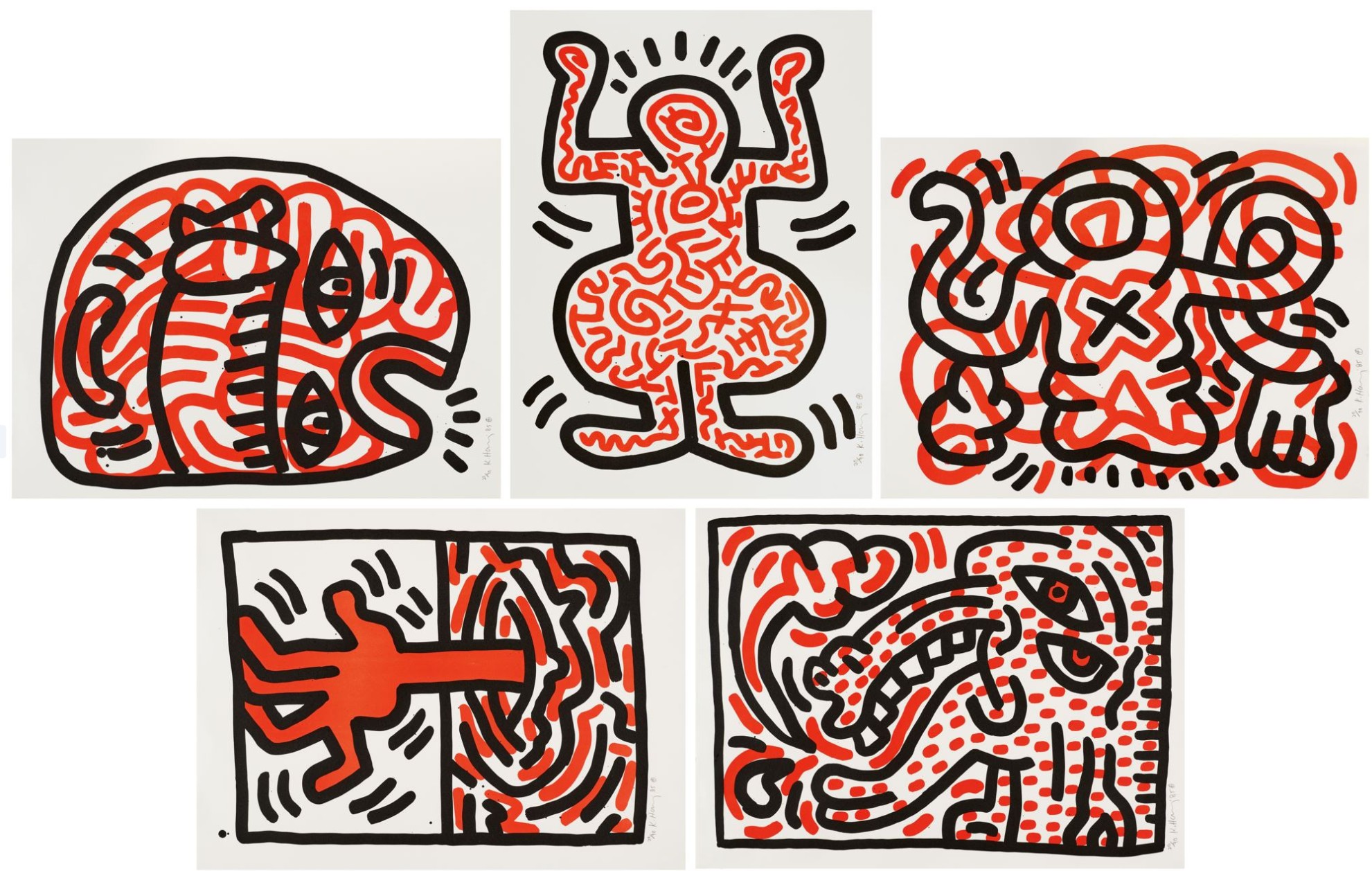
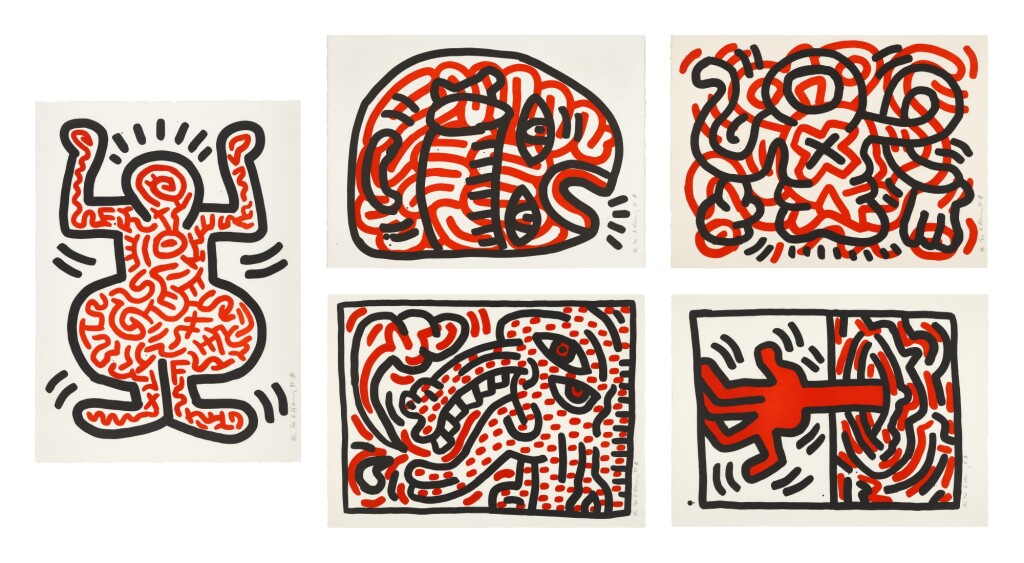
Ludo 1-5
The complete portfolio comprising five lithographs printed in colors
Medium: Lithograph in colors on Arches wove paper
Year: 1985
Sheet: 19×26 inches (48×66 cm) (or reverse)
Edition: 90
Artist’s Proofs: 15 AP
Hors Commerce: 15 HC (numbered in Roman numerals)
Printer/Publisher: Éditions F.B./Atelier I. D. L., Paris
Literature: Littmann pp. 44-47
Each signed, dated, and numbered in pencil
Throughout the Ludo series, Haring maintains a dominance of the color red, depicting eyes, limbs, and other body parts in abstracted forms. There is a sense of anxiety running through each print that differs from much of his earlier work, alluding to a turning point in Haring’s life. As the AIDS epidemic overwhelmed his community in the mid-1980s, Haring’s work began to reflect the difficulties he was facing in his personal life. In Ludo 1, a figure raises its arms high. In a departure from his usually narrow stick figures, this subject’s hips extend outward as wide as the feet and hands. Haring’s characteristic energy marks emanate from the head, elbows and feet, giving the standing figure a sense of movement. This reflects the motion of the chaotic red interior. The limited color palate characterizes much of Haring’s work and is most reminiscent of his Free South Africa series from the same year. Ludo 1 is the only truly figurative image in the series. The following prints of the Ludo series depict eyes, limbs, and other body parts in abstracted forms. The series’ simplified forms, like Haring’s other work, betrays the influence of the Pop Art movement and a childhood filled with Dr. Seuss, Disney, and Looney Tunes. However, the Ludo series comes at a moment of transition for Haring. As the AIDS epidemic overtook his community in the mid-1980s, Haring’s artwork reflected his increasing involvement in advocacy for the disease.
“My drawings don’t try to imitate life;
they try to create life, to invent life”
Haring’s print is reminiscent of Aztec or Aboriginal art through his use of flowing, organic shapes and thick bold lines to create a pattern that plays out across the image surface. Explaining why many of his works resemble Aztec or Aboriginal art, Haring has said “My drawings don’t try to imitate life; they try to create life, to invent life,” something that he believed aligned with so-called primitive ideas. Ludo 2 is exemplary of this notion by forming a rhythmic, kinetic composition that focuses on pattern rather than realism.
Ludo, 1985
Ludo 1 (L. p. 45)
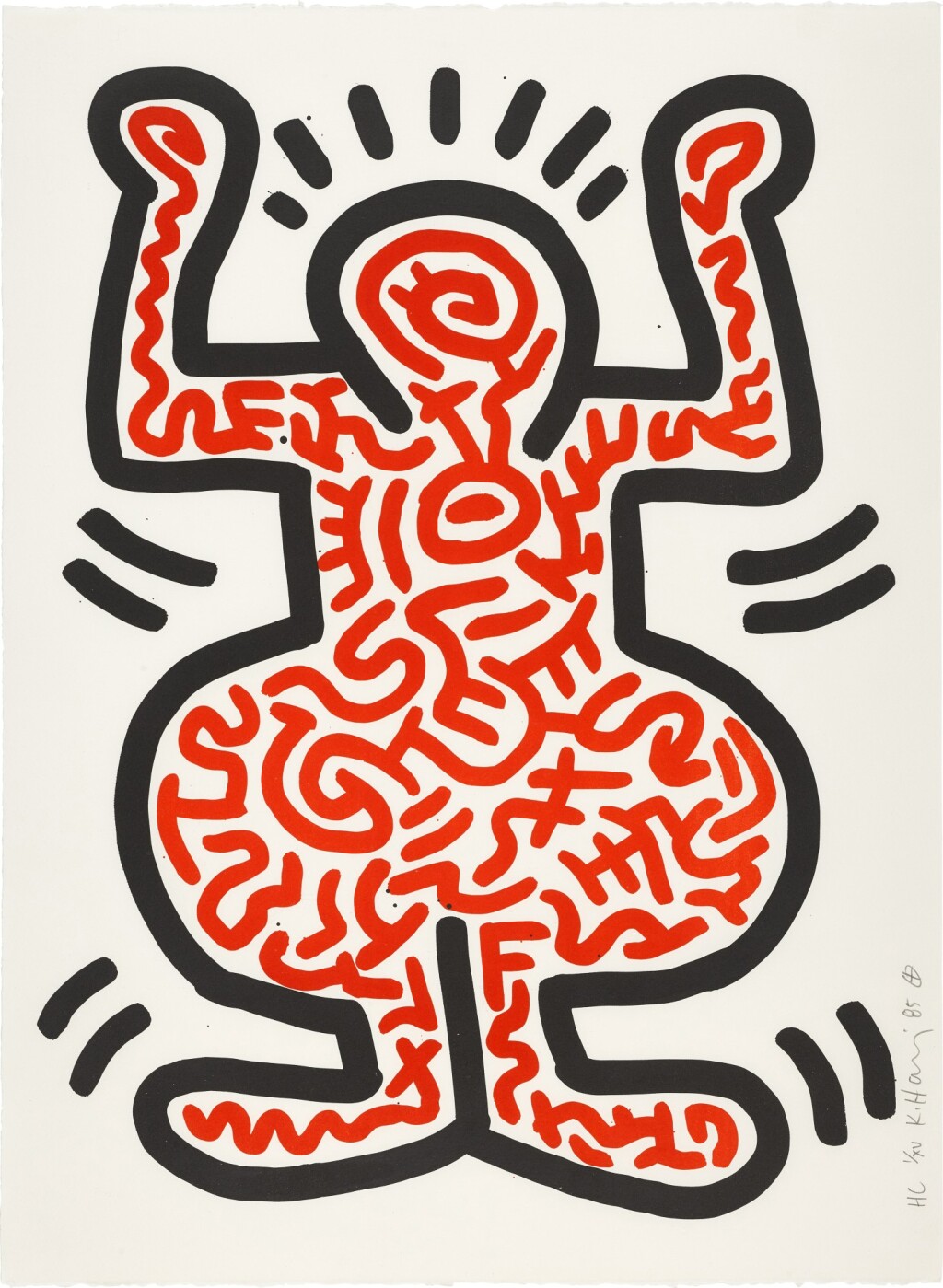
Ludo 2 (L. p. 46)
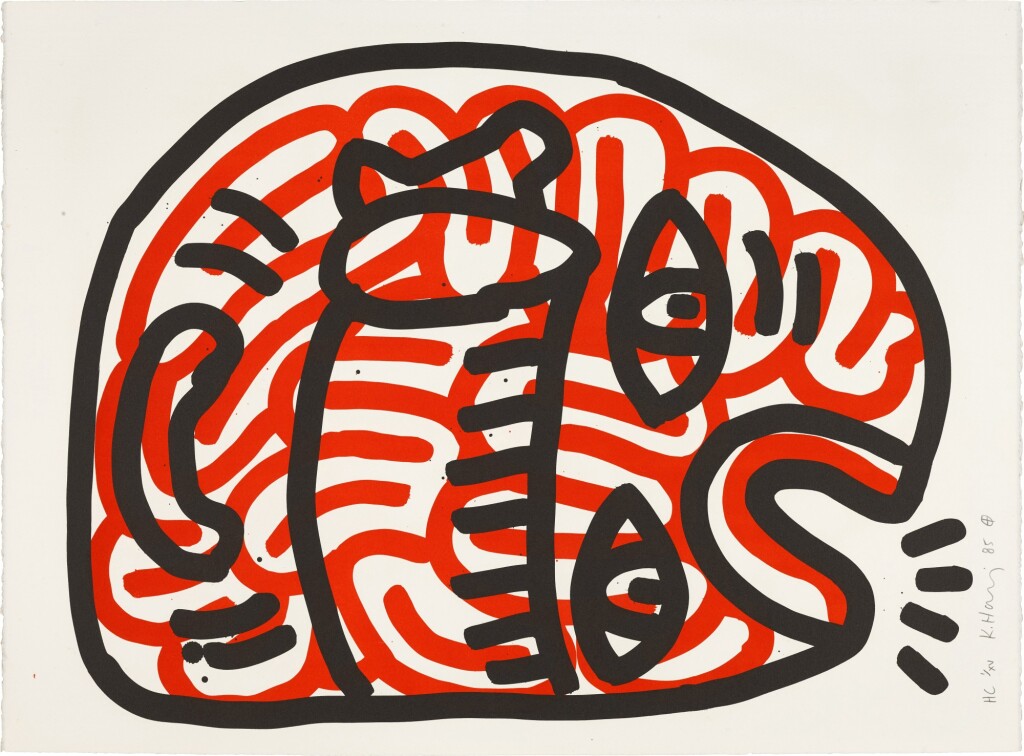
Ludo 3 (L. p.46)
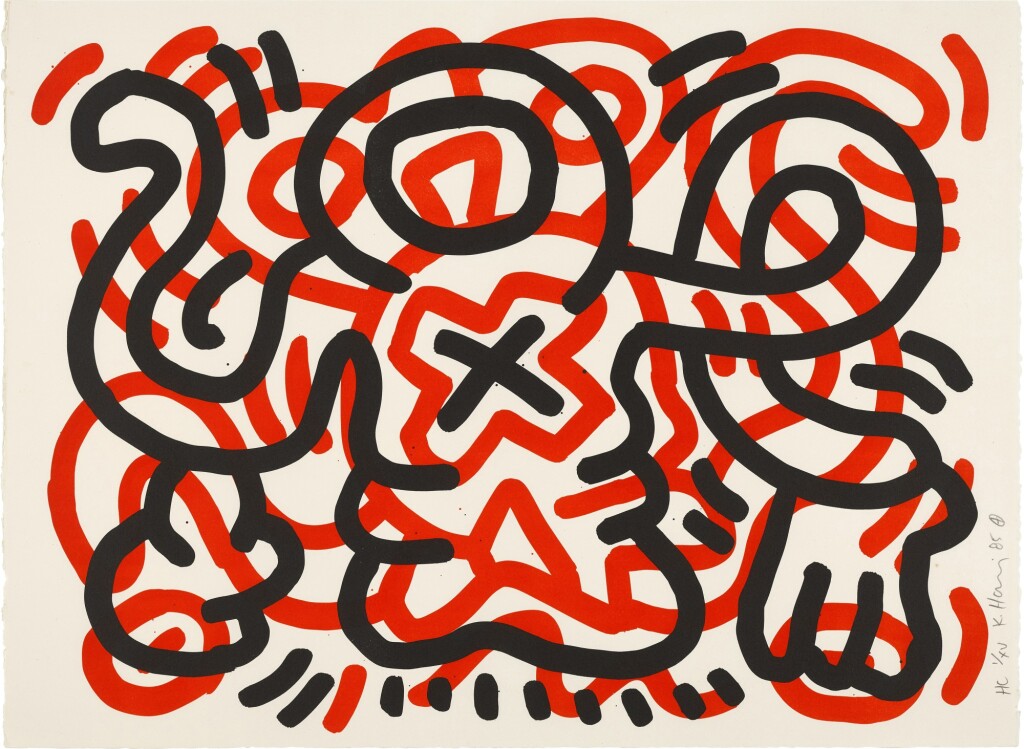
Ludo 4 (L. p. 47)
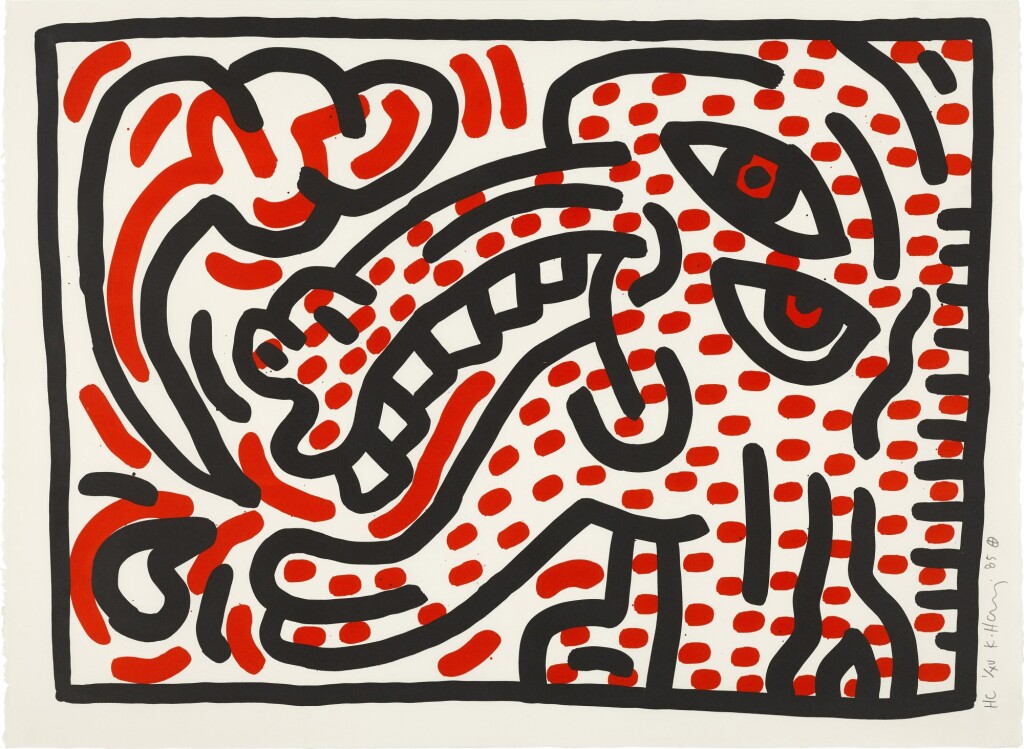
Ludo 5 (L. p. 47)
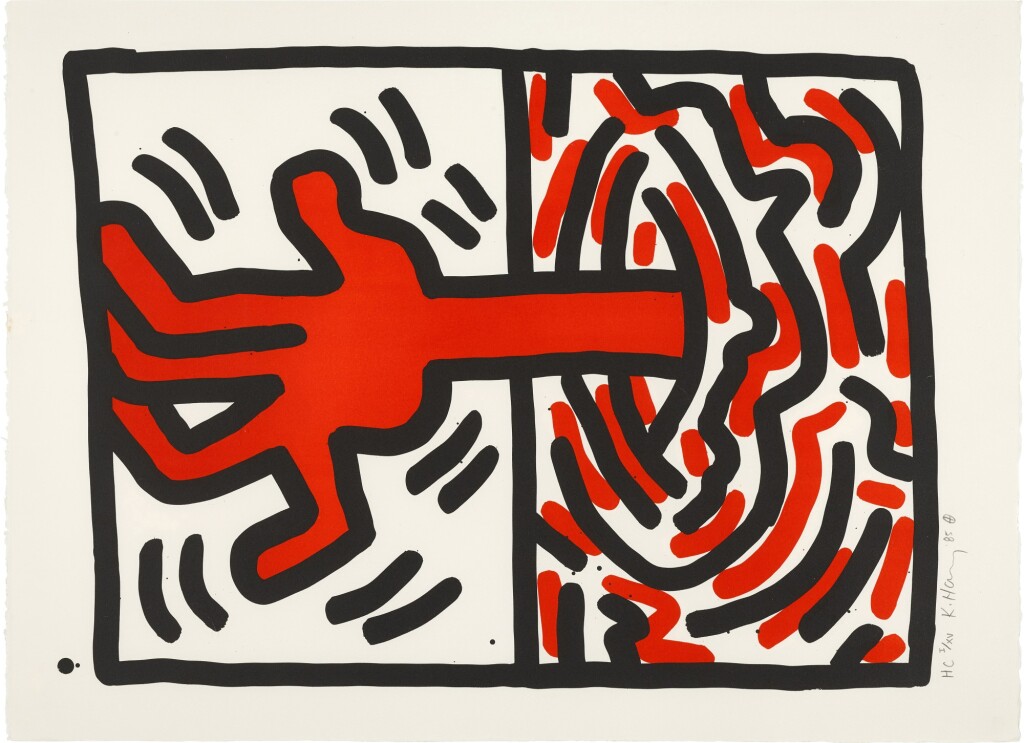
Auction Results
1. Single Prints
Bonhams LA: 3 October 2023
Estimated: USD 4,000 – 6,000
USD 11,520
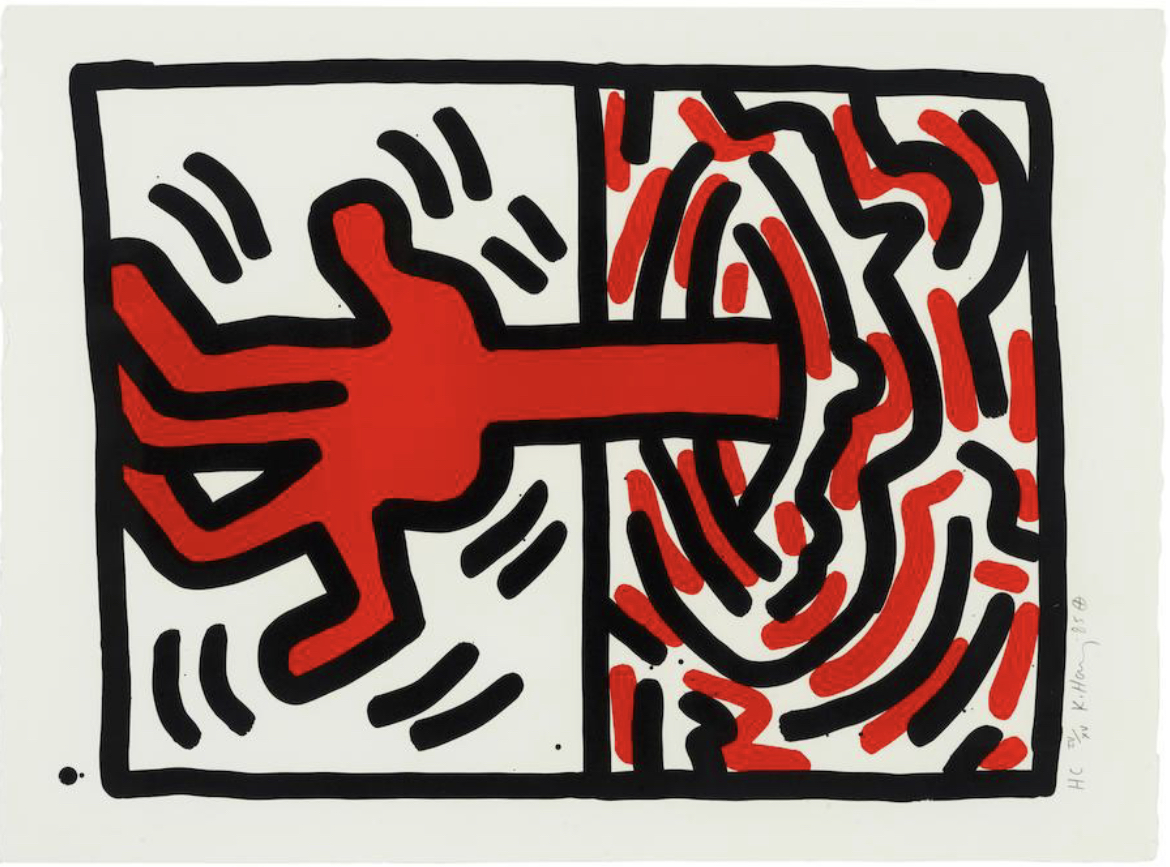
Lithograph in colors on Arches paper
Signed in pencil, dated and numbered HC IV/XV
An hors-commerce, aside from the edition of 90
2. Complete Sets
Van Ham Cologne: 3 June 2025
Estimated: EUR 30,000 – 50,000
EUR 58,433 / USD 66,615
KEITH HARING (1958 Kutztown, PA/USA – 1990 New York)
Ludo (5-part) (Littmann pp.44-47), 1985
Each: Color lithograph on Arches FRANCE (watermark)
Signed, dated, numbered 20/90 and inscribed
Bonhams Los Angeles: 27 September 2022
Estimated: USD 30,000 – 50,000
USD 75,975

The complete suite, comprising 5 lithographs in colors
Each signed in pencil, dated and numbered 37/90
Sotheby’s London: 16 March 2022
Estimated: USD 18,000 – 22,000
GBP 75,600
KEITH HARING
Ludo 1-5 (Littmann pp. 44-47), 1985
The complete portfolio, comprising five lithographs printed in colours
Each signed in pencil, dated, inscribed and numbered ‘HC I/XV’
An hors commerce set aside from the numbered edition of 90
Sotheby’s London: 15 September 2021
Estimated: USD 18,000 – 22,000
GBP 47,880
KEITH HARING (1958 – 1990)
Ludo 1-5 (L. pp. 44-47), 1985
The complete portfolio comprising five lithographs printed in colors
Each signed in pencil, dated, inscribed HC I/XV
(a hors commerce set aside from the numbered edition of 90)
Also signed on the justification page