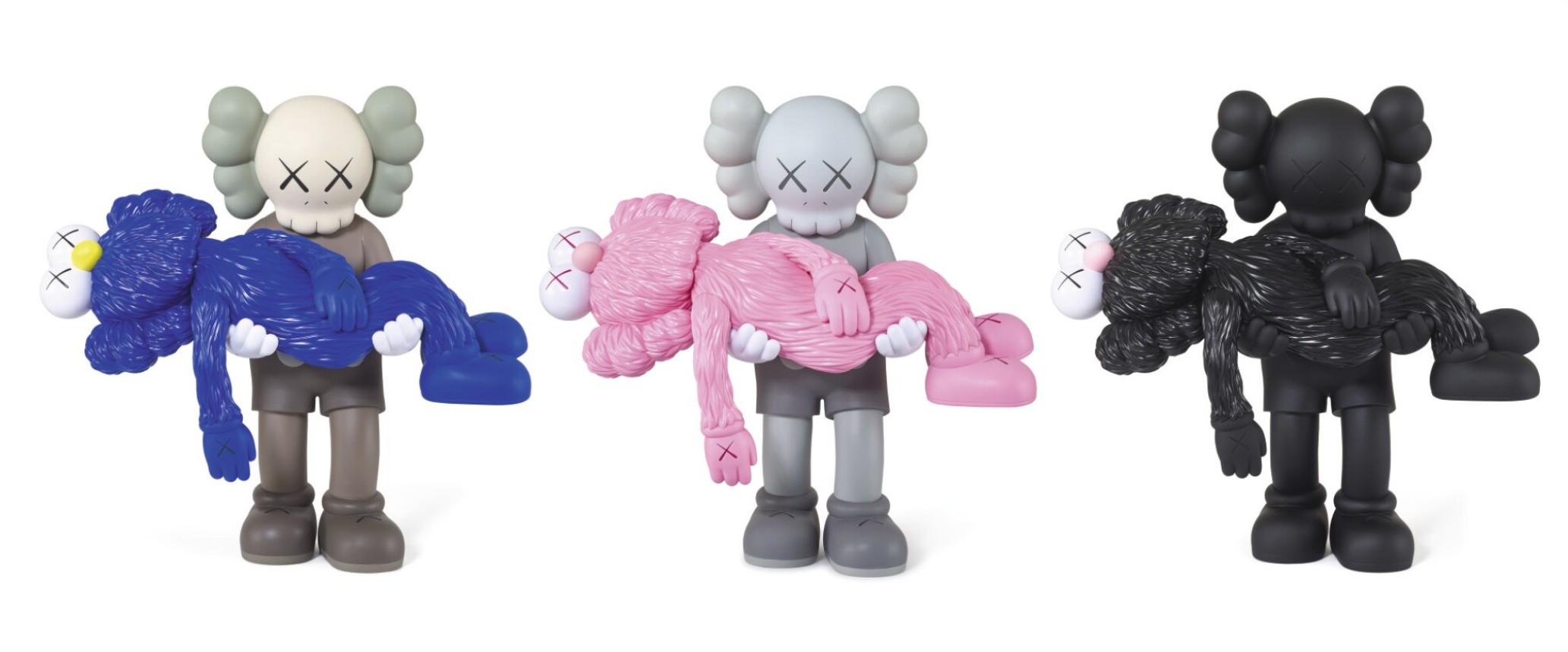
Gone (2019) stands among the most emotionally charged and visually striking sculptural works by KAWS, marking a moment in which the artist fully embraces narrative, vulnerability, and psychological intensity within his practice. Released in multiple color variations, the work expands KAWS’s exploration of relationships and emotional states through a composition that departs from the static autonomy of earlier figures. At its core, Gone is a work about connection and loss, rendered through a powerful and immediate gesture that transforms familiar characters into carriers of deeply human emotion.
Introduction
Gone depicts a standing Companion figure holding a limp BFF character in its arms. The Companion, recognizable through its skull-like head and crossed-out eyes, is rendered with its characteristic solidity and structure. In contrast, the BFF—covered in soft, textured fur—is shown in a state of complete physical release, its body slack and unresponsive. The composition is dynamic and asymmetrical. The weight of the BFF is visibly supported by the Companion, whose posture adjusts to carry the figure. This introduces a sense of gravity and tension that is rarely present in KAWS’s more static works.
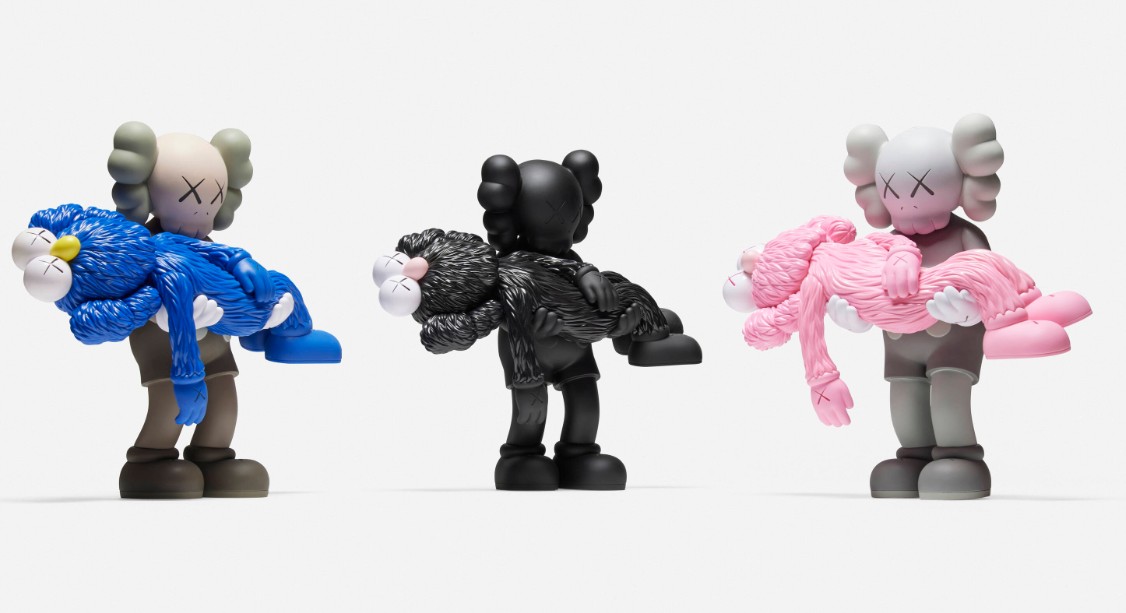
The contrast between materials and surfaces is central. The Companion appears smooth and controlled, while the BFF’s fur is expressive and tactile. This opposition reinforces the emotional divide between the two figures, one active and bearing, the other passive and withdrawn.
Gone (Black)
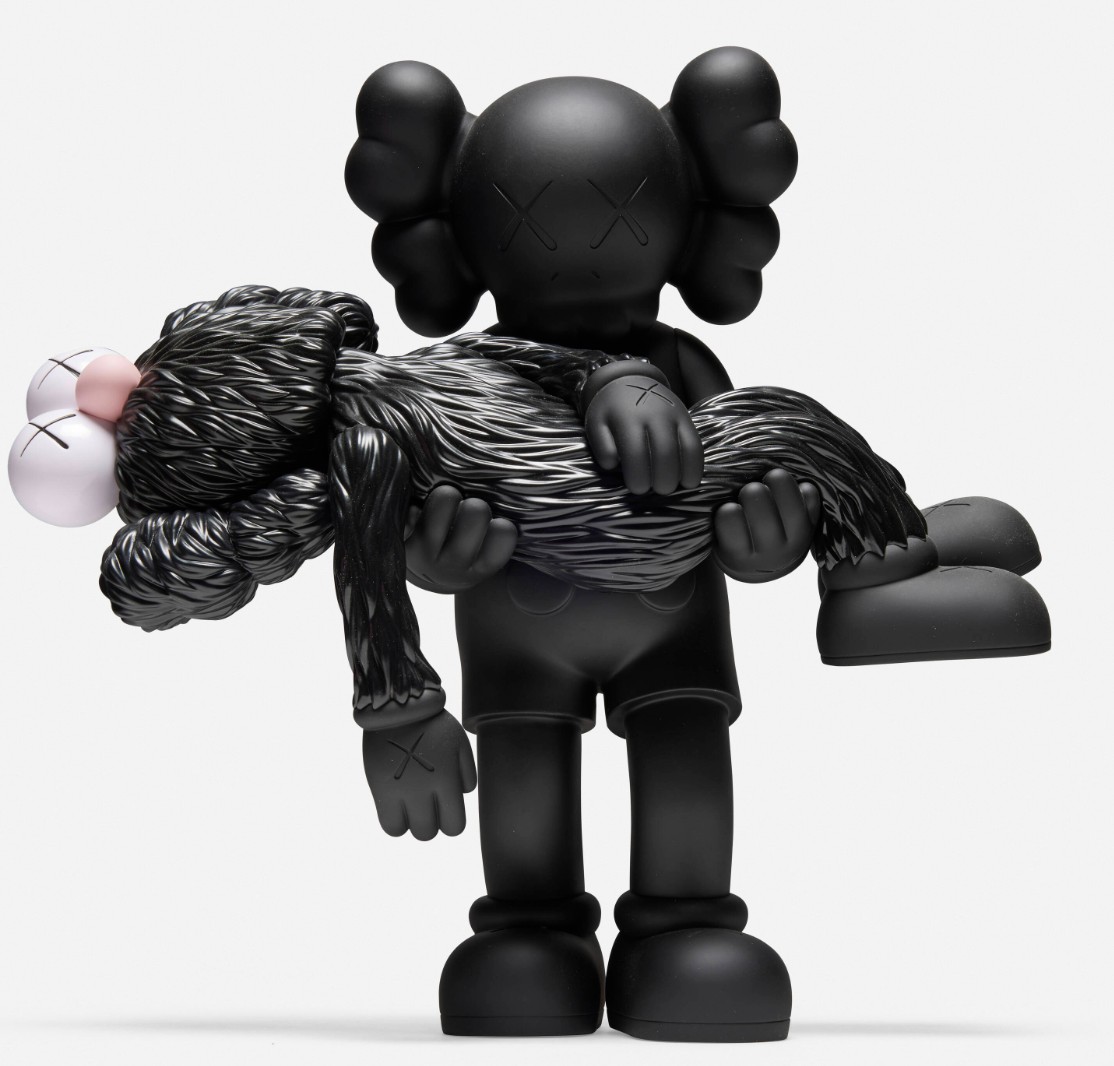
Gone builds upon KAWS’s ongoing engagement with the Companion and BFF characters, two of the most recognizable elements of his visual language. While earlier works often present these figures independently, here they are brought into direct interaction. The work can be seen as an extension of themes explored in sculptures such as Along the Way and Good Intentions, yet it introduces a more explicit narrative dimension. The act of carrying transforms the relationship into a moment of crisis or transition, suggesting a before and an after. Presented in 3 colorways (blue, black, and pink variations) the work maintains its compositional integrity while allowing for subtle shifts in tone and perception.
Gone (Blue)
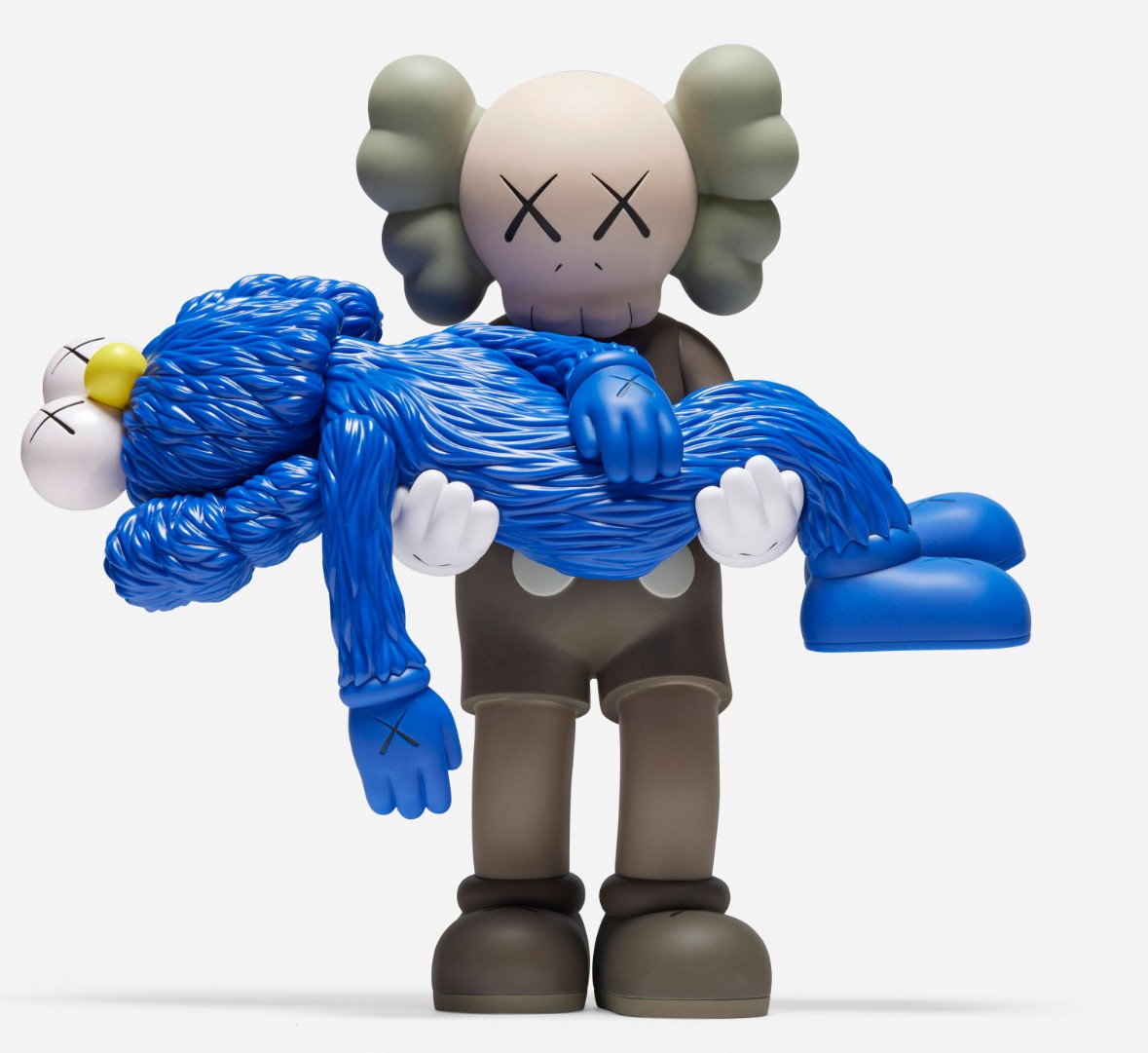
At its core, Gone is a meditation on loss, care, and emotional burden. The image of one figure carrying another evokes a range of associations, from protection and support to grief and farewell. The ambiguity of the BFF’s state is central to the work’s power. It is unclear whether the figure is asleep, unconscious, or absent in a more final sense. This uncertainty allows the viewer to project their own interpretations onto the scene. The Companion, typically perceived as emotionally neutral, here assumes a role of responsibility and weight. Its gesture suggests both care and obligation, reinforcing the complexity of relationships. The title Gone introduces a definitive note, implying absence, departure, or loss. Combined with the visual composition, it transforms the work into a quiet yet profound reflection on the fragility of connection.
Gone represents a significant development in KAWS’s sculptural language, introducing a heightened sense of narrative and emotional specificity. While earlier works often rely on symbolic gestures, this piece constructs a scene that unfolds in time. The interaction between figures allows KAWS to explore relational dynamics more directly, moving beyond isolated characters toward compositions that engage with human experience in a more explicit way. At the same time, the work remains grounded in his established visual vocabulary, ensuring continuity within his broader practice.
Gone (Pink)
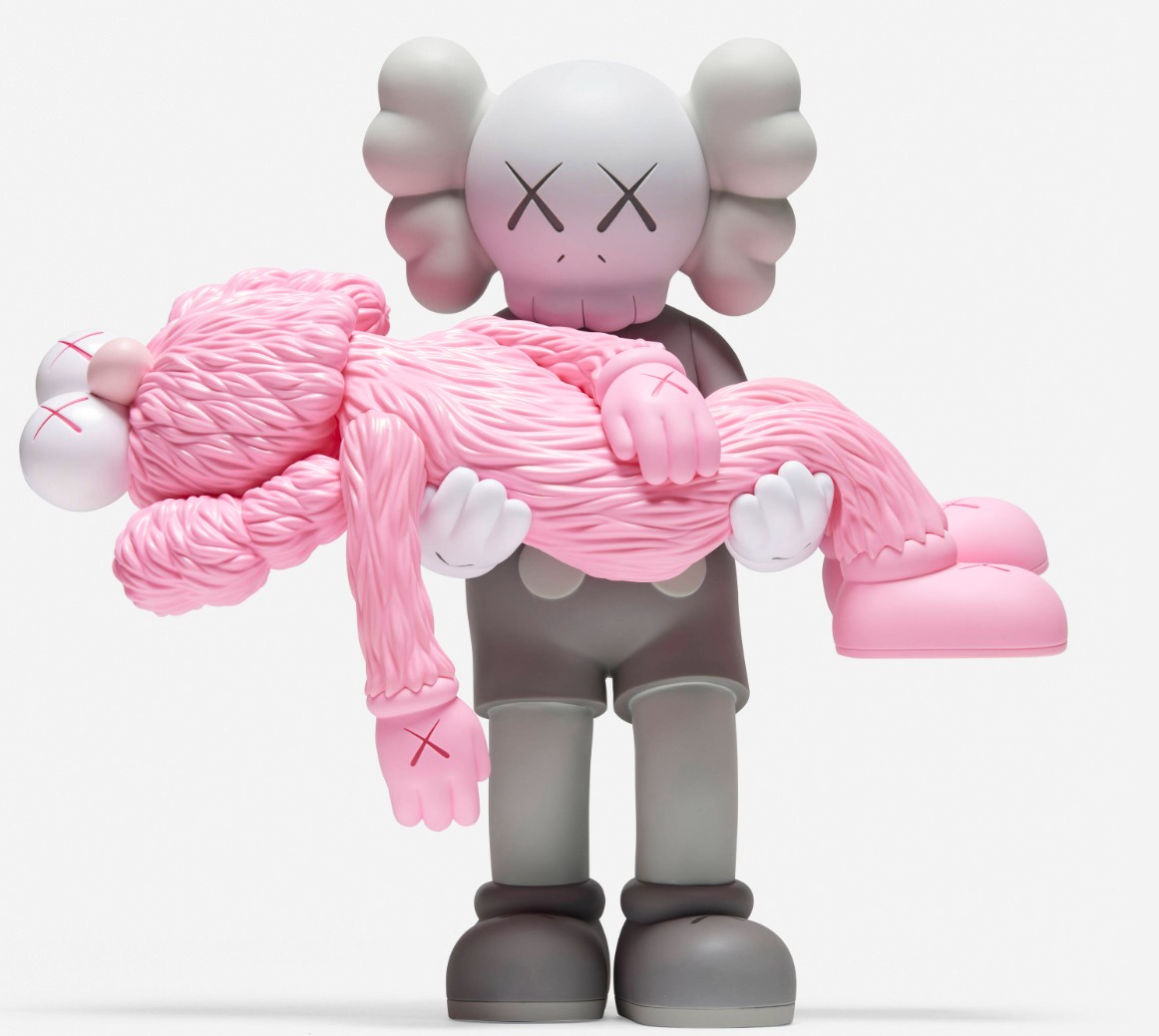
Gone is among the most sought-after sculptural editions by KAWS, due in part to its strong visual impact and emotional resonance. The presence of multiple colorways has expanded its accessibility while maintaining high demand across variations. Collectors are particularly drawn to the work’s narrative quality, which distinguishes it from more iconic but static figures. Its recognizability, combined with its conceptual depth, ensures its continued relevance within both primary and secondary markets. The work’s position within a key moment of KAWS’s evolution further reinforces its importance, making it a central piece within collections focused on his sculptural output.
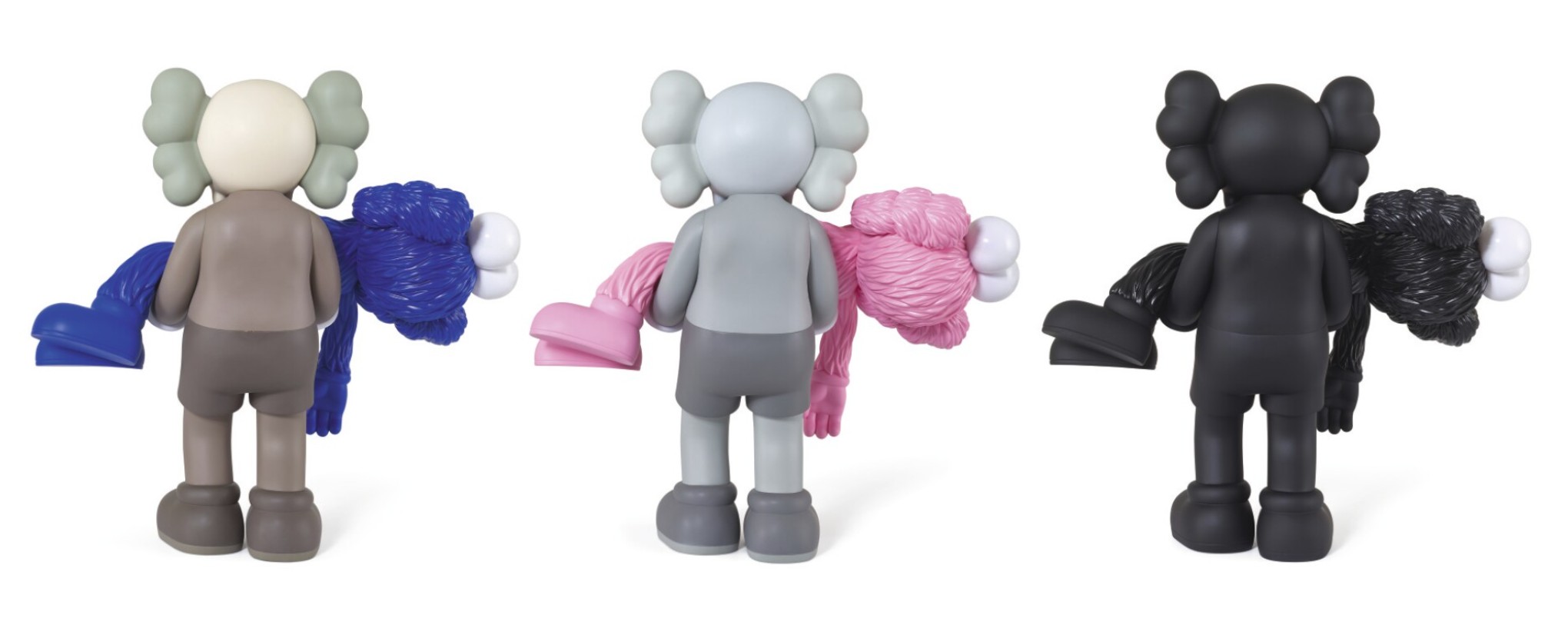
Gone stands as one of the most poignant articulations of emotion within KAWS’s work. Through a simple yet powerful composition, the artist captures a universal experience, transforming familiar characters into vehicles for reflection on care, loss, and human connection. By introducing narrative and physical interaction, KAWS expands the possibilities of his sculptural language, demonstrating an ability to convey complex emotional states with clarity and restraint. In doing so, Gone secures its place as a defining work within his oeuvre, embodying both the accessibility and depth that have come to characterize his practice.
GONE, 2019
Gone (Blue/Pink/Black)
The complete set of three works
Medium: Painted cast vinyl
Year: 2019
Dimensions: 36x36x14 cm (14-1/4 x 14-1/4 x 5-1/2 inches)
Edition: Unknown size
Produced by Medicom Toy, Tokyo
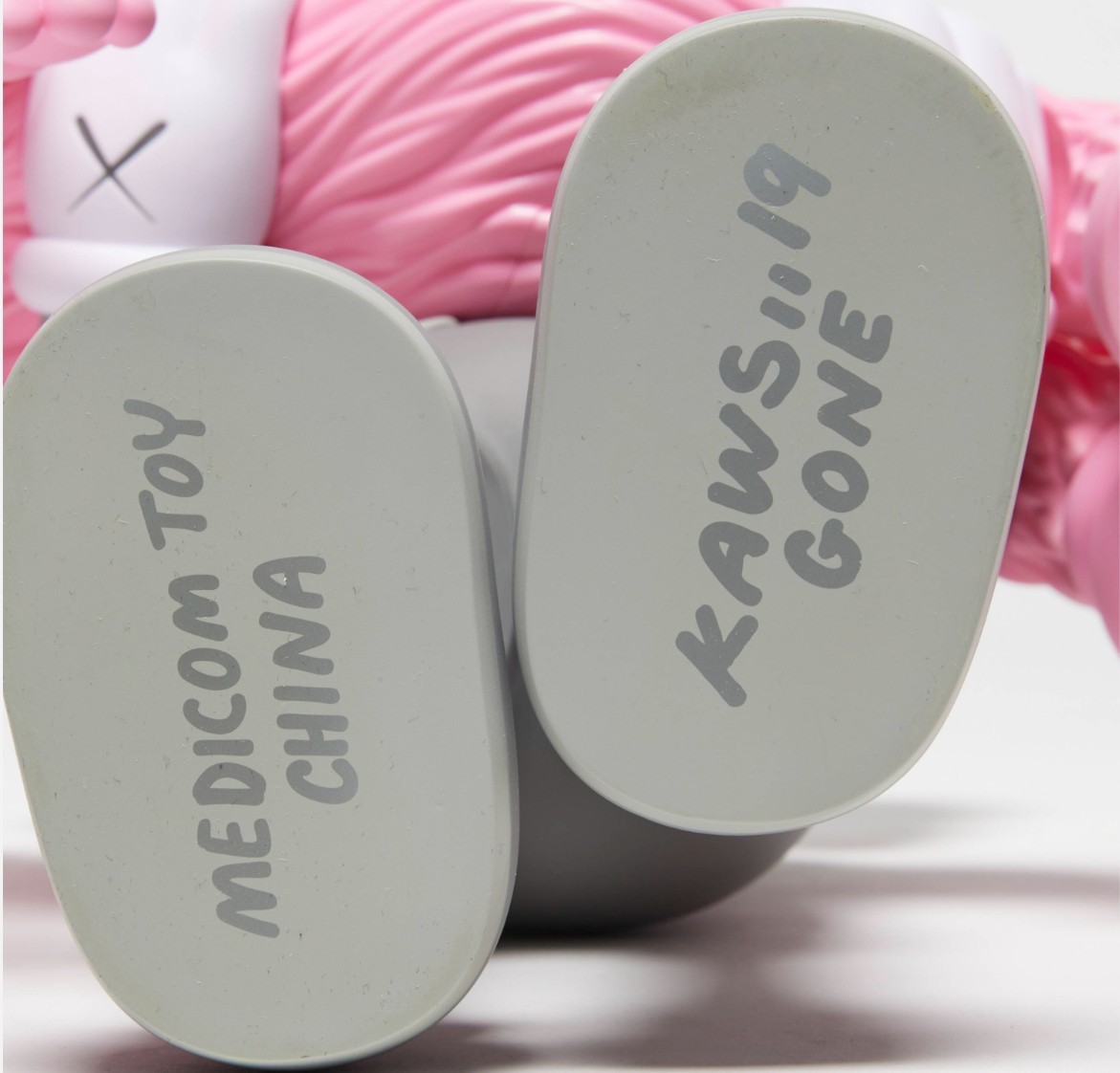
Stamped signature, title, date and manufacturer’s mark to underside
‘Kaws 19 Gone Medicom Toy China’
Auction Results
LA Modern: 3 December 2024
Estimated: USD 3,000 – 5,000
USD 1,890
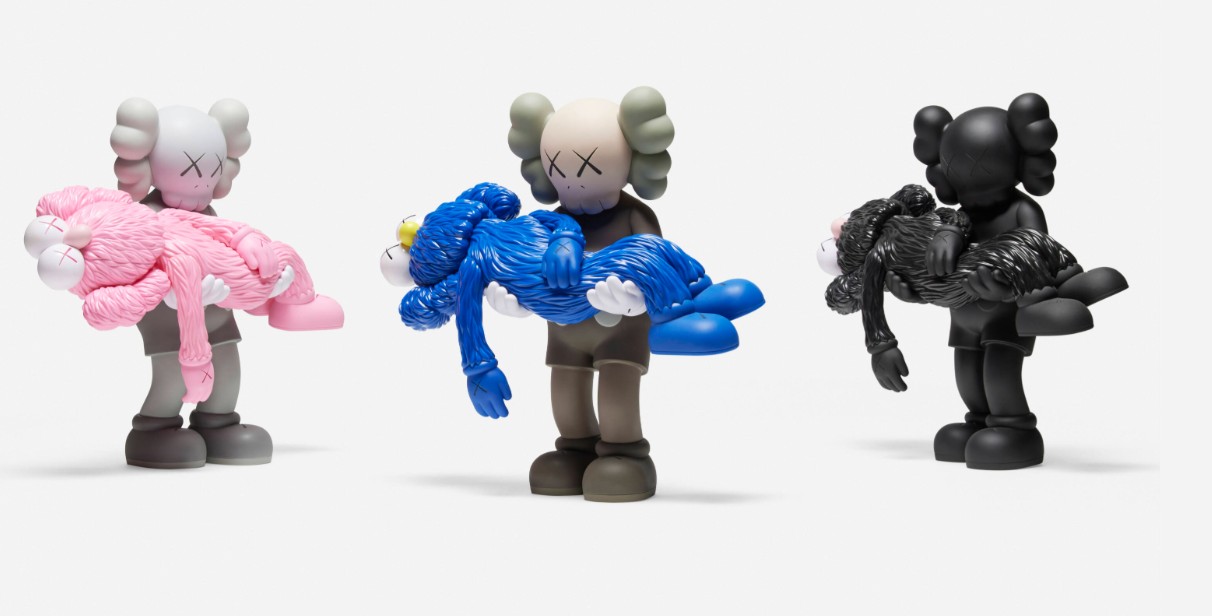
KAWS (Brian Donnelly, b.1974)
Gone (three works), 2019
Painted cast vinyl
Stamped signature, title, date and manufacturer’s mark to underside of each work
‘Kaws 19 Gone Medicom Toy China’
This complete set of three works is from an edition of unknown size
Produced by Medicom Toy, Tokyo
Sold with original packaging
Sotheby’s Hong-Kong: 16 April 2020
Estimated: HKD 20,000 – 30,000
HKD 56,250 / USD 7,255
KAWS (b.1974
GONE (BROWN/ GREY/ BLACK) (THREE WORKS), 2019
Painted cast vinyl, with respective original box
Each printed with the artist’s signature, dated 19 and titled on the underside
These works are from an open edition produced by Medicom Toy
GONE (Black), 2019
Gone (Black)
Medium: Painted cast vinyl
Year: 2019
Dimensions: 36x36x14 cm (14-1/4 x 14-1/4 x 5-1/2 inches)
Edition: Unknown size
Produced by Medicom Toy, Tokyo
Stamped signature, title, date and manufacturer’s mark to underside
‘Kaws 19 Gone Medicom Toy China’
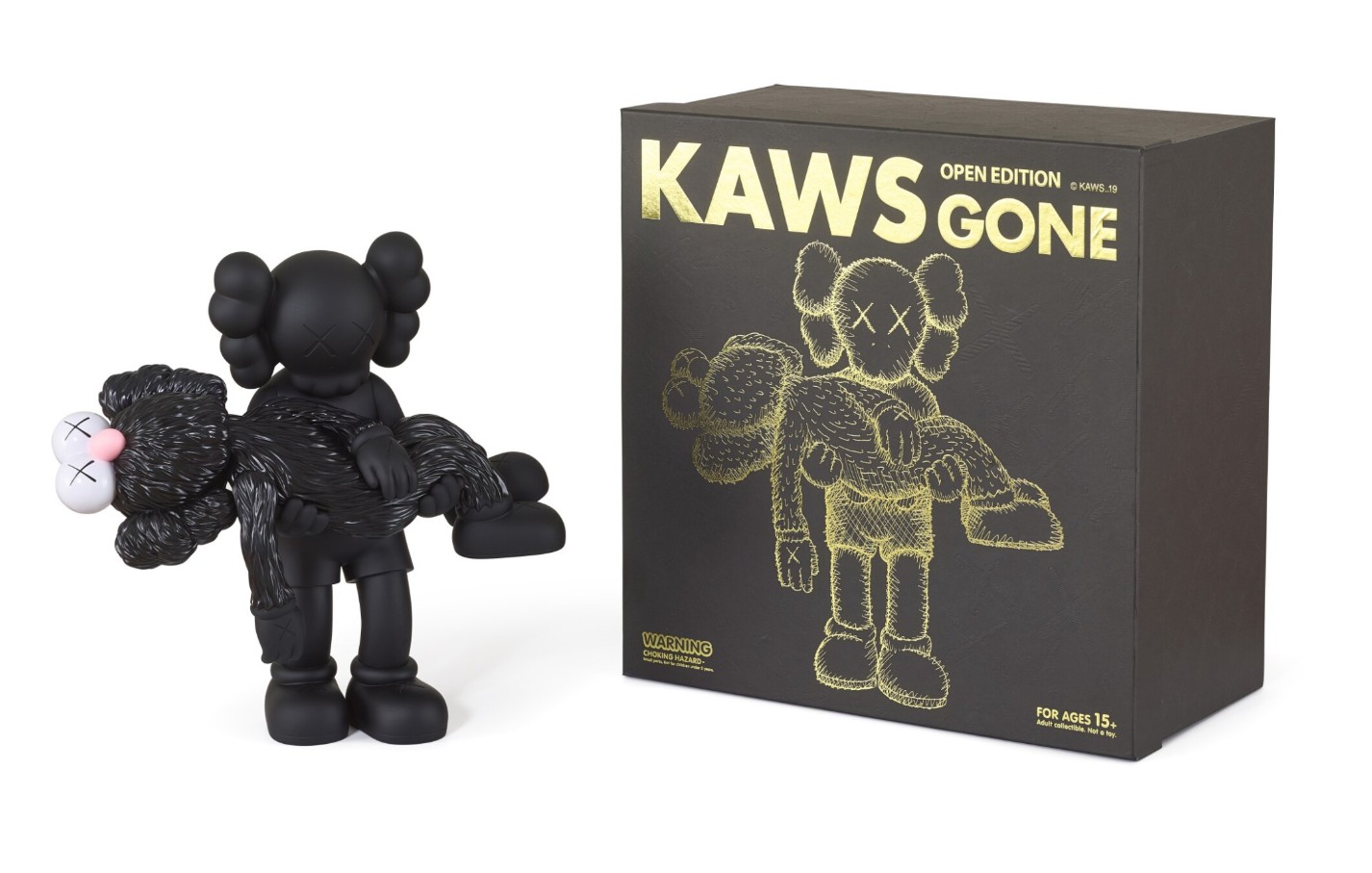
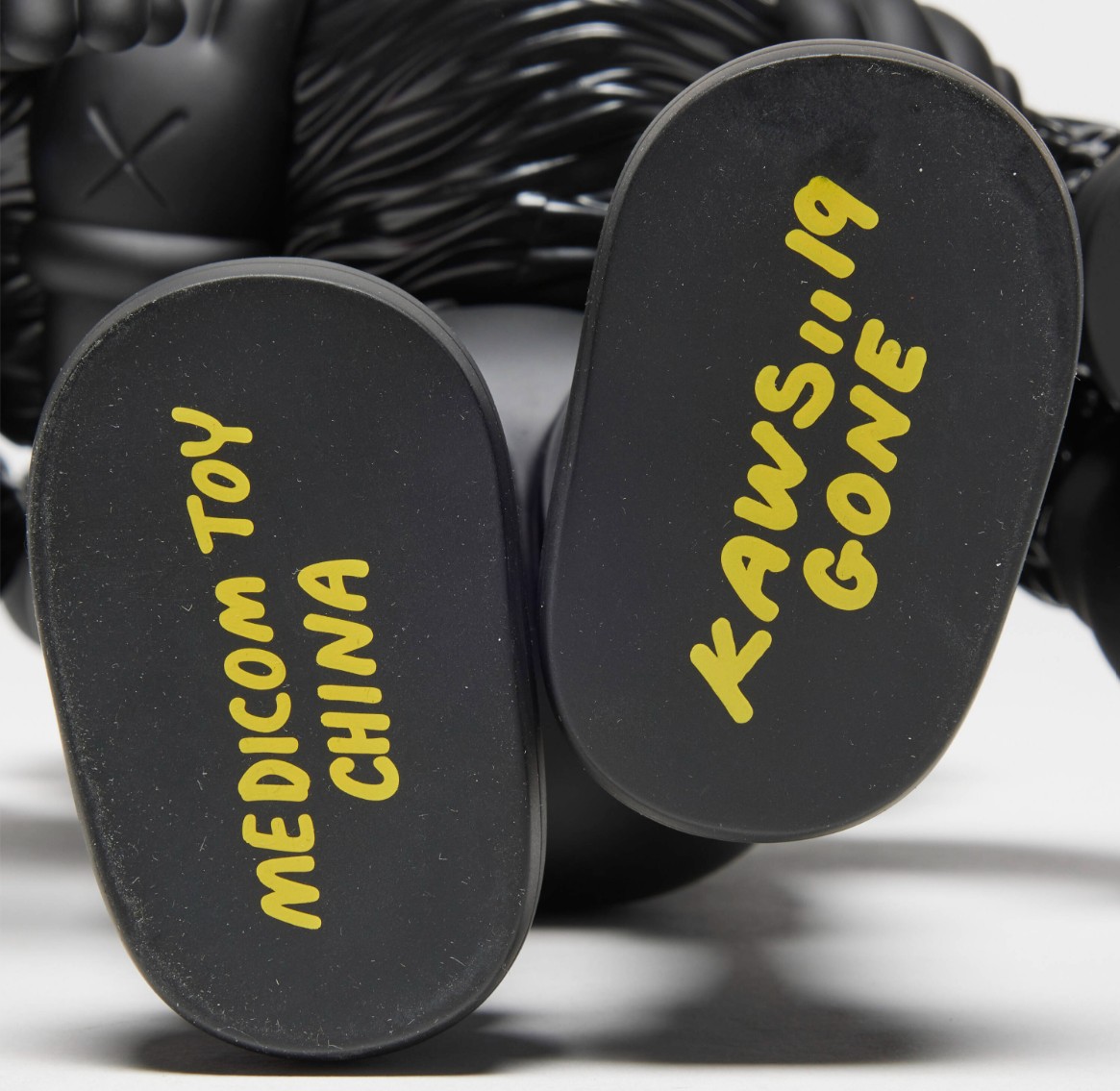
Heritage Auctions: 12 December 2025
USD 1,375
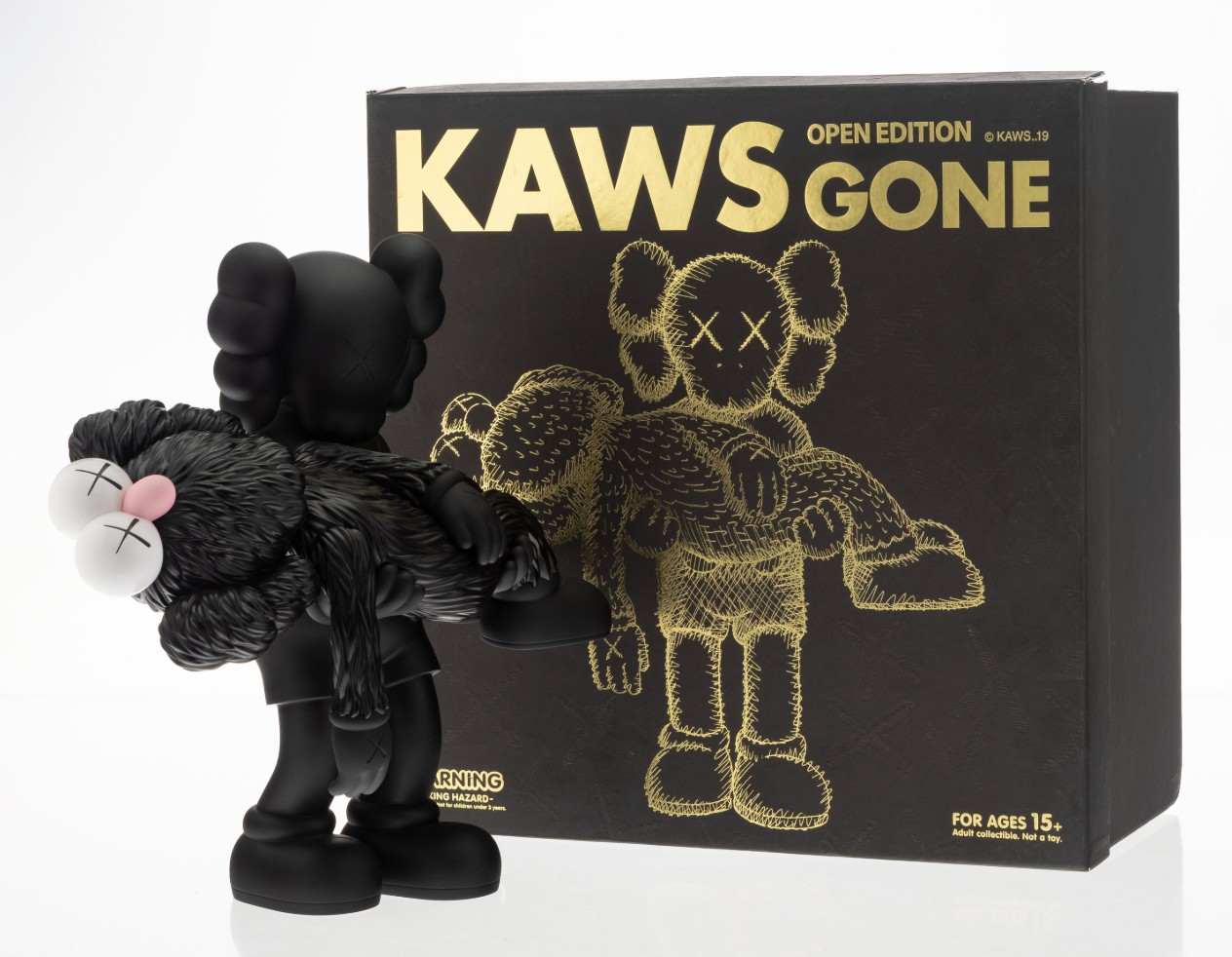
KAWS (b. 1974)
Gone (Black), 2019
Painted cast vinyl
Stamped to underside of feet
Produced by Medicom Toy, Tokyo
Gone (Brown/Blue)
Gone (Brown/Blue)
Medium: Painted cast vynil
Year: 2019
Dimensions: 36x36x14 cm (14-1/4 x 14-1/4 x 5-1/2 inches)
Edition: Unknown size
Produced by Medicom Toy, Tokyo
Stamped signature, title, date and manufacturer’s mark to underside
‘Kaws 19 Gone Medicom Toy China’
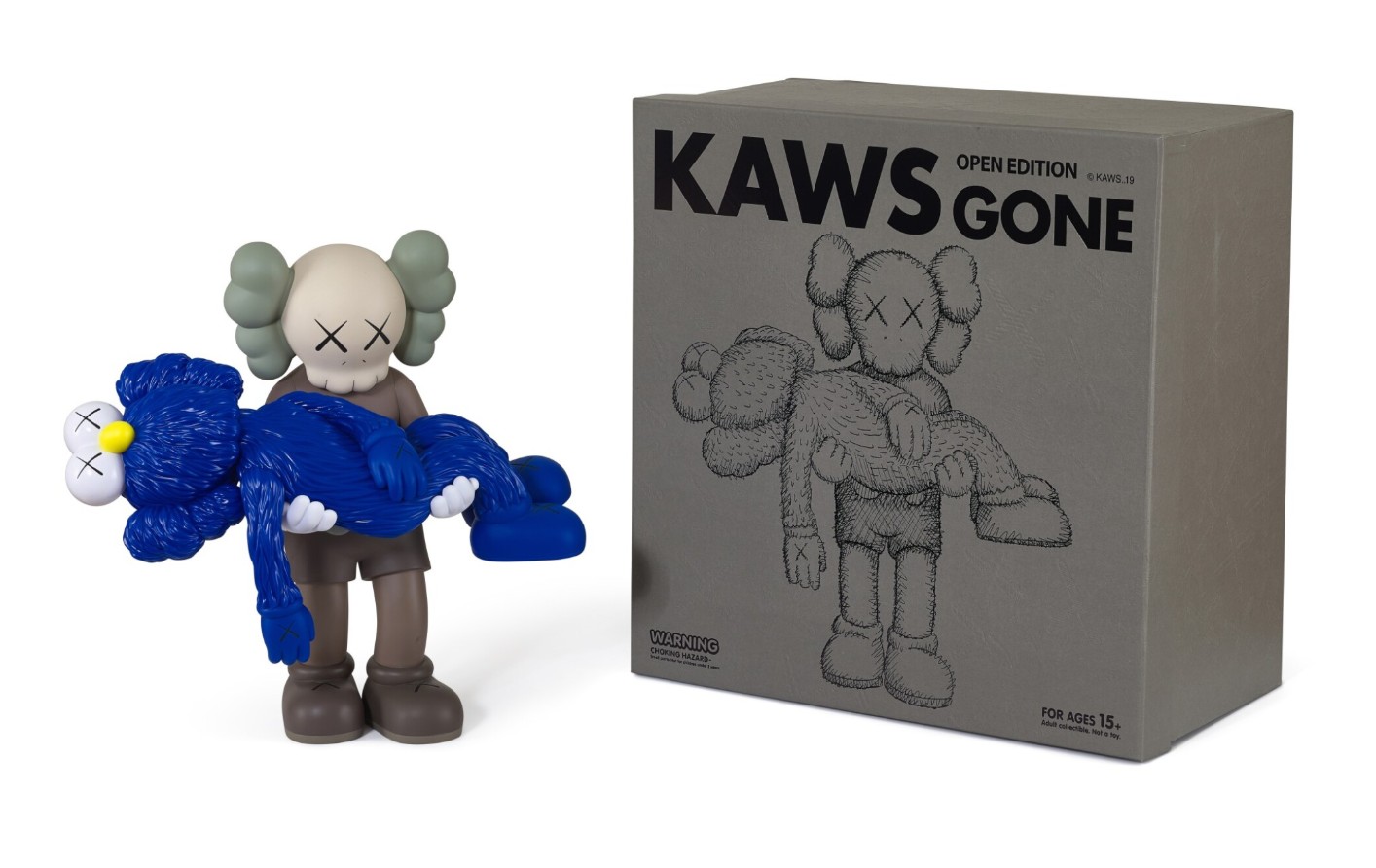
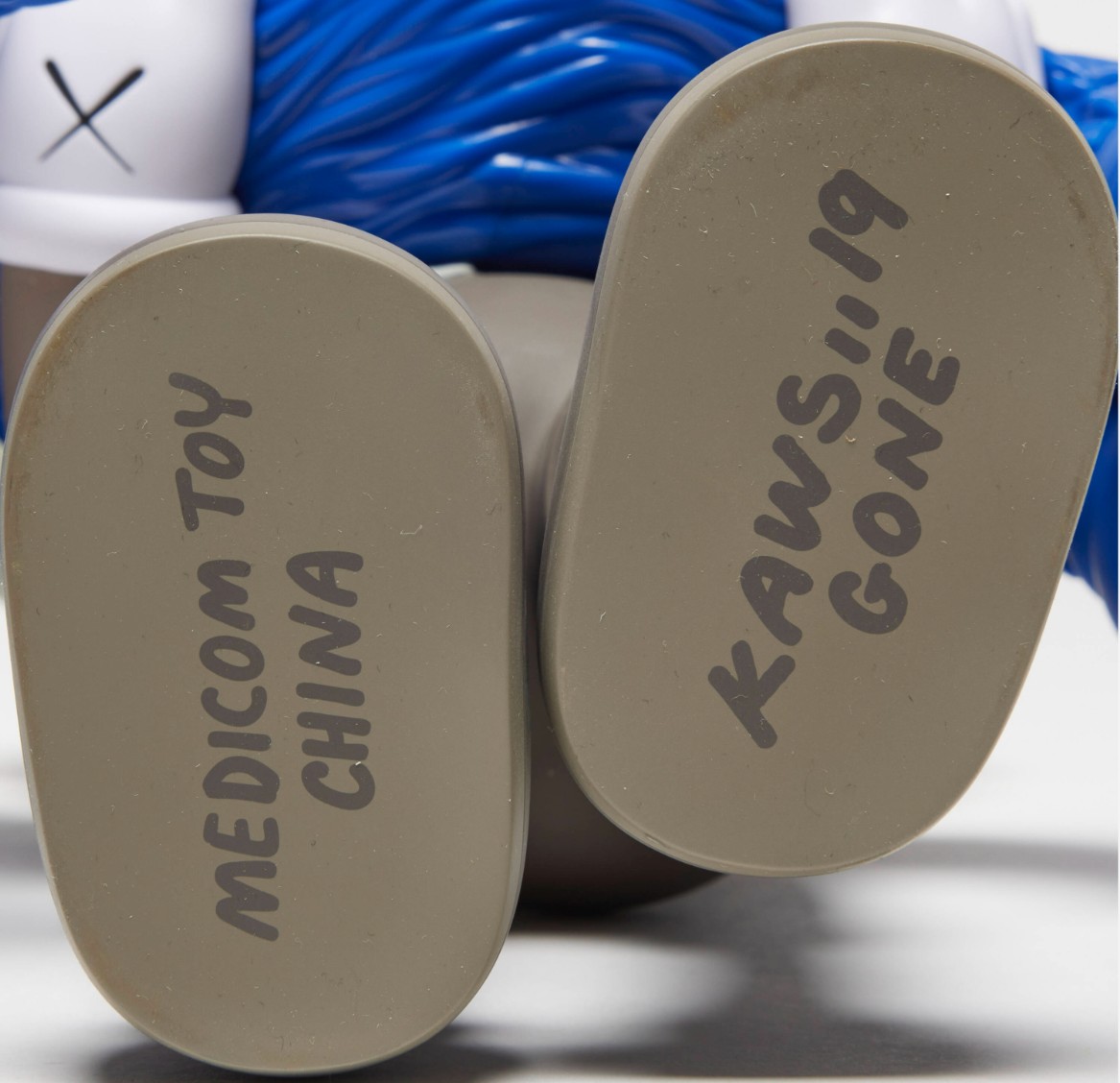
Heritage Auctions: 4 February 2026
USD 2,250
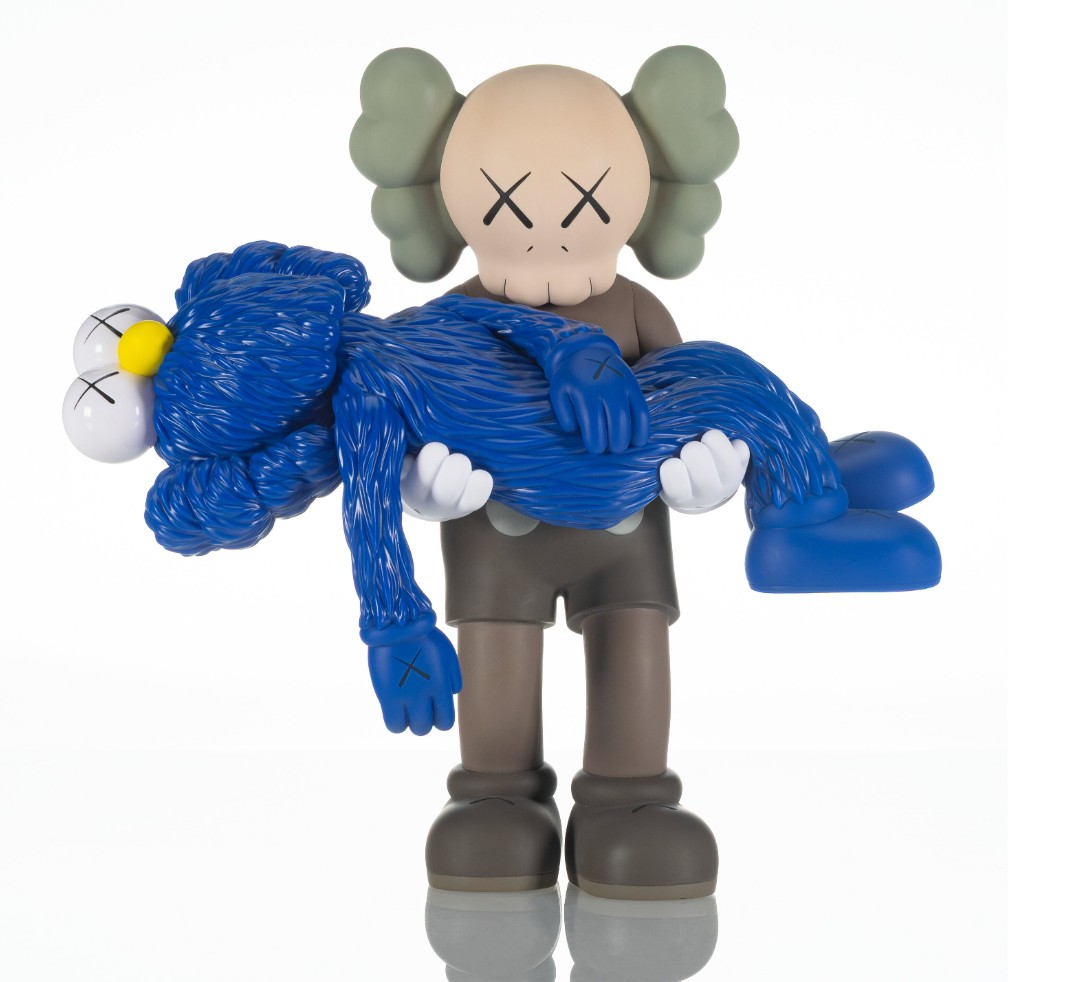
KAWS (b. 1974)
Gone (Brown), 2019
Painted cast vinyl
Stamped on underside of feet
Produced by Medicom Toy, Tokyo
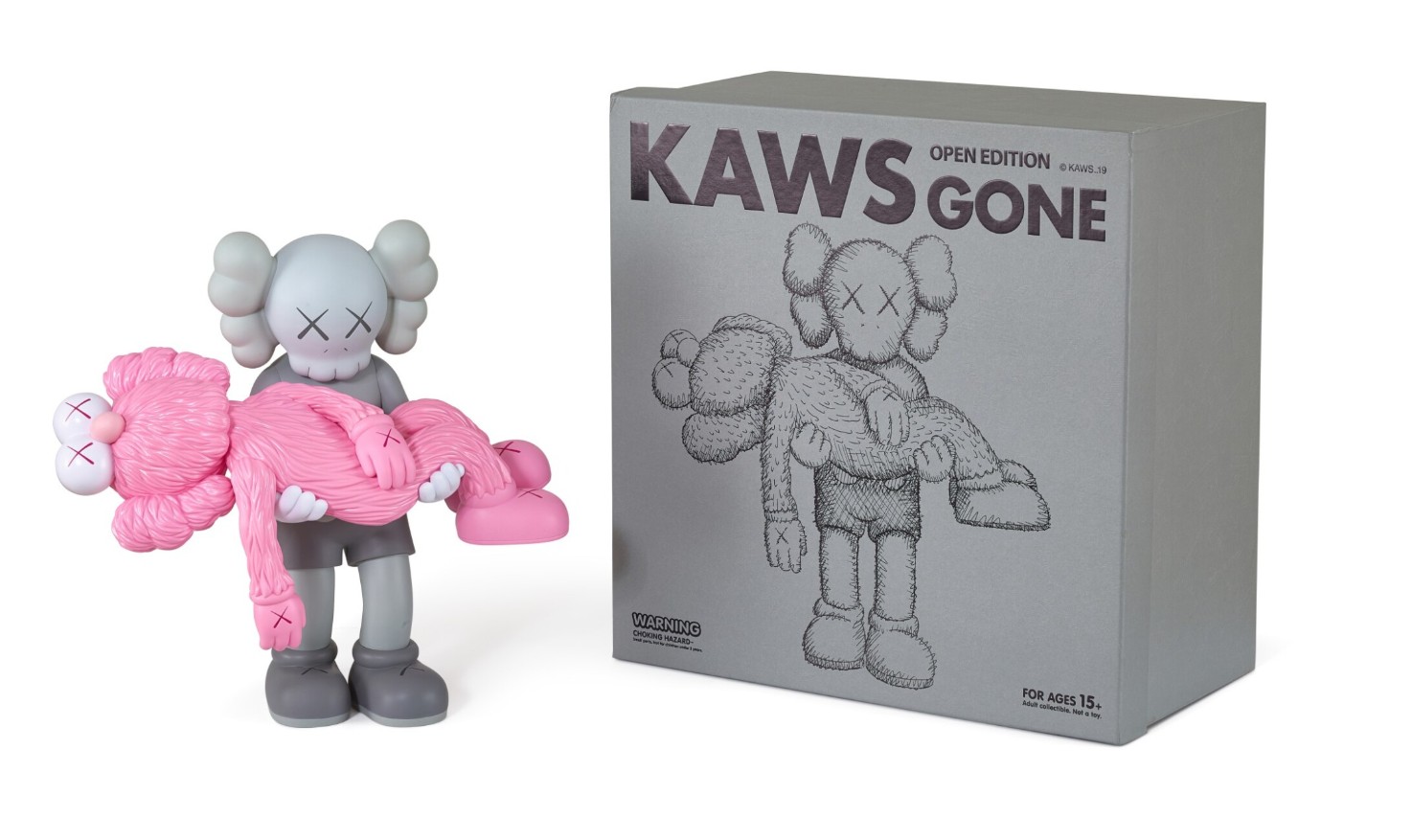
Gone (Grey/Pink)
Gone (Grey/Pink)
Medium: Painted cast vynil
Year: 2019
Dimensions: 36x36x14 cm (14-1/4 x 14-1/4 x 5-1/2 inches)
Edition: Unknown size
Produced by Medicom Toy, Tokyo
Stamped signature, title, date and manufacturer’s mark to underside
‘Kaws 19 Gone Medicom Toy China’
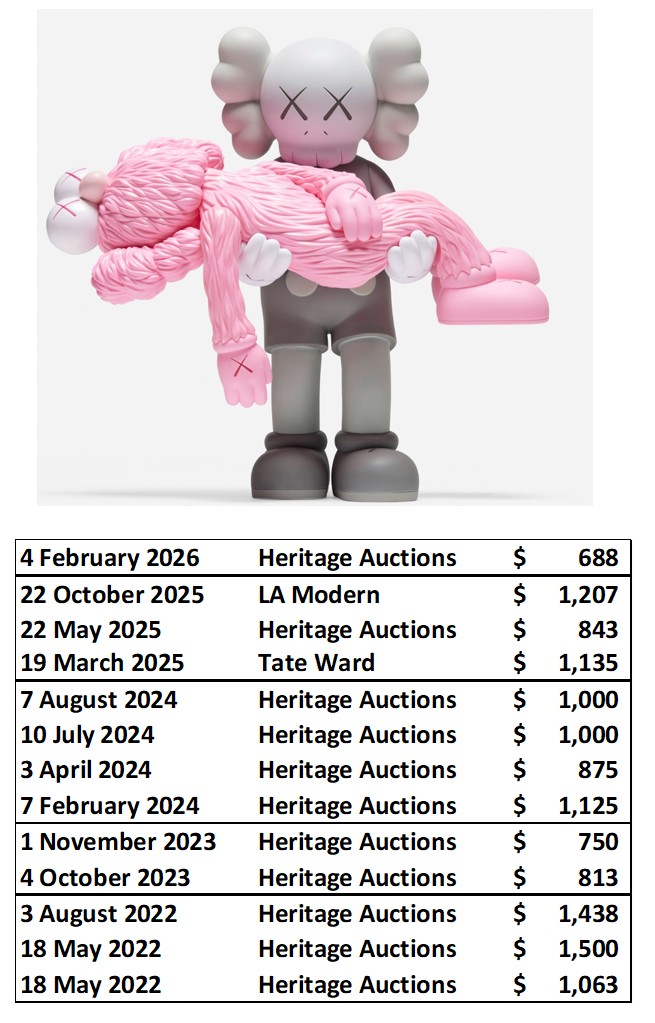
Auction Results
Monumental Bronze
GONE, 2018
Phillips London: 6 March 2025
Estimated: GBP 600,000 – 800,000
GBP 571,500 / USD 731,520
KAWS – Modern & Contemporary Art Eveni… Lot 27 March 2025 | Phillips
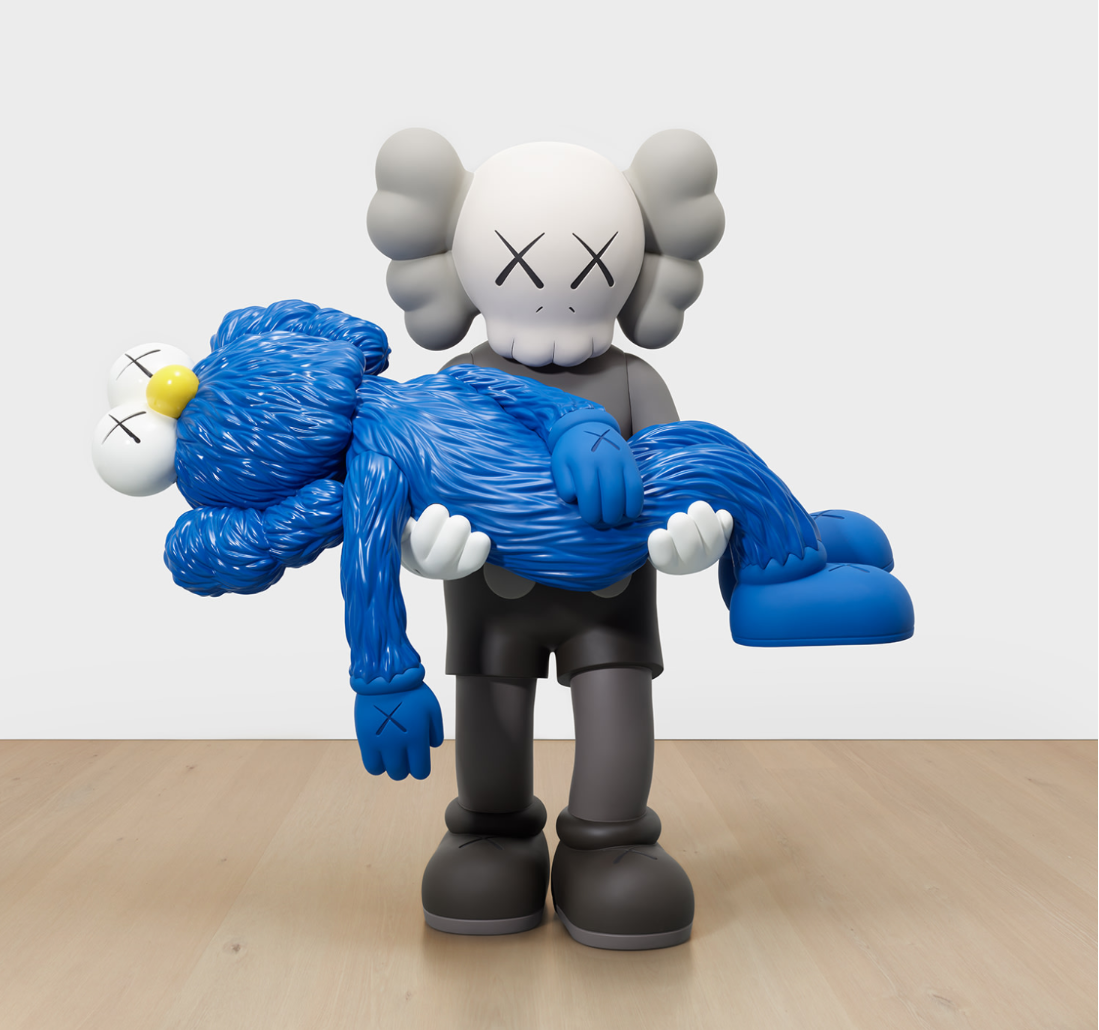
KAWS
GONE, 2018
Painted bronze
71 x 71 1/2 x 29 3/4 inches (180.3 x 181.6 x 75.6 cm)
Inscribed with the artist’s signature, numbered and dated ‘3/5 KAWS..18’ on the underside
This work is number 3 from an edition of 5 plus 2 artist’s proofs
Few contemporary artists have successfully navigated the intersection of high art and popular culture with the precision and impact of KAWS. Born Brian Donnelly in 1974, KAWS has spent the last three decades reshaping the way audiences engage with art, seamlessly merging the visual languages of street culture, consumerism, and fine art. His instantly recognizable characters—hybrid figures that reference cartoon nostalgia while carrying deep emotional resonance—have solidified his status as one of the most influential artists of his generation.
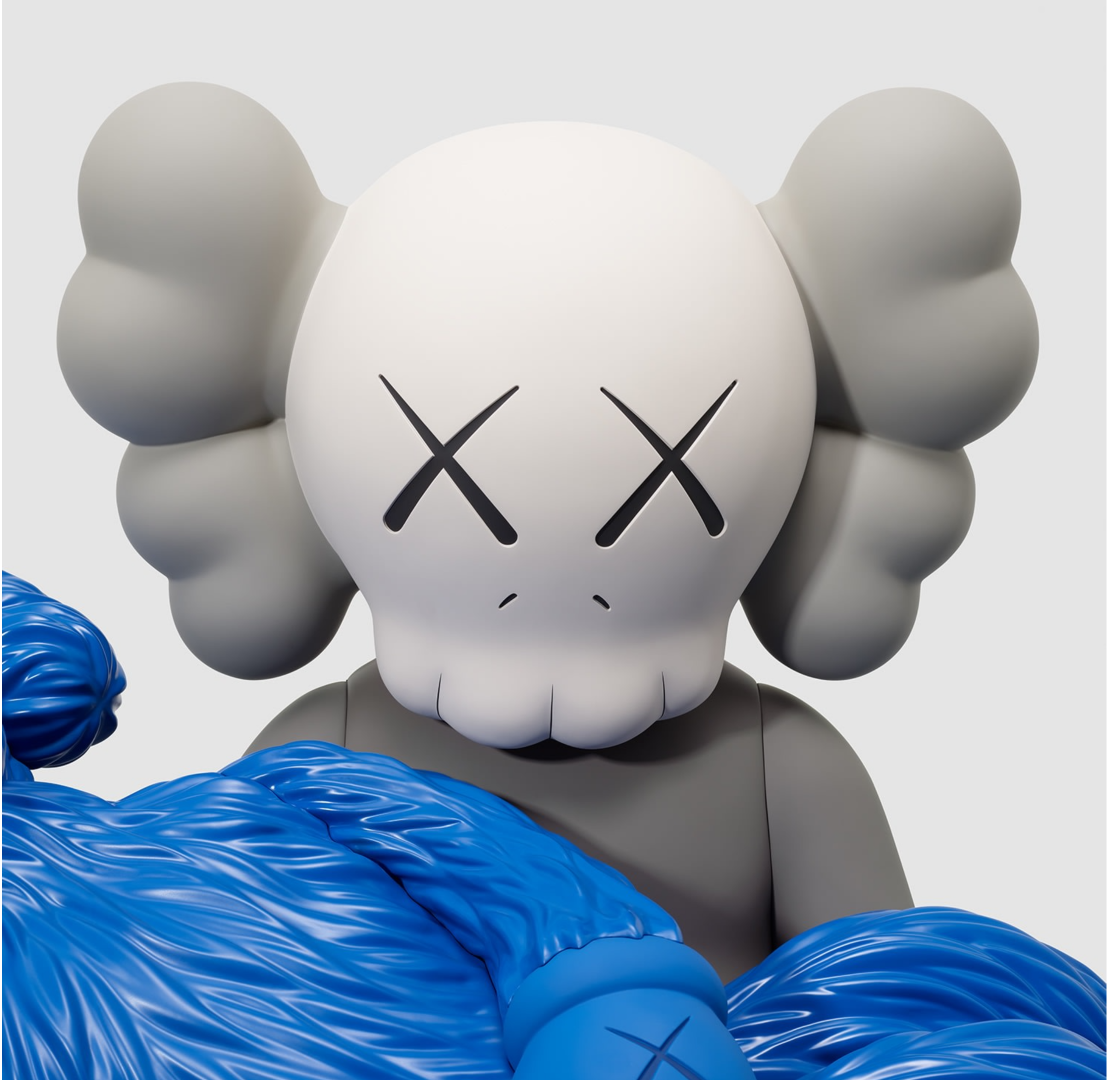
Among these, GONE stands as one of KAWS’ most poignant and sophisticated works, distilling the essence of his practice into a single sculptural moment. Debuting at Skarstedt Gallery in New York as part of KAWS’ inaugural exhibition with the gallery – also titled GONE – the work depicts his iconic ‘COMPANION’ figure carrying the lifeless body of ‘BFF’ in an unmistakable reference to Michelangelo’s Pietà. This powerful composition transforms KAWS’ familiar characters into a meditation on grief, loss, and the passage of time—an evolution of his practice that deepens the emotional weight behind his work.
“When I was younger, I wasn’t going to galleries, I wasn’t going to museums […] There was a lot of ‘this is fine art’ or ‘this is not fine art’; ‘this is commercial’, ‘this is high art’. In my mind I thought, art’s purpose is to communicate and reach people. Whichever outlet that’s being done through is the right one.”
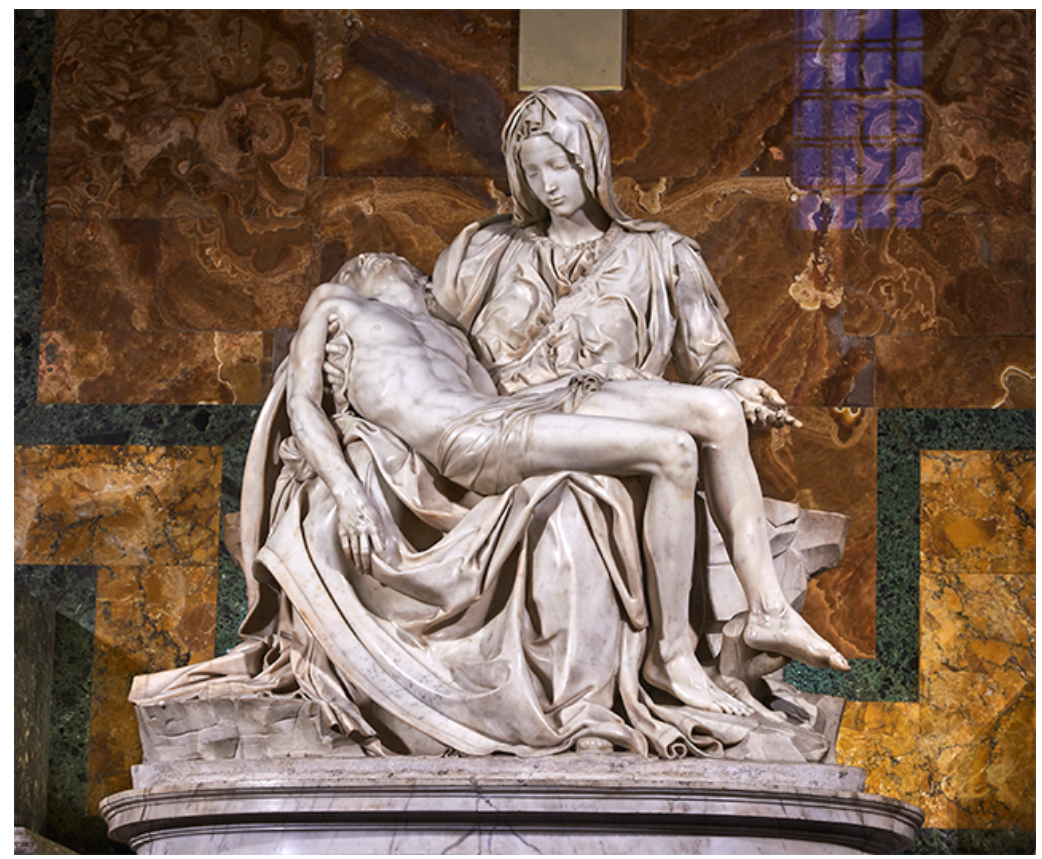
Michelangelo Buonarroti, Pietà, 1497–1499, St Paul’s Basilica, Vatican City. Image: wikicommons
Since the late 1990s, KAWS’ artistic trajectory has been shaped by a commitment to reimagining mass culture. Beginning as a graffiti artist known for subverting advertisements on billboards and bus shelters, KAWS quickly developed a signature visual language: rounded forms, bold color palettes, and the ever-present X-ed-out eyes that imbue his figures with a unique blend of melancholy and universality. COMPANION, first introduced in 1999 as a limited-edition vinyl figure, has served as the linchpin of his oeuvre—a character who, despite its cartoon-like origins, speaks poignantly to the human condition. In scaling-up his originally toy-sized figures, KAWS shifts the dynamic between the viewer and the work.
“Something somebody could hold in their hand at one point […] can probably now hold you.”
This change in scale dramatically alters the way we relate to KAWS’ sculptures, especially works like GONE which not only reflect human emotions but also mirror a human-like scale. In stark contrast to earlier iterations of COMPANION—who has often been depicted covering its eyes in shame or sitting in introspective repose—here, the character takes on a tragic heroism. By cradling BFF’s limp body, COMPANION shifts from a symbol of personal anguish to one of collective mourning. The evocation of the Pietà lends the work an art-historical gravity, situating KAWS within a lineage of artists who have explored themes of sacrifice and loss. This sculptural composition does more than monumentalize his characters—it elevates them to the realm of universal myth.
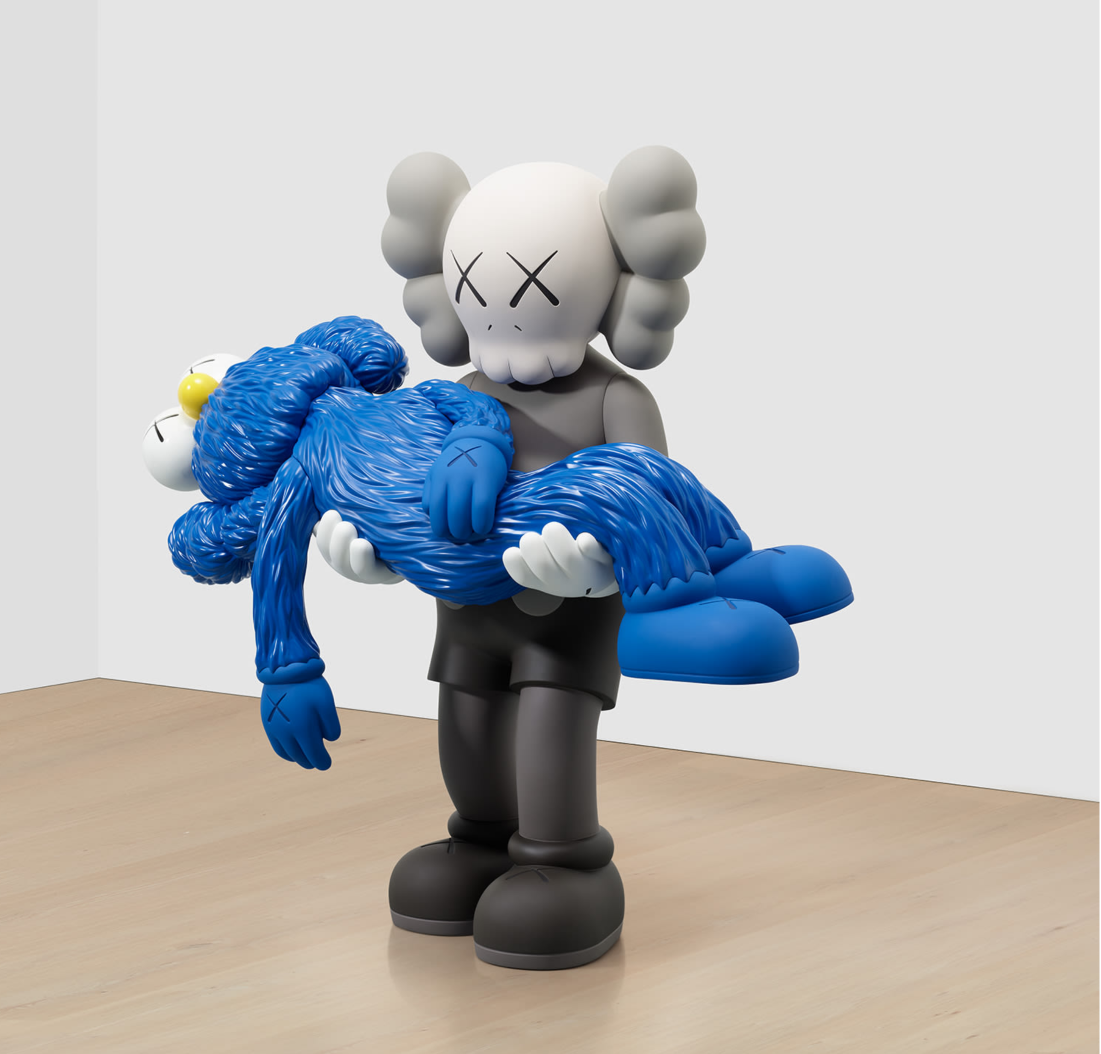
While GONE speaks to the depth of KAWS’ conceptual framework, it also underscores his unique ability to reach audiences beyond the traditional art world. His practice exists at the intersection of multiple cultural spaces: fine art, fashion, collectible design, and street culture. KAWS has successfully maintained his integrity across these platforms, producing work that is as at home in the Brooklyn Museum as it is in a Supreme collection. His collaborations with brands like Dior and Uniqlo have only further cemented his role as a cultural force—one whose appeal spans generations and demographics. GONE encapsulates the artist’s ability to bridge high and low culture while maintaining an acute sense of emotional truth. It shares a thematic lineage with works like the 2011 PASSING THROUGH, where COMPANION sits in dejection, and KAWS’ 2019 Art Basel installation, where his figure lays in a sea of existential dread, afloat in Hong Kong’s Victoria Harbour. Yet, unlike these works, GONE possesses a cinematic drama that propels KAWS’ work into the realm of narrative potency. The sculpture invites viewers share in a moment of loss, to feel the weight—both literal and figurative—of COMPANION’s grief. As Anne Pasternak remarks, ‘[KAWS] emphasizes that even within a world shaped by image and consumption, universal emotions–from love and friendship to loneliness and alienation–are what binds us.’
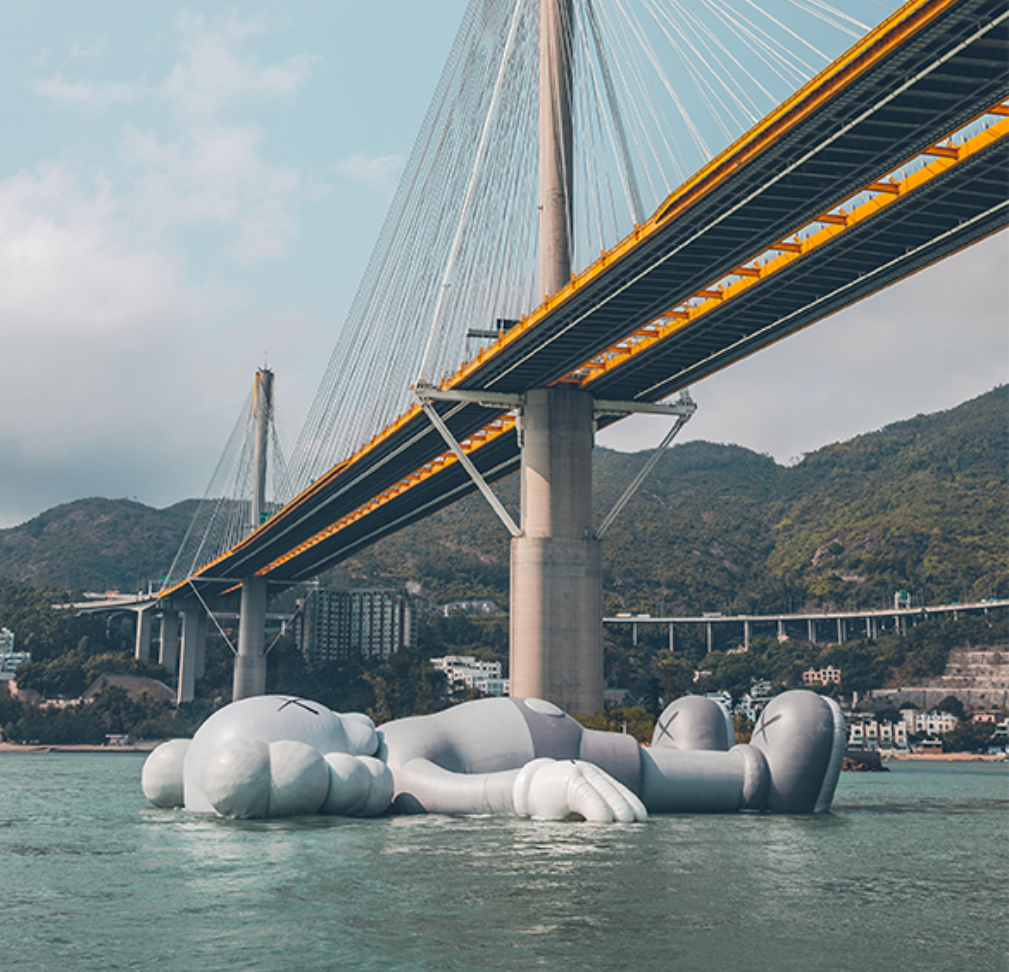
KAWS’ inflatable COMPANION figure installed in Hong Kong’s Victoria Harbour in conjunction with Art Basel, 2019.
Image: Imaginechina Limited / Alamy Stock Photo, Artwork: © KAWS
KAWS’ enduring impact stems from his ability to distil human emotion into forms that are simultaneously playful and reflective. GONE is a testament to this rare alchemy, a work that transcends its materiality to become a symbol of contemporary pathos. As collectors and institutions continue to embrace his work, pieces like GONE will be recognized not just as striking sculptures, but as touchstones of an era—one in which art, culture, and commerce collide in ways that redefine the landscape of contemporary visual expression.
GONE, 2020
Christie’s London: 26 June 2025
Estimated: GBP 500,000 – 700,000
GBP 567,000 / USD 776,790
KAWS (B. 1974), GONE | Christie’s
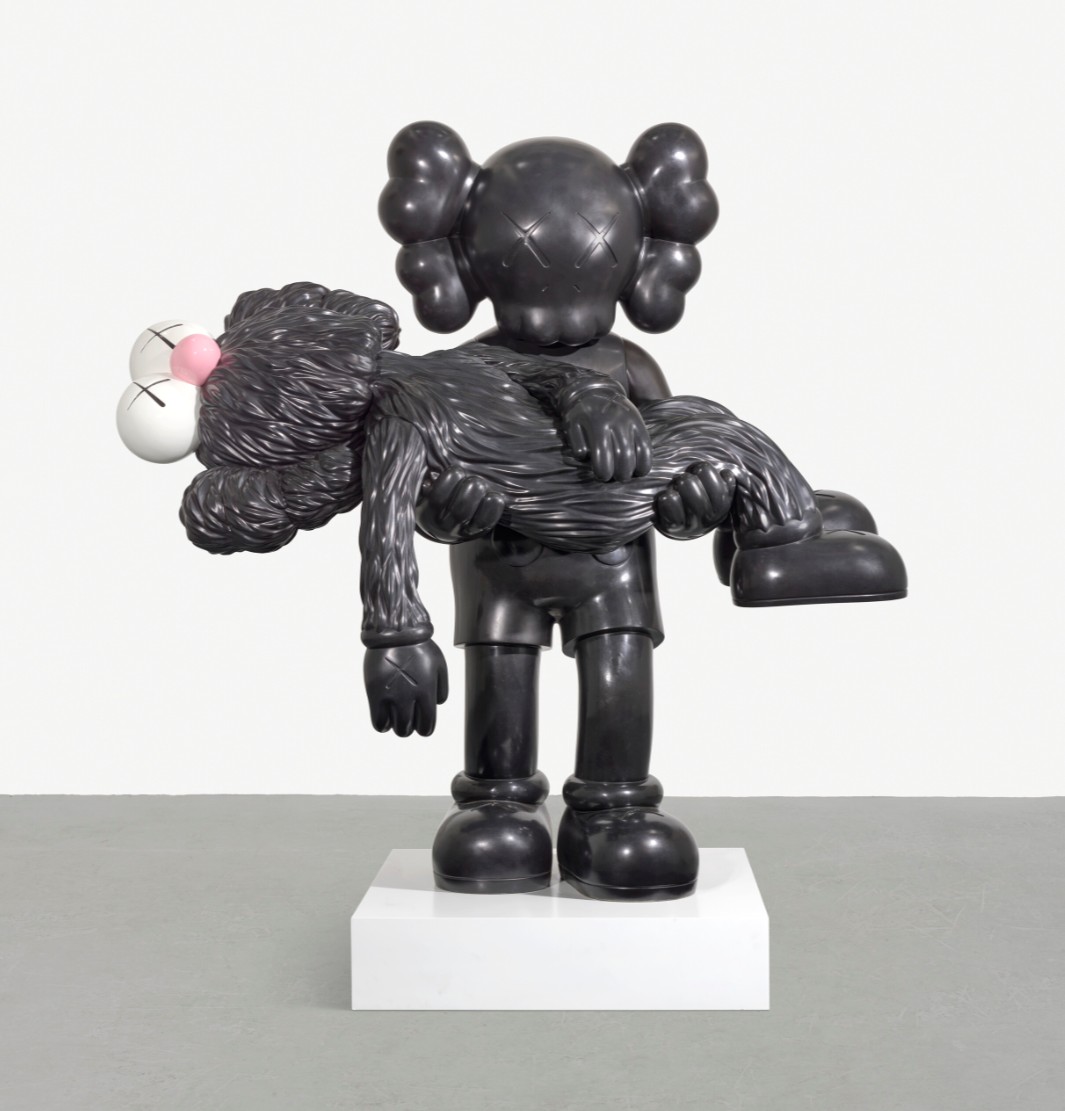
KAWS (B. 1974)
GONE, 2020
Painted bronze
71 x 71 1/2 x 31 1/8 inches (180.3 x 181.6 x 79.1 cm)
Stamped with the artist’s signature, number and date ‘1⁄1 KAWS.. 20’ (on the underside)
This work is number one from an edition of one, plus one artist’s proof