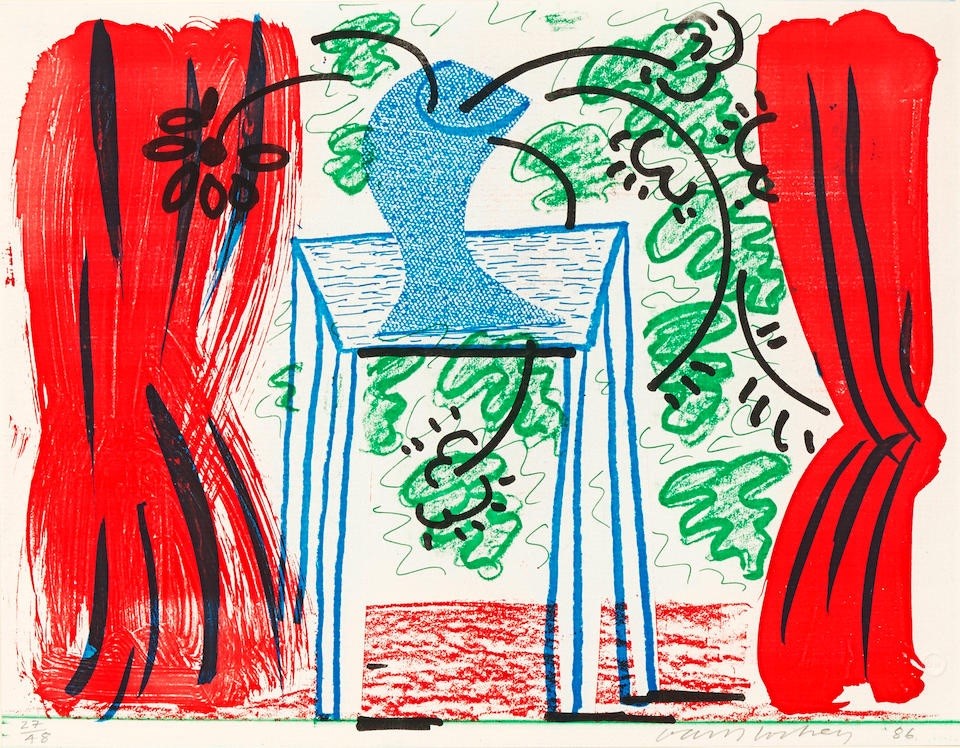
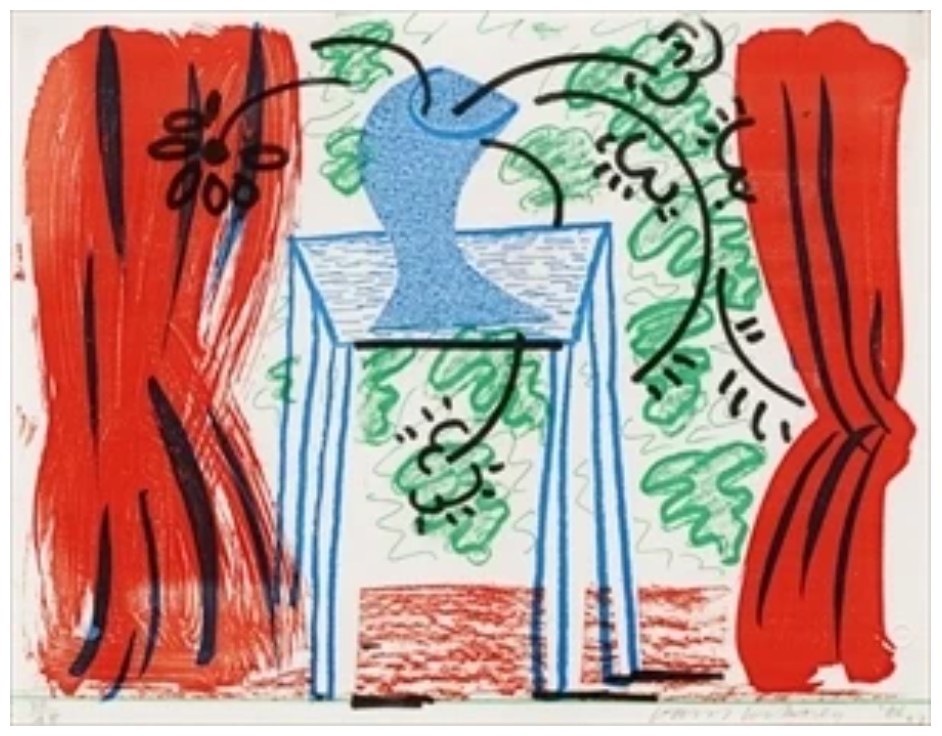
Still Life with Curtains, March 1986
from Homemade Prints
Medium: Homemade print executed on an office color copy machine on Arches Text paper
Year: 1986
Sheet: 8 1/2 x 11 inches (21.5 x 27.9 cm)
Edition: 48
Publisher & Printer: The Artist
Literature: Museum of Contemporary Art Tokyo (289)
Signed, dated and numbered in pencil with the artist’s blindstamp
David Hockney’s Still Life with Curtains belongs to the celebrated Homemade Prints series, a body of work that emerged from one of the artist’s most inventive technical experiments. Created in 1986 using a color office photocopier, the work demonstrates Hockney’s ability to transform an everyday commercial device into a sophisticated artistic tool, blurring the boundaries between traditional printmaking, drawing, and emerging technologies.
During the mid-1980s, Hockney became increasingly fascinated by new methods of image production and reproduction. Never content to remain confined by established artistic conventions, he began exploring the creative possibilities offered by the color photocopier, a machine normally associated with administrative rather than artistic purposes. Intrigued by both its capabilities and limitations, Hockney embraced the copier’s restricted sheet size and color system, which relied on the four fundamental printing colours: cyan, magenta, yellow, and black. Rather than producing a finished image in a single operation, Hockney created separate drawings for individual color components before combining them through successive photocopying stages. The process echoed traditional multi-layer printmaking techniques such as screenprinting, woodcut, and linocut, yet removed the need for printing presses, specialist workshops, or master printers. For the first time, Hockney could produce limited-edition prints entirely on his own terms.
“New technologies have started revolutions that need not frighten us, they can be humanized by artists. The office copier has opened up commercial printing as a direct artist’s medium.”
The Homemade Prints series stands as one of the earliest and most convincing demonstrations of this philosophy, anticipating Hockney’s later enthusiasm for fax machines, digital cameras, computer drawing programs, and eventually the iPhone and iPad.
Still Life with Curtains presents a deceptively simple domestic arrangement. At the center of the composition stands a blue vase resting upon a square table, framed by two dramatic crimson curtains that occupy the left and right edges of the image. The vase overflows with green foliage punctuated by a single black flower, while expressive hand-drawn marks animate the surrounding space.
The photocopying process produces exceptionally vibrant reds, blues, and greens while preserving the tactile quality of the original crayon and hand-drawn line work. Rather than concealing the mechanical origins of the image, Hockney embraces the copier’s distinctive visual language, allowing areas of grain, texture, and irregularity to become integral components of the composition. The result is both intimate and exuberant, combining the immediacy of a sketch with the visual impact of a finished print.
Beyond its technical innovation, Still Life with Curtains demonstrates Hockney’s continuing fascination with pictorial space and perception. The work can be viewed as a continuation of the spatial investigations that occupied the artist throughout the early 1980s, particularly in the ambitious Moving Focus series. The table appears simultaneously stable and unstable, its surface tilting forward towards the viewer while maintaining a flattened decorative quality. The curtains serve as theatrical framing devices, recalling Hockney’s longstanding involvement with stage design, yet they also function as spatial barriers that complicate the relationship between foreground and background.
This deliberate manipulation of perspective allows multiple viewpoints to coexist within a single image. The foliage appears to spill beyond its assigned space, visually overlapping the curtains and disrupting any conventional sense of depth. Such distortions create a dynamic tension between flatness and illusion, reinforcing Hockney’s belief that vision itself is fluid, subjective, and constantly shifting.
The significance of Still Life with Curtains extends far beyond its subject matter. The work occupies an important place in the history of contemporary printmaking, demonstrating how emerging technologies could be incorporated into artistic practice without sacrificing individuality or craftsmanship. Unlike conventional reproductive uses of the photocopier, Hockney employed the machine as a creative instrument. He manipulated color separations, layering, registration, and scale with the same intentionality traditionally associated with fine-art printmaking. The photocopier became both printing press and studio, allowing the artist unprecedented autonomy over every stage of production. In retrospect, these experiments appear remarkably prescient. Long before digital image-making became commonplace, Hockney recognized that new technologies could expand rather than diminish artistic expression.
Today, the Homemade Prints series occupies a distinctive place within Hockney’s oeuvre. While often overshadowed by his celebrated swimming pools, Yorkshire landscapes, and photographic collages, these works represent a pivotal moment in his lifelong dialogue with technology. Still Life with Curtains encapsulates many of the concerns that would define Hockney’s later career: the exploration of perception, the challenge of representing space, and the creative potential of new visual tools. By transforming a mundane office machine into an instrument of artistic invention, Hockney demonstrated that innovation in art is rarely dependent upon technology itself, but rather upon the imagination of the artist who employs it. Nearly four decades later, the work remains both historically significant and strikingly contemporary, standing as an early precursor to the digital revolution that would reshape image-making in the decades that followed.
Auction Results
Estimated: GBP 7,000 – 9,000
GBP 16,380 / USD 18,885
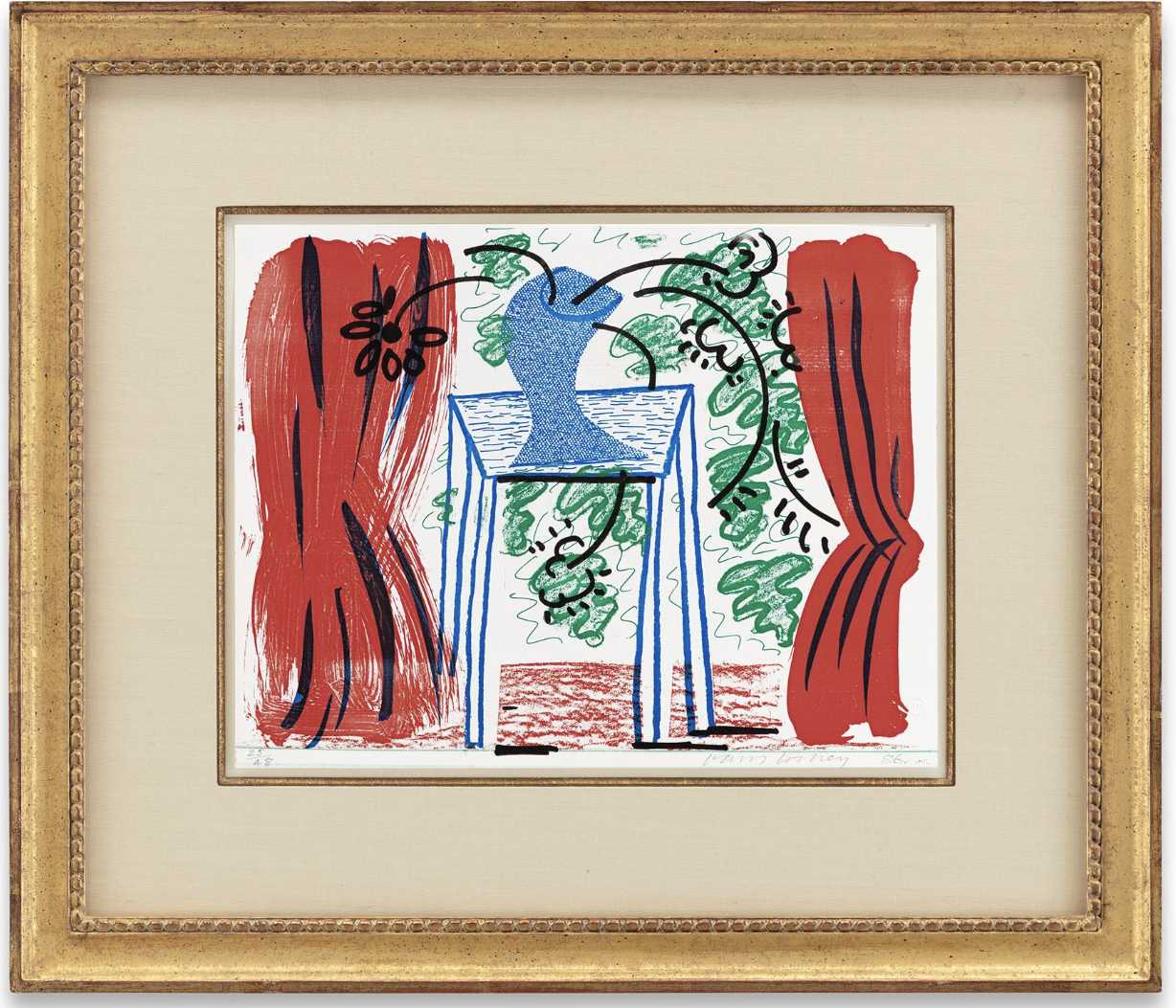
DAVID HOCKNEY
Still Life with Curtains, March 1986 (M.C.A.T. 289), 1986
Home-made print executed on an office color copy machine on Arches Text paper
Signed, dated and numbered 25/48 in pencil
Contained in the original artist’s specified gilded wooden frame
Estimated: USD 5,000 – 7,000
USD 17,812
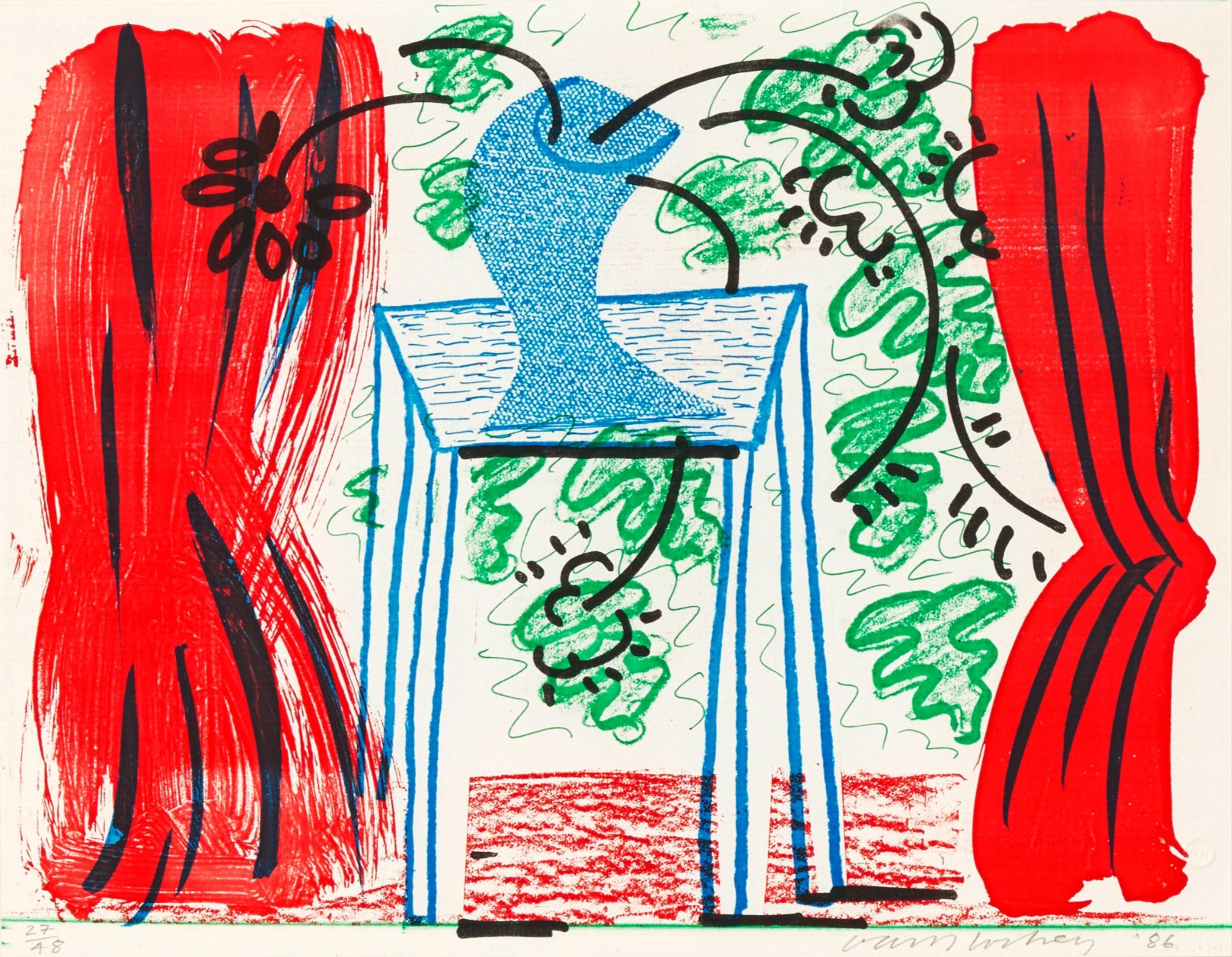
Homemade print executed on an office color copy machine, on Arches Text paper
Signed in pencil, dated and numbered 27/48
Estimated: USD 4,000 – 6,000
USD 9,375
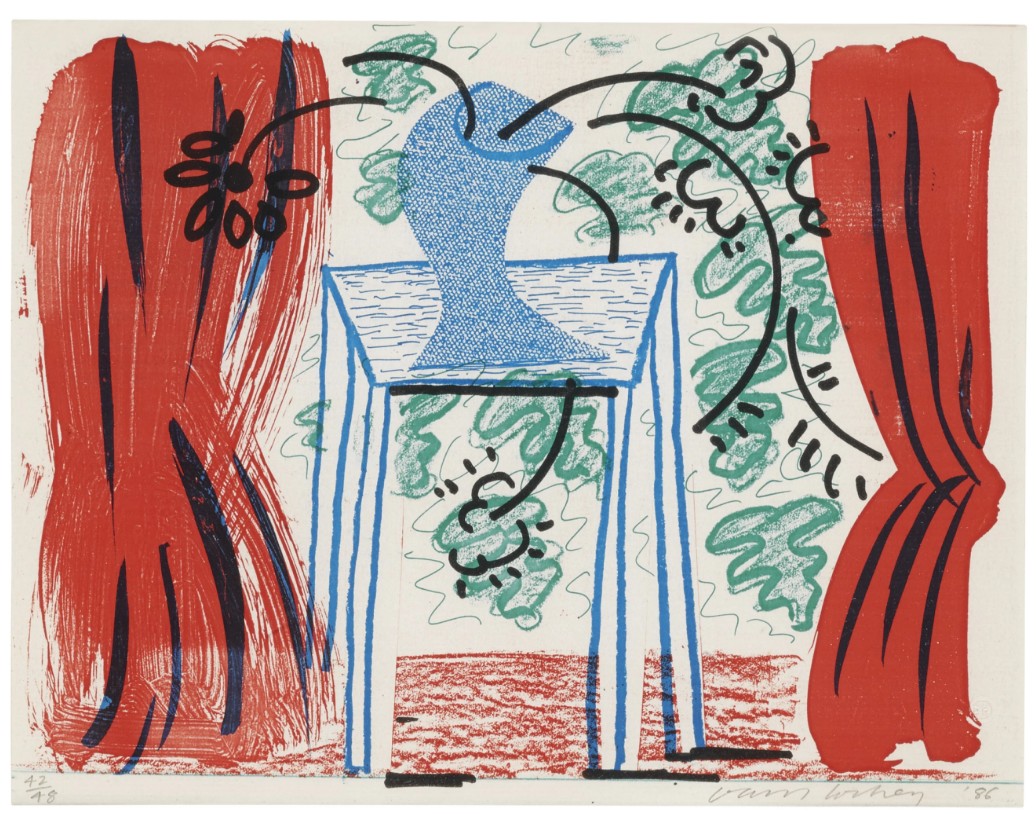
Still Life with Curtains, March 1986 (Museum of Contemporary Art, Tokyo 289), 1986
Home made print executed on an office color copy machine on Arches Text paper
Signed in pencil, dated and numbered 42/48
Published by the artist and with his blindstamp
Estimated: JPY 500,000 – 700,000
JPY 720,000 (Hammer)
JPY 838,800 / USD 7,570
DAVID HOCKNEY
Still Life with Curtains, 1986
Homemade color photocopy printed on two sheets with an office copy machine
Signed
Edition: 32/48