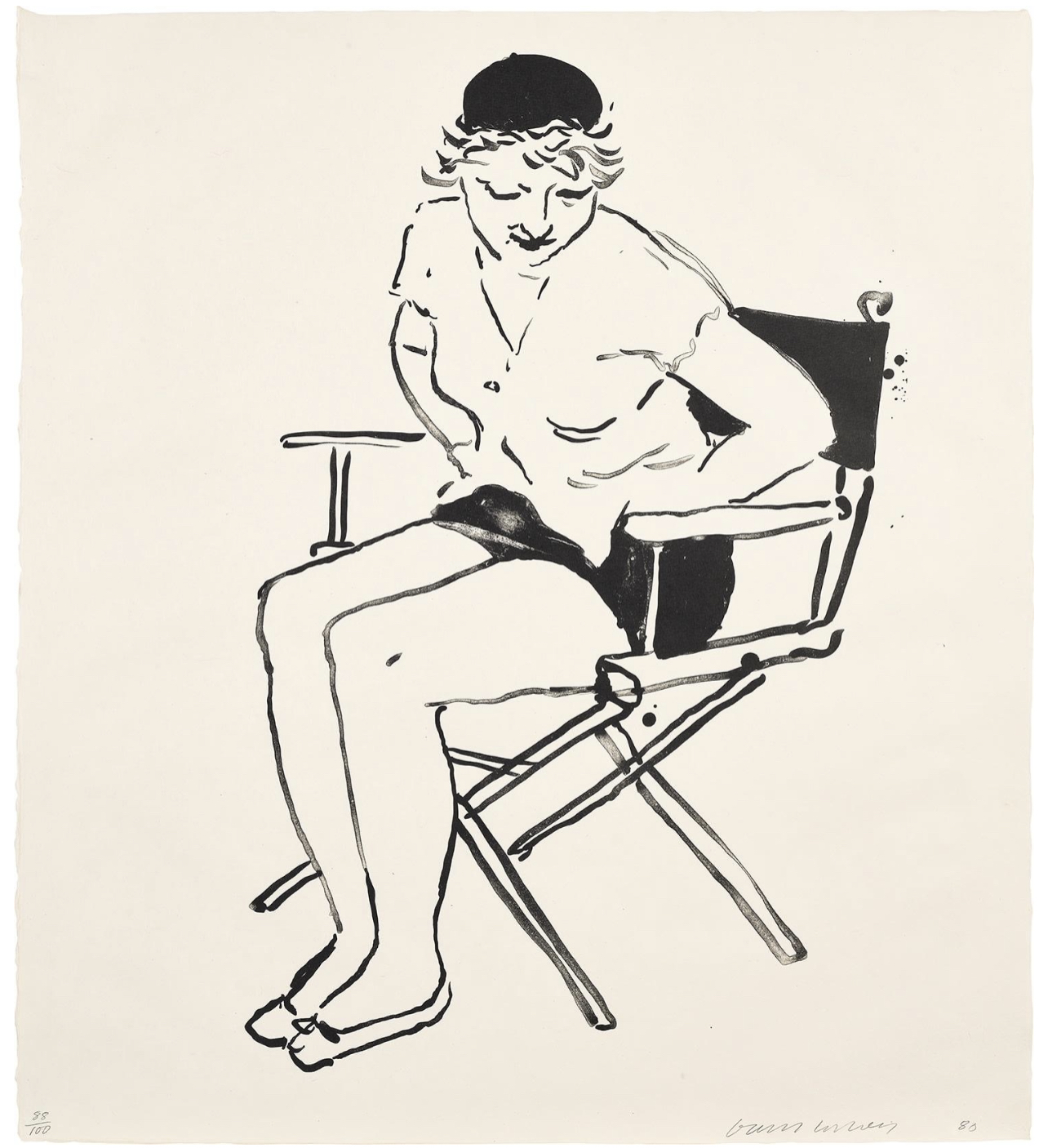
Celia in the Director’s Chair
Medium: Lithograph on Kurotani paper
Year: 1980
Image: 96×62 cm (37 3/4 x 24 3/8 inches)
Sheet: 106.2 x 96 cm (41 3/4 x 37 3/4 inches)
Edition: 100
Artist’s Proofs: 20
Publisher: Gemini G.E.L., Los Angeles
Literature: Gemini (916), Museum of Contemporary Art Tokyo (244)
Signed, dated and numbered in pencil with the publisher’s blindstamp
Celia in the Director’s Chair features one of David Hockney’s closest friends and arguably his most famous muse: Celia Birtwell. Born in Bury, Greater Manchester, in 1941, Celia Birtwell studied textile design at the Royal Technical College in Salford. In 1959, she met Raymond ‘Ossie’ Clark, an up-and-coming fashion designer. The pair were married in London in 1969, with David Hockney in attendance as Clark’s best man. Although Ossie Clark initially crossed paths with Hockney in the early 1960s, it was not until 1969 that Hockney produced his first portraits of Celia. Upon meeting, Celia and Hockney immediately formed a special bond, and the British fashion designer has since sat for the artist on more than eighty occasions over the past five decades. A motif in his work as familiar as the swimming pools of Los Angeles or the landscape of Normandy, Celia’s likeness features in approximately a quarter of Hockney’s printed portraits.
“Portraits aren’t just made up of drawing, they are made up of other insights as well. Celia is one of the few girls I know really well. I’ve drawn her so many times and knowing her makes it always slightly different. I don’t bother getting the likeness in her face because I know it so well. She has many faces and I think if you looked through all the drawings I’ve done of her, you’d see that they don’t look alike”
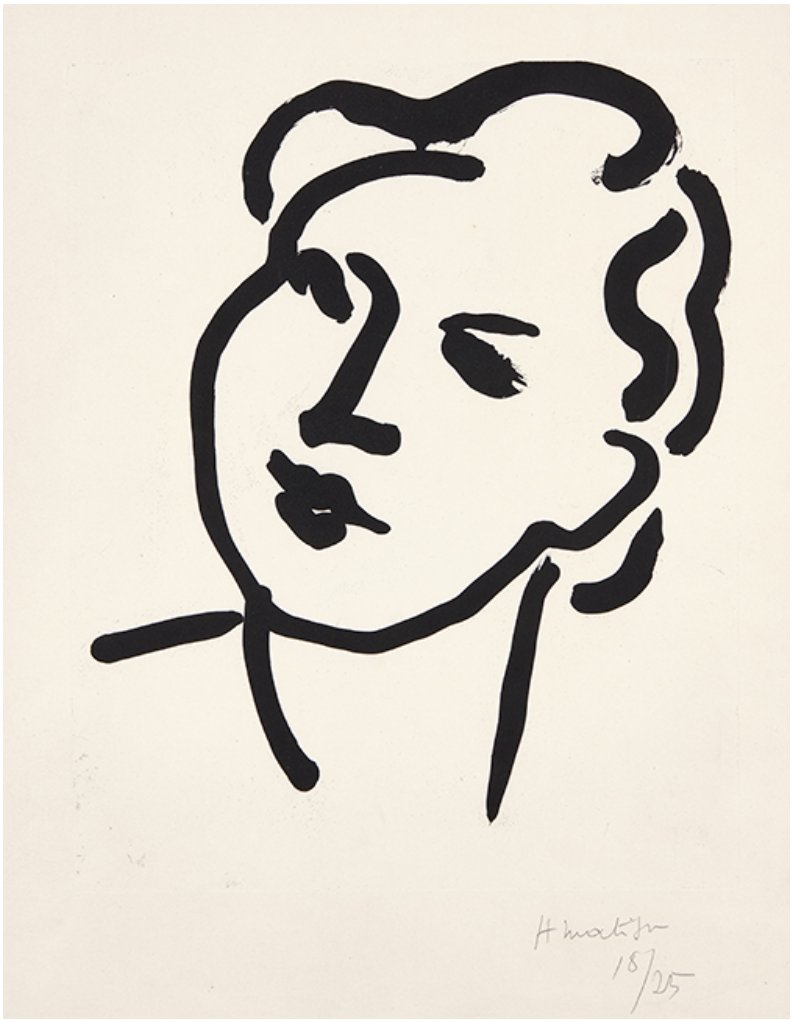
Henri Matisse, Nadia, au visage rond, 1948. Artwork: © Succession H. Matisse / DACS 2022
Celia in the Director’s Chair demonstrate the strong influence that the linear drawings and prints of early-twentieth century French artists like Henri Matisse had on Hockney’s work. In prints such as Nadia, au visage rond (1948), Matisse depicted his sitter solely through his use of black lines, resulting in a highly simplistic yet captivating portrait. Inspired by the French master, Hockney similarly manages to convey various textures and surfaces through minimal gestures and the occasional use of solid blacks or block colors. In Celia in the Director’s Chair, the differentiation between Celia’s clothing, her hair and the chair she perches on are achieved solely through monochromatic mark making. Celia’s face is constructed using only the most essential lines. Instead of restricting himself to creating an exact likeness in line with the conventions of portraiture, Hockney continuously challenged himself to experiment through his numerous depictions of Celia. In Celia in the Director’s Chair, Hockney investigates how much information is required to capture the essence of his sitter and to convey her likeness. The fluidity of line in the two prints also exemplifies the freedom Hockney discovered in lithography as a medium.
Source: Phillips
Auction Results
Heritage Auctions: 18 April 2023
Estimated: USD 12,000 – 18,000
USD 12,500
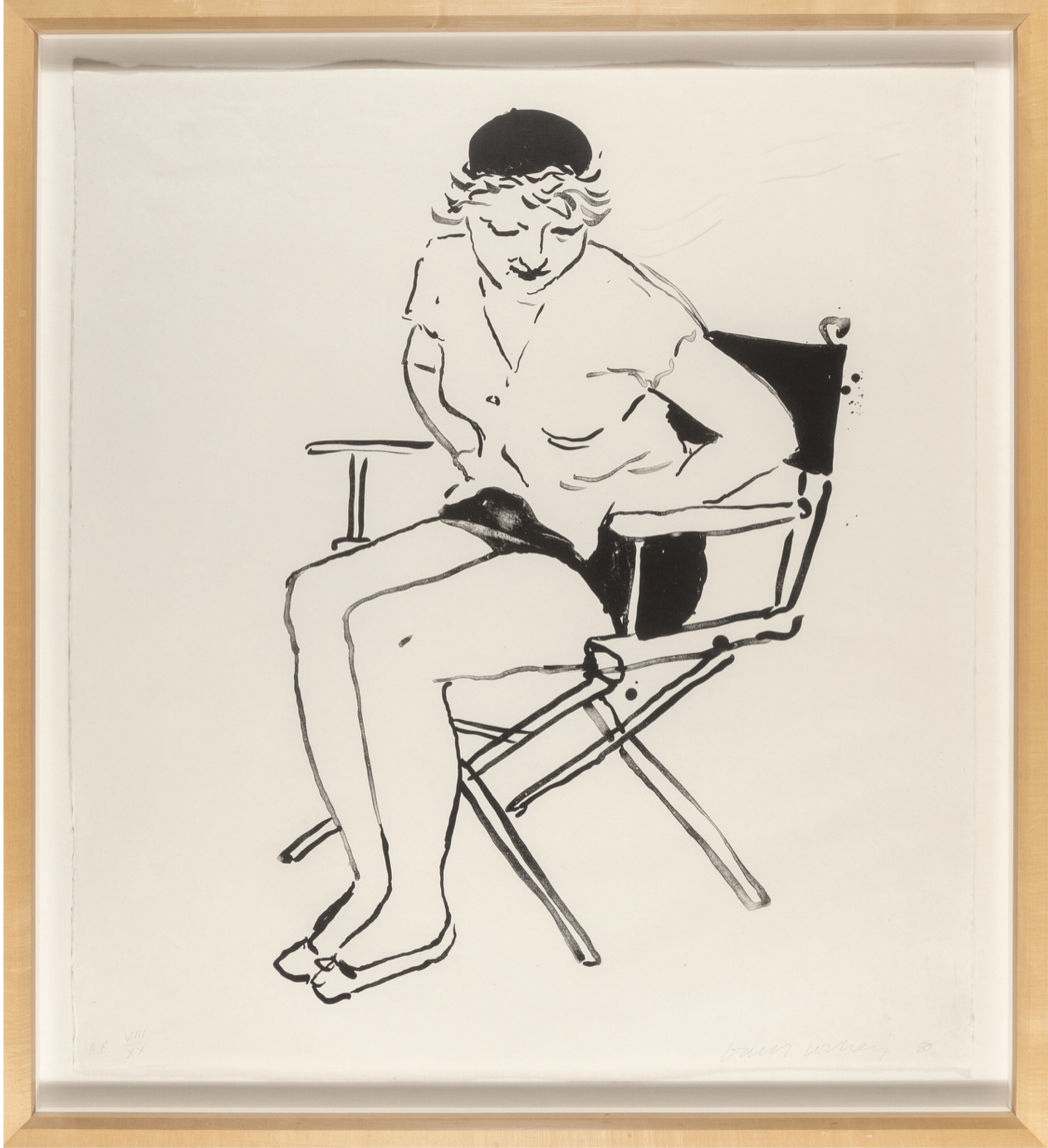
DAVID HOCKNEY
Celia in the Director’s Chair, 1980
Lithograph on Kurotani paper
Signed, dated and numbered AP VIII/XX in pencil along lower edge
———
Phillips London: 19 January 2023
Estimated: GBP 10,000 – 15,000
GBP 16,380
DAVID HOCKNEY
Celia in the Director’s Chair (Gemini G.E.L. 916, M.C.A.T. 244), 1980
Lithograph on Kurotani paper
Signed, dated and numbered 88/100 in pencil